


2 Samuel 20:22
Bible text: King James Version (1769 Blayney text) · Public domain
Bible text: King James Version with Strong's numbers · Public domain
Bible text: Berean Standard Bible · Public domain
Bible text: American Standard Version (1901) · Public domain
Bible text: World English Bible, Messianic edition · Public domain
Bible text: Geneva Bible (1599) · Public domain
Bible text: Young's Literal Translation · Public domain
- וַתָּבוֹאva·ta·Vo'and she wentH935Conj-w ¦ V-Qal-ConsecImperf-3fsVerb Qal Consecutive Imperfect 3rd Singular Feminineוַandתָּבוֹאshe went
- הָאִשָּׁהha·'i·Shahthe womanH802Art ¦ N-fsNoun Singular Feminine Absoluteהָtheאִשָּׁהwoman
- אֶל'eltoH413PrepPreposition
- כָּלkolallH3605N-mscNoun Singular Masculine Construct
- הָעָםha·'Amthe peopleH5971Art ¦ N-msNoun Singular Masculine Absoluteהָtheעָםpeople
- בְּחָכְמָתָהּbe·cha·khe·ma·Tahwith her wisdomH2451Prep-b ¦ N-fsc ¦ 3fsNoun Singular Feminine Constructבְּwithחָכְמָתָwisdomהּher
- וַיִּכְרְתוּvai·yikh·re·Tuand they cut offH3772Conj-w ¦ V-Qal-ConsecImperf-3mpVerb Qal Consecutive Imperfect 3rd Plural Masculineוַandיִּכְרְתוּthey cut off
- אֶת'et<obj.>H853DirObjMParticle Object Indicator
- רֹאשׁrosh[the] head ofH7218N-mscNoun Singular Masculine Construct
- שֶׁבַעShe·va'ShebaH7652N-proper-mNoun Proper Masculine
- בֶּןben[the] son ofH1121N-mscNoun Singular Masculine Construct
- בִּכְרִיbikh·RiBicriH1075N-proper-mNoun Proper Masculine
- וַיַּשְׁלִכוּvai·yash·Li·khuand they threw [it]H7993Conj-w ¦ V-Hiphil-ConsecImperf-3mpVerb Hiphil Consecutive Imperfect 3rd Plural Masculineוַandיַּשְׁלִכוּthey threw [it]
- אֶל'eltoH413PrepPreposition
- יוֹאָבyo·'AvJoabH3097N-proper-mNoun Proper Masculine
- וַיִּתְקַעvai·yit·Ka'and he gave a blastH8628Conj-w ¦ V-Qal-ConsecImperf-3msVerb Qal Consecutive Imperfect 3rd Singular Masculineוַandיִּתְקַעhe gave a blast
- בַּשּׁוֹפָרba·sho·Faron the trumpetH7782Prep-b ¦ N-msNoun Singular Masculine Absoluteבַּon theשּׁוֹפָרtrumpet
- וַיָּפֻצוּvai·ya·Fu·tzuand they were scatteredH6327Conj-w ¦ V-Qal-ConsecImperf-3mpVerb Qal Consecutive Imperfect 3rd Plural Masculineוַandיָּפֻצוּthey were scattered
- מֵעַלme·'alfrom onH5921Prep-m ¦ PrepPrepositionמֵfromעַלon
- הָעִירha·'Irthe cityH5892Art ¦ N-fsNoun Singular Feminine Absoluteהָtheעִירcity
- אִישׁ'isheachH376N-msNoun Singular Masculine Absolute
- לְאֹהָלָיוle·'o·ha·Lavto his tentsH168Prep-l ¦ N-mpc ¦ 3msNoun Plural Masculine Constructלְtoאֹהָלָיtentsוhis
- וְיוֹאָבve·yo·'Avand JoabH3097Conj-w ¦ N-proper-mNoun Proper MasculineוְandיוֹאָבJoab
- שָׁבshavhe returnedH7725V-Qal-Perf-3msVerb Qal Perfect 3rd Singular Masculine
- יְרוּשָׁלִַםye·ru·sha·LimJerusalemH3389N-properNoun Proper Location
- אֶל'eltoH413PrepPreposition
- הַמֶּלֶךְha·Me·lekhthe kingH4428Art ¦ N-msNoun Singular Masculine Absoluteהַtheמֶּלֶךְking
English is a literal word-by-word gloss of the Hebrew, not the KJV's wording. Why?
This is the original text the KJV's translators worked from — each Hebrew word with its own literal English meaning in this verse, prepared by scholars at Tyndale House, Cambridge. The KJV translates whole sentences, not word by word, so its wording differs: one Hebrew word can become several English words, and the KJV may choose “the LORD” where the gloss reads “Yahweh”. Both are faithful — they answer different questions. For the KJV's own rendering, switch to the KJV text.
Details
See on the biblical-era maps
Study this verse
Public-domain commentary
Matthew Henry
From his Commentary on the Whole Bible. Henry comments on passages, not single verses — this entry covers 2 Samuel 20:14–22. His four-level outline is real structure in the source text, so it is rendered as structure.
We have here the conclusion of Sheba's attempt.
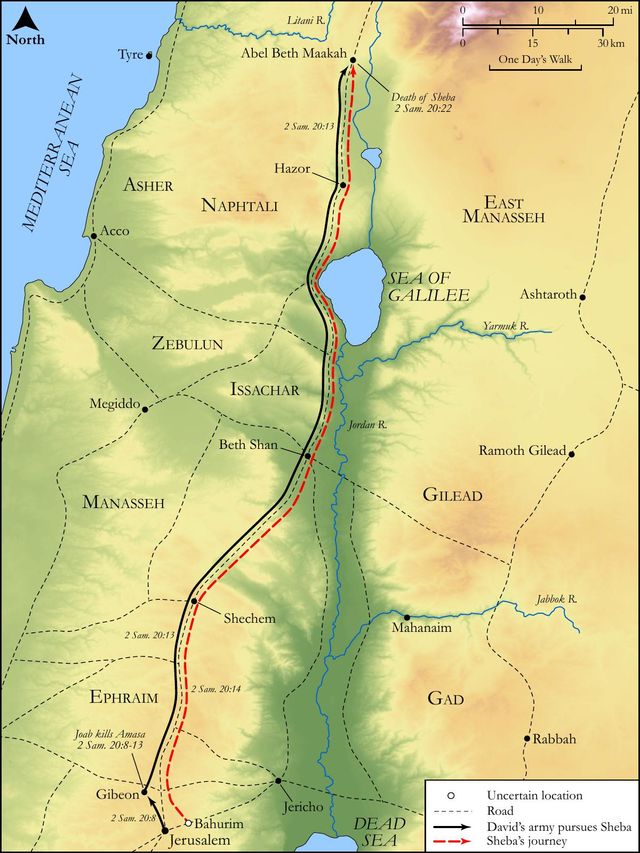
I.The rebel, when he had rambled over all the tribes of Israel, and found them not so willing, upon second thoughts, to follow him, as they had been upon a sudden provocation to desert David (having only picked up a few like himself, that sided with him), at length entered Abel-Beth-maacah, a strong city in the north, in the lot of Naphtali, where we find it placed, Kg2 15:29. Here he took shelter, whether by force or with consent does not appear; but his adherents were most Berites, of Beeroth in Benjamin, Sa2 20:14. One bad man will find or make more.
II.Joab drew up all his force against the city, besieged it, battered the wall, and made it almost ready for a general storm, Sa2 20:15.
Justly is that place attacked with all this fury which dares harbour a traitor; nor will that heart fare better which indulges those rebellious lusts that will not have Christ to reign over them.
III.A discreet good woman of the city of Abel brings this matter, by her prudent management, to a good issue, so as to satisfy Joab and yet save the city. Here is,
1.Her treaty with Joab, and her capitulation with him, by which he is engaged to raise the siege, upon condition that Sheba be delivered up. It seems, none of all the men of Abel, none of the elders or magistrates, offered to treat with Joab, no, not when they were reduced to the last extremity. They were stupid and unconcerned for the public safety, or they stood in awe of Sheba, or they despaired of gaining any good terms with Joab, or they had not sense enough to manage the treaty. But this one woman and her wisdom saved the city. Souls know no difference of sexes. Though the man be the head, it does not therefore follow that he has the monopoly of the brains, and therefore he ought not, by any salique law, to have the monopoly of the crown. Many a masculine heart, and more than masculine, has been found in a female breast; nor is the treasure of wisdom the less valuable for being lodged in the weaker vessel. In the treaty between this nameless heroine and Joab,
(1.)She gains his audience and attention, Sa2 20:16, Sa2 20:17. We may suppose it was the first time he had ever treated with a woman in martial affairs.
(2.)She reasons with him on behalf of her city, and very ingeniously.
[1.]That it was a city famous for wisdom (Sa2 20:18), as we translate it. She pleads that this city had been long in such reputation for prudent knowing men that it was the common referee of the country, and all agreed to abide by the award of its elders. Their sentence was an oracle; let them be consulted and the matter is ended, all sides will acquiesce. Now shall such a city as this be laid in ashes and never treated with?
[2.]That the inhabitants were generally peaceable and faithful in Israel, Sa2 20:19. She could speak, not for herself only, but for all those whose cause she pleaded, that they were not of turbulent and seditious spirits, but of known fidelity to their prince and peaceableness with their fellow-subjects; they were neither seditious nor litigious.
[3.]That it was a mother in Israel, a guide and nurse to the towns and country about; and that it was a part of the inheritance of the Lord, a city of Israelites, not of heathen; and the destruction of it would lessen and weaken that nation which God had chosen for his heritage.
[4.]That they expected him to offer them peace before he made an attack upon the, according to that known law of war, Deu 20:10. So the margin reads (Sa2 20:18): They plainly spoke in the beginning (of the siege), saying, Surely they will ask of Abel, that is, "The besiegers will demand the traitor, and will ask us to surrender him; and if they do, we will soon come to an agreement, and so end the matter." Thus she tacitly upbraids Joab for not offering them peace, but hopes it is not too late to beg it.
(3.)Joab and Abel's advocate soon agree that Sheba's head shall be the ransom of the city. Joab, though in a personal quarrel he had lately swallowed up and destroyed Amasa, yet, when he acts as a general, will by no means bear the imputation of delighting in bloodshed: "Far be it from me that I should delight to swallow up or destroy, or design it but when it is necessary for the public safety, Sa2 20:20. The matter is not so. Our quarrel is not with your city; we would hazard our lives for its protection. Our quarrel is only with the traitor that is harboured among you; deliver him up, and we have done." A great deal of mischief would be prevented if contending parties would but understand one another. The city obstinately holds out, believing Joab aims at its ruin. Joab furiously attacks it, believing the citizens all confederates with Sheba. Whereas both were mistaken; let both sides be undeceived, and the matter is soon accommodated. The single condition of peace is the surrender of the traitor. It is so in God's dealing with the soul, when it is besieged by conviction and distress: sin is the traitor; the beloved lust is the rebel; part with that, cast away the transgression, and all shall be well. No peace on any other terms. Our wise woman immediately agrees to the proposal: Behold, his head shall be thrown to thee presently.
2.Her treaty with the citizens. She went to them in her wisdom (and perhaps she had as much need of it in dealing with them as in dealing with Joab) and persuaded them to cut off Sheba's head, probably by some public order of their government, and it was thrown over the wall to Joab. He knew the traitor's face, and therefore looked no further, intending not that any of his adherents should suffer. The public safety was secured, and he felt no wish to gratify the public revenge. Joab hereupon raised the siege, and marched back to Jerusalem, with the trophies rather of peace than victory.
Continue studying 2 Samuel 20:22 across the web’s major study libraries — every link below opens this exact verse, chapter, or book on the destination site.
Read & Compare
 BibleGatewayThis verse in more than 200 translations and 70 languages.
 Bible.comThe YouVersion reader — hundreds of translations, reading plans, and highlights.
 ESV.orgCrossway's official English Standard Version reader.
 NET BibleThe NET translation with 60,000+ translators' notes on every rendering decision.
 STEP BibleTyndale House's free study tool — original text, vocabulary, and scholarly resources.
 BibliaLogos Bible Software's free web reader.
 USCCBThe New American Bible (Revised Edition) with the U.S. bishops' study notes.
Commentaries
 BibleHub CommentariesDozens of classic commentaries on this verse, gathered on one page.
 StudyLightMore than 100 commentary sets — the largest collection on the web.
 BibleRefPlain-English commentary on what this verse means, verse by verse.
 Enduring WordDavid Guzik's free commentary on this chapter, widely used by Bible teachers.
 Bible Study ToolsVerse commentary alongside Greek and Hebrew study aids.
Original Language & Research
- BibleHub InterlinearThe verse word by word — original language, transliteration, and English.
- BibleHub LexiconEvery word's original-language definition and Strong's entry.
 Blue Letter BibleDeep-study tools — Strong's numbers, concordance, and word studies.
 SefariaThe Hebrew text with Rashi and centuries of Jewish commentary.
Sermons, Hymns & Audio


TrulyRandomVerse is not affiliated with these sites and doesn’t control their content. They’re linked because they’re genuinely useful.
Summary
This pivotal verse culminates the rebellion of Sheba, son of Bichri, against King David, powerfully demonstrating how strategic wisdom and decisive action can avert widespread destruction. Through the intervention of an unnamed wise woman of Abel of Beth-maachah, the city's inhabitants are persuaded to choose loyalty over rebellion, swiftly executing Sheba and delivering his head to Joab. This pragmatic act immediately ends the siege, disperses Joab's forces, and restores order, bringing a turbulent period to a swift and peaceful close.
Context
ShowHideLiterary Context
2 Samuel 20:22 serves as the dramatic climax and resolution of Sheba's rebellion, which erupted in the immediate aftermath of King David's tumultuous return to Jerusalem following Absalom's devastating revolt. The preceding chapters (specifically 2 Samuel 19 and 2 Samuel 20) detail the deep-seated tribal tensions, particularly between Judah and the northern tribes, which Sheba exploited with his rallying cry, "We have no part in David!" (2 Samuel 20:1). Joab, David's seasoned general, was dispatched to quash the uprising, eventually cornering Sheba in the fortified city of Abel of Beth-maachah. The narrative builds intense suspense as Joab lays siege, constructing a siege ramp and preparing to "swallow it up" (2 Samuel 20:19), implying total annihilation. This verse provides the miraculous turning point, where a diplomatic solution, initiated by a wise woman, averts the impending catastrophe and brings the conflict to an abrupt, decisive end, setting the stage for the subsequent listing of David's officials and the re-establishment of administrative order in 2 Samuel 20:23-26.
Historical & Cultural Context
The period following Absalom's rebellion (detailed in 2 Samuel 15-18) was marked by significant instability and a fragile consolidation of power for David's kingdom. Tribal loyalties were often fluid, and the Benjamite tribe, from which Sheba originated, harbored lingering resentments from the downfall of Saul's dynasty, making them fertile ground for rebellion against David. Siege warfare was a brutal and common reality in the days of the kings; cities that harbored rebels or resisted royal authority faced complete annihilation, with inhabitants often put to the sword and the city razed. The gruesome practice of presenting the head of a defeated enemy or rebel was a widespread custom, serving as undeniable proof of death and a potent symbol of the threat's eradication. Within this predominantly patriarchal society, the emergence of a "wise woman" as a central figure of mediation and leadership, as observed here and with the woman of Tekoa in 2 Samuel 14, is noteworthy. Such figures, though rare in the biblical narrative, highlight that wisdom and influence were not exclusively confined to men, and they were highly respected for their practical discernment and ability to navigate complex, life-threatening situations.
Key Themes
ShowHideThis verse powerfully underscores several key themes within the broader narrative of 2 Samuel and the Old Testament. Firstly, it highlights the transformative power of wisdom, demonstrating that strategic insight and diplomatic skill can achieve peace and preserve life far more effectively than brute military force. The wise woman's intervention is the pivotal turning point, showcasing wisdom (Hebrew: ḥokmâ) as a divine gift that promotes order and well-being, echoing the sentiments of Proverbs 11:14. Secondly, the verse illustrates the severe consequences of rebellion against established authority, particularly against God's anointed king. Sheba's swift and brutal demise serves as a stark warning to those who would sow discord and challenge the divinely sanctioned leadership of David, reinforcing the stability and unity of the kingdom after the turmoil of Absalom's revolt, a principle later articulated in Romans 13:1-2. Lastly, it subtly emphasizes the importance of community responsibility and self-preservation. The city's inhabitants, persuaded by the wise woman's pragmatic counsel, choose to sacrifice one individual (Sheba) to save the entire community, demonstrating a clear understanding of loyalty and the ultimate cost of harboring a rebel.
Exposition and Analysis
ShowHideKey Word Analysis
ShowHideThis term refers not merely to intellectual knowledge, but to practical skill, discernment, and the ability to act effectively and prudently in complex, high-stakes situations. It encompasses shrewdness, good judgment, and the capacity to navigate social and political challenges to achieve a beneficial outcome. In this context, the woman's ḥokmâ is profoundly demonstrated by her courage to approach Joab, her persuasive argumentation, and her ability to rally her own people to a decisive, life-saving action.
This verb signifies a decisive act of severance, often with violent implications. While kārat can also mean to "make a covenant" (by cutting animals), here it literally describes the act of decapitation. The immediate and brutal nature of "cutting off the head" emphasizes the finality of Sheba's defeat and the swift, unforgiving justice meted out by the city's inhabitants to secure their own survival.
The blowing of the shofar (trumpet) was a common military signal in ancient Israel. It could signify assembly, the beginning of battle, or, as in this instance, the cessation of hostilities and the dispersal of troops. Joab's command to blow the trumpet immediately after receiving Sheba's head underscores his authority and the disciplined nature of David's army, allowing for a swift and orderly withdrawal from the city.
Verse Breakdown
ShowHide"Then the woman went unto all the people in her wisdom"
This clause highlights the wise woman's proactive leadership and the persuasive power of her counsel. Having successfully negotiated with Joab and secured a conditional peace, she now turns to her own community, demonstrating her ability to influence and mobilize them to action. Her "wisdom" is not just in speaking to the general, but in convincing her fellow citizens of the pragmatic necessity of their actions to save their lives and their city.
"And they cut off the head of Sheba the son of Bichri, and cast [it] out to Joab"
This describes the immediate and decisive response of the city's inhabitants. Convinced by the wise woman's compelling argument, they take justice into their own hands, executing Sheba and delivering his head as irrefutable proof of his death and their renewed loyalty to King David. This act signifies their rejection of the rebellion and their willingness to sacrifice one life to save the entire city from destruction.
"And he blew a trumpet, and they retired from the city, every man to his tent"
Upon receiving the gruesome but conclusive evidence of Sheba's demise, Joab immediately signals the end of the siege. The trumpet blast is a clear military command, and the subsequent dispersal of the army "every man to his tent" indicates a swift, orderly, and peaceful conclusion to the campaign, restoring a sense of normalcy and peace to the region.
"And Joab returned to Jerusalem unto the king"
This final phrase confirms the successful completion of Joab's mission and the full restoration of royal authority. His return to Jerusalem signifies the complete quelling of the rebellion, the re-establishment of stability to David's kingdom after a turbulent period, and the affirmation of David's reign.
Literary Devices
ShowHideThe narrative of 2 Samuel 20:22 employs several effective literary devices to convey its powerful message. The most prominent is Juxtaposition, contrasting the imminent, brutal destruction of Abel of Beth-maachah (implied by Joab's siege preparations in preceding verses) with the peaceful and swift resolution achieved through the wise woman's intervention. This highlights the profound power of diplomacy and wisdom over brute military force, emphasizing that a well-reasoned argument can be more potent than a battering ram. The "head of Sheba" serves as a potent Symbolism, representing the definitive end of the rebellion, the eradication of the threat, and the reassertion of Davidic authority. Similarly, the "trumpet" is a powerful Symbol of military command and the immediate transition from conflict and siege to peace and dispersal. The entire episode also functions as a form of Foreshadowing, demonstrating the inevitable consequences of rebellion against God's anointed king and reinforcing the eventual stability and divine preservation of David's kingdom, despite internal strife, through decisive action and God-given wisdom.
Theological and Thematic Connections
ShowHideThe resolution of Sheba's rebellion in 2 Samuel 20:22 offers profound theological insights into the nature of divine wisdom, the consequences of rebellion, and God's providential care for His anointed. The unnamed wise woman acts as a remarkable instrument of divine wisdom, demonstrating that God can use unexpected individuals, regardless of their social standing or gender, to bring about peace and justice, even in the midst of chaos. Her practical discernment, courage, and persuasive ability reflect a wisdom that is not merely intellectual but divinely empowered to preserve life and order, echoing the biblical emphasis on wisdom as a gift from God (e.g., James 1:5). The swift execution of Sheba underscores the biblical principle that rebellion against legitimate, God-ordained authority carries severe consequences, reinforcing the sanctity of the king's rule and the importance of societal order for the well-being of the community. Ultimately, this episode illustrates God's faithfulness in preserving David's kingdom, even when it faces internal threats, by raising up agents of peace and justice and ensuring the triumph of order over chaos.
Reflection and Application
ShowHideThe narrative of 2 Samuel 20:22 offers timeless and profound lessons for believers today. It powerfully illustrates the extraordinary impact that one individual, empowered by wisdom, courage, and discernment, can have in averting catastrophe and promoting peace. The wise woman of Abel of Beth-maachah did not possess military might, political office, or even a name in the text, yet her discerning counsel and persuasive communication saved an entire city from utter destruction. This challenges us to recognize the potential for positive influence within our own spheres, regardless of our perceived status, power, or gender. In times of conflict, whether personal, communal, or societal, this passage encourages us to prioritize peaceful resolution and to actively seek out or embody the kind of practical wisdom that can bridge divides and prevent destructive outcomes. It also serves as a powerful reminder of the importance of civic responsibility and the willingness to address sources of discord decisively for the greater good, even when it involves difficult and uncomfortable choices. We are called to be peacemakers, using our God-given wisdom to foster harmony and justice.
Questions for Reflection
ShowHideFAQ
ShowHideWho was the "wise woman" mentioned in this verse?
ShowHideThe "wise woman" of Abel of Beth-maachah is not named in the biblical text, which is a significant detail. Her anonymity serves to emphasize her role as an embodiment of practical wisdom and civic responsibility rather than her individual identity. She is presented as a resourceful and courageous leader who understands both the immediate military threat posed by Joab's army and the pragmatic necessity of dealing with Sheba to save her people. Her wisdom is demonstrated through her ability to initiate dialogue with Joab (2 Samuel 20:16-21), articulate a compelling argument for peace, and then successfully persuade her own city's inhabitants to take decisive action, ultimately saving countless lives and preserving her community.
Why did the people of Abel of Beth-maachah turn against Sheba?
ShowHideThe citizens of Abel of Beth-maachah turned against Sheba because the wise woman convinced them that harboring him would inevitably lead to the complete destruction of their city by Joab's forces. She appealed to their fundamental instinct for self-preservation and their ultimate loyalty to King David, framing Sheba as a disruptive element who was not worth the cost of their lives and the obliteration of their city. Her argument, as recorded in 2 Samuel 20:18-21, was compelling and pragmatic: why should an entire city perish for the sake of one rebel who had brought the siege upon them? Their action was a clear, pragmatic choice for survival and a demonstration of allegiance to legitimate authority.
Christ-Centered Fulfillment
ShowHideThe resolution of Sheba's rebellion through the wisdom of an unnamed woman and the sacrifice of one life to save many finds a profound Christ-centered fulfillment. Just as the wise woman brought peace and averted destruction, Jesus Christ is the ultimate embodiment of divine wisdom, for in Him "are hidden all the treasures of wisdom and knowledge" (Colossians 2:3). He is indeed "Christ the power of God and the wisdom of God" (1 Corinthians 1:24). He is our true "Prince of Peace" (Isaiah 9:6), who came not to condemn but to reconcile, breaking down the wall of hostility and making peace through His cross (Ephesians 2:14-16). The act of sacrificing Sheba's head to save the city foreshadows the ultimate sacrifice of the Lamb of God, who takes away the sin of the world!. Jesus Christ willingly laid down His life to redeem not just a city, but all humanity from the rebellion of sin and its destructive consequences. His death on the cross, the ultimate act of self-giving love, brought about a peace and reconciliation that no human wisdom or military might could ever achieve, offering true life and eternal peace to all who turn from their rebellion and embrace Him as King and Savior (Romans 5:1).