


Luke 10:29
Bible text: King James Version (1769 Blayney text) · Public domain
Bible text: Berean Standard Bible · Public domain
Bible text: American Standard Version (1901) · Public domain
Bible text: World English Bible, Messianic edition · Public domain
Bible text: Geneva Bible (1599) · Public domain
Bible text: Young's Literal Translation · Public domain
- ὉHo<the>G3588T-NSMDefinite article Nominative Singular Masculine
- δὲdeButG1161CONJConjunction
- θέλωνthelōndesiringG2309V-PAP-NSMVerb Present Active Participle Nominative Singular Masculine
- δικαιῶσαιdikaiōsaito justifyG1344V-AANVerb Aorist Active Infinitive
- ἑαυτὸνhe'autonhimselfG1438F-3ASMReflexive pronoun Accusative 3rd Singular Masculine
- εἶπενeipenhe saidG2036V-2AAI-3SVerb 2nd Aorist Active Indicative 3rd Singular
- πρὸςprostoG4314PREPPreposition
- τὸνton<the>G3588T-ASMDefinite article Accusative Singular Masculine
- Ἰησοῦν·IēsounJesusG2424N-ASM-PNoun Accusative Singular Masculine Individual
- καὶkaiAndG2532CONJConjunction
- τίςtiswhoG5101I-NSMInterrogative pronoun Nominative Singular Masculine
- ἐστίνestinisG1510V-PAI-3SVerb Present Active Indicative 3rd Singular
- μουmoumyG3165P-1GSPersonal pronoun Genitive 1st Singular
- πλησίον;plēsionneighbour?G4139ADVAdverb
English is a literal word-by-word gloss of the Greek, not the KJV's wording. Why?
This is the original text the KJV's translators worked from — each Greek word with its own literal English meaning in this verse, prepared by scholars at Tyndale House, Cambridge. The KJV translates whole sentences, not word by word, so its wording differs: one Greek word can become several English words, and the KJV may choose “charity” where the gloss reads “love”. Both are faithful — they answer different questions. For the KJV's own rendering, switch to the KJV text.
Details
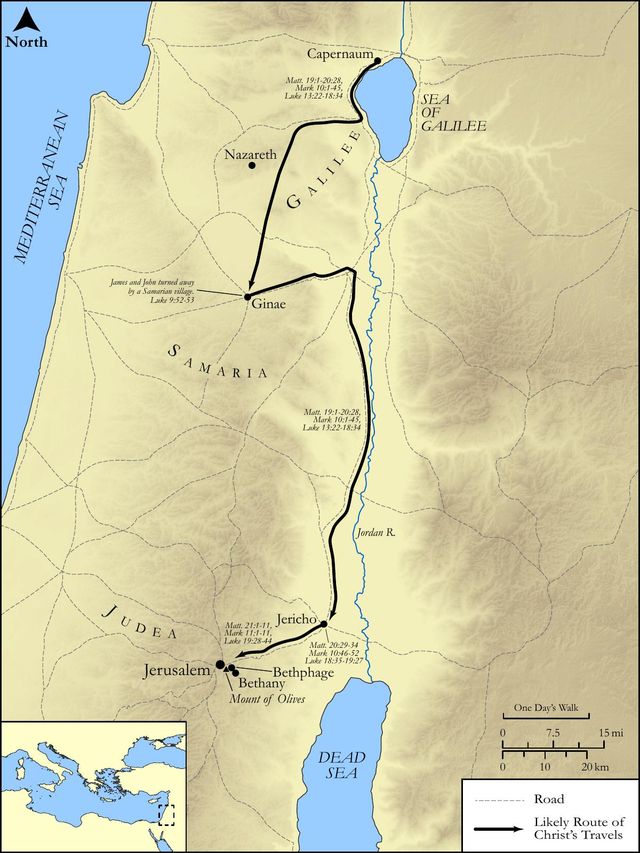
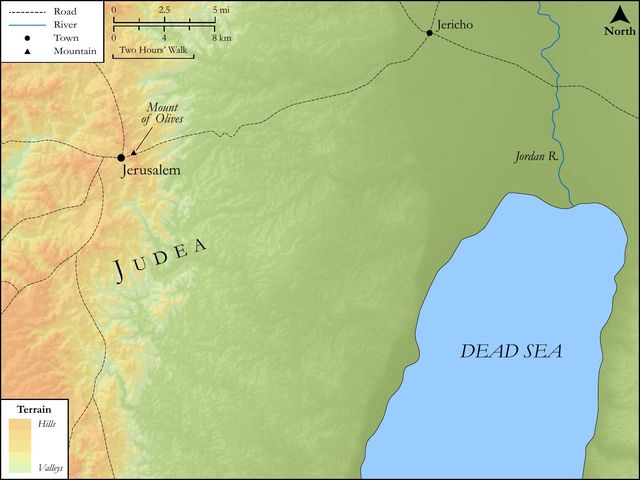
See on the biblical-era maps

Study this verse
Public-domain commentary
Matthew Henry
From his Commentary on the Whole Bible. Henry comments on passages, not single verses — this entry covers Luke 10:25–37. His four-level outline is real structure in the source text, so it is rendered as structure.
We have here Christ's discourse with a lawyer about some points of conscience, which we are all concerned to be rightly informed in and are so here from Christ though the questions were proposed with no good intention.
I.We are concerned to know what that good is which we should do in this life, in order to our attaining eternal life.
A question to this purport was proposed to our Saviour by a certain lawyer, or scribe, only with a design to try him, not with a desire to be instructed by him, Luk 10:25. The lawyer stood up, and asked him, Master, what shall I do to inherit eternal life? If Christ had any thing peculiar to prescribe, by this question he would get it out of him, and perhaps expose him for it; if not, he would expose his doctrine as needless, since it would give no other direction for obtaining happiness than what they had already received; or, perhaps, he had no malicious design against Christ, as some of the scribes had, only he was willing to have a little talk with him, just as people go to church to hear what the minister will say. This was a good question: What shall I do to inherit eternal life? But it lost all its goodness when it was proposed with an ill design, or a very mean one. Note, It is not enough to speak of the things of God, and to enquire about them, but we must do it with a suitable concern. If we speak of eternal life, and the way to it, in a careless manner, merely as matter of discourse, especially as matter of dispute, we do but take the name of God in vain, as the lawyer here did. Now this question being started, observe,
1.How Christ turned him over to the divine law, and bade him follow the direction of that. Though he knew the thoughts and intents of his heart, he did not answer him according to the folly of that, but according to the wisdom and goodness of the question he asked. He answered him with a question: What is written in the law? How readest thou? Luk 10:26. He came to catechize Christ, and to know him; but Christ will catechize him, and make him know himself. He talks to him as a lawyer, as one conversant in the law: the studies of his profession would inform him; let him practise according to his knowledge, and he should not come short of eternal life. Note, It will be of great use to us, in our way to heaven, to consider what is written in the law, and what we read there. We must have recourse to our bibles, to the law, as it is now in the hand of Christ and walk in the way that is shown us there. It is a great mercy that we have the law written, that we have it thereby reduced to certainty, and that thereby it is capable of spreading the further, and lasting the longer. Having it written, it is our duty to read it, to read it with understanding, and to treasure up what we read, so that when there is occasion, we may be able to tell what is written in the law, and how we read. To this we must appeal; by this we must try doctrines and end disputes; this must be our oracle, our touchstone, our rule, our guide. What is written in the law? How do we read? if there be light in us, it will have regard to this light.
2.What a good account he gave of the law, of the principal commandments of the law, to the observance of which we must bind ourselves if we would inherit eternal life. He did not, like a Pharisee, refer himself to the tradition of the elders, but, like a good textuary, fastened upon the two first and great commandments of the law, as those which he thought must be most strictly observed in order to the obtaining of eternal life, and which included all the rest, Luk 10:27.
(1.)We must love God with all our hearts, must look upon him as the best of beings, in himself most amiable, and infinitely perfect and excellent; as one whom we lie under the greatest obligations to, both in gratitude and interest. We must prize him, and value ourselves by our elation to him; must please ourselves in him, and devote ourselves entirely to him. Our love to him must be sincere, hearty, and fervent; it must be a superlative love, a love that is as strong as death, but an intelligent love, and such as we can give a good account of the grounds and reasons of. It must be an entire love; he must have our whole souls, and must be served with all that is within us. We must love nothing besides him, but what we love for him and in subordination to him.
(2.)We must love our neighbours as ourselves, which we shall easily do, if we, as we ought to do, love God better than ourselves. We must wish well to all and ill to none; must do all the good we can in the world and no hurt, and must fix it as a rule to ourselves to do to others as we would they should do to us; and this is to love our neighbour as ourselves.
3.Christ's approbation of what he said, Luk 10:28. Though he came to tempt him, yet what he said that was good Christ commended: Thou hast answered right. Christ himself fastened upon these as the two great commandments of the law (Mat 22:37): both sides agreed in this. Those who do well shall have praise of the same, and so should those have that speak well. So far is right; but he hardest part of this work yet remains: "This do, and thou shalt live; thou shalt inherit eternal life."
4.His care to avoid the conviction which was now ready to fasten upon him. When Christ said, This do, and thou shalt live, he began to be aware that Christ intended to draw from him an acknowledgment that he had not done this, and therefore an enquiry what he should do, which way he should look, to get his sins pardoned; an acknowledgment also that he could not do this perfectly for the future by any strength of his own, and therefore an enquiry which way he might fetch in strength to enable him to do it: but he was willing to justify himself, and therefore cared not for carrying on that discourse, but saith, in effect, as another did (Mat 19:20), All these things have I kept from my youth up. Note, Many ask good questions with a design rather to justify themselves than to inform themselves, rather proudly to show what is good in them than humbly to see what is bad in them.
II.We are concerned to know who is our neighbour, whom by the second great commandment we are obliged to love.
This is another of this lawyer's queries, which he started only that he might drop the former, lest Christ should have forced him, in the prosecution of it, to condemn himself, when he was resolved to justify himself. As to loving God, he was willing to say no more of it; but, as to his neighbour, he was sure that there he had come up to the rule, for he had always been very kind and respectful to all about him. Now observe,
1.What was the corrupt notion of the Jewish teachers in this matter. Dr. Lightfoot quotes their own words to this purport: "Where he saith, Thou shalt love thy neighbour, he excepts all Gentiles, for they are not our neighbours, but those only that are of our own nation and religion." They would not put an Israelite to death for killing a Gentile, for he was not his neighbour: they indeed say that they ought not to kill a Gentile whom they were not at war with; but, if they saw a Gentile in danger of death, they thought themselves under no obligation to help to save his life. Such wicked inferences did they draw from that holy covenant of peculiarity by which God had distinguished them, and by abusing it thus they had forfeited it; God justly took the forfeiture, and transferred covenant-favours to the Gentile world, to whom they brutishly denied common favours.
2.How Christ corrected this inhuman notion, and showed, by a parable, that whomsoever we have need to receive kindness fRom. and find ready to show us the kindness we need, we cannot but look upon as our neighbour; and therefore ought to look upon all those as such who need our kindness, and to show them kindness accordingly, though they be not of our own nation and religion. Now observe,
(1.)The parable itself, which represents to us a poor Jew in distressed circumstances, succoured and relieved by a good Samaritan. Let us see here,
[1.]How he was abused by his enemies. The honest man was traveling peaceably upon his lawful business in the road, and it was a great road that led from Jerusalem to Jericho, Luk 10:30. The mentioning of those places intimates that it was matter of fact, and not a parable; probably it happened lately, just as it is here related. The occurrences of Providence would yield us many good instructions, if we would carefully observe and improve them, and would be equivalent to parables framed on purpose for instruction, and be more affecting. This poor man fell among thieves. Whether they were Arabians, plunderers, that lived by spoil, or some profligate wretches of his own nation, or some of the Roman soldiers, who, notwithstanding the strict discipline of their army, did this villany, does not appear; but they were very barbarous; they not only took his money, but stripped him of his clothes, and, that he might not be able to pursue them, or only to gratify a cruel disposition (for otherwise what profit was there in his blood?) they wounded him, and left him half dead, ready to die of his wounds. We may here conceive a just indignation at highwaymen, that have divested themselves of all humanity, and are as natural brute beasts, beasts of prey, made to be taken and destroyed; and at the same time we cannot but think with compassion on those that fall into the hands of such wicked and unreasonable men, and be ready, when it is in our power, to help them. What reason have we to thank God for our preservation from perils by robbers!
[2.]How he was slighted by those who should have been his friends, who were not only men of his own nation and religion, but one a priest and the other a Levite, men of a public character and station; nay, they were men of professed sanctity, whose offices obliged them to tenderness and compassion (Heb 5:2), who ought to have taught others their duty in such a case as this, which was to deliver them that were drawn unto death; yet they would not themselves do it. Dr. Lightfoot tells us that many of the courses of the priests had their residence in Jericho, and thence came up to Jerusalem, when it was their turn to officiate there, and so back again, which occasioned abundance of passing and repassing of priests that way, and Levites their attendants. They came this way, and saw the poor wounded man. It is probable that they heard his groans, and could not but perceive that if he were not helped he must quickly perish. The Levite not only saw him, but came and looked on him Luk 10:32. But they passed by on the other side; when they saw his case, they got as far off him as ever they could, as if they would have had a pretence to say, Behold, we knew it not. It is sad when those who should be examples of charity are prodigies of cruelty, and when those who should by displaying the mercies of God, open the bowels of compassion in others, shut up their own.
[3.]How he was succoured and relieved by a stranger, a certain Samaritan, of that nation which of all others the Jews most despised and detested and would have no dealings with. This man had some humanity in him, Luk 10:33. The priest had his heart hardened against one of his own people, but the Samaritan had his opened towards one of another people. When he saw him he had compassion on him, and never took into consideration what country he was of. Though he was a Jew, he was a man, and a man in misery, and the Samaritan has learned to honour all men; he knows not how soon this poor man's case may be his own, and therefore pities him, as he himself would desire and expect to be pitied in the like case. That such great love should be found in a Samaritan was perhaps thought as wonderful as that great faith which Christ admired in a Roman, and in a woman of Canaan; but really it was not so, for pity is the work of a man, but faith is the work of divine grace. The compassion of this Samaritan was not an idle compassion; he did not think it enough to say, "Be healed, be helped" (Jam 2:16); but, when he drew out his soul, he reached forth his hand also to this poor needy creature, Isa 58:7, Isa 58:10; Pro 31:20. See how friendly this good Samaritan was. First, He went to the poor man, whom the priest and Levite kept at a distance from; he enquired, no doubt, how he came into this deplorable condition, and condoled with him. Secondly, He did the surgeon's part, for want of a better. He bound up his wounds, making use of his own linen, it is likely, for that purpose; and poured in oil and wine, which perhaps he had with him; wine to wash the wound, and oil to mollify it, and close it up. He did all he could to ease the pain, and prevent the peril, of his wounds, as one whose heart bled with him. Thirdly, He set him on his own beast, and went on foot himself, and brought him to an inn. A great mercy it is to have inns upon the road, where we may be furnished for our money with all the conveniences for food and rest. Perhaps the Samaritan, if he had not met with this hindrance, would have got that night to his journey's end; but, in compassion to that poor man, he takes up short at an inn. Some think that the priest and Levite pretended they could not stay to help the poor man, because they were in haste to go and attend the temple-service at Jerusalem. We suppose the Samaritan went upon business; but he understood that both his own business and God's sacrifice too must give place to such an act of mercy as this. Fourthly, He took care of him in the inn, got him to bed, had food for him that was proper, and due attendance, and, it may be, prayed with him. Nay, Fifthly, As if he had been his own child, or one he was obliged to look after, when he left him next morning, he left money with the landlord, to be laid out for his use, and passed his word for what he should spend more. Twopence of their money was about fifteen pence of ours, which, according to the rate of things then, would go a great way; however, here it was an earnest of satisfaction to the full of all demands. All this was kind and generous, and as much as one could have expected from a friend or a brother; and yet here it is done by a stranger and foreigner.
Now this parable is applicable to another purpose than that for which it was intended; and does excellently set forth the kindness and love of God our Saviour towards sinful miserable man. We were like this poor distressed traveller. Satan, our enemy, had robbed us, stripped us, wounded us; such is the mischief that sin had done us. We were by nature more than half dead, twice dead, in trespasses and sins; utterly unable to help ourselves, for we were without strength. The law of Moses, like the priest and Levite, the ministers of the law, looks upon us, but has no compassion on us, gives us no relief, passes by on the other side, as having neither pity nor power to help us; but then comes the blessed Jesus, that good Samaritan (and they said of him, by way of reproach, he is a Samaritan), he has compassion on us, he binds up our bleeding wounds (Psa 147:3; Isa 61:1), pours in, not oil and wine, but that which is infinitely more precious, his own blood. He takes care of us, and bids us put all the expenses of our cure upon his account; and all this though he was none of us, till he was pleased by his voluntary condescension to make himself so, but infinitely above us. This magnifies the riches of his love, and obliges us all to say, "How much are we indebted, and what shall we render?"
(2.)The application of the parable. [1.] The truth contained in it is extorted from the lawyer's own mouth. "Now tell me," saith Christ, "which of these three was neighbour to him that fell among thieves (Luk 10:36), the priest, the Levite, or the Samaritan? Which of these did the neighbour's part?" To this the lawyer would not answer, as he ought to have done, "Doubtless, the Samaritan was;" but, "He that showed mercy on him; doubtless, he was a good neighbour to him, and very neighbourly, and I cannot but say that it was a good work thus to save an honest Jew from perishing." [2.] The duty inferred from it is pressed home upon the lawyer's own conscience: Go, and do thou likewise. The duty of relations is mutual and reciprocal; the titles of friends, brethren, neighbours, are, as Grotius here speaks tōn pros ti - equally binding on both sides: if one side be bound, the other cannot be loose, as is agreed in all contracts. If a Samaritan does well that helps a distressed Jew, certainly a Jew does not well if he refuses in like manner to help a distressed Samaritan. Petimusque damusque vicissim - These kind offices are to be reciprocated. "And therefore go thou and do as the Samaritan did, whenever occasion offers: show mercy to those that need thy help, and do it freely, and with concern and compassion, though they be not of thy own nation and thy own profession, or of thy own opinion and communion in religion. Let thy charity be thus extensive, before thou boastest of having conformed thyself to that great commandment of loving thy neighbour." This lawyer valued himself much upon his learning and his knowledge of the laws, and in that he thought to have puzzled Christ himself; but Christ sends him to school to a Samaritan, to learn his duty: "Go, and do like him." Note, It is the duty of every one of us, in our places, and according to our ability, to succour, help, and relieve all that are in distress and necessity, and of lawyers particularly; and herein we must study to excel many that are proud of their being priests and Levites.
Historical interpretation
Eleven Centuries of Reception
14 surviving comments on this verse. Each one is dated, so this reads as a timeline rather than a list.
Select a marker to jump to its quote. Markers stagger vertically where authors wrote within a few decades of each other.
(Hypognos. lib. 3.) Or by Jerusalem, which is by interpretation "the sight of peace," we mean Paradise, for before man sinned he was in sight of peace, that is, in paradise; whatever he saw was peace, and going thence he descended (as if brought low and made wretched by sin) into Jericho, that is, the world, in which all things that are born die as the moon.
(ubi sup.) For the half dead has his vital function (that is, free will) wounded, in that he is not able to return to the eternal life which he has lost. And therefore he lay, because he had not strength of his own sufficient to rise and seek a physician, that is, God, to heal him.
(ubi sup.) Seeing him lying down weak and motionless. And therefore was He moved with compassion, because He saw in him nothing to merit a cure, but He Himself for sin condemned sin in the flesh. (Rom. 8:3.) Hence it follows, And went to him, and bound up his wounds, pouring in oil and wine.
The second in order, and not any less than this, He says, is, "Thou shalt love thy neighbour as thyself," consequently God above thyself. And on His interlocutor inquiring, "Who is my neighbour?" He did not, in the same way with the Jews, specify the blood-relation, or the fellow-citizen, or the proselyte, or him that had been similarly circumcised, or the man who uses one and the same law. But He introduces one on his way down from the upland region from Jerusalem to Jericho, and represents him stabbed by robbers, cast half-dead on the way, passed by the priest, looked sideways at by the Levite, but pitied by the vilified and excommunicated Samaritan; who did not, like those, pass casually, but came provided with such things as the man in danger required.
He [the Lord] teaches that the man going down was the neighbor of no one except of him who wanted to keep the commandments and prepare himself to be a neighbor to every one that needs help. This is what is found after the end of the parable, “Which of these three does it seem to you is the neighbor of the man who fell among robbers?” Neither the priest nor the Levite was his neighbor, but—as the teacher of the law himself answered—“he who showed pity” was his neighbor. The Savior says, “Go, and do likewise.”
This interpretation corresponds to the places, if any one will examine them. For Jericho lies in the low parts of Palestine, Jerusalem is seated on an eminence, occupying the crest of a mountain. The man then came from the high parts to the low, to fall into the hands of the robbers who infested the desert. As it follows, And he fell among thieves.
Or it may be understood that they stripped us after first inflicting wounds; or wounds precede nakedness, as sin precedes the absence of grace.
He answered that he knew not his neighbour, because he believed not on Christ, and he who knows not Christ knows not the law, for being ignorant of the truth, how can he know the law which makes known the truth?
But who are those robbers but the Angels of night and darkness, among whom he had not fallen, unless by deviating from the divine command he had placed himself in their way.
Or they stripped us of the garments which we have received of spiritual grace, and so are wont to inflict wounds. For if we keep the unspotted garments we have put on, we can not feel the wounds of robbers.
Now this Samaritan was also coming down. For who is he that ascended upon into heaven, but he who came down from heaven, even the Son of Man who is in heaven (John 3:13.).
Now when He came He was made very near to us by His taking upon Himself our infirmities, He became a neighbour by bestowing compassion. Hence it follows, And when he saw him he was moved with compassion.
Or, He binds up our wounds by a stricter commandment, as by oil he soothes by the remission of sin, as by wine he pricks to the heart by the denunciation of judgment.
Or, He places us on His beast in that He bears our sins, and is afflicted for us, (Isai. 53:4, LXX) for man hath been made like to the beasts, (Ps. 49:12) therefore He placed us on His beast, that we might not be as horse and mule, (Ps. 32:9.) in order that by taking upon Him our body, He might abolish the weakness of our flesh.
But as the Samaritan had not time to stay longer on the earth, he must needs return to the place whence he descended, as it follows, And on the morrow he took out two pence, &c. (Ps. 118:24.) What is that morrow, but perchance the day of our Lord's resurrection? of which it was said, This is the day the Lord hath made. But the two pence are the two covenants, which bear stamped on them the image of the eternal King, by the price of which our wounds are healed.
Blessed then is that inn-keeper who is able to cure the wounds of another; blessed is he to whom Jesus says, Whatsoever thou hast spent more, when I come again I will repay thee. But when wilt thou return, O Lord, save on the Judgment day? For though Thou art ever every where, and though standing in the midst of us, art not perceived by us, yet the time will be in which all flesh shall behold Thee coming again. Thou wilt then restore what Thou owest to the blessed, whose debtor Thou art. Would that we were confident debtors, that we could pay what we had received!
For relationship does not make a neighbour, but compassion, for compassion is according to nature. For nothing is so natural as to assist one who shares our nature.
(Hom. in loc. Ed. Lat.) First, we must needs pity the ill fortune of the man who fell unarmed and helpless among robbers, and who was so rash and unwise as to choose the road in which he could not escape the attack of robbers. For the unarmed can never escape the armed, the heedless the villain, the unwary the malicious. Since malice is ever armed with guile, fenced round with cruelty, fortified with deceit, and ready for fierce attack.
(ubi sup.) At the beginning of the world then the devil accomplished his treacherous attack upon man, against whom he practised the poison of deceit, and directed all the deadliness of his malice.
(ubi sup.) Here then was man (that is, Adam) lying destitute of the aid of salvation, pierced with the wounds of his sins, whom neither Aaron the high priest passing by could advantage by his sacrifice; for it follows, And by chance there came down a certain priest that way, and when he saw him, he passed by on the other side. Nor again could his brother Moses the Levite assist him by the Law, as it follows, And likewise a Levite, when he was at the place, came and looked on him, and passed by on the other side.
(Hom. in loc.) Or, he poured in wine, that is, the blood of His passion, and oil, that is, the anointing of the chrism, that pardon might be granted by His blood, sanctification be conferred by the chrism. The wounded parts are bound up by the heavenly Physician, and containing a salve within themselves, are by the working of the remedy restored to their former soundness. Having poured in wine and oil, he placed him upon His beast, as it follows, and placing him upon his beast, &c.
(ut sup.) For the Inn is the Church, which receives travellers, who are tired with their journey through the world, and oppressed with the load of their sins; where the wearied traveller casting down the burden of his sins is relieved, and after being refreshed is restored with wholesome food. And this is what is here said, and took care of him. For without is every thing that is conflicting, hurtful and evil, while within the Inn is contained all rest and health.
(in Heb. Hom. 10.) As if He said, If thou seest any one oppressed, say not, Surely he is wicked; but be he Gentile or Jew and need help, dispute not, he has a claim to thy assistance, into whatever evil he has fallen.
Some think that their neighbor is their brother, family, relative or their kinsman. Our Lord teaches who our neighbor is in the Gospel parable of a certain man going down from Jerusalem to Jericho.… Everyone is our neighbor, and we should not harm anyone. If, on the contrary, we understand our fellow human beings to be only our brother and relatives, is it then permissible to do evil to strangers? God forbid such a belief! We are neighbors, all people to all people, for we have one Father.
The lawyer, when praised by our Saviour for having answered right, breaks forth into pride, thinking that he had no neighbour, as though there was no one to be compared to him in righteousness. Hence it is said, But he willing to justify himself said unto Jesus, And who is my neighbour? For somehow first one sin and then another takes him captive. From the cunning with which he sought to tempt Christ, ho falls into pride. But here when asking, who is my neighbour, he proves himself to be devoid of love for his neighbour, since he did not consider any one to be his neighbour, and consequently of the love of God; for he who loves not his brother whom he sees, cannot love God whom he does not see. (1 John 4:20.)
(20. Moral. c. 8.) Or in the wine he applies the sharpness of constraint, in the oil the softness of mercy. By wine let the corrupt parts be washed, by oil let the healing parts be assuaged; we must then mix gentleness with severity, and we must so combine the two, that those who are put under us be neither exasperated by our excessive harshness, nor be relaxed by too much kindness.
But sins are called wounds, because the perfectness of human nature is violated by them. And they departed, not by ceasing to lie in wait, but by hiding the craft of their devices.
And rightly He brought him placed on His beast, since no one, except he be united to Christ's body by Baptism, shall enter the Church.
But he, wishing to justify himself, said to Jesus: And who is my neighbor? What a great madness of vain glory! The lawyer, to capture the favor of the people, so that he might be seen to have responded wisely, first confesses that he does not know the command of the law, truly according to the Savior's judgment, wise and prudent in the law, but because he does not desire to humble himself with the little ones of Christ, but to justify himself, refusing to receive the blessed eyes of doves washed in the milk of innocence, with which he might see Christ's secrets. Indeed, to him the Lord thus tempered his response, teaching that anyone who shows mercy to another becomes his neighbor, and yet this same parable particularly signifies the Son of God himself, who deigned to become our neighbor through his humanity. For we should not interpret so the neighbor whom we are commanded to love as ourselves so above Christ, as to try to diminish and remove the moral teachings of mutual brotherhood under the rules of allegory.
Now our Saviour defines a neighbour not in respect of actions or honour, but of nature; as if He says, Think not that because thou art righteous thou hast no neighbour, for all who partake of the same nature are thy neighbours. Be thou also their neighbour, not in place, but in affection and solicitude for them. And in addition to this, he brings forward the Samaritan as an example. As it follows, And Jesus answering him said, A certain man went down, &c.
Now he says not "descended," but "was descending." For human nature was ever tending downwards, and not for a time only, but throughout busied about a life liable to suffering.
Or man after sin is said to be half dead, because his soul is immortal, but his body mortal, so that the half of man is under death. Or, because his human nature hoped to obtain salvation in Christ, so as not altogether to lie under death. But in that Adam had sinned death entered in the world, (Rom. 5:12.) in the righteousness of Christ death was to be destroyed.
But He says, passed by, (Rom. 3:20; 8:3.) because the Law came and stood till its time foreordained, then, not being able to cure, departed. Mark also that the Law was not given with this previous intention that it should cure man, for man could not from the beginning receive the mystery of Christ. And therefore it is said, And by chance there came a certain priest, which expression we use with respect to those things which happen without forethought.
They pitied him, I say, when they thought about him, but afterwards, overcome by selfishness, they went away again. For this is signified by the word, passed him by.
But He says, journeying, as though He purposely determined this in order to cure us.
Or else, intercourse with man is the oil, and intercourse with God is the wine which signifies divinity, which no one can endure unmixed unless oil be added, that is, human intercourse. Hence he worked some things humanly, some divinely. He poured then in oil and wine, as having saved us both by His human and His divine nature.
Or He placed us on His beast, that is, on His body. For He hath made us His members, and partakers of His body. The Law indeed did not take in all the Moabites, and the Ammonites shall not enter into the Church of God; (Deut. 23:3.) but now in every nation he that feareth the Lord is accepted by Him, who is willing to believe and to become part of the Church. Wherefore He says, that he brought him to an inn.
After the Saviour praised him, the lawyers pride and arrogance knew no bounds. That is why he said, And who is my neighbour? that is, "Who is close to me?" (1) He imagined himself to be righteous and thought that there was no one like him and that no one could come close to him in virtue. He imagined that a righteous man could have as "neighbor" only another righteous man. Therefore wanting to show himself to be righteous and superior to all men, he says haughtily, And who is my neighbour? But the Saviour as Maker of all, knowing that all men are one creation, defines neighbour not according to deeds or merits, but according to human nature. "Do not think," He says, "that just because you are righteous, no one is like you. All mankind shares the same nature and thus all men are your neighbors. Therefore, you too must be a neighbor to them and be near to all, not by location, but by the disposition of your heart and by your care for others. Therefore I present to you a Samaritan as an example, to show you that no matter how different or foreign he may have seemed, he was the neighbor of the one in need of mercy. You also must show yourself to be a neighbor by your compassion, and even unasked you must go to the help of others." Thus we learn from this parable to be always ready to show mercy and to make haste to be near those in need of our help. But this parable also teaches us the goodness of God towards man. It was our human nature that was going down from Jerusalem, that is, was descending from tranquillity and peace, for Jerusalem means vision of peace. Where was man descending? To Jericho, a place sunk down low and suffocating with heat, that is, to a life of passions. See that He did not say, "went down," but, was going down. For fallen human nature is always inclined downwards, not just once of old, but continuously going down towards passionate life. And man fell among thieves, that is, among demons. For if a man did not come down from that high place where the spiritual mind rules, he would not fall among demons who strip the man, depriving him of his raiment of virtue, and then inflict the wounds of sin. They strip us of every good thought and of Gods protection, and when we are thus naked, they lay on the stripes of sin. They leave human nature half dead, that is, with a mortal body and an immortal soul. And human nature was left only half dead in the further sense that man did not lie completely in despair, but hoped to find salvation in Christ. Human nature had not yet been slain outright; though death had entered the world through Adams transgression, death was soon to be abolished by the righteousness of Christ. The priest and the Levite signify the law and the prophets, who desired to make human nature righteous, but were unable to do so. For it is not possible, says Paul, that the blood of bulls and goats should take away sin. [Heb. 10:4] The law and the prophets took pity on man and sought to heal him. But they were defeated by the severity of the wounds of sin, and they passed into the past. This is what it means that they passed by. The law came and stood over the fallen man, but since it could not heal him, it turned away in revulsion and went on theother side. See that the words as it happened also have a certain spiritual meaning. For indeed the law was not given for the express purpose [of healing the wounds of sin, for Christ, not the law, was to be the healing of Adams wound]. Instead, the law was given [as a stopgap measure] on account of human weakness which could not immediately receive the mystery of Christ. This is why He says that it was as it happened, or, as we say, "by chance," and not intentionally, that the priest, signifying the law, came to heal the man. But our Lord and God, Who for our sake was made a curse [Gal. 3:13], and was called a Samaritan [Jn. 8:48], journeyed to us, that is, His journey had as its very purpose and goal our healing. He did not just catch a glimpse of us as He happened to pass by: He actually came to us and lived together with us and spoke to us. Therefore He at once bound up our wounds. He no longer permitted wickedness to operate in us freely and at will, but He bound and restrained our sinfulness and poured on oil and wine. Oil is the word of teaching which exhorts us to virtue by the promise of good things; wine is the word of teaching leading us towards virtue by the fear of punishment. For example, when you hear the Lord say, Come unto Me and I will give you rest [Mt. 11:28], this is the oil of gladness and rest. And it is the same when He says, Come ye and inherit the kingdom prepared for you [Mt. 25:34]. But when He says, "Depart into darkness [Mt. 25:30], this is the wine of sharp teaching which stings as it cleanses our wounds. You may also understand it this way: oil represents Christs human actions and wine represents His divine actions, for I may say that the Lord acted at times as a man and at times as God. When He ate and drank and relaxed, not displaying the austerity and asceticism of John the Forerunner, this is the oil. But His extraordinary fasting, His walking on the water, and all His mighty deeds of divine power, these are the wine. We can compare Christs divinity to wine, which no one could tolerate if it were poured onto a wound, unless it were tempered with oil, that is, accompanied by His humanity. Therefore, since Christ has saved us both by His divinity and by His humanity, this is why it is said that oil and wine were poured out. And at every baptism those who are baptized are delivered from wounds of the soul when they are chrismated with the oil of myrrh and then immediately commune of the divine Blood. The Lord lifted up our wounded nature upon His own beast of burden, namely, upon His own Body. For He made us members of Himself and communicants of His own Body; and when we were lying down, wounded, He raised us up to His own dignity, making us one Body with Himself. The inn is the Church, which receives all. (2) But the law did not receive all. For the law says, the Ammanite and the Moabite shall not enter into the Church of God [Dt. 23:3] But now, from every tribe and people, God accepts those who fear Him and who desire to believe and to become a member of Christs Body, the Church. God receives all, even sinners and publicans. See the preciseness of His expression, how He says that the Samaritan brought him to an inn, and took care of him. Before he brought him to the inn, he had only bound his wounds. What then am I saying? That when the Church had been established, becoming the inn which receives all, and was increased by the faith of nearly all peoples, then there were the gifts of the Holy Spirit, and the grace of God was spread far and wide. You may learn this from the Acts of the Apostles. The innkeeper is a type and symbol of every apostle, teacher, and archpastor, to whom the Lord gave two pence, representing the two Testaments, Old and New. Just as both coins bear the image of the one king, so do both Testaments bear the words of the same God. When the Lord ascended into the heavens He left these two coins in the hands of the Apostles, and in the hands of the bishops and teachers of every generation. And He said to them, And whatsoever thou spendest more of thine own, I will repay thee. Indeed the Apostles spent much more of their own—with great labors they sowed the word of teaching everywhere. And those teachers in each generation who have explained the Old and the New Testaments have also spent much of their own, for which they will be rewarded when the Lord returns at the second coming. Then may each of them say to him, "Lord, Thou gayest me two pence; behold, another two pence have I spent of mine own." And to him the Lord will answer, "Well done, thou good servant."
(Severus) He has well used the general term. For He says not, "a certain one went down," but, a certain man, for his discourse was of the whole human race.
(Severus.) Now Christ here fully calls Himself a Samaritan. For in addressing the lawyer who was glorying in the Law, He wished to express that neither Priest nor Levite, nor all they who were conversant with the Law, fulfilled the requirements of the Law, but He came to accomplish the ordinances of the Law.
Or He came by the way. For He was a true traveller, not a wanderer; and came down to the earth for our sakes.
Continue studying Luke 10:29 across the web’s major study libraries — every link below opens this exact verse, chapter, or book on the destination site.
Read & Compare
 BibleGatewayThis verse in more than 200 translations and 70 languages.
 Bible.comThe YouVersion reader — hundreds of translations, reading plans, and highlights.
 ESV.orgCrossway's official English Standard Version reader.
 NET BibleThe NET translation with 60,000+ translators' notes on every rendering decision.
 STEP BibleTyndale House's free study tool — original text, vocabulary, and scholarly resources.
 BibliaLogos Bible Software's free web reader.
 USCCBThe New American Bible (Revised Edition) with the U.S. bishops' study notes.
Commentaries
 BibleHub CommentariesDozens of classic commentaries on this verse, gathered on one page.
 StudyLightMore than 100 commentary sets — the largest collection on the web.
 BibleRefPlain-English commentary on what this verse means, verse by verse.
 Enduring WordDavid Guzik's free commentary on this chapter, widely used by Bible teachers.
 Bible Study ToolsVerse commentary alongside Greek and Hebrew study aids.
Original Language & Research
- BibleHub InterlinearThe verse word by word — original language, transliteration, and English.
- BibleHub LexiconEvery word's original-language definition and Strong's entry.
 Blue Letter BibleDeep-study tools — Strong's numbers, concordance, and word studies.
 CNTR CollationThe earliest Greek manuscripts of this verse, collated letter by letter.
Sermons, Hymns & Audio


TrulyRandomVerse is not affiliated with these sites and doesn’t control their content. They’re linked because they’re genuinely useful.
Summary
Luke 10:29 captures a pivotal moment in Jesus' interaction with a lawyer, immediately preceding the Parable of the Good Samaritan. This verse reveals the lawyer's underlying motivation—a desire to vindicate himself and define the boundaries of his obligation—as he poses the seemingly simple yet profoundly challenging question, "And who is my neighbour?" This inquiry sets the stage for Jesus to expand the traditional understanding of compassion and love beyond narrow, self-serving interpretations.
Context
ShowHideLiterary Context
This verse is the lawyer's direct response to Jesus' affirmation of his correct summary of the Law in Luke 10:27-28. Having been told, "This do, and thou shalt live," the lawyer's follow-up question in Luke 10:29 shifts the focus from the doing to the defining. It serves as the immediate narrative trigger for the renowned Parable of the Good Samaritan, which directly answers the lawyer's self-serving inquiry. The exchange highlights the contrast between intellectual understanding of the law and practical, compassionate application.
Historical & Cultural Context
In first-century Jewish society, the concept of "neighbor" (Hebrew: rea') was often interpreted within the confines of one's own community, fellow Israelites, or those who adhered to Jewish law. While the Old Testament commands to love one's neighbor (e.g., Leviticus 19:18) were broad, rabbinic interpretations sometimes narrowed the scope, distinguishing between fellow Jews and Gentiles, or even between different social classes. The lawyer's question likely stemmed from this prevailing cultural inclination to categorize and limit responsibility, seeking a definition that would exclude certain groups, such as Samaritans, from the obligation of neighborly love.
Key Themes
ShowHideThe exchange in Luke 10:25-37 introduces several critical themes. Self-justification is prominent, as the lawyer's question reveals his desire to prove his own righteousness rather than genuinely seeking deeper understanding or acknowledging his shortcomings. The theme of defining "neighbor" is central, as the lawyer attempts to draw boundaries around who he is obligated to love, contrasting with Jesus' expansive definition. This interaction also highlights the tension between the letter of the Law and its spirit, showing that intellectual assent to commandments (as in Luke 10:27) is insufficient without compassionate action and a heart truly transformed by love, as demonstrated in the subsequent parable.
Exposition and Analysis
ShowHideKey Word Analysis
ShowHideThis word indicates a deliberate choice or preference stemming from an active, subjective impulse. It suggests the lawyer's question was not a spontaneous inquiry but a calculated intention. He willed or desired to justify himself, implying a conscious motivation behind his words.
Derived from the word for "just" or "righteous," dikaióō means "to render (i.e., show or regard as) just or innocent." In this context, it signifies the lawyer's attempt to vindicate himself, to prove his own righteousness, or to demonstrate that he had already fulfilled the law sufficiently. He sought to establish his own blamelessness or to limit his obligations to a manageable, self-defined scope.
This term literally means "one who is near" or "close by." Crucially, its semantic range in Greek does not inherently specify ethnic, social, or religious affiliation. The lawyer's question, "And who is my neighbour?", sought to impose such limitations on a word that, in its original meaning, was broad and inclusive, setting the stage for Jesus to reveal the true, expansive nature of neighborly love.
Verse Breakdown
ShowHide"But he, willing to justify himself,"
This opening clause immediately reveals the lawyer's internal disposition and motivation. The conjunction "But" (G1161, dé) indicates a contrast or shift from the previous affirmation. He was not asking for clarification out of humility or a desire for deeper understanding, but rather out of a conscious intention (thélō) to vindicate his own standing or actions (dikaióō heautoû). This phrase exposes a heart more concerned with self-preservation and self-righteousness than with genuine obedience.
"said unto Jesus,"
This simple phrase indicates the direct address. The lawyer, having been affirmed by Jesus for his correct understanding of the Law, now turns the conversation back to Jesus with a follow-up question. This highlights the dialogical nature of the encounter, where Jesus consistently engages with the questions posed to Him, often using them as opportunities for profound teaching.
"And who is my neighbour?"
This is the core of the lawyer's inquiry. The "And" (G2532, kaí) introduces the question as a continuation of his line of thought, stemming from the command to love one's neighbor. The interrogative "who" (G5101, tís) seeks a specific definition or boundary. By asking "who is my neighbour," the lawyer implicitly seeks a limited, definable group, hoping to narrow his personal responsibility and perhaps exclude those he deemed unworthy or inconvenient to love.
Literary Devices
ShowHideLuke 10:29 employs several literary devices that enrich its meaning. The most prominent is Irony, as the lawyer's attempt to "justify himself" through a seemingly innocent question actually exposes his spiritual deficiency and self-righteousness. His desire to limit the scope of the commandment reveals a heart unwilling to embrace the full breadth of God's love. The verse also utilizes Dialogue, presenting a direct verbal exchange between the lawyer and Jesus, which is a common narrative technique in the Gospels to convey theological truth. Finally, the lawyer's question, "And who is my neighbour?", functions as a Rhetorical Question from his perspective, not truly seeking information but rather aiming to elicit an answer that would confirm his preconceived, limited understanding of the Law. Jesus, however, transforms it into a genuine question that demands a radical re-evaluation of compassion.
Theological and Thematic Connections
ShowHideLuke 10:29 is profoundly theological, laying bare the human tendency towards self-justification and the desire to limit God's expansive commands. The lawyer's question, "Who is my neighbour?", exposes a common misunderstanding of righteousness: that it can be achieved by meticulously defining and adhering to the letter of the law while neglecting its spirit. This verse underscores that true righteousness is not about what we avoid doing or who we exclude, but about actively embracing and extending compassionate love to all, even those we might deem "other" or inconvenient. It challenges the notion that salvation or spiritual standing can be earned through legalistic adherence, pointing instead to the need for a transformed heart that mirrors God's boundless love.
Reflection and Application
ShowHideLuke 10:29 serves as a mirror, inviting us to examine our own hearts when confronted with God's commands. Do we, like the lawyer, seek to "justify ourselves" by finding loopholes, setting boundaries, or defining our obligations in ways that are convenient and comfortable? When the call to love, sacrifice, or serve becomes challenging, do we instinctively ask, "Who is my neighbor?" or "How little can I do?" instead of "How can I love more fully?" This verse challenges our propensity to limit our compassion to those within our comfort zones—our family, friends, or those who look and think like us. True discipleship calls us to move beyond self-serving definitions and embrace a radical, expansive love that extends to anyone in need, regardless of their background, status, or our personal biases. It reminds us that genuine faith is demonstrated not merely by intellectual assent to truth, but by active, selfless love that transcends all boundaries.
Questions for Reflection
ShowHideFAQ
ShowHideWhat does it mean that the lawyer was "willing to justify himself"?
ShowHideTo be "willing to justify himself" means that the lawyer had a deliberate intention to prove his own righteousness or to vindicate his actions. He wasn't asking Jesus for genuine insight into the law or seeking to deepen his understanding of compassion. Instead, he wanted to demonstrate that he had already fulfilled the law's requirements, or at least that his current understanding and practice of it were sufficient. This often involves a desire to avoid further obligation or to appear righteous in the eyes of others, rather than a humble pursuit of truth. His question, "And who is my neighbour?", was therefore not an honest inquiry but a strategic move to limit his responsibility and confirm his own perceived blamelessness in the context of the command to love his neighbor as himself (as seen in Luke 10:27).
Christ-Centered Fulfillment
ShowHideLuke 10:29, with the lawyer's self-justifying question, powerfully highlights humanity's need for Christ. The lawyer's attempt to "justify himself" underscores the futility of seeking righteousness through one's own efforts or by narrowly defining moral obligations. This stands in stark contrast to the perfect righteousness of Jesus Christ, who alone fulfilled the Law without blemish (Matthew 5:17). The lawyer's desire to limit the definition of "neighbor" reveals a heart incapable of the boundless, sacrificial love that God requires and that Christ perfectly embodies. Jesus, the ultimate "Good Samaritan," did not ask "who is my neighbor?" but rather became the neighbor to all humanity, extending grace and mercy even to His enemies (Romans 5:8). Through His atoning sacrifice, Christ provides the true justification that the lawyer sought in vain by his own efforts, offering it freely to all who believe, not based on their limited definitions of love or their ability to keep the law, but on His perfect obedience and selfless love (Romans 3:23-24). He not only defines true neighborly love but also empowers His followers through the Holy Spirit to live out this expansive, self-giving love that transcends all human-made boundaries (Galatians 5:22-23).