


2 Samuel 20:18
Bible text: King James Version (1769 Blayney text) · Public domain
Bible text: Berean Standard Bible · Public domain
Bible text: American Standard Version (1901) · Public domain
Bible text: World English Bible, Messianic edition · Public domain
Bible text: Geneva Bible (1599) · Public domain
Bible text: Young's Literal Translation · Public domain
- וַתֹּאמֶרva·To·merand she saidH559Conj-w ¦ V-Qal-ConsecImperf-3fsVerb Qal Consecutive Imperfect 3rd Singular Feminineוַandתֹּאמֶרshe said
- לֵאמֹרle·Mor<to> sayingH559Prep-l ¦ V-Qal-InfVerb Qal Infinitive Constructלֵ<to>אמֹרsaying
- דַּבֵּרda·Bersurely <speak>H1696V-Piel-InfVerb Piel Infinitive Construct
- יְדַבְּרוּye·da·be·Ruthey spokeH1696V-Piel-Imperf-3mpVerb Piel Imperfect 3rd Plural Masculine
- בָרִאשֹׁנָהva·ri·sho·Nahat the former [time]H7223Prep-b ¦ Adj-fsAdjective Numerical Position Singular Feminine Absoluteבָat theרִאשֹׁנָהformer [time]
- לֵאמֹרle·Mor<to> sayingH559Prep-l ¦ V-Qal-InfVerb Qal Infinitive Constructלֵ<to>אמֹרsaying
- שָׁאֹלsha·'Olcertainly <to ask>H7592V-Qal-InfAbsVerb Qal Infinitive Absolute
- יְשָׁאֲלוּye·sha·'a·Luthey will askH7592V-Piel-Imperf-3mpVerb Piel Imperfect 3rd Plural Masculine
- בְּאָבֵלbe·'a·Velat AbelH59Prep-b ¦ N-properNoun Proper LocationבְּatאָבֵלAbel
- וְכֵןve·Khenand thusH3651Conj-w ¦ AdvAdverbוְandכֵןthus
- הֵתַמּוּhe·Ta·muthey ceasedH8552V-Hiphil-Perf-3cpVerb Hiphil Perfect 3rd Plural common gender
English is a literal word-by-word gloss of the Hebrew, not the KJV's wording. Why?
This is the original text the KJV's translators worked from — each Hebrew word with its own literal English meaning in this verse, prepared by scholars at Tyndale House, Cambridge. The KJV translates whole sentences, not word by word, so its wording differs: one Hebrew word can become several English words, and the KJV may choose “the LORD” where the gloss reads “Yahweh”. Both are faithful — they answer different questions. For the KJV's own rendering, switch to the KJV text.
Details
See on the biblical-era maps
Study this verse
Public-domain commentary
Matthew Henry
From his Commentary on the Whole Bible. Henry comments on passages, not single verses — this entry covers 2 Samuel 20:14–22. His four-level outline is real structure in the source text, so it is rendered as structure.
We have here the conclusion of Sheba's attempt.
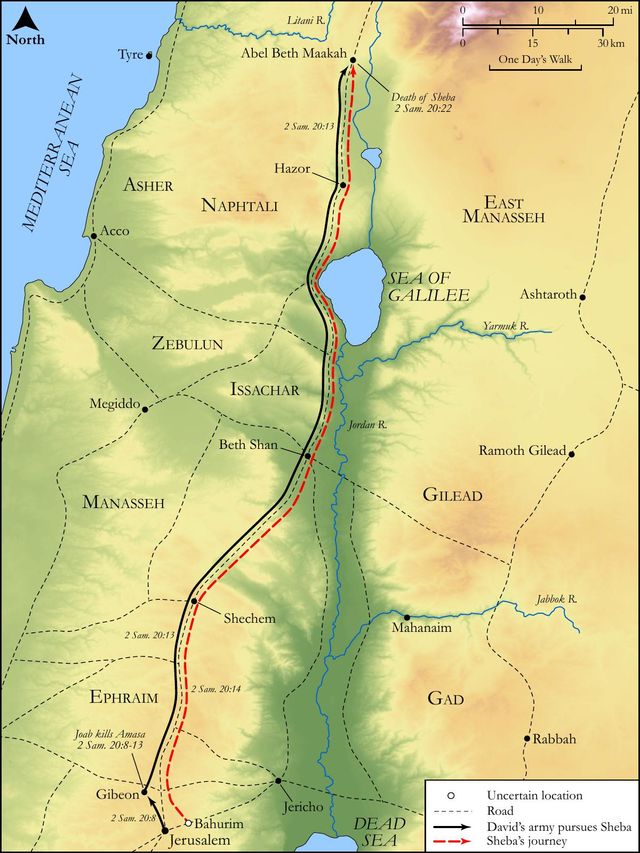
I.The rebel, when he had rambled over all the tribes of Israel, and found them not so willing, upon second thoughts, to follow him, as they had been upon a sudden provocation to desert David (having only picked up a few like himself, that sided with him), at length entered Abel-Beth-maacah, a strong city in the north, in the lot of Naphtali, where we find it placed, Kg2 15:29. Here he took shelter, whether by force or with consent does not appear; but his adherents were most Berites, of Beeroth in Benjamin, Sa2 20:14. One bad man will find or make more.
II.Joab drew up all his force against the city, besieged it, battered the wall, and made it almost ready for a general storm, Sa2 20:15.
Justly is that place attacked with all this fury which dares harbour a traitor; nor will that heart fare better which indulges those rebellious lusts that will not have Christ to reign over them.
III.A discreet good woman of the city of Abel brings this matter, by her prudent management, to a good issue, so as to satisfy Joab and yet save the city. Here is,
1.Her treaty with Joab, and her capitulation with him, by which he is engaged to raise the siege, upon condition that Sheba be delivered up. It seems, none of all the men of Abel, none of the elders or magistrates, offered to treat with Joab, no, not when they were reduced to the last extremity. They were stupid and unconcerned for the public safety, or they stood in awe of Sheba, or they despaired of gaining any good terms with Joab, or they had not sense enough to manage the treaty. But this one woman and her wisdom saved the city. Souls know no difference of sexes. Though the man be the head, it does not therefore follow that he has the monopoly of the brains, and therefore he ought not, by any salique law, to have the monopoly of the crown. Many a masculine heart, and more than masculine, has been found in a female breast; nor is the treasure of wisdom the less valuable for being lodged in the weaker vessel. In the treaty between this nameless heroine and Joab,
(1.)She gains his audience and attention, Sa2 20:16, Sa2 20:17. We may suppose it was the first time he had ever treated with a woman in martial affairs.
(2.)She reasons with him on behalf of her city, and very ingeniously.
[1.]That it was a city famous for wisdom (Sa2 20:18), as we translate it. She pleads that this city had been long in such reputation for prudent knowing men that it was the common referee of the country, and all agreed to abide by the award of its elders. Their sentence was an oracle; let them be consulted and the matter is ended, all sides will acquiesce. Now shall such a city as this be laid in ashes and never treated with?
[2.]That the inhabitants were generally peaceable and faithful in Israel, Sa2 20:19. She could speak, not for herself only, but for all those whose cause she pleaded, that they were not of turbulent and seditious spirits, but of known fidelity to their prince and peaceableness with their fellow-subjects; they were neither seditious nor litigious.
[3.]That it was a mother in Israel, a guide and nurse to the towns and country about; and that it was a part of the inheritance of the Lord, a city of Israelites, not of heathen; and the destruction of it would lessen and weaken that nation which God had chosen for his heritage.
[4.]That they expected him to offer them peace before he made an attack upon the, according to that known law of war, Deu 20:10. So the margin reads (Sa2 20:18): They plainly spoke in the beginning (of the siege), saying, Surely they will ask of Abel, that is, "The besiegers will demand the traitor, and will ask us to surrender him; and if they do, we will soon come to an agreement, and so end the matter." Thus she tacitly upbraids Joab for not offering them peace, but hopes it is not too late to beg it.
(3.)Joab and Abel's advocate soon agree that Sheba's head shall be the ransom of the city. Joab, though in a personal quarrel he had lately swallowed up and destroyed Amasa, yet, when he acts as a general, will by no means bear the imputation of delighting in bloodshed: "Far be it from me that I should delight to swallow up or destroy, or design it but when it is necessary for the public safety, Sa2 20:20. The matter is not so. Our quarrel is not with your city; we would hazard our lives for its protection. Our quarrel is only with the traitor that is harboured among you; deliver him up, and we have done." A great deal of mischief would be prevented if contending parties would but understand one another. The city obstinately holds out, believing Joab aims at its ruin. Joab furiously attacks it, believing the citizens all confederates with Sheba. Whereas both were mistaken; let both sides be undeceived, and the matter is soon accommodated. The single condition of peace is the surrender of the traitor. It is so in God's dealing with the soul, when it is besieged by conviction and distress: sin is the traitor; the beloved lust is the rebel; part with that, cast away the transgression, and all shall be well. No peace on any other terms. Our wise woman immediately agrees to the proposal: Behold, his head shall be thrown to thee presently.
2.Her treaty with the citizens. She went to them in her wisdom (and perhaps she had as much need of it in dealing with them as in dealing with Joab) and persuaded them to cut off Sheba's head, probably by some public order of their government, and it was thrown over the wall to Joab. He knew the traitor's face, and therefore looked no further, intending not that any of his adherents should suffer. The public safety was secured, and he felt no wish to gratify the public revenge. Joab hereupon raised the siege, and marched back to Jerusalem, with the trophies rather of peace than victory.
Continue studying 2 Samuel 20:18 across the web’s major study libraries — every link below opens this exact verse, chapter, or book on the destination site.
Read & Compare
 BibleGatewayThis verse in more than 200 translations and 70 languages.
 Bible.comThe YouVersion reader — hundreds of translations, reading plans, and highlights.
 ESV.orgCrossway's official English Standard Version reader.
 NET BibleThe NET translation with 60,000+ translators' notes on every rendering decision.
 STEP BibleTyndale House's free study tool — original text, vocabulary, and scholarly resources.
 BibliaLogos Bible Software's free web reader.
 USCCBThe New American Bible (Revised Edition) with the U.S. bishops' study notes.
Commentaries
 BibleHub CommentariesDozens of classic commentaries on this verse, gathered on one page.
 StudyLightMore than 100 commentary sets — the largest collection on the web.
 BibleRefPlain-English commentary on what this verse means, verse by verse.
 Enduring WordDavid Guzik's free commentary on this chapter, widely used by Bible teachers.
 Bible Study ToolsVerse commentary alongside Greek and Hebrew study aids.
Original Language & Research
- BibleHub InterlinearThe verse word by word — original language, transliteration, and English.
- BibleHub LexiconEvery word's original-language definition and Strong's entry.
 Blue Letter BibleDeep-study tools — Strong's numbers, concordance, and word studies.
 SefariaThe Hebrew text with Rashi and centuries of Jewish commentary.
Sermons, Hymns & Audio


TrulyRandomVerse is not affiliated with these sites and doesn’t control their content. They’re linked because they’re genuinely useful.
Summary
In 2 Samuel 20:18, a wise woman from Abel of Beth-maachah strategically addresses Joab, King David's commander, who is besieging her city in pursuit of the rebel Sheba. She invokes an ancient, well-established proverb or saying that highlights Abel's long-standing reputation as a place renowned for its profound wisdom and its consistent ability to bring even the most difficult matters to a definitive and peaceful conclusion. This astute appeal to the city's esteemed history serves as a powerful and persuasive argument for sparing it from destruction, thereby setting the stage for a diplomatic resolution to a potentially devastating conflict.
Context
ShowHideLiterary Context
This verse is a pivotal moment within the larger narrative of Joab's relentless pursuit of Sheba, son of Bichri, a Benjaminite who had ignited a fresh rebellion against King David immediately following the suppression of Absalom's revolt. Sheba, having traversed various Israelite territories, ultimately sought refuge in Abel of Beth-maachah, a heavily fortified city situated in the northern reaches of Israel. Joab, with his formidable forces, cornered Sheba there and promptly commenced the construction of a siege ramp against the city wall, signaling an imminent and destructive assault. The wise woman's intervention, detailed in 2 Samuel 20:16-22, marks a dramatic turning point. She boldly confronts Joab, appealing to his sense of justice and the city's established reputation, thereby averting what appeared to be an inevitable slaughter. Her words in verse 18 form the core of her compelling argument, leveraging the city's past renown to negotiate its present salvation.
Historical & Cultural Context
Abel of Beth-maachah was strategically located in northern Israel, near the border with Aram, making it a significant administrative and potentially judicial center. Its robust fortifications underscore its importance as a regional stronghold. The practice of seeking counsel from specific individuals or places was a common and respected custom in Israel, where wisdom was highly valued as a primary means of resolving disputes, making legal judgments, and guiding community affairs. A "wise woman," as she is explicitly called in 2 Samuel 20:16, was a recognized and respected figure in Israelite society, often possessing a reputation for exceptional discernment, practical knowledge, and the invaluable ability to mediate conflicts or offer sound advice, particularly during times of crisis. Her appeal to a traditional saying about Abel underscores the significant cultural weight given to established reputation and the profound power of collective memory in shaping present actions and decisions.
Key Themes
ShowHideThe primary themes that powerfully emerge from this verse and its surrounding narrative include the transformative power of wisdom and counsel in averting destruction, demonstrating emphatically that diplomacy and discernment can be far more effective than brute force. It also highlights the intrinsic value of reputation and honor, as Abel's long-standing renown for peaceful resolution becomes its unexpected shield against Joab's wrath. The narrative further underscores the profound theme of peacemaking and the preservation of life, as the woman's courageous intervention seeks to prevent unnecessary bloodshed and uphold the sanctity of the covenant community. This aligns seamlessly with broader biblical principles found in passages like Proverbs 11:14, which sagely states, "Where no counsel is, the people fall: but in the multitude of counsellors there is safety." Ultimately, the story celebrates the agency and profound impact of an individual to rebuke the powerful and influence the course of events for the greater good of the community, echoing the courageous actions of other influential women in Israel's history, such as Deborah in Judges 4.
Exposition and Analysis
ShowHideKey Word Analysis
ShowHideThis primitive root primarily means "to speak," but can also imply "to arrange" or "to subdue." In this context, "wont to speak" (KJV) captures the sense of a long-established, habitual practice of speaking or declaring something. It signifies a deeply ingrained tradition or a customary way of communicating, suggesting that the proverb was not a new invention but a recognized and authoritative saying passed down through generations. This emphasizes the weight and antiquity of the counsel associated with Abel.
This primitive root means "to inquire," "to request," or "to demand." The KJV's addition of "[counsel]" accurately captures the implication here. The verb denotes a deliberate act of seeking information or guidance, often with the expectation of receiving a definitive answer or solution. The repetition implied by "surely ask" in the KJV further emphasizes the certainty and reliability of seeking counsel at Abel, portraying it as the go-to place for authoritative resolution.
This primitive root means "to complete," "to finish," or "to bring to an end." It can be used in both good and bad senses, literally or figuratively. Here, it signifies the successful and conclusive resolution of a matter or dispute. It implies that the counsel received at Abel was not merely advisory but led to a final, satisfying settlement, bringing closure and peace to contentious situations. This highlights Abel's reputation for practical, effective wisdom that brought about definitive outcomes.
Verse Breakdown
ShowHide"Then she spake, saying"
This phrase introduces the wise woman's direct, courageous, and authoritative address to Joab. Her act of speaking is a strategic initiative, a bold word spoken in a tense military setting in a moment of crisis.
"They were wont to speak in old time, saying"
This clause establishes the ancient, respected, and traditional nature of the proverb she is about to quote. It appeals to the long-standing custom and collective memory of the people, lending significant weight, credibility, and historical authority to her argument, implying that the city's reputation for wisdom was deeply rooted and enduring.
"They shall surely ask [counsel] at Abel"
This is the core assertion of the proverb, proclaiming Abel's renown as a place where people would reliably and confidently go to seek definitive and wise solutions to their most complex problems. The emphasis on "surely ask" underscores the certainty and reliability of the counsel found there, portraying Abel as a recognized beacon of wisdom and arbitration.
"and so they ended [the matter]."
This concluding clause highlights the effectiveness, finality, and peaceful outcome of the counsel received at Abel. It implies that the advice given there was not just sound but consistently led to a conclusive and satisfying resolution of disputes, thereby preventing further conflict or bloodshed. This directly contrasts with Joab's current destructive intent, presenting Abel as a place of resolution, not ruin.
Literary Devices
ShowHideThe verse employs several significant literary devices that enhance its persuasive power. Most prominently, it features a Proverb or traditional saying, which lends ancient authority and cultural weight to the woman's argument. The use of a well-known adage appeals to shared knowledge and values, making her point more persuasive and difficult to dismiss. There is also a strong element of Reputation/Honor, as the woman strategically invokes Abel's long-standing fame for wisdom and peacemaking. This appeal to honor serves as a powerful rhetorical tool, challenging Joab to act in a manner consistent with the city's esteemed past rather than its immediate destruction. Furthermore, the woman's speech demonstrates Strategic Rhetoric, as she carefully crafts her words to disarm Joab and present a compelling case for preserving the city, leveraging its history as a place of resolution rather than conflict. The entire interaction also functions as a form of Dramatic Irony, as Joab, a seasoned military commander accustomed to force, is outmaneuvered not by military might, but by the profound wisdom and persuasive power of a single woman.
Theological and Thematic Connections
ShowHideThe narrative of the wise woman of Abel profoundly illustrates the biblical value of wisdom, not merely as intellectual acumen, but as practical discernment that consistently leads to life and peace. It underscores God's preference for resolution over destruction, and His remarkable ability to use unexpected instruments—like a "wise woman" from a besieged city—to achieve His sovereign purposes. The appeal to "counsel" and "ending the matter" speaks to a divine order where disputes are ideally resolved through justice, understanding, and reconciliation, rather than unbridled violence. This echoes the broader biblical emphasis on seeking wisdom from God and diligently applying it to life's conflicts, recognizing that true strength often lies in discernment, humility, and the courageous pursuit of peacemaking.
Reflection and Application
ShowHideThe story of the wise woman of Abel is a timeless testament to the transformative power of wisdom, courage, and strategic communication in de-escalating conflict and preserving life. It challenges us deeply to consider how we approach disputes, whether they are personal, communal, or even international. Rather than rushing to judgment, resorting to reactive anger, or defaulting to force, the narrative profoundly encourages a posture of seeking and offering wise counsel, valuing open dialogue, and appealing to shared principles of justice, truth, and peace. It reminds us that a good reputation, built on integrity, discernment, and a consistent history of wise actions, can be an invaluable asset in times of profound crisis. Furthermore, it highlights the profound impact one individual, even one seemingly without conventional power or authority, can have when they speak truth with courage, clarity, and discerning wisdom. We are called to be proactive peacemakers in our various spheres of influence, to diligently seek resolution, and to champion life over destruction, trusting that God can work powerfully through our efforts to bring about His purposes of shalom.
Questions for Reflection
ShowHideFAQ
ShowHideWho was the wise woman of Abel, and why was her intervention so significant?
ShowHideThe Bible does not provide her name, referring to her simply as a "wise woman" of Abel of Beth-maachah. Her significance lies in her extraordinary courage, profound wisdom, and strategic initiative. At a critical moment when her entire city was on the brink of utter destruction by Joab, King David's formidable commander, she took the unprecedented step of speaking directly to him from the city wall. Her intervention was profoundly significant because she successfully negotiated a peaceful resolution, thereby saving countless lives, by appealing to the city's ancient and revered reputation for wisdom and by offering a practical, decisive solution (delivering the rebel Sheba) that fully satisfied Joab's objective without further bloodshed. She demonstrated powerfully that discernment, diplomacy, and a well-articulated appeal to tradition could be far more potent than military might, embodying the biblical principle that "by wise counsel you will wage your own war, and in abundance of counselors there is victory" as found in Proverbs 24:6.
Christ-Centered Fulfillment
ShowHideThe wise woman of Abel's appeal to ancient counsel and the peaceful resolution of matters at Abel serves as a poignant foreshadowing of the ultimate source of wisdom, peace, and definitive resolution found uniquely in Jesus Christ. While Abel was a place where "they ended the matter" through human wisdom and negotiation, Christ is the very embodiment of divine wisdom, the one through whom all creation came into being and in whom "are hidden all the treasures of wisdom and knowledge" (Colossians 2:3). He is the ultimate "Wonderful Counselor" (Isaiah 9:6), who not only offers perfect advice but perfectly executes God's eternal plan for salvation and the reconciliation of all things to Himself. Unlike the temporary peace achieved at Abel, Christ brings about an eternal and unshakeable peace, reconciling fallen humanity to a holy God through His sacrificial death on the cross (Colossians 1:20). He is the "Lamb of God who takes away the sin of the world" (John 1:29), definitively "ending the matter" of humanity's sin, guilt, and alienation from God, offering not just a temporary reprieve from destruction but eternal life and true shalom. His wisdom leads to ultimate reconciliation and everlasting peace, fulfilling the deepest longings for final resolution that human wisdom can only ever hint at.