


2 Samuel 20:14
Bible text: King James Version (1769 Blayney text) · Public domain
Bible text: Berean Standard Bible · Public domain
Bible text: American Standard Version (1901) · Public domain
Bible text: World English Bible, Messianic edition · Public domain
Bible text: Geneva Bible (1599) · Public domain
Bible text: Young's Literal Translation · Public domain
- וַיַּעֲבֹרvai·ya·'a·Vorand he passedH5674Conj-w ¦ V-Qal-ConsecImperf-3msVerb Qal Consecutive Imperfect 3rd Singular Masculineוַandיַּעֲבֹרhe passed
- בְּכָלbe·kholin allH3605Prep-b ¦ N-mscNoun Singular Masculine Constructבְּinכָלall
- שִׁבְטֵיshiv·Tei[the] tribes ofH7626N-mpcNoun Plural Masculine Construct
- יִשְׂרָאֵלYis·ra·'ElIsraelH3478N-properNoun Proper Location
- אָבֵלָה'a·Ve·lahAbel towardsH62N-proper ¦ SfxNoun Proper LocationאָבֵלָAbelהtowards
- וּבֵיתu·Veitand BethH62Conj-w ¦ N-mscNoun Singular Masculine ConstructוּandבֵיתBeth
- מַעֲכָהma·'a·KhahMaacahH62N-properNoun Proper Location
- וְכָלve·kholand allH3605Conj-w ¦ N-mscNoun Singular Masculine Constructוְandכָלall
- הַבֵּרִיםha·be·Rimthe BeritesH1276Art ¦ N-mpNoun Gentilic Plural Masculine AbsoluteהַtheבֵּרִיםBerites
- וַיִּקָּהֲלוּvai·yik·le·huand they assembledH6950Conj-w ¦ V-Niphal-ConsecImperf-3mpVerb Niphal Consecutive Imperfect 3rd Plural Masculineוַandיִּקָּהֲלוּthey assembled
- וַיָּבֹאוּvai·ya·Vo·'uand they wentH935Conj-w ¦ V-Qal-ConsecImperf-3mpVerb Qal Consecutive Imperfect 3rd Plural Masculineוַandיָּבֹאוּthey went
- אַף'afalsoH637PrtParticle Interjection
- אַחֲרָיו'a·cha·Ravafter himH310Adj-mpc ¦ 3msAdjective Numerical Plural Masculine Constructאַחֲרָיafterוhim
English is a literal word-by-word gloss of the Hebrew, not the KJV's wording. Why?
This is the original text the KJV's translators worked from — each Hebrew word with its own literal English meaning in this verse, prepared by scholars at Tyndale House, Cambridge. The KJV translates whole sentences, not word by word, so its wording differs: one Hebrew word can become several English words, and the KJV may choose “the LORD” where the gloss reads “Yahweh”. Both are faithful — they answer different questions. For the KJV's own rendering, switch to the KJV text.
Details
See on the biblical-era maps
Study this verse
Public-domain commentary
Matthew Henry
From his Commentary on the Whole Bible. Henry comments on passages, not single verses — this entry covers 2 Samuel 20:14–22. His four-level outline is real structure in the source text, so it is rendered as structure.
We have here the conclusion of Sheba's attempt.
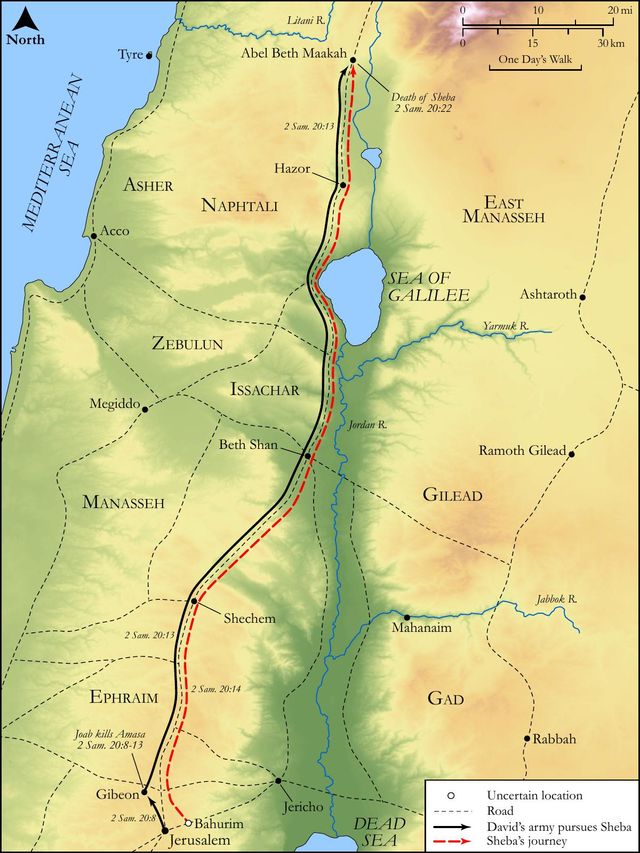
I.The rebel, when he had rambled over all the tribes of Israel, and found them not so willing, upon second thoughts, to follow him, as they had been upon a sudden provocation to desert David (having only picked up a few like himself, that sided with him), at length entered Abel-Beth-maacah, a strong city in the north, in the lot of Naphtali, where we find it placed, Kg2 15:29. Here he took shelter, whether by force or with consent does not appear; but his adherents were most Berites, of Beeroth in Benjamin, Sa2 20:14. One bad man will find or make more.
II.Joab drew up all his force against the city, besieged it, battered the wall, and made it almost ready for a general storm, Sa2 20:15.
Justly is that place attacked with all this fury which dares harbour a traitor; nor will that heart fare better which indulges those rebellious lusts that will not have Christ to reign over them.
III.A discreet good woman of the city of Abel brings this matter, by her prudent management, to a good issue, so as to satisfy Joab and yet save the city. Here is,
1.Her treaty with Joab, and her capitulation with him, by which he is engaged to raise the siege, upon condition that Sheba be delivered up. It seems, none of all the men of Abel, none of the elders or magistrates, offered to treat with Joab, no, not when they were reduced to the last extremity. They were stupid and unconcerned for the public safety, or they stood in awe of Sheba, or they despaired of gaining any good terms with Joab, or they had not sense enough to manage the treaty. But this one woman and her wisdom saved the city. Souls know no difference of sexes. Though the man be the head, it does not therefore follow that he has the monopoly of the brains, and therefore he ought not, by any salique law, to have the monopoly of the crown. Many a masculine heart, and more than masculine, has been found in a female breast; nor is the treasure of wisdom the less valuable for being lodged in the weaker vessel. In the treaty between this nameless heroine and Joab,
(1.)She gains his audience and attention, Sa2 20:16, Sa2 20:17. We may suppose it was the first time he had ever treated with a woman in martial affairs.
(2.)She reasons with him on behalf of her city, and very ingeniously.
[1.]That it was a city famous for wisdom (Sa2 20:18), as we translate it. She pleads that this city had been long in such reputation for prudent knowing men that it was the common referee of the country, and all agreed to abide by the award of its elders. Their sentence was an oracle; let them be consulted and the matter is ended, all sides will acquiesce. Now shall such a city as this be laid in ashes and never treated with?
[2.]That the inhabitants were generally peaceable and faithful in Israel, Sa2 20:19. She could speak, not for herself only, but for all those whose cause she pleaded, that they were not of turbulent and seditious spirits, but of known fidelity to their prince and peaceableness with their fellow-subjects; they were neither seditious nor litigious.
[3.]That it was a mother in Israel, a guide and nurse to the towns and country about; and that it was a part of the inheritance of the Lord, a city of Israelites, not of heathen; and the destruction of it would lessen and weaken that nation which God had chosen for his heritage.
[4.]That they expected him to offer them peace before he made an attack upon the, according to that known law of war, Deu 20:10. So the margin reads (Sa2 20:18): They plainly spoke in the beginning (of the siege), saying, Surely they will ask of Abel, that is, "The besiegers will demand the traitor, and will ask us to surrender him; and if they do, we will soon come to an agreement, and so end the matter." Thus she tacitly upbraids Joab for not offering them peace, but hopes it is not too late to beg it.
(3.)Joab and Abel's advocate soon agree that Sheba's head shall be the ransom of the city. Joab, though in a personal quarrel he had lately swallowed up and destroyed Amasa, yet, when he acts as a general, will by no means bear the imputation of delighting in bloodshed: "Far be it from me that I should delight to swallow up or destroy, or design it but when it is necessary for the public safety, Sa2 20:20. The matter is not so. Our quarrel is not with your city; we would hazard our lives for its protection. Our quarrel is only with the traitor that is harboured among you; deliver him up, and we have done." A great deal of mischief would be prevented if contending parties would but understand one another. The city obstinately holds out, believing Joab aims at its ruin. Joab furiously attacks it, believing the citizens all confederates with Sheba. Whereas both were mistaken; let both sides be undeceived, and the matter is soon accommodated. The single condition of peace is the surrender of the traitor. It is so in God's dealing with the soul, when it is besieged by conviction and distress: sin is the traitor; the beloved lust is the rebel; part with that, cast away the transgression, and all shall be well. No peace on any other terms. Our wise woman immediately agrees to the proposal: Behold, his head shall be thrown to thee presently.
2.Her treaty with the citizens. She went to them in her wisdom (and perhaps she had as much need of it in dealing with them as in dealing with Joab) and persuaded them to cut off Sheba's head, probably by some public order of their government, and it was thrown over the wall to Joab. He knew the traitor's face, and therefore looked no further, intending not that any of his adherents should suffer. The public safety was secured, and he felt no wish to gratify the public revenge. Joab hereupon raised the siege, and marched back to Jerusalem, with the trophies rather of peace than victory.
Historical interpretation
Historical reception
1 surviving comment on this verse from the historical church.
Abela and Bethmaacha: Cities of the tribe of Nephtali.
Continue studying 2 Samuel 20:14 across the web’s major study libraries — every link below opens this exact verse, chapter, or book on the destination site.
Read & Compare
 BibleGatewayThis verse in more than 200 translations and 70 languages.
 Bible.comThe YouVersion reader — hundreds of translations, reading plans, and highlights.
 ESV.orgCrossway's official English Standard Version reader.
 NET BibleThe NET translation with 60,000+ translators' notes on every rendering decision.
 STEP BibleTyndale House's free study tool — original text, vocabulary, and scholarly resources.
 BibliaLogos Bible Software's free web reader.
 USCCBThe New American Bible (Revised Edition) with the U.S. bishops' study notes.
Commentaries
 BibleHub CommentariesDozens of classic commentaries on this verse, gathered on one page.
 StudyLightMore than 100 commentary sets — the largest collection on the web.
 BibleRefPlain-English commentary on what this verse means, verse by verse.
 Enduring WordDavid Guzik's free commentary on this chapter, widely used by Bible teachers.
 Bible Study ToolsVerse commentary alongside Greek and Hebrew study aids.
Original Language & Research
- BibleHub InterlinearThe verse word by word — original language, transliteration, and English.
- BibleHub LexiconEvery word's original-language definition and Strong's entry.
 Blue Letter BibleDeep-study tools — Strong's numbers, concordance, and word studies.
 SefariaThe Hebrew text with Rashi and centuries of Jewish commentary.
Sermons, Hymns & Audio


TrulyRandomVerse is not affiliated with these sites and doesn’t control their content. They’re linked because they’re genuinely useful.
Summary
Second Samuel 20:14 vividly portrays the strategic movements of Sheba, son of Bichri, as he actively consolidates his rebellion against King David. This verse details his journey through the northern territories of Israel, specifically highlighting his successful recruitment efforts in Abel-beth-maachah and among the Berites, thereby demonstrating the expanding geographical reach and growing strength of his insurgent movement.
Context
ShowHideLiterary Context
This verse is strategically placed immediately after the dramatic and fragile resolution of Absalom's rebellion and King David's tumultuous return to Jerusalem. The kingdom, though nominally reunited, remains deeply fractured, particularly along the ancient tribal lines separating Judah from the northern tribes of Israel. Sheba, a Benjamite, shrewdly exploits this lingering discontent and the perceived favoritism shown towards Judah by David, issuing a defiant rallying cry for secession in 2 Samuel 20:1. The narrative swiftly shifts to Joab's determined pursuit of Sheba, and verse 14 specifically chronicles Sheba's tactical retreat and intensive recruitment efforts as he moves northward. This sets the immediate stage for the climactic siege at Abel-beth-maachah, which becomes the focal point of the conflict detailed in the subsequent verses of 2 Samuel 20.
Historical & Cultural Context
In the aftermath of Absalom's defeat, David's attempts to reconcile with the northern tribes were met with significant resentment, especially from the tribe of Benjamin, which had lost its royal lineage (Saul) to David's ascendancy. Sheba, being a Benjamite, skillfully leveraged this deep-seated tribalistic sentiment and the broader disaffection among those who felt neglected by David's administration or who preferred a leader from their own region. The mention of "Abel, and to Bethmaachah" (referring to Abel-beth-maachah) pinpoints a heavily fortified city in the far north of Israel, strategically located near the borders of Syria. Such a location was ideal for a rebel leader to establish a stronghold, being distant from Jerusalem and potentially capable of drawing support from a region less directly controlled by David's central authority. The "Berites" most likely refer to the inhabitants of Beeroth, a Gibeonite city within the territory of Benjamin, or a broader regional designation, indicating that Sheba's support base extended beyond the northern tribes to include elements from his own home region.
Key Themes
ShowHideThe verse powerfully underscores several persistent themes found throughout the Books of Samuel and the broader Old Testament narrative. Disunity and Fragmentation within Israel are paramount, demonstrating that even after a major civil war, the kingdom remained highly susceptible to internal strife and tribal loyalties that often superseded national unity, a recurring problem evident from the period of the Judges (e.g., Judges 12:1-6). Sheba's actions vividly highlight the theme of Usurpation and Challenge to Authority, as he directly opposes David's divinely appointed kingship, mirroring and extending the pattern set by Absalom's earlier rebellion. Furthermore, the strategic movement and successful gathering of forces described here reflect the ongoing theme of Leadership and Governance Challenges, as David is continually forced to reassert his authority and maintain control over a volatile and often fractious kingdom. This showcases the immense difficulties of ruling a diverse people, a challenge also seen in the early reign of Saul in 1 Samuel 11.
Exposition and Analysis
ShowHideKey Word Analysis
ShowHideFrom the primitive root H5674, this verb means "to cross over" and is used very widely to describe any transition, literal or figurative. In this context, it emphasizes Sheba's purposeful and strategic movement, not merely wandering, but actively transitioning through territories to achieve his rebellious aims. It conveys the deliberate nature of his journey to gather support.
Meaning "house of Maakah," this refers to Beth-Maakah, a specific place in Palestine. Often combined with "Abel" to form Abel-beth-maachah, it signifies a key northern fortified city. Its mention highlights the strategic importance of Sheba's chosen destination as a secure base for his rebellion, far from David's immediate reach.
(and related to H7035), this primitive root means "to convoke; assemble (selves) (together), gather (selves) (together)." This term implies a deliberate and successful act of assembling people. It underscores that Sheba was effective in his recruitment, not just encountering people, but actively consolidating them into a cohesive and organized force, indicating the growing strength and intentionality of his rebellion.
Verse Breakdown
ShowHide"And he went through all the tribes of Israel unto Abel, and to Bethmaachah, and all the Berites:"
This initial clause details Sheba's calculated and purposeful journey. He is not aimlessly wandering but moving with a clear objective: to garner support from the various northern tribes and establish a stronghold in a defensible location. The phrase "all the tribes of Israel" (implicitly excluding Judah, which largely remained loyal to David) underscores the widespread nature of the disaffection Sheba exploited. His destination, Abel-beth-maachah, indicates a pre-planned move to a secure, northern base. The specific inclusion of "all the Berites" suggests that particular groups or regions actively joined his cause, indicating a targeted recruitment strategy.
"and they were gathered together,"
This phrase signifies the successful outcome of Sheba's recruitment efforts. The people he encountered and appealed to responded positively to his call, forming an organized assembly. This indicates that Sheba's message resonated with a significant portion of the population, leading to a substantial and unified following, thereby validating his capacity to incite widespread rebellion.
"and went also after him."
This final clause emphasizes the active commitment and allegiance of those who joined Sheba. They did not merely assemble passively but actively followed him, indicating their loyalty to his cause and their willingness to participate in the rebellion against King David. This demonstrates the formation of a determined and growing insurgent force, ready to engage in conflict.
Literary Devices
ShowHideThe narrative in 2 Samuel 20:14 employs several literary devices to convey its message with precision and impact. Strategic Movement is a key narrative technique, as the detailed description of Sheba's journey ("went through all the tribes of Israel unto Abel, and to Bethmaachah") highlights his calculated and effective leadership in building a rebellion. This movement is not random but purposeful, aiming for a fortified northern city to establish a secure base. The mention of "all the Berites" functions as a form of Synecdoche, where a specific group or city (Beeroth) represents a broader regional or tribal allegiance to Sheba's cause, indicating widespread disaffection. Furthermore, the successful gathering of forces in Abel-beth-maachah serves as a clear instance of Foreshadowing, setting the stage for the dramatic siege of that very city, which becomes the focal point of the conflict in the subsequent verses. The concise yet descriptive language effectively portrays the escalating threat Sheba posed to David's fragile kingdom.
Theological and Thematic Connections
ShowHideThis verse, detailing Sheba's successful recruitment and the consolidation of his forces, powerfully illustrates the persistent problem of disunity and the alluring nature of rebellion within Israel. The nation, despite being God's chosen people and under a divinely appointed king, frequently struggled with internal divisions rooted in tribalism, regional loyalties, and discontent with leadership. Sheba's ability to "gather together" followers underscores how quickly factionalism can escalate into open revolt when grievances are left unaddressed or when ambitious individuals exploit existing tensions. Theologically, this highlights the pervasive human propensity for rebellion against established authority, whether divine or divinely appointed, and the constant need for spiritual and political unity to maintain a healthy and flourishing society. It serves as a stark reminder that even a kingdom established by God's decree is vulnerable to the destructive forces of internal strife and the pursuit of self-interest over communal harmony and divine order.
Reflection and Application
ShowHideThe account of Sheba's rebellion and his successful gathering of forces in 2 Samuel 20:14 offers profound insights into the dynamics of division and leadership, insights that remain remarkably applicable to all communities, including the contemporary church and broader society. It serves as a potent reminder that discontent, if left unaddressed or allowed to fester, can quickly lead to destructive schisms and fragmentation. Just as Sheba exploited existing grievances and tribal loyalties, so too can internal divisions arise in our own contexts when people feel unheard, overlooked, or when selfish ambitions are allowed to take root and undermine collective well-being. This passage calls us to cultivate a spirit of unity, reconciliation, and mutual respect, actively working to bridge divides rather than widen them. It also challenges leaders to be acutely attentive to the needs and concerns of all members within their spheres of influence, fostering an environment where grievances can be addressed constructively and empathetically before they escalate into open rebellion or destructive conflict. Ultimately, true strength, resilience, and flourishing within any community come not from forced uniformity, but from a shared commitment to a common, righteous purpose, guided by humble and discerning leadership that seeks the welfare of all.
Questions for Reflection
ShowHideFAQ
ShowHideWho was Sheba, son of Bichri, and what was his motivation for rebellion?
ShowHideSheba, son of Bichri, was a Benjamite from the hill country of Ephraim. He emerged as a rebel leader immediately after Absalom's rebellion was quelled, capitalizing on the lingering tensions and tribal animosity between the tribes of Israel and Judah following King David's return to Jerusalem. His primary motivation was to exploit the widespread disaffection with David's rule, particularly among the northern tribes who felt neglected or unfairly treated compared to Judah. His defiant rallying cry, "We have no part in David, neither have we inheritance in the son of Jesse: every man to his tents, O Israel!" (2 Samuel 20:1), clearly articulated his goal of secession and the establishment of a separate kingdom, likely under his own leadership.
Why was Abel-beth-maachah a strategic location for Sheba's rebellion?
ShowHideAbel-beth-maachah (referred to as "Abel, and to Bethmaachah" in this verse) was a highly strategic and heavily fortified city located in the far northern reaches of Israel, near the borders of Syria. Its importance lay in its strong defenses, which made it an ideal defensive stronghold for a rebel leader. By retreating to this city, Sheba aimed to establish a secure base far from David's immediate reach in Jerusalem. Its northern location also allowed him to draw support from tribes and regions that were historically more independent and perhaps less loyal to the Davidic dynasty. The city's strength and strategic value are further highlighted by the subsequent siege it endures, as detailed in 2 Samuel 20:15-22.
Who were "all the Berites" mentioned in this verse?
ShowHideThe exact identity of "all the Berites" is a subject of scholarly discussion, but the most widely accepted view is that they were the inhabitants of Beeroth, one of the Gibeonite cities mentioned in Joshua 9. Beeroth was located in the territory of Benjamin, which was Sheba's own tribe. Their inclusion in the list of those who "gathered together, and went also after him" indicates that Sheba's support base extended beyond just the northern tribes and included people from his home region, possibly those who harbored resentment against David due to the lingering effects of the Saulide-Davidic dynastic struggle. This suggests a broader base of disaffection that Sheba successfully tapped into.
Christ-Centered Fulfillment
ShowHideThe narrative of Sheba's rebellion, culminating in his successful gathering of forces in 2 Samuel 20:14, serves as a poignant foreshadowing of the ongoing spiritual rebellion against God's anointed King, Jesus Christ. Just as Sheba exploited existing disunity and tribal loyalties to draw people away from David's rightful reign, so too does sin and worldly ambition seek to pull humanity away from the sovereign and benevolent reign of Christ. The "tribes of Israel" who followed Sheba represent humanity's pervasive propensity to follow false leaders and embrace divisions rather than submitting to the true and eternal King. However, in Christ, we find the ultimate and perfect answer to such fragmentation and rebellion. He is the true Son of David, who does not merely suppress rebellion through force but conquers it through self-sacrificial love, offering profound reconciliation and true unity to all who believe. The Apostle Paul beautifully emphasizes that in Christ, "there is neither Jew nor Gentile, neither slave nor free, nor is there male and female, for you are all one in Christ Jesus" (Galatians 3:28). Unlike Sheba, who gathered followers for destructive purposes, Jesus calls His followers to a kingdom of peace, righteousness, and eternal life, where "every knee should bow, in heaven and on earth and under the earth, and every tongue acknowledge that Jesus Christ is Lord, to the glory of God the Father" (Philippians 2:10-11). His reign brings true and lasting unity, fulfilling the longing for a perfectly harmonious kingdom that David's earthly reign could only imperfectly reflect, ultimately establishing a new covenant where all who believe are "one body in Christ, and individually members one of another" (Romans 12:5).