


Judges 9:53
- וַתַּשְׁלֵךְva·tash·Lekhand she threwH7993Conj-w ¦ V-Hiphil-ConsecImperf-3fsVerb Hiphil Consecutive Imperfect 3rd Singular Feminineוַandתַּשְׁלֵךְshe threw
- אִשָּׁה'i·Shaha womanH802N-fsNoun Singular Feminine Absolute
- אַחַת'a·ChatoneH259N-fsNoun Singular Feminine Absolute
- פֶּלַחPe·lacha mill-stone ofH6400N-fscNoun Singular Feminine Construct
- רֶכֶבRe·khevan upper mill-stoneH7393N-msNoun Singular Masculine Absolute
- עַל'alonH5921PrepPreposition
- רֹאשׁrosh[the] head ofH7218N-mscNoun Singular Masculine Construct
- אֲבִימֶלֶךְ'a·vi·Me·lekhAbimelechH40N-proper-mNoun Proper Masculine
- וַתָּרִץva·Ta·ritzand it crushedH7533Conj-w ¦ V-Hiphil-ConsecImperf-3fsVerb Hiphil Consecutive Imperfect 3rd Singular Feminineוַandתָּרִץit crushed
- אֶת'et<obj.>H853DirObjMParticle Object Indicator
- גֻּלְגָּלְתּוֹgul·gal·Tohis skullH1538N-fsc ¦ 3msNoun Singular Feminine Constructגֻּלְגָּלְתּskullוֹhis
English is a literal word-by-word gloss of the Hebrew, not the KJV's wording. Why?
This is the original text the KJV's translators worked from — each Hebrew word with its own literal English meaning in this verse, prepared by scholars at Tyndale House, Cambridge. The KJV translates whole sentences, not word by word, so its wording differs: one Hebrew word can become several English words, and the KJV may choose “the LORD” where the gloss reads “Yahweh”. Both are faithful — they answer different questions. For the KJV's own rendering, switch to the KJV text.
Details
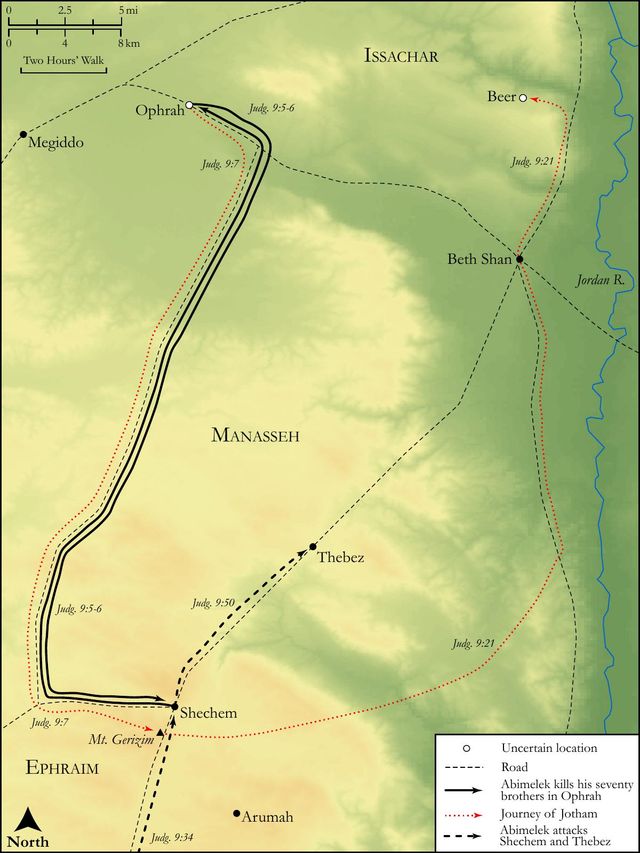
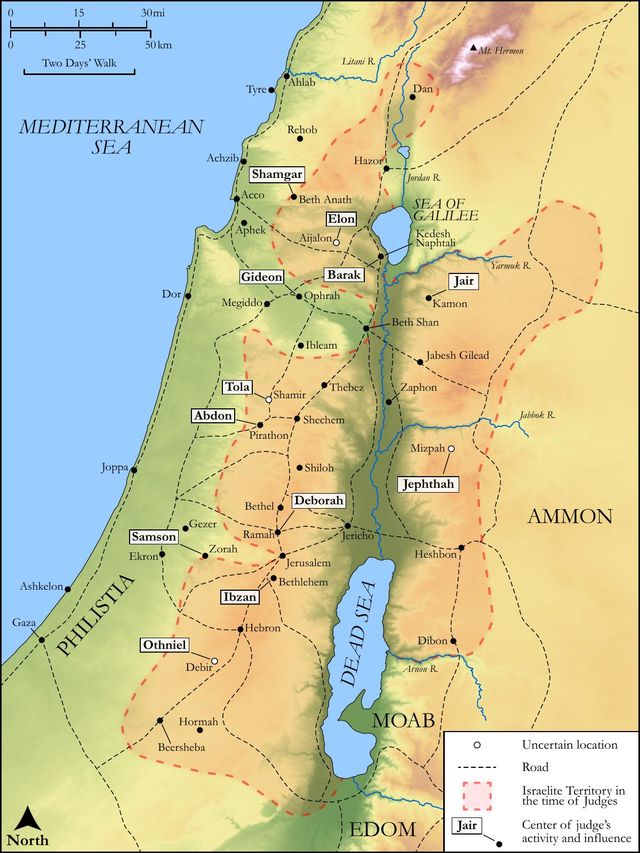
See on the biblical-era map
Study this verse
Public-domain commentary
Matthew Henry
From his Commentary on the Whole Bible. Henry comments on passages, not single verses — this entry covers Judges 9:50–57. His two-level outline is real structure in the source text, so it is rendered as structure.
We have seen the ruin of the Shechemites completed by the hand of Abimelech; and now it comes to his turn to be reckoned with who was their leader in villany. Thebez was a small city, probably not far from Shechem, dependent upon it, and in confederacy with it. Now,
I.Abimelech attempted the destruction of this city (Jdg 9:50), drove all the inhabitants of the town into the castle, or citadel, Jdg 9:51.
When he had them there he did not doubt but he should do the same execution here that he had lately done at the strong-hold of the temple of Baal-berith, not considering that the tower of an idol-temple lay more exposed to divine vengeance than any other tower. He attempted to set fire to this tower, at least to burn down the door, and so force an entrance, Jdg 9:52. Those who have escaped and succeeded well in one desperate attempt are apt to think the like attempt another time not desperate. This instance was long after quoted to show how dangerous it is to come near the call of a besieged city, Sa2 11:20, etc. But God infatuates those whom he will ruin.
II.In the attempt he was himself destroyed, having his brains knocked out with a piece of a millstone, Jdg 9:57.
No doubt this man was a murderer, whom, though he had escaped the dangers of the war with Shechem, yet vengeance suffered not to live, Act 28:4. Evil pursues sinners, and sometimes overtakes them when they are not only secure, but triumphant. Thebez, we may suppose, was a weak inconsiderable place, compared with Shechem. Abimelech, having conquered the greater, makes no doubt of being master of the less without any difficulty, especially when he had taken the city, and had only the tower to deal with; yet he lays his bones by that, and there is all his honour buried. Thus are the mighty things of the world often confounded by the weakest and those things that are most made light of. See here what rebukes those are justly put under many times by the divine providence that are unreasonable in their demands of satisfaction for injuries received. Abimelech had some reason to chastise the Shechemites, and he had done it with a witness; but when he will carry his revenges further, and nothing will serve but that Thebez also must be sacrificed to his rage, he is not only disappointed there, but destroyed; for verily there is a God that judges in the earth. Three circumstances are worthy of observation in the death of Abimelech: - 1. That he was slain with a stone, as he had slain his brethren all upon one stone. 2. That he had his skull broken. Vengeance aimed at that guilty head which had worn the usurped crown. 3. That the stone was cast upon him by a woman, Jdg 9:53. He saw the stone come; it was therefore strange he did not avoid it, but, no doubt, this made it so much the greater mortification to him to see from what hand it came. Sisera died by a woman's hand and knew it not; but Abimelech not only fell by the hand of a woman but knew it, and, when he found himself ready to breathe his last, nothing troubled him so much as this, that it should be said, A woman slew him. See, (1.) His foolish pride, in laying so much to heart this little circumstance of his disgrace. Here was no care taken about his precious soul, no concern what would become of that, no prayer to God for his mercy; but very solicitous he is to patch up his shattered credit, when there is no patching his shattered skull. "O let it never be said that such a mighty man as Abimelech was killed by a woman!" The man was dying, but his pride was alive and strong, and the same vain-glorious humour that had governed him all along appears now at last. Qualis vita, finis ita - As was his life, such was his death. As God punished his cruelty by the manner of his death, so he punished his pride by the instrument of it. (2.) His foolish project to avoid this disgrace; nothing could be more ridiculous; his own servant must run him through, not to rid him the sooner out of his pain, but that men say not, A woman slew him. Could he think that this would conceal what the woman had done, and not rather proclaim it the more? Nay, it added to the infamy of his death, for hereby he became a self-murderer. Better have it said, A woman slew him, than that it should be said, His servant slew him by his own order; yet now both will be said of him to his everlasting reproach. And it is observable that this very thing which Abimelech was in such care to conceal appears to have been more particularly remembered by posterity than most passages of his history; for Joab speaks of it as that which he expected David would reproach him with, for coming so nigh the wall, Sa2 11:21. The ignominy we seek to avoid by sin we do but perpetuate the remembrance of.
III.The issue of all is that Abimelech being slain,
1.Israel's peace was restored, and an end was put to this civil war; for those that followed him departed every man to his place, Jdg 9:55.
2.God's justice was glorified (Jdg 9:56, Jdg 9:57): Thus God punished the wickedness of Abimelech, and of the men of Shechem, and fulfilled Jotham's curse, for it was not a curse causeless. Thus he preserved the honour of his government, and gave warning to all ages to expect blood for blood. The Lord is known by the judgments which he executes, when the wicked is snared in the work of his own hands. Though wickedness may prosper awhile, it will not prosper always.
Historical interpretation
Historical reception
1 surviving comment on this verse from the historical church.
The homicide Abimelech, bastard son of Gideon, killed the seventy legitimate sons, and, thinking he had hit upon a ruse for securing his grasp on the royal power, he destroyed his accomplices in the crime. He, however, was in turn destroyed by them and in the end was slain with a stone cast by a woman’s hand.… In short, countless examples teach us that the profit of human wisdom is illusory, for it is a meager and lowly thing and not a great and preeminent good.
Continue studying Judges 9:53 across the web’s major study libraries — every link below opens this exact verse, chapter, or book on the destination site.
Read & Compare
 BibleGatewayThis verse in more than 200 translations and 70 languages.
 Bible.comThe YouVersion reader — hundreds of translations, reading plans, and highlights.
 ESV.orgCrossway's official English Standard Version reader.
 NET BibleThe NET translation with 60,000+ translators' notes on every rendering decision.
 STEP BibleTyndale House's free study tool — original text, vocabulary, and scholarly resources.
 BibliaLogos Bible Software's free web reader.
 USCCBThe New American Bible (Revised Edition) with the U.S. bishops' study notes.
Commentaries
 BibleHub CommentariesDozens of classic commentaries on this verse, gathered on one page.
 StudyLightMore than 100 commentary sets — the largest collection on the web.
 BibleRefPlain-English commentary on what this verse means, verse by verse.
 Enduring WordDavid Guzik's free commentary on this chapter, widely used by Bible teachers.
 Bible Study ToolsVerse commentary alongside Greek and Hebrew study aids.
Original Language & Research
- BibleHub InterlinearThe verse word by word — original language, transliteration, and English.
- BibleHub LexiconEvery word's original-language definition and Strong's entry.
 Blue Letter BibleDeep-study tools — Strong's numbers, concordance, and word studies.
 SefariaThe Hebrew text with Rashi and centuries of Jewish commentary.
Sermons, Hymns & Audio


TrulyRandomVerse is not affiliated with these sites and doesn’t control their content. They’re linked because they’re genuinely useful.
Summary
Judges 9:53 vividly recounts the ignominious end of Abimelech, the self-proclaimed king of Shechem, during his siege of Thebez. Having cornered the city's inhabitants in a fortified tower, Abimelech, a ruthless and ambitious leader who seized power by murdering his seventy half-brothers, meets his demise not by the hand of a mighty warrior, but by an unnamed woman who casts a piece of a millstone upon his head, fatally fracturing his skull. This dramatic event serves as a powerful illustration of divine justice and the unexpected ways God works to bring down the proud and violent.
Context
ShowHideLiterary Context
Judges 9:53 marks the climactic fulfillment of Jotham's prophetic fable and curse found in Judges 9:7-20. The chapter opens with Abimelech's brutal consolidation of power, murdering all but one of his seventy half-brothers in Ophrah, an act of unparalleled cruelty (Judges 9:5). His subsequent coronation by the men of Shechem (Judges 9:6) establishes an ungodly, human-initiated kingship, a stark contrast to the Spirit-empowered judges God raised up. The narrative then details the growing conflict between Abimelech and the people of Shechem, culminating in his destruction of the city (Judges 9:45). His final act, besieging Thebez, mirrors his earlier actions and directly leads to his death, closing the tragic story of a man who sought power through bloodshed and human ambition rather than divine appointment.
Historical & Cultural Context
The period of the Judges was characterized by political fragmentation and moral decay, with the recurring phrase "everyone did what was right in his own eyes" (Judges 17:6). Abimelech's attempt to establish a monarchy is premature and self-serving, predating God's chosen king, Saul, by centuries. In ancient Near Eastern warfare, besieging a city often involved attacking its fortified towers, where the last defenders would gather. The use of a "millstone" (specifically, the upper millstone) as a weapon is highly significant; these were heavy, common household items, typically operated by women. For a mighty warrior and self-proclaimed king to be killed by an unnamed woman using a domestic implement was deeply humiliating in a patriarchal society, underscoring his ignominious downfall. This cultural context amplifies the divine irony of his death.
Key Themes
ShowHideThis verse powerfully illustrates several key themes prevalent in the book of Judges and the broader biblical narrative. Firstly, it showcases Divine Justice and the principle of lex talionis (law of retribution), as Abimelech's violent end is a direct consequence of his earlier atrocities, particularly the murder of his brothers and the inhabitants of Shechem (Judges 9:56-57). Secondly, it highlights God's Sovereignty and Use of the Unexpected, demonstrating that God can use the seemingly weak and insignificant—an unnamed woman and a household item—to bring down the powerful and proud, echoing themes seen elsewhere in Scripture, such as David and Goliath (1 Samuel 17:47). Finally, the verse underscores the Downfall of Pride and Ungodly Ambition, serving as a cautionary tale against seizing power through violence and self-exaltation, reminding readers that "pride goes before destruction, and a haughty spirit before a fall" (Proverbs 16:18).
Exposition and Analysis
ShowHideKey Word Analysis
ShowHideThis verb (H7993) means "to throw out, down or away (literally or figuratively)." In this context, it describes a forceful, deliberate action—the woman actively and intentionally hurls the millstone. This is not an accidental dropping but a decisive act of defiance and judgment.
This noun (H7393) refers to the upper grinding stone of a hand mill, a heavy, circular stone used for grinding grain. Its use as a weapon by a woman underscores the domestic nature of the object, making its deployment in battle highly unusual and symbolically significant. It represents an instrument of daily life turned into an instrument of divine judgment, highlighting the unexpected means God employs.
This term (H1538), derived from a root meaning "to roll," refers specifically to the cranium, the bony framework of the head. The direct impact to the skull signifies a fatal blow, leaving no doubt about the cause of Abimelech's death. The imagery is graphic and underscores the brutal justice meted out, targeting the very seat of his pride and leadership.
Verse Breakdown
ShowHide"And a certain woman cast a piece of a millstone upon Abimelech's head"
This clause introduces the unexpected agent and weapon of Abimelech's downfall. The anonymity of the woman emphasizes that God can use anyone, regardless of status or recognition, to accomplish His purposes. The "piece of a millstone" highlights the humble, non-military nature of the weapon, contrasting sharply with Abimelech's warrior status and military might. The act is precise and deliberate, aimed directly at his head, the seat of his pride and power.
"and all to brake his skull"
This second clause describes the immediate and devastating consequence of the woman's action. The KJV's "all to brake" is an archaic idiom meaning "completely broke" or "utterly shattered," vividly conveying the complete shattering of Abimelech's skull, indicating a fatal injury. This blow is not merely a wound but a definitive, humiliating end to his tyrannical reign, directly fulfilling the curse pronounced by Jotham. The broken skull symbolizes the utter destruction of his self-exalted authority and the violent recompense for his violent deeds.
Literary Devices
ShowHideThe verse is rich in Irony, which is the most prominent literary device. Abimelech, a mighty warrior and self-proclaimed king who murdered seventy men, is brought down not by an army or a male combatant, but by an unnamed woman using a domestic implement. This stark contrast highlights the unexpected nature of divine justice and the humiliation of the proud. There is also Symbolism at play; the millstone, an object of daily sustenance, becomes an instrument of death, symbolizing the reversal of fortune and the unexpected means by which God's judgment is enacted. The broken skull itself symbolizes the utter destruction of Abimelech's illegitimate power and the violent consequences of his ambition. The narrative also employs Foreshadowing through Jotham's fable (Judges 9:7-20), which explicitly predicts the destructive "fire" that would consume Abimelech and the men of Shechem, a prophecy powerfully fulfilled in this verse and the preceding events.
Theological and Thematic Connections
ShowHideJudges 9:53 stands as a potent testament to the biblical principle of divine justice, where the violent and ambitious meet a fitting end. Abimelech's death is not a random accident but a clear act of God's retribution for his heinous crimes, particularly the murder of his brothers and the treachery against Shechem. It underscores that God is sovereign over human affairs, capable of bringing down the proud and exalting the humble, often through unexpected means. This narrative serves as a cautionary tale against seeking power through ungodly means and reminds us that true authority comes from God, not from human ambition or violence. The ignominious nature of his death also highlights the futility of human pride when confronted with divine judgment.
Reflection and Application
ShowHideAbimelech's story, culminating in his dramatic demise in Judges 9:53, serves as a profound cautionary tale for all who seek power or influence through selfish ambition, violence, or deceit. It reminds us that true authority and lasting impact are not achieved through human might or manipulation, but through humble submission to God's will and righteous living. The unexpected instrument of Abimelech's downfall—an unnamed woman and a millstone—is a powerful reminder that God's ways are often beyond our comprehension, and He can use the most unassuming individuals and circumstances to accomplish His purposes and bring about justice. This should encourage us not to despise humble beginnings or unexpected instruments in God's hands, and to recognize that our strength and significance are found not in ourselves, but in Him. It calls us to examine our own hearts for any seeds of pride or ungodly ambition, urging us instead to cultivate humility, integrity, and a reliance on divine leading rather than human scheming.
Questions for Reflection
ShowHideFAQ
ShowHideWhy is it significant that a woman killed Abimelech?
ShowHideThe fact that an unnamed woman delivered the fatal blow to Abimelech is profoundly significant for several reasons. In ancient Israelite society, warfare was predominantly a male domain, and for a powerful warrior and self-proclaimed king to be killed by a woman was considered deeply humiliating and dishonorable. Abimelech himself, in his dying breath, begs his armor-bearer to kill him so it would not be said that "a woman killed him" (Judges 9:54). This detail underscores the divine irony and justice at play: the one who exalted himself through violence is brought low by the most unexpected and seemingly weakest of instruments, highlighting God's power to use anyone to accomplish His will and humble the proud.
What does the phrase "all to brake" mean in the King James Version?
ShowHideThe phrase "all to brake" is an older English idiom, common in the King James Version, meaning "completely broke" or "utterly shattered." It emphasizes the severity and finality of the injury Abimelech sustained. It's not just that his skull was broken, but that it was completely crushed, indicating a definitively fatal blow that left no doubt about his immediate demise. This archaic phrasing powerfully conveys the devastating impact of the millstone.
How does Abimelech's story fit into the broader narrative and themes of the book of Judges?
ShowHideAbimelech's story in Judges 9 is a dark chapter that exemplifies the moral and spiritual decline of Israel during the period of the Judges. It stands as a stark warning against the dangers of human ambition and the consequences of rejecting God's righteous leadership. His attempt to establish an ungodly monarchy through violence foreshadows the later, divinely appointed kingship, highlighting the chaotic and self-destructive nature of a people who "did what was right in their own eyes" (Judges 21:25). His violent rise and fall serve as a powerful illustration of the cycle of sin, oppression, and divine judgment that characterizes the book, ultimately pointing to Israel's desperate need for a true, righteous king.
Christ-Centered Fulfillment
ShowHideThe ignominious end of Abimelech in Judges 9:53, struck down by a humble millstone wielded by an unnamed woman, stands in stark contrast to the true King, Jesus Christ, and yet, in its very contrast, points to Him. Abimelech's self-exaltation, violence, and illegitimate claim to kingship led to his humiliating death, a testament to the futility of human ambition apart from God. In stark contrast, Jesus, though truly God, "did not count equality with God a thing to be grasped, but emptied himself, by taking the form of a servant, being born in the likeness of men" (Philippians 2:6-7). While Abimelech sought to avoid the shame of being killed by a woman, Christ willingly embraced the ultimate shame of the cross, dying a public, humiliating death at the hands of those He came to save, becoming the "Lamb of God who takes away the sin of the world" (John 1:29). His death, seemingly a defeat, was the means by which He triumphed over sin and death, fulfilling God's righteous judgment not upon us, but in our place. Thus, Abimelech's story, a tale of a failed, self-appointed king brought low by unexpected means, indirectly highlights the glorious and humble kingship of Christ, who, through His weakness on the cross, secured eternal victory and true justice for all who believe, ultimately reigning not through violence, but through sacrificial love (Colossians 2:14-15).