


Judges 9:54
- וַיִּקְרָאvai·yik·Ra'and he calledH7121Conj-w ¦ V-Qal-ConsecImperf-3msVerb Qal Consecutive Imperfect 3rd Singular Masculineוַandיִּקְרָאhe called
- מְהֵרָהme·he·RahquicklyH4120AdvAdverb
- אֶל'eltoH413PrepPreposition
- הַנַּעַרha·Na·'arthe young manH5288Art ¦ N-msNoun Singular Masculine Absoluteהַtheנַּעַרyoung man
- נֹשֵׂאno·Se'[who] carriedH5375V-Qal-Prtcpl-msVerb Qal Participle Singular Masculine Construct
- כֵלָיוkhe·Lav<of> his armor<s>H3627N-mpc ¦ 3msNoun Plural Masculine Constructכֵלָי<of> armor<s>וhis
- וַיֹּאמֶרvai·Yo·merand he saidH559Conj-w ¦ V-Qal-ConsecImperf-3msVerb Qal Consecutive Imperfect 3rd Singular Masculineוַandיֹּאמֶרhe said
- לוֹloto <the> himPrep-l ¦ 3msSuffix Personal 3rd Singular Masculineלto <the>וֹhim
- שְׁלֹףshe·LofdrawH8025V-Qal-Imp-2msVerb Qal Imperative 2nd Singular Masculine
- חַרְבְּךָchar·be·Khayour swordH2719N-fsc ¦ 2msNoun Singular Feminine Constructחַרְבְּswordךָyour
- וּמוֹתְתֵנִיu·Mo·Te·niand kill meH4191Conj-w ¦ V-Piel-Imp-2ms ¦ 1csVerb Piel Imperative 2nd Singular Masculineוּandמוֹתְתֵkillנִיme
- פֶּןpenlestH6435PrtParticle Conditional
- יֹאמְרוּYo·me·rupeople should sayH559V-Qal-Imperf-3mpVerb Qal Imperfect 3rd Plural Masculine
- לִיliof <the> mePrep-l ¦ 1csSuffix Personal 1st Singular common genderלִof <the>יme
- אִשָּׁה'i·Shaha womanH802N-fsNoun Singular Feminine Absolute
- הֲרָגָתְהוּha·ra·Ga·te·hushe killed himH2026V-Qal-Perf-3fs ¦ 3msVerb Qal Perfect 3rd Singular Feminineהֲרָגָתְshe killedהוּhim
- וַיִּדְקְרֵהוּvai·yid·ke·Re·huand he pierced through himH1856Conj-w ¦ V-Qal-ConsecImperf-3ms ¦ 3msVerb Qal Consecutive Imperfect 3rd Singular Masculineוַandיִּדְקְרֵhe pierced throughהוּhim
- נַעֲרוֹna·'a·Rohis young manH5288N-msc ¦ 3msNoun Singular Masculine Constructנַעֲרyoung manוֹhis
- וַיָּמֹתvai·ya·Motand he diedH4191Conj-w ¦ V-Qal-ConsecImperf-3msVerb Qal Consecutive Imperfect 3rd Singular Masculineוַandיָּמֹתhe died
English is a literal word-by-word gloss of the Hebrew, not the KJV's wording. Why?
This is the original text the KJV's translators worked from — each Hebrew word with its own literal English meaning in this verse, prepared by scholars at Tyndale House, Cambridge. The KJV translates whole sentences, not word by word, so its wording differs: one Hebrew word can become several English words, and the KJV may choose “the LORD” where the gloss reads “Yahweh”. Both are faithful — they answer different questions. For the KJV's own rendering, switch to the KJV text.
Details
See on the biblical-era map
Study this verse
Public-domain commentary
Matthew Henry
From his Commentary on the Whole Bible. Henry comments on passages, not single verses — this entry covers Judges 9:50–57. His two-level outline is real structure in the source text, so it is rendered as structure.
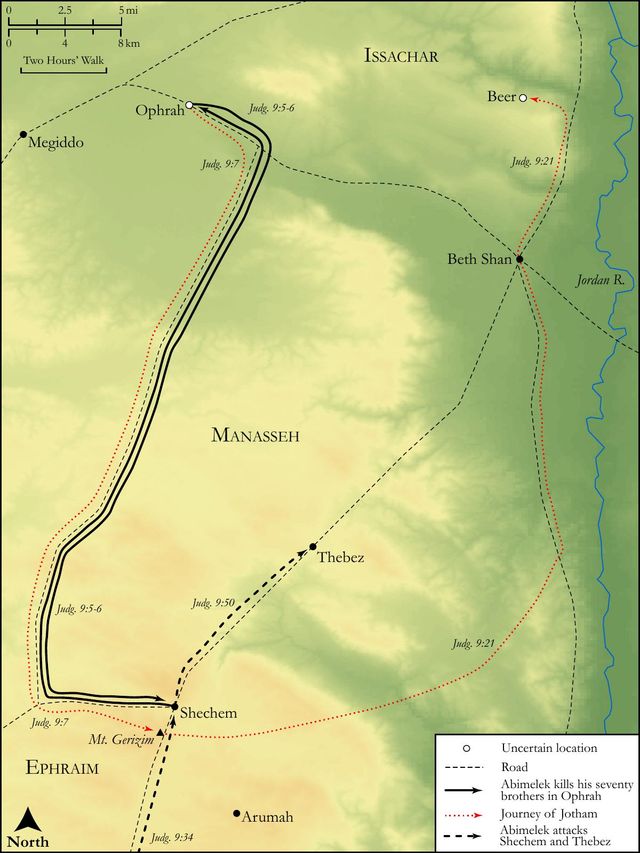
We have seen the ruin of the Shechemites completed by the hand of Abimelech; and now it comes to his turn to be reckoned with who was their leader in villany. Thebez was a small city, probably not far from Shechem, dependent upon it, and in confederacy with it. Now,
I.Abimelech attempted the destruction of this city (Jdg 9:50), drove all the inhabitants of the town into the castle, or citadel, Jdg 9:51.
When he had them there he did not doubt but he should do the same execution here that he had lately done at the strong-hold of the temple of Baal-berith, not considering that the tower of an idol-temple lay more exposed to divine vengeance than any other tower. He attempted to set fire to this tower, at least to burn down the door, and so force an entrance, Jdg 9:52. Those who have escaped and succeeded well in one desperate attempt are apt to think the like attempt another time not desperate. This instance was long after quoted to show how dangerous it is to come near the call of a besieged city, Sa2 11:20, etc. But God infatuates those whom he will ruin.
II.In the attempt he was himself destroyed, having his brains knocked out with a piece of a millstone, Jdg 9:57.
No doubt this man was a murderer, whom, though he had escaped the dangers of the war with Shechem, yet vengeance suffered not to live, Act 28:4. Evil pursues sinners, and sometimes overtakes them when they are not only secure, but triumphant. Thebez, we may suppose, was a weak inconsiderable place, compared with Shechem. Abimelech, having conquered the greater, makes no doubt of being master of the less without any difficulty, especially when he had taken the city, and had only the tower to deal with; yet he lays his bones by that, and there is all his honour buried. Thus are the mighty things of the world often confounded by the weakest and those things that are most made light of. See here what rebukes those are justly put under many times by the divine providence that are unreasonable in their demands of satisfaction for injuries received. Abimelech had some reason to chastise the Shechemites, and he had done it with a witness; but when he will carry his revenges further, and nothing will serve but that Thebez also must be sacrificed to his rage, he is not only disappointed there, but destroyed; for verily there is a God that judges in the earth. Three circumstances are worthy of observation in the death of Abimelech: - 1. That he was slain with a stone, as he had slain his brethren all upon one stone. 2. That he had his skull broken. Vengeance aimed at that guilty head which had worn the usurped crown. 3. That the stone was cast upon him by a woman, Jdg 9:53. He saw the stone come; it was therefore strange he did not avoid it, but, no doubt, this made it so much the greater mortification to him to see from what hand it came. Sisera died by a woman's hand and knew it not; but Abimelech not only fell by the hand of a woman but knew it, and, when he found himself ready to breathe his last, nothing troubled him so much as this, that it should be said, A woman slew him. See, (1.) His foolish pride, in laying so much to heart this little circumstance of his disgrace. Here was no care taken about his precious soul, no concern what would become of that, no prayer to God for his mercy; but very solicitous he is to patch up his shattered credit, when there is no patching his shattered skull. "O let it never be said that such a mighty man as Abimelech was killed by a woman!" The man was dying, but his pride was alive and strong, and the same vain-glorious humour that had governed him all along appears now at last. Qualis vita, finis ita - As was his life, such was his death. As God punished his cruelty by the manner of his death, so he punished his pride by the instrument of it. (2.) His foolish project to avoid this disgrace; nothing could be more ridiculous; his own servant must run him through, not to rid him the sooner out of his pain, but that men say not, A woman slew him. Could he think that this would conceal what the woman had done, and not rather proclaim it the more? Nay, it added to the infamy of his death, for hereby he became a self-murderer. Better have it said, A woman slew him, than that it should be said, His servant slew him by his own order; yet now both will be said of him to his everlasting reproach. And it is observable that this very thing which Abimelech was in such care to conceal appears to have been more particularly remembered by posterity than most passages of his history; for Joab speaks of it as that which he expected David would reproach him with, for coming so nigh the wall, Sa2 11:21. The ignominy we seek to avoid by sin we do but perpetuate the remembrance of.
III.The issue of all is that Abimelech being slain,
1.Israel's peace was restored, and an end was put to this civil war; for those that followed him departed every man to his place, Jdg 9:55.
2.God's justice was glorified (Jdg 9:56, Jdg 9:57): Thus God punished the wickedness of Abimelech, and of the men of Shechem, and fulfilled Jotham's curse, for it was not a curse causeless. Thus he preserved the honour of his government, and gave warning to all ages to expect blood for blood. The Lord is known by the judgments which he executes, when the wicked is snared in the work of his own hands. Though wickedness may prosper awhile, it will not prosper always.
Continue studying Judges 9:54 across the web’s major study libraries — every link below opens this exact verse, chapter, or book on the destination site.
Read & Compare
 BibleGatewayThis verse in more than 200 translations and 70 languages.
 Bible.comThe YouVersion reader — hundreds of translations, reading plans, and highlights.
 ESV.orgCrossway's official English Standard Version reader.
 NET BibleThe NET translation with 60,000+ translators' notes on every rendering decision.
 STEP BibleTyndale House's free study tool — original text, vocabulary, and scholarly resources.
 BibliaLogos Bible Software's free web reader.
 USCCBThe New American Bible (Revised Edition) with the U.S. bishops' study notes.
Commentaries
 BibleHub CommentariesDozens of classic commentaries on this verse, gathered on one page.
 StudyLightMore than 100 commentary sets — the largest collection on the web.
 BibleRefPlain-English commentary on what this verse means, verse by verse.
 Enduring WordDavid Guzik's free commentary on this chapter, widely used by Bible teachers.
 Bible Study ToolsVerse commentary alongside Greek and Hebrew study aids.
Original Language & Research
- BibleHub InterlinearThe verse word by word — original language, transliteration, and English.
- BibleHub LexiconEvery word's original-language definition and Strong's entry.
 Blue Letter BibleDeep-study tools — Strong's numbers, concordance, and word studies.
 SefariaThe Hebrew text with Rashi and centuries of Jewish commentary.
Sermons, Hymns & Audio


TrulyRandomVerse is not affiliated with these sites and doesn’t control their content. They’re linked because they’re genuinely useful.
Summary
Judges 9:54 vividly portrays the final, ignominious moments of Abimelech, the self-proclaimed king of Shechem. Mortally wounded by a millstone dropped by a woman during his siege of Thebez, Abimelech, consumed by pride and the ancient Near Eastern warrior code of honor, desperately commands his young armor-bearer to deliver the fatal blow. His primary motivation is to avoid the ultimate disgrace of being remembered as having been killed by a woman, a fate he deemed more shameful than death itself. This verse marks the climactic fulfillment of Jotham's prophetic curse against Abimelech and the men of Shechem, underscoring the certainty of divine retribution for his tyrannical rule and murderous actions.
Context
ShowHideLiterary Context
Judges 9:54 serves as the dramatic culmination of Abimelech's violent and self-serving reign, which began with the brutal murder of seventy of his half-brothers on one stone, leaving only Jotham to escape and deliver his powerful parable and curse in Judges 9:7-21, "Jotham's Parable and Curse". Abimelech's ascent to power was illegitimate, marked by bloodshed and the manipulation of the men of Shechem. The narrative meticulously details the escalating conflict between Abimelech and Shechem, culminating in the siege of Thebez. Just prior to this verse, Judges 9:53, "Abimelech Wounded by a Millstone" describes the pivotal moment when a woman on the tower of Thebez drops an upper millstone, crushing Abimelech's skull and inflicting a mortal wound. This immediate preceding event directly precipitates Abimelech's desperate command in verse 54, highlighting his final, desperate attempt to control his narrative and preserve his perceived honor even in death, thereby bringing his tragic story to a swift and decisive close.
Historical & Cultural Context
The ancient Near East, including Israel, operated within a strong honor-shame culture, particularly for male warriors and leaders. A man's honor was paramount, tied to his strength, prowess, and ability to dominate. To be defeated, and especially killed, by a woman was considered the ultimate humiliation and disgrace, stripping a warrior of all dignity and leaving an indelible stain on his legacy. This cultural sensitivity is vividly demonstrated by Abimelech's frantic plea, revealing that for him, the manner of death was more significant than death itself. The role of an "armourbearer" was also significant; this young man was a trusted servant, often a relative or close attendant, whose duty included carrying the leader's weapons and, in extreme circumstances, assisting in battle or even in a dignified death. The narrative implicitly contrasts Abimelech's ignominious end with the earlier, triumphant account of Jael, who slew Sisera with a tent peg, an act celebrated as a divine intervention, further emphasizing the shame intended for Abimelech.
Key Themes
ShowHideThis verse powerfully reinforces several major themes woven throughout the book of Judges and specifically within Abimelech's narrative. Firstly, it underscores the theme of divine retribution and justice. Abimelech's violent and shameful end is presented as a direct consequence of his wickedness, particularly his murder of his brothers and his tyrannical rule, fulfilling Jotham's curse that "fire would come out from Abimelech and devour the citizens of Shechem and Beth Millo, and fire would come out from the citizens of Shechem and Beth Millo and devour Abimelech" (Judges 9:20, "Jotham's Curse"). The narrative consistently portrays God's sovereign hand at work, ensuring that justice is meted out, a principle explicitly stated in Judges 9:56-57, "God Repaid Abimelech's Evil". Secondly, the story highlights the destructive nature of tyranny and self-serving ambition. Abimelech's reign, built on murder and deceit, ultimately collapses in a humiliating and violent end, illustrating the biblical principle that those who live by the sword often perish by it, a concept echoed in Matthew 26:52, "Jesus' Words on the Sword". Finally, the verse speaks to the futility of human pride and the pursuit of earthly honor over righteousness. Abimelech's dying concern for his reputation rather than repentance serves as a stark warning against unchecked ego.
Exposition and Analysis
ShowHideKey Word Analysis
ShowHideThis primitive root (H2026) means "to smite with deadly intent; destroy, kill, murder, put to death." Abimelech's command to "slay me" uses this forceful verb, indicating his desire for a definitive and immediate end. It underscores his preference for a deliberate, albeit proxy, killing by a male warrior rather than a lingering death from a wound inflicted by a woman, thereby attempting to control the narrative of his demise.
This term (H802) refers to a female. In the context of ancient Near Eastern honor-shame culture, being killed by a woman was considered the ultimate disgrace for a male warrior. Abimelech's desperate plea, "that men say not of me, A woman slew him," reveals his profound fear of this specific humiliation, which he perceived as more devastating than death itself. It highlights the patriarchal societal values and Abimelech's deep-seated pride.
This word (H5288) refers to a boy or lad, often implying a servant or attendant. The "young man his armourbearer" was a trusted subordinate. Abimelech's calling upon this specific individual, rather than a more senior officer, emphasizes the urgency and intimacy of his final, desperate request. The armourbearer's immediate obedience to this grim command underscores the hierarchical loyalty and the dire circumstances of Abimelech's final moments.
Verse Breakdown
ShowHide"Then he called hastily unto the young man his armourbearer"
This opening clause immediately conveys Abimelech's desperate urgency. Mortally wounded and facing imminent death, he acts swiftly to prevent the public knowledge of his humiliating injury. His call to his "young man," his personal armourbearer, signifies his reliance on a trusted subordinate to execute his final, crucial command. The word "hastily" (H4120, mᵉhêrâh) emphasizes the speed required to salvage his perceived honor before it was too late.
"and said unto him, Draw thy sword, and slay me"
Abimelech's direct and imperative command reveals his strong will and his desire to dictate the terms of his death, even in extremis. He orders the armourbearer to use his own sword, implying a quick, decisive, and "honorable" warrior's death, rather than a lingering, undignified one from the millstone wound. This act is a desperate attempt to salvage his perceived honor and control his legacy.
"that men say not of me, A woman slew him"
This is the core motivation behind Abimelech's command and the central point of the verse. His greatest fear is not death itself, but the lasting shame and public humiliation of being remembered as having been killed by a woman. This reveals the immense weight of honor and reputation in his culture and his own inflated ego, prioritizing his posthumous image over any spiritual or moral considerations.
"And his young man thrust him through, and he died"
This final clause describes the immediate and decisive execution of Abimelech's command. The armourbearer's obedience is swift and effective, ensuring Abimelech's desired "honorable" death. The phrase "thrust him through" (H1856, dâqar) indicates a piercing, fatal blow, bringing a swift end to Abimelech's tyrannical life and reign, thus fulfilling the divine judgment against him.
Literary Devices
ShowHideThe narrative of Abimelech's death is rich with literary devices that amplify its theological and moral impact. Irony is prominent, as Abimelech, who ruthlessly seized power through murder, meets his end in a humiliating manner, not by a mighty warrior but by an anonymous woman and then by his own command to avoid shame. His attempt to control his death ironically underscores the very disgrace he sought to avoid, as the true circumstances of his wounding are clearly recorded for posterity. There is also strong Poetic Justice at play; Abimelech, who shed much innocent blood and acted with fire and violence (burning the tower of Shechem), is himself brought down by an unexpected, seemingly insignificant act (a millstone from a woman) and ultimately perishes by the sword, fulfilling the principle of reaping what one sows. The Symbolism of the millstone is also significant; it is a common, domestic item, not a weapon of war, making its use against a powerful king particularly demeaning and highlighting the unexpected ways God's judgment can be enacted. Finally, the entire account serves as a Foreshadowing and fulfillment of Jotham's earlier curse, where "fire" (destruction) would come from Abimelech and consume Shechem, and "fire" (destruction) would come from Shechem and consume Abimelech.
Theological and Thematic Connections
ShowHideJudges 9:54 powerfully illustrates the unwavering nature of divine justice and the ultimate futility of human pride and ambition when set against God's sovereign will. Abimelech's desperate attempt to control his narrative even in death reveals a heart consumed by self-glory rather than repentance or recognition of divine judgment. His concern for human opinion over God's righteous decree serves as a stark warning about the destructive path of unchecked ego. The narrative demonstrates that while evil may seem to triumph for a season, God's moral order will ultimately prevail, ensuring that the wicked receive their just recompense. This is not merely a tale of human consequence but a demonstration of God's active involvement in the affairs of humanity, upholding justice and fulfilling prophetic declarations.
Reflection and Application
ShowHideAbimelech's final moments offer profound lessons for contemporary believers. His desperate concern for his reputation, even in the face of death, serves as a powerful reminder of the destructive nature of pride and the deceptive allure of human honor. In a world often obsessed with image and public perception, Abimelech's story challenges us to consider whose approval we truly seek: God's or man's. True honor, from a biblical perspective, is found not in avoiding shame or controlling narratives, but in humility, righteousness, and obedience to God. Furthermore, Abimelech's demise reinforces the certainty of divine justice. While the wicked may prosper for a time, God's ultimate judgment is sure. This should instill both a healthy fear of God and a confident trust that He will ultimately right all wrongs, even if His timing differs from ours. Our focus should be on living righteously and humbly before God, rather than striving for fleeting earthly glory.
Questions for Reflection
ShowHideFAQ
ShowHideWhy was being killed by a woman considered such a profound disgrace in Abimelech's culture?
ShowHideIn the patriarchal societies of the ancient Near East, a warrior's honor was inextricably linked to his masculine strength, prowess, and dominance in battle. To be defeated, and especially killed, by a woman was seen as the ultimate humiliation because it implied a complete lack of strength and a failure to uphold the expected standards of male leadership and warfare. It would signify that the warrior was so weak or ineffective that even a woman, typically not involved in direct combat, could overcome him. This cultural norm is starkly contrasted with the divinely orchestrated victory of Jael over Sisera in Judges 4, "Jael and Sisera", where a woman's act of slaying an enemy general was celebrated as a sign of God's power working through unexpected means, further highlighting the specific shame intended for Abimelech.
How does Abimelech's death fulfill Jotham's curse from Judges 9:20?
ShowHideJotham's curse declared, "Let fire come out from Abimelech and devour the citizens of Shechem and Beth Millo, and let fire come out from the citizens of Shechem and Beth Millo and devour Abimelech!" This curse is fulfilled with striking poetic justice. Abimelech, acting as "fire," ruthlessly attacked and burned the tower of Shechem, killing a thousand people (Judges 9:49, "Abimelech Burns the Tower of Shechem"). In turn, the "fire" (destruction) from the citizens of Shechem (symbolically represented by the woman from Thebez, a city allied with Shechem against Abimelech, and the general rebellion) "devoured" Abimelech. The millstone thrown by the woman, though not literal fire, initiated his fatal wound, leading to his ignominious death. This reciprocal destruction demonstrates God's precise and just repayment for the wickedness of both Abimelech and the people of Shechem who supported his murderous rise to power, as explicitly stated in Judges 9:56-57, "God Repaid Abimelech's Evil".
Christ-Centered Fulfillment
ShowHideAbimelech's desperate attempt to preserve his honor through a manipulated death stands in stark contrast to the ultimate self-giving sacrifice of Jesus Christ. Abimelech, driven by pride and a fear of human shame, chose a death that he believed would salvage his reputation. Yet, his end was one of ignominy and divine judgment for his sin. Conversely, Jesus, though innocent and divine, willingly embraced the most shameful and cursed form of death known to the ancient world: crucifixion. He did not seek to avoid public humiliation but endured it fully, becoming a "curse for us" (Galatians 3:13, "Christ Redeemed Us from the Curse") and bearing the shame of the cross for the joy set before Him (Hebrews 12:2, "Looking to Jesus, the Author and Finisher of Our Faith"). While Abimelech died to save his own perceived honor, Christ died to take away the sin of the world (John 1:29, "Jesus, the Lamb of God") and to reconcile humanity to God, offering true honor and eternal life to all who believe. His death, though outwardly humiliating, was the ultimate act of obedience and love, triumphing over sin, death, and shame, and securing a glorious victory that Abimelech, in his self-centered ambition, could never comprehend.