


Judges 9:55
Bible text: King James Version (1769 Blayney text) · Public domain
Bible text: Berean Standard Bible · Public domain
Bible text: American Standard Version (1901) · Public domain
Bible text: World English Bible, Messianic edition · Public domain
Bible text: Geneva Bible (1599) · Public domain
Bible text: Young's Literal Translation · Public domain
- וַיִּרְאוּvai·yir·'Uand they sawH7200Conj-w ¦ V-Qal-ConsecImperf-3mpVerb Qal Consecutive Imperfect 3rd Plural Masculineוַandיִּרְאוּthey saw
- אִישׁ'ish[the] man ofH376N-mscNoun Singular Masculine Construct
- יִשְׂרָאֵלYis·ra·'ElIsraelH3478N-properNoun Proper Location
- כִּיkithatH3588PrtParticle Conditional
- מֵתmethe was deadH4191V-Qal-Perf-3msVerb Qal Perfect 3rd Singular Masculine
- אֲבִימֶלֶךְ'a·vi·Me·lekhAbimelechH40N-proper-mNoun Proper Masculine
- וַיֵּלְכוּvai·ye·le·Khuand they wentH1980Conj-w ¦ V-Qal-ConsecImperf-3mpVerb Qal Consecutive Imperfect 3rd Plural Masculineוַandיֵּלְכוּthey went
- אִישׁ'isheveryoneH376N-msNoun Singular Masculine Absolute
- לִמְקֹמוֹlim·ko·Moto his own placeH4725Prep-l ¦ N-msc ¦ 3msNoun Singular Masculine Constructלִtoמְקֹמown placeוֹhis
English is a literal word-by-word gloss of the Hebrew, not the KJV's wording. Why?
This is the original text the KJV's translators worked from — each Hebrew word with its own literal English meaning in this verse, prepared by scholars at Tyndale House, Cambridge. The KJV translates whole sentences, not word by word, so its wording differs: one Hebrew word can become several English words, and the KJV may choose “the LORD” where the gloss reads “Yahweh”. Both are faithful — they answer different questions. For the KJV's own rendering, switch to the KJV text.
Details
See on the biblical-era maps
Study this verse
Public-domain commentary
Matthew Henry
From his Commentary on the Whole Bible. Henry comments on passages, not single verses — this entry covers Judges 9:50–57. His two-level outline is real structure in the source text, so it is rendered as structure.
We have seen the ruin of the Shechemites completed by the hand of Abimelech; and now it comes to his turn to be reckoned with who was their leader in villany. Thebez was a small city, probably not far from Shechem, dependent upon it, and in confederacy with it. Now,
I.Abimelech attempted the destruction of this city (Jdg 9:50), drove all the inhabitants of the town into the castle, or citadel, Jdg 9:51.
When he had them there he did not doubt but he should do the same execution here that he had lately done at the strong-hold of the temple of Baal-berith, not considering that the tower of an idol-temple lay more exposed to divine vengeance than any other tower. He attempted to set fire to this tower, at least to burn down the door, and so force an entrance, Jdg 9:52. Those who have escaped and succeeded well in one desperate attempt are apt to think the like attempt another time not desperate. This instance was long after quoted to show how dangerous it is to come near the call of a besieged city, Sa2 11:20, etc. But God infatuates those whom he will ruin.
II.In the attempt he was himself destroyed, having his brains knocked out with a piece of a millstone, Jdg 9:57.
No doubt this man was a murderer, whom, though he had escaped the dangers of the war with Shechem, yet vengeance suffered not to live, Act 28:4. Evil pursues sinners, and sometimes overtakes them when they are not only secure, but triumphant. Thebez, we may suppose, was a weak inconsiderable place, compared with Shechem. Abimelech, having conquered the greater, makes no doubt of being master of the less without any difficulty, especially when he had taken the city, and had only the tower to deal with; yet he lays his bones by that, and there is all his honour buried. Thus are the mighty things of the world often confounded by the weakest and those things that are most made light of. See here what rebukes those are justly put under many times by the divine providence that are unreasonable in their demands of satisfaction for injuries received. Abimelech had some reason to chastise the Shechemites, and he had done it with a witness; but when he will carry his revenges further, and nothing will serve but that Thebez also must be sacrificed to his rage, he is not only disappointed there, but destroyed; for verily there is a God that judges in the earth. Three circumstances are worthy of observation in the death of Abimelech: - 1. That he was slain with a stone, as he had slain his brethren all upon one stone. 2. That he had his skull broken. Vengeance aimed at that guilty head which had worn the usurped crown. 3. That the stone was cast upon him by a woman, Jdg 9:53. He saw the stone come; it was therefore strange he did not avoid it, but, no doubt, this made it so much the greater mortification to him to see from what hand it came. Sisera died by a woman's hand and knew it not; but Abimelech not only fell by the hand of a woman but knew it, and, when he found himself ready to breathe his last, nothing troubled him so much as this, that it should be said, A woman slew him. See, (1.) His foolish pride, in laying so much to heart this little circumstance of his disgrace. Here was no care taken about his precious soul, no concern what would become of that, no prayer to God for his mercy; but very solicitous he is to patch up his shattered credit, when there is no patching his shattered skull. "O let it never be said that such a mighty man as Abimelech was killed by a woman!" The man was dying, but his pride was alive and strong, and the same vain-glorious humour that had governed him all along appears now at last. Qualis vita, finis ita - As was his life, such was his death. As God punished his cruelty by the manner of his death, so he punished his pride by the instrument of it. (2.) His foolish project to avoid this disgrace; nothing could be more ridiculous; his own servant must run him through, not to rid him the sooner out of his pain, but that men say not, A woman slew him. Could he think that this would conceal what the woman had done, and not rather proclaim it the more? Nay, it added to the infamy of his death, for hereby he became a self-murderer. Better have it said, A woman slew him, than that it should be said, His servant slew him by his own order; yet now both will be said of him to his everlasting reproach. And it is observable that this very thing which Abimelech was in such care to conceal appears to have been more particularly remembered by posterity than most passages of his history; for Joab speaks of it as that which he expected David would reproach him with, for coming so nigh the wall, Sa2 11:21. The ignominy we seek to avoid by sin we do but perpetuate the remembrance of.
III.The issue of all is that Abimelech being slain,
1.Israel's peace was restored, and an end was put to this civil war; for those that followed him departed every man to his place, Jdg 9:55.
2.God's justice was glorified (Jdg 9:56, Jdg 9:57): Thus God punished the wickedness of Abimelech, and of the men of Shechem, and fulfilled Jotham's curse, for it was not a curse causeless. Thus he preserved the honour of his government, and gave warning to all ages to expect blood for blood. The Lord is known by the judgments which he executes, when the wicked is snared in the work of his own hands. Though wickedness may prosper awhile, it will not prosper always.
Continue studying Judges 9:55 across the web’s major study libraries — every link below opens this exact verse, chapter, or book on the destination site.
Read & Compare
 BibleGatewayThis verse in more than 200 translations and 70 languages.
 Bible.comThe YouVersion reader — hundreds of translations, reading plans, and highlights.
 ESV.orgCrossway's official English Standard Version reader.
 NET BibleThe NET translation with 60,000+ translators' notes on every rendering decision.
 STEP BibleTyndale House's free study tool — original text, vocabulary, and scholarly resources.
 BibliaLogos Bible Software's free web reader.
 USCCBThe New American Bible (Revised Edition) with the U.S. bishops' study notes.
Commentaries
 BibleHub CommentariesDozens of classic commentaries on this verse, gathered on one page.
 StudyLightMore than 100 commentary sets — the largest collection on the web.
 BibleRefPlain-English commentary on what this verse means, verse by verse.
 Enduring WordDavid Guzik's free commentary on this chapter, widely used by Bible teachers.
 Bible Study ToolsVerse commentary alongside Greek and Hebrew study aids.
Original Language & Research
- BibleHub InterlinearThe verse word by word — original language, transliteration, and English.
- BibleHub LexiconEvery word's original-language definition and Strong's entry.
 Blue Letter BibleDeep-study tools — Strong's numbers, concordance, and word studies.
 SefariaThe Hebrew text with Rashi and centuries of Jewish commentary.
Sermons, Hymns & Audio


TrulyRandomVerse is not affiliated with these sites and doesn’t control their content. They’re linked because they’re genuinely useful.
Summary
Judges 9:55 provides a stark and concise conclusion to the tumultuous and bloody reign of Abimelech, the self-proclaimed king of Shechem. This brief verse captures the immediate aftermath of his ignominious death, highlighting the swift dissolution of his short-lived and illegitimate authority as the Israelite forces, no longer bound by his command or the conflict he instigated, dispersed and returned to their respective tribal territories, underscoring the fragmented and decentralized nature of Israel during the period of the Judges.
Context
ShowHideLiterary Context
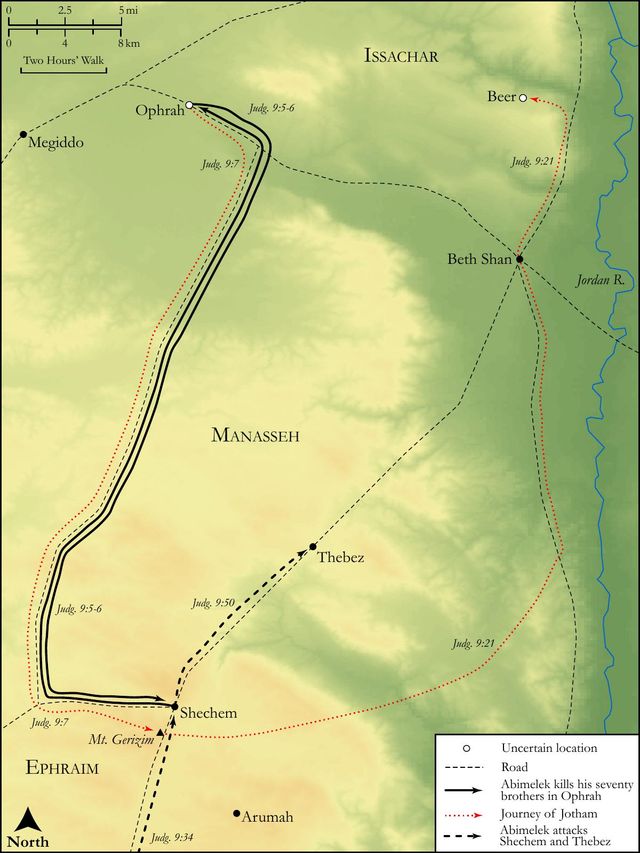
Judges 9:55 stands near the close of the Abimelech narrative, which began with his ruthless ambition to seize power. Following the death of his father, Gideon (Jerubbaal), Abimelech murdered seventy of his half-brothers on a single stone, leaving only Jotham, the youngest, alive, as recounted in Judges 9:5. Jotham then delivered a powerful and prophetic parable of the trees, warning the people of Shechem and Beth-millo that their alliance with Abimelech would lead to mutual destruction, as detailed in Judges 9:7-21. The subsequent chapters detail the escalating conflict between Abimelech and the people of Shechem, culminating in the siege of Thebez. Abimelech's death is particularly humiliating: he is mortally wounded by a millstone dropped by a woman from a tower, and to avoid the shame of dying by a woman's hand, he orders his armor-bearer to kill him, a scene vividly described in Judges 9:53-54. Verse 55 immediately follows this, demonstrating the complete and immediate collapse of his "kingdom" upon his demise.
Historical & Cultural Context
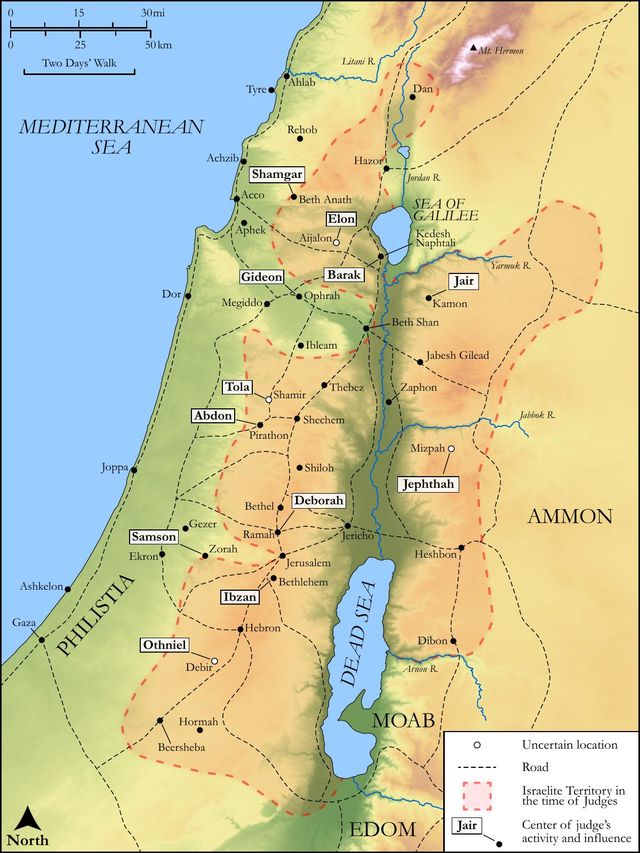
The book of Judges depicts a period in Israel's history characterized by a lack of central leadership, tribal disunity, and recurrent cycles of apostasy, oppression, repentance, and deliverance by divinely appointed judges. Abimelech's attempt to establish a monarchy in Shechem was an anomaly, a premature and illegitimate usurpation of power in a time when "there was no king in Israel," a phrase repeated to underscore the chaotic state of affairs in Judges 17:6 and Judges 21:25. His reign was not divinely sanctioned but rather a product of human ambition and the chaotic political landscape. The immediate dispersal of the "men of Israel" upon his death underscores the absence of a standing army, a unified national command structure, or a clear line of succession, which would have been present in a true kingdom. Instead, forces were typically assembled for specific military campaigns and disbanded once the objective was met, reflecting the tribal, decentralized nature of Israelite society at this time.
Key Themes
ShowHideJudges 9:55 powerfully contributes to several overarching themes within the book of Judges and the broader biblical narrative. Firstly, it exemplifies the theme of Divine Retribution and justice, as Abimelech's violent and treacherous actions, particularly the murder of his brothers, are met with a similarly violent and humiliating end, fulfilling Jotham's curse, as explicitly stated in Judges 9:56-57. Secondly, it highlights the Futility of Ungodly Power and ambition; a kingdom built on murder, deceit, and human will, rather than divine appointment, is inherently unstable and ultimately collapses upon itself. Abimelech's "reign" was a fleeting, destructive episode. Thirdly, the verse underscores the Decentralized and Fragmented State of Israel during the Judges period, emphasizing the absence of true, unified leadership and the prevailing reality that "every man did that which was right in his own eyes" (Judges 21:25), leading to cycles of chaos and a longing for a righteous king.
Exposition and Analysis
ShowHideKey Word Analysis
ShowHideThis phrase, combining H376 and H3478, refers to the collective Israelite fighting force that had gathered to oppose Abimelech. It is significant because it implies a temporary, ad-hoc assembly of tribal contingents rather than a unified national army under a central command. Their immediate departure upon Abimelech's death reveals the lack of a broader national purpose or sustained military structure beyond the specific conflict at hand, reinforcing the decentralized nature of Israel during this era, where each "man" (H376) from the people of "Israel" (H3478) acted according to immediate circumstances.
The verb "departed" (H3212) signifies a swift and decisive action. There was no deliberation, no succession planning, no further military objective. As soon as the threat (Abimelech) was neutralized, the forces disbanded. This immediacy emphasizes the provisional nature of their assembly and the lack of any enduring political or military cohesion under Abimelech's attempted rule, highlighting a simple "going away" or "walking" back to their former state.
This simple phrase (H4725) is profoundly telling. It indicates a return to individual homes, families, and tribal territories. It signifies a reversion to the status quo ante, a decentralized existence where loyalty was primarily to one's clan or tribe rather than a national entity. The absence of a central authority or a unified national vision meant that once the immediate crisis was over, people simply returned to their local "spot" or "locality," highlighting the persistent disunity and the longing for true, God-ordained leadership that would eventually be fulfilled in the monarchy.
Verse Breakdown
ShowHide"And when the men of Israel saw that Abimelech was dead"
This opening clause establishes the immediate cause and effect. The "men of Israel" refers to the forces that had been engaged in the siege against Abimelech or had been drawn into the conflict. Their perception of Abimelech's death is the catalyst for the subsequent action. It implies that their primary objective in being assembled was tied directly to Abimelech's existence and the threat he posed. Once he was gone, their purpose was fulfilled.
"they departed every man unto his place"
This second clause describes the direct consequence of Abimelech's demise. The phrase "every man unto his place" emphasizes the complete and immediate dispersal of the forces. There was no consolidation of power, no new leader appointed, no continuation of the "kingdom" Abimelech had tried to establish. Instead, the temporary coalition dissolved, and individuals returned to their homes and tribal lands, underscoring the lack of a unified national structure and the fleeting, illegitimate nature of Abimelech's rule.
Literary Devices
ShowHideThe brevity and abruptness of Judges 9:55 serve as a powerful literary device, mirroring the swift and inglorious end of Abimelech's reign. The verse employs Conciseness to deliver a profound message: a kingdom built on violence and human ambition, without divine sanction, is inherently unstable and crumbles instantly upon the removal of its unrighteous leader. There is a strong sense of Irony in Abimelech's death; he, who murdered seventy brothers to gain power, is ultimately defeated by a woman and then by his own armor-bearer, dying a humiliating death that nullifies his grand ambitions. The immediate dispersal of his forces, described in this verse, stands in stark Contrast to the unified and lasting kingdoms established by God-appointed leaders. The phrase "every man unto his place" also functions as a Metonymy for the return to the decentralized, tribal structure of Israel, emphasizing the absence of a true, divinely ordained national authority.
Theological and Thematic Connections
ShowHideJudges 9:55 stands as a profound theological statement on divine justice and the futility of human ambition apart from God's will. Abimelech's violent end and the immediate collapse of his self-proclaimed kingdom are presented as the direct fulfillment of Jotham's curse and God's retribution for his heinous crimes, particularly the murder of his brothers. This verse underscores the biblical principle that those who sow violence and discord will ultimately reap destruction, and that power gained through illegitimate means is inherently unstable and fleeting. It serves as a stark reminder that true and lasting authority originates from God, and any attempt to establish a kingdom based on human will and unrighteousness is doomed to fail. The immediate dispersal of the "men of Israel" highlights the persistent need for righteous, God-ordained leadership, a theme that resonates throughout the book of Judges and anticipates the eventual establishment of a divinely chosen monarchy in Israel.
Reflection and Application
ShowHideJudges 9:55 offers a powerful and enduring lesson for believers today. Abimelech's story is a cautionary tale against the dangers of unbridled ambition, the pursuit of power through unrighteous means, and the tragic consequences of self-serving leadership. His ignominious end and the immediate dissolution of his "kingdom" remind us that true authority and lasting peace do not come from human machinations or violence, but from alignment with God's will and principles. For us, this means examining our own motives for influence or leadership, ensuring they are rooted in service and humility rather than self-glory or control. It also encourages us to discern carefully the leaders we follow, both secular and spiritual, seeking those who exemplify righteousness and integrity, rather than those who build their platforms on deceit or manipulation. Ultimately, the verse points to the transient nature of all earthly kingdoms not founded on God's truth, prompting us to invest our lives in the eternal kingdom of God, which alone will never depart or be dissolved.
Questions for Reflection
ShowHideFAQ
ShowHideWhy did the men of Israel immediately disperse after Abimelech's death?
ShowHideThe immediate dispersal of the "men of Israel" highlights the provisional and decentralized nature of the forces assembled during the period of the Judges. Unlike a standing army of a unified kingdom, these were likely tribal contingents or local militias gathered for a specific purpose: to deal with Abimelech and the conflict he instigated. Once Abimelech, the source of the immediate conflict, was dead, their objective was fulfilled. There was no central government, no unified national leadership, and no established successor to Abimelech to whom they owed allegiance or from whom they would receive further orders. This reflects the reality described elsewhere in Judges, where "there was no king in Israel" (Judges 17:6) and people often acted independently, returning to their own tribal spheres once a crisis was resolved, as also noted in Judges 21:25.
Christ-Centered Fulfillment
ShowHideJudges 9:55, with its depiction of Abimelech's swift and ignominious end and the immediate collapse of his self-proclaimed kingdom, serves as a powerful negative type, foreshadowing the ultimate triumph of the true King, Jesus Christ. Abimelech, a self-appointed ruler whose reign was built on murder and deceit, saw his power dissolve into nothingness upon his death, leaving behind only chaos and fragmentation. This stands in stark contrast to the eternal and righteous reign of Jesus, the Son of David, whose kingdom is "an everlasting kingdom" (Daniel 7:27) that "shall never be destroyed" (Daniel 2:44). While the "men of Israel" departed "every man unto his place" after Abimelech's death, signifying disunity and a return to fragmented tribal life, Christ's death and resurrection did not lead to the dissolution of His followers but rather to the formation of a unified body, the Church, gathered from "every tribe and language and people and nation" (Revelation 5:9), bound together by His Spirit. Abimelech's reign brought only destruction and division; Christ's reign brings reconciliation, peace, and eternal life, gathering all who believe into His unshakable kingdom, where He is truly "King of kings and Lord of lords" (Revelation 19:16).