


Judges 4:21
Bible text: King James Version (1769 Blayney text) · Public domain
Bible text: King James Version with Strong's numbers · Public domain
Bible text: Berean Standard Bible · Public domain
Bible text: American Standard Version (1901) · Public domain
Bible text: World English Bible, Messianic edition · Public domain
Bible text: Geneva Bible (1599) · Public domain
Bible text: Young's Literal Translation · Public domain
- וַתִּקַּחva·ti·Kachand she tookH3947Conj-w ¦ V-Qal-ConsecImperf-3fsVerb Qal Consecutive Imperfect 3rd Singular Feminineוַandתִּקַּחshe took
- יָעֵלya·'ElJaelH3278N-proper-fNoun Proper Feminine
- אֵשֶׁת'e·shet[the] wife ofH802N-fscNoun Singular Feminine Construct
- חֶבֶרChe·verHeberH2268N-proper-mNoun Proper Masculine
- אֶת'et<obj.>H853DirObjMParticle Object Indicator
- יְתַדye·Tad[the] peg ofH3489N-fscNoun Singular Feminine Construct
- הָאֹהֶלha·'O·helthe tentH168Art ¦ N-msNoun Singular Masculine Absoluteהָtheאֹהֶלtent
- וַתָּשֶׂםva·Ta·semand she putH7760Conj-w ¦ V-Qal-ConsecImperf-3fsVerb Qal Consecutive Imperfect 3rd Singular Feminineוַandתָּשֶׂםshe put
- אֶת'et<obj.>H853DirObjMParticle Object Indicator
- הַמַּקֶּבֶתha·ma·Ke·vetthe hammerH4718Art ¦ N-fsNoun Singular Feminine Absoluteהַtheמַּקֶּבֶתhammer
- בְּיָדָהּbe·ya·Dahin her handH3027Prep-b ¦ N-csc ¦ 3fsNoun Singular common gender Constructבְּinיָדָhandהּher
- וַתָּבוֹאva·ta·Vo'and she wentH935Conj-w ¦ V-Qal-ConsecImperf-3fsVerb Qal Consecutive Imperfect 3rd Singular Feminineוַandתָּבוֹאshe went
- אֵלָיו'e·Lavto himH413Prep ¦ 3msPreposition Definiteאֵלָיtoוhim
- בַּלָּאטba·Latin <the> secrecyH3814Prep-b ¦ N-msNoun Singular Masculine Absoluteבַּin <the>לָּאטsecrecy
- וַתִּתְקַעva·tit·Ka'and she droveH8628Conj-w ¦ V-Qal-ConsecImperf-3fsVerb Qal Consecutive Imperfect 3rd Singular Feminineוַandתִּתְקַעshe drove
- אֶת'et<obj.>H853DirObjMParticle Object Indicator
- הַיָּתֵדhai·ya·Tedthe pegH3489Art ¦ N-fsNoun Singular Feminine Absoluteהַtheיָּתֵדpeg
- בְּרַקָּתוֹbe·ra·ka·Toin his templeH7541Prep-b ¦ N-fsc ¦ 3msNoun Singular Feminine Constructבְּinרַקָּתtempleוֹhis
- וַתִּצְנַחva·titz·Nachand it went downH6795Conj-w ¦ V-Qal-ConsecImperf-3fsVerb Qal Consecutive Imperfect 3rd Singular Feminineוַandתִּצְנַחit went down
- בָּאָרֶץba·'A·retzin the groundH776Prep-b ¦ N-fsNoun Singular Feminine Absoluteבָּin theאָרֶץground
- וְהוּאve·hu'and heH1931Conj-w ¦ Pro-3msPronoun Personal 3rd Singular Masculineוְandהוּאhe
- נִרְדָּםnir·Dam[was] sleepingH7290V-Niphal-Prtcpl-msVerb Niphal Participle Singular Masculine Absolute
- וַיָּעַףvai·Ya·'afand he was wearyH5888Conj-w ¦ V-Qal-ConsecImperf-3msVerb Qal Consecutive Imperfect 3rd Singular Masculineוַandיָּעַףhe was weary
- וַיָּמֹתvai·ya·Motand he diedH4191Conj-w ¦ V-Qal-ConsecImperf-3msVerb Qal Consecutive Imperfect 3rd Singular Masculineוַandיָּמֹתhe died
English is a literal word-by-word gloss of the Hebrew, not the KJV's wording. Why?
This is the original text the KJV's translators worked from — each Hebrew word with its own literal English meaning in this verse, prepared by scholars at Tyndale House, Cambridge. The KJV translates whole sentences, not word by word, so its wording differs: one Hebrew word can become several English words, and the KJV may choose “the LORD” where the gloss reads “Yahweh”. Both are faithful — they answer different questions. For the KJV's own rendering, switch to the KJV text.
Details
See on the biblical-era maps
Study this verse
Public-domain commentary
Matthew Henry
From his Commentary on the Whole Bible. Henry comments on passages, not single verses — this entry covers Judges 4:17–24. His four-level outline is real structure in the source text, so it is rendered as structure.
We have seen the army of the Canaanites totally routed. It is said (Psa 83:9, Psa 83:10, where the defeat of this army is pleaded as a precedent for God's doing the like in after times) that they became as dung for the earth. Now here we have,
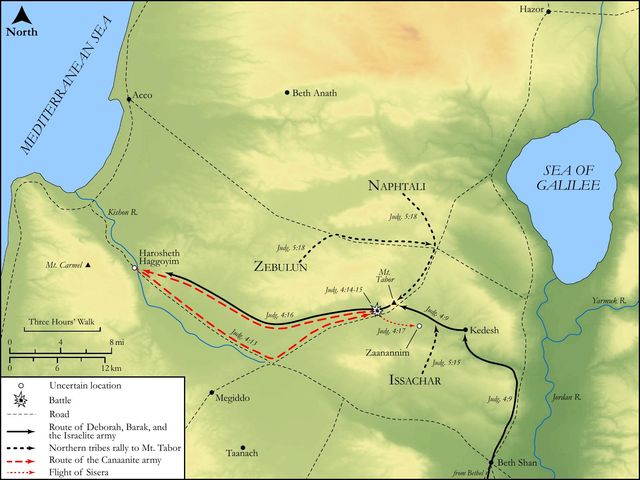
I.The fall of their general, Sisera, captain of the host, in whom, it is likely, Jabin their king put an entire confidence, and therefore was not himself present in the action. Let us trace the steps of this mighty man's fall.
1.He quitted his chariot, and took to his feet, Jdg 4:15, Jdg 4:17. His chariots had been his pride and his confidence; and we may suppose he had therefore despised and defied the armies of the living God, because they were all on foot, and had neither chariot nor horse, as he had. Justly therefore is he thus made ashamed of his confidence, and forced to quit it, and thinks himself then most safe and easy when he has got clear of his chariot, though we may well suppose it the best made, and best drawn, of any of them. Thus are those disappointed who rest on the creature; like a broken reed, it not only breaks under them, but runs into their hand, and pierceth them with many sorrows. The idol may quickly become a burden (Isa 46:1), and what we were sick for God can make us sick of. How miserable doth Sisera look now he is dismounted! It is hard to say whether he blusheth or trembleth more. Put not your trust in princes, if they may so soon be brought to this, if he who but lately trusted to his arms with so much assurance must now trust to his heels only with so little.
2.He fled for shelter to the tents of the Kenites, having no strong-hold, nor any place of is own in reach to retire to. The mean and solitary way of the Kenites' living, perhaps, he had formerly despised and ridiculed, and the more because religion was kept up among them; yet now he is glad to put himself under the protection of one of these tents: and he chooses the wife's tent or apartment, either because less suspected, or because it happened to be next to him, and the first he came to, Jdg 4:17. And that which encouraged him to go thither was that at this time there was peace between his master and the house of Heber: not that there was any league offensive and defensive between them, only at present there were no indications of hostility. Jabin did them no harm, did not oppress them as he did the Israelites, their plain, quiet, harmless way of living making them not suspected nor feared, and perhaps God so ordering it as a recompence for their constant adherence to the true religion. Sisera thought he might therefore be safe among them; not considering that, though they themselves suffered not by Jabin's power, they heartily sympathized with the Israel of God that did.
3.Jael invited him in, and bade him very welcome. Probably she stood at the tent door, to enquire what news from the army, and what the success of the battle which was fought not far off.
(1.)She invited him in. Perhaps she stood waiting for an opportunity to show kindness to any distressed Israelite, if there should be occasion for it; but seeing Sisera come in great haste, panting and out of breath, she invited him to come and repose himself in her tent, in which, while she seemed to design the relieving of his fatigue, perhaps she really intended the retarding of his flight, that he might fall into the hands of Barak, who was not in a hot chase after him (Jdg 4:18), and it may well questioned whether she had at first any thought of taking away his life, but rather God afterwards put it into her heart.
(2.)She made very much of him, and seemed mighty careful to have him easy, as her invited guest. Was he weary? she finds him a very convenient place to repose himself in, and recruit his strength. Was he thirsty? well he might. Did he want a little water to cool his tongue? the best liquor her tent afforded was at his service, and that was milk (Jdg 4:19), which, we may suppose, he drank heartily of, and, being refreshed with it, was the better disposed to sleep. Was he cold, or afraid of catching cold? or did he desire to be hid from the pursuers, if they should search that tent? she covered him with a mantle, Jdg 4:18. All expressions of care for his safety. Only when he desired her to tell a lie for him, and to say he was not there, she declined making any such promise, Jdg 4:20. We must not sin against God, no, not to oblige those we would show ourselves most observant of. Lastly, We must suppose she kept her tent as quiet as she could, and free from noise, that he might sleep the sooner and the faster. And now was Sisera least safe when he was most secure. How uncertain and precarious is human life! and what assurance can we have of it, when it may so easily be betrayed by those with whom it is trusted, and those may prove its destroyers who we hoped would be its protectors! It is best making God our friend, for he will not deceive us.
4.When he lay fast asleep she drove a long nail through his temples, so fastened his head to the ground, and killed him, Jdg 4:21. And, though this was enough to do the business, yet, to make sure work (if we translate it rightly, Jdg 5:26), she cut off his head, and left it nailed there. Whether she designed this or no when she invited him into her tent does not appear; probably the thought was darted into her mind when she saw him lie so conveniently to receive such a fatal blow; and, doubtless, the thought brought with it evidence sufficient that it came not from Satan as a murderer and destroyer, but from God as a righteous judge and avenger, so much of brightness and heavenly light did she perceive in the inducements to it that offered themselves, the honour of God and the deliverance of Israel, and nothing of the blackness of malice, hatred, or personal revenge.
(1.)It was a divine power that enabled her to do it, and inspired her with a more than manly courage. What if her hand should shake, and she should miss her blow? What if he should awake when she was attempting it? Or suppose some of his own attendants should follow him, and surprise her in the face, how dearly would she and all hers be made to pay for it? Yet, obtaining help of God, she did it effectually.
(2.)It was a divine warrant that justified her in the doing of it; and therefore, since no such extraordinary commissions can now be pretended, it ought not in any case to be imitated. The laws of friendship and hospitality must be religiously observed, and we must abhor the thought of betraying any whom we have invited and encouraged to put a confidence in us. And, as to this act of Jael (like that of Ehud in the chapter before), we have reason to think she was conscious of such a divine impulse upon her spirit to do it as did abundantly satisfy herself (and it ought therefore to satisfy us) that it was well done. God's judgments are a great deep. The instrument of this execution was a nail of the tent, that is, one of the great pins with which the tent, or the stakes of it, were fastened. They often removing their tents, she had been used to drive these nails, and therefore knew how to do it the more dexterously on this great occasion. he that thought to destroy Israel with his many iron chariots is himself destroyed with one iron nail. Thus do the weak things of the world confound the mighty. See here Jael's glory and Sisera's shame. The great commander dies,
[1.]In his sleep, fast asleep, and weary. It comes in as a reason why he stirred not, to make resistance. So fettered was he in the chains of sleep that he could not find his hands. Thus the stout-hearted are spoiled at thy rebuke, O God of Jacob! they are cast into a dead sleep, and so are made to sleep their last, Psa 76:5, Psa 76:6. Let not the strong man then glory in his strength; for when he sleeps where is it? It is weak, and he can do nothing; a child may insult him then, and steal his life from him; and yet if he sleep not he is soon spent and weary, and can do nothing either. Those words which we here put in a parenthesis (for he was weary) all the ancient versions read otherwise: he struggled (or started, as we say) and died, so the Syriac and Arabic, Exagitans ses mortuus est. He fainted and died, so the lxx. Consocians morte soporem, so the vulgar Latin, joining sleep and death together, seeing they are so near akin. He fainted and died. He dies,
[2.]With his head nailed to the ground, an emblem of his earthly-mindedness. O curve in terram animoe! His ear (says bishop Hall) was fastened close to the earth, as if his body had been listening what had become of his soul. He dies,
[3.]By the hand of a woman. This added to the shame of his death before men; and had he but known it, as Abimelech (Jdg 9:54), we may well imagine how much it would have added to the vexation of his own heart.
II.The glory and joy of Israel hereupon.
1.Barak their leader finds his enemy dead, (Jdg 4:22), and no doubt, he was very well pleased to find his work done so well to his hand, and so much to the glory of God and the confusion of his enemies. had he stood too nicely upon a point of honour, he would have resented it as an affront to have the general slain by any hand but his; but now he remembered that this diminution of his honour he was sentenced to undergo, for insisting upon Deborah's going with him (the Lord shall sell Sisera into the hand of a woman), though then it was little thought that the prediction would be fulfilled in such a way as this.
2.Israel is completely delivered out of the hands of Jabin king of Canaan, Jdg 4:23, Jdg 4:24. They not only shook off his yoke by this day's victory, but they afterwards prosecuted the war against him, till they had destroyed him, he and his nation being by the divine appointment devoted to ruin and not to be spared. The Israelites, having soundly smarted for their foolish pity in not doing it before, resolved now it is in their power to indulge them no longer, but to make a thorough riddance of them, as a people to whom to show mercy was as contrary to their own interest as it was to God's command; and probably it is with an eye to the sentence they were under that this enemy is named three times here in these last two verses, and called king of Canaan; for as such he was to be destroyed; and so thoroughly was he destroyed that I do not remember to read of the kings of Canaan any more after this. The children of Israel would have prevented a great deal of mischief if they had sooner destroyed these Canaanites, as God had both commanded and enabled them; but better be wise late, and buy wisdom by experience, than never wise.
Historical interpretation
Two Centuries of Reception
3 surviving comments on this verse. Each one is dated, so this reads as a timeline rather than a list.
Select a marker to jump to its quote. Markers stagger vertically where authors wrote within a few decades of each other.
What, therefore, does the web of all this mystical history show us? The woman Jael, that foreigner about whom Deborah's prophecy said that victory would be had "through the hand of a woman," symbolizes the church, which was assembled from foreign nations. But Jael's name means "ascent," for truly there is no route whereby one may ascend into heaven except "through the church of the manifold wisdom of God." She, therefore, while ascending from the corporeal to the spiritual and from the earthly to the heavenly, killed Sisera, who, as we have already said above, symbolizes the man of carnal or animal vices, for Sisera's name means "vision of a horse," concerning which Scripture teaches: "Do not become like horses and mules, in which there is no understanding." She killed him with a stake, then, which is to say that she overthrew him by the power and cunning of the wood of the cross. Nor is it without reason that the stake is described as having pierced his jaws, for that mouth which spoke of carnal things and that doctrine which preferred the glory of the flesh, deceiving and persuading the human race, by secular wisdom and by the idolatry of comfort, to live for selfish delights and pleasure, that very mouth, I say, is pierced and penetrated by the wood of the cross, in as much as the "broad and easy way" of pleasure which is preached by philosophy has been exposed by Christ, who showed that the "way of our salvation is narrow and difficult." [Thus], Jael the church sent Sisera the king of vices to his everlasting sleep covered with skins, that is, lulled to sleep by the mortification of his members.
So, then, Deborah foretold the event of the battle. Barak, as he was bidden, led forth the army; Jael carried off the triumph, for the prophecy of Deborah fought for her, who in a mystery revealed to us the rising of the church from among the Gentiles, for whom should be found a triumph over Sisera, that is, over the powers opposed to her. For us, then, the oracles of the prophets fought, for us those judgments and arms of the prophets won the victory. And for this reason it was not the people of the Jews but Jael who gained the victory over the enemy. Unhappy, then, was that people which could not follow up by the virtue of faith the enemy, whom it had put to flight. And so by their fault salvation came to the Gentiles; by Jewish sluggishness the victory was reserved for us.Jael then destroyed Sisera, whom however the band of Jewish veterans had put to flight under their brilliant leader, for this is the interpretation of the name of Barak; for often, as we read, the sayings and merits of the prophets procured heavenly aid for the fathers. But even at that time was victory being prepared over spiritual wickedness for those to whom it is said in the Gospel: “Come, you who are blessed of my Father, take possession of the kingdom prepared for you from the foundation of the world.” So the commencement of the victory was from the fathers, its conclusion is in the church.
But the church does not overcome the powers of the enemy with weapons of this world but with spiritual arms, “which are mighty through God to the destruction of strongholds and the high places of spiritual wickedness.” And Sisera’s thirst was quenched with a bowl of milk, because he was overcome by wisdom, for what is healthful for us as food is deadly and weakening to the power of the enemy. The weapons of the church are faith, the weapons of the church are prayer, which overcomes the enemy.
And so according to this history a woman, that the minds of women might be stirred up, became a judge, a woman set all in order, a woman prophesied, a woman triumphed, and joining in the battle array taught men to war under a woman’s lead. But in a mystery it is the battle of faith and the victory of the church.
We read that when God wished it clearly understood that great deeds were done by him, they were done through a few or through the lowliest, lest the work of his heavenly hand be attributed to human strength. In this way the leader Sisera, before whom the Hebrew army trembled, was laid low by a woman.
Continue studying Judges 4:21 across the web’s major study libraries — every link below opens this exact verse, chapter, or book on the destination site.
Read & Compare
 BibleGatewayThis verse in more than 200 translations and 70 languages.
 Bible.comThe YouVersion reader — hundreds of translations, reading plans, and highlights.
 ESV.orgCrossway's official English Standard Version reader.
 NET BibleThe NET translation with 60,000+ translators' notes on every rendering decision.
 STEP BibleTyndale House's free study tool — original text, vocabulary, and scholarly resources.
 BibliaLogos Bible Software's free web reader.
 USCCBThe New American Bible (Revised Edition) with the U.S. bishops' study notes.
Commentaries
 BibleHub CommentariesDozens of classic commentaries on this verse, gathered on one page.
 StudyLightMore than 100 commentary sets — the largest collection on the web.
 BibleRefPlain-English commentary on what this verse means, verse by verse.
 Enduring WordDavid Guzik's free commentary on this chapter, widely used by Bible teachers.
 Bible Study ToolsVerse commentary alongside Greek and Hebrew study aids.
Original Language & Research
- BibleHub InterlinearThe verse word by word — original language, transliteration, and English.
- BibleHub LexiconEvery word's original-language definition and Strong's entry.
 Blue Letter BibleDeep-study tools — Strong's numbers, concordance, and word studies.
 SefariaThe Hebrew text with Rashi and centuries of Jewish commentary.
Sermons, Hymns & Audio


TrulyRandomVerse is not affiliated with these sites and doesn’t control their content. They’re linked because they’re genuinely useful.
Summary
Judges 4:21 vividly recounts the dramatic and decisive moment of Sisera's death, where Jael, the wife of Heber the Kenite, executes the formidable Canaanite general. After his army's devastating defeat by Barak and Deborah, Sisera sought refuge and hospitality in Jael's tent, only to be met with a fatal blow from a tent peg driven into his temples while he lay in a deep, exhausted sleep. This act, both brutal and divinely orchestrated, marks the pivotal end of Canaanite oppression and powerfully signifies God's unconventional deliverance for the nation of Israel.
Context
ShowHideLiterary Context
Judges 4:21 serves as the climactic and decisive resolution of the narrative arc introduced at the beginning of Judges 4. The preceding verses meticulously detail Israel's severe oppression under King Jabin of Hazor and his formidable commander Sisera, Deborah's prophetic call to Barak, and the miraculous, divinely-aided victory of Israel's forces at the Wadi Kishon. Sisera's desperate flight from the battlefield and his ill-fated decision to seek refuge in Jael's tent are chronicled in Judges 4:17-20. This verse directly and powerfully fulfills Deborah's prophecy in Judges 4:9 that Sisera would ultimately be delivered into the hand of a woman, underscoring God's precise control over historical events and His use of unexpected agents. Following this pivotal verse, the narrative seamlessly transitions into the triumphant Song of Deborah and Barak in Judges 5, which resoundingly celebrates Jael's valor and the complete deliverance of Israel from Canaanite tyranny.
Historical & Cultural Context
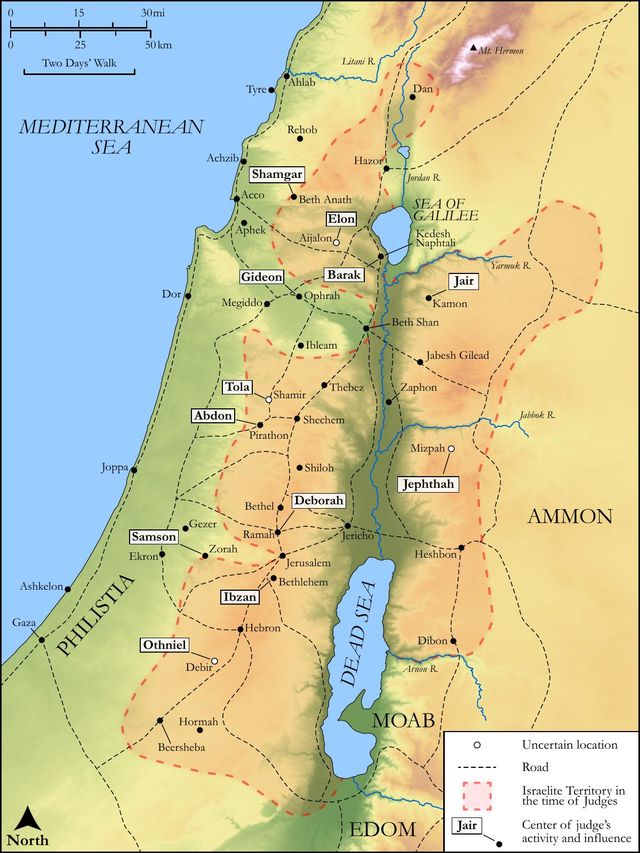
The period of the Judges (roughly 12th-11th century BCE) was characterized by a decentralized Israelite confederacy, frequent cycles of foreign oppression, Israel's apostasy, and subsequent divine deliverance through charismatic leaders. King Jabin of Hazor represented a significant Canaanite power, notorious for his formidable military strength, particularly his nine hundred iron chariots, as noted in Judges 4:3. The Kenites, to whom Jael's husband Heber belonged, were a nomadic, metal-working tribe often allied with Israel, tracing their lineage back to Moses's father-in-law. However, Heber had established a separate peace treaty with King Jabin (Judges 4:11), making Jael's act an even greater betrayal from Sisera's perspective. Hospitality was a sacred and binding custom in that day, offering inviolable protection to a guest. Jael's initial offer of water (or milk, as per Judges 5:25) and a blanket would have been perceived by Sisera as a solemn pledge of safety. Her subsequent action, while a profound violation of this social norm, is presented within the biblical narrative as a divinely sanctioned act of war and liberation, given the context of Sisera's role as a cruel oppressor of God's covenant people. Tent pegs were ubiquitous, sturdy tools for nomadic life, typically made of wood or metal, and essential for securing tents against the elements.
Key Themes
ShowHideThis verse powerfully illustrates several overarching themes central to the book of Judges and broader biblical theology. It highlights Divine Sovereignty and Unconventional Deliverance, demonstrating God's remarkable ability to use the most unexpected instruments—a woman and a domestic tool—to achieve His redemptive purposes, rather than relying solely on traditional military might. This direct fulfillment of prophecy in Judges 4:9 profoundly affirms God's foreknowledge and meticulous control over all events. The theme of Justice Against Oppression is undeniably central, as Sisera's death marks the definitive and dramatic end of a twenty-year period of severe Canaanite subjugation of Israel, as detailed in Judges 4:3. Furthermore, Jael's actions powerfully embody Unconventional Heroism, fulfilling Deborah's word (4:9) and showcasing that God empowers individuals from all walks of life—regardless of their social standing or conventional capabilities—to participate significantly in His unfolding redemptive plan, a theme also powerfully exemplified by Deborah herself.
Exposition and Analysis
ShowHideKey Word Analysis
ShowHideThis word, derived from a root meaning "to pin through or fast," refers to a "peg" or "stake," specifically a tent peg. It signifies a sturdy, pointed implement used to secure nomadic tents by driving it into the ground. While the KJV's "nail" might suggest a smaller object, the context of a tent and the use of a hammer clarify its substantial nature, highlighting its surprising effectiveness as a weapon in Jael's hands.
This primitive root means "to clatter," "to slap," "to clang," and by extension, "to drive" (a nail or tent-pin), "to strike," or "to thrust." In this context, it denotes a forceful, decisive, and deliberate action. It conveys the immense impact and finality of Jael's blow, emphasizing the power, precision, and unwavering resolve with which she delivered the fatal stroke.
This feminine noun, derived from a root meaning "thinness," refers specifically to the soft, vulnerable part of the head on either side, situated between the eye and the forehead. It is a highly sensitive and critical area, making a blow to this region instantly fatal. The specificity of this target underscores Jael's lethal intent and the immediate, incontrovertible efficacy of her action.
Verse Breakdown
ShowHide"Then Jael Heber's wife took a nail of the tent, and took an hammer in her hand"
This clause meticulously sets the scene for Jael's decisive and unexpected action. It emphasizes her deliberate preparation and the intentional choice of her instruments—a common tent peg and a hammer—highlighting the profoundly domestic and unconventional nature of the tools used to defeat a mighty general. This immediate establishment of the tools creates a powerful sense of irony and foreshadows the surprising outcome.
"and went softly unto him, and smote the nail into his temples, and fastened it into the ground"
This describes Jael's stealthy approach and the precise, fatal execution of her plan. "Went softly" (Hebrew lâʼṭ, meaning "muffled" or "silently") indicates her cunning and the element of surprise, taking full advantage of Sisera's deep sleep and false sense of security. The act itself is graphic and direct: the tent peg is driven not merely into his head, but specifically into his vulnerable temples, and then, with overwhelming force, through him and into the ground, pinning him inextricably, ensuring his immediate death and preventing any struggle or escape.
"for he was fast asleep and weary. So he died."
This final clause provides the crucial explanation for Sisera's utter vulnerability and confirms the immediate, definitive outcome. His profound exhaustion from battle and flight, combined with the false sense of security offered by Jael's deceptive hospitality, rendered him completely defenseless. The concise, stark declaration "So he died" provides a stark and definitive conclusion to the life of Israel's oppressor, marking the abrupt and absolute end of his reign of terror.
Literary Devices
ShowHideJudges 4:21 is profoundly rich in literary devices that amplify its dramatic impact and theological significance. The most prominent device is Irony, as the formidable Sisera, commander of nine hundred iron chariots and a symbol of military might, is ultimately defeated not by a mighty warrior like Barak, but by a woman using humble, domestic tools—a tent peg and a hammer. He sought refuge in a tent, a place of supposed safety and hospitality, only to find his brutal demise there. This also creates a powerful Contrast between Sisera's overwhelming military might and Jael's seemingly insignificant tools, powerfully highlighting God's ability to use the weak and unexpected to confound the strong and mighty. The narrative employs Vivid Imagery, painting a clear, visceral, and unforgettable picture of Jael's precise and brutal act, which contributes significantly to the verse's lasting impact and memorability. Furthermore, the verse serves as the direct Fulfillment of Prophecy, echoing Deborah's specific words in Judges 4:9, thereby reinforcing the overarching theme of divine sovereignty and meticulous foreknowledge.
Theological and Thematic Connections
ShowHideJudges 4:21 stands as a powerful testament to God's sovereign hand in history, demonstrating His profound capacity to use unexpected means and seemingly insignificant individuals to bring about His purposes of deliverance and justice for His people. Jael's act, while undeniably violent and culturally transgressive, is unambiguously celebrated within the biblical narrative as a righteous deed, fitting into the larger pattern of God raising up unconventional deliverers for Israel in times of severe oppression. It profoundly underscores that God's strength is made perfect in human weakness, and His divine plans are often executed through those whom society might deem inconsequential or incapable. This dramatic event serves as a stark reminder of the inevitable consequences of opposing God's people and His unwavering divine judgment against those who oppress them. It also powerfully highlights the theme of God delivering Israel by the hand of a woman, as Deborah had foretold, "the LORD shall sell Sisera into the hand of a woman" (4:9), to fulfill His redemptive will and bring about His justice.
Reflection and Application
ShowHideJudges 4:21 profoundly challenges our conventional notions of heroism, power, and the instruments God chooses to use, inviting us to consider how the Almighty often works in the most unexpected and unconventional ways. It serves as a potent reminder that our perceived weaknesses, ordinary circumstances, or societal limitations do not, in any way, disqualify us from being powerful instruments in God's mighty hands. Jael, a woman in a deeply patriarchal society, used a common household tool to achieve a strategic victory that a mighty army could not fully secure on its own. This narrative powerfully encourages believers today to look beyond their own perceived limitations and societal expectations, recognizing that God can and does empower anyone, regardless of their background, gender, social standing, or apparent capabilities, to contribute significantly and decisively to His kingdom purposes. It calls us to be acutely attentive to divine opportunities, even when they present themselves in unconventional, challenging, or even seemingly mundane forms, and to trust implicitly that God's wisdom and strength far surpass all human understanding and might.
Questions for Reflection
ShowHideFAQ
ShowHideWas Jael's act morally justifiable, given the rules of hospitality in that day?
ShowHideFrom a purely human and cultural perspective, Jael's act was indeed a profound violation of the sacred custom of hospitality, which dictated inviolable protection for a guest, especially one who had sought refuge and accepted sustenance. However, within the overarching biblical narrative, Jael's action is presented as divinely sanctioned and unequivocally celebrated as a righteous act of deliverance for Israel. The triumphant Song of Deborah and Barak in Judges 5:24 explicitly praises her, declaring her "most blessed of women among tents." This indicates that her ultimate allegiance to God and His covenant people, in the context of a holy war against a cruel oppressor, superseded the conventional cultural norm of hospitality. The Bible frequently portrays God using unconventional, and at times seemingly harsh, means to execute justice against those who defiantly oppose Him and brutally oppress His covenant people, viewing Sisera's death as a necessary and divinely ordained act of liberation for Israel.
Christ-Centered Fulfillment
ShowHideThe dramatic and unexpected defeat of Sisera by Jael, using a humble tent peg, serves as a powerful foreshadowing of the ultimate and decisive victory of Christ over the powers of sin, death, and the devil. Just as Sisera, the formidable oppressor of God's people, was overcome by an unexpected agent and an ordinary, domestic tool, so too was humanity's greatest enemy, Satan, decisively defeated by the seemingly weak and scandalous means of the cross. The prophecy that Sisera would fall by the hand of a woman (Judges 4:9) resonates deeply with the protoevangelium in Genesis 3:15, where God declares that the "seed of the woman" would crush the serpent's head. Christ, born of a woman (Galatians 4:4), is the ultimate and perfect fulfiller of this ancient promise, dealing a fatal and irreversible blow to the power of evil and death. His victory, achieved not through conventional military might or earthly power, but through sacrificial love, obedient suffering, and resurrection power, utterly disarmed the spiritual principalities and powers, triumphing over them by the cross (Colossians 2:15). Jael's act, while violent and specific to its historical context of temporal deliverance, points forward to a far greater spiritual deliverance where the "strong man" (Satan) is bound and his kingdom plundered by the true Son of David (Mark 3:27), who brings eternal freedom and salvation.