


Judges 4:23
Bible text: King James Version (1769 Blayney text) · Public domain
Bible text: Berean Standard Bible · Public domain
Bible text: American Standard Version (1901) · Public domain
Bible text: World English Bible, Messianic edition · Public domain
Bible text: Geneva Bible (1599) · Public domain
Bible text: Young's Literal Translation · Public domain
- וַיַּכְנַעvai·yakh·Na'and he subduedH3665Conj-w ¦ V-Hiphil-ConsecImperf-3msVerb Hiphil Consecutive Imperfect 3rd Singular Masculineוַandיַּכְנַעhe subdued
- אֱלֹהִים'E·lo·HimGodH430N-mpNoun Plural Masculine Absolute
- בַּיּוֹםbai·Yomon the dayH3117Prep-b ¦ N-msNoun Singular Masculine Absoluteבַּon theיּוֹםday
- הַהוּאha·Hu'<the> thatH1931Art ¦ Pro-3msPronoun Personal 3rd Singular Masculineהַ<the>הוּאthat
- אֵת'et<obj.>H853DirObjMParticle Object Indicator
- יָבִיןya·VinJabinH2985N-proper-mNoun Proper Masculine
- מֶלֶךְMe·lekh[the] king ofH4428N-mscNoun Singular Masculine Construct
- כְּנָעַןke·Na·'anCanaanH3667N-properNoun Proper Location
- לִפְנֵיlif·Nei<to> beforeH6440Prep-l ¦ N-mpcNoun Plural Masculine Constructלִ<to>פְנֵיbefore
- בְּנֵיbe·Nei[the] people ofH1121N-mpcNoun Plural Masculine Construct
- יִשְׂרָאֵלYis·ra·'ElIsraelH3478N-properNoun Proper Location
English is a literal word-by-word gloss of the Hebrew, not the KJV's wording. Why?
This is the original text the KJV's translators worked from — each Hebrew word with its own literal English meaning in this verse, prepared by scholars at Tyndale House, Cambridge. The KJV translates whole sentences, not word by word, so its wording differs: one Hebrew word can become several English words, and the KJV may choose “the LORD” where the gloss reads “Yahweh”. Both are faithful — they answer different questions. For the KJV's own rendering, switch to the KJV text.
Details
See on the biblical-era maps
Study this verse
Public-domain commentary
Matthew Henry
From his Commentary on the Whole Bible. Henry comments on passages, not single verses — this entry covers Judges 4:17–24. His four-level outline is real structure in the source text, so it is rendered as structure.
We have seen the army of the Canaanites totally routed. It is said (Psa 83:9, Psa 83:10, where the defeat of this army is pleaded as a precedent for God's doing the like in after times) that they became as dung for the earth. Now here we have,
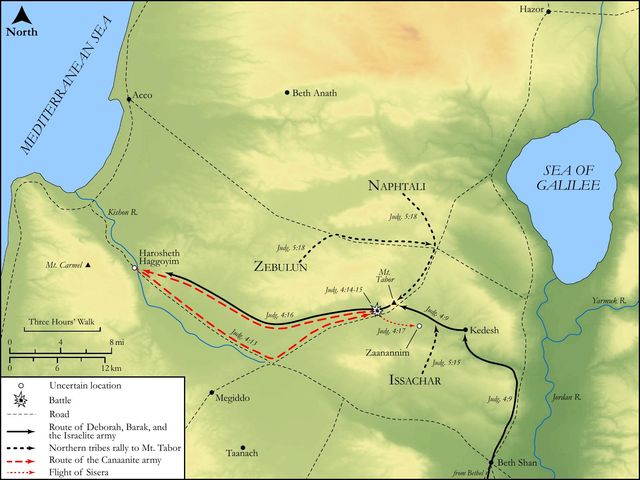
I.The fall of their general, Sisera, captain of the host, in whom, it is likely, Jabin their king put an entire confidence, and therefore was not himself present in the action. Let us trace the steps of this mighty man's fall.
1.He quitted his chariot, and took to his feet, Jdg 4:15, Jdg 4:17. His chariots had been his pride and his confidence; and we may suppose he had therefore despised and defied the armies of the living God, because they were all on foot, and had neither chariot nor horse, as he had. Justly therefore is he thus made ashamed of his confidence, and forced to quit it, and thinks himself then most safe and easy when he has got clear of his chariot, though we may well suppose it the best made, and best drawn, of any of them. Thus are those disappointed who rest on the creature; like a broken reed, it not only breaks under them, but runs into their hand, and pierceth them with many sorrows. The idol may quickly become a burden (Isa 46:1), and what we were sick for God can make us sick of. How miserable doth Sisera look now he is dismounted! It is hard to say whether he blusheth or trembleth more. Put not your trust in princes, if they may so soon be brought to this, if he who but lately trusted to his arms with so much assurance must now trust to his heels only with so little.
2.He fled for shelter to the tents of the Kenites, having no strong-hold, nor any place of is own in reach to retire to. The mean and solitary way of the Kenites' living, perhaps, he had formerly despised and ridiculed, and the more because religion was kept up among them; yet now he is glad to put himself under the protection of one of these tents: and he chooses the wife's tent or apartment, either because less suspected, or because it happened to be next to him, and the first he came to, Jdg 4:17. And that which encouraged him to go thither was that at this time there was peace between his master and the house of Heber: not that there was any league offensive and defensive between them, only at present there were no indications of hostility. Jabin did them no harm, did not oppress them as he did the Israelites, their plain, quiet, harmless way of living making them not suspected nor feared, and perhaps God so ordering it as a recompence for their constant adherence to the true religion. Sisera thought he might therefore be safe among them; not considering that, though they themselves suffered not by Jabin's power, they heartily sympathized with the Israel of God that did.
3.Jael invited him in, and bade him very welcome. Probably she stood at the tent door, to enquire what news from the army, and what the success of the battle which was fought not far off.
(1.)She invited him in. Perhaps she stood waiting for an opportunity to show kindness to any distressed Israelite, if there should be occasion for it; but seeing Sisera come in great haste, panting and out of breath, she invited him to come and repose himself in her tent, in which, while she seemed to design the relieving of his fatigue, perhaps she really intended the retarding of his flight, that he might fall into the hands of Barak, who was not in a hot chase after him (Jdg 4:18), and it may well questioned whether she had at first any thought of taking away his life, but rather God afterwards put it into her heart.
(2.)She made very much of him, and seemed mighty careful to have him easy, as her invited guest. Was he weary? she finds him a very convenient place to repose himself in, and recruit his strength. Was he thirsty? well he might. Did he want a little water to cool his tongue? the best liquor her tent afforded was at his service, and that was milk (Jdg 4:19), which, we may suppose, he drank heartily of, and, being refreshed with it, was the better disposed to sleep. Was he cold, or afraid of catching cold? or did he desire to be hid from the pursuers, if they should search that tent? she covered him with a mantle, Jdg 4:18. All expressions of care for his safety. Only when he desired her to tell a lie for him, and to say he was not there, she declined making any such promise, Jdg 4:20. We must not sin against God, no, not to oblige those we would show ourselves most observant of. Lastly, We must suppose she kept her tent as quiet as she could, and free from noise, that he might sleep the sooner and the faster. And now was Sisera least safe when he was most secure. How uncertain and precarious is human life! and what assurance can we have of it, when it may so easily be betrayed by those with whom it is trusted, and those may prove its destroyers who we hoped would be its protectors! It is best making God our friend, for he will not deceive us.
4.When he lay fast asleep she drove a long nail through his temples, so fastened his head to the ground, and killed him, Jdg 4:21. And, though this was enough to do the business, yet, to make sure work (if we translate it rightly, Jdg 5:26), she cut off his head, and left it nailed there. Whether she designed this or no when she invited him into her tent does not appear; probably the thought was darted into her mind when she saw him lie so conveniently to receive such a fatal blow; and, doubtless, the thought brought with it evidence sufficient that it came not from Satan as a murderer and destroyer, but from God as a righteous judge and avenger, so much of brightness and heavenly light did she perceive in the inducements to it that offered themselves, the honour of God and the deliverance of Israel, and nothing of the blackness of malice, hatred, or personal revenge.
(1.)It was a divine power that enabled her to do it, and inspired her with a more than manly courage. What if her hand should shake, and she should miss her blow? What if he should awake when she was attempting it? Or suppose some of his own attendants should follow him, and surprise her in the face, how dearly would she and all hers be made to pay for it? Yet, obtaining help of God, she did it effectually.
(2.)It was a divine warrant that justified her in the doing of it; and therefore, since no such extraordinary commissions can now be pretended, it ought not in any case to be imitated. The laws of friendship and hospitality must be religiously observed, and we must abhor the thought of betraying any whom we have invited and encouraged to put a confidence in us. And, as to this act of Jael (like that of Ehud in the chapter before), we have reason to think she was conscious of such a divine impulse upon her spirit to do it as did abundantly satisfy herself (and it ought therefore to satisfy us) that it was well done. God's judgments are a great deep. The instrument of this execution was a nail of the tent, that is, one of the great pins with which the tent, or the stakes of it, were fastened. They often removing their tents, she had been used to drive these nails, and therefore knew how to do it the more dexterously on this great occasion. he that thought to destroy Israel with his many iron chariots is himself destroyed with one iron nail. Thus do the weak things of the world confound the mighty. See here Jael's glory and Sisera's shame. The great commander dies,
[1.]In his sleep, fast asleep, and weary. It comes in as a reason why he stirred not, to make resistance. So fettered was he in the chains of sleep that he could not find his hands. Thus the stout-hearted are spoiled at thy rebuke, O God of Jacob! they are cast into a dead sleep, and so are made to sleep their last, Psa 76:5, Psa 76:6. Let not the strong man then glory in his strength; for when he sleeps where is it? It is weak, and he can do nothing; a child may insult him then, and steal his life from him; and yet if he sleep not he is soon spent and weary, and can do nothing either. Those words which we here put in a parenthesis (for he was weary) all the ancient versions read otherwise: he struggled (or started, as we say) and died, so the Syriac and Arabic, Exagitans ses mortuus est. He fainted and died, so the lxx. Consocians morte soporem, so the vulgar Latin, joining sleep and death together, seeing they are so near akin. He fainted and died. He dies,
[2.]With his head nailed to the ground, an emblem of his earthly-mindedness. O curve in terram animoe! His ear (says bishop Hall) was fastened close to the earth, as if his body had been listening what had become of his soul. He dies,
[3.]By the hand of a woman. This added to the shame of his death before men; and had he but known it, as Abimelech (Jdg 9:54), we may well imagine how much it would have added to the vexation of his own heart.
II.The glory and joy of Israel hereupon.
1.Barak their leader finds his enemy dead, (Jdg 4:22), and no doubt, he was very well pleased to find his work done so well to his hand, and so much to the glory of God and the confusion of his enemies. had he stood too nicely upon a point of honour, he would have resented it as an affront to have the general slain by any hand but his; but now he remembered that this diminution of his honour he was sentenced to undergo, for insisting upon Deborah's going with him (the Lord shall sell Sisera into the hand of a woman), though then it was little thought that the prediction would be fulfilled in such a way as this.
2.Israel is completely delivered out of the hands of Jabin king of Canaan, Jdg 4:23, Jdg 4:24. They not only shook off his yoke by this day's victory, but they afterwards prosecuted the war against him, till they had destroyed him, he and his nation being by the divine appointment devoted to ruin and not to be spared. The Israelites, having soundly smarted for their foolish pity in not doing it before, resolved now it is in their power to indulge them no longer, but to make a thorough riddance of them, as a people to whom to show mercy was as contrary to their own interest as it was to God's command; and probably it is with an eye to the sentence they were under that this enemy is named three times here in these last two verses, and called king of Canaan; for as such he was to be destroyed; and so thoroughly was he destroyed that I do not remember to read of the kings of Canaan any more after this. The children of Israel would have prevented a great deal of mischief if they had sooner destroyed these Canaanites, as God had both commanded and enabled them; but better be wise late, and buy wisdom by experience, than never wise.
Continue studying Judges 4:23 across the web’s major study libraries — every link below opens this exact verse, chapter, or book on the destination site.
Read & Compare
 BibleGatewayThis verse in more than 200 translations and 70 languages.
 Bible.comThe YouVersion reader — hundreds of translations, reading plans, and highlights.
 ESV.orgCrossway's official English Standard Version reader.
 NET BibleThe NET translation with 60,000+ translators' notes on every rendering decision.
 STEP BibleTyndale House's free study tool — original text, vocabulary, and scholarly resources.
 BibliaLogos Bible Software's free web reader.
 USCCBThe New American Bible (Revised Edition) with the U.S. bishops' study notes.
Commentaries
 BibleHub CommentariesDozens of classic commentaries on this verse, gathered on one page.
 StudyLightMore than 100 commentary sets — the largest collection on the web.
 BibleRefPlain-English commentary on what this verse means, verse by verse.
 Enduring WordDavid Guzik's free commentary on this chapter, widely used by Bible teachers.
 Bible Study ToolsVerse commentary alongside Greek and Hebrew study aids.
Original Language & Research
- BibleHub InterlinearThe verse word by word — original language, transliteration, and English.
- BibleHub LexiconEvery word's original-language definition and Strong's entry.
 Blue Letter BibleDeep-study tools — Strong's numbers, concordance, and word studies.
 SefariaThe Hebrew text with Rashi and centuries of Jewish commentary.
Sermons, Hymns & Audio


TrulyRandomVerse is not affiliated with these sites and doesn’t control their content. They’re linked because they’re genuinely useful.
Summary
Judges 4:23 stands as a profound theological declaration, succinctly summarizing the divine culmination of Israel's deliverance from the oppressive hand of Jabin, King of Canaan. This verse powerfully asserts that the ultimate victory was not a mere human triumph, but a direct, sovereign act of God, who decisively humbled and brought low a formidable enemy before His covenant people, thereby restoring peace and demonstrating His unwavering faithfulness.
Context
ShowHideLiterary Context
Judges 4:23 serves as the climactic and theological capstone to the dramatic narrative of Deborah and Barak's victory over Jabin, King of Hazor, and his formidable general, Sisera. The preceding verses meticulously detail the twenty years of severe oppression Israel endured under Jabin, whose military might, particularly his "900 chariots of iron," struck fear into the hearts of the Israelites, prompting their desperate cry to the Lord, as recounted in Judges 4:1-3. The narrative then introduces Deborah, a unique figure as both a prophetess and a judge, who, under divine inspiration, commissions Barak to lead the Israelite forces, prophesying that the ultimate glory of Sisera's defeat would fall to a woman (Judges 4:4-9). The ensuing battle is depicted as a miraculous divine intervention, where "the Lord routed Sisera and all his chariots and all his host" (Judges 4:15), leading to Sisera's ignominious flight and his subsequent death at the hands of Jael, a Kenite woman, in a tent (Judges 4:16-22). Thus, verse 23 transcends the immediate battlefield victory over Sisera, shifting the focus to the comprehensive divine subjugation of Jabin himself, the true source of Israel's long-standing oppression, thereby bringing the entire episode to its divinely ordained and conclusive end.
Historical & Cultural Context
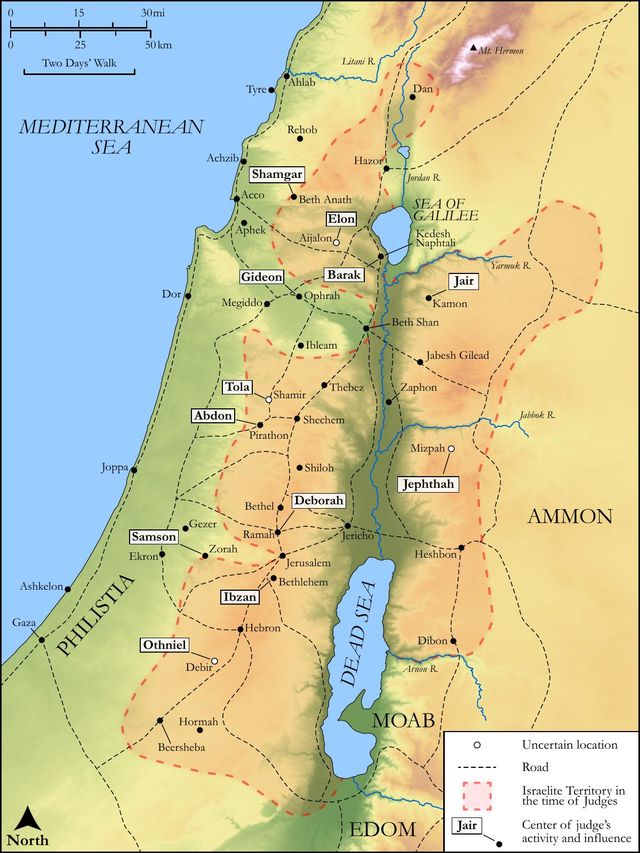
The period of the Judges, roughly spanning from 1200 to 1000 BC, was a tumultuous era for Israel, marked by their cyclical disobedience, subsequent oppression by surrounding nations, and divine deliverance through divinely appointed "judges." Jabin, King of Hazor, was not merely a local chieftain but represented a significant regional power. Hazor, located in the northern Levant, was one of the largest and most influential city-states in Canaan, strategically positioned and historically formidable. Archaeological excavations at Hazor have indeed uncovered evidence of its immense size and a major destruction layer, which many scholars correlate with the biblical accounts of its defeat, either by Joshua (Joshua 11:1-15) or, as here, by Deborah and Barak, suggesting a possible re-emergence of Canaanite power. The mention of "900 chariots of iron" in Judges 4:3 is crucial; iron technology was advanced for the time, providing the Canaanites with a substantial military advantage over the Israelite forces, who were primarily infantry and lacked such sophisticated weaponry. The Kenites, Jael's tribe, were a nomadic people often maintaining peaceful relations or alliances with Israel, underscoring the complex network of relationships between Israel and the peoples of Canaan. Furthermore, the prominent roles of Deborah and Jael, two women in a patriarchal society, are culturally striking, emphasizing that God's instruments of deliverance often defy conventional expectations and societal norms.
Key Themes
ShowHideJudges 4:23 powerfully encapsulates and reinforces several foundational themes woven throughout the book of Judges and the broader biblical narrative. Central to this verse is the theme of Divine Sovereignty and Intervention, explicitly stating "God subdued," which unequivocally attributes the victory and deliverance to the Lord's direct and decisive action, rather than human strength or military prowess. This aligns with the recurring pattern in Judges, where Israel's cries of distress, born from their repentance, are met by God's raising up of a deliverer, demonstrating His Faithfulness to His Covenant despite Israel's persistent spiritual apostasy and subsequent oppression (Judges 2:16-19). The comprehensive defeat of Jabin also powerfully illustrates Divine Justice Against Oppression, as God acts to vindicate His people and bring down those who unjustly afflict them, a principle echoed in many Old Testament passages such as Psalm 9:9-10. Moreover, the entire narrative leading to this verse highlights God's profound willingness to Use Unexpected Instruments—a prophetess (Deborah) and a tent-dwelling woman (Jael)—to accomplish His purposes, thereby challenging conventional notions of power, leadership, and military might, and underscoring that His ways are often above human understanding.
Exposition and Analysis
ShowHideKey Word Analysis
ShowHideThis term (H430) is the plural form of ʾĕlôah, commonly used in the Old Testament to refer to the one true God of Israel. Its immediate placement at the beginning of the clause, "So God subdued," is highly significant. It establishes the divine agent as the sole and ultimate source of the victory, emphasizing that this was not merely a human triumph facilitated by divine blessing, but a direct, sovereign, and omnipotent act of God. This underscores His active involvement in the affairs of His people and the nations, asserting His supreme authority over all earthly powers.
The verb kānaʿ (H3665) is a primitive root meaning "to bend the knee," and by extension, "to humiliate," "to vanquish," "to bring down (low)," or "to bring into subjection." Its use here denotes a comprehensive and decisive subjugation, implying that Jabin was not merely defeated in battle but utterly broken in spirit and authority. This word choice highlights the thoroughness of God's victory, signifying a complete and irreversible conquest of Jabin's oppressive power, demonstrating God's ability to humble the proud and mighty.
Verse Breakdown
ShowHide"So God subdued on that day"
This opening phrase unequivocally identifies the divine agent as the primary actor. The conjunction "So" (וַיַּכְנַע - wayyaknaʿ) links this conclusive statement to the preceding narrative, indicating that the entire sequence of events, culminating in Sisera's death, was part of God's overarching plan to bring Jabin low. "On that day" refers to the day of the great battle and Sisera's defeat, emphasizing the immediacy and divine timing of this powerful act of subjugation, underscoring that God's deliverance is both timely and decisive.
"Jabin the king of Canaan"
This clause precisely identifies the chief oppressor and the ultimate target of God's subduing power. While Sisera was the general and the immediate military threat, Jabin was the sovereign ruler of Hazor, representing the entrenched Canaanite power that had cruelly oppressed Israel for two decades. God's subduing of Jabin signifies the breaking of the entire oppressive rule and the dismantling of the source of Israel's long-suffering, not merely the defeat of one military leader.
"before the children of Israel"
This concluding phrase highlights the beneficiaries and witnesses of God's mighty act. The victory was not only achieved for Israel but was publicly displayed before them. This served as a powerful, tangible demonstration of God's faithfulness to His covenant, His immense power, and His unwavering commitment to His people. It would have instilled a profound sense of awe and fear in their enemies, while simultaneously renewing faith, hope, and courage among the Israelites, reminding them that their God actively fights for them and delivers them from their oppressors.
Literary Devices
ShowHideJudges 4:23 primarily employs Divine Action as its central literary device, directly attributing the comprehensive subduing of Jabin to God ("So God subdued"). This emphatic statement underscores God's direct involvement and supreme sovereignty over human affairs and military outcomes, shifting the focus from the human agents like Deborah and Barak to the ultimate divine orchestrator of the victory. The verse also functions as a powerful Climax and Resolution for the narrative arc of Jabin's oppression, providing a definitive and conclusive end to the conflict and a clear declaration of Israel's deliverance. Furthermore, it utilizes Conciseness to deliver a profound theological truth in a brief, impactful statement, summarizing the entire preceding account with a powerful declaration of divine triumph. The phrase "before the children of Israel" serves as a form of Witnessing, highlighting that this act was a public manifestation of God's power, intended for His people to observe, remember, and find renewed faith in His protective hand.
Theological and Thematic Connections
ShowHideJudges 4:23 stands as a monumental testament to God's unwavering sovereignty and His active, decisive intervention in human history. It underscores the profound theological truth that ultimate victory and deliverance belong unequivocally to the Lord, not to human strength, military might, or strategic genius. This verse serves as a powerful reminder that even in the face of overwhelming oppression and technologically superior adversaries, God is supremely capable of bringing down the mightiest of kings and nations for the sake of His covenant people. It reinforces the theme of God as the divine warrior who fights on behalf of His chosen ones, fulfilling His promises, executing justice against those who defy Him, and liberating those who are oppressed. This divine intervention is a consistent thread throughout salvation history, demonstrating God's commitment to His people and His ultimate triumph over all forms of evil and tyranny.
Reflection and Application
ShowHideJudges 4:23 offers profound encouragement and a vital theological anchor for believers navigating the complexities and challenges of life. In a world where we often feel overwhelmed by powerful systems, oppressive circumstances, or seemingly insurmountable personal struggles, this verse reorients our perspective. It reminds us that our hope and ultimate deliverance do not rest on our own strength, ingenuity, or limited resources, but on the omnipotent, active power of God. Just as He decisively subdued Jabin, a formidable enemy equipped with iron chariots, He remains sovereign over every challenge we face, whether spiritual, emotional, relational, or circumstantial. This truth calls us to cultivate a deeper and more radical trust in His active involvement in our lives, to cry out to Him in times of distress, and to remember that He is the one who fights for us, capable of bringing low anything that stands against His righteous purposes. Our faith is not in our ability to overcome, but in His unfailing power to deliver, transform, and ultimately triumph.
Questions for Reflection
ShowHideFAQ
ShowHideWhat does "subdued" mean in this context, and why is it significant that God is the one doing the subduing?
ShowHideThe Hebrew word translated "subdued" is kānaʿ (כָּנַע), meaning "to humble," "to bring low," or "to bring into submission." In the context of Judges 4:23, it signifies a complete and decisive defeat, not merely of Jabin's army, but of his entire power and authority. It implies that Jabin was forced to yield and was utterly broken, his reign of terror brought to a definitive end. It is profoundly significant that "God" is explicitly named as the one who "subdued" Jabin. This emphasizes divine sovereignty and intervention as the true source of Israel's victory. While human agents like Deborah, Barak, and Jael played crucial roles in the unfolding narrative, the ultimate power and decisive action came from God alone. This highlights that the victory was not a result of Israel's military might or strategic brilliance, but a direct act of God's faithfulness to His covenant and His justice against their oppressor. It reinforces the theological principle that God is the ultimate deliverer and that His power transcends all human or material strength, even against enemies equipped with "900 chariots of iron" (Judges 4:3).
Christ-Centered Fulfillment
ShowHideJudges 4:23, with its powerful declaration of God subduing Jabin, profoundly foreshadows the ultimate and complete subjugation of all spiritual enemies by Jesus Christ. Just as God brought low a formidable earthly king who oppressed His people, so too has Christ, through His sacrificial death and glorious resurrection, triumphed decisively over the powers of sin, death, and the devil. The victory over Jabin was a temporal deliverance for Israel, securing their physical peace, but Christ's victory is an eternal deliverance for all who believe, freeing them from the spiritual oppression of the "prince of the power of the air" (Ephesians 2:2). The seemingly weak and vulnerable "Lamb of God" (John 1:29) on the cross paradoxically "disarmed the powers and authorities" (Colossians 2:15), leading them as captives in His triumphal procession. This ultimate subduing by Christ ensures that one day every knee will bow and every tongue confess that Jesus Christ is Lord (Philippians 2:10-11), fulfilling the promise of complete and everlasting victory over all forms of oppression, both physical and spiritual, and establishing His eternal reign.