


2 Samuel 21:3
Bible text: King James Version (1769 Blayney text) · Public domain
Bible text: King James Version with Strong's numbers · Public domain
Bible text: Berean Standard Bible · Public domain
Bible text: American Standard Version (1901) · Public domain
Bible text: World English Bible, Messianic edition · Public domain
Bible text: Geneva Bible (1599) · Public domain
Bible text: Young's Literal Translation · Public domain
- וַיֹּאמֶרvai·Yo·merand he saidH559Conj-w ¦ V-Qal-ConsecImperf-3msVerb Qal Consecutive Imperfect 3rd Singular Masculineוַandיֹּאמֶרhe said
- דָּוִדda·VidDavidH1732N-proper-mNoun Proper Masculine
- אֶל'eltoH413PrepPreposition
- הַגִּבְעֹנִיםha·giv·'o·Nimthe GibeonitesH1393Art ¦ N-mpNoun Gentilic Plural Masculine AbsoluteהַtheגִּבְעֹנִיםGibeonites
- מָהmahwhat?H4100InterrogPronoun Interrogative
- אֶעֱשֶׂה'e·'e·Sehwill I doH6213V-Qal-Imperf-1csVerb Qal Imperfect 1st Singular common gender
- לָכֶםla·Khemfor <the> youPrep-l ¦ 2mpSuffix Personal 2nd Plural Masculineלָfor <the>כֶםyou
- וּבַמָּהu·va·Mahand <in> how?H4100Conj-w ¦ Prep-b ¦ InterrogPronoun Interrogativeוּandבַ<in>מָּהhow?
- אֲכַפֵּר'a·kha·Perwill I make amendsH3722V-Piel-Imperf-1csVerb Piel Imperfect 1st Singular common gender
- וּבָרְכוּu·va·re·Khuand blessH1288Conj-w ¦ V-Piel-Imp-2mpVerb Piel Imperative 2nd Plural Masculineוּandבָרְכוּbless
- אֶת'et<obj.>H853DirObjMParticle Object Indicator
- נַחֲלַתna·cha·Lat[the] inheritance ofH5159N-fscNoun Singular Feminine Construct
- יְהוָהYah·wehYahwehH3068N-properNoun Proper Title
English is a literal word-by-word gloss of the Hebrew, not the KJV's wording. Why?
This is the original text the KJV's translators worked from — each Hebrew word with its own literal English meaning in this verse, prepared by scholars at Tyndale House, Cambridge. The KJV translates whole sentences, not word by word, so its wording differs: one Hebrew word can become several English words, and the KJV may choose “the LORD” where the gloss reads “Yahweh”. Both are faithful — they answer different questions. For the KJV's own rendering, switch to the KJV text.
Details
See on the biblical-era maps
Study this verse
Public-domain commentary
Matthew Henry
From his Commentary on the Whole Bible. Henry comments on passages, not single verses — this entry covers 2 Samuel 21:1–9. His four-level outline is real structure in the source text, so it is rendered as structure.
Here I. Were are told of the injury which Saul had, long before this, done to the Gibeonites, which we had no account of in the history of his reign, nor should we have heard of it here but that it came now to be reckoned for. The Gibeonites were of the remnant of the Amorites (Sa2 21:2), who by a stratagem had made peace with Israel, and had the public faith pledged to them by Joshua for their safety. We had the story Jos. 9, where it was agreed (v. 23) that they should have their lives secured, but be deprived of their lands and liberties, that they and theirs should be tenants in villanage to Israel. It does not appear that they had broken their part of the covenant, either by denying their service or attempting to recover their lands or liberties; nor was this pretended; but Saul, under colour of zeal for the honour of Israel, that it might not be said that they had any of the natives among them, aimed to root them out, and, in order to that, slew many of them. Thus he would seem wiser than his predecessors the judges, and more zealous for the public interest; and perhaps he designed it for an instance of his royal prerogative and the power which as king he assumed to rescind the former acts of government and to disannul the most solemn leagues. It may be, he designed, by this severity towards the Gibeonites, to atone for his clemency towards the Amalekites. Some conjecture that he sought to cut off the Gibeonites at the same time when he put away the witches (Sa1 28:3), or perhaps many of them were remarkably pious, and he sought to destroy them when he slew the priests their masters. That which made this an exceedingly sinful sin was that he not only shed innocent blood, but therein violated the solemn oath by which the nation was bound to protect them. See what brought ruin on Saul's house: it was a bloody house.
II.We find the nation of Israel chastised with a sore famine, long after, for this sin of Saul. Observe,
1.Even in the land of Israel, that fruitful land, and in the reign of David, that glorious reign, there was a famine, not extreme (for then notice would sooner have been taken of it and enquiry made into the cause of it), but great drought, and scarcity of provisions, the consequence of it, for three years together. If corn miss one year, commonly the next makes up the deficiency; but, if it miss three years successively, it will be a sore judgment; and the man of wisdom will by it hear God's voice crying to the country to repent of the abuse of plenty.
2.David enquired of God concerning it. Though he was himself a prophet, he must consult the oracle, and know God's mind in his own appointed way. Note, When we are under God's judgments we ought to enquire into the grounds of the controversy. Lord, show me wherefore thou contendest with me. It is strange that David did not sooner consult the oracle, not till the third year; but perhaps, till then, he apprehended it not to be an extraordinary judgment for some particular sin. Even good men are often slack and remiss in doing their duty. We continue in ignorance, and under mistake, because we delay to enquire.
3.God was ready in his answer, though David was slow in his enquiries: It is for Saul. Note, God's judgments often look a great way back, which obliges us to do so when we are under his rebukes. It is not for us to object against the people's smarting for the sin of their king (perhaps they were aiding and abetting), nor against this generation's suffering for the sin of the last God often visiteth the sins of the fathers upon the children, and his judgments are a great deep. He gives not account of any of his matters. Time does not wear out the guilt of sin; nor can we build hopes of impunity upon the delay of judgments. There is no statute of limitation to be pleaded against God's demands. Nullum tempus occurrit Deo - God may punish when he pleases.
III.We have vengeance taken upon the house of Saul for the turning away of God's wrath from the land, which, at present, smarted for his sin.
1.David, probably by divine direction, referred it to the Gibeonites themselves to prescribe what satisfaction should be given them for the wrong that had been done them, Sa2 21:3. They had many years remained silent, had not appealed to David, nor given the kingdom any disturbance with their complaints or demands; and now, at length, God speaks for them (I heard not, for thou wilt hear, Psa 38:14, Psa 38:15); and they are recompensed for their patience with this honour, that they are made judges in their own case, and have a blank given them to write their demands on: What you shall say, that will I do (Sa2 21:4), that atonement may be made, and that you may bless the inheritance of the Lord, Sa2 21:3. It is sad for any family or nation to have the prayers of oppressed innocency against them, and therefore the expense of a just restitution is well bestowed for the retrieving of the blessing of those that were ready to perish, Job 29:13. "My servant Job, whom you have wronged, shall pray for you," says God, "and then I will be reconciled to you, and not till then." Those understand not themselves that value not the prayers of the poor and despised.
2.They desired that seven of Saul's posterity might be put to death, and David granted their demand.
(1.)They required no silver, nor gold, Sa2 21:4. Note, Money is no satisfaction for blood, see Num 35:31-33. It is the ancient law that blood calls for blood (Gen 9:6); and those over-value money and under-value life, that sell the blood of their relations for corruptible things, such as silver and gold. The Gibeonites had now a fair opportunity to get a discharge from their servitude, in compensation for the wrong done them, according to the equity of that law (Exo 21:26), If a man strike out his servant's eye, he shall let him go free for his eye's sake. But they did not insist on this; though the covenant was broken on the other side, it should not be broken on theirs. They were Nethinim, given to God and his people Israel, and they would not seem weary of the service.
(2.)They required no lives but of Saul's family. He had done them the wrong, and therefore his children must pay for it. We sue the heirs for the parents' debts. Men may not extend this principle so far as life, Deu 24:16. The children in an ordinary course of law, shall never be put to death for the parents. But this case of the Gibeonites was altogether extraordinary. God had made himself an immediate party to the cause and no doubt put it into the heart of the Gibeonites to make this demand, for he owned what was done (Sa2 21:14), and his judgments are not subject to the rules which men's judgments must be subject to. Let parents take heed of sin, especially the sin of cruelty and oppression, for their poor children's sake, who may be smarting for it by the just hand of God when they themselves are in their graves. Guilt and a curse are a bad entail upon a family. It should seem, Saul's posterity trod in his steps, for it is called a bloody house; it was the spirit of the family, and therefore they are justly reckoned with for his sin, as well as for their own.
(3.)They would not impose it upon David to do this execution: Thou shalt not for us kill any man (Sa2 21:4), but we will do it ourselves, we will hang them up unto the Lord (Sa2 21:6), that if there were any hardship in it, they might bear the blame, and not David or his house. By our old law, if a murderer had judgment given against him upon an appeal, the relations that appealed had the executing of him.
(4.)They did not require this out of malice against Saul or his family (had they been revengeful, they would have moved it themselves long before), but out of love to the people of Israel, whom they saw plagued for the injury done to them: "We will hang them up unto the Lord (Sa2 21:6), to satisfy his justice, not to gratify any revenge of our own - for the good of the public, not for our own reputation." (5.) The nomination of the persons they left to David, who took care to secure Mephibosheth for Jonathan's sake, that, while he was avenging the breach of one oath, he might not himself break another (Sa2 21:7); but he delivered up two of Saul's sons whom he had by a concubine, and five of his grandsons, whom his daughter Merab bore to Adriel (Sa1 18:19), but his daughter Michal brought up, Sa2 21:8. Now Saul's treachery was punished, in giving Merab to Adriel, when he had promised her to David, with a design to provoke him. "It is a dangerous matter," says bishop Hall upon this, "to offer injury to any of God's faithful ones; if their meekness have easily remitted it, their God will not pass it over without a severe retribution, though it may be long first." (6.) The place, time, and manner, of their execution, all added to the solemnity of their being sacrificed to divine justice.
[1.]They were hanged up, as anathemas, under a peculiar mark of God's displeasure; for the law had said, He that is hanged is accursed of God, Deu 21:23; Gal 3:13. Christ being made a curse for us, and dying to satisfy for our sins and to turn away the wrath of God, became obedient to this ignominious death.
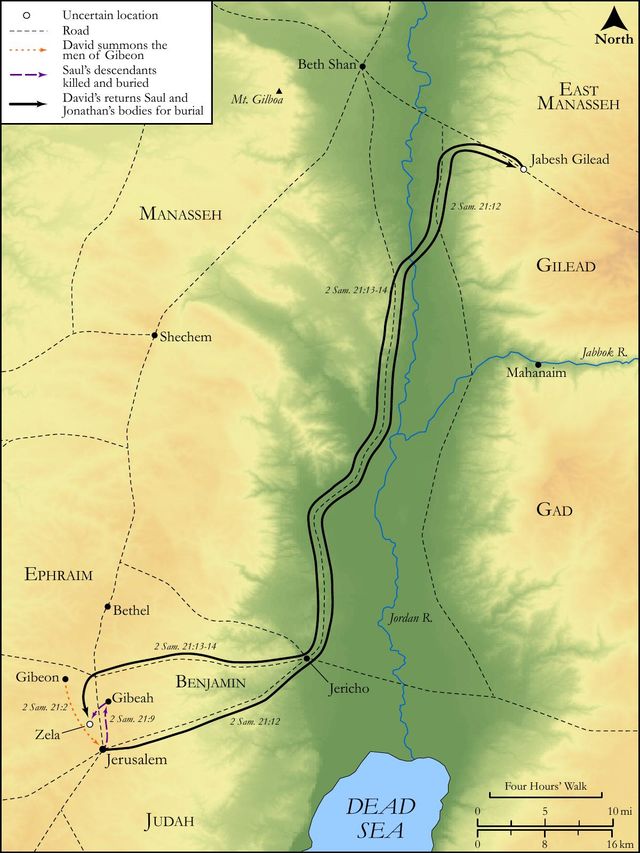
[2.]They were hanged up in Gibeah of Saul (Sa2 21:6), to show that it was for his sin that they died. They were hanged, as it were, before their own door, to expiate the guilt of the house of Saul; and thus God accomplished the ruin of that family, for the blood of the priests, and their families, which, doubtless, now came in remembrance before God, and inquisition was made for it, Psa 9:12. Yet the blood of the Gibeonites only is mentioned, because that was shed in violation of a sacred oath, which, though sworn long before, though obtained by a wile, and the promise made to Canaanites, yet is thus severely reckoned for. The despising of the oath, and breaking of the covenant, will be recompensed on the head of those who thus profane God's sacred name, Eze 17:18, Eze 17:19. And thus God would show that with him rich and poor meet together. Even royal blood must go to atone for the blood of the Gibeonites, who were but the vassals for the congregation.
[3.]They were put to death in the days of harvest (Sa2 21:9), at the beginning of harvest (Sa2 21:10), to show that they were thus sacrificed for the turning sway of that wrath of God which had withheld from them their harvest-mercies for some years past, and to obtain his favour in the present harvest. Thus there is no way of appeasing God's anger but by mortifying and crucifying our lusts and corruptions. In vain do we expect mercy from God, unless we do justice upon our sins. Those executions must not be complained of as cruel which have become necessary to the public welfare. Better that seven of Saul's bloody house be hanged than that all Israel be famished.
Historical interpretation
Historical reception
1 surviving comment on this verse from the historical church.
The Gibeonites met the children of Israel, and although other nations were slaughtered, they were kept for hewers of wood and drawers of water. And of such value were they in God’s eyes that the family of Saul was destroyed for the wrong done to them. Where would you put them? Among the goats? But they were not slain, and they were avenged by the determination of God. Among the sheep? But holy Scripture says they were not of the same merit as the Israelites. You see then that they do indeed stand on the right hand but are of a far inferior grade.
Continue studying 2 Samuel 21:3 across the web’s major study libraries — every link below opens this exact verse, chapter, or book on the destination site.
Read & Compare
 BibleGatewayThis verse in more than 200 translations and 70 languages.
 Bible.comThe YouVersion reader — hundreds of translations, reading plans, and highlights.
 ESV.orgCrossway's official English Standard Version reader.
 NET BibleThe NET translation with 60,000+ translators' notes on every rendering decision.
 STEP BibleTyndale House's free study tool — original text, vocabulary, and scholarly resources.
 BibliaLogos Bible Software's free web reader.
 USCCBThe New American Bible (Revised Edition) with the U.S. bishops' study notes.
Commentaries
 BibleHub CommentariesDozens of classic commentaries on this verse, gathered on one page.
 StudyLightMore than 100 commentary sets — the largest collection on the web.
 BibleRefPlain-English commentary on what this verse means, verse by verse.
 Enduring WordDavid Guzik's free commentary on this chapter, widely used by Bible teachers.
 Bible Study ToolsVerse commentary alongside Greek and Hebrew study aids.
Original Language & Research
- BibleHub InterlinearThe verse word by word — original language, transliteration, and English.
- BibleHub LexiconEvery word's original-language definition and Strong's entry.
 Blue Letter BibleDeep-study tools — Strong's numbers, concordance, and word studies.
 SefariaThe Hebrew text with Rashi and centuries of Jewish commentary.
Sermons, Hymns & Audio


TrulyRandomVerse is not affiliated with these sites and doesn’t control their content. They’re linked because they’re genuinely useful.
Summary
A devastating three-year famine afflicts Israel, prompting King David to seek divine counsel. The Lord reveals the calamity is a direct consequence of King Saul's past breach of covenant with the Gibeonites, involving the shedding of their innocent blood. In 2 Samuel 21:3, David confronts the Gibeonites, expressing his urgent desire to rectify this historical injustice and make "atonement" to restore God's blessing upon the nation. His pivotal question, "What shall I do for you? and wherewith shall I make the atonement, that ye may bless the inheritance of the LORD?", underscores his commitment to national reconciliation and the removal of divine judgment.
Context
ShowHideLiterary Context
This verse appears at the beginning of 2 Samuel 21, a section often considered an appendix to the main narrative of David's reign, focusing on various historical records and lists. The immediate preceding chapters conclude the account of Absalom's rebellion and David's restoration to the throne. The narrative opens abruptly with a severe three-year famine, prompting David to inquire of the Lord. The Lord's revelation in 2 Samuel 21:1 points directly to Saul's actions against the Gibeonites as the cause. David's question in 2 Samuel 21:3 is his direct response to this divine indictment, demonstrating his proactive leadership in seeking reconciliation and atonement for a national sin that predates his kingship.
Historical & Cultural Context
The Gibeonites were a Hivite people who, during the time of Joshua, had tricked Israel into a covenant of peace, recorded in Joshua 9. Despite the deception, this covenant was sworn before the Lord and thus considered sacred and binding by Israelite law and custom. King Saul, however, "in his zeal for the people of Israel and Judah" (2 Samuel 21:2), had violated this oath by attempting to exterminate them, shedding innocent blood. This act constituted a grave breach of covenant and a direct affront to God's faithfulness. In ancient Israelite thought, the shedding of innocent blood defiled the land (Numbers 35:33) and could bring corporate judgment, such as famine, upon the entire nation, even generations later. David's actions reflect the understanding that a king was responsible for the spiritual well-being and covenant fidelity of the nation.
Key Themes
ShowHideThis passage powerfully illustrates several profound theological and narrative themes. The consequences of sin are starkly displayed, showing that covenantal breaches and the shedding of innocent blood can have long-lasting, intergenerational repercussions, affecting an entire nation. It underscores the paramount importance of covenant faithfulness, highlighting God's unwavering commitment to His sworn oaths and His expectation that His people uphold theirs. David's proactive search for "atonement" demonstrates a vital theme of seeking reconciliation and justice, recognizing that national healing and the restoration of divine blessing require addressing past wrongs. Finally, the narrative reveals aspects of divine justice and mercy: God, in His justice, reveals the hidden cause of the famine, but in His mercy, He also provides a clear path for reconciliation and healing through David's inquiry and the subsequent actions, allowing for the restoration of blessing upon the land and its people, referred to as the "inheritance of the LORD."
Exposition and Analysis
ShowHideKey Word Analysis
ShowHideThe Hebrew verb כָּפַר (kâphar, H3722) carries a rich semantic range, meaning "to cover," "to purge," "to make expiation for," or "to make reconciliation." It is the same root used for the Day of Atonement (Yom Kippur), signifying a process of appeasement, purification, and reconciliation for sin or wrongdoing. David's use of this term indicates his understanding that a specific, divinely sanctioned act of reconciliation is required to "cover" or "purge" Saul's sin and remove the divine judgment manifest in the famine. It implies a need for a satisfaction of justice to restore a right relationship with God and the affected party.
The Hebrew verb בָּרַךְ (bârak, H1288) fundamentally means "to kneel," and by implication, "to bless." When God blesses man, it signifies a bestowal of benefit and favor. When man blesses God, it is an act of adoration and praise. In this context, the Gibeonites' "blessing" the inheritance of the LORD implies their lifting of the curse or grievance that their unavenged blood had brought upon the land. It signifies their forgiveness and the restoration of a harmonious relationship, which is a prerequisite for God's favor to return to Israel.
The Hebrew noun נַחֲלָה (nachălâh, H5159) refers to something inherited, an heirloom, or generally an estate or patrimony. When coupled with "of the LORD" (יְהוָה, Yᵉhôvâh, H3068), as in "the inheritance of the LORD," it refers to Israel itself—both the land God promised to His people and the people chosen by Him. It emphasizes God's proprietary claim over Israel, viewing them as His treasured possession and sacred trust. The famine, therefore, was not merely a natural disaster but a direct affliction upon God's own "inheritance," signifying a disruption of His blessing and presence among His people. David's concern for the "inheritance of the LORD" highlights his understanding that the national crisis was fundamentally a spiritual one, impacting God's relationship with His chosen nation.
Verse Breakdown
ShowHide"Wherefore David said unto the Gibeonites,"
This opening clause establishes David's immediate and direct engagement with the aggrieved party, the Gibeonites, following the Lord's revelation. It underscores his role as a righteous king who takes personal responsibility for national sin and seeks to mediate reconciliation. His approach is not one of command but of humble inquiry, acknowledging their rightful grievance and the weight of their suffering.
"What shall I do for you?"
This is a direct and open-ended question, demonstrating David's willingness to listen to the Gibeonites' demands for justice. It signifies a posture of humility and a recognition of their legitimate claim as victims of Saul's unjust aggression. David is not dictating terms but inviting their input on how the wrong can be righted, indicating a genuine desire for restitution that honors the wronged party.
"and wherewith shall I make the atonement,"
This part of David's question explicitly seeks the means or method by which expiation (as discussed in "Key Word Analysis") can be made. It reveals David's theological understanding that the famine is a consequence of unatoned sin and that a specific act of reconciliation is necessary to appease God's righteous anger and lift the curse. He is asking for a pathway to reconciliation that satisfies both the Gibeonites and, implicitly, God, acknowledging the need for a divinely acceptable remedy.
"that ye may bless the inheritance of the LORD?"
This final clause articulates David's ultimate objective: to restore God's blessing upon Israel, the "inheritance of the LORD." He understands that the Gibeonites' forgiveness and "blessing" (which here implies lifting their curse or grievance) are prerequisites for God's blessing to return to the land and its people. This highlights the interconnectedness of human justice, divine favor, and national well-being in the covenant relationship, emphasizing that the Gibeonites' reconciliation is key to Israel's restoration.
Literary Devices
ShowHideThe passage employs several potent literary devices to convey its profound message. Symbolism is evident in the three-year famine itself, which serves as a tangible manifestation of divine judgment and the defilement of the land due to unatoned bloodshed. The prolonged nature of the famine emphasizes the severity and deep-seated nature of the sin. There is also a strong element of Irony in Saul's actions: his "zeal for the people of Israel and Judah" (2 Samuel 21:2), intended to benefit Israel, ultimately brought divine wrath and suffering upon the very nation he sought to protect, highlighting the danger of zeal without covenant fidelity. Furthermore, David's question, "What shall I do for you? and wherewith shall I make the atonement?", functions as a Rhetorical Question that is genuinely seeking an answer, yet it also rhetorically emphasizes the gravity of the situation and David's desperate need for a solution to a problem that has plagued the nation.
Theological and Thematic Connections
ShowHideThe narrative of 2 Samuel 21:3 powerfully reinforces core theological principles concerning divine justice, corporate responsibility, and the necessity of atonement. It underscores that God takes covenant obligations with utmost seriousness, and their violation, especially through the shedding of innocent blood, carries severe, long-lasting consequences for the entire community. The famine serves as a divine indicator that a breach has occurred, demanding a specific act of reconciliation to restore the broken relationship between God, His people, and the aggrieved party. David's inquiry and subsequent actions demonstrate the biblical principle that true national healing and the restoration of God's blessing often require acknowledging past injustices, seeking forgiveness, and making appropriate restitution, even for sins committed by previous generations or leaders. This passage illustrates the deep connection between moral order, communal well-being, and divine favor, emphasizing that God's justice demands a response to unpunished wrongdoing for the land to be cleansed and blessed.
Reflection and Application
ShowHideThe account of David seeking atonement for Saul's sin against the Gibeonites provides profound lessons for contemporary believers and communities. It calls us to consider the enduring impact of injustice, even when it predates our direct involvement. Just as David took responsibility for a national sin committed by a previous leader, we are challenged to acknowledge and address pervasive injustices, historical wrongs, or unconfessed sins within our families, churches, or nations. True healing and restoration often begin with humble inquiry, a willingness to listen to the aggrieved, and a commitment to making things right, even when it is costly. This passage reminds us that God's blessing is intricately linked to justice and righteousness, and that repentance, reconciliation, and restitution are essential pathways to spiritual and communal flourishing. It encourages us to be proactive in seeking God's will when facing persistent challenges, trusting that His revelation will guide us toward actions that bring about genuine atonement and renewed blessing.
Questions for Reflection
ShowHideFAQ
ShowHideWhy did God punish Israel for Saul's sin years later?
ShowHideGod punished Israel for Saul's sin years later to demonstrate the seriousness of covenant breaking and the defilement caused by the shedding of innocent blood. In ancient Israelite understanding, national sins, especially those involving a breach of a divinely sworn covenant and unatoned bloodshed, could bring corporate judgment upon the entire community, even across generations. This was not merely a delayed reaction but a persistent consequence of an unresolved spiritual debt. The famine served as a divine indicator that the land was defiled and God's covenant faithfulness had been affronted, requiring a specific act of atonement to restore the nation's relationship with Him and lift the curse. This highlights the enduring nature of divine justice and the profound impact of leadership's actions on the entire people, underscoring that God's righteous character demands that justice be served for such grave transgressions.
What does "inheritance of the LORD" mean in this context?
ShowHideIn this context, "the inheritance of the LORD" (Hebrew: nachalat Yahweh) refers primarily to the nation of Israel itself, including both the people and the land God had promised them. It signifies that Israel was God's chosen possession, His treasured people, and the land was His sacred trust, given to them as an eternal inheritance (Psalm 105:11). The famine, therefore, was not merely an agricultural crisis but a direct affliction upon God's own "inheritance," indicating a disruption of His blessing and presence among His people. David's concern for the "inheritance of the LORD" underscores his understanding that the national crisis was fundamentally a spiritual one, impacting God's relationship with His own cherished nation and necessitating a spiritual remedy to restore divine favor and prosperity to His chosen people and their land.
How does David's action here reflect righteous leadership?
ShowHideDavid's action in 2 Samuel 21:3 reflects righteous leadership in several key ways. First, he demonstrates humility and dependence on God by seeking the Lord's counsel when faced with a national crisis, rather than relying on his own wisdom or military might (1 Samuel 30:8). Second, he exhibits courage and integrity by confronting a difficult historical truth—the sin of a previous king—and taking responsibility for it, even though he was not personally involved in the original transgression. Third, he shows a commitment to justice and reconciliation by directly engaging with the aggrieved Gibeonites and asking them how atonement could be made, prioritizing their input and the restoration of right relationships over political expediency (Proverbs 21:3). Finally, his ultimate goal is the restoration of God's blessing upon the nation, demonstrating a deep concern for the spiritual well-being of "the inheritance of the LORD" above all else, aligning his leadership with God's righteous standards for His people.
Christ-Centered Fulfillment
ShowHideThe narrative of 2 Samuel 21:3, with its emphasis on unatoned bloodshed, covenant breach, and the desperate need for reconciliation, powerfully foreshadows the ultimate work of Christ. Saul's violation of the covenant with the Gibeonites and the shedding of their innocent blood brought a curse upon the land, illustrating the profound defilement that sin, particularly innocent bloodshed, brings. This points to humanity's greater sin against God, culminating in the shedding of the ultimate innocent blood—that of Jesus Christ, the righteous One. Just as David sought a means of "atonement" to appease God's righteous anger and cleanse the land, so too did God provide the perfect and final atonement through His Son. Christ, the true Lamb of God, who takes away the sin of the world, became the propitiation for our sins, satisfying divine justice and reconciling humanity to God through His sacrificial death (Romans 3:25). His blood, unlike any other, truly cleanses from all sin and removes the curse (Hebrews 9:22; 1 Peter 1:18-19). Through Christ, the "inheritance of the LORD" is no longer limited to a physical nation but extends to all who believe, as believers become God's chosen inheritance and are blessed with every spiritual blessing in Him (Ephesians 1:11; Colossians 1:12). Thus, the famine and the need for atonement in 2 Samuel 21:3 ultimately direct our gaze to the cross, where the ultimate and eternal reconciliation was achieved, bringing true blessing and peace to God's redeemed people.