


2 Samuel 21:4
Bible text: King James Version (1769 Blayney text) · Public domain
Bible text: King James Version with Strong's numbers · Public domain
Bible text: Berean Standard Bible · Public domain
Bible text: American Standard Version (1901) · Public domain
Bible text: World English Bible, Messianic edition · Public domain
Bible text: Geneva Bible (1599) · Public domain
Bible text: Young's Literal Translation · Public domain
- וַיֹּאמְרוּvai·Yo·me·ruand they saidH559Conj-w ¦ V-Qal-ConsecImperf-3mpVerb Qal Consecutive Imperfect 3rd Plural Masculineוַandיֹּאמְרוּthey said
- לוֹloto <the> himPrep-l ¦ 3msSuffix Personal 3rd Singular Masculineלto <the>וֹhim
- הַגִּבְעֹנִיםha·giv·'o·Nimthe GibeonitesH1393Art ¦ N-mpNoun Gentilic Plural Masculine AbsoluteהַtheגִּבְעֹנִיםGibeonites
- אֵין'einnotH369N-mscNoun Singular Masculine Construct
- לָנוּlnuto <the> usPrep-l ¦ 1cpSuffix Personal 1st Plural common genderלָto <the>נוּus
- כֶּסֶףKe·sefsilverH3701N-msNoun Singular Masculine Absolute
- וְזָהָבve·za·Havand goldH2091Conj-w ¦ N-msNoun Singular Masculine Absoluteוְandזָהָבgold
- עִם'imwithH5973PrepPreposition
- שָׁאוּלsha·'UlSaulH7586N-proper-mNoun Proper Masculine
- וְעִםve·'imand withH5973Conj-w ¦ PrepPrepositionוְandעִםwith
- בֵּיתוֹbei·Tohis houseH1004N-msc ¦ 3msNoun Singular Masculine Constructבֵּיתhouseוֹhis
- וְאֵיןve·'einand notH369Conj-w ¦ N-mscNoun Singular Masculine Constructוְandאֵיןnot
- לָנוּLa·nuto <the> usPrep-l ¦ 1cpSuffix Personal 1st Plural common genderלָto <the>נוּus
- אִישׁ'isha manH376N-msNoun Singular Masculine Absolute
- לְהָמִיתle·ha·Mitto put to deathH4191Prep-l ¦ V-Hiphil-InfVerb Hiphil Infinitive Constructלְtoהָמִיתput to death
- בְּיִשְׂרָאֵלbe·Yis·ra·'Elin IsraelH3478Prep-b ¦ N-properNoun Proper LocationבְּinיִשְׂרָאֵלIsrael
- וַיֹּאמֶרvai·Yo·merand he saidH559Conj-w ¦ V-Qal-ConsecImperf-3msVerb Qal Consecutive Imperfect 3rd Singular Masculineוַandיֹּאמֶרhe said
- מָהmahwhat?H4100InterrogPronoun Interrogative
- אַתֶּם'a·Tem[are] youH859Pro-2mpPronoun Personal 2nd Plural Masculine
- אֹמְרִים'o·me·RimsayingH559V-Qal-Prtcpl-mpVerb Qal Participle Plural Masculine Absolute
- אֶעֱשֶׂה'e·'e·SehI will doH6213V-Qal-Imperf-1csVerb Qal Imperfect 1st Singular common gender
- לָכֶםla·Khemfor <the> youPrep-l ¦ 2mpSuffix Personal 2nd Plural Masculineלָfor <the>כֶםyou
English is a literal word-by-word gloss of the Hebrew, not the KJV's wording. Why?
This is the original text the KJV's translators worked from — each Hebrew word with its own literal English meaning in this verse, prepared by scholars at Tyndale House, Cambridge. The KJV translates whole sentences, not word by word, so its wording differs: one Hebrew word can become several English words, and the KJV may choose “the LORD” where the gloss reads “Yahweh”. Both are faithful — they answer different questions. For the KJV's own rendering, switch to the KJV text.
Details
See on the biblical-era maps
Study this verse
Public-domain commentary
Matthew Henry
From his Commentary on the Whole Bible. Henry comments on passages, not single verses — this entry covers 2 Samuel 21:1–9. His four-level outline is real structure in the source text, so it is rendered as structure.
Here I. Were are told of the injury which Saul had, long before this, done to the Gibeonites, which we had no account of in the history of his reign, nor should we have heard of it here but that it came now to be reckoned for. The Gibeonites were of the remnant of the Amorites (Sa2 21:2), who by a stratagem had made peace with Israel, and had the public faith pledged to them by Joshua for their safety. We had the story Jos. 9, where it was agreed (v. 23) that they should have their lives secured, but be deprived of their lands and liberties, that they and theirs should be tenants in villanage to Israel. It does not appear that they had broken their part of the covenant, either by denying their service or attempting to recover their lands or liberties; nor was this pretended; but Saul, under colour of zeal for the honour of Israel, that it might not be said that they had any of the natives among them, aimed to root them out, and, in order to that, slew many of them. Thus he would seem wiser than his predecessors the judges, and more zealous for the public interest; and perhaps he designed it for an instance of his royal prerogative and the power which as king he assumed to rescind the former acts of government and to disannul the most solemn leagues. It may be, he designed, by this severity towards the Gibeonites, to atone for his clemency towards the Amalekites. Some conjecture that he sought to cut off the Gibeonites at the same time when he put away the witches (Sa1 28:3), or perhaps many of them were remarkably pious, and he sought to destroy them when he slew the priests their masters. That which made this an exceedingly sinful sin was that he not only shed innocent blood, but therein violated the solemn oath by which the nation was bound to protect them. See what brought ruin on Saul's house: it was a bloody house.
II.We find the nation of Israel chastised with a sore famine, long after, for this sin of Saul. Observe,
1.Even in the land of Israel, that fruitful land, and in the reign of David, that glorious reign, there was a famine, not extreme (for then notice would sooner have been taken of it and enquiry made into the cause of it), but great drought, and scarcity of provisions, the consequence of it, for three years together. If corn miss one year, commonly the next makes up the deficiency; but, if it miss three years successively, it will be a sore judgment; and the man of wisdom will by it hear God's voice crying to the country to repent of the abuse of plenty.
2.David enquired of God concerning it. Though he was himself a prophet, he must consult the oracle, and know God's mind in his own appointed way. Note, When we are under God's judgments we ought to enquire into the grounds of the controversy. Lord, show me wherefore thou contendest with me. It is strange that David did not sooner consult the oracle, not till the third year; but perhaps, till then, he apprehended it not to be an extraordinary judgment for some particular sin. Even good men are often slack and remiss in doing their duty. We continue in ignorance, and under mistake, because we delay to enquire.
3.God was ready in his answer, though David was slow in his enquiries: It is for Saul. Note, God's judgments often look a great way back, which obliges us to do so when we are under his rebukes. It is not for us to object against the people's smarting for the sin of their king (perhaps they were aiding and abetting), nor against this generation's suffering for the sin of the last God often visiteth the sins of the fathers upon the children, and his judgments are a great deep. He gives not account of any of his matters. Time does not wear out the guilt of sin; nor can we build hopes of impunity upon the delay of judgments. There is no statute of limitation to be pleaded against God's demands. Nullum tempus occurrit Deo - God may punish when he pleases.
III.We have vengeance taken upon the house of Saul for the turning away of God's wrath from the land, which, at present, smarted for his sin.
1.David, probably by divine direction, referred it to the Gibeonites themselves to prescribe what satisfaction should be given them for the wrong that had been done them, Sa2 21:3. They had many years remained silent, had not appealed to David, nor given the kingdom any disturbance with their complaints or demands; and now, at length, God speaks for them (I heard not, for thou wilt hear, Psa 38:14, Psa 38:15); and they are recompensed for their patience with this honour, that they are made judges in their own case, and have a blank given them to write their demands on: What you shall say, that will I do (Sa2 21:4), that atonement may be made, and that you may bless the inheritance of the Lord, Sa2 21:3. It is sad for any family or nation to have the prayers of oppressed innocency against them, and therefore the expense of a just restitution is well bestowed for the retrieving of the blessing of those that were ready to perish, Job 29:13. "My servant Job, whom you have wronged, shall pray for you," says God, "and then I will be reconciled to you, and not till then." Those understand not themselves that value not the prayers of the poor and despised.
2.They desired that seven of Saul's posterity might be put to death, and David granted their demand.
(1.)They required no silver, nor gold, Sa2 21:4. Note, Money is no satisfaction for blood, see Num 35:31-33. It is the ancient law that blood calls for blood (Gen 9:6); and those over-value money and under-value life, that sell the blood of their relations for corruptible things, such as silver and gold. The Gibeonites had now a fair opportunity to get a discharge from their servitude, in compensation for the wrong done them, according to the equity of that law (Exo 21:26), If a man strike out his servant's eye, he shall let him go free for his eye's sake. But they did not insist on this; though the covenant was broken on the other side, it should not be broken on theirs. They were Nethinim, given to God and his people Israel, and they would not seem weary of the service.
(2.)They required no lives but of Saul's family. He had done them the wrong, and therefore his children must pay for it. We sue the heirs for the parents' debts. Men may not extend this principle so far as life, Deu 24:16. The children in an ordinary course of law, shall never be put to death for the parents. But this case of the Gibeonites was altogether extraordinary. God had made himself an immediate party to the cause and no doubt put it into the heart of the Gibeonites to make this demand, for he owned what was done (Sa2 21:14), and his judgments are not subject to the rules which men's judgments must be subject to. Let parents take heed of sin, especially the sin of cruelty and oppression, for their poor children's sake, who may be smarting for it by the just hand of God when they themselves are in their graves. Guilt and a curse are a bad entail upon a family. It should seem, Saul's posterity trod in his steps, for it is called a bloody house; it was the spirit of the family, and therefore they are justly reckoned with for his sin, as well as for their own.
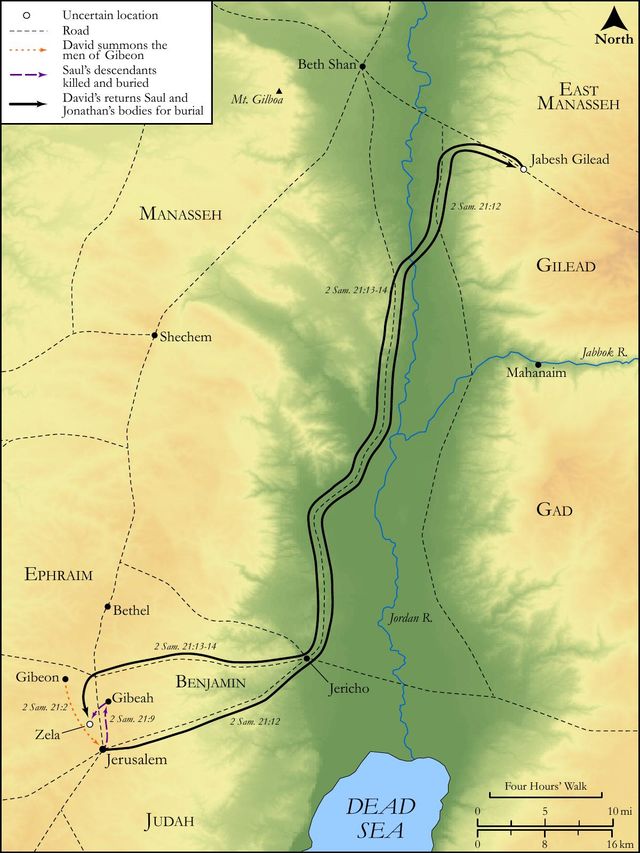
(3.)They would not impose it upon David to do this execution: Thou shalt not for us kill any man (Sa2 21:4), but we will do it ourselves, we will hang them up unto the Lord (Sa2 21:6), that if there were any hardship in it, they might bear the blame, and not David or his house. By our old law, if a murderer had judgment given against him upon an appeal, the relations that appealed had the executing of him.
(4.)They did not require this out of malice against Saul or his family (had they been revengeful, they would have moved it themselves long before), but out of love to the people of Israel, whom they saw plagued for the injury done to them: "We will hang them up unto the Lord (Sa2 21:6), to satisfy his justice, not to gratify any revenge of our own - for the good of the public, not for our own reputation." (5.) The nomination of the persons they left to David, who took care to secure Mephibosheth for Jonathan's sake, that, while he was avenging the breach of one oath, he might not himself break another (Sa2 21:7); but he delivered up two of Saul's sons whom he had by a concubine, and five of his grandsons, whom his daughter Merab bore to Adriel (Sa1 18:19), but his daughter Michal brought up, Sa2 21:8. Now Saul's treachery was punished, in giving Merab to Adriel, when he had promised her to David, with a design to provoke him. "It is a dangerous matter," says bishop Hall upon this, "to offer injury to any of God's faithful ones; if their meekness have easily remitted it, their God will not pass it over without a severe retribution, though it may be long first." (6.) The place, time, and manner, of their execution, all added to the solemnity of their being sacrificed to divine justice.
[1.]They were hanged up, as anathemas, under a peculiar mark of God's displeasure; for the law had said, He that is hanged is accursed of God, Deu 21:23; Gal 3:13. Christ being made a curse for us, and dying to satisfy for our sins and to turn away the wrath of God, became obedient to this ignominious death.
[2.]They were hanged up in Gibeah of Saul (Sa2 21:6), to show that it was for his sin that they died. They were hanged, as it were, before their own door, to expiate the guilt of the house of Saul; and thus God accomplished the ruin of that family, for the blood of the priests, and their families, which, doubtless, now came in remembrance before God, and inquisition was made for it, Psa 9:12. Yet the blood of the Gibeonites only is mentioned, because that was shed in violation of a sacred oath, which, though sworn long before, though obtained by a wile, and the promise made to Canaanites, yet is thus severely reckoned for. The despising of the oath, and breaking of the covenant, will be recompensed on the head of those who thus profane God's sacred name, Eze 17:18, Eze 17:19. And thus God would show that with him rich and poor meet together. Even royal blood must go to atone for the blood of the Gibeonites, who were but the vassals for the congregation.
[3.]They were put to death in the days of harvest (Sa2 21:9), at the beginning of harvest (Sa2 21:10), to show that they were thus sacrificed for the turning sway of that wrath of God which had withheld from them their harvest-mercies for some years past, and to obtain his favour in the present harvest. Thus there is no way of appeasing God's anger but by mortifying and crucifying our lusts and corruptions. In vain do we expect mercy from God, unless we do justice upon our sins. Those executions must not be complained of as cruel which have become necessary to the public welfare. Better that seven of Saul's bloody house be hanged than that all Israel be famished.
Historical interpretation
Historical reception
1 surviving comment on this verse from the historical church.
The Gibeonites met the children of Israel, and although other nations were slaughtered, they were kept for hewers of wood and drawers of water. And of such value were they in God’s eyes that the family of Saul was destroyed for the wrong done to them. Where would you put them? Among the goats? But they were not slain, and they were avenged by the determination of God. Among the sheep? But holy Scripture says they were not of the same merit as the Israelites. You see then that they do indeed stand on the right hand but are of a far inferior grade.
Continue studying 2 Samuel 21:4 across the web’s major study libraries — every link below opens this exact verse, chapter, or book on the destination site.
Read & Compare
 BibleGatewayThis verse in more than 200 translations and 70 languages.
 Bible.comThe YouVersion reader — hundreds of translations, reading plans, and highlights.
 ESV.orgCrossway's official English Standard Version reader.
 NET BibleThe NET translation with 60,000+ translators' notes on every rendering decision.
 STEP BibleTyndale House's free study tool — original text, vocabulary, and scholarly resources.
 BibliaLogos Bible Software's free web reader.
 USCCBThe New American Bible (Revised Edition) with the U.S. bishops' study notes.
Commentaries
 BibleHub CommentariesDozens of classic commentaries on this verse, gathered on one page.
 StudyLightMore than 100 commentary sets — the largest collection on the web.
 BibleRefPlain-English commentary on what this verse means, verse by verse.
 Enduring WordDavid Guzik's free commentary on this chapter, widely used by Bible teachers.
 Bible Study ToolsVerse commentary alongside Greek and Hebrew study aids.
Original Language & Research
- BibleHub InterlinearThe verse word by word — original language, transliteration, and English.
- BibleHub LexiconEvery word's original-language definition and Strong's entry.
 Blue Letter BibleDeep-study tools — Strong's numbers, concordance, and word studies.
 SefariaThe Hebrew text with Rashi and centuries of Jewish commentary.
Sermons, Hymns & Audio


TrulyRandomVerse is not affiliated with these sites and doesn’t control their content. They’re linked because they’re genuinely useful.
Summary
2 Samuel 21:4 captures the pivotal response of the Gibeonites to King David's inquiry regarding the severe famine afflicting Israel, a famine divinely revealed to be a consequence of King Saul's violent breach of the ancient covenant with them. In this verse, the Gibeonites explicitly reject any offer of material compensation, such as silver or gold, and clarify that their desire is not for the indiscriminate slaughter of any man in Israel. This precise refusal sets the stage for their specific and grave demand for justice against Saul's house, a demand David immediately pledges to fulfill, demonstrating his commitment to resolving the national bloodguilt and restoring divine favor.
Context
ShowHideLiterary Context
This verse is strategically placed within 2 Samuel 21, which opens with a three-year famine in Israel. The narrative establishes a direct causal link between the famine and Saul's earlier violation of the covenant with the Gibeonites, whom he zealously sought to exterminate (2 Samuel 21:1-2). David's proactive approach to the Gibeonites in verse 3, seeking to understand and rectify the wrong, underscores his role as a righteous leader attuned to divine justice. Verse 4 serves as a crucial clarification from the Gibeonites, defining the parameters of their desired retribution. By explicitly stating what they do not want (material wealth or indiscriminate killing), they narrow the scope of their forthcoming demand, preparing the reader for the specific, targeted justice they will request against Saul's descendants in the verses that follow. This rejection highlights the profound nature of the offense and the Gibeonites' understanding of proper atonement.
Historical & Cultural Context
The covenant between Israel and the Gibeonites, recorded in Joshua 9, was a solemn oath sworn by Joshua and the Israelite leaders, even though it was secured through deception. In Israel, covenants, especially those invoked by the name of God, were considered inviolable and carried severe consequences if broken. Violating such an oath, particularly through bloodshed, incurred "bloodguilt" upon the land and its people, believed to provoke divine judgment often manifested as famine, plague, or military defeat. Saul's attempt to annihilate the Gibeonites, despite this centuries-old oath, was an act of profound sacrilege and a direct affront to God's holiness and Israel's covenant integrity. The Gibeonites' response in 2 Samuel 21:4 illuminates their understanding of justice: it was not a matter of financial restitution but of atonement for a grave spiritual and physical wrong. Their refusal to accept "silver nor gold" emphasizes that the offense was against life and sacred trust, not merely property or economic interests, demanding a deeper form of reconciliation.
Key Themes
ShowHideThe episode in 2 Samuel 21, and this verse specifically, powerfully illustrates several core biblical themes. Covenant Faithfulness is paramount, demonstrating God's unwavering commitment to holding His people accountable for their oaths, even those made generations prior. The severe consequences of Saul's breach of the Gibeonite covenant underscore the enduring nature of divine law and the seriousness of human promises. The theme of Justice and Atonement is central, as the Gibeonites seek a specific form of justice to cleanse the land of bloodguilt, rejecting mere monetary compensation for a profound spiritual and physical offense. This highlights that some wrongs require a deeper, more personal reckoning. David's Righteous Leadership is prominently displayed by his humility in seeking divine counsel regarding the famine and his immediate willingness to rectify a national sin, prioritizing righteousness and the welfare of the nation over political expediency. This stands in stark contrast to Saul's earlier actions driven by misguided zeal. Finally, the Gibeonites' statement "neither for us shalt thou kill any man in Israel" introduces the theme of the Nature of Retribution, emphasizing that their pursuit is for targeted justice against the offending house, not indiscriminate revenge upon the innocent populace, aligning with principles of individual accountability found in passages like Deuteronomy 24:16.
Exposition and Analysis
ShowHideKey Word Analysis
ShowHideA patrial term referring to the inhabitants of Gibeon. These were the people who, through deception, secured a covenant with Joshua and the Israelites as detailed in Joshua 9:3-15. They were Hivites, a non-Israelite group, whose continued existence and their role in this narrative underscore the enduring nature of divine oaths and the severe, generational consequences of their violation.
This phrase denotes material wealth or monetary compensation. The Gibeonites' explicit rejection of these items signifies that their grievance was not economic but a profound violation of life and sacred trust. Their refusal emphasizes that some wrongs, particularly those involving bloodshed and covenant breach, cannot be rectified by mere financial payment but demand a deeper form of justice and atonement.
This translates to "to cause to die a man" or "to put to death an individual." The Gibeonites' refusal to have David "kill any man in Israel" highlights their desire for targeted justice rather than widespread, indiscriminate vengeance. They were not seeking a general massacre of Israelites but a specific reckoning with the house that committed the offense, demonstrating a nuanced understanding of justice that distinguished between the guilty party and the innocent populace.
Verse Breakdown
ShowHide"And the Gibeonites said unto him, We will have no silver nor gold of Saul, nor of his house;"
This opening declaration immediately clarifies the Gibeonites' primary concern and their rejection of conventional reparations. They are not interested in financial restitution from Saul's estate or his descendants. This refusal of material compensation underscores the profound gravity of the wrong committed against them—it was a breach of covenant and an act of violent betrayal, not a simple financial debt. Their focus is on a deeper, spiritual, and retributive justice that transcends monetary value.
"neither for us shalt thou kill any man in Israel."
This clause further refines their demand by explicitly stating what they do not want: a general slaughter of innocent Israelites. This demonstrates that their desire is for specific, targeted justice against the offenders, not indiscriminate revenge upon the nation. It also suggests an understanding of the principle of individual accountability, preventing widespread bloodshed for the sins of a few, even as they sought justice for a national sin.
"And he said, What ye shall say, [that] will I do for you."
David's immediate and unequivocal response demonstrates his profound commitment to resolving the famine and cleansing the land of bloodguilt. His willingness to fully submit to the Gibeonites' terms, whatever they may be, reflects his righteous leadership, his humility before God, and his understanding of the severity of the divine judgment. This promise sets the stage for the Gibeonites' subsequent, chilling request in 2 Samuel 21:6, highlighting David's resolve to bring about national reconciliation with God.
Literary Devices
ShowHideThe passage employs several effective literary devices that enhance its impact and convey its theological depth. There is a strong sense of Foreshadowing in the Gibeonites' initial rejection of material compensation and indiscriminate killing; this subtly yet powerfully prepares the reader for their specific and severe demand that follows in the narrative, which focuses on the lineage of Saul. The passage implicitly highlights a stark Contrast between Saul's misguided zeal (which led to the covenant breach and national judgment) and David's humble, righteous leadership (seeking to atone for the sin and restore divine favor). Furthermore, the Gibeonites' measured response, refusing widespread retribution, demonstrates a form of Restraint that underscores the moral weight of their grievance and distinguishes their pursuit of justice from mere vengeance, framing it as a quest for covenantal integrity. The dialogue itself is concise, yet packed with profound meaning, efficiently revealing character, advancing the plot, and setting the stage for the dramatic resolution.
Theological and Thematic Connections
ShowHideThis passage profoundly underscores God's unwavering commitment to covenant faithfulness and the severe, intergenerational consequences of its violation. The three-year famine serves as a stark reminder that national sin, particularly the shedding of innocent blood and the breaking of sacred oaths, incurs divine judgment that can span generations, demanding a reckoning. The Gibeonites' rejection of "silver nor gold" for a more profound form of justice highlights that some spiritual debts cannot be settled by mere material means; true atonement requires a specific, often painful, reckoning that addresses the root of the offense. David's posture of humility, seeking divine counsel, and his immediate willingness to fulfill their request exemplifies righteous leadership that prioritizes divine justice and the spiritual well-being of the nation over personal comfort or political expediency, demonstrating a king who fears the Lord and seeks to remove bloodguilt from the land.
Reflection and Application
ShowHideThe narrative of 2 Samuel 21:4 serves as a potent reminder of the enduring consequences of sin, particularly the breaking of sacred promises and the shedding of innocent blood. It challenges us to consider the seriousness with which God views our commitments, whether to Him or to others. Are we people of our word, understanding that integrity in our agreements is not merely a social nicety but a profound reflection of our character and our reverence for God? The Gibeonites' refusal of material compensation for a spiritual wrong also prompts us to reflect on what true justice entails. Is our pursuit of justice merely transactional, seeking quick fixes or monetary settlements, or does it seek genuine reconciliation and atonement for the deeper wounds inflicted by sin and broken trust? For leaders in any sphere—family, church, or community—this passage is a powerful call to courageous and humble leadership, willing to confront difficult truths and take decisive action to address injustices, even when the consequences are costly or politically unpopular. It underscores that true leadership involves prioritizing the spiritual health and well-being of the community by addressing root causes of sin and seeking divine wisdom in times of crisis, rather than simply managing symptoms.
Questions for Reflection
ShowHideFAQ
ShowHideWhy did the Gibeonites refuse silver or gold?
ShowHideThe Gibeonites refused silver or gold because their grievance was not a financial one, but a profound violation of a sacred covenant and an act of bloodshed. Saul's attempt to exterminate them was an offense against their very existence and a breach of an oath sworn before God by Joshua centuries earlier (Joshua 9:15). For them, true justice and atonement for bloodguilt could not be satisfied with material compensation; it required a specific, targeted reckoning that would cleanse the land and restore the integrity of the covenant. This highlights that some wrongs are so grave they transcend monetary value and demand a deeper, spiritual form of justice that addresses the sanctity of life and the inviolability of divine oaths.
Christ-Centered Fulfillment
ShowHideWhile 2 Samuel 21:4 describes a specific act of atonement for national bloodguilt under the Old Covenant, it ultimately points to the greater and perfect atonement found in Jesus Christ. The Gibeonites' demand for a specific, targeted reckoning, rather than indiscriminate slaughter, foreshadows the principle that justice for sin requires a precise and perfect payment. Under the Old Covenant, the shedding of blood was necessary for the cleansing of sin and defilement (Hebrews 9:22). However, the repeated sacrifices of animals or the specific acts of retribution, like those against Saul's house, could only temporarily cover sin and address specific instances of bloodguilt. The ultimate fulfillment is found in Jesus Christ, who, as the true Lamb of God, offered Himself as the once-for-all sacrifice for the sins of the world. His shed blood on the cross is the perfect and final atonement, not for a specific national bloodguilt, but for the universal sin of humanity, cleansing us from all unrighteousness (1 John 1:7). Unlike the Gibeonites' demand, which brought about further death as a consequence, Christ's sacrifice brings life and reconciliation, making peace through His blood (Colossians 1:20), fulfilling the ultimate need for justice and cleansing in a way that truly brings redemption and eternal life to all who believe.