


2 Samuel 21:5
Bible text: King James Version (1769 Blayney text) · Public domain
Bible text: Berean Standard Bible · Public domain
Bible text: American Standard Version (1901) · Public domain
Bible text: World English Bible, Messianic edition · Public domain
Bible text: Geneva Bible (1599) · Public domain
Bible text: Young's Literal Translation · Public domain
- וַיֹּאמְרוּvai·yo·me·Ruand they saidH559Conj-w ¦ V-Qal-ConsecImperf-3mpVerb Qal Consecutive Imperfect 3rd Plural Masculineוַandיֹּאמְרוּthey said
- אֶל'eltoH413PrepPreposition
- הַמֶּלֶךְha·Me·lekhthe kingH4428Art ¦ N-msNoun Singular Masculine Absoluteהַtheמֶּלֶךְking
- הָאִישׁha·'Ishthe manH376Art ¦ N-msNoun Singular Masculine Absoluteהָtheאִישׁman
- אֲשֶׁר'a·SherwhoH834RelParticle Relative
- כִּלָּנוּki·La·nuhe made an end of usH3615V-Piel-Perf-3ms ¦ 1cpVerb Piel Perfect 3rd Singular Masculineכִּלָּhe made an end ofנוּus
- וַאֲשֶׁרva·'a·Sherand whoH834Conj-w ¦ RelParticle Relativeוַandאֲשֶׁרwho
- דִּמָּהdi·mahhe plannedH1819V-Piel-Perf-3msVerb Piel Perfect 3rd Singular Masculine
- לָנוּLa·nuto <the> usPrep-l ¦ 1cpSuffix Personal 1st Plural common genderלָto <the>נוּus
- נִשְׁמַדְנוּnish·Mad·nuwe were destroyedH8045V-Niphal-Perf-1cpVerb Niphal Perfect 1st Plural common gender
- מֵהִתְיַצֵּבme·hit·ya·Tzevfrom standingH3320Prep-m ¦ V-Hithpael-InfVerb Hithpael Infinitive Constructמֵfromהִתְיַצֵּבstanding
- בְּכָלbe·kholin allH3605Prep-b ¦ N-mscNoun Singular Masculine Constructבְּinכָלall
- גְּבֻלge·Vul[the] territory ofH1366N-mscNoun Singular Masculine Construct
- יִשְׂרָאֵלYis·ra·'ElIsraelH3478N-properNoun Proper Location
English is a literal word-by-word gloss of the Hebrew, not the KJV's wording. Why?
This is the original text the KJV's translators worked from — each Hebrew word with its own literal English meaning in this verse, prepared by scholars at Tyndale House, Cambridge. The KJV translates whole sentences, not word by word, so its wording differs: one Hebrew word can become several English words, and the KJV may choose “the LORD” where the gloss reads “Yahweh”. Both are faithful — they answer different questions. For the KJV's own rendering, switch to the KJV text.
Details
See on the biblical-era maps
Study this verse
Public-domain commentary
Matthew Henry
From his Commentary on the Whole Bible. Henry comments on passages, not single verses — this entry covers 2 Samuel 21:1–9. His four-level outline is real structure in the source text, so it is rendered as structure.
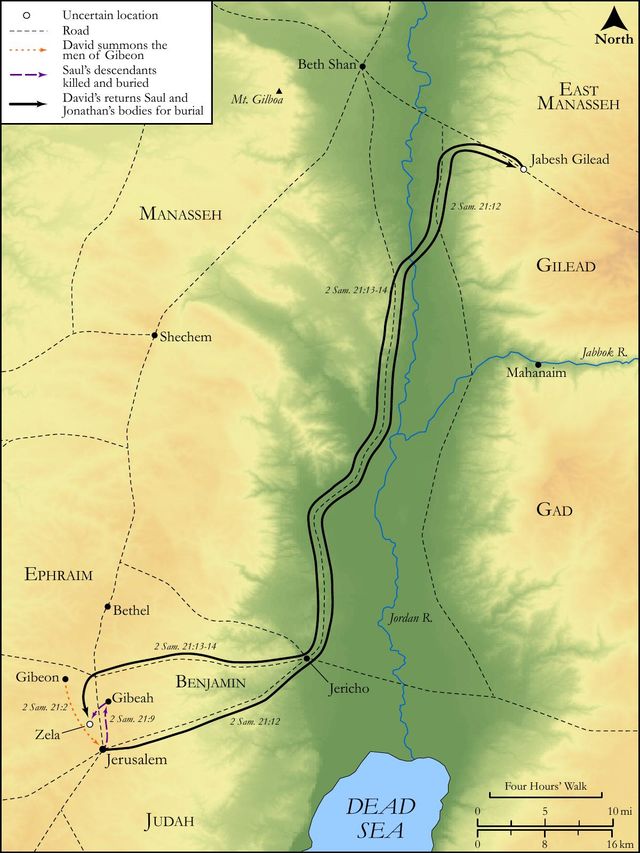
Here I. Were are told of the injury which Saul had, long before this, done to the Gibeonites, which we had no account of in the history of his reign, nor should we have heard of it here but that it came now to be reckoned for. The Gibeonites were of the remnant of the Amorites (Sa2 21:2), who by a stratagem had made peace with Israel, and had the public faith pledged to them by Joshua for their safety. We had the story Jos. 9, where it was agreed (v. 23) that they should have their lives secured, but be deprived of their lands and liberties, that they and theirs should be tenants in villanage to Israel. It does not appear that they had broken their part of the covenant, either by denying their service or attempting to recover their lands or liberties; nor was this pretended; but Saul, under colour of zeal for the honour of Israel, that it might not be said that they had any of the natives among them, aimed to root them out, and, in order to that, slew many of them. Thus he would seem wiser than his predecessors the judges, and more zealous for the public interest; and perhaps he designed it for an instance of his royal prerogative and the power which as king he assumed to rescind the former acts of government and to disannul the most solemn leagues. It may be, he designed, by this severity towards the Gibeonites, to atone for his clemency towards the Amalekites. Some conjecture that he sought to cut off the Gibeonites at the same time when he put away the witches (Sa1 28:3), or perhaps many of them were remarkably pious, and he sought to destroy them when he slew the priests their masters. That which made this an exceedingly sinful sin was that he not only shed innocent blood, but therein violated the solemn oath by which the nation was bound to protect them. See what brought ruin on Saul's house: it was a bloody house.
II.We find the nation of Israel chastised with a sore famine, long after, for this sin of Saul. Observe,
1.Even in the land of Israel, that fruitful land, and in the reign of David, that glorious reign, there was a famine, not extreme (for then notice would sooner have been taken of it and enquiry made into the cause of it), but great drought, and scarcity of provisions, the consequence of it, for three years together. If corn miss one year, commonly the next makes up the deficiency; but, if it miss three years successively, it will be a sore judgment; and the man of wisdom will by it hear God's voice crying to the country to repent of the abuse of plenty.
2.David enquired of God concerning it. Though he was himself a prophet, he must consult the oracle, and know God's mind in his own appointed way. Note, When we are under God's judgments we ought to enquire into the grounds of the controversy. Lord, show me wherefore thou contendest with me. It is strange that David did not sooner consult the oracle, not till the third year; but perhaps, till then, he apprehended it not to be an extraordinary judgment for some particular sin. Even good men are often slack and remiss in doing their duty. We continue in ignorance, and under mistake, because we delay to enquire.
3.God was ready in his answer, though David was slow in his enquiries: It is for Saul. Note, God's judgments often look a great way back, which obliges us to do so when we are under his rebukes. It is not for us to object against the people's smarting for the sin of their king (perhaps they were aiding and abetting), nor against this generation's suffering for the sin of the last God often visiteth the sins of the fathers upon the children, and his judgments are a great deep. He gives not account of any of his matters. Time does not wear out the guilt of sin; nor can we build hopes of impunity upon the delay of judgments. There is no statute of limitation to be pleaded against God's demands. Nullum tempus occurrit Deo - God may punish when he pleases.
III.We have vengeance taken upon the house of Saul for the turning away of God's wrath from the land, which, at present, smarted for his sin.
1.David, probably by divine direction, referred it to the Gibeonites themselves to prescribe what satisfaction should be given them for the wrong that had been done them, Sa2 21:3. They had many years remained silent, had not appealed to David, nor given the kingdom any disturbance with their complaints or demands; and now, at length, God speaks for them (I heard not, for thou wilt hear, Psa 38:14, Psa 38:15); and they are recompensed for their patience with this honour, that they are made judges in their own case, and have a blank given them to write their demands on: What you shall say, that will I do (Sa2 21:4), that atonement may be made, and that you may bless the inheritance of the Lord, Sa2 21:3. It is sad for any family or nation to have the prayers of oppressed innocency against them, and therefore the expense of a just restitution is well bestowed for the retrieving of the blessing of those that were ready to perish, Job 29:13. "My servant Job, whom you have wronged, shall pray for you," says God, "and then I will be reconciled to you, and not till then." Those understand not themselves that value not the prayers of the poor and despised.
2.They desired that seven of Saul's posterity might be put to death, and David granted their demand.
(1.)They required no silver, nor gold, Sa2 21:4. Note, Money is no satisfaction for blood, see Num 35:31-33. It is the ancient law that blood calls for blood (Gen 9:6); and those over-value money and under-value life, that sell the blood of their relations for corruptible things, such as silver and gold. The Gibeonites had now a fair opportunity to get a discharge from their servitude, in compensation for the wrong done them, according to the equity of that law (Exo 21:26), If a man strike out his servant's eye, he shall let him go free for his eye's sake. But they did not insist on this; though the covenant was broken on the other side, it should not be broken on theirs. They were Nethinim, given to God and his people Israel, and they would not seem weary of the service.
(2.)They required no lives but of Saul's family. He had done them the wrong, and therefore his children must pay for it. We sue the heirs for the parents' debts. Men may not extend this principle so far as life, Deu 24:16. The children in an ordinary course of law, shall never be put to death for the parents. But this case of the Gibeonites was altogether extraordinary. God had made himself an immediate party to the cause and no doubt put it into the heart of the Gibeonites to make this demand, for he owned what was done (Sa2 21:14), and his judgments are not subject to the rules which men's judgments must be subject to. Let parents take heed of sin, especially the sin of cruelty and oppression, for their poor children's sake, who may be smarting for it by the just hand of God when they themselves are in their graves. Guilt and a curse are a bad entail upon a family. It should seem, Saul's posterity trod in his steps, for it is called a bloody house; it was the spirit of the family, and therefore they are justly reckoned with for his sin, as well as for their own.
(3.)They would not impose it upon David to do this execution: Thou shalt not for us kill any man (Sa2 21:4), but we will do it ourselves, we will hang them up unto the Lord (Sa2 21:6), that if there were any hardship in it, they might bear the blame, and not David or his house. By our old law, if a murderer had judgment given against him upon an appeal, the relations that appealed had the executing of him.
(4.)They did not require this out of malice against Saul or his family (had they been revengeful, they would have moved it themselves long before), but out of love to the people of Israel, whom they saw plagued for the injury done to them: "We will hang them up unto the Lord (Sa2 21:6), to satisfy his justice, not to gratify any revenge of our own - for the good of the public, not for our own reputation." (5.) The nomination of the persons they left to David, who took care to secure Mephibosheth for Jonathan's sake, that, while he was avenging the breach of one oath, he might not himself break another (Sa2 21:7); but he delivered up two of Saul's sons whom he had by a concubine, and five of his grandsons, whom his daughter Merab bore to Adriel (Sa1 18:19), but his daughter Michal brought up, Sa2 21:8. Now Saul's treachery was punished, in giving Merab to Adriel, when he had promised her to David, with a design to provoke him. "It is a dangerous matter," says bishop Hall upon this, "to offer injury to any of God's faithful ones; if their meekness have easily remitted it, their God will not pass it over without a severe retribution, though it may be long first." (6.) The place, time, and manner, of their execution, all added to the solemnity of their being sacrificed to divine justice.
[1.]They were hanged up, as anathemas, under a peculiar mark of God's displeasure; for the law had said, He that is hanged is accursed of God, Deu 21:23; Gal 3:13. Christ being made a curse for us, and dying to satisfy for our sins and to turn away the wrath of God, became obedient to this ignominious death.
[2.]They were hanged up in Gibeah of Saul (Sa2 21:6), to show that it was for his sin that they died. They were hanged, as it were, before their own door, to expiate the guilt of the house of Saul; and thus God accomplished the ruin of that family, for the blood of the priests, and their families, which, doubtless, now came in remembrance before God, and inquisition was made for it, Psa 9:12. Yet the blood of the Gibeonites only is mentioned, because that was shed in violation of a sacred oath, which, though sworn long before, though obtained by a wile, and the promise made to Canaanites, yet is thus severely reckoned for. The despising of the oath, and breaking of the covenant, will be recompensed on the head of those who thus profane God's sacred name, Eze 17:18, Eze 17:19. And thus God would show that with him rich and poor meet together. Even royal blood must go to atone for the blood of the Gibeonites, who were but the vassals for the congregation.
[3.]They were put to death in the days of harvest (Sa2 21:9), at the beginning of harvest (Sa2 21:10), to show that they were thus sacrificed for the turning sway of that wrath of God which had withheld from them their harvest-mercies for some years past, and to obtain his favour in the present harvest. Thus there is no way of appeasing God's anger but by mortifying and crucifying our lusts and corruptions. In vain do we expect mercy from God, unless we do justice upon our sins. Those executions must not be complained of as cruel which have become necessary to the public welfare. Better that seven of Saul's bloody house be hanged than that all Israel be famished.
Historical interpretation
Historical reception
1 surviving comment on this verse from the historical church.
The Gibeonites met the children of Israel, and although other nations were slaughtered, they were kept for hewers of wood and drawers of water. And of such value were they in God’s eyes that the family of Saul was destroyed for the wrong done to them. Where would you put them? Among the goats? But they were not slain, and they were avenged by the determination of God. Among the sheep? But holy Scripture says they were not of the same merit as the Israelites. You see then that they do indeed stand on the right hand but are of a far inferior grade.
Continue studying 2 Samuel 21:5 across the web’s major study libraries — every link below opens this exact verse, chapter, or book on the destination site.
Read & Compare
 BibleGatewayThis verse in more than 200 translations and 70 languages.
 Bible.comThe YouVersion reader — hundreds of translations, reading plans, and highlights.
 ESV.orgCrossway's official English Standard Version reader.
 NET BibleThe NET translation with 60,000+ translators' notes on every rendering decision.
 STEP BibleTyndale House's free study tool — original text, vocabulary, and scholarly resources.
 BibliaLogos Bible Software's free web reader.
 USCCBThe New American Bible (Revised Edition) with the U.S. bishops' study notes.
Commentaries
 BibleHub CommentariesDozens of classic commentaries on this verse, gathered on one page.
 StudyLightMore than 100 commentary sets — the largest collection on the web.
 BibleRefPlain-English commentary on what this verse means, verse by verse.
 Enduring WordDavid Guzik's free commentary on this chapter, widely used by Bible teachers.
 Bible Study ToolsVerse commentary alongside Greek and Hebrew study aids.
Original Language & Research
- BibleHub InterlinearThe verse word by word — original language, transliteration, and English.
- BibleHub LexiconEvery word's original-language definition and Strong's entry.
 Blue Letter BibleDeep-study tools — Strong's numbers, concordance, and word studies.
 SefariaThe Hebrew text with Rashi and centuries of Jewish commentary.
Sermons, Hymns & Audio


TrulyRandomVerse is not affiliated with these sites and doesn’t control their content. They’re linked because they’re genuinely useful.
Summary
Second Samuel 21:5 records the Gibeonites' poignant and direct accusation against King Saul, identifying him as "the man that consumed us, and that devised against us [that] we should be destroyed from remaining in any of the coasts of Israel." This declaration is pivotal, revealing the malicious and premeditated nature of Saul's persecution against them, which violated an ancient, sacred covenant and brought a three-year famine upon Israel. The Gibeonites' words underscore Saul's genocidal intent to utterly eradicate them from the land, thereby setting the stage for the specific atonement required to lift God's judgment and cleanse the land.
Context
ShowHideLiterary Context
This verse is situated at a crucial point in 2 Samuel 21, which opens with a severe three-year famine afflicting Israel. King David's inquiry of the Lord reveals the divine cause: "It is for Saul, and for his bloody house, because he slew the Gibeonites" (2 Samuel 21:1). This immediate revelation establishes the profound gravity of Saul's unpunished crime. David then approaches the Gibeonites, asking what recompense they desire to make atonement. Their response in this verse directly identifies Saul as the perpetrator and details the malicious intent behind his actions, setting the grim stage for the resolution that follows, where the Gibeonites demand the lives of seven of Saul's descendants as retribution. The narrative emphasizes the immediate cause-and-effect relationship between Saul's sin and the national suffering, highlighting the need for a just resolution.
Historical & Cultural Context
The covenant between Israel and the Gibeonites, established during the time of Joshua, was a solemn oath sworn before the Lord (Joshua 9:15). In Israel, such covenants, even if made under initial deception, were considered binding and sacred, with severe divine and human consequences for their violation. Saul's attempt to annihilate the Gibeonites, despite their status as covenant partners, was an act of profound treachery and a direct affront to God's name, by which the oath was sworn. The concept of "bloodguilt" (Hebrew: damim), particularly unatoned innocent blood, was believed to defile the land and bring divine judgment, often in the form of famine or pestilence (Numbers 35:33). The famine, therefore, was understood as a direct consequence of Saul's actions, demanding a specific form of justice to cleanse the land and restore divine favor and blessing.
Key Themes
ShowHideThe passage powerfully underscores the theme of the consequences of broken covenants, highlighting God's unwavering commitment to justice and His holding even His chosen people accountable for solemn oaths. Saul's disregard for the Gibeonite covenant, driven by misguided zeal for Israel (2 Samuel 21:2), resulted in national suffering. This narrative also emphasizes the theme of divine justice and the necessity of atonement, demonstrating that God's righteousness demands a reckoning for unaddressed injustices, even across generations. The Gibeonites' description of Saul's actions as a deliberate "devised" plan to "destroy" them further highlights the theme of malicious intent and persecution, painting a picture of calculated cruelty rather than accidental harm, which amplifies the need for a just response and underscores the severity of the bloodguilt incurred.
Exposition and Analysis
ShowHideKey Word Analysis
ShowHideThe verb כִּלָּנוּ (killanu), derived from H3615 (kâlâh), means "to end, whether intransitive (to cease, be finished, perish) or transitived (to complete, prepare, consume)." In this context, it conveys a sense of utter destruction, termination, or annihilation. The Gibeonites are not merely saying Saul oppressed them, but that he sought their complete eradication, leaving nothing remaining. This strong verb emphasizes the severity and totality of Saul's aggressive actions against them, indicating a systematic effort to wipe out their presence.
The verb דִּמָּה (dimmah), derived from H1819 (dâmâh), means "to compare; by implication, to resemble, liken, consider; compare, devise, (be) like(-n), mean, think, use similitudes." Here, it implies premeditation and a deliberate, calculated scheme. This was not an impulsive act but a thought-out strategy to eliminate the Gibeonites. The Gibeonites' use of this term highlights the malicious intent behind Saul's actions, indicating that his persecution was not accidental but a well-conceived plot aimed at their destruction.
The noun גְּבֻל (gᵉbûwl), derived from H1366, properly refers to "a cord (as twisted), i.e. (by implication) a boundary; by extension the territory inclosed; border, bound, coast, [idiom] great, landmark, limit, quarter, space." In this context, "coasts of Israel" refers to the entire territory or borders of the land. The Gibeonites' statement emphasizes Saul's intent to remove them from any part of the land, signifying a complete and total expulsion or extermination, leaving no refuge within Israel's boundaries.
Verse Breakdown
ShowHide"And they answered the king"
This phrase establishes the Gibeonites' direct communication with King David, indicating their agency and authority to articulate the wrong done to them and their terms for reconciliation. Their answer is not a plea but a firm declaration of the injustice they suffered, demonstrating their standing as a people with whom Israel had a binding covenant.
"The man that consumed us"
This refers unequivocally to King Saul. The Gibeonites accuse him directly of attempting to utterly destroy them, a profound violation of the sacred covenant that had granted them protection within Israel. This "consumption" implies not just killing, but a systematic and comprehensive effort to wipe out their very existence.
"and that devised against us"
This clause emphasizes the premeditated and malicious nature of Saul's actions. It was not a spontaneous outburst of anger or a simple mistake, but a deliberate, calculated plan. This indicates a deep-seated hostility and a well-thought-out strategy to harm them, underscoring Saul's moral culpability and the severity of his crime.
"[that] we should be destroyed from remaining in any of the coasts of Israel"
This specifies the ultimate, genocidal goal of Saul's "devised" plan: the complete eradication of the Gibeonites from the land of Israel. It highlights the intent to remove their very presence and memory from the territory, despite their covenantal status, leaving them no place of refuge or existence within the nation.
Literary Devices
ShowHideThe Gibeonites' statement in 2 Samuel 21:5 employs several powerful literary devices to convey the depth of their suffering and the severity of Saul's crime. The most prominent is Direct Accusation, as the Gibeonites unequivocally name Saul as the perpetrator of their suffering, providing a clear and unambiguous indictment. Their language also contains elements of Hyperbole or intense Vivid Imagery in the terms "consumed us" and "destroyed from remaining," which, while reflecting Saul's intent, serve to emphasize the profound and devastating impact of his actions. This vivid language paints a picture of complete annihilation, underscoring the depth of their suffering and the severity of Saul's crime. Furthermore, the phrase "devised against us" highlights Intentionality, portraying Saul's actions not as accidental or impulsive but as a deliberate, malicious plot, thereby intensifying his culpability and the justness of the Gibeonites' demand for retribution.
Theological and Thematic Connections
ShowHideThis verse powerfully illustrates the enduring theological principle of divine justice and the serious consequences of covenant violation. God is portrayed as one who remembers and acts upon broken oaths, even those made centuries prior, demonstrating His faithfulness to His word and His unwavering commitment to righteousness. The famine serves as a tangible manifestation of God's displeasure, indicating that unaddressed sin, particularly the shedding of innocent blood, defiles the land and disrupts the covenant relationship between God and His people. The Gibeonites' demand for justice is not merely an act of revenge but a necessary step in the process of atonement, highlighting the corporate responsibility of Israel for the sins of its leaders and the need for a just reckoning to restore harmony with God and cleanse the land.
Reflection and Application
ShowHideThe Gibeonites' poignant accusation in 2 Samuel 21:5 serves as a profound reminder that unaddressed injustices, particularly those involving the abuse of power and the breaking of sacred trusts, can have far-reaching and enduring consequences, even across generations. This narrative calls believers to a deep sense of accountability for past wrongs, both personal and corporate, urging us to seek reconciliation, pursue restitution, and acknowledge the ripple effects of our actions, especially those in leadership. It underscores the truth that God is a God of justice who sees and responds to the cries of the oppressed, and that true healing and blessing for a community often require confronting and atoning for historical sins. We are challenged to examine our own lives and communities for areas where justice is lacking or where past harms remain unaddressed, recognizing that God's faithfulness to His covenants extends to His expectation of our faithfulness to ours. This passage compels us to consider how we might be complicit in, or benefit from, pervasive injustices, and to actively work towards righteousness and restoration.
Questions for Reflection
ShowHideFAQ
ShowHideWhy was Saul's action against the Gibeonites considered such a severe transgression?
ShowHideSaul's actions were considered a severe transgression primarily because they constituted a direct violation of a solemn covenant sworn before the Lord by Joshua and the leaders of Israel centuries earlier (Joshua 9:15). In ancient Israel, a covenant was a sacred, binding agreement, often sealed with an oath in God's name. To break such an oath was to show profound contempt for God's holiness and faithfulness, as well as a disregard for the divine witness to the oath. Furthermore, Saul's intent was to "consume" and "destroy" the Gibeonites from the land, an act of attempted genocide against a people under divine protection, driven by misguided zeal for Israel (2 Samuel 21:2). This unprovoked shedding of innocent blood resulted in "bloodguilt" that defiled the land and brought divine judgment, specifically the famine, upon all Israel (Numbers 35:33), demonstrating God's unwavering commitment to justice and the sanctity of oaths made in His name.
Christ-Centered Fulfillment
ShowHideThe narrative of 2 Samuel 21:5, with its focus on unatoned bloodguilt, covenant violation, and the resulting divine judgment, powerfully foreshadows the ultimate solution found in Jesus Christ. The famine in Israel was a tangible consequence of sin that defiled the land, demanding a specific atonement to restore peace and blessing. This points to the profound truth that all sin incurs a "bloodguilt" before a holy God, separating humanity from Him and bringing spiritual death and judgment. Just as the Gibeonites' cry for justice required a specific, albeit grim, reckoning, so too did humanity's sin require a perfect, once-for-all sacrifice. Jesus, the true Lamb of God who takes away the sin of the world, perfectly fulfills this need for atonement. His shed blood on the cross is the ultimate payment for sin, cleansing not only the individual conscience but also addressing the "bloodguilt" that afflicts all creation (Colossians 1:20). Through His new covenant in His blood (Luke 22:20), Christ establishes a lasting peace and reconciliation, not through the death of others, but through His own perfect, substitutionary sacrifice, thereby fulfilling all demands of divine justice and restoring humanity to fellowship with God, breaking the curse of sin and death forever (Hebrews 9:22). He is the one who "consumes" sin and "devised" a plan of salvation, not destruction, for humanity.