


1 Kings 4:4
Bible text: King James Version (1769 Blayney text) · Public domain
Bible text: Berean Standard Bible · Public domain
Bible text: American Standard Version (1901) · Public domain
Bible text: World English Bible, Messianic edition · Public domain
Bible text: Geneva Bible (1599) · Public domain
Bible text: Young's Literal Translation · Public domain
- וּבְנָיָהוּu·ve·na·Ya·huand BenaiahH1141Conj-w ¦ N-proper-mNoun Proper MasculineוּandבְנָיָהוּBenaiah
- בֶןven[the] son ofH1121N-mscNoun Singular Masculine Construct
- יְהוֹיָדָעye·ho·ya·Da'JehoiadaH3077N-proper-mNoun Proper Masculine
- עַל'al[was] overH5921PrepPreposition
- הַצָּבָאha·tza·Va'the armyH6635Art ¦ N-msNoun Singular Masculine Absoluteהַtheצָּבָאarmy
- וְצָדוֹקve·tza·Dokand ZadokH6659Conj-w ¦ N-proper-mNoun Proper MasculineוְandצָדוֹקZadok
- וְאֶבְיָתָרve·'ev·ya·Tarand AbiatharH54Conj-w ¦ N-proper-mNoun Proper MasculineוְandאֶבְיָתָרAbiathar
- כֹּהֲנִיםko·ha·Nim[were] priestsH3548N-mpNoun Plural Masculine Absolute
English is a literal word-by-word gloss of the Hebrew, not the KJV's wording. Why?
This is the original text the KJV's translators worked from — each Hebrew word with its own literal English meaning in this verse, prepared by scholars at Tyndale House, Cambridge. The KJV translates whole sentences, not word by word, so its wording differs: one Hebrew word can become several English words, and the KJV may choose “the LORD” where the gloss reads “Yahweh”. Both are faithful — they answer different questions. For the KJV's own rendering, switch to the KJV text.
Details
See on the biblical-era maps

Study this verse
Public-domain commentary
Matthew Henry
From his Commentary on the Whole Bible. Henry comments on passages, not single verses — this entry covers 1 Kings 4:1–19. His two-level outline is real structure in the source text, so it is rendered as structure.
Here we have,
I.Solomon upon his throne (Kg1 4:1):
So king Solomon was king, that is, he was confirmed and established king over all Israel, and not, as his successors, only over two tribes. He was a king, that is, he did the work and duty of a king, with the wisdom God had given him. Those preserve the name and honour of their place that mind the business of it and make conscience of it.
II.The great officers of his court, in the choice of whom, no doubt, his wisdom much appeared. It is observable,
1.That several of them are the same that were in his father's time. Zadok and Abiathar were then priests (Sa2 20:25), so they were now; only then Abiathar had the precedency, now Zadok. Jehoshaphat was then recorder, or keeper of the great seal, so he was now. Benaiah, in his father's time, was a principal man in military affairs, and so he was now. Shisha was his father's scribe, and his sons were his, Kg1 4:3. Solomon, though a wise man, would not affect to be wiser than his father in this matter. When sons come to inherit their father's wealth, honour, and power, it is a piece of respect to their memory, caeteris paribus - where it can properly be done, to employ those whom they employed, and trust those whom they trusted. Many pride themselves in being the reverse of their good parents.
2.The rest were priests' sons. His prime-minister of state was Azariah the son of Zadok the priest. Two others of the first rank were the sons of Nathan the prophet, Kg1 4:5. In preferring them he testified the grateful respect he had for their good father, whom he loved in the name of a prophet.
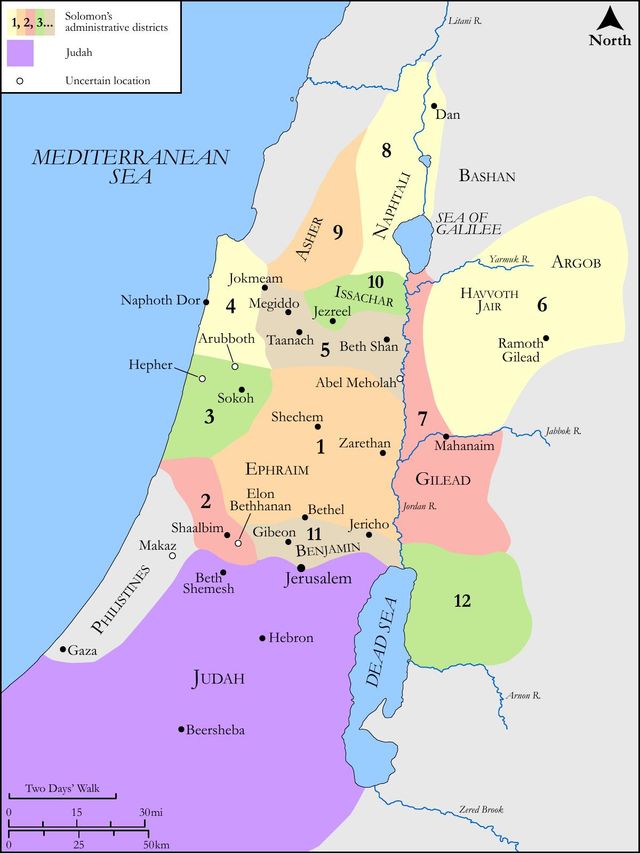
III.The purveyors for his household, whose business it was to send in provisions from several parts of the country, for the king's tables and cellars (Kg1 4:7) and for his stables (Kg1 4:27, Kg1 4:28), that thus,
1.His house might always be well furnished at the best hand. Let great men learn hence good house-keeping, to be generous in spending according to their ability, but prudent in providing. It is the character of the virtuous woman that she bringeth her food from afar (Pro 31:14), not far-fetched and dear-bought, but the contrary, every thing bought where it is cheapest.
2.That thus he himself, and those who immediately attended him, might be eased of a great deal of care, and the more closely apply themselves to the business of the state, not troubled about much serving, provision for that being got ready to their hand.
3.That thus all the parts of the kingdom might be equally benefited by the taking off of the commodities that were the productions of their country and the circulating of the coin. Industry would hereby be encouraged, and consequently wealth increased, even in those tribes that lay most remote from the court. The providence of God extends itself to all places of his dominions (Psa 103:22); so should the prudence and care of princes.
4.The dividing of this trust into so many hands was prudent, that no man might be continually burdened with the care of it nor grow exorbitantly rich with the profit of it, but that Solomon might have those, in every district, who, having a dependence upon the court, would be serviceable to him and his interest as there was occasion. These commissioners of the victualling-office, not for the army or navy (Solomon was engaged in no war), but for the household, are here named, several of them only by their surnames, as great men commonly call their servants: Ben-hur, Ben-dekar, etc., though several of them have also their proper names prefixed. Two of them married Solomon's daughters, Ben-Abinadab (Kg1 4:11) and Ahimaaz (Kg1 4:15), and no disparagement to them to marry men of business. Better match with the officers of their father's court that were Israelites than with the sons of princes that were strangers to the covenant of promise. The son of Geber was in Ramoth-Gilead (Kg1 4:19), and Geber himself was in the country of Sihon and Og, which included that and Mahanaim, Kg1 4:14. He is therefore said to be the only officer in that land, because the other two, mentioned Kg1 4:13, Kg1 4:14, depended on him, and were subordinate to him.
Historical interpretation
Fourteen Centuries of Reception
2 surviving comments on this verse. Each one is dated, so this reads as a timeline rather than a list.
Select a marker to jump to its quote. Markers stagger vertically where authors wrote within a few decades of each other.
The officials elected by Solomon designate the order of the chosen ones whom Christ affirmed in his grace and appointed as rulers of his people. Indeed, twelve prefects were selected to administer the incomes of this king and his house, because just as many apostles had to be distributed over the entire world and had to be appointed as treasures of the divine mysteries, so that they might nourish with living and immortal food the Israel of God and might administer the incomes of the house of the peaceful king. Therefore, also the limits of each prefecture were clearly denoted, because, in a similar way, each apostle received a certain province: Simon preached in Rome, John in Ephesus, Matthew in Palestine and Thomas in the region of India.
Abiathar: By this it appears that Abiathar was not altogether deposed from the high priesthood; but only banished to his country house, and by that means excluded from the exercise of his functions.
Continue studying 1 Kings 4:4 across the web’s major study libraries — every link below opens this exact verse, chapter, or book on the destination site.
Read & Compare
 BibleGatewayThis verse in more than 200 translations and 70 languages.
 Bible.comThe YouVersion reader — hundreds of translations, reading plans, and highlights.
 ESV.orgCrossway's official English Standard Version reader.
 NET BibleThe NET translation with 60,000+ translators' notes on every rendering decision.
 STEP BibleTyndale House's free study tool — original text, vocabulary, and scholarly resources.
 BibliaLogos Bible Software's free web reader.
 USCCBThe New American Bible (Revised Edition) with the U.S. bishops' study notes.
Commentaries
 BibleHub CommentariesDozens of classic commentaries on this verse, gathered on one page.
 StudyLightMore than 100 commentary sets — the largest collection on the web.
 BibleRefPlain-English commentary on what this verse means, verse by verse.
 Enduring WordDavid Guzik's free commentary on this chapter, widely used by Bible teachers.
 Bible Study ToolsVerse commentary alongside Greek and Hebrew study aids.
Original Language & Research
- BibleHub InterlinearThe verse word by word — original language, transliteration, and English.
- BibleHub LexiconEvery word's original-language definition and Strong's entry.
 Blue Letter BibleDeep-study tools — Strong's numbers, concordance, and word studies.
 SefariaThe Hebrew text with Rashi and centuries of Jewish commentary.
Sermons, Hymns & Audio


TrulyRandomVerse is not affiliated with these sites and doesn’t control their content. They’re linked because they’re genuinely useful.
Summary
1 Kings 4:4 meticulously details two pivotal appointments within King Solomon's burgeoning administration: Benaiah, son of Jehoiada, as the supreme commander of the army, and Zadok and Abiathar as the high priests. This verse, embedded within a comprehensive roster of royal officials, fundamentally underscores the dual pillars of Solomon's kingdom—robust military strength and consecrated religious authority—both indispensable for the stability, security, and spiritual flourishing of Israel during its golden age of peace and prosperity.
Context
ShowHideLiterary Context
1 Kings 4 commences by enumerating King Solomon's chief officials, immediately following the strategic consolidation of his reign through the decisive elimination of rivals and the establishment of justice, as meticulously detailed in 1 Kings 2-3. This chapter serves as a comprehensive administrative roster, vividly illustrating the breadth and sophistication of Solomon's governmental structure, which provided the essential framework for his renowned wisdom, immense wealth, and extensive influence. The systematic listing of these officials, encompassing both military and religious leaders, precedes the vivid descriptions of the kingdom's unprecedented prosperity, Solomon's unparalleled wisdom, and the vastness of his dominion (1 Kings 4:20-34), thereby establishing the administrative bedrock upon which these remarkable achievements were built. Specifically, this verse highlights two of the most powerful non-royal positions, emphasizing the king's direct control over both the temporal and sacred spheres of national life.
Historical & Cultural Context
Solomon's reign, spanning approximately 970-931 BC, marked an era of unparalleled peace and prosperity for the united monarchy of Israel, largely a legacy of King David's extensive military conquests and Solomon's astute diplomatic alliances. The establishment of a centralized bureaucracy, as meticulously detailed in this chapter, represented a significant evolutionary step for a kingdom that had historically relied more heavily on decentralized tribal structures. The appointment of a formidable military commander was paramount for maintaining internal order and deterring potential external aggressions, while the priests wielded immense spiritual and societal influence, functioning as vital mediators between God and the people, authoritative interpreters of the Mosaic Law, and diligent custodians of sacred religious rites. The temporary arrangement of a dual priesthood, as noted in this verse, reflects the complex power dynamics inherent in the transition from David's era to Solomon's consolidated rule, where unwavering loyalty to the new monarch was of supreme importance.
Key Themes
ShowHideThis verse contributes profoundly to several overarching themes within 1 Kings. Firstly, it vividly illustrates the Consolidation of Power by King Solomon, demonstrating his strategic acumen in placing loyal and highly capable individuals in critical governmental roles, thereby securing his throne after the tumultuous succession struggles meticulously detailed in 1 Kings 1-2. Secondly, it underscores the theme of Order and Governance, showcasing the meticulous administrative structure that was absolutely necessary for the effective management of a vast and flourishing kingdom, serving as a tangible testament to Solomon's divinely granted wisdom (1 Kings 3:9). Lastly, the deliberate inclusion of both military and religious leaders in this administrative roster powerfully emphasizes the Intertwined Nature of Secular and Sacred Authority in ancient Israel, where the king's rule was intrinsically understood to be under divine mandate, necessitating both robust physical protection and profound spiritual guidance for the nation's holistic well-being.
Exposition and Analysis
ShowHideKey Word Analysis
ShowHideThis term (צָבָא, H6635) refers primarily to "a mass of persons... especially reg. organized for war (an army)." It can also imply "a campaign" or "service." In the context of 1 Kings 4:4, "over the host" unequivocally signifies Benaiah's role as the supreme commander of Israel's national army. His authority extended to national defense, internal security, and leading military campaigns. This appointment highlights the critical role of military strength in maintaining the stability and security of Solomon's kingdom, ensuring its peace and prosperity.
The term (כֹּהֵן, H3548) denotes "one officiating, a priest," specifically those consecrated for religious service in the tabernacle or temple. Their sacred duties included mediating between God and the people through sacrifices, offerings, and providing instruction in the Law. The mention of "the priests," specifically Zadok and Abiathar, underscores the king's ultimate authority over the religious sphere and the indispensable importance of a functioning priesthood for the spiritual health and divine legitimacy of the kingdom. It also alludes to the complex and transitional state of priestly authority during Solomon's early reign.
Verse Breakdown
ShowHide"And Benaiah the son of Jehoiada [was] over the host:"
This clause precisely identifies Benaiah as the chief military officer of Solomon's kingdom. Benaiah was a figure of proven loyalty and formidable capability, having served King David with distinction and played a pivotal role in securing Solomon's throne by executing key rivals like Adonijah, Joab, and Shimei at Solomon's direct command (see 1 Kings 2:34-46). His appointment to this paramount military position demonstrates Solomon's strategic wisdom in placing the kingdom's armed forces under the command of an individual whose loyalty was unquestionable and whose effectiveness was well-established, thereby ensuring firm control over the military apparatus.
"and Zadok and Abiathar [were] the priests:"
This clause names the two individuals who, at this specific juncture in Solomon's reign, held the esteemed office of high priest. Zadok had consistently demonstrated unwavering loyalty to Solomon during the contentious succession crisis (see 1 Kings 1:32-39), while Abiathar had unfortunately sided with Adonijah in his bid for the throne (see 1 Kings 1:7). This initial dual high priesthood was, however, a temporary arrangement. Solomon subsequently removed Abiathar from his priestly office (see 1 Kings 2:26-27), a decisive action that fulfilled a long-standing prophecy against the house of Eli (see 1 Samuel 2:31-35), thereby leaving Zadok as the sole high priest and solidifying the legitimate priestly line through his descendants.
Literary Devices
ShowHideThe primary literary device prominently featured in 1 Kings 4:4, and indeed throughout the entire chapter, is Enumeration. This technique involves a detailed and systematic listing of individuals and their respective governmental roles, serving to emphasize the comprehensive, organized, and extensive nature of Solomon's administration. It highlights the king's meticulous attention to the details of governance and the vast scope of his royal authority. Furthermore, the specific pairing of military and religious leaders within this verse also employs a subtle form of Merism. By mentioning two contrasting yet foundational elements—the army, representing temporal power and national security, and the priests, symbolizing spiritual authority and divine mediation—the text signifies the totality of the kingdom's essential functions operating under the king's direct and comprehensive oversight. This structured presentation powerfully reinforces the overarching theme of Solomon's divinely granted wisdom, not only in rendering justice but also in effectively managing the affairs of the entire nation.
Theological and Thematic Connections
ShowHide1 Kings 4:4 profoundly underscores the critical importance of both secular and sacred leadership in maintaining a divinely blessed and stable kingdom. Solomon's strategic appointments of Benaiah, a loyal and capable military commander, alongside the priests Zadok and Abiathar, highlight the king's acute understanding that national well-being was inextricably linked to both physical security and spiritual fidelity. This administrative arrangement perfectly reflects the Old Testament theological understanding that a nation's prosperity and flourishing were directly contingent upon its obedience to God's covenant, a relationship mediated through the priesthood and protected by a capable military. The king, as God's anointed representative on earth, bore the ultimate responsibility for overseeing both these vital spheres, ensuring that the nation's collective life was meticulously aligned with divine purposes and commands.
Reflection and Application
ShowHideThe detailed account of Solomon's meticulously structured administration in 1 Kings 4, particularly the crucial roles highlighted in verse 4, offers profound and timeless insights into the enduring principles of effective leadership and governance that transcend historical and cultural contexts. Just as King Solomon astutely recognized the absolute necessity of placing capable, loyal, and trustworthy individuals in positions of significant authority—whether in the realm of military strategy or spiritual leadership—so too does any healthy organization, community, or even family unit require clear roles, precisely defined responsibilities, and unwavering integrity from its leaders. This passage challenges us to critically examine the foundational principles upon which we construct our own "kingdoms," be they personal endeavors, professional careers, or spiritual ministries. It serves as a powerful reminder that true stability, sustainable growth, and genuine flourishing emerge not from haphazard arrangements but from intentional, wise, and principled leadership that judiciously values both strength and spiritual guidance. For believers, this extends directly to the church, where the effective functioning and spiritual vitality of its various ministries are profoundly reliant upon God-appointed leaders who are faithful, competent, and deeply committed to the holistic spiritual and practical well-being of the body of Christ.
Questions for Reflection
ShowHideFAQ
ShowHideWhy were there two high priests, Zadok and Abiathar, at this point in Solomon's reign?
ShowHideThe presence of two high priests, Zadok and Abiathar, was indeed a unique and temporary situation during the very early part of King Solomon's reign. Historically, the norm in Israel was to have one chief high priest. This dual arrangement reflected the complex political and religious landscape immediately following King David's reign and the contentious succession crisis. Zadok had demonstrated unwavering loyalty to Solomon and belonged to the priestly line of Eleazar, while Abiathar, from the line of Ithamar, had served David faithfully for many years but unfortunately sided with Adonijah in his attempt to usurp the throne (see 1 Kings 1:7). Solomon initially allowed Abiathar to remain as priest, likely out of respect for his extensive past service to King David. However, this dual arrangement was short-lived, as Solomon soon removed Abiathar from the priesthood due to his disloyalty, an action that decisively fulfilled a long-standing prophecy against the house of Eli (see 1 Kings 2:26-27 and 1 Samuel 2:31-35). After Abiathar's removal, Zadok became the sole high priest, thereby solidifying the legitimate priestly line through his descendants.
What was Benaiah's significance beyond being "over the host"?
ShowHideBenaiah, the son of Jehoiada, was far more than simply the commander of the army; he was a truly pivotal figure in securing King Solomon's throne and decisively consolidating his power. Prior to this significant appointment, Benaiah was renowned as one of King David's elite "mighty men," celebrated for his extraordinary feats of valor and strength (see 2 Samuel 23:20-23). His loyalty to Solomon during the intense succession crisis was absolute and unwavering. He was the trusted executor of Solomon's commands, personally carrying out the executions of Adonijah, Joab, and Shimei, thereby demonstrating his unyielding commitment and strategic ruthlessness in establishing the new king's authority (see 1 Kings 2:25-46). Therefore, his appointment as "over the host" (commander of the army) was not merely an administrative decision but a profoundly strategic move by Solomon to place the kingdom's entire military might under the direct command of a proven, loyal, and formidable leader, ensuring the immediate stability and long-term security of his reign.
How did Solomon's administration, as described in this chapter, contribute to the kingdom's prosperity?
ShowHideKing Solomon's meticulously organized and highly efficient administration, as comprehensively detailed in 1 Kings 4, served as a fundamental cornerstone of his kingdom's unprecedented prosperity. By appointing a cadre of capable and loyal officials to oversee every vital aspect of governance—ranging from military and religious affairs (as prominently seen in 1 Kings 4:4) to the establishment of twelve regional governors responsible for the systematic provision of supplies to the royal household (see 1 Kings 4:7-19)—Solomon ensured highly efficient resource management, equitable and effective taxation, and the consistent maintenance of internal order throughout the realm. This robust and well-structured administrative framework greatly facilitated the vast building projects, extensive international trade networks, and crucial diplomatic alliances that became hallmarks of his reign (see 1 Kings 4:20-34). Ultimately, the pervasive peace and stability provided by his well-governed system created an environment of abundance that allowed the kingdom of Israel to flourish economically, socially, and culturally to an unparalleled degree.
Christ-Centered Fulfillment
ShowHideThe administrative structure of Solomon's kingdom, particularly the significant roles of military commander and high priests mentioned in 1 Kings 4:4, serve as profound foreshadowings of the multifaceted and ultimate authority embodied in Jesus Christ. While Benaiah commanded the earthly host, Christ is revealed as the true and eternal Commander of the Lord's host, leading the armies of heaven and exercising supreme, undisputed authority over all powers and principalities, both seen and unseen (Joshua 5:14 and Colossians 2:10). Similarly, the earthly priesthood, with its temporary dual leadership and eventual consolidation under Zadok, pointed directly to the perfect and eternal high priesthood of Jesus. Unlike Zadok and Abiathar, whose service was inherently limited by human frailty, sin, and the inevitability of death, Christ serves as our great High Priest forever, established according to the indestructible order of Melchizedek, having offered a single, perfect, and all-sufficient sacrifice for sins once for all time (Hebrews 7:23-27 and Hebrews 9:11-14). Thus, the stability, prosperity, and divinely sanctioned order of Solomon's kingdom, established through human appointments, find their ultimate and eternal fulfillment in the reign of Christ, who perfectly embodies both sovereign rule and redemptive mediation, securing a spiritual kingdom that will endure forever and never know an end (Luke 1:33 and Revelation 19:11-16).