


1 Kings 4:3
Bible text: King James Version (1769 Blayney text) · Public domain
Bible text: Berean Standard Bible · Public domain
Bible text: American Standard Version (1901) · Public domain
Bible text: World English Bible, Messianic edition · Public domain
Bible text: Geneva Bible (1599) · Public domain
Bible text: Young's Literal Translation · Public domain
- אֱלִיחֹרֶף'e·li·Cho·refElihorephH456N-proper-mNoun Proper Masculine
- וַאֲחִיָּהva·'a·chi·Yahand AhijahH281Conj-w ¦ N-proper-mNoun Proper MasculineוַandאֲחִיָּהAhijah
- בְּנֵיbe·Nei[the] sons ofH1121N-mpcNoun Plural Masculine Construct
- שִׁישָׁאshi·Sha'ShishaH7894N-proper-mNoun Proper Masculine
- סֹפְרִיםso·fe·Rim[were] scribesH5608N-mpNoun Plural Masculine Absolute
- יְהוֹשָׁפָטye·ho·sha·FatJehoshaphatH3092N-proper-mNoun Proper Masculine
- בֶּןben[the] son ofH1121N-mscNoun Singular Masculine Construct
- אֲחִילוּד'a·chi·LudAhiludH286N-proper-mNoun Proper Masculine
- הַמַּזְכִּירha·maz·Kir[was] the recorderH2142Art ¦ V-Hiphil-Prtcpl-msVerb Hiphil Participle Singular Masculine Absoluteהַ[was] theמַּזְכִּירrecorder
English is a literal word-by-word gloss of the Hebrew, not the KJV's wording. Why?
This is the original text the KJV's translators worked from — each Hebrew word with its own literal English meaning in this verse, prepared by scholars at Tyndale House, Cambridge. The KJV translates whole sentences, not word by word, so its wording differs: one Hebrew word can become several English words, and the KJV may choose “the LORD” where the gloss reads “Yahweh”. Both are faithful — they answer different questions. For the KJV's own rendering, switch to the KJV text.
Details
See on the biblical-era maps

Study this verse
Public-domain commentary
Matthew Henry
From his Commentary on the Whole Bible. Henry comments on passages, not single verses — this entry covers 1 Kings 4:1–19. His two-level outline is real structure in the source text, so it is rendered as structure.
Here we have,
I.Solomon upon his throne (Kg1 4:1):
So king Solomon was king, that is, he was confirmed and established king over all Israel, and not, as his successors, only over two tribes. He was a king, that is, he did the work and duty of a king, with the wisdom God had given him. Those preserve the name and honour of their place that mind the business of it and make conscience of it.
II.The great officers of his court, in the choice of whom, no doubt, his wisdom much appeared. It is observable,
1.That several of them are the same that were in his father's time. Zadok and Abiathar were then priests (Sa2 20:25), so they were now; only then Abiathar had the precedency, now Zadok. Jehoshaphat was then recorder, or keeper of the great seal, so he was now. Benaiah, in his father's time, was a principal man in military affairs, and so he was now. Shisha was his father's scribe, and his sons were his, Kg1 4:3. Solomon, though a wise man, would not affect to be wiser than his father in this matter. When sons come to inherit their father's wealth, honour, and power, it is a piece of respect to their memory, caeteris paribus - where it can properly be done, to employ those whom they employed, and trust those whom they trusted. Many pride themselves in being the reverse of their good parents.
2.The rest were priests' sons. His prime-minister of state was Azariah the son of Zadok the priest. Two others of the first rank were the sons of Nathan the prophet, Kg1 4:5. In preferring them he testified the grateful respect he had for their good father, whom he loved in the name of a prophet.
III.The purveyors for his household, whose business it was to send in provisions from several parts of the country, for the king's tables and cellars (Kg1 4:7) and for his stables (Kg1 4:27, Kg1 4:28), that thus,
1.His house might always be well furnished at the best hand. Let great men learn hence good house-keeping, to be generous in spending according to their ability, but prudent in providing. It is the character of the virtuous woman that she bringeth her food from afar (Pro 31:14), not far-fetched and dear-bought, but the contrary, every thing bought where it is cheapest.
2.That thus he himself, and those who immediately attended him, might be eased of a great deal of care, and the more closely apply themselves to the business of the state, not troubled about much serving, provision for that being got ready to their hand.
3.That thus all the parts of the kingdom might be equally benefited by the taking off of the commodities that were the productions of their country and the circulating of the coin. Industry would hereby be encouraged, and consequently wealth increased, even in those tribes that lay most remote from the court. The providence of God extends itself to all places of his dominions (Psa 103:22); so should the prudence and care of princes.
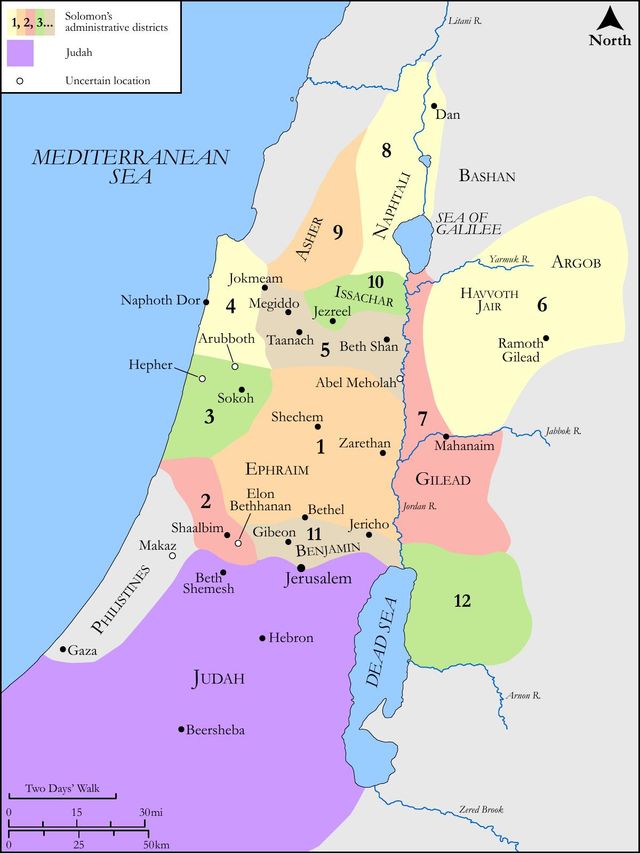
4.The dividing of this trust into so many hands was prudent, that no man might be continually burdened with the care of it nor grow exorbitantly rich with the profit of it, but that Solomon might have those, in every district, who, having a dependence upon the court, would be serviceable to him and his interest as there was occasion. These commissioners of the victualling-office, not for the army or navy (Solomon was engaged in no war), but for the household, are here named, several of them only by their surnames, as great men commonly call their servants: Ben-hur, Ben-dekar, etc., though several of them have also their proper names prefixed. Two of them married Solomon's daughters, Ben-Abinadab (Kg1 4:11) and Ahimaaz (Kg1 4:15), and no disparagement to them to marry men of business. Better match with the officers of their father's court that were Israelites than with the sons of princes that were strangers to the covenant of promise. The son of Geber was in Ramoth-Gilead (Kg1 4:19), and Geber himself was in the country of Sihon and Og, which included that and Mahanaim, Kg1 4:14. He is therefore said to be the only officer in that land, because the other two, mentioned Kg1 4:13, Kg1 4:14, depended on him, and were subordinate to him.
Historical interpretation
Historical reception
1 surviving comment on this verse from the historical church.
The officials elected by Solomon designate the order of the chosen ones whom Christ affirmed in his grace and appointed as rulers of his people. Indeed, twelve prefects were selected to administer the incomes of this king and his house, because just as many apostles had to be distributed over the entire world and had to be appointed as treasures of the divine mysteries, so that they might nourish with living and immortal food the Israel of God and might administer the incomes of the house of the peaceful king. Therefore, also the limits of each prefecture were clearly denoted, because, in a similar way, each apostle received a certain province: Simon preached in Rome, John in Ephesus, Matthew in Palestine and Thomas in the region of India.
Continue studying 1 Kings 4:3 across the web’s major study libraries — every link below opens this exact verse, chapter, or book on the destination site.
Read & Compare
 BibleGatewayThis verse in more than 200 translations and 70 languages.
 Bible.comThe YouVersion reader — hundreds of translations, reading plans, and highlights.
 ESV.orgCrossway's official English Standard Version reader.
 NET BibleThe NET translation with 60,000+ translators' notes on every rendering decision.
 STEP BibleTyndale House's free study tool — original text, vocabulary, and scholarly resources.
 BibliaLogos Bible Software's free web reader.
 USCCBThe New American Bible (Revised Edition) with the U.S. bishops' study notes.
Commentaries
 BibleHub CommentariesDozens of classic commentaries on this verse, gathered on one page.
 StudyLightMore than 100 commentary sets — the largest collection on the web.
 BibleRefPlain-English commentary on what this verse means, verse by verse.
 Enduring WordDavid Guzik's free commentary on this chapter, widely used by Bible teachers.
 Bible Study ToolsVerse commentary alongside Greek and Hebrew study aids.
Original Language & Research
- BibleHub InterlinearThe verse word by word — original language, transliteration, and English.
- BibleHub LexiconEvery word's original-language definition and Strong's entry.
 Blue Letter BibleDeep-study tools — Strong's numbers, concordance, and word studies.
 SefariaThe Hebrew text with Rashi and centuries of Jewish commentary.
Sermons, Hymns & Audio


TrulyRandomVerse is not affiliated with these sites and doesn’t control their content. They’re linked because they’re genuinely useful.
Summary
1 Kings 4:3 introduces two key administrative figures, Elihoreph and Ahiah, identified as the sons of Shisha and serving as scribes, alongside Jehoshaphat, the son of Ahilud, who held the esteemed position of royal recorder. This verse is an essential component of a broader enumeration of King Solomon's principal officials, meticulously detailing the sophisticated bureaucratic framework that underpinned the unprecedented peace, prosperity, and expansive reach of his divinely blessed kingdom. It underscores the critical importance of specialized roles and diligent administration in effective governance within a monarchy.
Context
ShowHideLiterary Context
This verse is situated within 1 Kings 4, a chapter primarily dedicated to portraying the unparalleled wisdom, peace, and prosperity that characterized King Solomon's reign. Following the consolidation of his kingdom and the divine bestowal of wisdom (as detailed in 1 Kings 3), chapter 4 systematically outlines the practical manifestations of this wisdom in the realm of governance. The listing of officials from 1 Kings 4:1-6 serves as a foundational element, illustrating the robust administrative infrastructure that supported the vast geographical extent of his kingdom (further elaborated in 1 Kings 4:21-25) and facilitated his ambitious building projects and extensive trade networks. The specific mention of scribes and a recorder in this verse highlights the critical role of documentation, communication, and historical memory within this highly organized system, preceding the descriptions of his daily provisions, military strength, and unique intellectual prowess.
Historical & Cultural Context
Among the kings of that day, royal courts were intricate centers of power, and efficient administration was absolutely paramount for effectively managing large territories, diverse populations, and complex state affairs. Scribes (Hebrew: sopherim) were highly educated and literate individuals, often fulfilling multifaceted roles as royal secretaries, legal experts, archivists, and even diplomatic communicators. Their specialized skills in reading, writing, and interpreting documents were invaluable in societies where literacy was a rare and specialized craft. The recorder (Hebrew: mazkir) held an exceptionally unique and prestigious position, primarily responsible for maintaining the official royal chronicles, advising the king on historical precedents and legal matters, and potentially serving as a public herald or master of ceremonies. These roles were far from mere clerical functions; they often involved significant political influence, direct access to the monarch, and a deep understanding of state affairs, reflecting the sophisticated administrative practices that were common in powerful empires of the era, such as Egypt and Mesopotamia, which Israel was now emulating and, in some respects, surpassing under Solomon's leadership.
Key Themes
ShowHideThe inclusion of these specific administrative roles in 1 Kings 4 contributes significantly to several overarching theological and narrative themes. Firstly, it powerfully underscores the theme of Order and Administration, showcasing Solomon's divinely inspired capacity to establish a highly structured, efficient, and functional government. This meticulous organization is presented as a hallmark of a truly wise and blessed ruler. Secondly, it highlights the theme of Specialized Governance, emphasizing that the unprecedented prosperity and stability of the kingdom were not solely a result of Solomon's personal wisdom but also of his astute ability to delegate authority to capable individuals in distinct, specialized roles. This reflects a crucial principle that effective leadership involves assembling, empowering, and coordinating a skilled team. Finally, these administrative details reinforce the central theme of Solomon's Unparalleled Wisdom, demonstrating how his wisdom, specifically prayed for in 1 Kings 3:9, translated directly into practical, effective, and enduring governance, thereby ushering in a period of unprecedented peace, security, and prosperity for the nation of Israel, precisely as prophesied and desired by God.
Exposition and Analysis
ShowHideKey Word Analysis
ShowHideDerived from the primitive root H5608 (çâphar), which properly means "to score with a mark as a tally or record," and by implication, "to inscribe" or "to enumerate." In ancient Israel, a sopher (scribe) was much more than a simple copyist. They were highly educated and literate officials tasked with drafting royal decrees, managing state correspondence, maintaining legal documents, and often serving as advisors to the king. Their role was absolutely crucial for the efficient functioning of the kingdom, encompassing administrative, legal, and educational duties. The plural form sopherim (implied by the context of "scribes" in the KJV) indicates that multiple individuals held this vital office, reflecting the extensive documentation and communication required by Solomon's expansive and complex kingdom.
From the primitive root H2142 (zâkar), meaning "to mark (so as to be recognized)," and by implication, "to remember" or "to mention," and in its denominative form, "to be male." In the context of the mazkir (recorder), the emphasis is on "to cause to be remembered" or "to record." The mazkir was a high-ranking official whose primary duty was to keep the official royal annals or chronicles, ensuring that the king's deeds, decrees, and significant events were accurately recorded for posterity. This prestigious role also involved advising the king on historical precedents, and potentially serving as a royal herald or public announcer. The recorder was essentially the keeper of the kingdom's institutional memory, a vital role in maintaining continuity, legitimacy, and historical accuracy for the monarchy.
Verse Breakdown
ShowHide"Elihoreph and Ahiah, the sons of Shisha, scribes"
This initial clause introduces two specific individuals, Elihoreph and Ahiah, who are identified through their patronymic, "the sons of Shisha." This familial designation not only serves to distinguish them but also may suggest a lineage of service to the crown or a connection to a prominent administrative house. Their explicit designation as "scribes" immediately places them in positions of significant administrative responsibility, highlighting their crucial role in the kingdom's extensive record-keeping, official correspondence, and the meticulous drafting of legal and governmental documents. The mention of two scribes underscores the sheer volume and critical importance of written communication and systematic administration within King Solomon's burgeoning court.
"Jehoshaphat the son of Ahilud, the recorder"
This second clause names Jehoshaphat, identified by his patronymic as "the son of Ahilud," and specifies his unique and highly prestigious role as "the recorder." It is noteworthy that this Jehoshaphat is the same individual who served as recorder under King David (as seen in 2 Samuel 8:16), indicating a remarkable continuity in this crucial administrative office across two reigns. His function as the official chronicler, the keeper of royal memory, and potentially a key advisor on historical precedents was indispensable for maintaining the kingdom's history, preserving its legal and political precedents, and shaping its public image.
Literary Devices
ShowHideThe presentation of 1 Kings 4:3, as an integral part of a larger enumeration of officials, primarily employs List as a literary device. This structured enumeration serves to convey a profound sense of comprehensive order, administrative completeness, and meticulous organization, thereby emphasizing the vastness and the sophisticated nature of Solomon's kingdom. The consistent use of Patronymics ("the sons of Shisha," "the son of Ahilud") is a common biblical convention that not only identifies individuals precisely but also anchors them within established families or lineages, lending credibility, historical grounding, and a sense of continuity to their positions within the royal administration. Furthermore, the detailed listing of specific, specialized roles (scribes, recorder) utilizes Specification to highlight the advanced division of labor within Solomon's government, demonstrating that his reign was characterized by expert administration and strategic delegation rather than arbitrary rule. This meticulous detail implicitly functions as a form of Validation, confirming the biblical narrative's portrayal of Solomon's unparalleled wisdom and the resultant unprecedented prosperity and stability of his kingdom.
Theological and Thematic Connections
ShowHideThe seemingly mundane listing of officials in 1 Kings 4:3 carries profound theological implications, subtly revealing God's active hand in establishing order, wisdom, and effective governance within human society. It powerfully demonstrates that divine blessing often manifests not solely through miraculous intervention but also through the careful, wise, and diligent organization of human affairs. Solomon's remarkable ability to assemble such a competent, specialized, and dedicated administrative team is presented as a direct outworking of God's sovereign gift of wisdom to him, showing that true wisdom extends far beyond abstract knowledge to encompass practical leadership, strategic delegation, and the effective stewardship of both human and material resources. This verse subtly teaches that God values order, accountability, and the proper delegation of authority, principles that are absolutely essential for any thriving society, organization, or spiritual community. The very existence and emphasis on these administrative roles underscore the enduring importance of record-keeping, historical memory, and diligent administration in reflecting God's own orderly, faithful, and wise character.
Reflection and Application
ShowHide1 Kings 4:3, despite being a simple enumeration of names and titles, offers profoundly rich insights for contemporary reflection and practical application. It serves as a powerful reminder that effective leadership, whether exercised in a nation, a corporate organization, or a local church, demands not only visionary foresight but also the practical wisdom to establish robust administrative structures and to empower competent individuals in specialized roles. Just as Solomon's kingdom flourished under a system of delegated authority, meticulous record-keeping, and expert administration, so too do modern endeavors benefit immensely from order, accountability, and the strategic leveraging of diverse gifts and talents. This verse challenges us to value, respect, and actively support those who serve diligently in administrative, organizational, and record-keeping capacities within our communities, recognizing their vital, often unsung, contributions to the overall health, efficiency, and effectiveness of any body. It also encourages us to consider how we, as individuals, can personally contribute to fostering order, diligence, and faithful stewardship within our own spheres of influence, utilizing our unique skills and callings to build up rather than tear down, thereby reflecting God's character of order, wisdom, and intentionality in all aspects of our lives.
Questions for Reflection
ShowHideFAQ
ShowHideWhy is such a detailed list of officials included in the biblical narrative?
ShowHideThe inclusion of a detailed list of Solomon's officials, including the scribes and the recorder, serves several crucial and interconnected purposes within the biblical narrative. Firstly, it underscores the historical veracity and meticulousness of the biblical record, providing concrete evidence of the sophisticated administrative machinery that supported and sustained Solomon's reign. Secondly, it highlights the unprecedented scale and prosperity of his kingdom, demonstrating that his era of peace and wealth was not accidental but was the direct result of divinely granted wisdom applied to practical and highly organized governance. A large, well-organized bureaucracy was absolutely essential for managing an empire that stretched from the Euphrates River to the border of Egypt, as vividly described in 1 Kings 4:21. Finally, and perhaps most importantly, it emphasizes Solomon's wisdom in governance, showing how he wisely delegated authority, established a system of specialized roles, and ensured accountability, reflecting the practical outworking of the "understanding heart" he specifically prayed for and received from God in 1 Kings 3:9. This detailed account ultimately validates the divine blessing and favor upon his rule.
Christ-Centered Fulfillment
ShowHideWhile 1 Kings 4:3 meticulously details the earthly administration of King Solomon, it subtly but profoundly points forward to the perfect, eternal, and universal administration of King Jesus. Solomon's reign, though glorious and divinely blessed, was ultimately a temporary and imperfect shadow, a mere type of the kingdom to come. His wise delegation of authority to scribes and recorders, establishing order and preserving institutional memory, foreshadows Christ's ultimate and perfect ordering of His spiritual and universal kingdom. Jesus, as the true and greater Solomon, is the King of kings and Lord of lords who perfectly governs His vast domain, not through human officials prone to error or succession, but by His inherent divine wisdom and sovereign decree. He is the ultimate "Recorder," whose very words are truth and life, and whose Incarnation, life, death, and resurrection constitute the ultimate record of God's faithfulness, love, and redemptive plan for humanity, perfectly fulfilling the law and the prophets (as seen in Matthew 5:17). Furthermore, just as Solomon's officials served distinct and specialized roles, Christ establishes His church as a living body with many members, each uniquely gifted and strategically placed by the Holy Spirit for specific functions that contribute to the whole (as beautifully articulated in 1 Corinthians 12:12-27). In Christ, all administrative order finds its perfect design, and all record-keeping culminates not in earthly annals, but in the Lamb's Book of Life (Revelation 21:27), where the names of His redeemed are eternally inscribed by the ultimate Scribe, God Himself, ensuring a kingdom that will never end.