


1 Chronicles 18:15
- וְיוֹאָבve·yo·'Avand JoabH3097Conj-w ¦ N-proper-mNoun Proper MasculineוְandיוֹאָבJoab
- בֶּןben[the] son ofH1121N-mscNoun Singular Masculine Construct
- צְרוּיָהtze·ru·YahZeruiahH6870N-proper-fNoun Proper Feminine
- עַל'al[was] overH5921PrepPreposition
- הַצָּבָאha·tza·Va'the armyH6635Art ¦ N-msNoun Singular Masculine Absoluteהַtheצָּבָאarmy
- וִיהוֹשָׁפָטvi·ho·sha·Fatand JehoshaphatH3092Conj-w ¦ N-proper-mNoun Proper MasculineוִandיהוֹשָׁפָטJehoshaphat
- בֶּןben[the] son ofH1121N-mscNoun Singular Masculine Construct
- אֲחִילוּד'a·chi·LudAhiludH286N-proper-mNoun Proper Masculine
- מַזְכִּירmaz·Kir[was the] recorderH2142V-Hiphil-Prtcpl-msVerb Hiphil Participle Singular Masculine Absolute
English is a literal word-by-word gloss of the Hebrew, not the KJV's wording. Why?
This is the original text the KJV's translators worked from — each Hebrew word with its own literal English meaning in this verse, prepared by scholars at Tyndale House, Cambridge. The KJV translates whole sentences, not word by word, so its wording differs: one Hebrew word can become several English words, and the KJV may choose “the LORD” where the gloss reads “Yahweh”. Both are faithful — they answer different questions. For the KJV's own rendering, switch to the KJV text.
Details
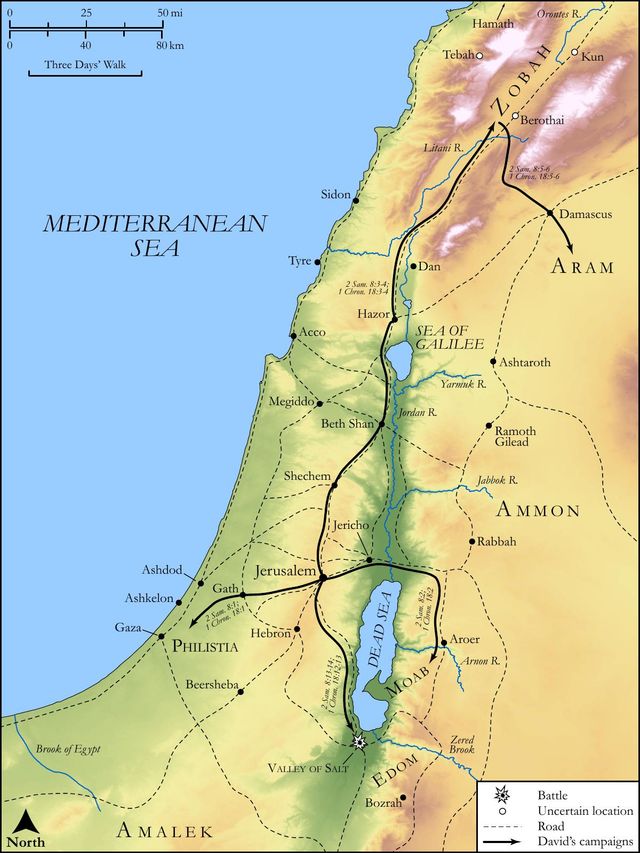
See on the biblical-era map
Study this verse
Public-domain commentary
Matthew Henry
From his Commentary on the Whole Bible. Henry comments on passages, not single verses — this entry covers 1 Chronicles 18:9–17.
Here let us learn, 1. That it is our interest to make those our friends who have the presence of God with them. The king of Hamath, hearing of David's great success, sent to congratulate him and to court his favour with a noble present, Ch1 18:9, Ch1 18:10. It is in vain to contend with the Son of David. Kiss the Son, therefore, lest he be angry; let the kings and judges of the earth, and all inferior people too, be thus wise, thus instructed. The presents we are to bring him are not vessels of gold and silver, as here (those shall be welcomed to him who have no such presents to bring), but our hearts and sincere affections, our whole selves, we must present to him as living sacrifices. 2. That what God blesses us with we must honour him with. The presents of his friends, as well as the spoils of his enemies, David dedicated unto the Lord (Ch1 18:11), that is, he laid them up towards the building and enriching of the temple. That is most truly and most comfortably our own which we have consecrated unto the Lord, and which we use for his glory. Let our merchandise and our hire be holiness to the Lord, Isa 23:18. 3. That those who take God along with them whithersoever they go may expect to prosper, and be preserved, whithersoever they go. It was said before (Ch1 18:6) and here it is repeated (Ch1 18:13) that the Lord preserved David whithersoever he went. Those are always under the eye of God that have God always in their eye. 4. God gives men power, not that they may look great with it, but that they may do good with it. When David reigned over all Israel he executed judgment and justice among all his people, and so answered the end of his elevation. He was not so intent on his conquests abroad as to neglect the administration of justice at home. Herein he served the purposes of the kingdom of providence, and of that God who sits in the throne judging right; and he was an eminent type of the Messiah, the sceptre of whose kingdom is a right sceptre.
Continue studying 1 Chronicles 18:15 across the web’s major study libraries — every link below opens this exact verse, chapter, or book on the destination site.
Read & Compare
 BibleGatewayThis verse in more than 200 translations and 70 languages.
 Bible.comThe YouVersion reader — hundreds of translations, reading plans, and highlights.
 ESV.orgCrossway's official English Standard Version reader.
 NET BibleThe NET translation with 60,000+ translators' notes on every rendering decision.
 STEP BibleTyndale House's free study tool — original text, vocabulary, and scholarly resources.
 BibliaLogos Bible Software's free web reader.
 USCCBThe New American Bible (Revised Edition) with the U.S. bishops' study notes.
Commentaries
 BibleHub CommentariesDozens of classic commentaries on this verse, gathered on one page.
 StudyLightMore than 100 commentary sets — the largest collection on the web.
 BibleRefPlain-English commentary on what this verse means, verse by verse.
 Enduring WordDavid Guzik's free commentary on this chapter, widely used by Bible teachers.
 Bible Study ToolsVerse commentary alongside Greek and Hebrew study aids.
Original Language & Research
- BibleHub InterlinearThe verse word by word — original language, transliteration, and English.
- BibleHub LexiconEvery word's original-language definition and Strong's entry.
 Blue Letter BibleDeep-study tools — Strong's numbers, concordance, and word studies.
 SefariaThe Hebrew text with Rashi and centuries of Jewish commentary.
Sermons, Hymns & Audio


TrulyRandomVerse is not affiliated with these sites and doesn’t control their content. They’re linked because they’re genuinely useful.
Summary
1 Chronicles 18:15 concisely outlines two pivotal appointments within King David's burgeoning administration: Joab, his formidable military commander, and Jehoshaphat, the diligent recorder. This verse, appearing immediately after a series of significant military victories, underscores David's strategic foresight in establishing a robust and organized kingdom. It highlights his commitment to not only securing his realm through conquest but also ensuring its long-term stability and effective governance through the delegation of authority to trusted and competent officials, thereby laying a foundational administrative framework for Israel's golden age.
Context
ShowHideLiterary Context
This verse is situated within a broader narrative in 1 Chronicles 18 that chronicles King David's military triumphs and the subsequent consolidation of his kingdom. The preceding verses, 1 Chronicles 18:1-14, detail David's decisive victories over the Philistines, Moabites, Syrians, Edomites, and Ammonites, bringing vast territories and tribute under his dominion. Following this period of intense military expansion and the establishment of regional supremacy, the Chronicler shifts focus to the internal organization of David's realm. The listing of key officials, beginning with Joab and Jehoshaphat, demonstrates that David was not merely a warrior-king but also a shrewd administrator, recognizing the necessity of a well-structured government to manage his expanded empire and maintain order. This administrative detail provides a crucial counterpoint to the military narrative, showing the holistic nature of David's reign and his comprehensive approach to establishing a stable kingdom.
Historical & Cultural Context
In the ancient Near East, a king's power and stability were directly tied to his ability to command a strong military and establish an efficient bureaucracy. As David's kingdom grew from a tribal confederacy into a regional empire, the need for specialized roles became paramount. Joab's position as "over the host" (commander of the army) was a common and essential role in any monarchy, signifying supreme military authority second only to the king. His appointment reflects the ongoing need for military readiness and command over the vast forces now at David's disposal. The "recorder" (Hebrew: mazkir) was a high-ranking official, far more than a simple scribe. This role, found in various ancient Near Eastern courts, involved keeping official state records, advising the king on policy, managing diplomatic correspondence, and essentially serving as a royal chronicler or secretary of state. The appointment of such officials signified the formalization and sophistication of David's government, moving beyond ad-hoc leadership to a structured administration capable of managing a complex and expanding kingdom.
Key Themes
ShowHideThe inclusion of this administrative detail in the Chronicler's account contributes to several overarching themes. Firstly, it highlights Order and Administration, emphasizing David's commitment to establishing a well-governed kingdom, not just a militarily dominant one. This reflects a divine principle of order, as seen in God's own creation and covenant arrangements. Secondly, the verse illustrates the crucial theme of Delegation of Authority. David, as a wise and effective leader, understood that he could not personally manage every aspect of his vast kingdom. By entrusting significant responsibilities to competent and loyal individuals like Joab and Jehoshaphat, he exemplified effective leadership and stewardship, allowing him to focus on broader strategic and spiritual leadership, echoing principles of wise governance found in passages like Exodus 18:21-22. Lastly, the role of the "recorder" underscores the Importance of Record-Keeping and Historical Memory. In a society where oral tradition was strong, official written records were vital for legal continuity, administrative consistency, and preserving the nation's history, including the unfolding of God's covenant promises, as seen in the very existence of the Books of Chronicles which draw upon such records.
Exposition and Analysis
ShowHideKey Word Analysis
ShowHideThe Hebrew word צָבָא (tsâbâʼ), Strong's H6635, refers to a mass of persons, especially those organized for war, an army, or a military force. In this context, "over the host" clearly designates Joab as the supreme commander of Israel's armed forces. This term emphasizes the organized, disciplined nature of David's military, which was instrumental in his conquests and the maintenance of his kingdom's security. It signifies not just a collection of warriors but a structured fighting force under a single, authoritative leader, crucial for both offense and defense.
The Hebrew term for "recorder" is mazkir, which is derived from the primitive root זָכַר (zâkar), Strong's H2142. This root means "to mark (so as to be recognized)," "to remember," and by implication, "to mention" or "to recount." The mazkir was a high-ranking royal official, literally "one who causes to remember" or a "remembrancer." This title goes beyond the modern understanding of a mere scribe or secretary. The mazkir was responsible for advising the king, bringing important matters to his attention, maintaining state archives, drafting official documents, and potentially handling foreign correspondence. The role required not only literacy and organizational skills but also political acumen and the king's absolute trust, as the recorder held sensitive information and influenced royal decisions.
Verse Breakdown
ShowHide"And Joab the son of Zeruiah [was] over the host"
This clause identifies Joab, David's nephew (son of his sister Zeruiah, Strong's H6870), as the supreme military commander. Joab (Strong's H3097) was a formidable and often ruthless warrior, instrumental in many of David's military campaigns. His position signifies the continued importance of military strength and leadership in securing and maintaining David's expanded kingdom. The Chronicler emphasizes Joab's established role, highlighting the stability and continuity of David's administrative appointments.
"and Jehoshaphat the son of Ahilud, recorder"
This second clause introduces Jehoshaphat (Strong's H3092), son of Ahilud (Strong's H286), as the "recorder." This appointment highlights the administrative sophistication of David's court. As discussed in "Key Word Analysis," the recorder was a vital official responsible for state records, advising the king, and ensuring the proper functioning of the royal bureaucracy. The pairing of military and administrative leadership in a single verse underscores the two essential pillars upon which David's kingdom was built: military might for external security and internal order, and efficient administration for governance and continuity.
Literary Devices
ShowHideThe verse employs Juxtaposition to highlight the dual pillars of David's successful reign: military power and administrative order. By placing Joab, the commander of the army, immediately alongside Jehoshaphat, the recorder, the text concisely presents the two most crucial aspects of governance in an expanding ancient kingdom. This pairing is not accidental; it demonstrates David's comprehensive approach to leadership, recognizing that conquest must be followed by stable rule. Furthermore, the verse's Conciseness is a notable literary feature. In just a few words, the Chronicler conveys significant information about the structure and key personnel of David's government, reflecting an efficient narrative style that prioritizes essential details for understanding the kingdom's foundation.
Theological and Thematic Connections
ShowHideThis seemingly administrative verse offers profound theological and thematic insights into the nature of righteous governance and the establishment of a divinely favored kingdom. David's meticulous organization of his kingdom, including the appointment of specialized officials like Joab and Jehoshaphat, reflects a commitment to order and wisdom that aligns with biblical principles of good stewardship. It demonstrates that true leadership, even under God's anointing, requires practical wisdom in delegation, administration, and the establishment of just structures. This attention to detail in governance is not merely secular efficiency but an outworking of God's own character of order and purpose, preparing the way for the future of His covenant people and the ultimate reign of the Messiah.
Reflection and Application
ShowHideThe brief mention of Joab and Jehoshaphat in 1 Chronicles 18:15 offers timeless principles for leadership, organization, and stewardship applicable to all areas of life, from personal endeavors to communal responsibilities. David's wisdom in delegating authority to competent individuals, whether in military strategy or meticulous record-keeping, reminds us of the importance of recognizing and utilizing diverse gifts within any team or organization. Effective leadership involves not doing everything oneself, but discerning who is best suited for particular tasks and empowering them to excel. This verse encourages us to consider the structures and systems we employ in our own lives, families, churches, and workplaces. Are we creating order where there is chaos? Are we preserving important records and lessons for the future? Are we stewarding our resources, talents, and time with the same intentionality David applied to his kingdom, recognizing that all we have is a trust from God? Ultimately, it calls us to cultivate environments of stability, efficiency, and accountability, reflecting the order and purpose of our Creator, and recognizing that good governance, even in seemingly mundane administrative tasks, contributes to the flourishing of God's purposes.
Questions for Reflection
ShowHideFAQ
ShowHideWhat was Joab's relationship with David?
ShowHideJoab was King David's nephew, the son of David's sister Zeruiah. This familial connection, combined with his exceptional military prowess, made him David's most trusted and formidable general. He served as the commander of David's army throughout much of his reign, playing a crucial role in securing David's kingdom through numerous military campaigns, as seen in passages like 2 Samuel 8:16 and 1 Chronicles 11:6. While fiercely loyal to David, Joab was also known for his ruthless pragmatism and occasional defiance, sometimes acting independently in ways that complicated David's reign.
What was the primary function of a "recorder" in ancient Israel?
ShowHideThe "recorder" (Hebrew: mazkir) was a high-ranking and highly influential administrative official in the royal court of ancient Israel, far more than a simple scribe. Their primary functions included keeping official state records and chronicles, advising the king on matters of policy and state, acting as a liaison between the king and his subjects or other officials, and potentially managing diplomatic correspondence. The title itself, derived from the root "to remember," suggests their role in bringing important matters to the king's attention and ensuring that key information and historical events were preserved for continuity and future reference. This position required significant trust, intellectual acumen, and political sensitivity, as highlighted in parallel accounts like 2 Samuel 8:17.
Why is this seemingly administrative verse included in Chronicles?
ShowHideThe Chronicler's primary purpose was to present a theological history of Israel, emphasizing the Davidic covenant, the temple, and the importance of faithful worship and righteous leadership for the post-exilic community. The inclusion of administrative details like 1 Chronicles 18:15 serves several key purposes. Firstly, it demonstrates David's wisdom and foresight in establishing a stable and well-ordered kingdom, which was a prerequisite for the future temple and the flourishing of the covenant people. Secondly, it highlights the divine blessing upon David, enabling him to not only conquer but also to govern effectively. Thirdly, it provides a model of good governance and delegation for future leaders, underscoring that spiritual leadership is often accompanied by practical organization and administrative competence. The Chronicler shows that David's success was holistic, encompassing both military might and internal order, laying a solid foundation for the enduring "house" and kingdom promised by God (e.g., 1 Chronicles 17:11-14).
Christ-Centered Fulfillment
ShowHideWhile 1 Chronicles 18:15 details the earthly administration of King David, it subtly points to the perfect and eternal administration of King Jesus, the ultimate Son of David. David's establishment of order through trusted officials foreshadows Christ's sovereign headship over all creation and His Church. Just as Joab commanded David's earthly hosts, Christ is the supreme Commander of the heavenly hosts and the Church, leading His people in spiritual warfare and ultimate victory over sin and death, as described in Ephesians 1:22-23. Moreover, like Jehoshaphat, the recorder, who preserved the king's decrees and advised on matters of state, Jesus is the ultimate "Recorder" and revealer of God's truth and will. He is the Word made flesh, the perfect embodiment and communication of God's eternal plan, the One who "upholds the universe by the word of his power" (Hebrews 1:3). In Christ, we find the perfect blend of power and wisdom, the one who perfectly governs His kingdom, ensuring its eternal stability and the faithful execution of God's redemptive purposes, far surpassing any earthly administration or record-keeping. His reign is one of perfect order, justice, and eternal peace, fulfilling all the promises made to David.