


1 Chronicles 18:14
Bible text: King James Version (1769 Blayney text) · Public domain
Bible text: Berean Standard Bible · Public domain
Bible text: American Standard Version (1901) · Public domain
Bible text: World English Bible, Messianic edition · Public domain
Bible text: Geneva Bible (1599) · Public domain
Bible text: Young's Literal Translation · Public domain
- וַיִּמְלֹךְvai·yim·Lokhand he reignedH4427Conj-w ¦ V-Qal-ConsecImperf-3msVerb Qal Consecutive Imperfect 3rd Singular Masculineוַandיִּמְלֹךְhe reigned
- דָּוִידda·VidDavidH1732N-proper-mNoun Proper Masculine
- עַל'aloverH5921PrepPreposition
- כָּלkolallH3605N-mscNoun Singular Masculine Construct
- יִשְׂרָאֵלYis·ra·'ElIsraelH3478N-properNoun Proper Location
- וַיְהִיvay·Hiand he wasH1961Conj-w ¦ V-Qal-ConsecImperf-3msVerb Qal Consecutive Imperfect 3rd Singular Masculineוַandיְהִיhe was
- עֹשֶׂה'o·SehdoingH6213V-Qal-Prtcpl-msVerb Qal Participle Singular Masculine Absolute
- מִשְׁפָּטmish·PatjusticeH4941N-msNoun Singular Masculine Absolute
- וּצְדָקָהu·tze·da·Kahand righteousnessH6666Conj-w ¦ N-fsNoun Singular Feminine Absoluteוּandצְדָקָהrighteousness
- לְכָלle·kholfor allH3605Prep-l ¦ N-mscNoun Singular Masculine Constructלְforכָלall
- עַמּוֹa·Mohis peopleH5971N-msc ¦ 3msNoun Singular Masculine Constructעַמּpeopleוֹhis
English is a literal word-by-word gloss of the Hebrew, not the KJV's wording. Why?
This is the original text the KJV's translators worked from — each Hebrew word with its own literal English meaning in this verse, prepared by scholars at Tyndale House, Cambridge. The KJV translates whole sentences, not word by word, so its wording differs: one Hebrew word can become several English words, and the KJV may choose “the LORD” where the gloss reads “Yahweh”. Both are faithful — they answer different questions. For the KJV's own rendering, switch to the KJV text.
Details
See on the biblical-era map
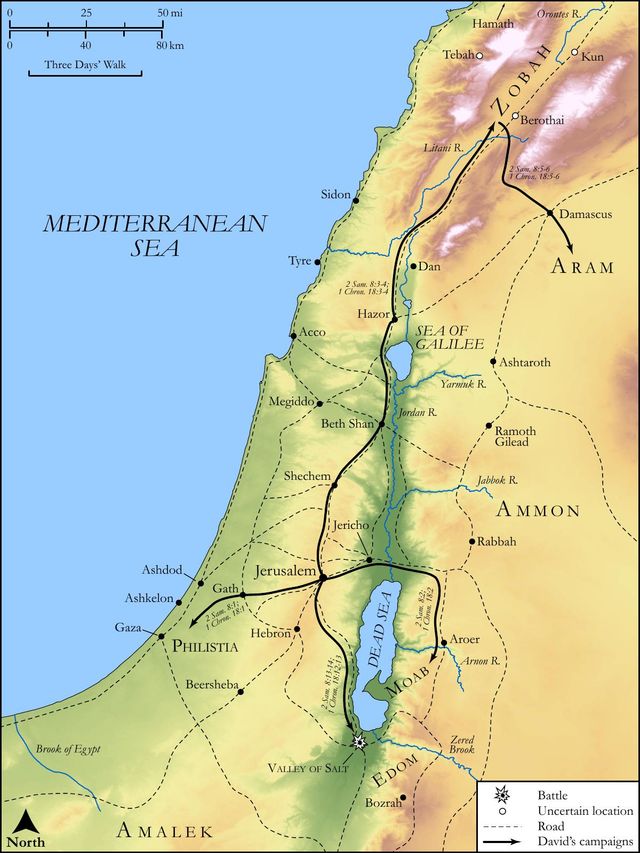
Study this verse
Public-domain commentary
Matthew Henry
From his Commentary on the Whole Bible. Henry comments on passages, not single verses — this entry covers 1 Chronicles 18:9–17.
Here let us learn, 1. That it is our interest to make those our friends who have the presence of God with them. The king of Hamath, hearing of David's great success, sent to congratulate him and to court his favour with a noble present, Ch1 18:9, Ch1 18:10. It is in vain to contend with the Son of David. Kiss the Son, therefore, lest he be angry; let the kings and judges of the earth, and all inferior people too, be thus wise, thus instructed. The presents we are to bring him are not vessels of gold and silver, as here (those shall be welcomed to him who have no such presents to bring), but our hearts and sincere affections, our whole selves, we must present to him as living sacrifices. 2. That what God blesses us with we must honour him with. The presents of his friends, as well as the spoils of his enemies, David dedicated unto the Lord (Ch1 18:11), that is, he laid them up towards the building and enriching of the temple. That is most truly and most comfortably our own which we have consecrated unto the Lord, and which we use for his glory. Let our merchandise and our hire be holiness to the Lord, Isa 23:18. 3. That those who take God along with them whithersoever they go may expect to prosper, and be preserved, whithersoever they go. It was said before (Ch1 18:6) and here it is repeated (Ch1 18:13) that the Lord preserved David whithersoever he went. Those are always under the eye of God that have God always in their eye. 4. God gives men power, not that they may look great with it, but that they may do good with it. When David reigned over all Israel he executed judgment and justice among all his people, and so answered the end of his elevation. He was not so intent on his conquests abroad as to neglect the administration of justice at home. Herein he served the purposes of the kingdom of providence, and of that God who sits in the throne judging right; and he was an eminent type of the Messiah, the sceptre of whose kingdom is a right sceptre.
Continue studying 1 Chronicles 18:14 across the web’s major study libraries — every link below opens this exact verse, chapter, or book on the destination site.
Read & Compare
 BibleGatewayThis verse in more than 200 translations and 70 languages.
 Bible.comThe YouVersion reader — hundreds of translations, reading plans, and highlights.
 ESV.orgCrossway's official English Standard Version reader.
 NET BibleThe NET translation with 60,000+ translators' notes on every rendering decision.
 STEP BibleTyndale House's free study tool — original text, vocabulary, and scholarly resources.
 BibliaLogos Bible Software's free web reader.
 USCCBThe New American Bible (Revised Edition) with the U.S. bishops' study notes.
Commentaries
 BibleHub CommentariesDozens of classic commentaries on this verse, gathered on one page.
 StudyLightMore than 100 commentary sets — the largest collection on the web.
 BibleRefPlain-English commentary on what this verse means, verse by verse.
 Enduring WordDavid Guzik's free commentary on this chapter, widely used by Bible teachers.
 Bible Study ToolsVerse commentary alongside Greek and Hebrew study aids.
Original Language & Research
- BibleHub InterlinearThe verse word by word — original language, transliteration, and English.
- BibleHub LexiconEvery word's original-language definition and Strong's entry.
 Blue Letter BibleDeep-study tools — Strong's numbers, concordance, and word studies.
 SefariaThe Hebrew text with Rashi and centuries of Jewish commentary.
Sermons, Hymns & Audio


TrulyRandomVerse is not affiliated with these sites and doesn’t control their content. They’re linked because they’re genuinely useful.
Summary
1 Chronicles 18:14 serves as a profound summary statement, encapsulating the pinnacle of King David's early reign. Following a period of extensive military triumphs that firmly established Israel's geopolitical dominance and secured its borders, this verse distills the very essence of his leadership. It highlights not only his comprehensive and unifying authority over a consolidated Israel but, more significantly, his unwavering commitment to administering equitable judgment and profound righteousness among all his subjects. This verse underscores the character of a divinely appointed king whose rule was marked by both formidable power and deep ethical integrity, laying the foundation for a stable and prosperous kingdom.
Context
ShowHideLiterary Context
This verse functions as a powerful concluding summary to the detailed account of David's extensive military victories presented in 1 Chronicles 18:1-13. The preceding narrative meticulously chronicles David's subjugation of formidable regional adversaries—including the Philistines, Moabites, Syrians, Edomites, and Ammonites—and the vast quantities of tribute and spoils he amassed. Crucially, the Chronicler repeatedly emphasizes the divine enablement behind these successes, stating unequivocally that "the LORD preserved David whithersoever he went" (1 Chronicles 18:6 and 1 Chronicles 18:13). This consistent divine intervention culminates in a period of unprecedented national security and prosperity, thereby setting the stage for the characterization of David's reign as one defined by righteous governance, rather than merely by military might. The verse seamlessly transitions the narrative from external conquest to internal consolidation, from addressing foreign threats to establishing just domestic administration, preparing the reader for subsequent accounts of David's spiritual and civic leadership.
Historical & Cultural Context
David's ascension to the throne marked a pivotal and transformative period for Israel, transitioning the nation from a loosely organized tribal confederacy to a unified and centralized monarchy. Prior to his reign, Israel frequently grappled with internal divisions and persistent external oppression from surrounding peoples. By David's era, the concept of kingship was well-established among the nations round about, with rulers often perceived as divine representatives or mediators between the gods and humanity, responsible for maintaining order in the world and in society. For Israel, however, kingship was uniquely defined by the Mosaic Law and the covenant relationship with Yahweh. A true Israelite king was expected to rule justly, uphold the principles of the Torah, and protect the vulnerable within society, thereby reflecting God's own righteous character. David's reign over "all Israel" signifies the monumental achievement of successfully integrating the northern and southern tribes under a single, divinely chosen monarch, a feat of immense political, social, and spiritual significance. His administration of "judgment and justice" was not merely a commendable practice but a fundamental covenantal requirement for a king operating under God's authority, ensuring the spiritual well-being and faithfulness of the entire nation.
Key Themes
ShowHideThis verse powerfully contributes to several overarching themes prevalent in 1 Chronicles and the broader biblical narrative. Firstly, it emphatically underscores Established Sovereignty, depicting David's complete and undisputed authority over a united Israel. This national unity, achieved through divine aid, stands in stark contrast to earlier periods of disunity and serves as a crucial precursor to the glorious Solomonic era, which would see the construction of the Temple. Secondly, the explicit emphasis on David having "executed judgment and justice" highlights Righteous Governance, which is a core expectation for all Israelite kings. This theme is central to the Chronicler's portrayal of David as an ideal king, whose rule directly reflected God's own attributes and established the moral and ethical foundation for the nation. This commitment to justice was not merely a political strategy but a profound theological imperative, reflecting the covenantal relationship between God and Israel, as vividly seen in passages like Deuteronomy 16:18-20. Finally, the verse implicitly reinforces the theme of Divine Mandate and Blessing. While not explicitly stating God's direct involvement in this specific verse, the preceding narrative's repeated assertion of God's preservation of David (1 Chronicles 18:6) strongly implies that David's capacity to rule justly and effectively was a direct outcome of divine favor and his faithful adherence to God's will, ensuring the stability and prosperity of the kingdom. This divine backing set David apart as a king uniquely chosen and empowered by God.
Exposition and Analysis
ShowHideKey Word Analysis
ShowHideThis verb (מָלַךְ, H4427) signifies the active exercise of kingship, to rule, or to ascend the throne. In this context, it denotes David's established and comprehensive authority, emphasizing not merely that he was king, but that he actively exercised his royal power over the entirety of Israel. The Chronicler's inclusion of the phrase "over all Israel" highlights the consolidated and effective nature of his monarchy, representing a fulfillment of God's promise to establish a king over His people. This word implies a stable and recognized dominion.
The Hebrew term (מִשְׁפָּט, H4941) refers to a verdict, a legal decision, or the administration of justice. It encompasses the entire legal and judicial process, including the application of laws, the resolution of disputes, and the protection of individual rights. For an Israelite king, "executing judgment" meant actively engaging in the legal system, ensuring that laws were applied fairly and impartially, and that justice was accessible to all, particularly the vulnerable and overlooked. It implies the establishment of a structured and orderly society under righteous rule, reflecting divine standards.
This word (צְדָקָה, H6666), often translated as "righteousness," denotes moral rectitude, conformity to divine standards, and doing what is inherently right in God's eyes. While mishpâṭ focuses on the procedural administration of law, tsᵉdâqâh speaks to the moral character and ethical foundation that underpins that administration. Together, "judgment and justice" (מִשְׁפָּט וּצְדָקָה) form a classic Hebrew pairing (a hendiadys) that describes ideal, ethical governance. This pairing signifies a rule that is not only legally sound and impartial but also morally upright, aligned with divine truth, and dedicated to the well-being of the community.
Verse Breakdown
ShowHide"So David reigned over all Israel"
This initial clause establishes David's supreme, unified, and undisputed authority. The introductory "So" (וַיִּמְלֹךְ, vayyimlokh, "and he reigned") serves as a direct connective, linking this summary statement to the preceding narrative of David's extensive military victories. These conquests provided the foundational stability necessary for his consolidated rule. The phrase "over all Israel" is crucial, emphasizing the unprecedented national unity achieved under David's leadership, a significant accomplishment given the historical tribal divisions and periods of disunity. It signifies a unified kingdom, politically and geographically, under one divinely appointed monarch, marking a new era of stability, strength, and centralized governance.
"and executed judgment and justice among all his people"
This second clause describes the intrinsic character and ethical foundation of David's reign, moving beyond mere political power to highlight his commitment to righteous governance. "Executed" (וַיַּעַשׂ, vayya'as, "and he did/made") indicates active and diligent implementation. The pairing of "judgment" (mishpâṭ) and "justice" (tsᵉdâqâh) signifies a rule that was both legally sound (fair application of the law, ensuring due process and equitable decisions) and morally upright (adherence to divine standards of righteousness, promoting societal well-being). The concluding phrase "among all his people" underscores the universal application of this righteous rule, meaning it extended to every citizen, regardless of their social standing or tribal affiliation, ensuring fairness, equity, and protection throughout the entire kingdom. This highlights David's role as a shepherd-king, diligently caring for the well-being and moral integrity of his entire flock.
Literary Devices
ShowHide1 Chronicles 18:14 masterfully employs several literary devices to convey its profound and multifaceted message. Primarily, it functions as a Summary Statement, providing a concise yet comprehensive encapsulation of David's reign immediately following his extensive military exploits. This technique allows the Chronicler to distill complex events into a memorable and impactful declaration, effectively shifting the narrative's focus from what David achieved militarily to how he governed ethically. There is also a subtle yet powerful Juxtaposition at play; the verse directly follows detailed accounts of David's military might, conquest, and the acquisition of vast spoils, yet it pivots to emphasize his internal, ethical governance. This highlights the Chronicler's theological perspective that true kingship is not merely about power and victory, but fundamentally about the righteous and just application of that power for the welfare of the people. The repetition of "all" in "all Israel" and "all his people" serves as a device of Emphasis, underscoring the comprehensive and universal nature of David's reign—both in terms of his territorial control over a unified nation and the equitable reach of his just administration to every citizen. This rhetorical choice reinforces the ideal of a unified and justly governed kingdom, a hallmark of David's exemplary rule.
Theological and Thematic Connections
ShowHideThis verse is profoundly theological, presenting David's reign as a quintessential model of divinely ordained kingship that directly reflects God's own immutable character. The pairing of "judgment" (mishpâṭ) and "justice" (tsᵉdâqâh) is a recurring and foundational motif throughout the Old Testament, frequently employed to describe the very attributes of God Himself and the expected conduct of His covenant people, especially their leaders. God is consistently portrayed as one who loves, establishes, and upholds justice (Psalm 33:5 and Psalm 99:4). Thus, David's unwavering commitment to these principles indicates his profound alignment with God's will and character, making his rule a tangible and earthly expression of divine governance. This ideal of righteous rule is foundational to the Davidic Covenant, where God promises an enduring dynasty, predicated on the king's faithfulness to uphold justice and righteousness. David's actions in this verse embody the very essence of what it means to be a king "after God's own heart," establishing a crucial precedent for all future rulers of Israel and powerfully foreshadowing the ultimate, perfectly righteous King.
Reflection and Application
ShowHideDavid's reign, as succinctly summarized in 1 Chronicles 18:14, offers a timeless and enduring blueprint for leadership and governance that extends far beyond the confines of ancient Israel. It profoundly challenges us to consider that true authority is not merely about wielding power, accumulating influence, or achieving outward success, but is fundamentally about character and an unwavering commitment to fairness, equity, and righteousness for all under one's influence. Whether in political office, corporate management, community leadership, or even within the intimate sphere of families, the principle remains constant: a stable, flourishing, and morally sound entity is built upon the consistent and impartial application of just principles. David's example powerfully reminds us that our actions as leaders, no matter how small our sphere of influence, have profound and lasting consequences for the well-being and moral fabric of those we serve. It calls us to actively reflect God's own divine attributes of justice and righteousness in our daily lives, recognizing that our leadership, in whatever capacity, is a sacred stewardship from God intended for the ultimate good of others and the glory of His holy name.
Questions for Reflection
ShowHideFAQ
ShowHideWhy is the pairing of "judgment and justice" so significant in biblical texts?
ShowHideThe pairing of "judgment" (mishpâṭ) and "justice" (tsᵉdâqâh) is profoundly significant in biblical texts because it represents the comprehensive ideal of righteous governance and moral order, directly reflecting God's own holy character. "Mishpâṭ" refers to the proper administration of law, legal decisions, and judicial proceedings, ensuring fairness and the protection of rights, especially for the vulnerable and overlooked members of society. "Tsᵉdâqâh," often translated as righteousness, speaks to the moral uprightness and ethical integrity that underpins these legal actions, ensuring they align with divine truth and God's moral standards. Together, they describe a holistic system where laws are not only applied impartially but are also inherently good, just, and rooted in divine principles. This combination is consistently presented as the indispensable foundation for a stable, prosperous, and God-honoring society, as vividly seen in passages like Psalm 33:5 and Proverbs 29:4. For a king like David, diligently executing both was a paramount sign of his faithfulness to God's covenant and his deep commitment to the holistic well-being of his people.
Christ-Centered Fulfillment
ShowHide1 Chronicles 18:14, while celebrating the earthly reign of King David, ultimately points forward with profound prophetic insight to the perfect, eternal, and universal reign of Jesus Christ, the true and greater Son of David. David's divinely enabled ability to "reign over all Israel" and "execute judgment and justice among all his people" was a powerful, yet ultimately imperfect, foreshadowing of the ultimate King. Jesus, as the promised Messiah, inherits David's throne not merely as a temporal monarch but as the sovereign Lord who establishes a kingdom that is not confined to a single nation but encompasses all creation (Matthew 28:18). His reign is uniquely characterized by perfect judgment and absolute justice, for He is rightly proclaimed as "the King of kings and Lord of lords" (Revelation 19:16). Unlike David, whose justice was limited by human fallibility and sin, Christ's justice is utterly flawless, rooted in His divine nature and perfect righteousness (Hebrews 1:8-9). He is the one who truly "will reign over the house of Jacob forever, and of His kingdom there will be no end" (Luke 1:32-33), bringing not just peace through military conquest, but profound and lasting peace through reconciliation, redemption, and the establishment of a new heavens and new earth. David's righteous rule was a shadow; Christ's rule is the glorious substance, establishing a kingdom where "righteousness and peace kiss each other" (Psalm 85:10).