


1 Chronicles 18:13
Bible text: King James Version (1769 Blayney text) · Public domain
Bible text: Berean Standard Bible · Public domain
Bible text: American Standard Version (1901) · Public domain
Bible text: World English Bible, Messianic edition · Public domain
Bible text: Geneva Bible (1599) · Public domain
Bible text: Young's Literal Translation · Public domain
- וַיָּשֶׂםvai·Ya·semand he putH7760Conj-w ¦ V-Qal-ConsecImperf-3msVerb Qal Consecutive Imperfect 3rd Singular Masculineוַandיָּשֶׂםhe put
- בֶּאֱדוֹםbe·'e·dOmin EdomH123Prep-b ¦ N-proper-mNoun Proper MasculineבֶּinאֱדוֹםEdom
- נְצִיבִיםne·tzi·VimgarrisonsH5333N-mpNoun Plural Masculine Absolute
- וַיִּהְיוּvai·yih·Yuand they becameH1961Conj-w ¦ V-Qal-ConsecImperf-3mpVerb Qal Consecutive Imperfect 3rd Plural Masculineוַandיִּהְיוּthey became
- כָלkholallH3605N-mscNoun Singular Masculine Construct
- אֱדוֹם'e·DomEdomH123N-proper-mNoun Proper Masculine
- עֲבָדִים'a·va·DimsubjectsH5650N-mpNoun Plural Masculine Absolute
- לְדָוִידle·da·Vidof DavidH1732Prep-l ¦ N-proper-mNoun Proper MasculineלְofדָוִידDavid
- וַיּוֹשַׁעvai·Yo·o·sha'and he gave victory toH3467Conj-w ¦ V-Hiphil-ConsecImperf-3msVerb Hiphil Consecutive Imperfect 3rd Singular Masculineוַandיּוֹשַׁעhe gave victory to
- יְהוָהYah·wehYahwehH3068N-properNoun Proper Title
- אֶת'et<obj.>H853DirObjMParticle Object Indicator
- דָּוִידda·VidDavidH1732N-proper-mNoun Proper Masculine
- בְּכֹלbe·Kholin everyH3605Prep-b ¦ N-msNoun Singular Masculine Absoluteבְּinכֹלevery
- אֲשֶׁר'a·SherwhereH834RelParticle Relative
- הָלָךְha·Lakhhe wentH1980V-Qal-Perf-3msVerb Qal Perfect 3rd Singular Masculine
English is a literal word-by-word gloss of the Hebrew, not the KJV's wording. Why?
This is the original text the KJV's translators worked from — each Hebrew word with its own literal English meaning in this verse, prepared by scholars at Tyndale House, Cambridge. The KJV translates whole sentences, not word by word, so its wording differs: one Hebrew word can become several English words, and the KJV may choose “the LORD” where the gloss reads “Yahweh”. Both are faithful — they answer different questions. For the KJV's own rendering, switch to the KJV text.
Details
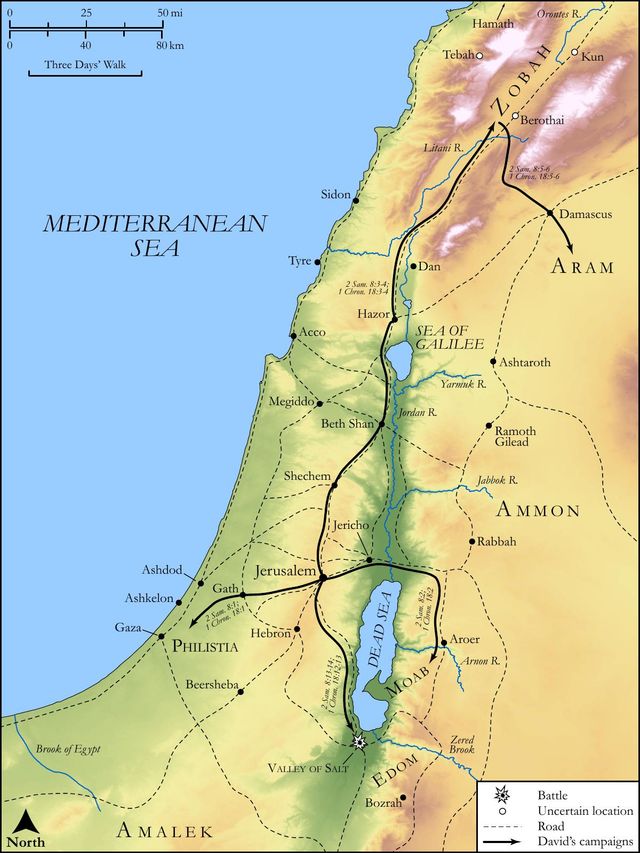
See on the biblical-era map
Study this verse
Public-domain commentary
Matthew Henry
From his Commentary on the Whole Bible. Henry comments on passages, not single verses — this entry covers 1 Chronicles 18:9–17.
Here let us learn, 1. That it is our interest to make those our friends who have the presence of God with them. The king of Hamath, hearing of David's great success, sent to congratulate him and to court his favour with a noble present, Ch1 18:9, Ch1 18:10. It is in vain to contend with the Son of David. Kiss the Son, therefore, lest he be angry; let the kings and judges of the earth, and all inferior people too, be thus wise, thus instructed. The presents we are to bring him are not vessels of gold and silver, as here (those shall be welcomed to him who have no such presents to bring), but our hearts and sincere affections, our whole selves, we must present to him as living sacrifices. 2. That what God blesses us with we must honour him with. The presents of his friends, as well as the spoils of his enemies, David dedicated unto the Lord (Ch1 18:11), that is, he laid them up towards the building and enriching of the temple. That is most truly and most comfortably our own which we have consecrated unto the Lord, and which we use for his glory. Let our merchandise and our hire be holiness to the Lord, Isa 23:18. 3. That those who take God along with them whithersoever they go may expect to prosper, and be preserved, whithersoever they go. It was said before (Ch1 18:6) and here it is repeated (Ch1 18:13) that the Lord preserved David whithersoever he went. Those are always under the eye of God that have God always in their eye. 4. God gives men power, not that they may look great with it, but that they may do good with it. When David reigned over all Israel he executed judgment and justice among all his people, and so answered the end of his elevation. He was not so intent on his conquests abroad as to neglect the administration of justice at home. Herein he served the purposes of the kingdom of providence, and of that God who sits in the throne judging right; and he was an eminent type of the Messiah, the sceptre of whose kingdom is a right sceptre.
Continue studying 1 Chronicles 18:13 across the web’s major study libraries — every link below opens this exact verse, chapter, or book on the destination site.
Read & Compare
 BibleGatewayThis verse in more than 200 translations and 70 languages.
 Bible.comThe YouVersion reader — hundreds of translations, reading plans, and highlights.
 ESV.orgCrossway's official English Standard Version reader.
 NET BibleThe NET translation with 60,000+ translators' notes on every rendering decision.
 STEP BibleTyndale House's free study tool — original text, vocabulary, and scholarly resources.
 BibliaLogos Bible Software's free web reader.
 USCCBThe New American Bible (Revised Edition) with the U.S. bishops' study notes.
Commentaries
 BibleHub CommentariesDozens of classic commentaries on this verse, gathered on one page.
 StudyLightMore than 100 commentary sets — the largest collection on the web.
 BibleRefPlain-English commentary on what this verse means, verse by verse.
 Enduring WordDavid Guzik's free commentary on this chapter, widely used by Bible teachers.
 Bible Study ToolsVerse commentary alongside Greek and Hebrew study aids.
Original Language & Research
- BibleHub InterlinearThe verse word by word — original language, transliteration, and English.
- BibleHub LexiconEvery word's original-language definition and Strong's entry.
 Blue Letter BibleDeep-study tools — Strong's numbers, concordance, and word studies.
 SefariaThe Hebrew text with Rashi and centuries of Jewish commentary.
Sermons, Hymns & Audio


TrulyRandomVerse is not affiliated with these sites and doesn’t control their content. They’re linked because they’re genuinely useful.
Summary
First Chronicles 18:13 encapsulates a pivotal moment in King David's reign, detailing his decisive military victory over the nation of Edom. This verse highlights David's strategic establishment of military control over the conquered territory and the subsequent subjugation of the Edomites, who became his servants. Crucially, the verse concludes with a profound theological declaration, attributing David's consistent success and preservation in all his campaigns not to his own might, but directly to the sovereign hand of the LORD, underscoring divine favor as the ultimate source of his expanding kingdom and security.
Context
ShowHideLiterary Context
This verse is situated within a broader narrative summary of King David's extensive military conquests following his consolidation of power in Jerusalem (1 Chronicles 18). The Chronicler meticulously details David's victories over surrounding nations, including the Philistines, Moabites, and the Arameans (Syrians) from Zobah and Damascus, before focusing on Edom. This chapter serves to demonstrate the fulfillment of God's covenant promises to David, portraying him as a divinely empowered king who successfully establishes and expands the kingdom of Israel, bringing peace and tribute. The placement of the Edomite conquest after other major victories emphasizes the comprehensive nature of David's dominion and the strategic importance of securing all borders.
Historical & Cultural Context
The Edomites, descendants of Esau (as noted in Genesis 25:30), were a long-standing rival of Israel, maintaining an often antagonistic relationship. Their territory, located south-east of Judah, was strategically vital as it controlled the "King's Highway," a major ancient trade route connecting Egypt to Mesopotamia and Arabia. David's subjugation of Edom, marked by the placement of "garrisons," signifies not only military dominance but also control over this crucial economic artery, providing significant economic benefits and securing Israel's southern flank. The act of making the Edomites "David's servants" implies the imposition of tribute and forced labor, a common practice for conquered peoples among the nations, solidifying Israel's regional hegemony.
Key Themes
ShowHideThe overarching theme of 1 Chronicles 18 is Divine Preservation and Sovereignty. The concluding phrase, "Thus the LORD preserved David whithersoever he went," serves as the theological anchor, asserting that David's military successes were not merely due to his strategic brilliance or military might, but were a direct result of God's active protection and guidance. This theme resonates throughout David's life, emphasizing that God was fulfilling His covenant promises to him (as seen in 2 Samuel 7:16) and was his ever-present help and deliverer (echoing David's own declaration in Psalm 18:2). Another key theme is David's Expanding Kingdom, where the establishment of "garrisons in Edom" and the Edomites becoming "David's servants" signifies the significant territorial expansion and consolidation of the Israelite kingdom under David's rule. This demonstrates the fulfillment of prophecies concerning Israel's dominion and influence over surrounding nations, showcasing the strength and authority of his kingdom.
Exposition and Analysis
ShowHideKey Word Analysis
ShowHideThis word (H5333) refers to something stationary, such as a prefect, a military post, or a statue. In the context of 1 Chronicles 18:13, it specifically denotes military outposts or appointed governors strategically placed by David to maintain control over the conquered territory of Edom. It signifies a permanent military presence and administrative oversight, ensuring the submission of the Edomites and the secure collection of tribute, thus solidifying Israel's dominion.
This term (H5650) denotes one who is subjected to another's authority, functioning as a servant, bondman, or man-servant. When the Edomites became "David's servants," it meant they were no longer independent but were brought under Israelite control, obligated to serve David's kingdom, likely through tribute payments or corvée labor. This highlights the complete subjugation and integration of Edom into David's sphere of influence.
This primitive root (H3467) properly means "to be open, wide, or free," and by implication, "to be safe." Causatively, it means "to free or succor," encompassing concepts like defending, delivering, helping, rescuing, and bringing salvation or victory. In the context of David's military campaigns, it unequivocally attributes his success and safety not to his own skill or strength, but to God's active intervention, protection, and deliverance. This emphasizes that God was the ultimate source of David's triumphs and security in all his endeavors.
Verse Breakdown
ShowHide"And he put garrisons in Edom;"
This clause details David's immediate and practical action following the conquest of Edom. The establishment of "garrisons" indicates a strategic military occupation designed to enforce control and prevent rebellion. This was a standard practice in ancient warfare to consolidate power over newly acquired territories, ensuring their continued submission and the flow of resources or tribute back to the conquering kingdom.
"and all the Edomites became David's servants."
This clause describes the direct consequence of the military victory and the establishment of garrisons. The Edomites, as an entire nation, were subjugated and brought under David's authority. This signifies a complete loss of their independence and autonomy, becoming subservient to the Israelite king, likely involving the payment of tribute and perhaps forced labor, thereby expanding the economic and political reach of David's kingdom.
"Thus the LORD preserved David whithersoever he went."
This concluding statement is the theological climax of the verse. It shifts the focus from David's actions to God's sovereign involvement. The phrase "Thus the LORD preserved David" functions as a divine commentary on all of David's successes, not just the Edomite conquest. It asserts that every victory, every secure border, and every expansion of his kingdom was ultimately due to God's active protection, guidance, and provision. This declaration reinforces the Chronicler's overarching theme that David's reign was divinely ordained and sustained, establishing him as God's chosen instrument.
Literary Devices
ShowHideThe verse employs several significant literary devices. Narrative Summary is evident as the verse concisely encapsulates a major military campaign and its outcome, providing a succinct overview rather than a detailed account. This brevity allows the Chronicler to quickly move through David's conquests while highlighting their cumulative effect. The phrase "Thus the LORD preserved David whithersoever he went" functions as a Divine Formula or Theological Interpretation, serving as a recurring refrain throughout the Chronicler's account of David's reign. This formula explicitly attributes all of David's success and safety directly to God's sovereign hand, emphasizing divine agency over human effort. This Repetition of the divine preservation theme across various conquests (e.g., 1 Chronicles 18:6) reinforces the theological message that God is the true source of David's strength and prosperity, shaping the reader's understanding of David's reign as a divinely orchestrated enterprise.
Theological and Thematic Connections
ShowHideFirst Chronicles 18:13 powerfully underscores the theme of divine sovereignty and preservation, presenting David's military successes as direct evidence of God's faithfulness to His covenant promises. The Chronicler consistently highlights that David's victories were not merely the result of his strategic brilliance or military might, but were divinely enabled and sustained. This theological perspective elevates God as the ultimate actor in history, guiding His chosen king and fulfilling His purposes for Israel. The subjugation of Edom, like the other conquests, serves as a tangible demonstration of God's power working through David to establish and secure the promised land, bringing about a period of peace and prosperity under a divinely appointed ruler.
Reflection and Application
ShowHideFirst Chronicles 18:13 offers profound encouragement for believers today, reminding us that our ultimate security and success do not rest on our own strength, wisdom, or resources, but on the unfailing preservation of the LORD. Just as God actively preserved David in all his ways, guiding him through battles and establishing his kingdom, we can trust in His faithfulness to navigate the challenges and uncertainties of our lives. This verse calls us to cultivate a deep reliance on God, recognizing that true flourishing—whether in our personal lives, spiritual journeys, or professional endeavors—comes from acknowledging His sovereign hand. It invites us to release the burden of self-reliance and instead lean into His divine protection, knowing that His presence ensures our safety and His power secures our triumphs, prompting us to give Him all the glory for every step of our journey.
Questions for Reflection
ShowHideFAQ
ShowHideWhy was the conquest of Edom particularly significant for David's kingdom?
ShowHideThe conquest of Edom was highly significant for several reasons. Geographically, Edom controlled the vital "King's Highway," a major ancient trade route that connected Egypt with Mesopotamia and Arabia. By establishing garrisons and making the Edomites servants, David gained control over this lucrative trade route, providing significant economic benefits to Israel through tolls and trade. Strategically, Edom was located south-east of Judah, and its subjugation secured Israel's southern border, preventing potential incursions and allowing for greater stability and peace within the kingdom. Furthermore, the Edomites, as descendants of Esau, had a long history of antagonism with Israel (see Numbers 20:14-21), making their subjugation a crucial step in establishing Israel's regional dominance and fulfilling the prophetic promises of dominion over surrounding nations (e.g., Genesis 27:29).
Christ-Centered Fulfillment
ShowHideWhile 1 Chronicles 18:13 speaks of David's earthly kingdom and God's preservation of him, it ultimately points to a greater King and a more profound preservation found in Jesus Christ. David's victories and the expansion of his kingdom foreshadow the spiritual dominion of Christ, whose kingdom is not of this world yet extends over all creation (as declared in Colossians 1:16). The "garrisons" David placed in Edom to secure his reign find their ultimate fulfillment in the spiritual authority Christ exercises over sin, death, and the powers of darkness, establishing His reign in the hearts of believers (see Colossians 2:15). The Edomites becoming "David's servants" prefigures the universal submission to Christ, where every knee will one day bow and every tongue confess His Lordship (as prophesied in Philippians 2:10-11). Most significantly, the declaration that "the LORD preserved David whithersoever he went" finds its ultimate and perfect expression in Christ. Jesus, the true Son of David, was perfectly preserved by the Father through His life, death, and resurrection, securing not just an earthly kingdom but eternal salvation for all who believe (as affirmed in Hebrews 5:8-9). His preservation was not merely for earthly success but for the ultimate victory over sin, offering true and lasting preservation to His people from spiritual death and eternal separation from God (as promised in John 10:28). Thus, David's story serves as a shadow, pointing to the perfect and eternal preservation offered by our Lord Jesus Christ.