


Job 1:19
Bible text: King James Version (1769 Blayney text) · Public domain
Bible text: King James Version with Strong's numbers · Public domain
Bible text: Berean Standard Bible · Public domain
Bible text: American Standard Version (1901) · Public domain
Bible text: World English Bible, Messianic edition · Public domain
Bible text: Geneva Bible (1599) · Public domain
Bible text: Young's Literal Translation · Public domain
- וְהִנֵּהve·hi·Nehand there!H2009Conj-w ¦ PrtParticle Interjectionוְandהִנֵּהthere!
- רוּחַRu·acha windH7307N-fsNoun Singular Feminine Absolute
- גְּדוֹלָהge·do·LahgreatH1419Adj-fsAdjective Singular Feminine Absolute
- בָּאָהBa·'ahit cameH935V-Qal-Perf-3fsVerb Qal Perfect 3rd Singular Feminine
- מֵעֵבֶרme·'E·verfrom [the] other side ofH5676Prep-m ¦ N-mscNoun Singular Masculine Constructמֵfromעֵבֶר[the] other side of
- הַמִּדְבָּרha·mid·Barthe wildernessH4057Art ¦ N-msNoun Singular Masculine Absoluteהַtheמִּדְבָּרwilderness
- וַיִּגַּעvai·yi·Ga'and it touchedH5060Conj-w ¦ V-Qal-ConsecImperf-3msVerb Qal Consecutive Imperfect 3rd Singular Masculineוַandיִּגַּעit touched
- בְּאַרְבַּעbe·'ar·Ba'<in> [the] fourH702Prep-b ¦ Adj-cscAdjective Numerical Singular common gender Constructבְּ<in>אַרְבַּע[the] four
- פִּנּוֹתpi·Not[the] corners ofH6438N-fpcNoun Plural Feminine Construct
- הַבַּיִתha·Ba·yitthe houseH1004Art ¦ N-msNoun Singular Masculine Absoluteהַtheבַּיִתhouse
- וַיִּפֹּלvai·yi·Poland it fellH5307Conj-w ¦ V-Qal-ConsecImperf-3msVerb Qal Consecutive Imperfect 3rd Singular Masculineוַandיִּפֹּלit fell
- עַל'alonH5921PrepPreposition
- הַנְּעָרִיםha·ne·'a·Rimthe youthsH5288Art ¦ N-mpNoun Plural Masculine Absoluteהַtheנְּעָרִיםyouths
- וַיָּמוּתוּvai·ya·Mu·tuand they diedH4191Conj-w ¦ V-Qal-ConsecImperf-3mpVerb Qal Consecutive Imperfect 3rd Plural Masculineוַandיָּמוּתוּthey died
- וָאִמָּלְטָהva·'i·Mal·Tahand I have escaped !H4422Conj-w ¦ V-Niphal-ConsecImperf-1cs ¦ SfxVerb Niphal Consecutive Imperfect 1st Singular common genderוָandאִמָּלְטָI have escapedה!
- רַקrakonlyH7535AdvAdverb
- אֲנִי'a·NiIH589Pro-1csPronoun Personal 1st Singular common gender
- לְבַדִּיle·va·Dito alone meH905Prep-l ¦ N-msc ¦ 1csNoun Singular Masculine Constructלְtoבַדִּaloneיme
- לְהַגִּידle·ha·Gidto tellH5046Prep-l ¦ V-Hiphil-InfVerb Hiphil Infinitive Constructלְtoהַגִּידtell
- לָךְLakhto youPrep-l ¦ 2msSuffix Personal 2nd Singular Masculineלָtoךְyou
English is a literal word-by-word gloss of the Hebrew, not the KJV's wording. Why?
This is the original text the KJV's translators worked from — each Hebrew word with its own literal English meaning in this verse, prepared by scholars at Tyndale House, Cambridge. The KJV translates whole sentences, not word by word, so its wording differs: one Hebrew word can become several English words, and the KJV may choose “the LORD” where the gloss reads “Yahweh”. Both are faithful — they answer different questions. For the KJV's own rendering, switch to the KJV text.
Details
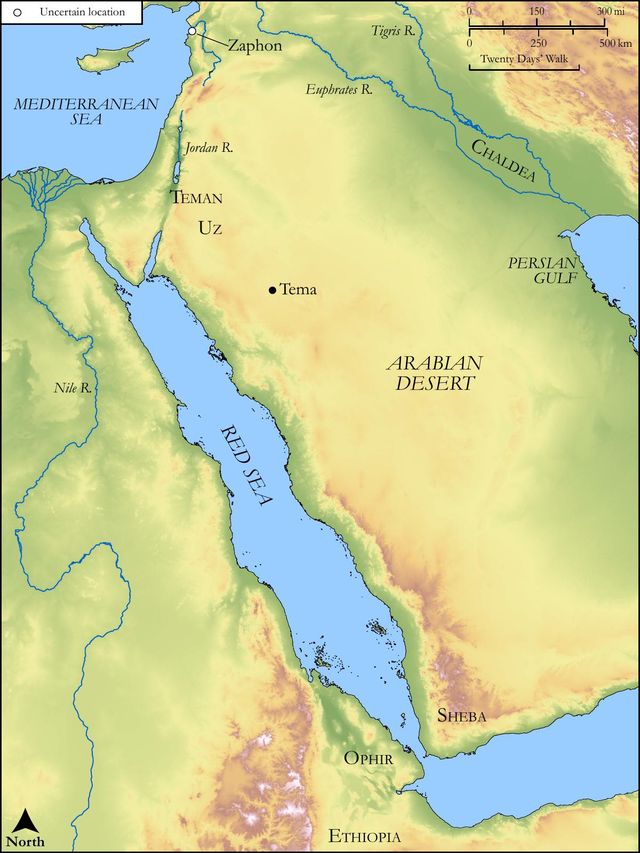
See on the biblical-era map
Study this verse
Public-domain commentary
Matthew Henry
From his Commentary on the Whole Bible. Henry comments on passages, not single verses — this entry covers Job 1:13–19. His three-level outline is real structure in the source text, so it is rendered as structure.
We have here a particular account of Job's troubles.
I.Satan brought them upon him on the very day that his children began their course of feasting, at their eldest brother's house (Job 1:13), where, he having (we may suppose) the double portion, the entertainment was the richest and most plentiful. The whole family, no doubt, was in perfect repose, and all were easy and under no apprehension of the trouble, now when they revived this custom; and this time Satan chose, that the trouble, coming now, might be the more grievous. The night of my pleasure has he turned into fear, Isa 21:4.
II.They all come upon him at once; while one messenger of evil tidings was speaking another came, and, before he had told his story, a third, and a fourth, followed immediately. Thus Satan, by the divine permission, ordered it,
1.That there might appear a more than ordinary displeasure of God against him in his troubles, and by that he might be exasperated against divine Providence, as if it were resolved, right or wrong, to ruin him, and not give him time to speak for himself.
2.That he might not have leisure to consider and recollect himself, and reason himself into a gracious submission, but might be overwhelmed and overpowered by a complication of calamities. If he have not room to pause a little, he will be apt to speak in haste, and then, if ever, he will curse his God. Note, The children of God are often in heaviness through manifold temptations; deep calls to deep; waves and billows come one upon the neck of another. Let one affliction therefore quicken and help us to prepare for another; for, how deep soever we have drunk of the bitter cup, as long as we are in this world we cannot be sure that we have drunk our share and that it will finally pass from us.
III.They took from him all that he had, and made a full end of his enjoyments. The detail of his losses answers to the foregoing inventory of his possessions.
1.He had 500 yoke of oxen, and 500 she-asses, and a competent number of servants to attend them; and all these he lost at once, Job 1:14, Job 1:15. The account he has of this lets him know,
(1.)That it was not through any carelessness of his servants; for then his resentment might have spent itself upon them: The oxen were ploughing, not playing, and the asses not suffered to stray and so taken up as waifs, but feeding beside them, under the servant's eye, each in their place; and those that passed by, we may suppose, blessed them, and said, God speed the plough. Note, All our prudence, care, and diligence, cannot secure us from affliction, no, not from those afflictions which are commonly owing to imprudence and negligence. Except the Lord keep the city, the watchman, though ever so wakeful, wakes but in vain. Yet it is some comfort under a trouble if it found us in the way of our duty, and not in any by-path.
(2.)That is was through the wickedness of his neighbours the Sabeans, probably a sort of robbers that lived by spoil and plunder. They carried off the oxen and asses, and slew the servants that faithfully and bravely did their best to defend them, and one only escaped, not in kindness to him or his master, but that Job might have the certain intelligence of it by an eye-witness before he heard it by a flying report, which would have brought it upon him gradually. We have no reason to suspect that either Job or his servants had given any provocation to the Sabeans to make this inroad, but Satan put it into their hearts to do it, to do it now, and so gained a double point, for he made both Job to suffer and them to sin. Note, When Satan has God's permission to do mischief he will not want mischievous men to be his instruments in doing it, for he is a spirit that works in the children of disobedience.
2.He had 7000 sheep, and shepherds that kept them; and all those he lost at the same time by lightning, Job 1:16. Job was perhaps, in his own mind, ready to reproach the Sabeans, and fly out against them for their injustice and cruelty, when the next news immediately directs him to look upwards: The fire of God has fallen from heaven. As thunder is his voice, so lightning is his fire: but this was such an extraordinary lightning, and levelled so directly against Job, that all his sheep and shepherds were not only killed, but consumed by it at once, and one shepherd only was left alive to carry the news to poor Job. The devil, aiming to make him curse God and renounce his religion, managed this part of the trial very artfully, in order thereto.
(1.)His sheep, with which especially he used to honour God in sacrifice, were all taken from him, as if God were angry at his offerings and would punish him in those very things which he had employed in his service. Having misrepresented Job to God as a false servant, in pursuance of his old design to set Heaven and earth at variance, he here misrepresented God to Jacob as a hard Master, who would not protect those flocks out of which he had so many burnt-offerings. This would tempt Job to say, It is in vain to serve God.
(2.)The messenger called the lightning the fire of God (and innocently enough), but perhaps Satan thereby designed to strike into his mind this thought, that God had turned to be his enemy and fought against him, which was much more grievous to him than all the insults of the Sabeans. He owned (Job 31:23) that destruction from God was a terror to him. How terrible then were the tidings of this destruction, which came immediately from the hand of God! Had the fire from heaven consumed the sheep upon the altar, he might have construed it into a token of God's favour; but, the fire consuming them in the pasture, he could not but look upon it as a token of God's displeasure. There have not been the like since Sodom was burned.
3.He had 3000 camels, and servants tending them; and he lost them all at the same time by the Chaldeans, who came in three bands, and drove them away, and slew the servants, Job 1:17. If the fire of God, which fell upon Job's honest servants, who were in the way of their duty, had fallen upon the Sabean and Chaldean robbers who were doing mischief, God's judgments therein would have been like the great mountains, evident and conspicuous; but when the way of the wicked prospers, and they carry off their booty, while just and good men are suddenly cut off, God's righteousness is like the great deep, the bottom of which we cannot find, Psa 36:6.
4.His dearest and most valuable possessions were his ten children; and, to conclude the tragedy, news if brought him, at the same time, that they were killed and buried in the ruins of the house in which they were feasting, and all the servants that waited on them, except one that came express with the tidings of it, Job 1:18, Job 1:19. This was the greatest of Job's losses, and which could not but go nearest him; and therefore the devil reserved it for the last, that, if the other provocations failed, this might make him curse God. Our children are pieces of ourselves; it is very hard to part with them, and touches a good man in as tender a part as any. But to part with them all at once, and for them to be all cut off in a moment, who had been so many years his cares and hopes, went to the quick indeed.
(1.)They all died together, and not one of them was left alive. David, though a wise and good man, was very much discomposed by the death of one son. How hard then did it bear upon poor Job who lost them all, and, in one moment, was written childless!
(2.)They died suddenly. Had they been taken away by some lingering disease, he would have had notice to expect their death, and prepare for the breach; but this came upon him without giving him any warning.
(3.)They died when they were feasting and making merry. Had they died suddenly when they were praying, he might the better have borne it. He would have hoped that death had found them in a good frame if their blood had been mingled with their feast, where he himself used to be jealous of them that they had sinned, and cursed God in their hearts - to have that day come upon them unawares, like a thief in the night, when perhaps their heads were overcharged with surfeiting and drunkenness - this could not but add much to his grief, considering what a tender concern he always had for his children's souls, and that they were now out of the reach of the sacrifices he used to offer according to the number of them all. See how all things come alike to all. Job's children were constantly prayed for by their father, and lived in love one with another, and yet came to this untimely end.
(4.)They died by a wind of the devil's raising, who is the prince of the power of the air (Eph 2:2), but it was looked upon to be an immediate hand of God, and a token of his wrath. So Bildad construed it (Job 8:4): Thy children have sinned against him, and he has cast them away in their transgression.
(5.)They were taken away when he had most need of them to comfort him under all his other losses. Such miserable comforters are all creatures. In God only we have a present help at all times.
Historical interpretation
Historical reception
1 surviving comment on this verse from the historical church.
Sometimes, while the mind is sustained with the fullness and richness of a gift so large, if it enjoys uninterrupted security in these things, it forgets the source from which they have come. It imagines that it derives these things from itself in a way that never ceases. Hence it is that this same grace sometimes withdraws itself for our good and shows the presumptuous mind how weak it is in itself. For then we really learn the source from which our good qualities proceed. Only by seemingly losing them are we made aware that they can never be preserved by our own efforts. And so for the purpose of tutoring us in lessons of humility, it very often happens that when the crisis of temptation is upon us, such extreme folly comes down upon our wisdom. Then, the mind being dismayed, it does not grasp how to meet the evils that threaten or how to guard against temptation. But this very foolishness wisely instructs the heart. For whatever causes the mind to turn to foolishness for a moment is afterwards faced as reality. As the mind becomes more humble, it becomes wiser. In this way the very wisdom that seems to be lost temporarily is now held in more secure possession.
Continue studying Job 1:19 across the web’s major study libraries — every link below opens this exact verse, chapter, or book on the destination site.
Read & Compare
 BibleGatewayThis verse in more than 200 translations and 70 languages.
 Bible.comThe YouVersion reader — hundreds of translations, reading plans, and highlights.
 ESV.orgCrossway's official English Standard Version reader.
 NET BibleThe NET translation with 60,000+ translators' notes on every rendering decision.
 STEP BibleTyndale House's free study tool — original text, vocabulary, and scholarly resources.
 BibliaLogos Bible Software's free web reader.
 USCCBThe New American Bible (Revised Edition) with the U.S. bishops' study notes.
Commentaries
 BibleHub CommentariesDozens of classic commentaries on this verse, gathered on one page.
 StudyLightMore than 100 commentary sets — the largest collection on the web.
 BibleRefPlain-English commentary on what this verse means, verse by verse.
 Enduring WordDavid Guzik's free commentary on this chapter, widely used by Bible teachers.
 Bible Study ToolsVerse commentary alongside Greek and Hebrew study aids.
Original Language & Research
- BibleHub InterlinearThe verse word by word — original language, transliteration, and English.
- BibleHub LexiconEvery word's original-language definition and Strong's entry.
 Blue Letter BibleDeep-study tools — Strong's numbers, concordance, and word studies.
 SefariaThe Hebrew text with Rashi and centuries of Jewish commentary.
Sermons, Hymns & Audio


TrulyRandomVerse is not affiliated with these sites and doesn’t control their content. They’re linked because they’re genuinely useful.
Summary
Job 1:19 delivers the climactic and most devastating blow in a series of rapid calamities, reporting the sudden and complete annihilation of Job's ten children. A "great wind" from the wilderness, supernaturally empowered, violently struck the house where Job's sons and daughters were feasting, causing its collapse and their immediate deaths. This verse underscores the extreme nature of Job's suffering, culminating the initial phase of his testing and setting the stage for his profound lament and the subsequent theological discourse on the nature of suffering, divine justice, and the resilience of true faith.
Context
ShowHideLiterary Context
Job 1:19 serves as the devastating crescendo in a meticulously orchestrated sequence of disasters designed to strip Job of all his earthly blessings. It immediately follows three prior reports of escalating loss: the Sabeans' raid on his oxen and donkeys, killing his servants (Job 1:14-15); "the fire of God" consuming his sheep and more servants (Job 1:16); and the Chaldeans plundering his camels and slaying additional servants (Job 1:17). Each report is delivered by a sole, breathless survivor, a narrative technique that heightens the dramatic tension and emphasizes the absolute totality of the destruction. This final, most grievous report, concerning the death of all his children, is the ultimate test of Job's integrity, directly fulfilling Satan's challenge to God in Job 1:11 and the divine permission granted in Job 1:12. The verse's stark finality sets the stage for Job's initial, remarkable response of worship and lament in Job 1:20-22, which profoundly defies Satan's cynical expectation.
Historical & Cultural Context
Among the men of the east, prosperity was widely interpreted as a direct sign of divine favor, and a large family, particularly many sons, was considered the pinnacle of blessing, security, and a lasting legacy. Job, described as "the greatest of all the men of the east" in Job 1:3, embodied this ideal with his vast possessions and ten children. The destruction of his entire household, especially the complete loss of his children, was not merely a financial or personal tragedy but a profound assault on his social standing, his legacy, and his very sense of divine blessing. The "wilderness" (מִדְבָּר, midbar) from which the wind came was often associated with chaos, danger, and the abode of demonic forces or untamed powers in ancient thought, lending a sinister, supernatural undertone to the natural phenomenon. Feasting, as described in Job 1:4, was a common social practice, and Job's regular purification rituals for his children in Job 1:5 highlight his deep piety and concern for their spiritual well-being, making their sudden, violent deaths even more tragic and perplexing.
Key Themes
ShowHideJob 1:19 powerfully contributes to several overarching themes in the book of Job. Firstly, it highlights the fragility of earthly blessings, demonstrating with brutal clarity how quickly wealth, family, and security can be stripped away, challenging the conventional wisdom that righteousness guarantees unwavering prosperity. Secondly, it underscores the reality of unseen spiritual warfare and the agency of evil, as the "great wind" is explicitly revealed in the preceding narrative as a tool of Satan, despite appearing to be a natural disaster. This introduces the profound theological question of the origin of suffering—is it always a direct punishment for sin, or can it be part of a larger spiritual test? Thirdly, the verse emphasizes the totality of loss, with the chilling "I only am escaped alone to tell thee" motif repeated by each messenger, leaving Job utterly bereft. This sets the stage for the book's exploration of lament, grief, and the struggle to maintain faith when God's ways seem inscrutable, a struggle that begins with Job's initial, profound act of worship amidst his devastation in Job 1:20.
Exposition and Analysis
ShowHideKey Word Analysis
ShowHideThis Hebrew word (H7307) is highly versatile, capable of referring to "wind," "breath," or "spirit." In this context, while literally denoting a powerful gust of air, its connection to Satan's agency (Job 1:12) suggests a force beyond mere natural phenomenon, implying a supernaturally empowered or even "spiritual" wind of destruction. The descriptor "great" (H1419, gâdôwl) further emphasizes its extraordinary, perhaps unprecedented, tempestuous nature.
The term (H4057) refers to an uncultivated, often desolate or barren region, a pasture for driven cattle. In biblical thought, the wilderness can be a place of testing, danger, and divine encounter, but also a source of destructive forces. Its association with the wind's origin here evokes a sense of untamed, hostile power, aligning with the destructive intent behind the storm and hinting at an external, chaotic source.
This verb (H5060) means to "touch," "strike," or "smite." Here, it conveys a violent, impactful striking, indicating the direct and forceful nature of the wind's destructive action upon the house. The choice of this word emphasizes the immediate, powerful blow that led to the house's collapse, rather than a gradual weakening or decay.
Verse Breakdown
ShowHide"And, behold, there came a great wind from the wilderness"
This clause introduces the final, climactic disaster with dramatic immediacy. The interjection "behold" (וְהִנֵּה, v'hinneh) draws the listener's attention to the sudden, unexpected, and powerful arrival of the wind. The description "great wind" signifies an extraordinary, powerful storm, and its origin "from the wilderness" adds a layer of ominous, untamed, and perhaps supernaturally charged danger, distinct from a typical localized storm, hinting at its malevolent source.
"and smote the four corners of the house"
This details the wind's devastating impact. The phrase "four corners" suggests a comprehensive, all-encompassing attack on the structure, implying that the entire building was subjected to the force, leading to a total collapse rather than partial damage. The house is explicitly identified in Job 1:4 and Job 1:13 as the place where Job's children were feasting, making it the site of their joyful gathering now tragically transformed into their tomb.
"and it fell upon the young men, and they are dead"
This is the horrific outcome of the house's collapse. The "young men" (הַנְּעָרִים, hanna'arim) refers collectively to Job's children, both sons and daughters, as indicated by the preceding context (Job 1:13). The house's collapse directly upon them confirms their immediate and complete demise. The stark, blunt declaration "and they are dead" leaves no room for doubt or hope, emphasizing the finality and totality of this loss, which is the most grievous of all the calamities Job suffers.
"and I only am escaped alone to tell thee"
This concluding phrase is the chilling, repeated signature of each messenger in Job 1. It serves as a powerful literary device to underscore the utter devastation, with only one individual miraculously (or agonizingly) surviving to bear the dreadful news. This repetition amplifies the sense of isolation and the overwhelming nature of Job's suffering, as he is confronted with the complete obliteration of his family and possessions, leaving him utterly bereft.
Literary Devices
ShowHideJob 1:19 employs several potent literary devices to convey its devastating message and maximize its emotional impact. The most prominent is Climax, as this verse presents the ultimate and most grievous loss—the death of all Job's children—following a rapid succession of lesser, though still severe, calamities. This narrative structure builds dramatic tension and achieves maximum emotional devastation. The chilling phrase "I only am escaped alone to tell thee," repeated across verses Job 1:15, Job 1:16, Job 1:17, and Job 1:19, functions as a powerful Refrain or Motif. This repetition emphasizes the totality of the destruction and the isolated horror of the sole survivor, creating a sense of relentless, inescapable doom. The "great wind from the wilderness" can be seen as a form of Symbolism, representing not just a natural phenomenon but a vehicle for unseen, malevolent forces, specifically Satan's destructive power, making the natural disaster a manifestation of spiritual warfare. Finally, the swift, unadorned declaration "and they are dead" is an example of Understatement in its brevity, yet it carries immense emotional weight, highlighting the profound and irreversible nature of the tragedy without needing elaborate description.
Theological and Thematic Connections
ShowHideJob 1:19 is a pivotal verse, exposing the raw reality of suffering that strikes even the righteous, directly challenging the simplistic retribution theology prevalent in Job's day. It forces the reader to grapple with the perplexing question of why good people suffer, particularly when the suffering is not a consequence of their sin but a result of a spiritual struggle between God and Satan. The verse highlights God's ultimate sovereignty even over destructive forces, as the "great wind" operates within the divine permission granted to Satan, demonstrating that evil's power is always circumscribed by God's will. It also sets the stage for the profound human response to inexplicable tragedy: grief, questioning, and the ultimate test of faith. This verse underscores that suffering is not always punitive but can be part of a larger, mysterious divine purpose, ultimately revealing the depth and resilience of true devotion that trusts God beyond understanding.
Reflection and Application
ShowHideJob 1:19 confronts us with the brutal reality of life's fragility and the sudden, devastating nature of loss. It shatters any illusions that faithfulness guarantees immunity from tragedy, compelling us to consider how we respond when our world is utterly upended. This verse invites us into a space of profound empathy for those who suffer inexplicable loss, reminding us that grief is a natural and necessary response, and that there are no easy answers to profound suffering. It challenges us to look beyond superficial explanations for suffering and to acknowledge the complex interplay of natural events, spiritual forces, and divine sovereignty, often operating in ways beyond our comprehension. Ultimately, Job's experience, beginning with this devastating news, teaches us that true faith is not the absence of questions or pain, but the courageous posture of seeking God even when His ways are inscrutable, and holding onto hope even when all seems lost. It encourages us to cultivate a faith that is resilient enough to endure the "great winds" of life, trusting in God's ultimate goodness and redemptive purpose, even when we cannot immediately discern it.
Questions for Reflection
ShowHideFAQ
ShowHideWas the "great wind" a natural disaster or a supernatural event?
ShowHideWhile the "great wind from the wilderness" appears to be a natural phenomenon, the preceding narrative in the book of Job clearly establishes it as a supernaturally empowered event, a direct instrument of Satan's destructive plan against Job. In Job 1:12, God explicitly puts "all that he hath" in Satan's power, with the exception of Job himself. The swift, targeted, and total destruction of Job's children's house by this wind, immediately following other supernaturally orchestrated calamities (the Sabeans' raid, the "fire of God," and the Chaldeans' plunder), confirms that this was no ordinary storm but a divinely permitted, demonic attack. It highlights the often unseen spiritual forces at work behind seemingly natural events, revealing an unseen dimension to human suffering.
Christ-Centered Fulfillment
ShowHideJob 1:19, with its stark portrayal of righteous suffering and total loss, finds profound Christ-centered fulfillment in the person and work of Jesus. Job's experience of inexplicable suffering, though for a different purpose, foreshadows the ultimate suffering of the innocent Lamb of God, who bore the full weight of humanity's sin and its devastating consequences. Just as Job's children were taken in a sudden, violent act, Jesus, the Son of God, was "smote" and "cut off from the land of the living" (Isaiah 53:8) not for His own sin, but for the sins of the world. The "great wind from the wilderness" that brought destruction upon Job's household can be seen as a type of the chaotic forces of sin, death, and spiritual darkness that Jesus confronted and ultimately conquered. While Job was left with nothing, Jesus willingly emptied Himself, enduring the ultimate separation from God on the cross (Matthew 27:46) to bring about salvation. His resurrection, however, demonstrates that even in the face of absolute devastation, God's ultimate purpose is redemptive and life-giving, transforming death into victory and offering eternal hope where there was once only loss (1 Corinthians 15:54-57). Thus, Job's lament in the aftermath of this verse ultimately points to the one who would truly suffer innocently and, through His suffering, bring about ultimate restoration and life for all who believe (John 11:25-26).