


2 Samuel 15:35
- וַהֲלוֹאva·ha·Lo'and ¿ notH3808Conj-w ¦ Interrog ¦ NegParticle Negativeוַandהֲ¿לוֹאnot
- עִמְּךָ'i·me·Khawith youH5973Prep ¦ 2msPreposition Definiteעִמְּwithךָyou
- שָׁםShamthereH8033AdvAdverb
- צָדוֹקtza·Dok[are] ZadokH6659N-proper-mNoun Proper Masculine
- וְאֶבְיָתָרve·'ev·ya·Tarand AbiatharH54Conj-w ¦ N-proper-mNoun Proper MasculineוְandאֶבְיָתָרAbiathar
- הַכֹּהֲנִיםha·ko·ha·Nimthe priestsH3548Art ¦ N-mpNoun Plural Masculine Absoluteהַtheכֹּהֲנִיםpriests
- וְהָיָהve·ha·Yahand it will beH1961Conj-w ¦ V-Qal-ConsecPerf-3msVerb Qal Consecutive Perfect 3rd Singular Masculineוְandהָיָהit will be
- כָּלkoleveryH3605N-mscNoun Singular Masculine Construct
- הַדָּבָרha·da·Var<the> wordH1697Art ¦ N-msNoun Singular Masculine Absoluteהַ<the>דָּבָרword
- אֲשֶׁר'a·SherwhichH834RelParticle Relative
- תִּשְׁמַעtish·Ma'you will hearH8085V-Qal-Imperf-2msVerb Qal Imperfect 2nd Singular Masculine
- מִבֵּיתmi·Beitfrom [the] house ofH1004Prep-m ¦ N-mscNoun Singular Masculine Constructמִfromבֵּית[the] house of
- הַמֶּלֶךְha·Me·lekhthe kingH4428Art ¦ N-msNoun Singular Masculine Absoluteהַtheמֶּלֶךְking
- תַּגִּידta·Gidyou will tellH5046V-Hiphil-Imperf-2msVerb Hiphil Imperfect 2nd Singular Masculine
- לְצָדוֹקle·tza·Dokto ZadokH6659Prep-l ¦ N-proper-mNoun Proper MasculineלְtoצָדוֹקZadok
- וּלְאֶבְיָתָרu·le·'ev·ya·Tarand to AbiatharH54Conj-w ¦ Prep-l ¦ N-proper-mNoun Proper MasculineוּandלְtoאֶבְיָתָרAbiathar
- הַכֹּהֲנִיםha·ko·ha·Nimthe priestsH3548Art ¦ N-mpNoun Plural Masculine Absoluteהַtheכֹּהֲנִיםpriests
English is a literal word-by-word gloss of the Hebrew, not the KJV's wording. Why?
This is the original text the KJV's translators worked from — each Hebrew word with its own literal English meaning in this verse, prepared by scholars at Tyndale House, Cambridge. The KJV translates whole sentences, not word by word, so its wording differs: one Hebrew word can become several English words, and the KJV may choose “the LORD” where the gloss reads “Yahweh”. Both are faithful — they answer different questions. For the KJV's own rendering, switch to the KJV text.
Details
See on the biblical-era map
Study this verse
Public-domain commentary
Matthew Henry
From his Commentary on the Whole Bible. Henry comments on passages, not single verses — this entry covers 2 Samuel 15:31–37.
Nothing, it seems, appeared to David more threatening in Absalom's plot than that Ahithophel was in it; for one good head, in such a design, is worth a thousand good hands. Absalom was himself no politician, but he had got one entirely in his interest that was, and would be the more dangerous because he had been all along acquainted with David's counsels and affairs; if therefore he can be baffled, Absalom is as good as routed and the head of the conspiracy cut off. This David endeavours to do.
I.By prayer.
When he heard that Ahithophel was in the plot he lifted up his heart to God in this short prayer: Lord, turn the counsel of Ahithophel into foolishness, Sa2 15:31. He had not opportunity for a long prayer, but he was not one of those that thought he should be heard for his much speaking. It was a fervent prayer: "Lord, I pray thee, do this." God is well pleased with the importunity of those that come to him with their petitions. David is particular in this prayer; he names the person whose counsels he prays against. God gives us leave, in prayer, to be humbly and reverently free with him, and to mention the particular care, and fear, and grief, that lies heavily upon us. David prayed not against Ahithophel's person, but against his counsel, that God would turn it into foolishness, that, though he was a wise man, he might at this time give foolish counsel, or, if he gave wise counsel, that it might be rejected as foolish, or, if it were followed, that by some providence or other it might be defeated, and not attain the end. David prayed this in a firm belief that God has all hearts in his hand, and tongues too, that, when he pleases, he can take away the understanding of the aged and make the judges fools, (Job 12:17; Isa 3:2, Isa 3:3), and in hope that God would own and plead his just and injured cause. Note, We may pray in faith, and should pray with fervency, that God will turn that counsel into foolishness which is taken against his people.
II.By policy.
We must second our prayer with our endeavours, else we tempt God. It is good service to countermine the policy of the church's enemies. When David came to the top of the mount, he worshipped God, Sa2 15:32. Note, Weeping must not hinder worshipping, but quicken it rather. Now he penned the third Psalm, as appears by the title; and some think that his singing this was the worship he now paid to God. Just now Providence brought Hushai to him. While he was yet speaking, God heard, and sent him the person that should be instrumental to befool Ahithophel. He came to condole with David on his present trouble, with his coat rent and earth upon his head; but David, having a great deal of confidence in his conduct and faithfulness, resolved to employ him as a spy upon Absalom. He would not take him with him (Sa2 15:33), for he had now more need of soldiers than counsellors, but sent him back to Jerusalem, to wait for Absalom's arrival, as a deserter from David, and to offer him his service, Sa2 15:34. Thus he might insinuate himself into his counsels, and defeat Ahithophel, either by dissuading Absalom from following his advice or by discovering it to David, that he might know where to stand upon his guard. How this gross dissimulation, which David put Hushai upon, can be justified, as a stratagem in war, I do not see. The best that can be made of it is that Absalom, if he rebel against his father, must stand upon his guard against all mankind, and, if he will be deceived, let him be deceived. David recommended Hushai to Zadok and Abiathar, as persons proper to be consulted with (Sa2 15:35), and to their two sons, as trusty men to be sent on errands to David, Sa2 15:36. Hushai, thus instructed, came to Jerusalem (Sa2 15:37), whither also Absalom soon after came with his forces. How soon do royal palaces and royal cities change their masters! But we look for a kingdom which cannot be thus shaken and in the possession of which we cannot be disturbed.
Continue studying 2 Samuel 15:35 across the web’s major study libraries — every link below opens this exact verse, chapter, or book on the destination site.
Read & Compare
 BibleGatewayThis verse in more than 200 translations and 70 languages.
 Bible.comThe YouVersion reader — hundreds of translations, reading plans, and highlights.
 ESV.orgCrossway's official English Standard Version reader.
 NET BibleThe NET translation with 60,000+ translators' notes on every rendering decision.
 STEP BibleTyndale House's free study tool — original text, vocabulary, and scholarly resources.
 BibliaLogos Bible Software's free web reader.
 USCCBThe New American Bible (Revised Edition) with the U.S. bishops' study notes.
Commentaries
 BibleHub CommentariesDozens of classic commentaries on this verse, gathered on one page.
 StudyLightMore than 100 commentary sets — the largest collection on the web.
 BibleRefPlain-English commentary on what this verse means, verse by verse.
 Enduring WordDavid Guzik's free commentary on this chapter, widely used by Bible teachers.
 Bible Study ToolsVerse commentary alongside Greek and Hebrew study aids.
Original Language & Research
- BibleHub InterlinearThe verse word by word — original language, transliteration, and English.
- BibleHub LexiconEvery word's original-language definition and Strong's entry.
 Blue Letter BibleDeep-study tools — Strong's numbers, concordance, and word studies.
 SefariaThe Hebrew text with Rashi and centuries of Jewish commentary.
Sermons, Hymns & Audio


TrulyRandomVerse is not affiliated with these sites and doesn’t control their content. They’re linked because they’re genuinely useful.
Summary
This verse encapsulates King David's strategic brilliance and his reliance on a loyal network amidst the chaos of Absalom's rebellion. As David flees Jerusalem, he instructs his trusted advisor, Hushai the Archite, to infiltrate Absalom's court as a double agent. Crucially, David establishes Zadok and Abiathar, the faithful high priests, as the vital intelligence conduit, ensuring that any information gathered by Hushai from within Absalom's "king's house" would be relayed directly to them, forming the backbone of David's counter-intelligence operation and demonstrating his foresight in a moment of profound crisis.
Context
ShowHideLiterary Context
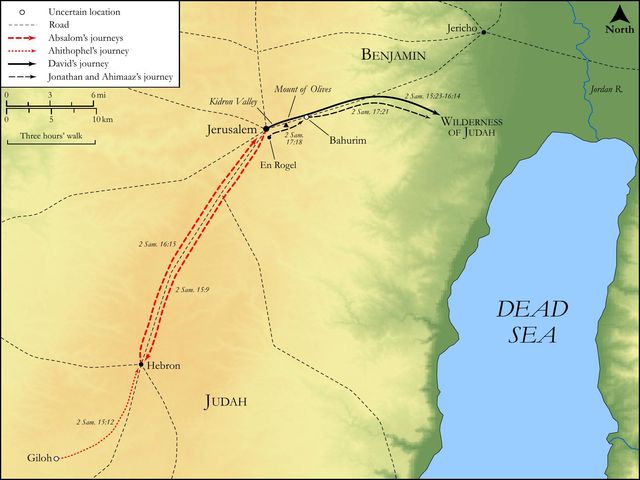
This instruction from David to Hushai is delivered as David makes his desperate escape from Jerusalem, fleeing Absalom's swift and popular coup. The preceding verses of 2 Samuel 15 describe Absalom's cunning consolidation of power, his deceptive charm, and the growing defection of the people from David. David's flight is a scene of profound sorrow and humility, as he ascends the Mount of Olives weeping (2 Samuel 15:30). Amidst this despair, David encounters Hushai, who initially wishes to flee with him. However, David, demonstrating remarkable foresight and strategic thinking, redirects Hushai, sending him back into Jerusalem with a specific, dangerous mission to "frustrate the counsel of Ahithophel" (2 Samuel 15:34). Verse 2 Samuel 15:35 then elaborates on the critical communication channel essential for this mission's success, integrating the priests Zadok and Abiathar into the clandestine network.
Historical & Cultural Context
The setting is ancient Israel, a monarchy still relatively young, grappling with issues of succession and loyalty. Kingship was often precarious, and rebellions, especially from within the royal family, were not uncommon. Absalom's rebellion was particularly potent due to his charismatic appeal and his exploitation of David's past failures, such as the affair with Bathsheba and the murder of Uriah (2 Samuel 11). Priests like Zadok and Abiathar held significant religious and often political influence, serving as custodians of the Ark of the Covenant and offering divine counsel through the Urim and Thummim. Their presence in Jerusalem, even as David fled, was culturally significant, as they represented a continuity of divine presence and authority. David's instruction leverages their established position and access within the city, making them ideal, unsuspecting conduits for intelligence.
Key Themes
ShowHideThis verse powerfully illustrates several key themes central to the narrative of 2 Samuel. Firstly, it highlights Divine Sovereignty and Human Agency, showing David's strategic planning working in concert with God's ultimate purpose to thwart Absalom's rebellion, as explicitly stated in 2 Samuel 17:14. Secondly, Loyalty and Betrayal are starkly contrasted; while many abandon David, Hushai, Zadok, and Abiathar remain steadfast, embodying the covenant faithfulness David himself often struggled to maintain. Thirdly, the theme of Wisdom and Folly is prominent, with David's shrewdness in counter-intelligence pitted against Absalom's impulsive decisions influenced by Ahithophel's initially sound, but ultimately frustrated, counsel. Finally, the Role of the Priesthood extends beyond ritual to practical matters of national security and governance, demonstrating their integral function in the life of the nation and their unwavering support for the legitimate king.
Exposition and Analysis
ShowHideKey Word Analysis
ShowHideThis word signifies "a word; by implication, a matter (as spoken of) or thing." In this context, it refers to any piece of information, counsel, plan, or decision that Hushai might overhear or uncover within Absalom's court. It emphasizes the comprehensive nature of the intelligence David seeks, encompassing both spoken words and the underlying matters they represent.
This primitive root means "to hear intelligently (often with implication of attention, obedience, etc.; causatively, to tell, etc.)." David's instruction to Hushai to "hear" implies not just passive reception of sound, but active listening, discerning, and understanding the significance of the information. It underscores Hushai's role as a perceptive observer and intelligence gatherer.
This primitive root means "properly, to front, i.e. stand boldly out opposite; by implication (causatively), to manifest; figuratively, to announce (always by word of mouth to one present); specifically, to expose, predict, explain, praise." Here, it denotes the clear and direct communication of the gathered intelligence. David emphasizes the importance of Hushai "telling" this information, ensuring it is explicitly conveyed to the designated recipients, Zadok and Abiathar, without ambiguity or delay.
Verse Breakdown
ShowHide"And hast thou not there with thee Zadok and Abiathar the priests?"
This rhetorical question from David to Hushai serves as an affirmation of a pre-existing understanding or a directive to utilize these trusted individuals. David is reminding Hushai of the critical assets available to him within Jerusalem, emphasizing their loyalty and strategic importance. The priests had initially accompanied David in his flight with the Ark, but David had sent them back to Jerusalem (2 Samuel 15:24-29), specifically envisioning their role in this intelligence operation.
"therefore it shall be, that what thing soever thou shalt hear out of the king's house,"
This clause sets the scope of Hushai's intelligence gathering. His primary task is to listen intently and gather all information—any "thing soever"—emanating from Absalom's court. This implies not just official decrees but also private conversations, strategic discussions, and any intelligence that could reveal Absalom's intentions or plans. The phrase "out of the king's house" specifies the source of this critical information, emphasizing the need for Hushai to be privy to Absalom's inner circle, the very seat of his newly established power.
"thou shalt tell it to Zadok and Abiathar the priests."
This is the core directive, establishing the communication protocol. Hushai is not to act on the information himself, nor is he to relay it through other channels. The priests are designated as the sole, trusted recipients of this sensitive intelligence. This centralized communication hub ensures security, discretion, and reliability, allowing David to receive filtered and actionable intelligence from a secure source, leveraging the priests' legitimate presence and their sons who could serve as messengers.
Literary Devices
ShowHideThe verse employs several effective literary devices that underscore David's strategic genius and the gravity of the situation. A Rhetorical Question ("And hast thou not there with thee Zadok and Abiathar the priests?") immediately draws Hushai's attention and underscores the importance of the priests' presence and role, framing the subsequent instruction as a logical extension of their established loyalty. The use of Synecdoche is evident in "king's house," which stands for the entire royal administration and the center of Absalom's power, rather than just the physical building. This emphasizes the comprehensive nature of the intelligence Hushai is to gather, targeting the very heart of the rebellion. Furthermore, the precise and direct nature of David's command ("thou shalt tell it") highlights the Pragmatism and Foresight of David's leadership, even in crisis, as he meticulously plans for his return. The entire passage functions as a pivotal moment of Plot Development, setting in motion the counter-intelligence operation that will ultimately lead to Absalom's downfall, demonstrating the intricate Irony of a king in exile orchestrating his return through a network of loyalists within the usurper's court.
Theological and Thematic Connections
ShowHideThis verse is a testament to the intricate interplay between divine sovereignty and human responsibility. While David meticulously crafts a human strategy, the broader narrative of 2 Samuel consistently affirms that God is ultimately in control, orchestrating events to fulfill His promises to David. David's wisdom here is not merely human cunning but is implicitly guided by the Lord, who "frustrated the good counsel of Ahithophel, to the intent that the Lord might bring evil upon Absalom" (2 Samuel 17:14). The loyalty of Zadok, Abiathar, and Hushai stands in stark contrast to the widespread defection, underscoring the theme of faithfulness amidst betrayal, a theme echoed throughout biblical history. It also highlights the multifaceted role of spiritual leaders, who, in times of crisis, may be called upon to serve their nation in practical, even clandestine, ways beyond their typical religious duties, demonstrating their unwavering support for the legitimate king.
Reflection and Application
ShowHideDavid's actions in 2 Samuel 15:35 offer profound lessons for navigating times of crisis and betrayal. His strategic thinking, even in the depths of despair, reminds us that faith in God does not negate the need for wise planning and decisive action. We are called to be "wise as serpents and innocent as doves" (Matthew 10:16), employing all available resources and discernment while trusting in God's ultimate control. The loyalty demonstrated by Hushai, Zadok, and Abiathar serves as a powerful example of steadfastness in the face of adversity, urging us to cultivate relationships with trusted allies who will stand with us through trials. Furthermore, the establishment of a clear communication channel underscores the importance of transparent and reliable information flow in any organization or personal endeavor, especially when stakes are high. Ultimately, this passage encourages us to seek God's wisdom in our strategies, to value faithful relationships, and to act with courage and prudence, knowing that even in the midst of chaos, God can work through our efforts to accomplish His sovereign will.
Questions for Reflection
ShowHideFAQ
ShowHideWhy did David send the priests back to Jerusalem instead of keeping them with him?
ShowHideDavid sent Zadok and Abiathar, along with the Ark of the Covenant, back to Jerusalem primarily for two strategic reasons, as outlined in 2 Samuel 15:25. Firstly, David believed that if it was God's will for him to return, God would bring him back to Jerusalem and the Ark. His humility and trust in divine providence led him to believe the Ark belonged in its proper place in the city. Secondly, and directly relevant to 2 Samuel 15:35, David immediately recognized their potential as intelligence assets. By remaining in Jerusalem, Zadok and Abiathar, with their legitimate access and their sons who could serve as messengers, could form a vital communication link for Hushai. This strategic foresight allowed David to establish a clandestine network within Absalom's court, essential for monitoring and ultimately undermining the rebellion.
Christ-Centered Fulfillment
ShowHideThe strategic wisdom and self-sacrificing leadership displayed by David in 2 Samuel 15:35, though imperfect, foreshadow the ultimate King, Jesus Christ. David, though fleeing, is actively working for the restoration of his kingdom, relying on loyal agents and a hidden network. This mirrors Christ's own "hidden" work of establishing His kingdom, often through seemingly weak or counter-intuitive means, relying on the faithfulness of His disciples and the unseen work of the Holy Spirit. Just as David sent Hushai into the "king's house" to subvert an enemy from within, Jesus sends His followers into the world, a domain often hostile to His rule, as "sheep in the midst of wolves" (Matthew 10:16), to bear witness to His truth and expand His spiritual kingdom. The loyalty of Zadok and Abiathar, who remained faithful to David, points to the unwavering faithfulness of God's true priests—believers in Christ—who serve Him in all circumstances, even when the King's visible presence seems absent. Ultimately, while David's kingdom was restored through human ingenuity and divine favor, Christ's kingdom is established through His perfect obedience, His ultimate sacrifice as the Lamb of God, who takes away the sin of the world!, and His triumphant resurrection, securing an eternal reign that no rebellion can ever overthrow, as prophesied in Isaiah 9:7 and fulfilled in the New Covenant.