


2 Samuel 17:15
- וַיֹּאמֶרvai·Yo·merand he saidH559Conj-w ¦ V-Qal-ConsecImperf-3msVerb Qal Consecutive Imperfect 3rd Singular Masculineוַandיֹּאמֶרhe said
- חוּשַׁיchu·ShaiHushaiH2365N-proper-mNoun Proper Masculine
- אֶל'eltoH413PrepPreposition
- צָדוֹקtza·DokZadokH6659N-proper-mNoun Proper Masculine
- וְאֶלve·'eland toH413Conj-w ¦ PrepPrepositionוְandאֶלto
- אֶבְיָתָר'ev·ya·TarAbiatharH54N-proper-mNoun Proper Masculine
- הַכֹּהֲנִיםha·Ko·ha·Nimthe priestsH3548Art ¦ N-mpNoun Plural Masculine Absoluteהַtheכֹּהֲנִיםpriests
- כָּזֹאתka·Zotlike thisH2063Prep-k ¦ PrtParticle Demonstrativeכָּlikeזֹאתthis
- וְכָזֹאתve·kha·Zotand like thisH2063Conj-w ¦ Prep-k ¦ PrtParticle Demonstrativeוְandכָlikeזֹאתthis
- יָעַץya·'Atzhe has counseledH3289V-Qal-Perf-3msVerb Qal Perfect 3rd Singular Masculine
- אֲחִיתֹפֶל'a·chi·To·felAhithophelH302N-proper-mNoun Proper Masculine
- אֶת'et<obj.>H853DirObjMParticle Object Indicator
- אַבְשָׁלֹם'av·sha·LomAbsalomH53N-proper-mNoun Proper Masculine
- וְאֵתve·'Etand <obj.>H853Conj-w ¦ DirObjMParticle Object Indicatorוְandאֵת<obj.>
- זִקְנֵיzik·Nei[the] elders ofH2205Adj-mpcAdjective Plural Masculine Construct
- יִשְׂרָאֵלYis·ra·'ElIsraelH3478N-properNoun Proper Location
- וְכָזֹאתve·kha·Zotand like thisH2063Conj-w ¦ Prep-k ¦ PrtParticle Demonstrativeוְandכָlikeזֹאתthis
- וְכָזֹאתve·kha·Zotand like thisH2063Conj-w ¦ Prep-k ¦ PrtParticle Demonstrativeוְandכָlikeזֹאתthis
- יָעַצְתִּיya·'Atz·tiI have counseledH3289V-Qal-Perf-1csVerb Qal Perfect 1st Singular common gender
- אָנִי'A·niIH589Pro-1csPronoun Personal 1st Singular common gender
English is a literal word-by-word gloss of the Hebrew, not the KJV's wording. Why?
This is the original text the KJV's translators worked from — each Hebrew word with its own literal English meaning in this verse, prepared by scholars at Tyndale House, Cambridge. The KJV translates whole sentences, not word by word, so its wording differs: one Hebrew word can become several English words, and the KJV may choose “the LORD” where the gloss reads “Yahweh”. Both are faithful — they answer different questions. For the KJV's own rendering, switch to the KJV text.
Details
See on the biblical-era map

Study this verse
Public-domain commentary
Matthew Henry
From his Commentary on the Whole Bible. Henry comments on passages, not single verses — this entry covers 2 Samuel 17:15–21.
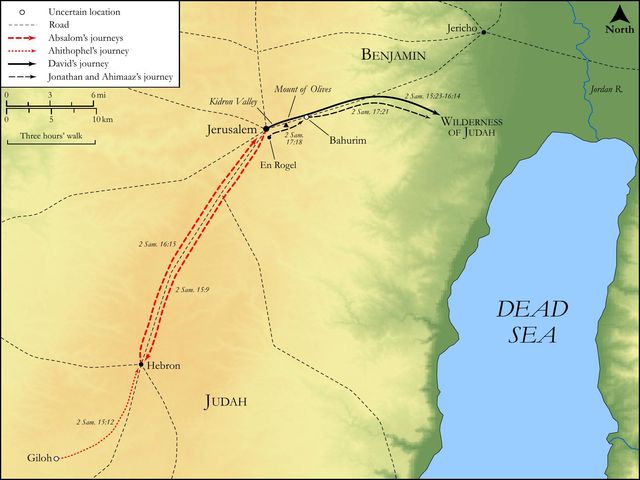
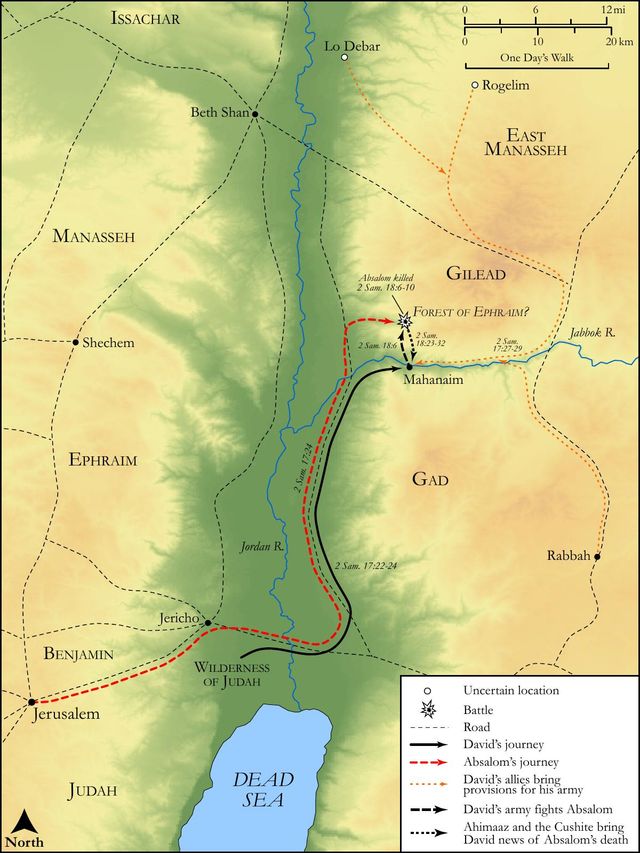
We must now leave David's enemies pleasing themselves with the thoughts of a sure victory by following Hushai's counsel, and sending a summons, no doubt, to all the tribes of Israel, to come to the general rendezvous at a place appointed, pursuant to that counsel; and we next find David's friends consulting how to get him notice of all this, that he might steer his course accordingly. Hushai tells the priests what had passed in council, Sa2 17:15. But, it should seem, he was not sure but that yet Ahithophel's counsel might be followed, and was therefore jealous lest, if he made not the best of his way, the king would be swallowed up, and all the people that were with him, Sa2 17:16. Perhaps, as he was called in to give advice (Sa2 17:5), so he was dismissed before they came to that resolve (Sa2 17:14) in favour of his advice, or he feared they might afterwards change their mind. However, it was good to provide against the worst, and therefore to hasten those valuable lives out of the reach of these destroyers. Such strict guards did Absalom set upon all the avenues to Jerusalem that they had much ado to get this necessary intelligence to David. 1. The young priests that were to be the messengers were forced to retire secretly out of the city, by En-rogel, which signifies, as some say, the fountain of a spy. Surely it went ill with Jerusalem when two such faithful priests as they were might not be seen to come into the city. 2. Instructions were sent to them by a poor simple young woman, who probably went to that well under pretence of fetching water, Sa2 17:17. If she carried the message by word of mouth, there was danger of her making some mistake or blunder in it; but Providence can make an ignorant girl a trusty messenger, and serve its wise counsels by the foolish things of the world. 3. Yet, by the vigilance of Absalom's spies, they were discovered, and information was brought to Absalom of their motions: A lad saw them and told him, Sa2 17:18. 4. They, being aware that they were discovered, sheltered themselves in a friend's house in Bahurim, where David had refreshed himself but just before, Sa2 16:14. There they were happily hidden in a well, which now, in summer time, perhaps was dry, Sa2 17:18. The woman of the house very ingeniously covered the mouth of the well with a cloth, on which she spread corn to dry, so that the pursuers were not aware that there was a well; else they would have searched it, Sa2 17:19. Thus far the woman did well; but we know not how to justify her further concealing them with a lie, Sa2 17:20. We must not do evil that good may come of it. However, hereby the messengers were protected, and the pursuers were defeated and returned to Absalom without their prey. It was well that Absalom did not hereupon fall upon their two fathers, Zadok and Abiathar, as Saul on Ahimelech for his kindness to David: but God restrained him. Being thus preserved, they brought their intelligence very faithfully to David (Sa2 17:21), with this advice of his friends, that he should not delay to pass over Jordan, near to which, it seems, he now was. There, as some think, he penned the 42nd and 43rd Psalms, looking back upon Jerusalem from the land of Jordan, Psa 42:6.
Historical interpretation
Historical reception
1 surviving comment on this verse from the historical church.
For in the history, Hushai is mentioned as the chief companion of David and the son of Arachi, but in the psalm, Hushai is the son of Jemini. Neither he nor any other of those appearing in the history was the son of Jemini. Perhaps he was called the son of Jemini for this reason, because he displayed great valor and strength through a mere pretense of friendship, going over, as he pretended, to Absalom, but in reality thwarting the plans of Ahithophel, a very skilled man, well trained in military affairs, who was giving his counsel. “The son of Jemini” is interpreted “the son of the right hand.” By his proposals he prevented the acceptance of the plan of Ahithophel—that no time should intervene in the affairs but that an attack should be made immediately on the father while he was unprepared—“in order that,” as Scripture says, “the Lord might bring all evils upon Absalom.” At all events, he seemed to them to introduce more plausible reasons for postponement and delay, while his real purpose was to give time to David to gather his forces. Because of Hushai’s counsel he was acceptable to Absalom, who said, “The counsel of Hushai the Archite is better than the counsel of Ahithophel.”However, Hushai informed David through the priests Zadok and Abiathar of the decision and bade him not to camp in Araboth in the desert but urged him to cross it. Since, then, he was on the right hand of David through his good advice, he obtained the name from his brave deed. Surely it is because of this that he is called “son of Jemini,” that is, “son of the right hand.” It is a custom of Scripture not only to give those who are more wicked a name from their sin rather than from their fathers but also to call the better sons from the virtue characterizing them.
Continue studying 2 Samuel 17:15 across the web’s major study libraries — every link below opens this exact verse, chapter, or book on the destination site.
Read & Compare
 BibleGatewayThis verse in more than 200 translations and 70 languages.
 Bible.comThe YouVersion reader — hundreds of translations, reading plans, and highlights.
 ESV.orgCrossway's official English Standard Version reader.
 NET BibleThe NET translation with 60,000+ translators' notes on every rendering decision.
 STEP BibleTyndale House's free study tool — original text, vocabulary, and scholarly resources.
 BibliaLogos Bible Software's free web reader.
 USCCBThe New American Bible (Revised Edition) with the U.S. bishops' study notes.
Commentaries
 BibleHub CommentariesDozens of classic commentaries on this verse, gathered on one page.
 StudyLightMore than 100 commentary sets — the largest collection on the web.
 BibleRefPlain-English commentary on what this verse means, verse by verse.
 Enduring WordDavid Guzik's free commentary on this chapter, widely used by Bible teachers.
 Bible Study ToolsVerse commentary alongside Greek and Hebrew study aids.
Original Language & Research
- BibleHub InterlinearThe verse word by word — original language, transliteration, and English.
- BibleHub LexiconEvery word's original-language definition and Strong's entry.
 Blue Letter BibleDeep-study tools — Strong's numbers, concordance, and word studies.
 SefariaThe Hebrew text with Rashi and centuries of Jewish commentary.
Sermons, Hymns & Audio


TrulyRandomVerse is not affiliated with these sites and doesn’t control their content. They’re linked because they’re genuinely useful.
Summary
This pivotal verse in 2 Samuel 17:15 captures the urgent moment when Hushai the Archite, King David's loyal confidant acting as a double agent within Absalom's court, transmits crucial intelligence to the faithful priests, Zadok and Abiathar. It details the contrasting counsel given to Absalom by both the treacherous Ahithophel and Hushai himself, initiating a critical chain of communication that will ultimately preserve David's life and kingdom from the immediate threat of rebellion and set the stage for Absalom's downfall.
Context
ShowHideLiterary Context
This verse is strategically placed at a critical juncture in the narrative of Absalom's rebellion against King David, immediately following the dramatic confrontation of counsel in Absalom's war council. David, having been forced to flee Jerusalem, shrewdly dispatched his loyal friend Hushai back to the city with the specific mission to counter the renowned counsel of Ahithophel. Ahithophel, David's former trusted advisor, was known for his exceptionally shrewd advice, which was regarded as if one had inquired of the oracle of God. In the preceding verses of 2 Samuel 17, Ahithophel had advised Absalom to launch an immediate, swift pursuit of David with a small, elite force, a plan that would almost certainly have resulted in David's capture and death (2 Samuel 17:1-4). However, Hushai, through divine intervention, successfully presented an alternative, seemingly more grandiose but ultimately delaying and flawed strategy, which Absalom, in his pride, foolishly chose over Ahithophel's sounder advice (2 Samuel 17:7-14). Verse 15 is Hushai's urgent and comprehensive report of both counsels to David's loyal network, setting the stage for David's escape.
Historical & Cultural Context
The setting is ancient Israel during a period of intense civil unrest and dynastic struggle. Absalom's rebellion was a significant challenge to David's kingship, representing a direct threat to the divinely appointed monarchy and the stability of the nation. In ancient Near Eastern courts, royal advisors like Ahithophel held immense power and influence, their counsel often determining the fate of kingdoms and rulers. The role of priests like Zadok and Abiathar was not merely ritualistic; they often served as trusted confidants, record-keepers, and, as seen here, crucial communicators, especially when loyalty to the king was paramount. The act of intelligence gathering and relaying was vital in ancient warfare and political maneuvering, where timely and accurate information could mean the difference between victory and defeat, or life and death. The urgency of Hushai's message underscores the precariousness of David's situation and the high stakes involved in the struggle for the throne, highlighting the reliance on a network of loyal agents.
Key Themes
ShowHideThis verse powerfully illustrates several overarching themes within 2 Samuel and the broader biblical narrative. Firstly, Divine Providence is supremely evident; God's unseen hand is at work, actively turning the "wise" counsel of Ahithophel into foolishness and protecting His anointed king, David. This echoes the truth that "There are many devices in a man's heart; nevertheless the counsel of the LORD, that shall stand" (Proverbs 19:21). Secondly, the theme of Loyalty and Treachery is starkly contrasted, highlighting Hushai's unwavering faithfulness to David against Ahithophel's profound betrayal. The priests Zadok and Abiathar, along with their sons, also exemplify selfless loyalty, risking their lives to serve as vital messengers. Thirdly, the narrative emphasizes the critical importance of Strategic Intelligence; the timely relay of information about both Ahithophel's immediate, deadly plan and Hushai's delaying tactic provided David with precious time and knowledge crucial for his survival. Finally, the passage underscores The Power of Counsel, demonstrating how advice, whether divinely inspired, humanly shrewd, or foolishly chosen, can profoundly impact the course of events, particularly in matters of leadership, war, and destiny, as seen in Absalom's fatal choice in 2 Samuel 17:14.
Exposition and Analysis
ShowHideKey Word Analysis
ShowHideFrom a primitive root meaning "to advise; reflexively, to deliberate or resolve." This word is central to the verse, appearing twice (implied in "counselled"). It highlights the act of giving strategic advice, which in this context is determinative for the fate of David and Absalom. The contrast between Ahithophel's counsel (shrewd but thwarted) and Hushai's counsel (deceptive but divinely purposed) underscores the power and impact of advice, especially in matters of state and war.
Derived from a root meaning "old," this term refers to the aged, ancient men, or senators. In ancient Israel, elders were highly respected community leaders who held significant influence and authority, often serving as advisors and decision-makers in public assemblies and legal matters. Their presence in Absalom's war council indicates a broad base of support for the rebellion and the weight given to the counsel presented before them. Hushai's success in swaying the elders, alongside Absalom, was crucial to the divine plan.
Verse Breakdown
ShowHide"Then said Hushai unto Zadok and to Abiathar the priests"
This opening clause immediately establishes the urgency and the communication channel. Hushai, having just left the war council, wastes no time in initiating the critical intelligence transfer. His direct approach to Zadok and Abiathar highlights their established role as loyal and trusted intermediaries for David, chosen because of their priestly status which afforded them a certain level of access and credibility within Jerusalem, making them ideal conduits for sensitive information.
"Thus and thus did Ahithophel counsel Absalom and the elders of Israel;"
Hushai first relays the details of Ahithophel's advice. The repeated idiomatic phrase "thus and thus" (כָּזֹאת וְכָזֹאת, ka'zot ve'ka'zot) signifies that he meticulously detailed Ahithophel's shrewd and deadly plan to pursue David immediately, as well as the compelling arguments Ahithophel used to persuade Absalom and the influential "elders of Israel." This part of the message was crucial for David to understand the imminent and severe threat he faced from the rebellion's most astute strategist.
"and thus and thus have I counselled."
Following the report of Ahithophel's counsel, Hushai then recounts his own counter-counsel. Again, "thus and thus" signifies a full explanation of his elaborate, delaying strategy and precisely how he managed to sway Absalom and the elders away from Ahithophel's sounder, but for David, fatal, advice. This second part of the message was equally vital, as it revealed the precious window of opportunity David had been granted to escape. Hushai's successful deception, divinely orchestrated, is the pivot point of the entire rebellion narrative, turning the tide in David's favor.
Literary Devices
ShowHideThe verse employs several significant literary devices that enrich its meaning and impact. Dramatic Irony is profoundly present, as the reader is fully aware of Hushai's true allegiance and the divine purpose behind his actions, while Absalom and his followers remain blissfully oblivious to their impending doom. This creates palpable tension and highlights the futility of human schemes when they run counter to God's sovereign will. The Repetition of the phrase "thus and thus" (כָּזֹאת וְכָזֹאת, ka'zot ve'ka'zot) serves as an emphatic device, underscoring the comprehensive and meticulous nature of Hushai's report. This repetition not only assures the recipients of the message's thoroughness but also builds a sense of urgency and gravity, reflecting the high stakes involved. Furthermore, the contrasting figures of Ahithophel and Hushai function as Foils, with Ahithophel representing human wisdom turned to treachery and ultimately self-destruction, while Hushai embodies loyal, divinely-empowered counter-intelligence that leads to salvation. The entire scene also serves as powerful Foreshadowing, as the successful relay of this critical intelligence directly leads to David's escape and, ultimately, to the tragic downfall of Absalom's rebellion.
Theological and Thematic Connections
ShowHideThis verse powerfully illustrates the overarching theological truth of God's sovereignty over human affairs, even amidst chaos, betrayal, and rebellion. It demonstrates that no human counsel, however shrewd or widely accepted, can thwart the divine purpose. God, in His infinite wisdom, can turn the "wisdom of the wise" into foolishness, using unexpected agents and seemingly improbable circumstances to achieve His will. Hushai's successful deception was not merely a clever human maneuver but a direct act of divine intervention, showing that God works through His faithful servants to protect His anointed and advance His kingdom purposes. This narrative offers profound assurance that even when faced with overwhelming opposition and seemingly insurmountable odds, God remains in control, orchestrating events for the good of His people and the fulfillment of His promises. It underscores the importance of trusting in God's plan, even when it unfolds in mysterious or unconventional ways, reminding us that His counsel alone will stand.
Reflection and Application
ShowHideThe account in 2 Samuel 17:15 offers profound lessons for contemporary believers, calling us to cultivate discernment in evaluating counsel, recognizing that not all advice, even from seemingly wise or authoritative sources, aligns with God's will or leads to life. We are reminded that true wisdom comes from God, and His plans often unfold in ways that defy human logic or expectation. This passage also celebrates the invaluable role of loyal friends and trusted allies in times of crisis—those who, like Hushai, Zadok, and Abiathar, are willing to risk their own safety and reputation for a righteous cause. It encourages us to be such faithful friends and to value those in our lives who demonstrate unwavering loyalty to Christ and His kingdom. Ultimately, the narrative reinforces the comforting truth that God is sovereign over all human schemes and machinations. In moments of personal or collective turmoil, when circumstances seem dire and opposition overwhelming, we are encouraged to trust in God's overarching providence, knowing that He can turn the counsel of the wicked into foolishness and orchestrate deliverance through unexpected means. Our call is to remain faithful, pray for wisdom, and act courageously when God opens a door for His purposes.
Questions for Reflection
ShowHideFAQ
ShowHideWhy was Hushai's counsel chosen over Ahithophel's?
ShowHideAbsalom, in his pride and desire for a grand, public victory, was swayed by Hushai's more elaborate and flattering plan, which appealed to his ego and seemed to offer a more decisive, overwhelming triumph. Ahithophel's plan, though strategically sound and immediate, was less glamorous. Crucially, Absalom's choice was not merely a matter of human preference; it was a direct result of divine intervention. As the text explicitly states, the Lord "had purposed to defeat the good counsel of Ahithophel, to the intent that the Lord might bring evil upon Absalom" (2 Samuel 17:14). God orchestrated the circumstances to ensure David's deliverance and Absalom's downfall.
What was the role of Zadok and Abiathar in this intelligence operation?
ShowHideZadok and Abiathar were faithful priests who remained loyal to King David despite Absalom's widespread rebellion. They served as crucial intermediaries for Hushai's intelligence. When Hushai needed to relay the vital information to David, he entrusted it to these priests. Their sons, Jonathan and Ahimaaz, then acted as swift and secret messengers, risking their lives to carry the message across the Jordan River to David. This highlights the important role of the priesthood in supporting the legitimate king and God's anointed during times of crisis, demonstrating their unwavering commitment and their willingness to act as a vital communication network, as seen in 2 Samuel 15:27-29.
What is the significance of the phrase "thus and thus"?
ShowHideThe Hebrew idiom "thus and thus" (כָּזֹאת וְכָזֹאת, ka'zot ve'ka'zot) is used to indicate that a complete and detailed recounting of the preceding events or conversations has been given. It is not a vague placeholder but a linguistic device that assures the recipient (Zadok and Abiathar) that Hushai has fully conveyed both Ahithophel's initial, dangerous counsel and his own successful counter-counsel, without needing to repeat the lengthy speeches from 2 Samuel 17:1-14. It underscores the thoroughness, accuracy, and urgency of Hushai's report, which was essential for David to make informed decisions for his survival.
Christ-Centered Fulfillment
ShowHideThe narrative of 2 Samuel 17:15, with its themes of divine providence, wisdom turned to foolishness, and the preservation of God's anointed through loyal agents, finds its ultimate fulfillment in Jesus Christ. Just as God sovereignly turned Ahithophel's "wise" counsel into folly to save King David, so too did He orchestrate the ultimate plan of salvation through what the world considered "foolishness"—the cross of Christ. The apostle Paul declares that God "made foolish the wisdom of the world" (1 Corinthians 1:20), choosing to save those who believe through the "foolishness of the message preached" (1 Corinthians 1:21). David, the anointed king, pursued by a rebellious son and preserved by loyal friends and divine intervention, foreshadows Jesus, the true King of Israel, who was betrayed by one of His own (Matthew 26:47-50) yet ultimately triumphed over all opposition—sin, death, and the powers of darkness—through His sacrificial death and glorious resurrection (Colossians 2:15). The "counsel" that leads to death (Ahithophel's) versus the "counsel" that brings life (Hushai's, divinely orchestrated) parallels the Law, which exposes sin and leads to death (Romans 7:7-11), versus the Gospel of grace, which offers true life and freedom in Christ (Romans 8:1-4). Jesus Himself is the embodiment of God's perfect wisdom and counsel, in whom "are hidden all the treasures of wisdom and knowledge" (Colossians 2:3). His life, death, and resurrection represent God's ultimate strategic plan, flawlessly executed to bring about eternal salvation for all who believe.