


2 Samuel 15:34
- וְאִםve·'imand ifH518Conj-w ¦ PrtParticle Conditionalוְandאִםif
- הָעִירha·'Irthe cityH5892Art ¦ N-fsNoun Singular Feminine Absoluteהָtheעִירcity
- תָּשׁוּבta·Shuvyou will returnH7725V-Qal-Imperf-2msVerb Qal Imperfect 2nd Singular Masculine
- וְאָמַרְתָּve·'a·mar·Taand you will sayH559Conj-w ¦ V-Qal-ConsecPerf-2msVerb Qal Consecutive Perfect 2nd Singular Masculineוְandאָמַרְתָּyou will say
- לְאַבְשָׁלוֹםle·'av·sha·lOmto AbsalomH53Prep-l ¦ N-proper-mNoun Proper MasculineלְtoאַבְשָׁלוֹםAbsalom
- עַבְדְּךָ'av·de·Khayour servantH5650N-msc ¦ 2msNoun Singular Masculine Constructעַבְדְּservantךָyour
- אֲנִי'a·NiIH589Pro-1csPronoun Personal 1st Singular common gender
- הַמֶּלֶךְha·Me·lekhO kingH4428Art ¦ N-msNoun Singular Masculine AbsoluteהַOמֶּלֶךְking
- אֶהְיֶה'eh·YehI will beH1961V-Qal-Imperf-1csVerb Qal Imperfect 1st Singular common gender
- עֶבֶד'E·ved[was] [the] servant ofH5650N-mscNoun Singular Masculine Construct
- אָבִיךָ'a·Vi·khayour fatherH1N-msc ¦ 2msNoun Singular Masculine Constructאָבִיfatherךָyour
- וַאֲנִיva·'a·Ni<and> IH589Conj-w ¦ Pro-1csPronoun Personal 1st Singular common genderוַ<and>אֲנִיI
- מֵאָזme·'Azfrom thenH227Prep-m ¦ AdvAdverbמֵfromאָזthen
- וְעַתָּהve·'a·Tahand nowH6258Conj-w ¦ AdvAdverbוְandעַתָּהnow
- וַאֲנִיva·'a·Ni<and> IH589Conj-w ¦ Pro-1csPronoun Personal 1st Singular common genderוַ<and>אֲנִיI
- עַבְדֶּךָ'av·De·kha[will be] your servantH5650N-msc ¦ 2msNoun Singular Masculine Constructעַבְדֶּ[will be] servantךָyour
- וְהֵפַרְתָּהve·he·far·Tahand you will frustrateH6565Conj-w ¦ V-Hiphil-ConsecPerf-2msVerb Hiphil Consecutive Perfect 2nd Singular Masculineוְandהֵפַרְתָּהyou will frustrate
- לִיLifor <the> mePrep-l ¦ 1csSuffix Personal 1st Singular common genderלִfor <the>יme
- אֵת'et<obj.>H853DirObjMParticle Object Indicator
- עֲצַת'a·Tzat[the] counsel ofH6098N-fscNoun Singular Feminine Construct
- אֲחִיתֹפֶל'a·chi·To·felAhithophelH302N-proper-mNoun Proper Masculine
English is a literal word-by-word gloss of the Hebrew, not the KJV's wording. Why?
This is the original text the KJV's translators worked from — each Hebrew word with its own literal English meaning in this verse, prepared by scholars at Tyndale House, Cambridge. The KJV translates whole sentences, not word by word, so its wording differs: one Hebrew word can become several English words, and the KJV may choose “the LORD” where the gloss reads “Yahweh”. Both are faithful — they answer different questions. For the KJV's own rendering, switch to the KJV text.
Details
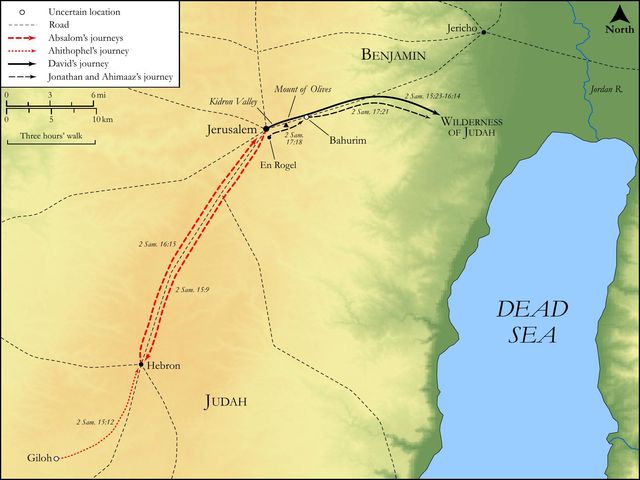
See on the biblical-era map

Study this verse
Public-domain commentary
Matthew Henry
From his Commentary on the Whole Bible. Henry comments on passages, not single verses — this entry covers 2 Samuel 15:31–37.
Nothing, it seems, appeared to David more threatening in Absalom's plot than that Ahithophel was in it; for one good head, in such a design, is worth a thousand good hands. Absalom was himself no politician, but he had got one entirely in his interest that was, and would be the more dangerous because he had been all along acquainted with David's counsels and affairs; if therefore he can be baffled, Absalom is as good as routed and the head of the conspiracy cut off. This David endeavours to do.
I.By prayer.
When he heard that Ahithophel was in the plot he lifted up his heart to God in this short prayer: Lord, turn the counsel of Ahithophel into foolishness, Sa2 15:31. He had not opportunity for a long prayer, but he was not one of those that thought he should be heard for his much speaking. It was a fervent prayer: "Lord, I pray thee, do this." God is well pleased with the importunity of those that come to him with their petitions. David is particular in this prayer; he names the person whose counsels he prays against. God gives us leave, in prayer, to be humbly and reverently free with him, and to mention the particular care, and fear, and grief, that lies heavily upon us. David prayed not against Ahithophel's person, but against his counsel, that God would turn it into foolishness, that, though he was a wise man, he might at this time give foolish counsel, or, if he gave wise counsel, that it might be rejected as foolish, or, if it were followed, that by some providence or other it might be defeated, and not attain the end. David prayed this in a firm belief that God has all hearts in his hand, and tongues too, that, when he pleases, he can take away the understanding of the aged and make the judges fools, (Job 12:17; Isa 3:2, Isa 3:3), and in hope that God would own and plead his just and injured cause. Note, We may pray in faith, and should pray with fervency, that God will turn that counsel into foolishness which is taken against his people.
II.By policy.
We must second our prayer with our endeavours, else we tempt God. It is good service to countermine the policy of the church's enemies. When David came to the top of the mount, he worshipped God, Sa2 15:32. Note, Weeping must not hinder worshipping, but quicken it rather. Now he penned the third Psalm, as appears by the title; and some think that his singing this was the worship he now paid to God. Just now Providence brought Hushai to him. While he was yet speaking, God heard, and sent him the person that should be instrumental to befool Ahithophel. He came to condole with David on his present trouble, with his coat rent and earth upon his head; but David, having a great deal of confidence in his conduct and faithfulness, resolved to employ him as a spy upon Absalom. He would not take him with him (Sa2 15:33), for he had now more need of soldiers than counsellors, but sent him back to Jerusalem, to wait for Absalom's arrival, as a deserter from David, and to offer him his service, Sa2 15:34. Thus he might insinuate himself into his counsels, and defeat Ahithophel, either by dissuading Absalom from following his advice or by discovering it to David, that he might know where to stand upon his guard. How this gross dissimulation, which David put Hushai upon, can be justified, as a stratagem in war, I do not see. The best that can be made of it is that Absalom, if he rebel against his father, must stand upon his guard against all mankind, and, if he will be deceived, let him be deceived. David recommended Hushai to Zadok and Abiathar, as persons proper to be consulted with (Sa2 15:35), and to their two sons, as trusty men to be sent on errands to David, Sa2 15:36. Hushai, thus instructed, came to Jerusalem (Sa2 15:37), whither also Absalom soon after came with his forces. How soon do royal palaces and royal cities change their masters! But we look for a kingdom which cannot be thus shaken and in the possession of which we cannot be disturbed.
Continue studying 2 Samuel 15:34 across the web’s major study libraries — every link below opens this exact verse, chapter, or book on the destination site.
Read & Compare
 BibleGatewayThis verse in more than 200 translations and 70 languages.
 Bible.comThe YouVersion reader — hundreds of translations, reading plans, and highlights.
 ESV.orgCrossway's official English Standard Version reader.
 NET BibleThe NET translation with 60,000+ translators' notes on every rendering decision.
 STEP BibleTyndale House's free study tool — original text, vocabulary, and scholarly resources.
 BibliaLogos Bible Software's free web reader.
 USCCBThe New American Bible (Revised Edition) with the U.S. bishops' study notes.
Commentaries
 BibleHub CommentariesDozens of classic commentaries on this verse, gathered on one page.
 StudyLightMore than 100 commentary sets — the largest collection on the web.
 BibleRefPlain-English commentary on what this verse means, verse by verse.
 Enduring WordDavid Guzik's free commentary on this chapter, widely used by Bible teachers.
 Bible Study ToolsVerse commentary alongside Greek and Hebrew study aids.
Original Language & Research
- BibleHub InterlinearThe verse word by word — original language, transliteration, and English.
- BibleHub LexiconEvery word's original-language definition and Strong's entry.
 Blue Letter BibleDeep-study tools — Strong's numbers, concordance, and word studies.
 SefariaThe Hebrew text with Rashi and centuries of Jewish commentary.
Sermons, Hymns & Audio


TrulyRandomVerse is not affiliated with these sites and doesn’t control their content. They’re linked because they’re genuinely useful.
Summary
2 Samuel 15:34 marks a critical turning point in Absalom's rebellion, revealing King David's strategic genius and unwavering trust in God's providence amidst his desperate flight from Jerusalem. In this pivotal moment, David instructs his loyal confidant, Hushai the Archite, to return to the city and feign allegiance to Absalom. Hushai's perilous mission is to infiltrate Absalom's inner circle, gain his trust by mimicking his past loyalty to David, and then strategically undermine and ultimately nullify the esteemed counsel of Ahithophel, David's former, now treacherous, advisor. This verse sets in motion a divinely orchestrated counter-intelligence operation designed to protect David, preserve the Davidic line, and thwart the rebellious coup.
Context
ShowHideLiterary Context
This verse is deeply embedded within the gripping narrative of Absalom's audacious rebellion against his father, King David, a story that unfolds from 2 Samuel 15 through 2 Samuel 18. Immediately preceding this command, David is depicted in a state of profound distress, fleeing Jerusalem barefoot and weeping as he ascends the Mount of Olives. His encounter with Hushai, who appears with torn clothes and dust on his head—traditional signs of mourning and deep loyalty—underscores the gravity of the situation and the depth of Hushai's devotion. While David initially considers keeping Hushai with him, he quickly devises this ingenious and perilous plan, recognizing Hushai's unique ability to infiltrate Absalom's court. The subsequent chapters, particularly 2 Samuel 16-17, vividly detail Hushai's execution of this dangerous mission, culminating in his successful frustration of Ahithophel's counsel and Ahithophel's subsequent suicide, thereby directly fulfilling David's strategic objective outlined in this verse. The narrative flow powerfully contrasts David's vulnerability with his strategic acumen and the unwavering faithfulness of his loyal retainers.
Historical & Cultural Context
The setting is ancient Israel during the united monarchy, a period characterized by intense political intrigue, dynastic struggles, and the ever-present threat of internal revolt. Absalom's rebellion was a full-scale civil war that deeply fractured the nation, challenging the very foundation of David's kingship. In this era, the counsel of trusted advisors was not merely advisory but a crucial component of effective leadership, military strategy, and national stability. Figures like Ahithophel wielded immense influence, their words often regarded with near-divine authority, as explicitly noted in 2 Samuel 16:23. Loyalty oaths and personal fealty were paramount, making betrayal by a trusted confidant, such as Ahithophel's defection, a profound and shocking act. David's desperate flight from Jerusalem highlights the precariousness of his reign and the personal toll of such conflicts. The use of spies, strategic deception, and counter-intelligence, while ethically complex, was a recognized and often necessary tactic in ancient Near Eastern political and military maneuvering, employed to gain an advantage in high-stakes situations.
Key Themes
ShowHideThis verse significantly contributes to several overarching themes within 2 Samuel and the broader Old Testament narrative. Firstly, it powerfully illustrates the theme of Divine Providence and Sovereignty, demonstrating that even amidst human chaos, political upheaval, and desperate strategies, God is actively at work, orchestrating events to fulfill His purposes. David's humanly conceived plan, though audacious, becomes the very instrument of God's will, as explicitly affirmed in 2 Samuel 17:14. Secondly, it highlights the profound theme of Loyalty and Betrayal, starkly contrasting Hushai's unwavering faithfulness and self-sacrificial commitment to David with Ahithophel's shocking and devastating defection. Thirdly, the narrative emphasizes The Power of Counsel, showcasing how strategic advice can determine the fate of a kingdom, and underscoring the critical importance of discerning between wise, God-honoring counsel and shrewd, self-serving advice that leads to destruction. Finally, it explores the Moral Complexity of Warfare and Deception, presenting a scenario where a loyal servant engages in strategic deception for what is presented as a righteous cause—the preservation of God's anointed king and the thwarting of a wicked rebellion—thereby raising nuanced questions about means and ends in a fallen world.
Exposition and Analysis
ShowHideKey Word Analysis
ShowHideThis verb (שׁוּב, shûwb') signifies "to turn back," "to go back," or "to restore." In this context, it is a directive for Hushai to physically re-enter Jerusalem, a city now under Absalom's control. The word implies a reversal of Hushai's initial action of accompanying David in his flight, marking a deliberate and dangerous strategic maneuver. It underscores the immediate peril and the calculated risk inherent in David's command, as Hushai is being sent back into the very heart of the enemy's camp.
The term "servant" (עֶבֶד, 'ebed') is central to Hushai's feigned allegiance. In ancient Near Eastern contexts, "servant" denoted a relationship of profound submission, loyalty, and duty, often implying a binding oath or lifelong commitment. By instructing Hushai to declare himself Absalom's "servant," David is orchestrating a profound and dangerous deception. Hushai is to outwardly adopt the posture of complete subservience and fidelity to Absalom, mirroring his past genuine loyalty to David, thereby gaining Absalom's trust and access to his inner circle. This word highlights the dangerous theatricality and the deep personal cost of Hushai's mission.
The verb "defeat" or "frustrate" (פָּרַר, pârar') signifies "to break up," "to violate," "to annul," "to bring to nothing," or "to render useless." David's instruction to Hushai was not merely to offer alternative advice, but specifically to nullify the effect of Ahithophel's counsel. This implies a proactive and destructive intent: Hushai's mission was to discredit Ahithophel's advice, cause delay, and ultimately prevent Absalom from acting upon it. This word highlights the critical, counter-strategic nature of Hushai's task and its direct opposition to Ahithophel's renowned influence.
Verse Breakdown
ShowHide"But if thou return to the city"
This opening clause establishes the dangerous and counter-intuitive premise of Hushai's mission. David is sending his loyal friend back into Jerusalem, a city now controlled by his rebellious son, Absalom. This directive immediately signals the high stakes and the immense personal courage required of Hushai, as he is willingly placing himself in the heart of the enemy's territory.
"and say unto Absalom, I will be thy servant, O king; [as] I [have been] thy father's servant hitherto, so [will] I now also [be] thy servant"
This is the core of the strategic deception. Hushai is instructed to feign absolute and immediate loyalty to Absalom, using language that directly mirrors and exploits his long-standing, genuine service to David. The repetition of "thy servant" emphasizes the complete and convincing submission Hushai must outwardly display to gain Absalom's trust and penetrate his inner circle. This calculated lie is designed to secure Hushai's access to Absalom's decision-making processes and counsel.
"then mayest thou for me defeat the counsel of Ahithophel"
This final clause articulates the ultimate and singular objective of Hushai's perilous mission. The entire purpose of his feigned loyalty and infiltration is to undermine, nullify, and bring to nothing the advice of Ahithophel. This reveals David's astute understanding of the existential threat Ahithophel's strategic brilliance posed to his survival and his kingdom, and his own strategic genius in countering it through indirect, yet highly effective, means.
Literary Devices
ShowHideThe passage employs several potent literary devices that deepen its impact. Irony is profoundly present, as Hushai's deep and unwavering loyalty to King David is paradoxically expressed through a deliberate and convincing act of feigned disloyalty to Absalom. The very words of allegiance ("I will be thy servant") become a deceptive tool in service of a greater truth and a righteous cause. There is also a strong element of Foreshadowing, as David's desperate plea for Hushai to "defeat the counsel of Ahithophel" directly sets up the dramatic confrontation between Hushai and Ahithophel's advice in the subsequent chapters of 2 Samuel, ultimately leading to Ahithophel's downfall and the preservation of David's life. The entire scenario is imbued with palpable Dramatic Tension, as the reader is acutely aware of the immense danger Hushai faces, the high stakes of his mission, and the precariousness of David's situation, creating suspense regarding the outcome of this strategic gamble and the ultimate fate of the kingdom.
Theological and Thematic Connections
ShowHideThis passage profoundly illustrates the intricate interplay between human strategy and divine sovereignty. David's desperate plan, born of immediate crisis and human ingenuity, is not merely a clever maneuver but becomes the very instrument through which God works to preserve His anointed king and frustrate the schemes of the wicked. While David devises the plan, the narrative explicitly states that "the Lord had purposed to defeat the good counsel of Ahithophel, to the intent that the Lord might bring evil upon Absalom" (2 Samuel 17:14). This highlights a crucial theological truth: God can use unexpected means, even morally complex ones like strategic deception, to achieve His righteous purposes, demonstrating His ultimate control over human events and the futility of any counsel or plan that stands against His sovereign will. It teaches us that God's ways are often beyond our comprehension, and His power is manifest even in the most chaotic and desperate human circumstances.
Reflection and Application
ShowHideThe story of Hushai's perilous mission offers profound and multifaceted insights for contemporary believers navigating a complex world. In moments of personal or communal crisis, when circumstances seem overwhelming, and betrayal or adversity is rampant, we are powerfully reminded that God is not absent but actively working behind the scenes, often through unexpected and even unconventional means. David's strategic thinking, coupled with Hushai's courageous and self-sacrificial loyalty, teaches us the invaluable lessons of both wisdom in planning and unwavering faithfulness in execution, even when the path is fraught with danger, moral ambiguity, and personal risk. It challenges us to cultivate a deep trust in God's overarching plan and sovereign control, even when our immediate circumstances are chaotic and seemingly out of control, and to recognize that He possesses the power to turn the most cunning schemes of adversaries to nothing. Moreover, this narrative underscores the critical importance of discerning counsel in our own lives, urging us to seek wisdom that aligns with God's immutable truth and righteous character, rather than that which merely appears shrewd, expedient, or self-serving but ultimately leads to destruction.
Questions for Reflection
ShowHideFAQ
ShowHideWas Hushai's deception morally justifiable?
ShowHideThis is a complex ethical question that has been debated by theologians. From a purely ethical standpoint, deception is generally condemned in biblical teaching (e.g., Exodus 20:16). However, the biblical narrative often presents instances where deception is employed by righteous figures in the context of warfare, to protect life, or to advance God's purposes, and these actions are not explicitly condemned, and sometimes even implicitly affirmed by their outcomes (e.g., the Hebrew midwives in Exodus 1:15-21 or Rahab in Joshua 2:1-7). In Hushai's case, his deception was not for personal gain but to protect God's anointed king and to thwart a wicked rebellion that threatened the stability and future of Israel. Crucially, the narrative explicitly states that "the Lord had purposed to defeat the good counsel of Ahithophel" (2 Samuel 17:14), suggesting divine endorsement of the outcome, even if the means were unconventional. This highlights the "dirty hands" dilemma in a fallen world, where difficult choices must sometimes be made in service of a greater, divinely ordained good.
Why was Ahithophel's counsel considered so dangerous?
ShowHideAhithophel was renowned throughout Israel for his extraordinary wisdom and unparalleled strategic acumen. His counsel was so highly regarded that it was "as if one consulted the oracle of God" (2 Samuel 16:23). His advice was consistently practical, decisive, and almost always led to successful outcomes. For instance, he advised Absalom to publicly lie with David's concubines, a shrewd political move designed to irrevocably alienate David from the people and solidify Absalom's claim to the throne (2 Samuel 16:20-22). His subsequent advice to immediately pursue David with 12,000 chosen men was militarily sound and would likely have led to David's capture and death, effectively crushing the rebellion before it could regroup (2 Samuel 17:1-4). David recognized that Ahithophel's wisdom, now tragically turned against him, was the most potent and immediate threat to his survival and the continuation of his kingdom.
Christ-Centered Fulfillment
ShowHideThe narrative of 2 Samuel 15:34, with its focus on the frustrating of wicked counsel through seemingly weak or deceptive means and the ultimate triumph of divine purpose, finds its profound and ultimate fulfillment in Jesus Christ. Just as Ahithophel's shrewd but ultimately self-serving counsel was defeated by God's intervention, so too the "wisdom of this world" and the insidious schemes of the "prince of this world" are utterly confounded and brought to nothing by the "foolishness" of God's plan revealed in Christ (1 Corinthians 1:20-25). The cross, which appeared to be the ultimate defeat for God's anointed King, was in fact the strategic masterpiece of divine wisdom that "disarmed the powers and authorities" and "made a public spectacle of them, triumphing over them by the cross" (Colossians 2:15). Jesus, the true and perfect Son of David, is the ultimate wise Counselor, whose counsel is always true, righteous, and whose plans can never be thwarted (Isaiah 9:6). He demonstrates ultimate and perfect loyalty to the Father, even unto death on a cross (Philippians 2:8), and through His perfect obedience and strategic sacrifice, He defeats the counsel of the adversary, securing eternal victory and salvation for all who believe, establishing a kingdom that will never be overthrown.