


Acts 7:23
- ὡςhōsWhenG5613PRTParticle or Disjunctive
- δὲdethenG1161CONJConjunction
- ἐπληροῦτοeplēroutowas fulfilledG4137V-IPI-3SVerb Imperfect Passive Indicative 3rd Singular
- αὐτῷautōto himG846P-DSMPersonal pronoun Dative Singular Masculine
- τεσσερακονταετὴςtesserakontaetēsof forty yearsG5063A-NSMAdjective Nominative Singular Masculine
- χρόνοςchronosa periodG5550N-NSMNoun Nominative Singular Masculine
- ἀνέβηanebēit cameG305V-2AAI-3SVerb 2nd Aorist Active Indicative 3rd Singular
- ἐπὶepiintoG1909PREPPreposition
- τὴνtēntheG3588T-ASFDefinite article Accusative Singular Feminine
- καρδίανkardianmindG2588N-ASFNoun Accusative Singular Feminine
- αὐτοῦautouof himG846P-GSMPersonal pronoun Genitive Singular Masculine
- ἐπισκέψασθαιepiskepsasthaito visitG1980V-ADNVerb Aorist Middle Deponent Infinitive
- τοὺςtoustheG3588T-APMDefinite article Accusative Plural Masculine
- ἀδελφοὺςadelphousbrothersG80N-APMNoun Accusative Plural Masculine
- αὐτοῦautouof himG846P-GSMPersonal pronoun Genitive Singular Masculine
- τοὺςtoustheG3588T-APMDefinite article Accusative Plural Masculine
- υἱοὺςhuioussonsG5207N-APMNoun Accusative Plural Masculine
- ἸσραήλIsraēlof IsraelG2474N-GSM-LNoun Genitive Singular Masculine Location
English is a literal word-by-word gloss of the Greek, not the KJV's wording. Why?
This is the original text the KJV's translators worked from — each Greek word with its own literal English meaning in this verse, prepared by scholars at Tyndale House, Cambridge. The KJV translates whole sentences, not word by word, so its wording differs: one Greek word can become several English words, and the KJV may choose “charity” where the gloss reads “love”. Both are faithful — they answer different questions. For the KJV's own rendering, switch to the KJV text.
Details
See on the biblical-era maps
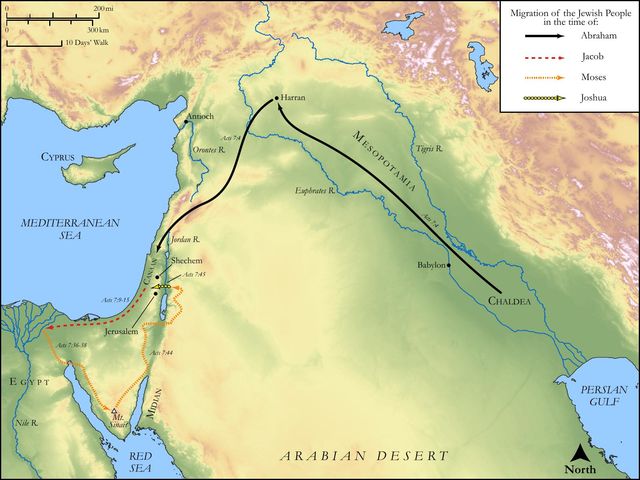
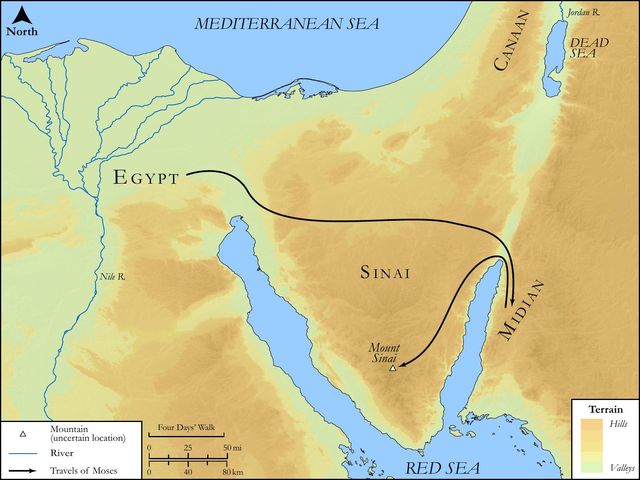
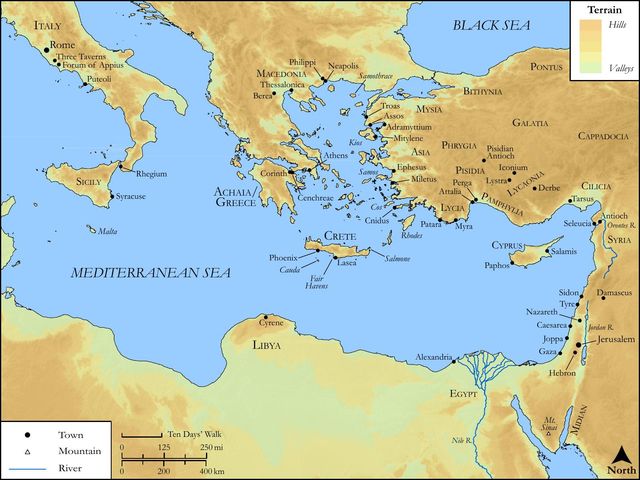
Study this verse
Public-domain commentary
Matthew Henry
From his Commentary on the Whole Bible. Henry comments on passages, not single verses — this entry covers Acts 7:17–29. His two-level outline is real structure in the source text, so it is rendered as structure.
Stephen here goes on to relate,
I.The wonderful increase of the people of Israel in Egypt; it was by a wonder of providence that in a little time they advanced from a family into a nation.
1.It was when the time of the promise drew nigh - the time when they were to be formed into a people. During the first two hundred and fifteen years after the promise made to Abraham, the children of the covenant were increased but to seventy; but in the latter two hundred and fifteen years they increased to six hundred thousand fighting men. The motion of providence is sometimes quickest when it comes nearest the centre. Let us not be discouraged at the slowness of the proceedings towards the accomplishment of God's promises; God knows how to redeem the time that seems to have been lost, and, when the year of the redeemed is at hand, can do a double work in a single day.
2.It was in Egypt, where they were oppressed, and ruled with rigour; when their lives were made so bitter to them that, one would think, they should have wished to be written childless, yet they married, in faith that God in due time would visit them; and God blessed them, who thus honoured him, saying, Be fruitful, and multiply. Suffering times have often been growing times with the church.
II.The extreme hardships which they underwent there, Act 7:18, Act 7:19.
When the Egyptians observed them to increase in number they increased their burdens, in which Stephen observes three things: - 1. Their base ingratitude: They were oppressed by another king that knew not Joseph, that is, did not consider the good service that Joseph had done to that nation; for, if he had, he would not have made so ill a requital to his relations and family. Those that injure good people are very ungrateful, for they are the blessings of the age and place they live in. 2. Their hellish craft and policy: They dealt subtly with our kindred. Come on, said they, let us deal wisely, thinking thereby to secure themselves, but it proved dealing foolishly, for they did but treasure up wrath by it. Those are in a great mistake who think they deal wisely for themselves when they deal deceitfully or unmercifully with their brethren. 3. Their barbarous and inhuman cruelty. That they might effectually extirpate them, they cast out their young children, to the end they might not live. The killing of their infant seed seemed a very likely way to crush an infant nation. Now Stephen seems to observe this to them, not only that they might further see how mean their beginnings were, fitly represented (perhaps with an eye to the exposing of the young children in Egypt) by the forlorn state of a helpless, out-cast infant (Eze 16:4), and how much they were indebted to God for his care of them, which they had forfeited, and made themselves unworthy of: but also that they might consider that what they were now doing against the Christian church in its infancy was as impious and unjust, and would be in the issue as fruitless and ineffectual, as that was which the Egyptians did against the Jewish church in its infancy. "You think you deal subtly in your ill treatment of us, and, in persecuting young converts, you do as they did in casting out the young children; but you will find it is to no purpose, in spite of your malice Christ's disciples will increase and multiply."
III.The raising up of Moses to be their deliverer.
Stephen was charged with having spoken blasphemous words against Moses, in answer to which charge he here speaks very honourably of him.
1.Moses was born when the persecution of Israel was at the hottest, especially in that most cruel instance of it, the murdering of the new-born children: At that time, Moses was born (Act 7:20), and was himself in danger, as soon as he came into the world (as our Saviour also was at Bethlehem) of falling a sacrifice to that bloody edict. God is preparing for his people's deliverance, when their way is darkest, and their distress deepest.
2.He was exceedingly fair; his face began to shine as soon as he was born, as a happy presage of the honour God designed to put upon him; he was asteios tō Theō - fair towards God; he was sanctified from the womb, and this made him beautiful in God's eyes; for it is the beauty of holiness that is in God's sight of great price.
3.He was wonderfully preserved in his infancy, first, by the care of his tender parents, who nourished him three months in their own house, as long as they durst; and then by a favourable providence that threw him into the arms of Pharaoh's daughter, who took him up, and nourished him as her own son (Act 7:21); for those whom God designs to make special use of he will take special care of. And did he thus protect the child Moses? Much more will he secure the interests of his holy child Jesus (as he is called Act 4:27) from the enemies that are gathered together against him.
4.He became a great scholar (Act 7:22): He was learned in all the wisdom of the Egyptians, who were then famed for all manner of polite literature, particularly philosophy, astronomy, and (which perhaps helped to lead them to idolatry) hieroglyphics. Moses, having his education at court, had opportunity of improving himself by the best books, tutors, and conversation, in all the arts and sciences, and had a genius for them. Only we have reason to think that he had not so far forgotten the God of his fathers as to acquaint himself with the unlawful studies and practices of the magicians of Egypt, any further than was necessary to the confuting of them.
5.He became a prime minister of state in Egypt. This seems to be meant by his being mighty in words and deeds. Though he had not a ready way of expressing himself, but stammered, yet he spoke admirably good sense, and every thing he said commanded assent, and carried its own evidence and force of reason along with it; and, in business, none went on with such courage, and conduct, and success. Thus was he prepared, by human helps, for those services, which, after all, he could not be thoroughly furnished for without divine illumination. Now, by all this, Stephen will make it appear that, notwithstanding the malicious insinuations of his persecutors, he had as high and honourable thoughts of Moses as they had.
IV.The attempts which Moses made to deliver Israel, which they spurned, and would not close in with.
This Stephen insists much upon, and it serves for a key to this story (Exo 2:11-15), as does also that other construction which is put upon it by the apostle, Heb 11:24-26. There it is represented as an act of holy self-denial, here as a designed prelude to, or entrance upon, the public service he was to be called out to (Act 7:23): When he was full forty years old, in the prime of his time for preferment in the court of Egypt, it came into his heart (for God put it there) to visit his brethren the children of Israel, and to see which way he might do them any service; and he showed himself as a public person, with a public character.
1.As Israel's saviour. This he gave a specimen of in avenging an oppressed Israelite, and killing the Egyptian that abused him (Act 7:24). Seeing one of his brethren suffer wrong, he was moved with compassion towards the sufferer, and a just indignation at the wrong-doer, as men in public stations should be, and he avenged him that was oppressed, and smote the Egyptian, which, if he had been only a private person, he could not lawfully have done; but he knew that his commission from heaven would bear him out, and he supposed that his brethren (who could not but have some knowledge of the promise made to Abraham, that the nation that should oppress them God would judge) would have understood that God by his hand would deliver them; for he could not have had either presence of mind or strength of body to do what he did, if he had not been clothed with such a divine power as evinced a divine authority. If they had but understood the signs of the times, they might have taken this for the dawning of the day of their deliverance; but they understood not, they did not take this, as it was designed, for the setting up of a standard, and sounding of a trumpet, to proclaim Moses their deliverer.
2.As Israel's judge. This he gave a specimen of, the very next day, in offering to accommodate matters between two contending Hebrews, wherein he plainly assumed a public character (Act 7:26): He showed himself to them as they strove, and, putting on an air of majesty and authority, he would have set them at one again, and as their prince have determined the controversy between them, saying, Sirs, you are brethren, by birth and profession of religion; why do you wrong one to another? For he observed that (as in most strifes) there was a fault on both sides; and therefore, in order to peace and friendship, there must be a mutual remission and condescension. When Moses was to be Israel's deliverer out of Egypt, he slew the Egyptians, and so delivered Israel out of their hands; but, when he was to be Israel's judge and lawgiver, he ruled them with the golden sceptre, not the iron rod; he did not kill and slay them when they strove, but gave them excellent laws and statutes, and decided upon their complaints and appeals made to him, Exo 18:16. But the contending Israelite that was most in the wrong thrust him away (Act 7:27), would not bear the reproof, though a just and gentle one, but was ready to fly in his face, with, Who made thee a ruler and a judge over us? Proud and litigious spirits are impatient of check and control. Rather would these Israelites have their bodies ruled with rigour by their task-masters than be delivered, and have their minds ruled with reason, by their deliverer. The wrong-doer was so enraged at the reproof given him that he upbraided Moses with the service he had done to their nation in killing the Egyptian, which, if they had pleased, would have been the earnest of further and greater service: Wilt thou kill me, as thou didst the Egyptian yesterday? Act 7:28, charging that upon him as his crime, and threatening to accuse him for it, which was the hanging out of the flag of defiance to the Egyptians, and the banner of love and deliverance to Israel. Hereupon Moses fled into the land of Midian, and made no further attempt to deliver Israel till forty years after; he settled as a stranger in Midian, married, and had two sons, by Jethro's daughter, Act 7:29.
Now let us see how this serves Stephen's purpose. 1. They charged him with blaspheming Moses, in answer to which he retorts upon them the indignities which their fathers did to Moses, which they ought to be ashamed of, and humbled for, instead of picking quarrels thus, under pretence of zeal for the honour of Moses, with one that had as great a veneration for him as any of them had. 2. They persecuted him for disputing in defence of Christ and his gospel, in opposition to which they set up Moses and his law: "But," saith he, "you had best take heed," (1.) "Lest you hereby do as your fathers did, refuse and reject one whom God has raised up to be to you a prince and a Saviour; you may understand, if you will not wilfully shut your eyes against the light, that God will, by this Jesus, deliver you out of a worse slavery than that in Egypt; take heed then of thrusting him away, but receive him as a ruler and a judge over you." (2.) "Lest you hereby fare as your fathers fared, who for this were very justly left to die in their slavery, for the deliverance came not till forty years after. This will be the issue of it, you put away the gospel from you, and it will be sent to the Gentiles; you will not have Christ, and you shall not have him, so shall your doom be." Mat 23:38, Mat 23:39.
Historical interpretation
Historical reception
1 surviving comment on this verse from the historical church.
"And when he was full forty years old." Forty years he was there, and was not found out from his being circumcised. Observe, how, being in safety, they overlook their own interests, both he and Joseph, in order that they may save others: "And when he was full forty years old, it came into his heart to visit his brethren the children of Israel."
Continue studying Acts 7:23 across the web’s major study libraries — every link below opens this exact verse, chapter, or book on the destination site.
Read & Compare
 BibleGatewayThis verse in more than 200 translations and 70 languages.
 Bible.comThe YouVersion reader — hundreds of translations, reading plans, and highlights.
 ESV.orgCrossway's official English Standard Version reader.
 NET BibleThe NET translation with 60,000+ translators' notes on every rendering decision.
 STEP BibleTyndale House's free study tool — original text, vocabulary, and scholarly resources.
 BibliaLogos Bible Software's free web reader.
 USCCBThe New American Bible (Revised Edition) with the U.S. bishops' study notes.
Commentaries
 BibleHub CommentariesDozens of classic commentaries on this verse, gathered on one page.
 StudyLightMore than 100 commentary sets — the largest collection on the web.
 BibleRefPlain-English commentary on what this verse means, verse by verse.
 Enduring WordDavid Guzik's free commentary on this chapter, widely used by Bible teachers.
 Bible Study ToolsVerse commentary alongside Greek and Hebrew study aids.
Original Language & Research
- BibleHub InterlinearThe verse word by word — original language, transliteration, and English.
- BibleHub LexiconEvery word's original-language definition and Strong's entry.
 Blue Letter BibleDeep-study tools — Strong's numbers, concordance, and word studies.
 CNTR CollationThe earliest Greek manuscripts of this verse, collated letter by letter.
Sermons, Hymns & Audio


TrulyRandomVerse is not affiliated with these sites and doesn’t control their content. They’re linked because they’re genuinely useful.
Summary
Acts 7:23, delivered by Stephen in his defense before the Sanhedrin, marks a pivotal moment in the life of Moses, highlighting his divinely orchestrated preparation and the profound internal prompting that led him to identify with his enslaved Israelite brethren. After forty years of Egyptian royal training, Moses' heart was stirred to acknowledge and engage with the suffering of his people, setting the stage for his eventual role as their deliverer. This verse underscores themes of divine timing, compassionate identification, and the inner call to purpose.
Context
ShowHideLiterary Context
Acts 7:23 is situated within Stephen's lengthy and comprehensive historical recounting of Israel's relationship with God, presented as his defense against accusations of blasphemy. Following his summary of Abraham's call and the patriarchs' journey, Stephen shifts focus to Moses, detailing his birth, rescue, and education in Egypt, as described in Acts 7:20-22. Verse 23 specifically transitions from Moses' privileged upbringing to the turning point where he consciously turns toward his Israelite heritage and the plight of his people. This narrative serves Stephen's broader argument that Israel consistently resisted God's chosen deliverers, culminating in their rejection of Jesus, the ultimate Deliverer.
Historical & Cultural Context
Moses' life unfolded within the oppressive context of Egyptian pharaonic rule, where the Israelites had been reduced to slavery, enduring harsh labor and pervasive dehumanization. Raised in Pharaoh's court, Moses would have been steeped in the sophisticated culture, education, and military training of ancient Egypt, as Stephen notes in Acts 7:22. This privileged position offered him a life of power and comfort, entirely separate from the suffering of his biological family. His decision to "visit his brethren" was thus a radical act of renunciation of his Egyptian status and a profound embrace of his true ethnic and spiritual identity, aligning himself with the lowly and oppressed.
Key Themes
ShowHideThis verse contributes significantly to several overarching themes within Stephen's sermon and the book of Acts. Firstly, it emphasizes Divine Timing and Preparation, illustrating God's meticulous, often lengthy, preparation of His chosen instruments, as seen in Moses' first forty years. Secondly, it highlights Identification with God's People, showcasing Moses' profound compassion and willingness to forsake personal privilege to stand in solidarity with the suffering. This act foreshadows the call for believers to identify with the lowly and oppressed, echoing the example of Christ himself. Thirdly, the phrase "it came into his heart" speaks to an Internal Calling and Purpose, suggesting a deep-seated conviction or divine stirring that compelled Moses towards his destiny, a theme central to the Spirit-led ministry depicted throughout the book of Acts.
Exposition and Analysis
ShowHideKey Word Analysis
ShowHideThis word signifies "to make replete," "to fill up," or "to complete." In the context of "full forty years old," it denotes the completion or fulfillment of a specific period of time. It implies that Moses had reached the appointed end of his first life stage, fully completing the forty years of his Egyptian preparation, making him ready for the next phase of God's plan.
This term refers to the physical organ, but more profoundly, it is used figuratively to denote the center of one's thoughts, feelings, will, and moral character—the inner person or mind. When something "came into his heart," it indicates a deep-seated conviction, a profound internal inclination, or a strong, deliberate intention that originated from within Moses' innermost being, rather than a superficial or fleeting thought.
This word means "to inspect," and by implication, "to select," "to go to see," or "to relieve." It suggests more than a casual call; it implies an intentional, purposeful visit with a view to observe, understand, and potentially intervene or provide relief. Moses' intention was not merely to see his brethren but to engage with their condition and assess their plight, indicating a burgeoning sense of responsibility and a desire to act.
Verse Breakdown
ShowHide"And when he was full forty years old"
This clause establishes a precise chronological marker in Moses' life. The "forty years" signifies a completed period of preparation and maturation. It emphasizes God's sovereign timing, indicating that Moses' human development and Egyptian training had reached their divinely appointed culmination, making him ready for the next phase of his calling. This period was essential for his education and understanding of the very system he would later confront.
"it came into his heart"
This phrase describes a profound internal impetus. It indicates that the idea or desire to connect with his people was not an external suggestion but an deeply rooted conviction or stirring within Moses' innermost being. This suggests a growing awareness of his true identity and a burgeoning sense of divine purpose, perhaps even a divinely inspired impulse that transcended his privileged upbringing.
"to visit his brethren the children of Israel"
This final clause reveals the specific outcome of Moses' internal prompting. His intention was to "visit" them, implying a purposeful engagement rather than a casual encounter. The designation "his brethren the children of Israel" underscores his recognition of his shared heritage and solidarity with the enslaved people, despite his royal upbringing. This act was a conscious choice to identify with the oppressed and suffering, foreshadowing his future role as their deliverer.
Literary Devices
ShowHideStephen's narrative in Acts 7:23 employs several literary devices. The mention of "forty years old" serves as Symbolism, as the number forty frequently appears in biblical narratives to denote periods of testing, preparation, judgment, or divine appointment (e.g., the forty years in the wilderness, forty days of rain in the flood). Here, it symbolizes a completed cycle of training and readiness for Moses' divine mission. The verse also utilizes Foreshadowing, as Moses' internal desire "to visit his brethren" and identify with their suffering clearly anticipates and sets the stage for his later, divinely appointed role as their deliverer from Egyptian bondage. His initial compassionate impulse is a precursor to the grander redemptive act God would accomplish through him. Furthermore, there is an element of Irony in the narrative: Moses, raised in the very palace of the oppressor, chooses to align himself with the oppressed. This stark contrast highlights the unexpected nature of God's chosen instruments and the power of an awakened conscience or divine calling to transcend worldly loyalties and privileges.
Theological and Thematic Connections
ShowHideActs 7:23 profoundly illustrates the principle of divine providence and the often-hidden preparatory work of God in the lives of His chosen servants. Moses' forty years in Egypt, seemingly a period of assimilation into the oppressor's culture, was in fact a crucial time of equipping him with the knowledge, skills, and perhaps even the political acumen necessary for his monumental task. This verse teaches that God's timing is perfect and that every experience, even those seemingly unrelated to our spiritual calling, can be meticulously woven into His larger redemptive plan. It also underscores the theological imperative of identification with the suffering, mirroring God's own compassionate nature and His call for His people to embody justice and mercy.
Reflection and Application
ShowHideActs 7:23 offers timeless lessons for believers today, encouraging a deeper understanding of God's sovereign hand in our lives and prompting us to cultivate a heart attuned to His purposes. Just as Moses underwent a long period of preparation, we too are often shaped through various seasons—some seemingly mundane, others challenging—that God uses to equip us for our unique callings. This verse challenges us to embrace these periods of growth, trusting that God is working all things for His good. Furthermore, Moses' compassionate identification with his suffering brethren serves as a powerful model. It calls us to move beyond passive observation and actively engage with the needs and struggles of those around us, especially within the family of faith and among the lowly. It reminds us that true spiritual maturity often manifests in a willingness to lay aside personal comfort and privilege to serve others, reflecting the very heart of Christ. Finally, the internal stirring in Moses' heart prompts us to pay attention to those deep convictions and promptings that align with God's Word and His character. These internal nudges may be the Holy Spirit inviting us to step into a new dimension of purpose, service, or intercession, requiring courage and obedience to respond.
Questions for Reflection
ShowHideFAQ
ShowHideWhy is the mention of "forty years old" significant in this verse?
ShowHideThe "forty years" mentioned in Acts 7:23 is highly significant for several reasons. Biblically, the number forty often symbolizes a period of testing, purification, preparation, or judgment. For Moses, it marks the completion of his first major life stage, during which he received a comprehensive Egyptian education and training, as detailed in Acts 7:22. This period equipped him with knowledge and skills, even though he was living among the very people he would later confront. It highlights God's meticulous timing and preparation, demonstrating that Moses was not a rash young man but a mature individual whose heart was profoundly stirred after a long period of development. This forty-year period would be followed by another forty years in the wilderness as a shepherd, further preparing him for his ultimate role as Israel's deliverer.
What does it mean that "it came into his heart" to visit his brethren?
ShowHideThe phrase "it came into his heart" (Greek: ἐπλήσθη καρδία αὐτοῦ, eplēsthē kardia autou, or as per KJV Strong's, a combination of G305 anabaínō "came," G1909 epí "into," and G2588 kardía "heart") signifies a deep, internal conviction or a profound, settled intention, rather than a fleeting thought or external suggestion. It implies a growing awareness within Moses' innermost being—his mind, will, and emotions—of his true identity and a burgeoning sense of responsibility towards his enslaved people. This was not a casual decision but a powerful, compelling impulse that led him to forsake his privileged life in Pharaoh's court and identify with the suffering of his Israelite brethren, setting the trajectory for his divine calling as their deliverer.
Christ-Centered Fulfillment
ShowHideActs 7:23, though recounting a pivotal moment in Moses' life, beautifully foreshadows the ultimate deliverer, Jesus Christ. Moses, despite his royal upbringing, chose to identify with his suffering brethren, a profound act of self-emptying love and solidarity. This mirrors Christ's incarnation, where He, being in the form of God, did not consider equality with God something to be grasped, but emptied Himself, taking the form of a bondservant, and coming in the likeness of men. Just as Moses "came into his heart to visit his brethren," Jesus, moved by divine compassion, "visited" humanity in its bondage to sin and death. He did not merely observe our plight from a distance but fully entered into our human experience, identifying with our weaknesses and sufferings, yet without sin (Hebrews 4:15). Moses' act of solidarity led to a temporary deliverance, but Christ's identification culminated in the ultimate sacrifice on the cross, securing eternal redemption for all who believe (Hebrews 9:12). Thus, Moses' compassionate heart and willingness to step into the suffering of his people serve as a powerful type, pointing forward to the infinitely greater love and identification demonstrated by the Lamb of God, who came to deliver His people from their sins (Matthew 1:21).