


Daniel 1:4
Bible text: King James Version (1769 Blayney text) · Public domain
Bible text: King James Version with Strong's numbers · Public domain
Bible text: Berean Standard Bible · Public domain
Bible text: American Standard Version (1901) · Public domain
Bible text: World English Bible, Messianic edition · Public domain
Bible text: Geneva Bible (1599) · Public domain
Bible text: Young's Literal Translation · Public domain
- יְלָדִיםye·la·DimyouthsH3206N-mpNoun Plural Masculine Absolute
- אֲשֶׁר'a·SherwhomH834RelParticle Relative
- אֵין'einnotH369N-mscNoun Singular Masculine Construct
- בָּהֶםba·Hem[was] in themPrep-b ¦ 3mpSuffix Personal 3rd Plural Masculineבָּ[was] inהֶםthem
- כָּלkolanyH3605N-mscNoun Singular Masculine Construct
- מוּםme·'umblemishH3971N-msNoun Singular Masculine Absolute
- וְטוֹבֵיve·to·Veiand good ofH2896Conj-w ¦ Adj-mpcAdjective Plural Masculine Constructוְandטוֹבֵיgood of
- מַרְאֶהmar·'EhappearanceH4758N-msNoun Singular Masculine Absolute
- וּמַשְׂכִּילִיםu·mas·ki·Limand having insightH7919Conj-w ¦ V-Hiphil-Prtcpl-mpVerb Hiphil Participle Plural Masculine Absoluteוּandמַשְׂכִּילִיםhaving insight
- בְּכָלbe·kholin allH3605Prep-b ¦ N-mscNoun Singular Masculine Constructבְּinכָלall
- חָכְמָהchokh·mahwisdomH2451N-fsNoun Singular Feminine Absolute
- וְיֹדְעֵיve·Yo·de·'eiand knowingH3045Conj-w ¦ V-Qal-Prtcpl-mpVerb Qal Participle Plural Masculine Constructוְandיֹדְעֵיknowing
- דַעַתda·'at<of> knowledgeH1847N-fsNoun Singular Feminine Absolute
- וּמְבִינֵיu·me·vi·Neiand understandingH995Conj-w ¦ V-Hiphil-Prtcpl-mpVerb Hiphil Participle Plural Masculine Constructוּandמְבִינֵיunderstanding
- מַדָּעma·Da'<of> knowledgeH4093N-msNoun Singular Masculine Absolute
- וַאֲשֶׁרva·'a·Sherand whomH834Conj-w ¦ RelParticle Relativeוַandאֲשֶׁרwhom
- כֹּחַKo·achabilityH3581N-msNoun Singular Masculine Absolute
- בָּהֶםba·Hem[was] in themPrep-b ¦ 3mpSuffix Personal 3rd Plural Masculineבָּ[was] inהֶםthem
- לַעֲמֹדla·'a·Modto standH5975Prep-l ¦ V-Qal-InfVerb Qal Infinitive Constructלַtoעֲמֹדstand
- בְּהֵיכַלbe·hei·Khalin [the] palace ofH1964Prep-b ¦ N-mscNoun Singular Masculine Constructבְּinהֵיכַל[the] palace of
- הַמֶּלֶךְha·Me·lekhthe kingH4428Art ¦ N-msNoun Singular Masculine Absoluteהַtheמֶּלֶךְking
- וּלֲלַמְּדָםu·la·la·me·Damand to teach themH3925Conj-w ¦ Prep-l ¦ V-Piel-Inf ¦ 3mpVerb Piel Infinitive Constructוּandלֲtoלַמְּדָteachםthem
- סֵפֶרSe·fer[the] writingH5612N-mscNoun Singular Masculine Construct
- וּלְשׁוֹןu·le·Shonand [the] tongue ofH3956Conj-w ¦ N-cscNoun Singular common gender Constructוּandלְשׁוֹן[the] tongue of
- כַּשְׂדִּיםkas·Dim[the] ChaldeansH3778N-properNoun Proper Location
English is a literal word-by-word gloss of the Hebrew, not the KJV's wording. Why?
This is the original text the KJV's translators worked from — each Hebrew word with its own literal English meaning in this verse, prepared by scholars at Tyndale House, Cambridge. The KJV translates whole sentences, not word by word, so its wording differs: one Hebrew word can become several English words, and the KJV may choose “the LORD” where the gloss reads “Yahweh”. Both are faithful — they answer different questions. For the KJV's own rendering, switch to the KJV text.
Details
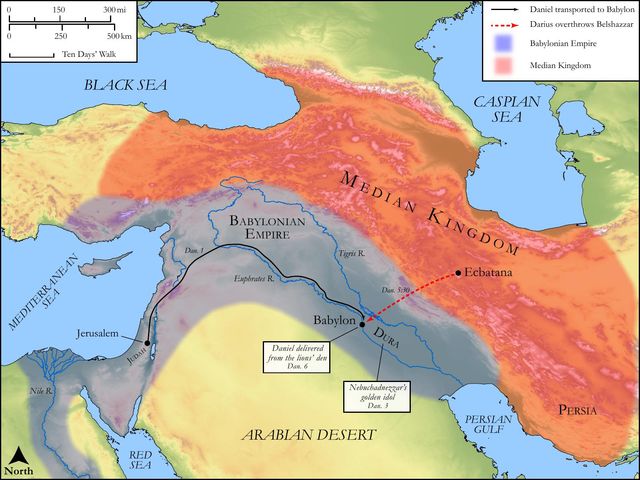
See on the biblical-era map
Study this verse
Public-domain commentary
Matthew Henry
From his Commentary on the Whole Bible. Henry comments on passages, not single verses — this entry covers Daniel 1:1–7. His four-level outline is real structure in the source text, so it is rendered as structure.
We have in these verses an account,
I.Of the first descent which Nebuchadnezzar, king of Babylon, in the first year of his reign, made upon Judah and Jerusalem, in the third year of the reign of Jehoiakim, and his success in that expedition (Dan 1:1, Dan 1:2.): He besieged Jerusalem, soon made himself master of it, seized the king, took whom he pleased and what he pleased away with him, and then left Jehoiakim to reign as tributary to him, which he did about eight years longer, but then rebelled, and it was his ruin. Now from this first captivity most interpreters think the seventy years are to be dated, though Jerusalem was not destroyed, nor the captivity completed, till about nineteen years after, In that first year Daniel was carried to Babylon, and there continued the whole seventy years (see Dan 1:21), during which time all nations shall serve Nebuchadnezzar, and his son, and his son's son, Jer 25:11. This one prophet therefore saw within the compass of his own time the rise, reign, and ruin of that monarchy; so that it was res unius aetatis - the affair of a single age, such short-lived things are the kingdoms of the earth; but the kingdom of heaven is everlasting. The righteous, that see them taking root, shall see their fall, Job 5:3; Pro 29:16. Mr. Broughton observes the proportion of times in God's government since the coming out of Egypt: thence to their entering Canaan forty years, thence seven years to the dividing of the land, thence seven Jubilees to the first year of Samuel, in whom prophecy began, thence to this first year of the captivity seven seventies of years, 490 (ten Jubilees), thence to the return one seventy, thence to the death of Christ seven seventies more, thence to the destruction of Jerusalem forty years.
II.The improvement he made of this success.
He did not destroy the city or kingdom, but did that which just accomplished the first threatening of mischief by Babylon. It was denounced against Hezekiah, for showing his treasures to the king of Babylon's ambassadors (Isa 39:6, Isa 39:7), that the treasures and the children should be carried away, and, if they had been humbled and reformed by this, hitherto the king of Babylon's power and success should have gone, but no further. If less judgments do the work, God will not send greater; but, if not, he will heat the furnace seven times hotter. Let us see what was now done.
1.The vessels of the sanctuary were carried away, part of them, Dan 1:2. They fondly trusted to the temple to defend them, though they went on in their iniquity. And now, to show them the vanity of that confidence, the temple is first plundered. Many of the holy vessels which used to be employed in the service of God were taken away by the king of Babylon, those of them, it is likely, which were most valuable, and he brought them as trophies of victory to the house of his god, to whom, with a blind devotion, he gave praise of his success; and having appropriated these vessels, in token of gratitude, to his god, he put them in the treasury of his temple. See the righteousness of God; his people had brought the images of other gods into his temple, and now he suffers the vessels of the temple to be carried into the treasuries of those other gods. Note, When men profane the vessels of the sanctuary with their sins it is just with God to profane them by his judgments. It is probable that the treasures of the king's house were rifled, as was foretold, but particular mention is made of the taking away of the vessels of the sanctuary because we shall find afterwards that the profanation of them was that which filled up the measure of the Chaldeans' iniquity, Dan 5:3. But observe, It was only part of them that went now; some were left them yet upon trial, to see if they would take the right course to prevent the carrying away of the remainder. See Jer 27:18.
2.The children and young men, especially such as were of noble or royal extraction, that were sightly and promising, and of good natural parts, were carried away. Thus was the iniquity of the fathers visited upon the children. These were taken away by Nebuchadnezzar,
(1.)As trophies, to be made a show of for the evidencing and magnifying of his success.
(2.)As hostages for the fidelity of their parents in their own land, who would be concerned to conduct themselves well that their children might have the better treatment.
(3.)As a seed to serve him. He took them away to train them up for employments and preferments under him, either out of an unaccountable affectation, which great men often have, to be attended by foreigners, though they be blacks, rather than by those of their own nation, or because he knew that there were no such witty, sprightly, ingenious young men to be found among his Chaldeans as abounded among the youth of Israel; and, if that were so, it was much for the honour of the Jewish nation, as of an uncommon genius above other people, and a fruit of the blessing. But it was a shame that a people who had so much wit should have so little wisdom and grace. Now observe,
[1.]The directions which the king of Babylon gave for the choice of these youths, Dan 1:4. They must not choose such as were deformed in body, but comely and well-favoured, whose countenances were indexes of ingenuity and good humour. But that is not enough; they must be skilful in all wisdom, and cunning, or well-seen in knowledge, and understanding science, such as were quick and sharp, and could give a ready and intelligent account of their own country and of the learning they had hitherto been brought up in. He chose such as were young, because they would be pliable and tractable, would forget their own people and incorporate with the Chaldeans. He had an eye to what he designed them for; they must be such as had ability in them to stand in the king's palace, not only to attend his royal person, but to preside in his affairs. This is an instance of the policy of this rising monarch, now in the beginning of his reign, and was a good omen of his prosperity, that he was in care to raise up a succession of persons fit for public business. He did not, like Ahasuerus, appoint them to choose him out young women for the service of his government. It is the interest of princes to have wise men employed under them; it is therefore their wisdom to take care for the finding out and training up of such. It is the misery of this world that so many who are fit for public stations are buried in obscurity, and so many who are unfit for them are preferred to them.
[2.]The care which he took concerning them. First, For their education. He ordered that they should be taught the learning and tongue of the Chaldeans. They are supposed to be wise and knowing young men, and yet they must be further taught. Give instructions to a wise man and he will increase in learning. Note, Those that would do good in the world when they grow up must learn when they are young. That is the learning age; if that time be lost, it will hardly be redeemed. It does not appear that Nebuchadnezzar designed they should learn the unlawful arts that were used among the Chaldeans, magic and divination; if he did, Daniel and his fellows would not defile themselves with them. Nay, we do not find that he ordered them to be taught the religion of the Chaldeans, by which it appears That he was at this time no bigot; if men were skilful and faithful, and fit for his business, it was not material to him what religion they were of, provided they had but some religion. They must be trained up in the language and laws of the country, in history, philosophy, and mathematics, in the arts of husbandry, war, and navigation, in such learning as might qualify them to serve their generation. Note, It is real service to the public to provide for the good education of the youth. Secondly, For their maintenance. He provided for them three years, not only necessaries, but dainties for their encouragement in their studies. They had daily provision of the king's meat, and of the wine which he drank, Dan 1:5. This was an instance of his generosity and humanity; though they were captives, he considered their birth and quality, their spirit and genius, and treated them honourably, and studied to make their captivity easy to them. There is a respect due to those who are well-born and bred when they have fallen into distress. With a liberal education there should be a liberal maintenance.
III.A particular account of Daniel and his fellows.
They were of the children of Judah, the royal tribe, and probably of the house of David, which had grown a numerous family; and God told Hezekiah that of the children that should issue from him some should be taken and made eunuchs, or chamberlains, in the palace of the king of Babylon. The prince of the eunuchs changed the names of Daniel and his fellows, partly to show his authority over them and their subjection to him, and partly in token of their being naturalized and made Chaldeans. Their Hebrew names, which they received at their circumcision, had something of God, or Jah, in them: Daniel - God is my Judge; Hananiah - The grace of the Lord; Mishael - He that is the strong God; Azariah - The Lord is a help. To make them forget the God of their fathers, the guide of their youth, they give them names that savour of the Chaldean idolatry. Belteshazzar signifies the keeper of the hidden treasures of Bel; Shadrach - The inspiration of the sun, which the Chaldeans worshipped; Meshach - Of the goddess Shach, under which name Venus was worshipped; Abed-nego, The servant of the shining fire, which they worshipped also. Thus, though they would not force them from the religion of their fathers to that of their conquerors, yet they did what they could by fair means insensibly to wean them from the former and instil the latter into them. Yet see how comfortably they were provided for; though they suffered for their fathers' sins they were preferred for their own merits, and the land of their captivity was made more comfortable to them than the land of their nativity at this time would have been.
Historical interpretation
Historical reception
1 surviving comment on this verse from the historical church.
And so the God of all makes evident the foolishness, infirmity and loathsome ways of the world in order to put to shame its power and wisdom. People who care for bodily things and seek beauty, greatness and great bodily strength know nothing of divine wisdom but rather only a false and artificial sort of eloquence. And thus is the distance between humanity and God. The false pretense of the king is shown as he wished not only the other captives be servants but also that they be descendents from kings. Now all this happened just as Isaiah had predicted to Hezekiah …: “And some of your own sons will become slaves, yes eunuchs, in the palace of the king of Babylon.”
Continue studying Daniel 1:4 across the web’s major study libraries — every link below opens this exact verse, chapter, or book on the destination site.
Read & Compare
 BibleGatewayThis verse in more than 200 translations and 70 languages.
 Bible.comThe YouVersion reader — hundreds of translations, reading plans, and highlights.
 ESV.orgCrossway's official English Standard Version reader.
 NET BibleThe NET translation with 60,000+ translators' notes on every rendering decision.
 STEP BibleTyndale House's free study tool — original text, vocabulary, and scholarly resources.
 BibliaLogos Bible Software's free web reader.
 USCCBThe New American Bible (Revised Edition) with the U.S. bishops' study notes.
Commentaries
 BibleHub CommentariesDozens of classic commentaries on this verse, gathered on one page.
 StudyLightMore than 100 commentary sets — the largest collection on the web.
 BibleRefPlain-English commentary on what this verse means, verse by verse.
 Enduring WordDavid Guzik's free commentary on this chapter, widely used by Bible teachers.
 Bible Study ToolsVerse commentary alongside Greek and Hebrew study aids.
Original Language & Research
- BibleHub InterlinearThe verse word by word — original language, transliteration, and English.
- BibleHub LexiconEvery word's original-language definition and Strong's entry.
 Blue Letter BibleDeep-study tools — Strong's numbers, concordance, and word studies.
 SefariaThe Hebrew text with Rashi and centuries of Jewish commentary.
Sermons, Hymns & Audio


TrulyRandomVerse is not affiliated with these sites and doesn’t control their content. They’re linked because they’re genuinely useful.
Summary
Daniel 1:4 meticulously details the rigorous qualifications for the young men chosen to serve in King Nebuchadnezzar's court. These criteria extended beyond mere physical perfection and appealing appearance to encompass exceptional intellectual prowess across various disciplines—including comprehensive wisdom, profound knowledge, and a deep understanding of academic subjects. Furthermore, the selected individuals needed to possess the inherent capability and fortitude to thrive within the demanding environment of the royal palace, demonstrating a blend of natural aptitude and social grace. The verse culminates by highlighting their intended intensive indoctrination into the language and learning traditions of the Chaldeans, thereby establishing the profound cultural and spiritual challenges that Daniel and his companions would soon face.
Context
ShowHideLiterary Context
Daniel 1:4 serves as a pivotal bridge within the opening narrative of the book of Daniel. It immediately follows the account of Jerusalem's conquest by Nebuchadnezzar and the subsequent deportation of a select group of Judah's elite young men to Babylon, as narrated in Daniel 1:1-3. This verse specifically elaborates on the precise criteria Nebuchadnezzar established for integrating these exiles into his royal administration. By detailing their physical, intellectual, and social qualifications, the verse sets the stage for the introduction of Daniel, Hananiah, Mishael, and Azariah, whose unique attributes and unwavering faithfulness will become central to the unfolding narrative. The exacting nature of these requirements underscores the immense pressure and high stakes involved, foreshadowing the profound conflict between Babylonian assimilation and Israelite fidelity that defines the initial chapters of Daniel, particularly their steadfast resolve demonstrated in Daniel 1:8.
Historical & Cultural Context
The selection process described in Daniel 1:4 was a well-established practice among the great kings of that day. Conquerors frequently integrated the most gifted and promising youth from subjugated nations into their imperial administration. This strategy served multiple geopolitical objectives: it effectively assimilated potential leaders, thereby minimizing the risk of rebellion; it enriched the imperial court with diverse skills and perspectives; and it unequivocally demonstrated the conqueror's absolute authority and dominance. Babylon, under the reign of Nebuchadnezzar, stood as a highly advanced civilization, renowned for its sophisticated wisdom traditions, advancements in astronomy and mathematics, and a complex bureaucratic system. The "learning and tongue of the Chaldeans" would have encompassed a rigorous curriculum, likely including Akkadian (the formal language of the empire) and Aramaic (the common lingua franca), alongside comprehensive instruction in Babylonian history, literature, astrology, and religious practices. This intensive, multi-year training program, implicitly confirmed by the three-year duration mentioned in Daniel 1:5, was meticulously designed to thoroughly indoctrinate the young men, fundamentally transforming their identity and allegiance to serve the Babylonian crown.
Key Themes
ShowHideDaniel 1:4 introduces and develops several foundational themes that resonate throughout the entire book of Daniel. Firstly, the theme of Excellence and Divine Gifting is prominently highlighted. The chosen youths are depicted as possessing remarkable natural abilities, intellectual acumen, and desirable physical attributes. This establishes a significant precedent for God's people: to excel even within pagan or hostile environments, not by compromising their faith but by demonstrating superior competence and integrity. Secondly, the tension between Cultural Assimilation vs. Distinctiveness emerges as a major thematic concern. The Babylonian program is explicitly designed for the full integration of these young men, posing a direct challenge to their Hebrew identity and covenantal faith. This tension becomes the crucible through which Daniel and his friends' unwavering commitment to God is rigorously tested and ultimately proven, most notably in their principled refusal to defile themselves with the king's provisions, as detailed in Daniel 1:8. Lastly, the overarching theme of Divine Sovereignty subtly undergirds the human selection process. While Nebuchadnezzar initiates the selection based on human criteria, the narrative implicitly suggests God's providential hand in strategically positioning Daniel and his companions for future roles, enabling them to bear powerful witness to His power and truth within the very heart of the world's leading empire, a truth powerfully exemplified by Daniel's interpretation of Nebuchadnezzar's dream in Daniel 2.
Exposition and Analysis
ShowHideKey Word Analysis
ShowHideFrom the primitive root meaning "to be born," this term refers to something born, specifically a lad or offspring. In the context of Daniel 1:4, it denotes young men, likely adolescents or those in their early twenties, emphasizing their youth, impressionability, and potential for extensive molding and training. The use of "children" rather than a term for adult men underscores their vulnerability and the profound influence the Babylonian indoctrination program was intended to exert over their identities and allegiances.
This word, typically mûm, signifies a physical or moral defect, spot, or blot. Its application here indicates a strict requirement for physical perfection, wholeness, and an unblemished appearance. Among the nations of that day, physical integrity was often associated with nobility, divine favor, and suitability for high office, especially for those destined to serve in the king's immediate presence. The absence of mʼûwm speaks to the ideal physical specimen sought by the king for his court.
Derived from the root meaning "to be wise," this term denotes wisdom in a positive and comprehensive sense, encompassing skill, prudence, and sagacity. It refers to a deep, integrated understanding and discernment, extending beyond mere factual knowledge to include the ability to apply knowledge effectively, make sound judgments, and navigate complex situations. This attribute was highly prized in ancient courts, essential for providing counsel, effective administration, and solving intricate problems.
Verse Breakdown
ShowHide"Children in whom [was] no blemish"
This initial clause establishes the fundamental physical prerequisite for selection. The young men were required to be physically perfect, devoid of any visible defect, deformity, or imperfection. This was not solely an aesthetic preference but a practical and symbolic consideration for those who would represent the king's court, signifying health, vitality, and often, a perceived noble lineage or divine favor.
"but well favoured"
Complementing the absence of blemish, this phrase emphasizes a pleasing or handsome appearance. It speaks to their overall comeliness, attractive demeanor, and perhaps even a charismatic presence, all of which would have been considered essential for individuals serving in close proximity to royalty, as their appearance would reflect directly upon the king himself.
"and skilful in all wisdom"
This shifts the focus to intellectual qualifications, demanding a comprehensive and profound understanding. "Skilful" (from sâkal) implies an innate aptitude for discerning, understanding, and applying knowledge, while "all wisdom" (from chokmâh) suggests a broad intellectual capacity that transcends a single discipline, encompassing practical sagacity and discernment.
"and cunning in knowledge"
This further specifies their intellectual prowess, indicating a deep, practical, and extensive acquaintance with various subjects. "Cunning" (from yâdaʻ) here means adept, proficient, or experienced, rather than deceitful, highlighting their ability to master, comprehend, and effectively utilize information across diverse fields.
"and understanding science"
This refers to intellectual insight, learned knowledge, and a firm grasp of the various academic and philosophical disciplines prevalent in Babylonian society, such as astronomy, mathematics, literature, and perhaps even early forms of medicine or engineering. It underscores the requirement for a well-rounded and sophisticated intellect, capable of engaging with advanced learning.
"and such as [had] ability in them to stand in the king's palace"
This crucial clause speaks to their practical aptitude, resilience, and social capability. "Ability" (Hebrew: kôach) implies strength, vigor, and capacity, suggesting they possessed the mental fortitude, emotional resilience, and perhaps the social graces and political acumen necessary to navigate and thrive within the high-pressure, demanding, and often treacherous environment of the royal court.
"and whom they might teach the learning and the tongue of the Chaldeans"
This final clause reveals the ultimate purpose of their rigorous selection: intensive cultural and linguistic indoctrination. They were chosen not only for their existing talents but for their teachability and potential to absorb the vast body of Babylonian knowledge (including history, religion, and literature) and master the Aramaic or Akkadian language, thereby becoming fully integrated into the empire's administrative and intellectual elite.
Literary Devices
ShowHideDaniel 1:4 employs several potent literary devices to convey its message and set the narrative's trajectory. Enumeration is a prominent feature, as the verse meticulously lists a series of specific qualifications—physical, intellectual, and practical—that the chosen young men must possess. This detailed catalog emphasizes the comprehensive and exacting nature of Nebuchadnezzar's selection process, highlighting the ideal candidate from a purely human, worldly perspective. There is also a subtle but significant juxtaposition woven into the verse: the outward perfection and intellectual brilliance sought by the king stand in stark contrast to the inner spiritual integrity and unwavering faithfulness that Daniel and his friends would later demonstrate. This contrast sets up a central conflict of the book: the clash between worldly wisdom and divine truth, between human power and God's sovereignty. Furthermore, the verse functions as a powerful form of foreshadowing, hinting at the immense challenges, pressures, and unique opportunities that await Daniel and his companions. Their exceptional abilities, so carefully detailed here, will be rigorously tested, and ultimately, God will providentially use these very qualities, refined and empowered by their faith, for His divine purposes within the heart of the formidable Babylonian empire. The phrase "ability in them to stand in the king's palace" also carries a subtle irony, as their true and lasting "standing" would ultimately be based not on their human qualifications or Babylonian training, but on their unyielding faithfulness to God, which would elevate them in ways the king could never have anticipated.
Theological and Thematic Connections
ShowHideDaniel 1:4 lays essential groundwork for understanding how God's providence can operate powerfully and strategically even within seemingly secular, hostile, or pagan environments. The meticulous criteria for selection, focusing on physical perfection, intellectual brilliance, and social aptitude, highlight the human desire for excellence, control, and the cultivation of talent. Theologically, this verse reminds us that God often chooses to use highly gifted and capable individuals for His purposes, not despite their natural talents but precisely through them. However, it also subtly introduces the profound tension between human selection and divine calling. While Nebuchadnezzar sought to assimilate these young men into Babylonian culture and religion for his own imperial ends, God's ultimate and sovereign plan was to use their unique positions and inherent abilities to reveal His sovereignty, truth, and power within the very heart of the world's leading pagan empire. Their journey, beginning with these qualifications, becomes a compelling testament to how believers can navigate, excel within, and even influence a foreign culture without compromising their core convictions, demonstrating that true wisdom, lasting ability, and ultimate authority originate from God alone.
Reflection and Application
ShowHideDaniel 1:4 offers profound and enduring lessons for contemporary believers regarding the pursuit of excellence, the maintenance of integrity, and the understanding of divine purpose in a complex world. It challenges us to cultivate our God-given talents—whether intellectual, physical, social, or spiritual—to the highest possible degree, recognizing that these abilities are not merely for personal gain or worldly advancement but are intended to be instruments for God's glory in every sphere of life. Like Daniel and his friends, we are called to pursue excellence in our education, our professions, our relationships, and our character, striving to be "well favoured" and "skilful in all wisdom" in a manner that authentically reflects the Creator who endowed us with these gifts. This verse also subtly introduces the critical tension between cultural engagement and spiritual distinctiveness. While we are undeniably called to be "in the world" and to engage thoughtfully with its systems, the subsequent narrative in Daniel powerfully reveals the paramount importance of maintaining our core convictions and not allowing the world's "learning and tongue" to erode our identity in Christ. Our ultimate "ability to stand in the king's palace" (metaphorically, in positions of influence or prominence) is rooted not in our own strength or worldly training, but in God's enabling power and our unwavering faithfulness to Him, even when faced with immense pressures to conform.
Questions for Reflection
ShowHideFAQ
ShowHideWhat was the purpose of Nebuchadnezzar's selection process for these young men?
ShowHideNebuchadnezzar's meticulous selection process, as vividly detailed in Daniel 1:4, served multiple strategic and pragmatic purposes for his burgeoning Neo-Babylonian Empire. Firstly, it was a highly effective means of assimilation and pacification. By identifying and taking the brightest, most promising, and often nobly-born young men from conquered territories, particularly from the royal and aristocratic families of Judah, he aimed to integrate them directly into Babylonian society and administration. This strategic move simultaneously prevented them from becoming potential leaders of rebellion in their homelands and instead transformed them into loyal, skilled servants of the Babylonian crown. Secondly, it was a calculated method to enrich his imperial court and empire with diverse talents and intellectual capital. Babylon was a highly sophisticated and advanced empire, and these exceptionally qualified individuals would contribute significantly to its bureaucracy, scholarship, military intelligence, and overall governance. Thirdly, the entire process served as a powerful display of power and and dominance, unequivocally demonstrating that even the elite and most gifted individuals from conquered nations were now utterly subservient to the Babylonian king and his will. The intensive training in "the learning and the tongue of the Chaldeans" (as explicitly mentioned in Daniel 1:4) was precisely designed to thoroughly indoctrinate them, fundamentally shifting their allegiance, worldview, and cultural identity to align with Babylon's imperial agenda.
Christ-Centered Fulfillment
ShowHideWhile Daniel 1:4 describes the human selection of young men for an earthly king's service, it profoundly foreshadows the ultimate "chosen one" and the divine qualifications for those who serve the King of kings. Jesus Christ is the perfect "child" (or Son) in whom there was "no blemish" (Hebrew: mʼûwm), not merely in a physical sense but in absolute moral and spiritual purity, thereby perfectly fulfilling the Old Testament sacrificial requirements of a spotless and unblemished lamb (a truth powerfully articulated in 1 Peter 1:18-19). He is the very embodiment of "all wisdom" and "cunning in knowledge," for in Him "are hidden all the treasures of wisdom and knowledge" (Colossians 2:3). Unlike the earthly Chaldean learning, Christ's wisdom is divine, eternal, and transformative, and He teaches a "new tongue"—the language of grace, truth, and the gospel. Furthermore, Jesus possessed the ultimate "ability to stand in the king's palace," not an earthly one, but in the very presence of God the Father, where He now eternally intercedes for His people (Hebrews 7:25). Believers, through their spiritual union with Christ, are called to reflect His blemishless character and divine wisdom, being continually transformed by the renewing of their minds (Romans 12:2) and supernaturally equipped by the Holy Spirit to "stand" faithfully, skillfully, and courageously in the world, bearing powerful witness to the true King and His eternal, unshakable kingdom (Matthew 28:19-20).