


Amos 2:10
Bible text: King James Version (1769 Blayney text) · Public domain
Bible text: Berean Standard Bible · Public domain
Bible text: American Standard Version (1901) · Public domain
Bible text: World English Bible, Messianic edition · Public domain
Bible text: Geneva Bible (1599) · Public domain
Bible text: Young's Literal Translation · Public domain
- וְאָנֹכִיve·'a·no·Khiand IH595Conj-w ¦ Pro-1csPronoun Personal 1st Singular common genderוְandאָנֹכִיI
- הֶעֱלֵיתִיhe·'e·Lei·tiI brought upH5927V-Hiphil-Perf-1csVerb Hiphil Perfect 1st Singular common gender
- אֶתְכֶם'et·Khem<obj.> youH853DirObjM ¦ 2mpParticle Object Indicatorאֶתְ<obj.>כֶםyou
- מֵאֶרֶץme·'E·retzfrom [the] land ofH776Prep-m ¦ N-fscNoun Singular Feminine Constructמֵfromאֶרֶץ[the] land of
- מִצְרָיִםmitz·Ra·yimEgyptH4714N-properNoun Proper Location
- וָאוֹלֵךְva·'o·Lekhand I ledH1980Conj-w ¦ V-Hiphil-ConsecImperf-1csVerb Hiphil Consecutive Imperfect 1st Singular common genderוָandאוֹלֵךְI led
- אֶתְכֶם'et·Khem<obj.> youH853DirObjM ¦ 2mpParticle Object Indicatorאֶתְ<obj.>כֶםyou
- בַּמִּדְבָּרba·mid·Barin the wildernessH4057Prep-b ¦ N-msNoun Singular Masculine Absoluteבַּin theמִּדְבָּרwilderness
- אַרְבָּעִים'ar·ba·'ImfortyH705N-mpNoun Plural Masculine Absolute
- שָׁנָהsha·Nahyear[s]H8141N-fsNoun Singular Feminine Absolute
- לָרֶשֶׁתla·Re·shetto take possession ofH3423Prep-l ¦ V-Qal-InfVerb Qal Infinitive Constructלָtoרֶשֶׁתtake possession of
- אֶת'et<obj.>H853DirObjMParticle Object Indicator
- אֶרֶץ'E·retz[the] land ofH776N-fscNoun Singular Feminine Construct
- הָאֱמֹרִיha·'e·mo·Rithe Amorite[s]H567Art ¦ N-msNoun Gentilic Singular Masculine AbsoluteהָtheאֱמֹרִיAmorite[s]
English is a literal word-by-word gloss of the Hebrew, not the KJV's wording. Why?
This is the original text the KJV's translators worked from — each Hebrew word with its own literal English meaning in this verse, prepared by scholars at Tyndale House, Cambridge. The KJV translates whole sentences, not word by word, so its wording differs: one Hebrew word can become several English words, and the KJV may choose “the LORD” where the gloss reads “Yahweh”. Both are faithful — they answer different questions. For the KJV's own rendering, switch to the KJV text.
Details
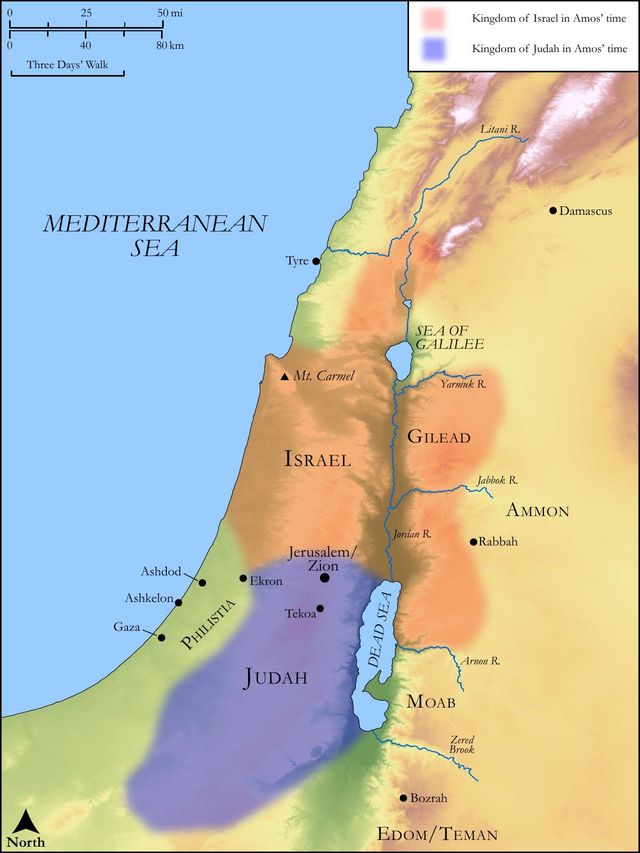
See on the biblical-era map
Study this verse
Public-domain commentary
Matthew Henry
From his Commentary on the Whole Bible. Henry comments on passages, not single verses — this entry covers Amos 2:9–16. His two-level outline is real structure in the source text, so it is rendered as structure.
Here, I. God puts his people Israel in mind of the great things he has done for them, in putting them into possession of the land of Canaan, the greatest part of which these ten tribes now enjoyed, Amo 2:9, Amo 2:10. Note, We need often to be reminded of the mercies we have received, which are the heaviest aggravations of the sins we have committed. God gives liberally, and upbraids us not with our meanness and unworthiness, and the disproportion between his gifts and our merits; but he justly upbraids us with our ingratitude, and ill requital of his favours, and tells us what he has done for us, to shame us for not rendering again according to the benefit done to us. "Son, remember; Israel, remember, 1. That God brought thee out of a house of bondage, rescued thee out of the land of Egypt, where thou wouldst otherwise have perished in slavery." 2. That he led thee forty years through a desert land, and fed thee in a wilderness, where thou wouldst otherwise have perished with hunger. Mercies to our ancestors were mercies to us, for, if they had been cut off, we should not have been. 3. That he made room for them in Canaan, by extirpating the natives by a series of wonders little inferior to those by which they were redeemed out of Egypt: I destroyed the Amorite before them, here put for all the devoted nations. Observe the magnificence of the enemies that stood in their way, which is taken notice of, that God may be the more magnified in the subduing of them. They were of great stature (whose height was like the height of the cedars) and the people of Israel were as shrubs to them; and they were also of great strength, not only tall, but well-set: He was strong as the oaks. Their kingdom was eminent among the nations, and over-topped all its neighbours. The supports and defences of it seemed impregnable; it was as fine as the stately cedar; it was as firm as the sturdy oak; yet, when God had a vine to plant there (Psa 80:8, Psa 80:9), this Amorite was not only cut down, but plucked up: I destroyed his fruit from above and his roots from beneath, so that the Amorites were no more a nation, nor ever read of any more. Thus highly did God value Israel. He gave men for them and people for their life, Isa 43:4. How ungrateful then were those who put such contempt upon him! 4. That he made them possess the land of the Amorite, not only put it into their hands, so that they became masters of it jure belli - by right of conquest, but gave them a better title to it, so that it became theirs by promise.
II.He likewise upbraids them with the spiritual privileges and advantages they enjoyed as a holy nation, Amo 2:11.
They had helps for their souls, which taught them how to make good use of their temporal enjoyments and were therefore more valuable. It is true the ten tribes had not God's temple, altar, and priesthood, and it was their own fault that they deserted them, and for that they might justly have been left in utter darkness; but God left not himself without witness, nor them without guides to show them the way.
1.They had prophets that were powerful instructors in piety, divinely inspired, and commissioned to make known the mind of God to them, to show them what is pleasing to God and what displeasing, to reprove them for their faults and warn them of their dangers, to direct them in their difficulties and comfort them in their troubles. God raised them up prophets, animated them for that work and employed them in it. He raised them up of their sons, from among themselves, as Moses and Christ were raised up from among their brethren, Deu 18:15. It was an honour put upon their nation, and upon their families, that they had children of their own to be God's messengers to them, of their own language, not strangers sent from another country, whom they might suspect to be prejudiced against them and their land, but those who, they knew, wished well to them. Note, Faithful ministers are great blessings to any people, and it is God that raises them up to be so, that they may justly be reckoned an honour to the families they are of.
2.They had Nazarites that were bright examples of piety: I raised up of your young men for Nazarites, men that bound themselves by a vow to God and his service, and, in pursuance of that, denied themselves many of the lawful delights of sense, as drinking wine and eating grapes. There were some of their young men that were in their prime for the enjoyment of the pleasures of this life and yet voluntarily abridged themselves of them; these God raised up by the power of his grace, to be monuments of his grace, to his glory, and to be his witnesses against the impieties of that degenerate age. Note, It is as great a blessing to any place to have eminent good Christians in it as to have eminent good ministers in it; for so they have examples to their rules. We must acknowledge that it bodes well to any people when God raises up numbers of hopeful young people among them, when he makes their young men Nazarites, devout, and conscientious, and mortified to the pleasures of sense; and those that are such Nazarites are purer than snow, whiter than milk; they are indeed the polite young men, for their polishing is of sapphires, Lam 4:7. Those that have such men, such young men, among them, have therein such an advantage, both for direction and encouragement, to be religious, as they will be called to an account for another day if they do not improve. Israel is here reckoned with, not only for the prophets, but for the Nazarites, raised up among them. Concerning the truth of this, he appeals to themselves: "Is it not even thus, O you children of Israel? Can you deny it? Have not you yourselves been sensible of the advantage you had by the prophets and Nazarites raised up among you?" Note, Sinners' own consciences will be witnesses for God that he has not been wanting to them in the means of grace, so that, if they perish, it is because they have been wanting to themselves in not improving those means. The men of Judah shall themselves judge between God and his vineyard, whether he could have done more for it, Isa 5:3, Isa 5:4.
III.He charges them with the abuse of the means of grace they enjoyed, and the opposition they gave to God's designs in affording them those means, Amo 2:12. They were so far from walking in the light that they rebelled against it, and did what they could to extinguish it, that it might not shine in their faces, to their conviction.
1.They did what they could to debauch good people, to draw them off from their seriousness in devotion and their strictness in conversation: You gave the Nazarites wine to drink, contrary to their vow, that, having broken it in that instance, they might not pretend to keep it in any other. Some they surprised, or allured into it, and with their much fair speech caused them to yield; others they forced and frightened into it, reproached and threatened them if they were more precise than their neighbours; and, by drawing them in to drink wine, they spoiled them for Nazarites. Note, Satan and his agents are very busy to corrupt the minds of young people that look heavenward; and many that we thought would have been Nazarites they have overcome by giving them wine to drink, by drawing them in to the love of mirth and pleasure, and drinking company. Multitudes of young men that bade fair for eminent professors of religion have erred through wine, and been undone for ever. And how do the factors for hell triumph in the debauching of a Nazarite!
2.They did what they could to silence good ministers, and to stop their mouths: "You commanded the prophets, saying, Prophesy not, and threatened them if they did prophesy (Amo 7:12), as if God's messengers were bound to observe your orders, and might not deliver their errand unless you gave them leave, and so you not only received the grace of God, in raising up those prophets, in vain, but put the highest affront imaginable upon that God in whose name the prophets spoke." Note, Those have a great deal to answer for that cannot bear faithful preaching, and those much more that suppress it.
IV.He complains of the wrong they did him by their sins (Amo 2:13):
"I am pressed under you, I am straitened by you, and can no longer bear it, and therefore I will ease myself of my adversaries, Isa 1:24. I am pressed under you and the load of your sins as a cart is pressed that is full of sheaves, is loaded with corn, in the midst of the joy of harvest, as long as any will lie on." Note, The great God complains of sin, especially the sins of his professing people, as a burden to him. He is grieved with this generation (Psa 95:10), is broken with their whorish heart (Eze 6:9), a consideration which, if it make not the sinner's repentance very deep, will make his ruin very great. The great God that upholds the world, and never complains that his is pressed under the weight of it (he fainteth not, neither is weary), yet complains of the sins of Israel, yea, and of their hypocritical services too, that he is weary of bearing them, Isa 1:14. No wonder the creature groans being burdened (Rom 8:22), when the Creator says, I am pressed under them.
V.He threatens them with unavoidable ruin.
And so some read, Amo 2:13, "Behold I will press, or straiten, your place, as a cart full of sheaves presses; they shall be loaded with judgments till they shall sink under them, and shall make a noise, as a cart overloaded does." Those that will not submit to the convictions of the word, that will neither be won by that nor by the conversation of those about them, shall be made to sink under the weight of God's judgments. If God load us daily with his benefits, and we, notwithstanding that, load him with our sins, how can we expect any other than that he should load us with his judgments? And it is here threatened in the last three verses that, when God comes forth to contend with this provoking people, they shall not be able to stand before him, to flee from him, nor to make their part good with him; for when God judges he will overcome. Though his patience be tired out, his power is not, and so the sinner shall find, to his cost. When the Assyrian army comes to lay the country waste by sword and captivity none shall escape, but every one shall have his share in the common desolation.
1.It will be in vain to think of fleeing from the enemy that comes armed with a commission to make all desolate: The flight shall perish from the swift; those that have been famed for happy escapes and happy retreats shall now find their arts fail them; they shall have no time to flee, or shall find no way to take, or they shall have no strength or spirit to attempt it; they shall be at their wits' end, and then they are soon at their flight's end. Are they, as Asahel, as swift of foot as a wild roe? (Sa2 2:18), yet, like him, they shall run the faster upon their own destruction: He that is swift of foot shall not deliver himself, Amo 2:15. Or do they say (as those, Isa 30:16), We will flee upon horses, and we will ride upon the swift? Yet they shall be overtaken: Neither shall he that rides the horse deliver himself from his pursuers. A horse is a vain thing for safety.
2.It will be in vain to think of fighting it out. God is at war with them; and are they stronger than he? Is there any military force that can pretend to be a match for Omnipotence? No: The strong shall not strengthen his force. He that has a habit of strength shall not be able to exert it when he has occasion for it. And the mighty, whose should protect and deliver others, shall not be able to deliver himself, to deliver his soul (so the word is), shall not save his life. Let not the strong man then glory in his strength, nor trust in it, but strengthen himself in the Lord his God, for in him is everlasting strength. And, as the bodily strength shall fail, so shall the weapons of war. The armour as well as the arm shall become insufficient: Neither shall he stand that handles the bow, though he stand at a distance, but shall betake himself to flight, and not trust to his own bow to save him. Though the arm be ever so strong, and the armour ever so well fixed, neither will avail when the spirit fails (Amo 2:16): He that is courageous among the mighty, that used to look danger in the face, and not be dismayed at it, shall flee away naked in that day, not only disarmed, having thrown away his weapons both offensive and defensive, but plundered of his treasure, which he thought to carry away with him, and he shall think it as much as he could expect that he has his life for a prey. Thus when God pleases he takes away the heart of the chief of the people of the earth, and causes those who used to boast of their courage, and their daring enterprises in the field, to wander and sneak in a wilderness where there is no way, Job 12:24.
Historical interpretation
Historical reception
1 surviving comment on this verse from the historical church.
(Verse 9 and following) But I destroyed the Amorite before them, whose height was like the height of cedar trees, and he was strong like an oak tree. And I destroyed his fruit from above and his roots from below. I am the one who brought you up from the land of Egypt and led you into the wilderness for forty years, so that you could possess the land of the Amorite. And I raised up prophets from among your sons and Nazirites from among your young men. LXX: But I destroyed the Amorite before them, whose height was like the height of the cedars, and he was strong as the oaks; and I destroyed his fruit from above, and his roots beneath. I brought you out of the land of Egypt, and led you forty years in the wilderness, that you might possess the land of the Amorites. And I took your sons as prophets and your young men as consecrated ones. Is it not true that you have sold the righteous for silver, and the poor for a pair of sandals? You have struck the heads of the poor, crushing them to the ground, and you have turned aside from the way of the humble. So much so that both father and son go to the same girl, defiling my holy name. Your garments are stained with the blood of the innocent and your clothes are polluted with adultery. You have bound yourselves with the chains of sin, committing adultery even in the sanctuary and joining injustice with drunkenness. You drink wine bought with foreign money in the house of your God. But on the contrary, I bestowed good things upon you in return for the evils you inflicted on me, so that I might destroy, before your presence, Seon, the king of the Amorites, who was so lofty and strong like a cedar and an oak, and I broke his fruit from above and his roots from below. I led you out of Egypt (Deut. 29), and for forty years I made you go around in circles to reach the holy land, so that you might possess the land of the Amorites, of which we have spoken before: which Moses divided to the sons of Reuben and Gad, and to half the tribe of Manasseh (Num. 32); and after so many benefits, I also added this, that I would take prophets for myself from your sons, and from your young men or chosen ones, I would make Nazarites, who the Seventy have interpreted as sanctified. And indeed, when it comes to praising God, the order of history must be preserved; but it often happens that what happened first is told last, and what is most recent is related to what came first. The seventy-seventh and one hundred and fourth psalms, where the power of signs is described, not the order, will teach us this, as well as the titles of the psalms, of which we will give just two examples: the third psalm and the fifty-first, where what happened first is narrated last, and what we read last is referred to in the beginning. For before we read in the book of Kings about Doeg the Edomite (1 Kings 21, 22), which is titled as the fifty-first psalm, how Absalom rose up against his father (2 Kings 15), which is mentioned in the title of the third psalm. And so the last Amorite was exterminated or erased, as is now first reported, and he made them go up from the land of Egypt and led them into the desert for forty years, we read about this in the beginning (2 Kings 21), which are called the last here with the order changed. Therefore, before God brought us out of the land of Egypt, from the iron furnace, He exterminated before our face the Amorite, who is called bitter or insolent, that is, speaking, or notorious, and celebrated in frequent conversation. But this Amorite is also called Seon, an unfruitful and barren tree, not because it does not produce fruit, but because it produces bad fruit, of which it is said: Every tree that does not bear good fruit will be cut down and thrown into the fire (Matth. 3:10; 7:19). And concerning false prophets, we read: They come in sheep's clothing, but inwardly they are ravenous wolves, by their fruits you shall know them (Matthew VII, 15, 16): namely, by their evil fruits. Therefore, whether they do not bear fruit, or they bear fruit but not good fruit: they are called fruitless trees. This is similar to Seon, about whom it is written: Now the axe is laid to the root of the trees (Luke III, 9), because he was a fruitless tree, and when the Lord struck, he was cut down, whose height is compared to that of cedars, of which we read: I have seen the wicked exalted, and lifted up as the cedars of Lebanon: and I passed by, and behold, he was not; and I sought him, and his place was not found (Psalm XXXVI, 35, 36). And he says that he passes beautifully, because he who passes from the world can say: Passing, I will see this great vision (Exod. III, 3), the cedar is removed, and the place of pride cannot be found. His strength, like that of the hardest and strongest oak tree. From which word, Philo, the most eloquent of the Hebrews, thinks that Esau is called 'δρύινον', that is, oaken and strong: although Esau can also be understood as 'ποίημα', that is, a work, referring to evil deeds. About this strong and robust, the Lord speaks in the Gospel: When a strong armed man guards his courtyard, all the things he possesses are in peace; but if a stronger man comes and defeats him, he will take away all his weapons in which he trusted, and distribute his spoils. And the Lord has granted us that he would crush and take away the fruits of this Amorite Sihon, whom we have interpreted as the fruitless tree, because they were evil, so that no one, thinking them good, would eat and perish. He also cut and crushed its roots, so that nothing would grow afterward from the evil tree. The Lord Himself made us leave the world, and for forty years, which is always a number of affliction and fasting, mourning and sorrow, through tribulations and distress, to come into the holy land, so that we would possess the land of the Amorites first, and that region would become our possession, and later He would raise up Prophets from our descendants, all holy men who received the prophetic spirit, about whom we read more fully in the first Epistle to the Corinthians (I Cor. XIV). And from our young men, or chosen ones, let him take the Nazarites and the sanctified ones, who offer their souls to God as a sacrifice, and who do not touch wine that can intoxicate and disturb the state of mind, so that they may have the hair of Samson, in whose head (for the head of a man is Christ) strength and victory resided (Judges 16).
Continue studying Amos 2:10 across the web’s major study libraries — every link below opens this exact verse, chapter, or book on the destination site.
Read & Compare
 BibleGatewayThis verse in more than 200 translations and 70 languages.
 Bible.comThe YouVersion reader — hundreds of translations, reading plans, and highlights.
 ESV.orgCrossway's official English Standard Version reader.
 NET BibleThe NET translation with 60,000+ translators' notes on every rendering decision.
 STEP BibleTyndale House's free study tool — original text, vocabulary, and scholarly resources.
 BibliaLogos Bible Software's free web reader.
 USCCBThe New American Bible (Revised Edition) with the U.S. bishops' study notes.
Commentaries
 BibleHub CommentariesDozens of classic commentaries on this verse, gathered on one page.
 StudyLightMore than 100 commentary sets — the largest collection on the web.
 BibleRefPlain-English commentary on what this verse means, verse by verse.
 Enduring WordDavid Guzik's free commentary on this chapter, widely used by Bible teachers.
 Bible Study ToolsVerse commentary alongside Greek and Hebrew study aids.
Original Language & Research
- BibleHub InterlinearThe verse word by word — original language, transliteration, and English.
- BibleHub LexiconEvery word's original-language definition and Strong's entry.
 Blue Letter BibleDeep-study tools — Strong's numbers, concordance, and word studies.
 SefariaThe Hebrew text with Rashi and centuries of Jewish commentary.
Sermons, Hymns & Audio


TrulyRandomVerse is not affiliated with these sites and doesn’t control their content. They’re linked because they’re genuinely useful.
Summary
Amos 2:10 serves as a profound divine reminder to Israel of God's steadfast faithfulness and powerful redemptive acts on their behalf, specifically their liberation from Egyptian bondage, their sustained journey through the wilderness, and their ultimate establishment in the Promised Land. This historical recounting precedes a severe indictment of their current spiritual apostasy and oppression, highlighting the stark contrast between God's unwavering grace and their profound ingratitude and rebellion.
Context
ShowHideLiterary Context
Amos 2:10 is strategically placed within the prophetic book of Amos, following a series of oracles against surrounding nations (Syria, Philistia, Tyre, Edom, Ammon, Moab) and Judah, before culminating in a detailed indictment against Israel, the primary audience. This verse marks a pivotal shift, as God, speaking through Amos, moves from general judgments to a direct confrontation with His chosen people. By recounting His foundational acts of deliverance and provision, God establishes the historical basis of His covenant relationship with Israel. This reminder serves not merely as a historical note but as a rhetorical device to magnify Israel's subsequent rebellion and underscore the justice of the impending judgment. The verse functions as a preamble to the specific charges of oppression, religious hypocrisy, and moral corruption that follow in the subsequent verses of chapter 2 and beyond.
Historical & Cultural Context
The prophet Amos ministered during the reigns of King Uzziah of Judah and King Jeroboam II of Israel, a period in the 8th century BC marked by significant economic prosperity and political stability for the northern kingdom of Israel. However, this outward success masked deep-seated disparity between rich and poor, rampant injustice, and syncretistic religious practices. The rich oppressed the poor, justice was perverted, and true worship was neglected in favor of ritualistic observances and idolatry (e.g., the worship of the golden calves at Bethel and Dan). The mention of "the land of the Amorite" specifically points to the pre-Israelite inhabitants of Canaan, a formidable group whose dispossession by divine power underscored God's faithfulness to His covenant promises to Abraham, Isaac, and Jacob. This historical context highlights the profound irony: Israel, delivered from slavery to possess a land by divine power, had now become oppressors themselves, forgetting the very God who established them.
Key Themes
ShowHideAmos 2:10 powerfully contributes to several overarching themes within the book of Amos and broader biblical theology. It underscores Divine Deliverance and Providence, emphasizing God's active and powerful hand in Israel's history, beginning with their miraculous rescue from slavery in Egypt (Exodus 12). This act of deliverance is a cornerstone of Israel's faith, demonstrating God's sovereignty and His unwavering commitment to His chosen people. The verse also highlights Covenant Faithfulness, as God fulfilled His promises to the patriarchs by bringing their descendants out of Egypt and leading them to the land He swore to give them. Despite Israel's frequent grumbling and disobedience during the forty years through the wilderness, God sustained them and guided them. The theme of Possession of the Land is central, with the ultimate goal of the Exodus and wilderness journey being to possess the land of Canaan, specifically mentioning "the land of the Amorite." This emphasizes God's power in overcoming formidable adversaries to establish His people in their inheritance, fulfilling the covenant promise of a land. Finally, by recounting these acts of grace, God implicitly levels a charge of Profound Ingratitude and Rebellion against Israel, making their current sins all the more egregious given the magnitude of His past mercies.
Exposition and Analysis
ShowHideKey Word Analysis
ShowHideThis verb (H5927) signifies an active, powerful ascent or lifting. In the context of the Exodus, it emphasizes God's decisive and sovereign act of raising Israel out of the depths of oppression and slavery in Egypt. It conveys the idea of a miraculous extraction and elevation, highlighting the divine initiative in their liberation.
This root (H3212) means "to walk" or, in its causative form as used here, "to cause to walk" or "to lead." It implies continuous, purposeful guidance and provision. For forty years, God actively directed Israel's journey through the challenging wilderness, demonstrating His constant care, sustenance, and protective presence, leading them towards their promised destination.
This verb (H3423) denotes the act of occupying land by dispossessing previous tenants, seizing, or inheriting. It underscores the forceful, divinely-empowered acquisition of the land of Canaan. It was not merely a gift but an inheritance secured through God's power in expelling the existing inhabitants, emphasizing the fulfillment of His covenant promise through a decisive act of conquest.
Verse Breakdown
ShowHide"Also I brought you up from the land of Egypt"
This clause immediately establishes the divine speaker ("I," referring to Yahweh) and His foundational act of redemption for Israel. The Exodus from Egypt was the defining moment of Israel's national birth, a demonstration of God's power over the greatest empire of their time, delivering His people from brutal slavery. It signifies a radical shift from bondage to freedom, initiated solely by God's sovereign will and might.
"and led you forty years through the wilderness"
Following the Exodus, God's active involvement continued through the arduous journey in the wilderness. The "forty years" symbolize a period of divine testing, purification, and sustained provision. During this time, God did not abandon His people but faithfully guided them, provided for their needs (manna, water), and protected them, despite their frequent complaints and rebellions. This period cemented their dependence on Him and prepared them for nationhood.
"to possess the land of the Amorite"
The ultimate purpose of the Exodus and wilderness wandering was the fulfillment of God's covenant promise to give Israel a land. The specific mention of "the Amorite" (a prominent Canaanite tribe) highlights God's power to dispossess formidable enemies and establish His people in their inheritance. This act of conquest was not by Israel's might but by God's decree and power, ensuring their settlement in the Promised Land as a demonstration of His faithfulness.
Literary Devices
ShowHideAmos 2:10 masterfully employs several literary devices to enhance its impact. The most prominent is Historical Allusion, specifically referencing the foundational events of the Exodus, the wilderness wandering, and the conquest of Canaan. These allusions are not mere historical facts but serve as powerful reminders of God's past faithfulness and Israel's covenant obligations. The verse also uses Anaphora (implied) and Parallelism through the repeated "I brought... and led... to possess," emphasizing God's continuous and multifaceted action on Israel's behalf. This repetitive structure highlights the divine initiative in every stage of their national formation. Furthermore, there is an inherent Rhetorical Contrast at play: God's unwavering faithfulness and mighty deeds are implicitly contrasted with Israel's current state of unfaithfulness and rebellion, setting the stage for the coming judgment. The mention of "the Amorite" can also be seen as a form of Synecdoche, where a prominent part (the Amorites) stands for the whole (all the Canaanite inhabitants dispossessed by Israel).
Theological and Thematic Connections
ShowHideAmos 2:10 is a powerful theological statement about God's redemptive character and His unwavering commitment to His covenant people, even in the face of their profound unfaithfulness. It underscores the principle that divine grace precedes and undergirds all human responsibility. God's acts of deliverance and provision were entirely unmerited, flowing from His sovereign love and covenant promises. By reminding Israel of these foundational acts, God highlights the depth of their ingratitude and the egregious nature of their sin. Their rebellion was not against a distant or passive deity, but against the very God who had actively and miraculously intervened in their history to establish them as a nation. This verse thus lays the theological groundwork for understanding God's righteous judgment as a response to covenant infidelity, not as arbitrary punishment, but as a just consequence for rejecting such immense grace.
Reflection and Application
ShowHideAmos 2:10 serves as a timeless mirror for believers today, inviting us to reflect on God's enduring faithfulness in our own lives and our corresponding response. Just as God delivered Israel from the bondage of Egypt, He has delivered us from the slavery of sin and death through Christ. He continues to lead us through the "wilderness" experiences of life—trials, uncertainties, and periods of growth—always providing, guiding, and sustaining us. This verse calls us to cultivate a profound and active gratitude, remembering the "Egypts" from which He has rescued us and the "wildernesses" through which He has faithfully led us. Our past experiences of God's grace should fuel our present obedience and future trust, preventing the spiritual amnesia and ingratitude that plagued ancient Israel. It challenges us to examine whether our current walk aligns with the magnitude of the grace we have received, prompting us to live in joyful submission to the One who has done so much for us, ultimately leading us to our spiritual inheritance.
Questions for Reflection
ShowHideFAQ
ShowHideWhy does Amos specifically mention "the land of the Amorite" instead of just "Canaanites" or "the Promised Land"?
ShowHideThe specific mention of "the Amorite" (H567) is significant because the Amorites were a prominent, powerful, and widespread group of inhabitants in Canaan whom Israel had to dispossess. They are often used in the Old Testament as a representative term for the pre-Israelite inhabitants of the land (e.g., Genesis 15:16). By naming them, God emphasizes the formidable nature of the obstacles He overcame on Israel's behalf, underscoring the magnitude of His power and faithfulness in fulfilling His promise to give them the land. It highlights that the land was not easily acquired but was a divine conquest.
What is the significance of "forty years through the wilderness" in this context?
ShowHideThe "forty years" (H705, H8141) in the wilderness is a crucial period in Israel's history, symbolizing a time of testing, judgment, and purification for the generation that rebelled against God at Kadesh-Barnea (Numbers 14:33-34). Yet, even within this period of divine discipline, God faithfully led (H3212) and sustained His people, providing manna, water, and protection. In Amos 2:10, it serves as a reminder of God's enduring patience and provision, even when Israel was disobedient. It highlights that God's commitment to His covenant was steadfast, despite human failure, ultimately leading them to possess (H3423) the land.
How does God's act of "possessing the land" relate to His character and promises?
ShowHideGod's act of enabling Israel "to possess" (H3423) the land of the Amorite is a direct fulfillment of His covenant promises to Abraham (e.g., Genesis 12:7). It demonstrates His sovereign power to establish His people in their inheritance, even by dispossessing other nations. This act reveals God as a covenant-keeping God who actively intervenes in history to bring about His purposes. It also underscores His justice, as the Amorites' "iniquity was not yet complete" (Genesis 15:16), implying a divine judgment upon their wickedness that paved the way for Israel's settlement.
Christ-Centered Fulfillment
ShowHideAmos 2:10, while rooted in Israel's historical exodus and conquest, finds its ultimate and profound fulfillment in the person and work of Jesus Christ. Just as God "brought up" Israel from the bondage of Egypt, Christ delivers His people from a far greater slavery—the dominion of sin and death (Colossians 1:13). He is the true and greater Moses, who "leads" His new covenant people through the wilderness of this fallen world, not with manna and water, but with the living bread and living water of His own Spirit and Word (John 6:35 and John 7:37-38). The earthly "land of the Amorite" that Israel was to "possess" foreshadows the spiritual inheritance and eternal rest that believers receive in Christ. Through His atoning sacrifice and resurrection, Jesus has conquered the ultimate enemies—sin, Satan, and death—enabling His followers to "possess" a spiritual kingdom and an eternal inheritance that is imperishable, undefiled, and unfading, kept in heaven (1 Peter 1:3-5). He is the one who leads us into God's true rest, a rest that the wilderness generation failed to enter due to unbelief (Hebrews 3-4). Thus, Amos 2:10 serves as a powerful Old Testament echo of the even greater salvation and inheritance secured for us in Christ.