


Exodus 2:1
- וַיֵּלֶךְvai·Ye·lekhand he wentH1980Conj-w ¦ V-Qal-ConsecImperf-3msVerb Qal Consecutive Imperfect 3rd Singular Masculineוַandיֵּלֶךְhe went
- אִישׁ'isha manH376N-msNoun Singular Masculine Absolute
- מִבֵּיתmi·Beitfrom [the] house ofH1004Prep-m ¦ N-mscNoun Singular Masculine Constructמִfromבֵּית[the] house of
- לֵוִיle·ViLeviH3878N-proper-mNoun Proper Masculine
- וַיִּקַּחvai·yi·Kachand he tookH3947Conj-w ¦ V-Qal-ConsecImperf-3msVerb Qal Consecutive Imperfect 3rd Singular Masculineוַandיִּקַּחhe took
- אֶת'et<obj.>H853DirObjMParticle Object Indicator
- בַּתbat[the] daughter ofH1323N-fscNoun Singular Feminine Construct
- לֵוִיle·ViLeviH3878N-proper-mNoun Proper Masculine
English is a literal word-by-word gloss of the Hebrew, not the KJV's wording. Why?
This is the original text the KJV's translators worked from — each Hebrew word with its own literal English meaning in this verse, prepared by scholars at Tyndale House, Cambridge. The KJV translates whole sentences, not word by word, so its wording differs: one Hebrew word can become several English words, and the KJV may choose “the LORD” where the gloss reads “Yahweh”. Both are faithful — they answer different questions. For the KJV's own rendering, switch to the KJV text.
Details
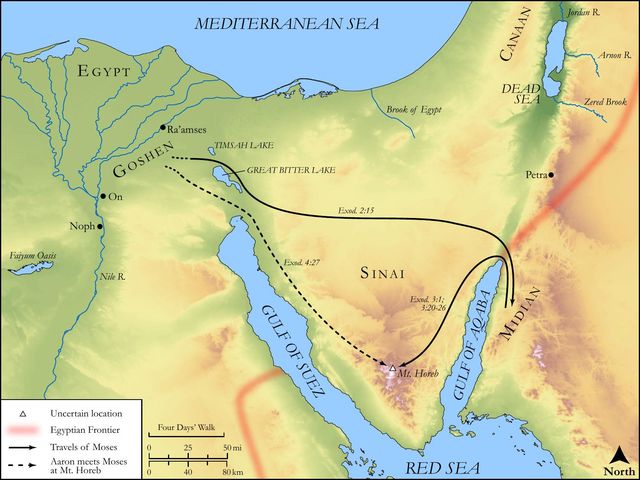
See on the biblical-era maps

Study this verse
Public-domain commentary
Matthew Henry
From his Commentary on the Whole Bible. Henry comments on passages, not single verses — this entry covers Exodus 2:1–4. His two-level outline is real structure in the source text, so it is rendered as structure.
Moses was a Levite, both by father and mother. Jacob left Levi under marks of disgrace (Gen 49:5); and yet, soon after, Moses appears a descendant from him, that he might typify Christ, who came in the likeness of sinful flesh and was made a curse for us. This tribe began to be distinguished from the rest by the birth of Moses, as afterwards it became remarkable in many other instances. Observe, concerning this newborn infant,
I.How he was hidden.
It seems to have been just at the time of his birth that the cruel law was made for the murder of all the male children of the Hebrews; and many, no doubt, perished by the execution of it. The parents of Moses had Miriam and Aaron, both older than he, born to them before this edict came out, and had nursed them without that peril: but those that begin the world in peace know not what troubles they may meet with before they have got through it. Probably the mother of Moses was full of anxiety in the expectation of his birth, now that this edict was in force, and was ready to say, Blessed are the barren that never bore, Luk 23:29. Better so than bring forth children to the murderer, Hos 9:13. Yet this child proves the glory of his father's house. Thus that which is most our fear often proves, in the issue, most our joy. Observe the beauty of providence: just at the time when Pharaoh's cruelty rose to this height the deliverer was born, though he did not appear for many years after. Note, When men are projecting the church's ruin God is preparing for its salvation. Moses, who was afterwards to bring Israel out of this house of bondage, was himself in danger of falling a sacrifice to the fury of the oppressor, God so ordering it that, being afterwards told of this, he might be the more animated with a holy zeal for the deliverance of his brethren out of the hands of such bloody men.
1.His parents observed him to be a goodly child, more than ordinarily beautiful; he was fair to God, Act 7:20. They fancied he had a lustre in his countenance that was something more than human, and was a specimen of the shining of his face afterwards, Exo 34:29. Note, God sometimes gives early earnests of his gifts, and manifests himself betimes in those for whom and by whom he designs to do great things. Thus he put an early strength into Samson (Jdg 13:24, Jdg 13:25), an early forwardness into Samuel (Sa1 2:18), wrought an early deliverance for David (Sa1 17:37), and began betimes with Timothy, Ti1 3:15.
2.Therefore they were the more solicitous for his preservation, because they looked upon this as an indication of some kind purpose of God concerning him, and a happy omen of something great. Note, A lively active faith can take encouragement from the least intimation of the divine favour; a merciful hint of Providence will encourage those whose spirits make diligent search, Three months they hid him in some private apartment of their own house, though probably with the hazard of their own lives, had he been discovered. Herein Moses was a type of Christ, who, in his infancy, was forced to abscond, and in Egypt too (Mat 2:13), and was wonderfully preserved, when many innocents were butchered. It is said (Heb 11:23) that the parents of Moses hid him by faith; some think they had a special revelation to them that the deliverer should spring from their loins; however they had the general promise of Israel's preservation, which they acted faith upon, and in that faith hid their child, not being afraid of the penalty annexed to the king's commandment. Note, Faith in God's promise is so far from superseding that it rather excites and quickens to the use of lawful means for the obtaining of mercy. Duty is ours, events are God's. Again, Faith in God will set us above the ensnaring fear of man.
II.How he was exposed.
At three months' end, probably when the searchers came about to look for concealed children, so that they could not hide him any longer (their faith perhaps beginning now to fail), they put him in an ark of bulrushes by the river's brink (Exo 2:3), and set his little sister at some distance to watch what would become of him, and into whose hands he would fall, Exo 2:4. God put it into their hearts to do this, to bring about his own purposes, that Moses might by this means be brought into the hands of Pharaoh's daughter, and that by his deliverance from this imminent danger a specimen might be given of the deliverance of God's church, which now lay thus exposed. Note,
1.God takes special care of the outcasts of Israel (Psa 147:2); they are his outcasts, Isa 16:4. Moses seemed quite abandoned by his friends; his own mother durst not own him: but now the Lord took him up and protected him, Psa 27:10.
2.In times of extreme difficulty it is good to venture upon the providence of God. Thus to have exposed their child while they might have preserved it, would have been to tempt Providence; but, when they could not, it was to trust to Providence. "Nothing venture, nothing win." If I perish, I perish.
Continue studying Exodus 2:1 across the web’s major study libraries — every link below opens this exact verse, chapter, or book on the destination site.
Read & Compare
 BibleGatewayThis verse in more than 200 translations and 70 languages.
 Bible.comThe YouVersion reader — hundreds of translations, reading plans, and highlights.
 ESV.orgCrossway's official English Standard Version reader.
 NET BibleThe NET translation with 60,000+ translators' notes on every rendering decision.
 STEP BibleTyndale House's free study tool — original text, vocabulary, and scholarly resources.
 BibliaLogos Bible Software's free web reader.
 USCCBThe New American Bible (Revised Edition) with the U.S. bishops' study notes.
Commentaries
 BibleHub CommentariesDozens of classic commentaries on this verse, gathered on one page.
 StudyLightMore than 100 commentary sets — the largest collection on the web.
 BibleRefPlain-English commentary on what this verse means, verse by verse.
 Enduring WordDavid Guzik's free commentary on this chapter, widely used by Bible teachers.
 Bible Study ToolsVerse commentary alongside Greek and Hebrew study aids.
Original Language & Research
- BibleHub InterlinearThe verse word by word — original language, transliteration, and English.
- BibleHub LexiconEvery word's original-language definition and Strong's entry.
 Blue Letter BibleDeep-study tools — Strong's numbers, concordance, and word studies.
 SefariaThe Hebrew text with Rashi and centuries of Jewish commentary.
Sermons, Hymns & Audio


TrulyRandomVerse is not affiliated with these sites and doesn’t control their content. They’re linked because they’re genuinely useful.
Summary
Exodus 2:1 serves as a foundational and profoundly significant verse, quietly introducing the parents of Moses, the future deliverer of Israel. This seemingly simple statement, devoid of specific names, sets the stage for one of the most pivotal narratives in the Old Testament, subtly revealing God's meticulous preparation and sovereign orchestration for His grand plan of salvation and the establishment of His covenant with His people, even amidst the direst circumstances.
Context
ShowHideLiterary Context
Exodus 2:1 immediately follows the harrowing narrative of Pharaoh's intensifying oppression against the Israelites, culminating in his horrific decree to cast every male Hebrew infant into the Nile River, as detailed in Exodus 1:22. The preceding chapter establishes a profound sense of despair and existential threat for the Hebrew nation. Against this backdrop of state-sponsored genocide and national crisis, Exodus 2:1 opens with a seemingly ordinary, private event—a marriage—yet it is precisely this quiet act of life and continuity that becomes the genesis of Israel's deliverance. The verse transitions the narrative from the broad, national persecution to the specific, providential circumstances surrounding the birth of the one who would challenge Pharaoh and lead God's people to freedom.
Historical & Cultural Context
The setting is Egypt, where the Israelite population had grown exponentially, fulfilling God's promise to Abraham. This growth was perceived as a demographic threat by the reigning Pharaoh, leading to forced labor and, subsequently, infanticide. Marriages within one's tribe were common and often preferred to maintain tribal identity and inheritance, especially in a foreign land where assimilation pressures were high. The specific mention of the "house of Levi" is significant, as this tribe would later be set apart for sacred service. While the Mosaic Law, which would later prohibit certain close familial marriages (such as aunt-nephew unions), had not yet been given, the cultural norms of the patriarchal period allowed for unions that would later be restricted, highlighting a progressive revelation of God's moral and social standards.
Key Themes
ShowHideThis verse, though brief, introduces several crucial themes that permeate the book of Exodus and the broader biblical narrative. Foremost among these is Divine Providence, demonstrating God's sovereign hand at work even in the most perilous and seemingly mundane circumstances, orchestrating events for His redemptive purposes. The quiet union of two individuals from the tribe of Levi underscores God's meticulous Preparation for Deliverance, highlighting that His plan unfolds through specific lineages and chosen instruments. It also introduces the theme of Hope Amidst Despair, as life continues and a deliverer is conceived even under the shadow of genocide. Furthermore, the specific mention of the tribe of Levi foreshadows the future Consecration of the Levitical Priesthood, a lineage that would play a central role in Israel's worship and covenant relationship with God, as seen later in passages like Numbers 3:6-9.
Exposition and Analysis
ShowHideExodus 2:1, "And there went a man of the house of Levi, and took [to wife] a daughter of Levi," is a concise yet profoundly significant statement that initiates the narrative of Moses' birth and early life. Its brevity and initial anonymity serve to highlight the divine orchestration behind what appears to be an ordinary human event.
Key Word Analysis
ShowHideA primitive root meaning "to walk (literally or figuratively); causatively, to carry (in various senses)." In this context, "went" signifies not merely physical movement but also a purposeful action, a progression in the divine narrative. It implies a deliberate step taken by the man, which, from a theological perspective, is part of God's unfolding plan.
Meaning "a man as an individual or a male person." The use of "man" here, without a specific name, emphasizes the individual's role in the narrative as a representative figure, a member of the tribe of Levi, whose actions are divinely significant despite his initial anonymity. It highlights the focus on his identity as a male of a specific lineage.
Meaning "a daughter (used in the same wide sense as other terms of relationship, literally and figuratively)." Similar to "man," the term "daughter" here denotes a female individual, emphasizing her role as the female counterpart in this union. The anonymity again draws attention to her tribal identity and the broader divine purpose rather than her personal name at this stage.
Verse Breakdown
ShowHide"And there went a man of the house of Levi,"
This clause introduces the male parent of Moses, identified only by his tribal affiliation. The phrase "house of Levi" immediately establishes his lineage, which is crucial for understanding the future roles of Moses and Aaron. The verb "went" (yâlak) suggests a deliberate, perhaps even providentially guided, action. The anonymity of the man (later revealed as Amram in Exodus 6:20) emphasizes that God's plan is not dependent on human fame or status but works through ordinary individuals in extraordinary ways.
"and took [to wife] a daughter of Levi."
This clause completes the description of the union, indicating that the man married a woman also from the tribe of Levi. The phrase "took [to wife]" is a common biblical idiom for marriage. The repetition of "of Levi" underscores the purity of their tribal lineage, reinforcing the significance of Moses' heritage. This union, seemingly a private family matter, is presented as the divinely appointed means through which the deliverer of Israel would be born, setting in motion the pivotal events of the Exodus narrative.
Literary Devices
ShowHideExodus 2:1 employs several subtle but powerful literary devices. The most prominent is Anonymity, as the parents of Moses are not named in this initial verse. This serves to elevate the divine agency over human identity, directing the reader's focus to God's sovereign plan rather than the specific individuals involved. Their later naming in Exodus 6:20 then provides specific context once Moses' lineage becomes relevant to the priesthood. Another device is Foreshadowing, as the explicit mention of the "house of Levi" subtly hints at the future role of this tribe in Israel's religious life, particularly regarding the priesthood and the Tabernacle service, which Moses and Aaron would establish. The verse also utilizes Juxtaposition, placing a quiet act of life (marriage and conception) immediately after the horrific decree of death (infanticide in Exodus 1:22), thereby highlighting God's power to bring hope and life amidst overwhelming despair.
Theological and Thematic Connections
ShowHideExodus 2:1 is a profound testament to God's meticulous providence, demonstrating His active involvement in the unfolding of human history, even in the most seemingly ordinary or desperate circumstances. It underscores the biblical truth that God works through specific individuals and their lineages to achieve His grand redemptive purposes, often in ways unseen and unappreciated until much later. This verse lays the essential groundwork for the entire Exodus narrative, establishing the divinely appointed lineage of Moses, who would not only deliver Israel from physical bondage but also mediate the covenant and establish the Levitical priesthood, thereby shaping the spiritual and national identity of God's chosen people. It is a powerful reminder that even in the darkest hours, God is faithfully at work, preserving His people and preparing for their salvation.
Reflection and Application
ShowHideExodus 2:1 offers a powerful and enduring lesson for believers today: God often initiates His greatest works in the most unassuming and ordinary settings, through seemingly insignificant details and quiet acts of faith. This verse encourages us to cultivate an awareness of God's sovereign hand at work even in the quiet, foundational moments of our lives, preparing the way for His purposes. It teaches us that every individual's story, even with its seemingly small beginnings, can be an integral part of a larger divine narrative, unfolding according to God's perfect timing and plan. This perspective instills a profound confidence that God is always working, even when His presence is not overtly dramatic or His plan fully revealed, laying the groundwork for future breakthroughs, deliverances, and the fulfillment of His promises. It calls us to trust in His unseen hand and to remain faithful in our own "ordinary" obedience, knowing that we are part of His extraordinary design.
Questions for Reflection
ShowHideFAQ
ShowHideWhy are Moses' parents not named in this verse?
ShowHideThe initial anonymity of Moses' parents in Exodus 2:1 serves a specific theological and narrative purpose: it highlights God's sovereign and providential work rather than human agency. By omitting their names, the text emphasizes that their union, though ordinary, was part of a divine plan unfolding in the background, orchestrated by God for the salvation of His people. Their names, Amram and Jochebed, are later revealed in Exodus 6:20, once Moses' lineage becomes more pertinent to the establishment of the Levitical priesthood and the covenant. This narrative choice draws attention to the miraculous nature of Moses' preservation and subsequent calling, underscoring that his birth was a divinely orchestrated intervention.
Was the marriage between Amram and Jochebed (uncle and niece) permissible?
ShowHideExodus 6:20 identifies Jochebed as Amram's father's sister, making her his aunt, not his niece. Thus, Amram married his aunt. While such a union was later explicitly prohibited under the Mosaic Law (see Leviticus 18:12), it was not uncommon or forbidden in the patriarchal period preceding the giving of the Law at Sinai. The Law, with its detailed prohibitions on certain familial marriages, was given through Moses, and its standards were established after his birth. This demonstrates a progressive revelation of God's moral and social standards for His covenant people. Therefore, at the time of their marriage, it was culturally and legally acceptable.
Christ-Centered Fulfillment
ShowHideExodus 2:1, by introducing the birth of Moses from the tribe of Levi, subtly but profoundly foreshadows the coming of Christ, the ultimate Deliverer. Moses, as the deliverer from physical bondage, the law-giver, and the mediator of the Old Covenant, serves as a powerful type of Christ. Just as Moses was born into a period of extreme oppression and threatened genocide, yet divinely preserved to lead his people out of bondage, so too was Christ born into a world under the oppression of sin and death, destined to be the ultimate Deliverer. The humble and seemingly ordinary beginning of Moses, born to unnamed parents from a specific lineage, mirrors the humble birth of Jesus in Bethlehem, yet both births were divinely orchestrated for the salvation of God's people (see Luke 2:7). Christ, the true and greater Prophet (as prophesied in Deuteronomy 18:15) and High Priest (as described in Hebrews 4:14), fulfills the Levitical lineage's purpose by offering the perfect, once-for-all sacrifice for sin. He mediates a new and eternal covenant, bringing ultimate deliverance from the spiritual bondage of sin and death (as proclaimed in John 8:36), a salvation far surpassing the physical liberation from Egypt (see Hebrews 8:6).