


Luke 19:42
- λέγωνlegōnsayingG3004V-PAP-NSMVerb Present Active Participle Nominative Singular Masculine
- ὅτιhotithatG3754CONJConjunction
- εἰeiIfG1487CONDConjunction
- ἔγνωςegnōsyou had knownG1097V-2AAI-2SVerb 2nd Aorist Active Indicative 2nd Singular
- καίkaiandG2532CONJConjunction
- γεgeindeedG1065PRTParticle or Disjunctive
- ἐνeninG1722PREPPreposition
- τῇtēatheG3588T-DSFDefinite article Dative Singular Feminine
- ἡμέρᾳhēmeradayG2250N-DSFNoun Dative Singular Feminine
- σουsouof youG4771P-2GSPersonal pronoun Genitive 2nd Singular
- ταύτῃtautēthisG3778D-DSFDemonstrative pronoun Dative Singular Feminine
- καὶkaievenG2532CONJConjunction
- σὺsuyou yourselfG4771P-2NSPersonal pronoun Nominative 2nd Singular
- τὰtathe [things]G3588T-APNDefinite article Accusative Plural Neuter
- πρὸςprosforG4314PREPPreposition
- εἰρήνηνeirēnēnpeaceG1515N-ASFNoun Accusative Singular Feminine
- σου·souof youG4771P-2GSPersonal pronoun Genitive 2nd Singular
- νῦνnunNowG3568ADVAdverb
- δὲdehoweverG1161CONJConjunction
- ἐκρύβηekrubēthey are hiddenG2928V-2API-3SVerb 2nd Aorist Passive Indicative 3rd Singular
- ἀπὸapofromG575PREPPreposition
- ὀφθαλμῶνophthalmōneyesG3788N-GPMNoun Genitive Plural Masculine
- σουsouof youG4771P-2GSPersonal pronoun Genitive 2nd Singular
English is a literal word-by-word gloss of the Greek, not the KJV's wording. Why?
This is the original text the KJV's translators worked from — each Greek word with its own literal English meaning in this verse, prepared by scholars at Tyndale House, Cambridge. The KJV translates whole sentences, not word by word, so its wording differs: one Greek word can become several English words, and the KJV may choose “charity” where the gloss reads “love”. Both are faithful — they answer different questions. For the KJV's own rendering, switch to the KJV text.
Details
See on the biblical-era map

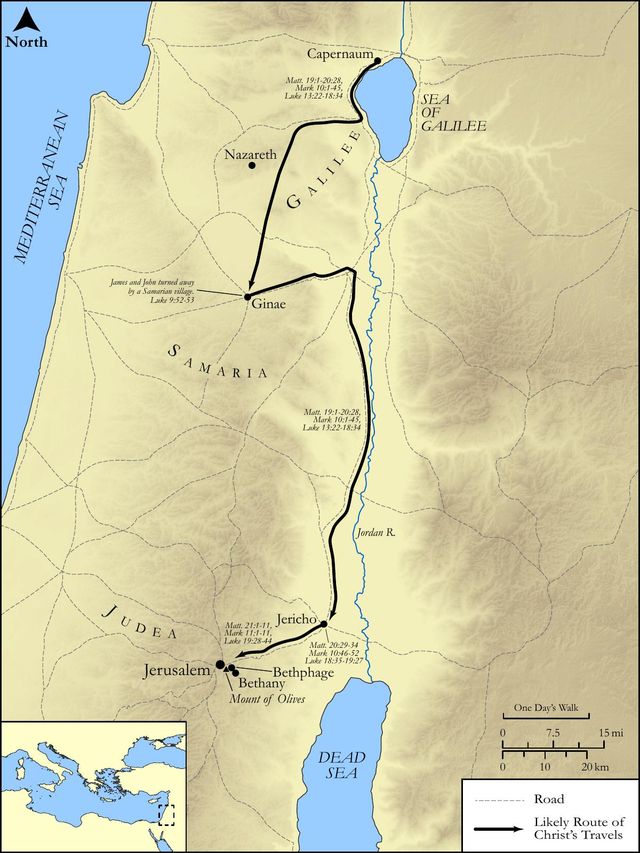
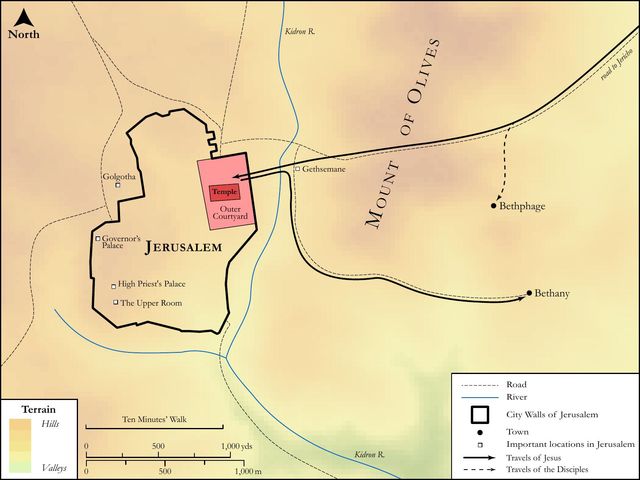
Study this verse
Public-domain commentary
Matthew Henry
From his Commentary on the Whole Bible. Henry comments on passages, not single verses — this entry covers Luke 19:41–48. His four-level outline is real structure in the source text, so it is rendered as structure.
The great Ambassador from heaven is here making his public entry into Jerusalem, not to be respected there, but to be rejected; he knew what a nest of vipers he was throwing himself into, and yet see here two instances of his love to that place and his concern for it.
I.The tears he shed for the approaching ruin of the city (Luk 19:41):
When he was come near, he beheld the city, and wept over it. Probably, it was when he was coming down the descent of the hill from the mount of Olives, where he had a full view of the city, the large extent of it, and the many stately structures in it, and his eye affected his heart, and his heart his eye again. See here,
1.What a tender spirit Christ was of; we never read that he laughed, but we often find him in tears. In this very place his father David wept, and those that were with him, though he and they were men of war. There are cases in which it is no disparagement to the stoutest of men to melt into tears.
2.That Jesus Christ wept in the midst of his triumphs, wept when all about him were rejoicing, to show how little he was elevated with the applause and acclamation of the people. Thus he would teach us to rejoice with trembling, and as though we rejoiced not. If Providence do not stain the beauty of our triumphs, we may ourselves see cause to sully it with our sorrows.
3.That he wept over Jerusalem. Note, There are cities to be wept over, and none to be more lamented than Jerusalem, that had been the holy city, and the joy of the whole earth, if it be degenerated. But why did Christ weep at the sight of Jerusalem? Was it because "Yonder is the city in which I must be betrayed and bound, scourged and spit upon, condemned and crucified?" No, he himself gives us the reason of his tears.
(1.)Jerusalem has not improved the day of her opportunities. He wept, and said, If thou hadst known, even thou at least in this thy day, if thou wouldst but yet know, while the gospel is preached to thee, and salvation offered thee by it; if thou wouldest at length bethink thyself, and understand the things that belong to thy peace, the making of thy peace with God, and the securing of thine own spiritual and eternal welfare - but thou dost not know the day of thy visitation, Luk 19:44. The manner of speaking is abrupt: If thou hadst known! O that thou hadst, so some take it; like that O that my people had hearkened unto me, Psa 81:13; Isa 48:18. Or, If thou hadst known, well; like that of the fig-tree, Luk 13:9. How happy had it been for thee! Or, "If thou hadst known, thou wouldest have wept for thyself, and I should have no occasion to weep for thee, but should have rejoiced rather." What he says lays all the blame of Jerusalem's impending ruin upon herself. Note,
[1.]There are things which belong to our peace, which we are all concerned to know and understand; the way how peace is made, the offers made of peace, the terms on which we may have the benefit of peace. The things that belong to our peace are those things that relate to our present and future welfare; these we must know with application.
[2.]There is a time of visitation when those things which belong to our peace may be known by us, and known to good purpose. When we enjoy the means of grace in great plenty, and have the word of God powerfully preached to us - when the Spirit strives with us, and our own consciences are startled and awakened - then is the time of visitation, which we are concerned to improve.
[3.]With those that have long neglected the time of their visitation, if at length, if at last, in this their day, their eyes be opened, and they bethink themselves, all will be well yet. Those shall not be refused that come into the vineyard at the eleventh hour.
[4.]It is the amazing folly of multitudes that enjoy the means of grace, and it will be of fatal consequence to them, that they do not improve the day of their opportunities. The things of their peace are revealed to them, but are not minded or regarded by them; they hide their eyes from them, as if they were not worth taking notice of. They are not aware of the accepted time and the day of salvation, and to let it slip and perish through mere carelessness. None are so blind as those that will not see; nor have any the things of their peace more certainly hidden from their eyes than those that turn their back upon them.
[5.]The sin and folly of those that persist in a contempt of gospel grace are a great grief to the Lord Jesus, and should be so to us. He looks with weeping eyes upon lost souls, that continue impenitent, and run headlong upon their own ruin; he had rather that they would turn and live than go on and die, for he is not willing that any should perish.
(2.)Jerusalem cannot escape the day of her desolation. The things of her peace are now in a manner hidden from her eyes; they will be shortly. Not but that after this the gospel was preached to them by the apostles; all the house of Israel were called to know assuredly that Christ was their peace (Act 2:36), and multitudes were convinced and converted. But as to the body of the nation, and the leading part of it, they were sealed up under unbelief; God had given them the spirit of slumber, Rom 11:8. They were so prejudiced and enraged against the gospel, and those few that did embrace it then, that nothing less than a miracle of divine grace (like that which converted Paul) would work upon them; and it could not be expected that such a miracle should be wrought, and so they were justly given up to judicial blindness and hardness. The peaceful things are not hidden from the eyes of particular persons; but it is too late to think now of the nation of the Jews, as such, becoming a Christian nation, by embracing Christ. And therefore they are marked for ruin, which Christ here foresees and foretels, as the certain consequence of their rejecting Christ. Note, Neglecting the great salvation often brings temporal judgments upon a people; it did so upon Jerusalem in less than forty years after this, when all that Christ here foretold was exactly fulfilled.
[1.]The Romans besieged the city, cast a trench about it, compassed it round, and kept their inhabitants in on every side. Josephus relates that Titus ran up a wall in a very short time, which surrounded the city, and cut off all hopes of escaping.
[2.]They laid it even with the ground. Titus commanded his soldiers to dig up the city, and the whole compass of it was levelled, except three towers; see Josephus's history of the wars of the Jews, 5.356-360; 7.1. Not only the city, but the citizens were laid even with the ground (thy children within thee), by the cruel slaughters that were made of them: and there was scarcely one stone left upon another. This was for their crucifying Christ; this was because they knew not the day of their visitation. Let other cities and nations take warning.
II.The zeal he showed for the present purification of the temple.
Though it must be destroyed ere long, it does not therefore follow that no care must be taken of it in the mean time.
1.Christ cleared it of those who profaned it. He went straight to the temple, and began to cast out the buyers and sellers, Luk 19:45. Hereby (though he was represented as an enemy to the temple, and that was the crime laid to his charge before the high priest) he made it to appear that he had a truer love for the temple than they had who had such a veneration for its corban, its treasury, as a sacred thing; for its purity was more its glory than its wealth was. Christ gave reason for his dislodging the temple-merchants, Luk 19:46. The temple is a house of prayer, set apart for communion with God: the buyers and sellers made it a den of thieves by the fraudulent bargains they made there, which was by no means to be suffered, for it would be a distraction to those who came there to pray.
2.He put it to the best use that ever it was put to, for he taught daily in the temple, Luk 19:47. Note, It is not enough that the corruptions of a church be purged out, but the preaching of the gospel must be encouraged. Now, when Christ preached in the temple, observe here,
(1.)How spiteful the church-rulers were against him; how industrious to seek an opportunity, or pretence rather, to do him a mischief (Luk 19:47): The chief priests and scribes, and the chief of the people, the great sanhedrim, that should have attended him, and summoned the people too to attend him, sought to destroy him, and put him to death.
(2.)How respectful the common people were to him. They were very attentive to hear him. He spent most of his time in the country, and did not then preach in the temple, but, when he did, the people paid him great respect, attended on his preaching with diligence, and let no opportunity slip of hearing him, attended to it with care, and would not lose a word. Some read it, All the people as they heard him, took his part; and so it comes in very properly as a reason why his enemies could not find what they might do against him; they saw the people ready to fly in their faces if they offered him any violence. Till his hour was come his interest in the common people protected him; but, when his hour was come, the chief priests' influence upon the common people delivered him up.
Historical interpretation
Nine Centuries of Reception
12 surviving comments on this verse. Each one is dated, so this reads as a timeline rather than a list.
Select a marker to jump to its quote. Markers stagger vertically where authors wrote within a few decades of each other.
Further, when, as He drew nigh to Jerusalem, He wept over it and said, "If thou hadst known, even thou, in this thy day, the things that belong unto thy peace, but they are hidden from thee"
Therefore He went into Galilee, for He was unwilling to show Himself to the Jews, lest He should lead them to repentance, and restore them from their impiety to a sound mind. And there He opened to His disciples again assembled the writings of Holy Scripture, that is, the secrets of the prophets; which before His suffering could by no means be understood, for they told of Him and of His passion.
He here declares that His coming was to bring peace to the whole world. For unto this He came, that He should preach both to them that were near, and those that were afar off. But as they did not wish to receive the peace that was announced to them, it was hid from them. And therefore the siege which was shortly to come upon them He most expressly foretells, adding, For the days shall come upon thee, &c.
But how these things were fulfilled we may gather from what is delivered to us by Josephus, who though he was a Jew, related each event as it toot place, in exact accordance with Christ's prophecies.
These things took place in this way in the second year of the reign of Vespasian in agreement with the prophetic pronouncements of our Lord and Savior Jesus Christ. By divine power, he foresaw these events as if already present and wept over them and mourned, according to the writings of the holy Evangelists. They add his own words, when on one occasion he spoke as if to Jerusalem itself. “Would that even today you knew the things that make for peace! Now they are hid from your eyes. For the days shall come upon you, when your enemies will cast up a bank about you and surround you, and hem you in on every side, and dash you to the ground, you and your children within you, and they will not leave one stone upon another in you; because you did not know the time of your visitation.” On another occasion, as if concerning the people, he said, “There will be great distress in the land and wrath on this people. They will fall by the edge of the sword and shall be led away captives into all nations. Jerusalem will be trampled down by the Gentiles until the times of the nations be fulfilled.” Again he says, “When you shall see Jerusalem encircled by an army, then know that its desolation is near.” If one should compare the words of our Savior with the other narratives of the historian, how could he help but marvel and confess the truly divine and supernaturally wonderful foreknowledge and prophecy of our Savior?
If thou hadst known, even thou. The Jews were not worthy to receive the divinely inspired Scriptures, which relate the mystery of Christ. For as often as Moses is read, a veil overshadows their heart that they should not see what has been accomplished in Christ, who being the truth puts to flight the shadow. And because they regarded not the truth, they rendered themselves unworthy of the salvation which flows from Christ.
To which the weeping Lord rightly says: "If you had known, even you"—understand: you would weep—you who now, because you do not know what threatens, rejoice. Whence it is also added: "And indeed in this your day, the things that are for your peace." For when it gave itself to the pleasures of the flesh and did not foresee the evils to come, it had in its day those things which could be for its peace. But why it had present goods for peace is made clear when it is said: "But now they are hidden from your eyes." For if the evils which threatened had not been hidden from the eyes of its heart, it would not have been joyful in present prosperity.
The sentence which follows fittingly applies to the soul about to perish: "And indeed in this your day, the things that are for your peace, but now they are hidden from your eyes." Here the perverse soul has its own day, which rejoices in transitory time. For such a soul the things present are for peace, because while it rejoices in temporal things, while it is exalted by honors, while it dissolves in carnal pleasure, while it is terrified by no fear of future punishment, it has peace in its day, which will have the grave scandal of its damnation in another's day. For there it will be afflicted, where the just will rejoice; and all the things which now are for its peace will then be turned into the bitterness of strife, because it will begin to quarrel with itself as to why it did not dread the damnation it suffers, why it closed the eyes of its mind from foreseeing the evils to follow. Hence it is told: "But now they are hidden from your eyes." For the perverse soul, devoted to present things, dissolved in earthly pleasures, hides from itself the evils to follow, because it refuses to foresee future things which would disturb its present joy; and while it abandons itself to the delights of the present life, what else does it do but go to the fire with closed eyes? Hence it is well written: "In the day of good things, do not be forgetful of evil things." And therefore it is said through Paul: "Let those who rejoice be as though not rejoicing," because even if there is any joy of the present time, it is to be experienced in such a way that the bitterness of the following judgment never departs from memory, so that while the fearful mind is pierced through by fear of final vengeance, as much as present joy now prevails, so much will the wrath that follows afterward be tempered. For hence it is written: "Blessed is the man who is always fearful; but he who is hard of mind will fall into evil." For the wrath of the following judgment will then be borne all the more severely, the less it is feared now even amid sins.
(Hom. 39. in Ev.) The merciful Redeemer wept then over the fall of the false city, which that city itself knew not was about to come upon it. As it is added, saying, If thou hadst known, even thou (we may here understand) wouldest weep. Thou who now rejoicest, for thou knowest not what is at hand. It follows, at least in this thy day. For when she gave herself up to carnal pleasures, she had the things which in her day might be her peace. But why she had present goods for her peace, is explained by what follows, But now they are hidden from thy eyes. For if the eyes of her heart had not been hidden from the future evils which were hanging over her, she would not have been joyful in the prosperity of the present. Therefore He shortly added the punishment which was near at hand, saying, For the days shall come upon thee.
(ut sup.) By these words the Roman leaders are pointed out. For that overthrow of Jerusalem is described, which was made by the Roman emperors Vespasian and Titus.
This too which is added, namely, They shall not leave in thee one stone upon another, is now witnessed in the altered situation of the same city, which is now built in that place where Christ was crucified without the gate, whereas the former Jerusalem, as it is called, was rooted up from the very foundation. And the crime for which this punishment of overthrow was inflicted is added, Because thou knewest not the time of thy visitation.
(ut sup.) For our Redeemer does not cease to weep through His elect whenever he perceives any to have departed from a good life to follow evil ways. Who if they had known their own damnation, hanging over them, would together with the elect shed tears over themselves. But the corrupt soul here has its day, rejoicing in the passing time; to whom things present are its peace, seeing that it takes delight in that which is temporal. It shuns the foresight of the future which may disturb its present mirth; and hence it follows, But now are they hid from thine eyes.
(Hom. 39. in Ev.) Or else; The evil spirits lay siege to the soul, as it goes forth from the body, for being seized with the love of the flesh, they caress it with delusive pleasures. They surround it with a trench, because bringing all its wickedness which it has committed before the eyes of its mind, they close confine it to the company of its own damnation, that being caught in the very extremity of life, it may see by what enemies it is blockaded, yet be unable to find any way of escape, because it can no longer do good works, since those which it might once have done it despised. On every side also they inclose the soul when its iniquities rise up before it, not only in deed but also in word and thought, that she who before in many ways greatly enlarged herself in wickedness, should now at the end be straitened every way in judgment. Then indeed the soul by the very condition of its guilt is laid prostrate on the ground, while its flesh which it believed to be its life is bid to return to dust. Then its children fall in death, when all unlawful thoughts which only proceed from it, are in the last punishment of life scattered abroad. These may also be signified by the stones. For the corrupt mind when to a corrupt thought it adds one more corrupt, places one stone upon another. But when the soul is led to its doom, the whole structure of its thoughts is rent asunder. But the wicked soul God ceases not to visit with His teaching, sometimes with the scourge and sometimes with a miracle; that the truth which it knew not it may hear, and though still despising it, may return pricked to the heart in sorrow, or overcome with mercies may be ashamed at the evil which it has done. But because it knows not the time of its visitation, at the end of life it is given over to its enemies, that with them it may be joined together in the bond of everlasting damnation.
But now they are hidden from your eyes. For if the evils that were impending had not been hidden from the eyes of his heart, he would not have rejoiced in present prosperity. Moreover, the punishment that was imminent from the Roman leaders, as I predicted, was added, when it is said:
Again, when our Lord descends from the mount of Olives, the multitude descend also, because since the Author of mercy has suffered humiliation, it is necessary that all those who need His mercy should follow His footsteps.
And as He drew near, seeing the city, He wept over it, saying: If you had known, even you. Because it is written that the Lord wept at this destruction of Jerusalem which was undertaken by the Roman princes Vespasian and Titus, no one who reads the history of its overthrow can be unaware. But one must first inquire what is meant by: Seeing the city, He wept over it, saying: If you had known, even you. The merciful Redeemer indeed wept over the ruin of the faithless city, which the city itself did not know was coming. To which it is rightly said by the Lord weeping: If you had known, even you, meaning: you would have wept over what you now exult over, because you do not know what is coming. Hence it is also added:
And indeed in this your day, what is to your peace. For when it was giving itself to carnal pleasures, it did not foresee the evils about to come, it had, in its day, what could have been for its peace. Why it would have present goods for peace is made clear when it is added:
That is, of my coming. For I came to visit and to save thee, which if thou hadst known and believed on Me, thou mightest have been reconciled to the Romans, and exempted from all danger, as did those who believed on Christ.
Continue studying Luke 19:42 across the web’s major study libraries — every link below opens this exact verse, chapter, or book on the destination site.
Read & Compare
 BibleGatewayThis verse in more than 200 translations and 70 languages.
 Bible.comThe YouVersion reader — hundreds of translations, reading plans, and highlights.
 ESV.orgCrossway's official English Standard Version reader.
 NET BibleThe NET translation with 60,000+ translators' notes on every rendering decision.
 STEP BibleTyndale House's free study tool — original text, vocabulary, and scholarly resources.
 BibliaLogos Bible Software's free web reader.
 USCCBThe New American Bible (Revised Edition) with the U.S. bishops' study notes.
Commentaries
 BibleHub CommentariesDozens of classic commentaries on this verse, gathered on one page.
 StudyLightMore than 100 commentary sets — the largest collection on the web.
 BibleRefPlain-English commentary on what this verse means, verse by verse.
 Enduring WordDavid Guzik's free commentary on this chapter, widely used by Bible teachers.
 Bible Study ToolsVerse commentary alongside Greek and Hebrew study aids.
Original Language & Research
- BibleHub InterlinearThe verse word by word — original language, transliteration, and English.
- BibleHub LexiconEvery word's original-language definition and Strong's entry.
 Blue Letter BibleDeep-study tools — Strong's numbers, concordance, and word studies.
 CNTR CollationThe earliest Greek manuscripts of this verse, collated letter by letter.
Sermons, Hymns & Audio


TrulyRandomVerse is not affiliated with these sites and doesn’t control their content. They’re linked because they’re genuinely useful.
Summary
Luke 19:42 captures Jesus' profound lament over Jerusalem as He approaches the city during His triumphal entry. Despite the joyous acclamations of the crowd, Jesus weeps, expressing deep sorrow and anguish over Jerusalem's spiritual blindness and its failure to recognize the Messiah and the opportunity for true peace presented in "this thy day." He foresees the tragic consequences of their rejection, lamenting that the path to their well-being has now become hidden from their eyes, foreshadowing the city's impending destruction.
Context
ShowHideLiterary Context
This verse immediately follows Jesus' triumphant entry into Jerusalem, detailed in Luke 19:28-40. The jubilant cries of the disciples and the crowd, hailing Jesus as the King who comes in the name of the Lord, abruptly transition to Jesus' heartbroken weeping. This stark contrast highlights the profound spiritual disconnect between the superficial celebration and the city's true spiritual state. The lament also serves as a poignant prelude to the events of Passion Week, setting a somber tone for the rejection and suffering Jesus would endure at the hands of those He came to save. It directly precedes Jesus' cleansing of the temple in Luke 19:45-46, further emphasizing the city's spiritual corruption.
Historical & Cultural Context
Jesus' lament takes place as He descends the Mount of Olives, offering a panoramic view of Jerusalem and its magnificent Temple. This setting is highly symbolic, as the Mount of Olives was traditionally associated with messianic expectation and eschatological events (e.g., Zechariah 14:4). The "day" Jesus refers to is the culmination of God's redemptive plan, the very moment of divine visitation by the Messiah. For centuries, Israel had awaited their Messiah, yet when He arrived, they largely failed to recognize Him. The Jewish people, under Roman occupation, longed for political peace and liberation, but Jesus offered a deeper, spiritual peace and liberation from sin. Their expectation of a conquering king, rather than a suffering servant, blinded them to the true nature of their "day of visitation." This historical context underscores the tragic irony of their missed opportunity.
Key Themes
ShowHideLuke 19:42 contributes significantly to several key themes in Luke's Gospel. Firstly, it powerfully illustrates Divine Compassion and Lament, showcasing Jesus' deep human emotion and divine sorrow over His people's spiritual state, a theme also evident in His prayer for forgiveness on the cross in Luke 23:34. Secondly, it highlights the theme of Missed Opportunity and Spiritual Blindness. Jerusalem, God's chosen city, failed to discern the crucial moment of God's visitation, leading to severe consequences. This blindness is a recurring motif, contrasting with those who, like the tax collector Zacchaeus in Luke 19:1-10, embrace Jesus. Thirdly, the verse directly foreshadows Impending Judgment and Desolation, a theme Jesus elaborates upon in the Olivet Discourse in Luke 21:20-24, where He prophesies the destruction of Jerusalem by foreign armies, which historically occurred in A.D. 70.
Exposition and Analysis
ShowHideKey Word Analysis
ShowHideThis verb signifies a deep, experiential knowledge, not merely intellectual assent. It implies recognizing, understanding, and acknowledging truth. Jesus laments that Jerusalem did not "know" Him in a saving, transformative way, failing to perceive His true identity and the significance of His presence among them.
More than just the absence of conflict, eirḗnē (the Greek equivalent of the Hebrew shalom) denotes a holistic state of well-being, wholeness, harmony, prosperity, and reconciliation. In this context, it refers to the spiritual peace that comes from a right relationship with God, offered through the Messiah. Jerusalem failed to grasp this ultimate peace, prioritizing political deliverance over spiritual reconciliation.
This word means to conceal or keep secret, often by covering. The passive voice ("they are hid") suggests that this concealment is not merely a human failing but has a divine dimension, a consequence of their persistent rejection. Their spiritual blindness has led to a state where the very things that would bring them peace are now inaccessible or obscured from their understanding.
Verse Breakdown
ShowHide"Saying, 'If thou hadst known, even thou, at least in this thy day, the things [which belong] unto thy peace!'"
Jesus expresses a profound, almost desperate wish. The conditional "If thou hadst known" implies a missed opportunity, a path not taken. "Even thou" emphasizes Jerusalem's unique privilege as the chosen city, the center of God's covenant people, making their ignorance all the more tragic. "In this thy day" points to the specific, critical moment of divine visitation—the time when the Messiah was physically present among them, offering salvation and true reconciliation. "The things which belong unto thy peace" refers to the spiritual realities and the person of Jesus Himself, who embodies the ultimate peace and well-being that God desired for His people.
"but now they are hid from thine eyes."
This clause marks a tragic turning point. The conjunction "but now" indicates a shift from a potential reality to a grim present truth. Because Jerusalem failed to recognize their Messiah and the offer of peace, those very "things" are now obscured. "Hid from thine eyes" signifies a spiritual blindness, a consequence of their hardened hearts and rejection, rendering them unable to perceive the truth and embrace the peace offered by God. This is not merely a lack of information but a judicial hardening, where the opportunity for peace has passed or become inaccessible.
Literary Devices
ShowHideLuke 19:42 is rich in literary devices that amplify its emotional and theological weight. The most prominent is Lament, as Jesus' weeping and utterance constitute a profound expression of sorrow over Jerusalem's spiritual state and impending doom. There is powerful Irony in the scene: while the crowds celebrate Jesus' triumphal entry, Jesus Himself is overcome with grief, seeing beyond their superficial joy to the city's tragic future. The phrase "this thy day" employs Emphasis to highlight the critical, kairos moment of divine visitation that Jerusalem failed to recognize. The concept of "peace" (Greek eirḗnē) functions as a potent Symbolism, representing not just the absence of conflict but the holistic well-being and reconciliation with God that Jesus offered. Finally, the entire lament serves as a stark Foreshadowing of Jerusalem's destruction in A.D. 70, directly linking their rejection of Christ to their future desolation.
Theological and Thematic Connections
ShowHideLuke 19:42 stands as a poignant reminder of God's deep love and desire for humanity's salvation, even in the face of rejection. Jesus' tears reveal the heart of God, who grieves over the choices that lead to destruction rather than rejoicing in judgment. This passage underscores the critical importance of recognizing and responding to God's gracious invitations when they are presented. It highlights the profound consequences of spiritual blindness and hardened hearts, which can lead to a missed opportunity for divine peace and ultimately, to judgment. The "peace" offered by Jesus is not merely political stability but a profound reconciliation with God that brings holistic well-being, a peace that Jerusalem tragically failed to embrace.
Reflection and Application
ShowHideLuke 19:42 serves as a timeless warning and a profound invitation for all believers. Jesus' lament over Jerusalem calls us to a deep self-examination regarding our own spiritual perception and responsiveness to God's voice. We are challenged to consider whether we are truly discerning the "things that belong to our peace" in "our day." This includes recognizing the ongoing presence and work of Christ in our lives and in the world, embracing His offer of salvation, and actively pursuing the holistic peace He provides. It warns against the spiritual blindness that can arise from pride, apathy, or a preoccupation with worldly concerns, which can prevent us from seeing God's truth clearly and accepting His transformative grace. Just as Jerusalem faced consequences for its rejection, we too must understand that persistent refusal of God's gracious invitation has profound implications for our spiritual well-being and eternal destiny. Jesus' tears remind us that God's heart is always for our flourishing, even as He respects our freedom to choose.
Questions for Reflection
ShowHideFAQ
ShowHideWhy did Jesus weep over Jerusalem, especially during a time of celebration?
ShowHideJesus wept over Jerusalem not out of self-pity, but out of profound divine compassion and grief for the city's spiritual blindness and its impending judgment. Despite the celebratory atmosphere of His triumphal entry, Jesus foresaw that Jerusalem, as a whole, would reject Him as their Messiah and the source of true peace. Their failure to recognize "this thy day" of divine visitation meant they would miss the opportunity for reconciliation with God, leading to their catastrophic destruction by the Romans in A.D. 70, which Jesus prophesied. His tears underscore the deep sorrow of God's heart when His people turn away from His gracious offer of salvation and well-being.
What does "the things which belong unto thy peace" refer to?
ShowHide"The things which belong unto thy peace" refers to the spiritual and holistic well-being that God desired for Jerusalem, embodied in the person and mission of Jesus Christ. The Greek word for peace, eirḗnē (equivalent to Hebrew shalom), encompasses not just the absence of conflict but a state of wholeness, harmony, prosperity, and most importantly, reconciliation with God. Jesus, as the Prince of Peace (Isaiah 9:6), was offering them true spiritual peace, forgiveness of sins, and a restored relationship with God. Jerusalem, however, was largely focused on political deliverance from Rome and failed to recognize the spiritual nature of the peace Jesus offered.
What does "now they are hid from thine eyes" signify?
ShowHideThis phrase signifies a tragic spiritual blindness that had befallen Jerusalem, leading to a judicial hardening. Because they persistently refused to acknowledge Jesus as the Messiah and embrace His message, the very truths and opportunities that would have led to their peace became obscured or inaccessible to them. It suggests that their rejection was so profound that the path to their well-being was no longer discernible. This is not merely a lack of understanding but a consequence of their hardened hearts, resulting in a state where divine truth was veiled from their perception, ultimately leading to their destruction as prophesied by Jesus in Luke 21:20-24.
Christ-Centered Fulfillment
ShowHideLuke 19:42, though a lament over Jerusalem's rejection, ultimately finds its Christ-centered fulfillment in the broader narrative of God's redemptive plan. Jesus, the very embodiment of "peace" and the "things which belong unto thy peace," would soon lay down His life to secure that peace for all who believe. While Jerusalem tragically missed its day of visitation, Christ's death and resurrection opened a new "day" of salvation for all humanity. He is the one who "made peace by the blood of His cross" (Colossians 1:20), breaking down the dividing wall of hostility and reconciling both Jews and Gentiles to God in one body through the cross (Ephesians 2:14-16). The "peace" that was hidden from Jerusalem's eyes because of their unbelief is now openly proclaimed through the Gospel, inviting all to enter into a saving relationship with the Prince of Peace, Jesus Christ (Acts 10:36). His tears over Jerusalem foreshadowed His ultimate sacrifice, demonstrating the depth of His love and His unwavering commitment to bringing true peace to a world lost in sin.