


2 Chronicles 22:10
Bible text: King James Version (1769 Blayney text) · Public domain
Bible text: Berean Standard Bible · Public domain
Bible text: American Standard Version (1901) · Public domain
Bible text: World English Bible, Messianic edition · Public domain
Bible text: Geneva Bible (1599) · Public domain
Bible text: Young's Literal Translation · Public domain
- וַעֲתַלְיָהוּva·'a·tal·Ya·huand AthaliahH6271Conj-w ¦ N-proper-fNoun Proper FeminineוַandעֲתַלְיָהוּAthaliah
- אֵם'em[the] mother ofH517N-fscNoun Singular Feminine Construct
- אֲחַזְיָהוּ'a·chaz·Ya·huAhaziahH274N-proper-mNoun Proper Masculine
- רָאֲתָהra·'a·Tahshe sawH7200V-Qal-Perf-3fsVerb Qal Perfect 3rd Singular Feminine
- כִּיkithatH3588PrtParticle Conditional
- מֵתmethe was deadH4191V-Qal-Perf-3msVerb Qal Perfect 3rd Singular Masculine
- בְּנָהּbe·Nahher sonH1121N-msc ¦ 3fsNoun Singular Masculine Constructבְּנָsonהּher
- וַתָּקָםva·Ta·komand she aroseH6965Conj-w ¦ V-Qal-ConsecImperf-3fsVerb Qal Consecutive Imperfect 3rd Singular Feminineוַandתָּקָםshe arose
- וַתְּדַבֵּרva·te·da·Berand she destroyedH1696Conj-w ¦ V-Piel-ConsecImperf-3fsVerb Piel Consecutive Imperfect 3rd Singular Feminineוַandתְּדַבֵּרshe destroyed
- אֶת'et<obj.>H853DirObjMParticle Object Indicator
- כָּלkolallH3605N-mscNoun Singular Masculine Construct
- זֶרַעZe·ra'[the] offspring ofH2233N-mscNoun Singular Masculine Construct
- הַמַּמְלָכָהha·mam·la·Khah<the> royaltyH4467Art ¦ N-fsNoun Singular Feminine Absoluteהַ<the>מַּמְלָכָהroyalty
- לְבֵיתle·Veitof [the] house ofH1004Prep-l ¦ N-mscNoun Singular Masculine Constructלְofבֵית[the] house of
- יְהוּדָהye·hu·DahJudahH3063N-properNoun Proper Location
English is a literal word-by-word gloss of the Hebrew, not the KJV's wording. Why?
This is the original text the KJV's translators worked from — each Hebrew word with its own literal English meaning in this verse, prepared by scholars at Tyndale House, Cambridge. The KJV translates whole sentences, not word by word, so its wording differs: one Hebrew word can become several English words, and the KJV may choose “the LORD” where the gloss reads “Yahweh”. Both are faithful — they answer different questions. For the KJV's own rendering, switch to the KJV text.
Details
See on the biblical-era maps
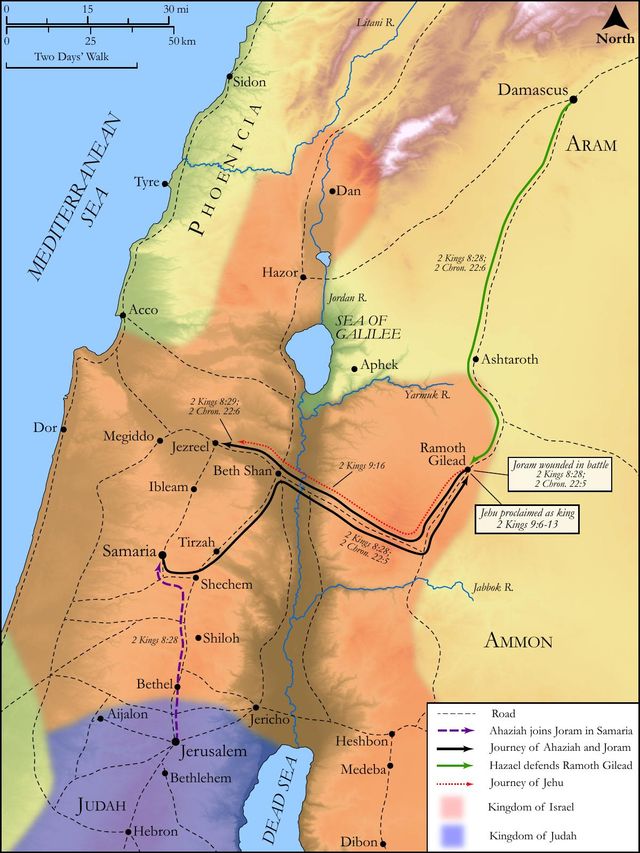
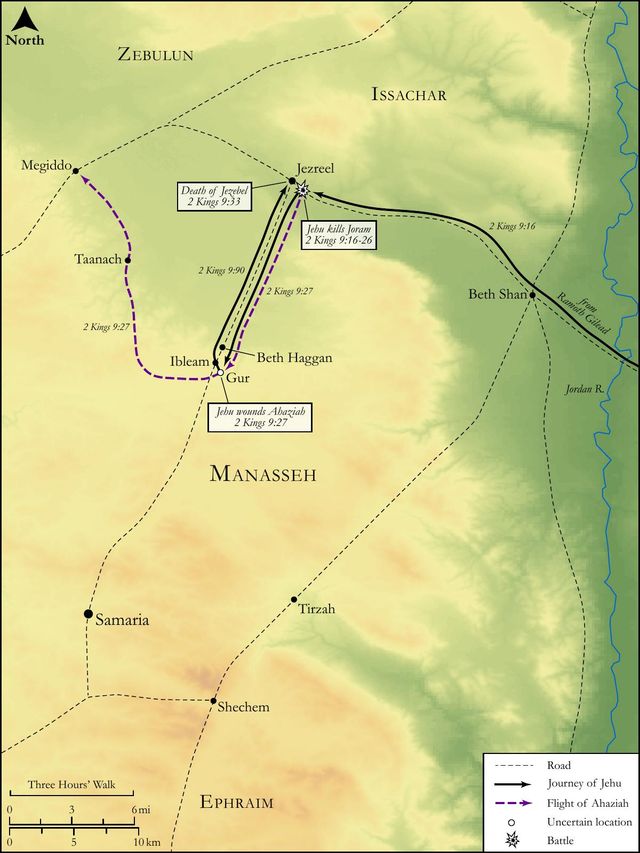
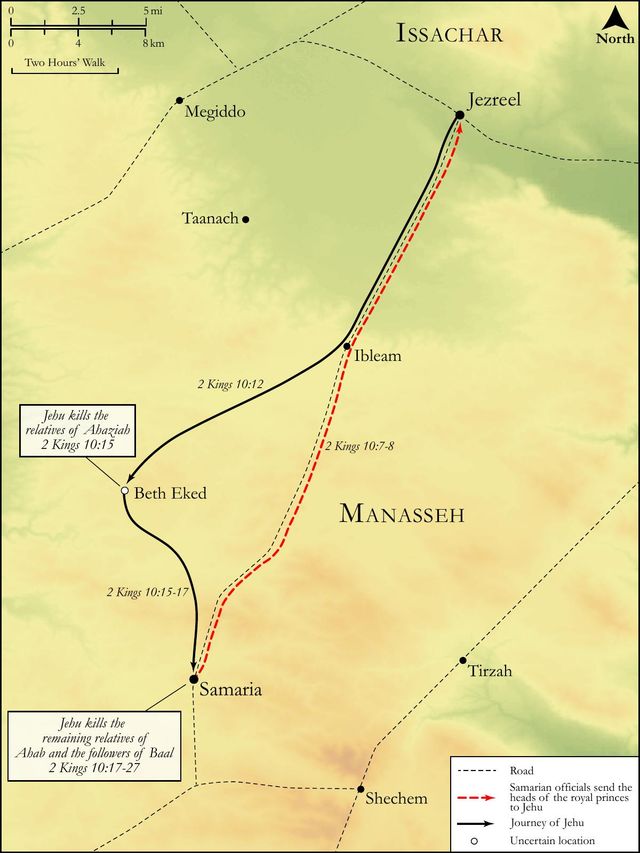
Study this verse
Public-domain commentary
Matthew Henry
From his Commentary on the Whole Bible. Henry comments on passages, not single verses — this entry covers 2 Chronicles 22:10–12.
We have here what we had before, Kg2 11:1, etc. 1. A wicked woman endeavouring to destroy the house of David, that she might set up a throne for herself upon the ruins of it. Athaliah barbarously cut off all the seed-royal (Ch2 22:10), perhaps intending to transmit the crown of Judah after herself to some of her own relations, that though her family was cut off in Israel by Jehu it might be planted in Judah. 2. A good woman effectually preserving it from being wholly extirpated. One of the late king's sons, a child of a year old, was rescued from among the dead, and saved alive by the care of Jehoiada's wife (Ch2 22:11, Ch2 22:12), that a lamp might be ordained for God's anointed; for no word of God shall fall to the ground.
Continue studying 2 Chronicles 22:10 across the web’s major study libraries — every link below opens this exact verse, chapter, or book on the destination site.
Read & Compare
 BibleGatewayThis verse in more than 200 translations and 70 languages.
 Bible.comThe YouVersion reader — hundreds of translations, reading plans, and highlights.
 ESV.orgCrossway's official English Standard Version reader.
 NET BibleThe NET translation with 60,000+ translators' notes on every rendering decision.
 STEP BibleTyndale House's free study tool — original text, vocabulary, and scholarly resources.
 BibliaLogos Bible Software's free web reader.
 USCCBThe New American Bible (Revised Edition) with the U.S. bishops' study notes.
Commentaries
 BibleHub CommentariesDozens of classic commentaries on this verse, gathered on one page.
 StudyLightMore than 100 commentary sets — the largest collection on the web.
 BibleRefPlain-English commentary on what this verse means, verse by verse.
 Enduring WordDavid Guzik's free commentary on this chapter, widely used by Bible teachers.
 Bible Study ToolsVerse commentary alongside Greek and Hebrew study aids.
Original Language & Research
- BibleHub InterlinearThe verse word by word — original language, transliteration, and English.
- BibleHub LexiconEvery word's original-language definition and Strong's entry.
 Blue Letter BibleDeep-study tools — Strong's numbers, concordance, and word studies.
 SefariaThe Hebrew text with Rashi and centuries of Jewish commentary.
Sermons, Hymns & Audio


TrulyRandomVerse is not affiliated with these sites and doesn’t control their content. They’re linked because they’re genuinely useful.
Summary
2 Chronicles 22:10 chronicles a profoundly dark and pivotal moment in the history of the Southern Kingdom of Judah, immediately following the death of King Ahaziah. His mother, Athaliah, a descendant of the notoriously wicked house of Ahab, ruthlessly seized power by orchestrating the massacre of all potential rivals to the throne. This act of extreme cruelty involved the attempted eradication of her own grandchildren and the entire royal lineage of David, representing a direct and audacious challenge to God's covenant promises concerning the perpetual Davidic dynasty.
Context
ShowHideLiterary Context
This verse is strategically placed at a critical juncture within the narrative of the divided monarchy, specifically detailing the history of Judah. It immediately follows the account of King Ahaziah's demise in 2 Chronicles 22:9, who, having unwisely allied himself with the idolatrous house of Ahab, met his end at the hands of Jehu, divinely appointed to purge wickedness from Israel. Athaliah's swift and violent reaction in 2 Chronicles 22:10 sets the stage for the dramatic divine intervention described in 2 Chronicles 22:11-12, where the Davidic line is miraculously preserved through Joash. This sequence powerfully highlights the stark contrast between human depravity and God's unwavering faithfulness. The preceding chapters, 2 Chronicles 21 and 2 Chronicles 22:1-9, detail the increasingly corrupt reigns of Jehoram and Ahaziah, heavily influenced by Athaliah's idolatrous heritage, making her subsequent act the horrifying culmination of Judah's spiritual decline.
Historical & Cultural Context
Athaliah was the daughter of the infamous King Ahab and Queen Jezebel of Israel, notorious for their fervent promotion of Baal worship. Her marriage to King Jehoram of Judah, a political alliance, tragically introduced significant idolatry and moral corruption into the Davidic kingdom, as explicitly noted in 2 Kings 8:18. In the turbulent monarchies of Israel and Judah, the death of a king frequently triggered power struggles for succession. However, Athaliah's response was exceptionally brutal, aiming for a complete eradication of the royal male line to prevent any challenge to her usurpation. This was an unprecedented act of regicide and infanticide within the Davidic dynasty, demonstrating the extreme lengths to which ambition, fueled by idolatry, could drive a ruler. Her actions, while reflecting the ruthless political climate of the era, stand out for their sheer scale and direct assault on the established, divinely ordained succession.
Key Themes
ShowHide2 Chronicles 22:10 powerfully contributes to several overarching themes in the book of Chronicles and the broader biblical narrative. Firstly, it starkly illustrates The Destructive Nature of Unchecked Ambition and Idolatry. Athaliah's descent into horrific cruelty is directly tied to her insatiable lust for power and her family's legacy of Baal worship, which had already deeply corrupted Judah's kings, as seen in the reign of her husband Jehoram (2 Chronicles 21) and son Ahaziah (2 Chronicles 22:1-9). Secondly, it highlights the severe Threat to the Davidic Covenant. The phrase "seed royal" refers specifically to the direct male descendants of King David, from whom God had solemnly promised a perpetual dynasty and, ultimately, the Messiah (2 Samuel 7:16). Athaliah's massacre was a direct, seemingly successful assault on this divine promise, threatening to extinguish the very lineage through which the Savior was to come. Finally, this verse sets up a dramatic tension between Human Wickedness and Divine Faithfulness, as the subsequent verses (2 Chronicles 22:11-12) immediately reveal God's sovereign preservation of a remnant, demonstrating that His covenant promises cannot be ultimately thwarted by human rebellion.
Exposition and Analysis
ShowHideKey Word Analysis
ShowHideThis name, meaning "Yahweh is exalted" or "Afflicted of Yahweh," stands in stark ironic contrast to her actions. As the daughter of Ahab and Jezebel, she embodied the very antithesis of Yahweh's exaltation, actively promoting Baal worship and demonstrating extreme cruelty. Her character is a prime example of unchecked ambition and idolatrous influence, illustrating how a name can belie one's true nature.
While primarily meaning "to speak," this primitive root can rarely (as noted in the Strong's definition) be used in a destructive sense, specifically "to subdue." In this context, Athaliah's "destroying" is a forceful act of subduing and eliminating. Her intent was not merely to remove rivals but to utterly wipe out the Davidic lineage, leaving no male heir to challenge her usurpation. This word underscores the ruthlessness and finality she sought to impose through violent subjugation.
This term refers to "seed" in the literal sense, but figuratively denotes "posterity" or "offspring." In the phrase "seed royal," its significance is profound, referring specifically to the male descendants of the reigning king, who were legitimate heirs to the throne. Its importance lies in its direct connection to the Davidic covenant, which promised an enduring lineage. Athaliah's attack was therefore not just on individuals but on the very continuation of the divinely ordained dynasty, seeking to cut off the "seed" that would perpetuate the royal line.
Verse Breakdown
ShowHide"But when Athaliah the mother of Ahaziah saw that her son was dead"
This clause establishes the immediate catalyst for Athaliah's horrifying actions. The death of her son, King Ahaziah, left a sudden power vacuum. Rather than mourn or facilitate a legitimate succession, Athaliah, already deeply entrenched in the corrupting influence of her Ahab-Jezebel heritage, perceived this as an opportune moment for personal gain and absolute power. Her perception of the situation was purely opportunistic and self-serving, devoid of natural maternal grief or concern for national stability.
"she arose"
This phrase denotes a decisive, immediate, and determined action. It suggests a sudden, energetic movement to execute her plan, indicating a lack of hesitation or deliberation. This swift and ruthless response to seize control is indicative of her character and unbridled ambition, highlighting her readiness to act violently to secure power.
"and destroyed all the seed royal of the house of Judah"
This is the horrific culmination of Athaliah's ambition. The verb "destroyed" (as discussed above, implying violent subjugation and elimination) indicates a systematic and comprehensive massacre. "All the seed royal" emphasizes the totality of her intent – to eliminate every male descendant of David who could lay claim to the throne, including her own grandchildren. This act was a direct, calculated assault on the very lineage through which God had promised to bring the Messiah, representing the deepest challenge to divine faithfulness and the Davidic covenant.
Literary Devices
ShowHideThe narrative of 2 Chronicles 22:10 employs several potent literary devices. Dramatic Irony is profoundly evident, as Athaliah's ruthless attempt to eradicate the "seed royal" ultimately fails to thwart God's larger redemptive plan, which is revealed in the subsequent verses with the miraculous preservation of Joash. Her actions, intended to secure her power, inadvertently highlight the unwavering faithfulness of God to His covenant promises. There is also a strong element of Foreshadowing, as this desperate assault on the Davidic line anticipates the ultimate spiritual battle against the "seed" of the woman (Christ) and the serpent's persistent attempts to destroy Him, as prophesied in Genesis 3:15. Furthermore, the passage uses Rhetorical Hyperbole in the phrase "all the seed royal," emphasizing the extreme nature of her attack and her intention to utterly wipe out the line, even though one child (Joash) was miraculously preserved. This highlights her comprehensive, murderous intent. The stark Contrast between human depravity (Athaliah's monstrous actions) and divine faithfulness (God's sovereign preservation of Joash) is a central theme, powerfully underscored by this verse.
Theological and Thematic Connections
ShowHide2 Chronicles 22:10 stands as a chilling testament to the depths of human depravity when ambition is unchecked and spiritual guidance is rejected. It underscores the constant spiritual battle against forces that seek to thwart God's redemptive plan, particularly concerning the lineage of the Messiah. Athaliah's attempt to extinguish the Davidic "seed royal" was a direct assault on God's covenant with David, promising an eternal dynasty and a king whose throne would be established forever. Yet, this dark moment paradoxically serves to highlight God's unwavering faithfulness and sovereign power. Even when human wickedness reaches its zenith, God's purposes cannot be ultimately defeated; His promises will endure, often through unexpected means, ensuring the continuation of the line through which salvation would come.
Reflection and Application
ShowHideThe account of Athaliah's ruthless actions in 2 Chronicles 22:10 serves as a profound warning against the corrupting influence of unchecked power and the devastating consequences of prioritizing self-interest over divine will. It compels us to examine our own hearts for any seeds of ambition that might lead us to compromise our integrity, neglect our responsibilities, or harm others in pursuit of control or personal gain. This passage also powerfully reminds us of God's sovereign faithfulness, even in the face of humanity's darkest moments. Just as God miraculously preserved a remnant of the Davidic line despite Athaliah's murderous intent, we can trust that His ultimate plans for redemption and restoration will prevail, regardless of the obstacles or opposition we encounter. It encourages us to find hope and security not in human strength, cunning schemes, or fleeting worldly power, but in the unshakeable promises of God, knowing that He is always at work, even when circumstances seem dire, to bring about His perfect and redemptive will.
Questions for Reflection
ShowHideFAQ
ShowHideWho was Athaliah, and why was her act so significant?
ShowHideAthaliah was the daughter of the infamous King Ahab and Queen Jezebel of Israel, known for their extreme promotion of Baal worship and their corrupting influence. She married King Jehoram of Judah, thereby introducing the spiritual decay and idolatry of her family into the Davidic line. Her act in 2 Chronicles 22:10 was profoundly significant because upon the death of her son, King Ahaziah, she seized power by attempting to eradicate "all the seed royal"—every male descendant of King David. This was a direct, violent assault on God's covenant promise to David that his lineage would endure and that a king from his house would always sit on the throne (2 Samuel 7:16). Her actions represented a profound challenge to divine faithfulness and the very continuation of the messianic line, aiming to extinguish the hope of the promised Savior.
Christ-Centered Fulfillment
ShowHide2 Chronicles 22:10, a dark chapter in Judah's history, profoundly underscores the vulnerability of the Davidic line, yet simultaneously magnifies the unwavering faithfulness of God in preserving it for the ultimate "seed royal," Jesus Christ. Athaliah's murderous rampage against "all the seed royal" was a direct, satanically-inspired assault on the lineage through which the Messiah was promised to come, fulfilling the ancient prophecy of the "seed of the woman" who would crush the serpent's head (Genesis 3:15). Her attempt to extinguish the Davidic dynasty seemed to threaten the very foundation of God's eternal covenant with David (2 Samuel 7:12-16). However, the miraculous preservation of Joash in the very next verses (2 Chronicles 22:11-12) serves as a powerful testament to God's sovereign protection over His redemptive plan. This event foreshadows the greater truth that no human wickedness or demonic scheme could ultimately thwart God's promise to send His Son. Jesus, born of the virgin Mary, truly is the "seed of David" (Romans 1:3), the rightful heir to David's throne (Luke 1:32-33), and the one who perfectly fulfills the Davidic covenant. Athaliah's failure to destroy the royal line ultimately highlights the invincibility of God's plan to bring forth the Lamb of God, who takes away the sin of the world (John 1:29), securing an eternal kingdom that can never be overthrown (Hebrews 1:8).