


1 Kings 12:17
Bible text: King James Version (1769 Blayney text) · Public domain
Bible text: Berean Standard Bible · Public domain
Bible text: American Standard Version (1901) · Public domain
Bible text: World English Bible, Messianic edition · Public domain
Bible text: Geneva Bible (1599) · Public domain
Bible text: Young's Literal Translation · Public domain
- וּבְנֵיu·ve·Neiand [the] people ofH1121Conj-w ¦ N-mpcNoun Plural Masculine Constructוּandבְנֵי[the] people of
- יִשְׂרָאֵלYis·ra·'ElIsraelH3478N-properNoun Proper Location
- הַיֹּשְׁבִיםhai·yo·she·Vimwho were dwellingH3427Art ¦ V-Qal-Prtcpl-mpVerb Qal Participle Plural Masculine Absoluteהַwhoיֹּשְׁבִיםwere dwelling
- בְּעָרֵיbe·'a·Reiin [the] cities ofH5892Prep-b ¦ N-mpcNoun Plural Masculine Constructבְּinעָרֵי[the] cities of
- יְהוּדָהye·hu·DahJudahH3063N-properNoun Proper Location
- וַיִּמְלֹךְvai·yim·Lokhand he reignedH4427Conj-w ¦ V-Qal-ConsecImperf-3msVerb Qal Consecutive Imperfect 3rd Singular Masculineוַandיִּמְלֹךְhe reigned
- עֲלֵיהֶם'a·lei·Hemover themH5921Prep ¦ 3mpPrepositionעֲלֵיoverהֶםthem
- רְחַבְעָםre·chav·'AmRehoboamH7346N-proper-mNoun Proper Masculine
English is a literal word-by-word gloss of the Hebrew, not the KJV's wording. Why?
This is the original text the KJV's translators worked from — each Hebrew word with its own literal English meaning in this verse, prepared by scholars at Tyndale House, Cambridge. The KJV translates whole sentences, not word by word, so its wording differs: one Hebrew word can become several English words, and the KJV may choose “the LORD” where the gloss reads “Yahweh”. Both are faithful — they answer different questions. For the KJV's own rendering, switch to the KJV text.
Details
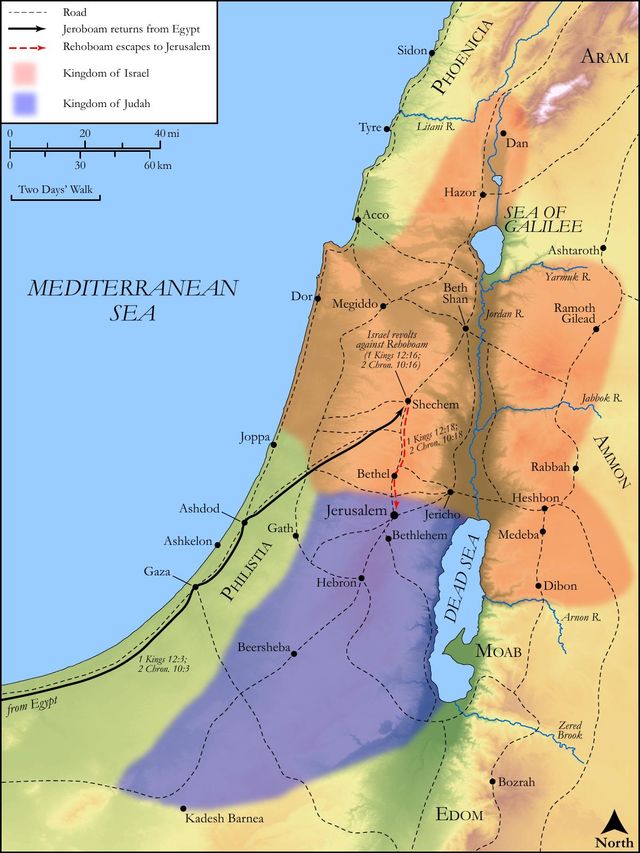
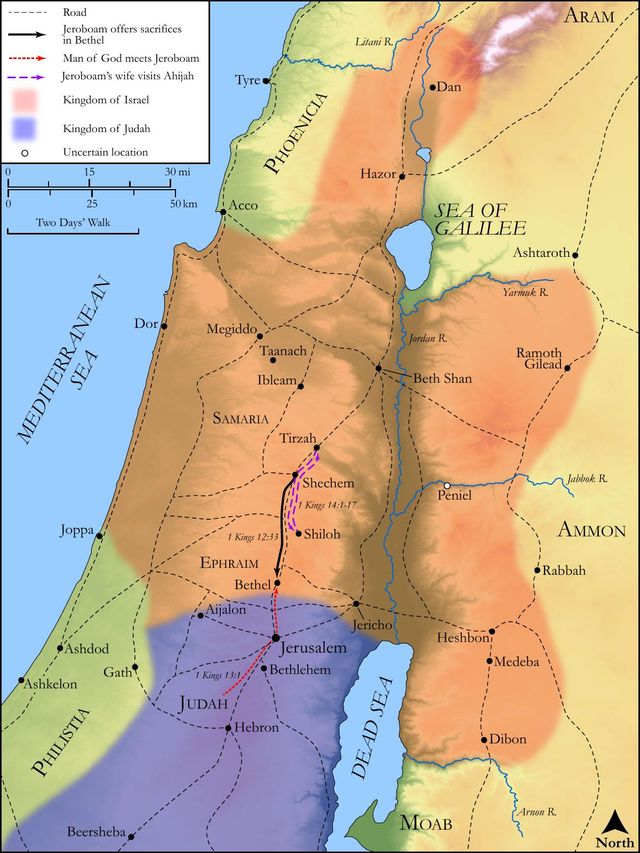
See on the biblical-era maps

Study this verse
Public-domain commentary
Matthew Henry
From his Commentary on the Whole Bible. Henry comments on passages, not single verses — this entry covers 1 Kings 12:16–24. His three-level outline is real structure in the source text, so it is rendered as structure.
We have here the rending of the kingdom of the ten tribes from the house of David, to effect which,
I.The people were hold and resolute in their revolt.
They highly resented the provocation that Rehoboam had given them, were incensed at his menaces, concluded that that government would in the progress of it be intolerably grievous which in the beginning of it was so very haughty, and therefore immediately came to this resolve, one and all: What portion have we in David? Kg1 12:16. They speak here very unbecomingly of David, that great benefactor of their nation, calling him the son of Jesse, no greater a man than his neighbours. How soon are good men, and their good services to the public, forgotten! The rashness of their resolution was also much to be blamed. In time, and with prudent management, they might have settled the original contract with Rehoboam to mutual satisfaction. Had they enquired who gave Rehoboam this advice, and taken a course to remove those evil counsellors from about him, the rupture might have been prevented: otherwise their jealousy for their liberty and property well became that free people. Israel is not a servant, is not a homeborn slave; why should he be spoiled? Jer 2:14. They are willing to be ruled, but not to be ridden. Protection draws allegiance, but destruction cannot. No marvel that Israel falls away from the house of David (Kg1 12:19) if the house of David fall away from the great ends of their advancement, which was to be ministers of God to them for good. But thus to rebel against the seed of David, whom God had advanced to the kingdom (entailing it on his seed), and to set up another king in opposition to that family, was a great sin; see Ch2 13:5-8. To this God refers, Hos 8:4. They have set up kings, but not by me. And it is here mentioned to the praise of the tribe of Judah that they followed the house of David (Kg1 12:17, Kg1 12:20), and, for aught that appears, they found Rehoboam better than his word, nor did he rule with the rigour which at first he threatened.
II.Rehoboam was imprudent in the further management of this affair, and more and more infatuated.
Having foolishly thrown himself into a quick-sand, he sunk the further in with plunging to get out.
1.He was very unadvised in sending Adoram, who was over the tribute, to treat with them, Kg1 12:18. The tribute was the thing, and, for the sake of that, Adoram was the person, they most complained of. The very sight of him, whose name was odious among them, exasperated them, and made them outrageous. He was one to whom they could not so much as give a patient hearing, but stoned him to death in a popular tumult. Rehoboam was now as unhappy in the choice of his ambassador as before of his counsellors.
2.Some think he was also unadvised in quitting his ground, and making so much haste to Jerusalem, for thereby he deserted his friends and gave advantage to his enemies, who had gone to their tents indeed (Kg1 12:16) in disgust, but did not offer to make Jeroboam king till Rehoboam had gone, Kg1 12:20. See how soon this foolish prince went from one extreme to the other. He hectored and talked big when he thought all was his own, but sneaked and looked very mean when he saw himself in danger. It is common for those that are most haughty in their prosperity to be most abject in adversity.
III.God forbade his attempt to recover by the sword what he had lost.
What was done was of God, who would not suffer that it should be undone again (as it would be if Rehoboam got the better and reduced the ten tribes), nor that more should be done to the prejudice of the house of David, as would be if Jeroboam got the better and conquered the two tribes. The thing must rest as it is, and therefore God forbids the battle.
1.It was brave in Rehoboam to design the reducing of the revolters by force. His courage came to him when he had come to Jerusalem, Kg1 12:21. There he thought himself among his firm friends, who generously adhered to him and appeared for him. Judah and Benjamin (who feared the Lord and the king, and meddled not with those that were given to change) presently raised an army of 180,000 men, for the recovery of their king's right to the ten tribes, and were resolved to stand by him (as we say) with their lives and fortunes, having either not such cause, or rather not such a disposition, to complain, as the rest had.
2.It as more brave in Rehoboam to desist when God, by a prophet, ordered him to lay down his arms. He would not lose a kingdom tamely, for then he would have been unworthy the title of a prince; and yet he would not contend for it in opposition to God, for then he would have been unworthy the title of an Israelite. To proceed in this war would be not only to fight against their brethren (Kg1 12:24), whom they ought to love, but to fight against their God, to whom they ought to submit: This thing is from me. These two considerations should reconcile us to our losses and troubles, that God is the author of them and our brethren are the instruments of them; let us not therefore meditate revenge. Rehoboam and his people hearkened to the word of the Lord, disbanded the army, and acquiesced. Though, in human probability, they had a fair prospect of success (for their army was numerous and resolute, Jeroboam's party weak and unsettled), though it would turn to their reproach among their neighbours to lose so much of their strength and never have one push for it, to make a flourish and do nothing, yet,
(1.)They regarded the command of God though sent by a poor prophet. When we know God's mind we must submit to it, how much soever it crosses our own mind.
(2.)They consulted their own interest, concluding that though they had all the advantages, even that of right, on their side, yet they could not prosper if they fought in disobedience to God; and it was better to sit still than to rise up and fall. In the next reign God allowed them to fight, and gave them victory (2 Chr. 13), but not now.
Continue studying 1 Kings 12:17 across the web’s major study libraries — every link below opens this exact verse, chapter, or book on the destination site.
Read & Compare
 BibleGatewayThis verse in more than 200 translations and 70 languages.
 Bible.comThe YouVersion reader — hundreds of translations, reading plans, and highlights.
 ESV.orgCrossway's official English Standard Version reader.
 NET BibleThe NET translation with 60,000+ translators' notes on every rendering decision.
 STEP BibleTyndale House's free study tool — original text, vocabulary, and scholarly resources.
 BibliaLogos Bible Software's free web reader.
 USCCBThe New American Bible (Revised Edition) with the U.S. bishops' study notes.
Commentaries
 BibleHub CommentariesDozens of classic commentaries on this verse, gathered on one page.
 StudyLightMore than 100 commentary sets — the largest collection on the web.
 BibleRefPlain-English commentary on what this verse means, verse by verse.
 Enduring WordDavid Guzik's free commentary on this chapter, widely used by Bible teachers.
 Bible Study ToolsVerse commentary alongside Greek and Hebrew study aids.
Original Language & Research
- BibleHub InterlinearThe verse word by word — original language, transliteration, and English.
- BibleHub LexiconEvery word's original-language definition and Strong's entry.
 Blue Letter BibleDeep-study tools — Strong's numbers, concordance, and word studies.
 SefariaThe Hebrew text with Rashi and centuries of Jewish commentary.
Sermons, Hymns & Audio


TrulyRandomVerse is not affiliated with these sites and doesn’t control their content. They’re linked because they’re genuinely useful.
Summary
1 Kings 12:17 serves as a pivotal clarification following the dramatic schism of the united monarchy of Israel. After the ten northern tribes rebelled against Rehoboam's oppressive policies and crowned Jeroboam as their king, this verse precisely defines the diminished scope of Rehoboam's authority. It specifies that his dominion was not entirely lost, but rather confined to those "children of Israel" who continued to reside within the geographical boundaries of the Southern Kingdom, particularly in the cities belonging to the tribe of Judah, thereby solidifying the new political landscape of a divided nation.
Context
ShowHideLiterary Context
This verse is strategically placed immediately after the climactic account of the kingdom's division, a watershed moment in Israelite history. The preceding narrative in 1 Kings 12 meticulously details Rehoboam's ill-fated ascension to the throne after Solomon's death, the people's plea for relief from heavy burdens, and Rehoboam's disastrous decision to disregard the wise counsel of the elders in favor of the harsh advice from his young peers (1 Kings 12:6-15). This arrogant stance directly provoked the rebellion of ten tribes, culminating in their famous declaration, "What portion have we in David? neither have we inheritance in the son of Jesse: to your tents, O Israel!" (1 Kings 12:16). They subsequently elevated Jeroboam to kingship. Verse 17 functions as an essential explanatory note, clarifying that despite this widespread defection, a significant segment of the Israelite population remained under Rehoboam's legitimate rule, specifically those residing within Judah's tribal territory, thus definitively establishing the boundaries of the newly formed Southern Kingdom.
Historical & Cultural Context
The division of the kingdom represented a profound political, social, and religious upheaval for ancient Israel. Historically, the nation had enjoyed a period of unprecedented unity and prosperity under the reigns of David and Solomon, with Jerusalem serving as both its political and spiritual capital, housing the sacred Temple. The concept of "all Israel" was deeply ingrained in the national consciousness, symbolizing the twelve tribes descended from Jacob. Culturally, loyalty to the Davidic dynasty was inextricably linked to God's eternal covenant promises (2 Samuel 7:12-16), making the kingdom's split a monumental theological crisis. The phrase "cities of Judah" refers to the tribal territory of Judah, which, by this time, also encompassed the tribe of Benjamin and parts of Simeon, along with many Levites who had migrated south due to the northern kingdom's apostasy (2 Chronicles 11:13-16). The verse clarifies that not all individuals identified as "children of Israel" (a term typically referring to the entire nation) joined the northern rebellion; some, whether due to their established residence, unwavering loyalty to the Davidic house, or religious conviction (Jerusalem and the Temple were in Judah), chose to remain under Rehoboam's rule.
Key Themes
ShowHideThis verse powerfully underscores the theme of the Divided Kingdom, marking the irreversible partition of what was once a unified nation into the Northern Kingdom (Israel, under Jeroboam) and the Southern Kingdom (Judah, under Rehoboam). It vividly illustrates the theme of Consequences of Unwise Leadership, as Rehoboam's pride, stubbornness, and refusal to heed sound counsel directly led to the catastrophic fracturing of the divinely established monarchy. Furthermore, it introduces the crucial theme of Remnant Loyalty, demonstrating that even amidst widespread rebellion and national fragmentation, a faithful portion of the "children of Israel" maintained their allegiance to the Davidic line and the spiritual center in Jerusalem. This distinction is vital for comprehending the subsequent narratives of both kingdoms, as their separate destinies unfold, yet the divine promise to David's house is miraculously preserved through the continuity of the Judahite monarchy, ensuring the lineage for the coming Messiah.
Exposition and Analysis
ShowHideKey Word Analysis
ShowHideMeaning "a son (as a builder of the family name), in the widest sense (of literal and figurative relationship, including grandson, subject, nation, quality or condition, etc.)." In this verse, "children of Israel" refers to the descendants of Jacob, the entire nation. However, its specific usage here is nuanced, denoting those individuals from the broader Israelite population who, despite the secession of the ten northern tribes, continued to reside within and pledge allegiance to the territory controlled by Rehoboam. This highlights that the split was not absolute along tribal lines, as some from other tribes had settled in Judah or chose to remain loyal, underscoring the complex, fragmented reality of the newly divided nation.
A primitive root meaning "properly, to sit down (specifically as judge, in ambush, in quiet); by implication, to dwell, to remain; causatively, to settle, to marry." The verb emphasizes the established residence of this specific group of Israelites. Their act of "dwelling" in the cities of Judah signifies not merely their physical location but also their settled presence and continued allegiance to the Southern Kingdom, implicitly distinguishing them from those who had departed to the north. This fixed habitation was a key factor in their ongoing subjection to Rehoboam's rule.
A primitive root meaning "to reign; inceptively, to ascend the throne; causatively, to induct into royalty; hence (by implication) to take counsel." This verb signifies the exercise of legitimate royal authority. Its use here confirms that despite the loss of the majority of the kingdom, Rehoboam retained legitimate kingship over the specified population. This continuity of the Davidic line in Judah, albeit over a smaller domain, was vital for the fulfillment of God's covenant promises to David regarding an enduring dynasty.
Verse Breakdown
ShowHide"But [as for] the children of Israel"
This introductory phrase serves as a clear distinction and exception to the preceding narrative of widespread rebellion. It signals that not all Israelites participated in the secession, drawing attention to a specific, remaining group, thereby setting the stage for the clarification of Rehoboam's continued dominion.
"which dwelt in the cities of Judah"
This clause precisely identifies the segment of the "children of Israel" who remained loyal to Rehoboam. Their residence within Judah's territory, which included Jerusalem and the Temple, was the defining factor of their continued allegiance to the Davidic dynasty and the Southern Kingdom, establishing the geographical limits of Rehoboam's diminished reign.
"Rehoboam reigned over them"
This final clause states the outcome of the kingdom's division for this specific group. It confirms that Rehoboam's authority, though significantly reduced from the glorious days of his father Solomon, was still legitimate and effective over those Israelites who resided in the Southern Kingdom, solidifying the establishment and identity of the newly formed Kingdom of Judah.
Literary Devices
ShowHideThe verse primarily employs Clarification and Geographical Delimitation. It functions as a precise clarification, immediately following the dramatic account of the ten tribes' rebellion, to specify the exact extent of Rehoboam's remaining kingdom. This clarifies that the split was not total, and a significant portion of the Israelite population, identified by their dwelling place, remained under the Davidic king. Implicitly, there is also a stark Contrast between the vast, unified kingdom of Solomon and the drastically diminished realm of Rehoboam, highlighting the severe consequences of his actions and the profound impact of the division. The explicit mention of "cities of Judah" serves as a form of Synecdoche, where the part (cities of Judah) stands for the whole (the Kingdom of Judah), effectively defining the new political entity and its boundaries.
Theological and Thematic Connections
ShowHide1 Kings 12:17, while a concise statement of fact, carries profound theological weight. It underscores the immediate and devastating consequences of human sin and folly, particularly Rehoboam's pride, arrogance, and stubbornness, which directly led to the fracturing of God's chosen nation. Yet, even in this moment of national catastrophe and human failure, the verse subtly points to God's overarching sovereignty and faithfulness. The division, though undeniably brought about by human choices, was foretold by the prophet Ahijah as a divine judgment against Solomon's idolatry and a means of preserving a remnant for David's sake (1 Kings 11:29-39). The preservation of a segment of "children of Israel" under Rehoboam's rule in Judah ensured the continuity of the Davidic line, a crucial element for the eventual fulfillment of God's covenant promises regarding an everlasting kingdom and a Messiah from David's lineage (2 Samuel 7:12-16). Thus, even in disunity and judgment, God's redemptive purposes were being meticulously advanced, demonstrating His unwavering commitment to His covenant.
Reflection and Application
ShowHideThe stark reality presented in 1 Kings 12:17, that a kingdom once unified could be so dramatically fractured by the choices of its leadership, offers enduring and sobering lessons for us today. It serves as a powerful reminder of the profound and far-reaching impact of pride, arrogance, and the refusal to heed wise counsel. Rehoboam's insistence on increasing the people's burden, rather than lightening it, shattered national unity and plunged the nation into centuries of division, demonstrating unequivocally that true leadership is characterized by humble service, empathetic listening, and a genuine concern for the well-being of others, not by a desire for power or control. This narrative challenges us to examine our own leadership roles, whether in families, communities, workplaces, or churches, asking if our decisions are driven by humility, a collaborative spirit, and a genuine concern for others' flourishing, or by self-interest, a need to assert authority, or a dismissive attitude towards sound advice. Furthermore, the verse highlights the painful reality of division, even within what should be a unified body. It prompts us to consider the causes of disunity in our own contexts—be it personal relationships, church congregations, or broader society—and to actively strive for reconciliation, understanding, and unity, remembering that God's ultimate desire is for His people to be one, reflecting His own unified nature.
Questions for Reflection
ShowHideFAQ
ShowHideWho were the "children of Israel" who remained in Judah?
ShowHideThese were individuals and families from various Israelite tribes who had either migrated to or were already residing within the geographical territory of Judah (which included Benjamin) prior to the kingdom's division. Their continued allegiance to Rehoboam was likely driven by a combination of factors: their established residence in the south, a desire to remain loyal to the Davidic dynasty, and their commitment to the spiritual center in Jerusalem, where the Temple was located. This group, though smaller than the northern confederation, represented the continuity of the covenant line through Judah, ensuring the preservation of the Davidic royal house.
Was the division of the kingdom permanent?
ShowHideYes, the division between the Northern Kingdom (Israel, later also called Ephraim or Samaria) and the Southern Kingdom (Judah) became a permanent political and religious reality for centuries. While there were occasional conflicts and brief periods of alliance between the two, they never fully reunified under a single monarch. Both kingdoms eventually fell to foreign powers – Israel to Assyria in 722 BC and Judah to Babylon in 586 BC – but they remained distinct entities until their respective exiles, and even after the return from exile, the concept of "Israel" and "Judah" maintained distinct historical and spiritual trajectories.
How does this verse relate to God's promises to David?
ShowHideWhile the division of the kingdom was a severe consequence of sin and human folly, 1 Kings 12:17 is crucial because it demonstrates that God's promise to David of an enduring dynasty (2 Samuel 7:12-16) was not entirely nullified. By preserving a remnant of "children of Israel" under Rehoboam's rule in Judah, the Davidic line continued to reign. This ensured that the lineage through which the Messiah would eventually come was maintained, even amidst national fragmentation and human failure, highlighting God's faithfulness to His covenant despite His people's unfaithfulness.
Christ-Centered Fulfillment
ShowHideThe tragic division of the kingdom in 1 Kings 12:17, a direct consequence of human pride and sin, ultimately points to the necessity and glory of Christ's perfect, undivided, and eternal reign. Rehoboam's failure to lead with wisdom and compassion resulted in a fractured earthly kingdom, a stark contrast to the unified and everlasting spiritual kingdom promised through the true Son of David. Jesus Christ is the ultimate King, not of a broken earthly realm, but of a spiritual kingdom that knows no division, for He perfectly fulfills the Davidic Covenant (Luke 1:32-33). Unlike Rehoboam, who oppressed his people with heavy burdens, Jesus is the Good Shepherd who lays down His life for His sheep, gathering them into one flock under one shepherd (John 10:16). His sacrificial death on the cross broke down the dividing wall of hostility between Jew and Gentile (Ephesians 2:14), uniting people from every tribe, tongue, and nation into a single body, the Church, under His headship. Thus, the fragmentation seen in 1 Kings 12:17 serves as a poignant backdrop, highlighting the profound peace, unity, and eternal security found only in the indivisible and righteous rule of King Jesus, whose dominion will never end and whose kingdom is indeed without blemish (Isaiah 9:6-7).