


2 Chronicles 11:17
Bible text: King James Version (1769 Blayney text) · Public domain
Bible text: King James Version with Strong's numbers · Public domain
Bible text: Berean Standard Bible · Public domain
Bible text: American Standard Version (1901) · Public domain
Bible text: World English Bible, Messianic edition · Public domain
Bible text: Geneva Bible (1599) · Public domain
Bible text: Young's Literal Translation · Public domain
- וַיְחַזְּקוּvay·cha·ze·Kuand they strengthenedH2388Conj-w ¦ V-Piel-ConsecImperf-3mpVerb Piel Consecutive Imperfect 3rd Plural Masculineוַandיְחַזְּקוּthey strengthened
- אֶת'et<obj.>H853DirObjMParticle Object Indicator
- מַלְכוּתmal·Khut[the] kingdom ofH4438N-fscNoun Singular Feminine Construct
- יְהוּדָהye·hu·DahJudahH3063N-properNoun Proper Location
- וַיְאַמְּצוּvay·'a·me·Tzuand they strengthenedH553Conj-w ¦ V-Piel-ConsecImperf-3mpVerb Piel Consecutive Imperfect 3rd Plural Masculineוַandיְאַמְּצוּthey strengthened
- אֶת'et<obj.>H853DirObjMParticle Object Indicator
- רְחַבְעָםre·chav·'AmRehoboamH7346N-proper-mNoun Proper Masculine
- בֶּןben[the] son ofH1121N-mscNoun Singular Masculine Construct
- שְׁלֹמֹהshe·lo·MohSolomonH8010N-proper-mNoun Proper Masculine
- לְשָׁנִיםle·sha·Nimfor yearsH8141Prep-l ¦ N-mpNoun Plural Masculine Absoluteלְforשָׁנִיםyears
- שָׁלוֹשׁsha·Lo·oshthreeH7969N-csNoun Singular common gender Absolute
- כִּיkiforH3588PrtParticle Conditional
- הָלְכוּha·le·Khuthey walkedH1980V-Qal-Perf-3cpVerb Qal Perfect 3rd Plural common gender
- בְּדֶרֶךְbe·De·rekhin [the] way ofH1870Prep-b ¦ N-cscNoun Singular common gender Constructבְּinדֶרֶךְ[the] way of
- דָּוִידda·VidDavidH1732N-proper-mNoun Proper Masculine
- וּשְׁלֹמֹהu·she·lo·Mohand SolomonH8010Conj-w ¦ N-proper-mNoun Proper MasculineוּandשְׁלֹמֹהSolomon
- לְשָׁנִיםle·sha·Nimfor yearsH8141Prep-l ¦ N-mpNoun Plural Masculine Absoluteלְforשָׁנִיםyears
- שָׁלוֹשׁsha·Lo·oshthreeH7969N-csNoun Singular common gender Absolute
English is a literal word-by-word gloss of the Hebrew, not the KJV's wording. Why?
This is the original text the KJV's translators worked from — each Hebrew word with its own literal English meaning in this verse, prepared by scholars at Tyndale House, Cambridge. The KJV translates whole sentences, not word by word, so its wording differs: one Hebrew word can become several English words, and the KJV may choose “the LORD” where the gloss reads “Yahweh”. Both are faithful — they answer different questions. For the KJV's own rendering, switch to the KJV text.
Details
See on the biblical-era map
Study this verse
Public-domain commentary
Matthew Henry
From his Commentary on the Whole Bible. Henry comments on passages, not single verses — this entry covers 2 Chronicles 11:13–23. His three-level outline is real structure in the source text, so it is rendered as structure.
See here,
I.How Rehoboam was strengthened by the accession of the priests and Levites, and all the devout and pious Israelites, to him, even all that were true to their God and their religion.
1.Jeroboam cast them off, that is, he set up such a way of worship as he knew they could not in conscience comply with, which obliged them to withdraw from his altar, and at the same time he would not allow them to go up to Jerusalem to worship at the altar there; so that he totally cast them off from executing the priest's office, Ch2 11:14. And very willing he was that they should turn themselves out of their places, that room might be made for those mean and scandalous persons whom he ordained priests for the high places, Ch2 11:15. Compare Kg1 12:31. No marvel if he that cast off God cast off his ministers; they were not for his purpose, would not do whatever he might bid them do, would not serve his gods, nor worship the golden image which he had set up.
2.They thereupon left their suburbs and possessions, Ch2 11:14. Out of the lot of each tribe the Levites had cities allowed them, where they were comfortable provided for and had opportunity of doing much good. But now they were driven out of all their cities except those in Judah and Benjamin. One would think their maintenance well settled, and yet they lost it. It was a comfort to them that the law so often reminded them that the Lord was their inheritance, and so they should find him when they were turned out of their house and possessions. But why did they leave their possessions?
(1.)Because they saw they could do no good among their neighbours, in whom (now that Jeroboam set up his calves) the old proneness to idolatry revived.
(2.)Because they themselves would be in continual temptation to some base compliances, and in danger of being drawn insensibly to that which was evil. If we pray, in sincerity, not to be led into temptation, we shall get and keep as far as we can out of the way of it.
(3.)Because, if they retained their integrity, they had reason to expect persecution from Jeroboam and his sons. The priests they made for the devils would not let the Lord's priests be long among them. No secular advantages whatsoever should draw us thither, or detain us there, where we are in danger of making shipwreck of faith and a good conscience.
3.They came to Judah and Jerusalem (Ch2 11:14) and presented themselves to Rehoboam, Ch2 11:13, margin. Where should God's priests and Levites be, but where his altar was? Thither they came because it was their business to attend at the times appointed.
(1.)It was a mercy to them that they had a place of refuge to flee to, and that when Jeroboam cast them off there were those so near that would entertain them, and bid them welcome, and they were not forced into the lands of the heathen.
(2.)It was an evidence that they loved their work better than their maintenance, in that they left their suburbs and possessions in the country (where they might have lived at ease upon their own), because they were restrained from serving God there, and cast themselves upon God's providence and the charity of their brethren in coming to a place where they might have the free enjoyment of God's ordinances, according to his institution. Poverty in the way of duty is to be chosen rather than plenty in the way of sin. Better live upon alms, or die in a prison, with a good conscience, than roll in wealth and pleasure with a prostituted one.
(3.)It was the wisdom and praise of Rehoboam and his people that they bade them welcome, though they crowded themselves perhaps to make room for them. Conscientious refugees will bring a blessing along with them to the countries that entertain them, as they leave a curse behind them with those that expel them. Open the gates, that the righteous nation, which keepeth truth, may enter in; it will be good policy. See Isa 26:1, Isa 26:2.
4.When the priests and Levites came to Jerusalem all the devout pious Israelites of every tribe followed them. Such as set their hearts to seek the Lord God of Israel, that made conscience of their duty to God and were sincere and resolute in it, left the inheritance of their fathers and went and took houses in Jerusalem, that they might have free access to the altar of God and be out of the temptation to worship the calves, Ch2 11:16. Note,
(1.)That is best for us which is best for our souls; and, in all our choices, advantages for religion must take place of all outward conveniences.
(2.)Where God's faithful priests are his faithful people should be. If Jeroboam cast off God's ministers, every true-born Israelite will think himself obliged to own them and stand by them. Forsake not the Levite, the out-cast Levite, as long as thou livest. When the ark removes do you remove and go after it, Jos 3:3.
5.They strengthened the kingdom of Judah (Ch2 11:17), not only by the addition of so many persons to it, who, it is likely, brought what they could of their effects with them, but by their piety and their prayers they procured a blessing upon the kingdom which was a sanctuary to them. See Zac 12:5. It is the interest of a nation to protect and encourage religion and religious people, and adds more than any thing to its strength. They made him and his people strong three years; for so long they walked in the way of David and Solomon, their good way. But when they forsook that, and so threw themselves out of God's favour and protection, the best friends they had could no longer help to strengthen them. We retain our strength while we cleave to God and our duty, and no longer.
II.How Rehoboam was weakened by indulging himself in his pleasures. He desired many wives, as his father did (Ch2 11:23), yet,
1.In this he was more wise than his father, that he does not appear to have married strange wives. The wives mentioned here were not only daughters of Israel, but of the family of David; one was a descendant from Eliab, David's brother (Ch2 11:18), another from Absalom, probably that Absalom who was David's son (Ch2 11:20), another from Jerimoth, David's son.
2.In this he was more happy than his father, that he had many sons and daughters; whereas we read not of more than one son that his father had. One can scarcely imagine that he had no more; but, if he had, they were not worth mentioning; whereas several of Rehoboam's sons are here named (Ch2 11:19, Ch2 11:20) as men of note, and such active men that he thought it his wisdom to disperse them throughout the countries of Judah and Benjamin (Ch2 11:23), either,
(1.)That they might not be rivals with his son Abijah, whom he designed for his successor, or rather,
(2.)Because he could repose a confidence in them for the preserving of the public peace and safety, could trust them with fenced cities, which he took care to have well victualled, that they might stand him in stead in case of an invasion. After-wisdom is better than none at all; nay, they say, "Wit is never good till it is bought;" though he was dearly bought with the loss of a kingdom.
Continue studying 2 Chronicles 11:17 across the web’s major study libraries — every link below opens this exact verse, chapter, or book on the destination site.
Read & Compare
 BibleGatewayThis verse in more than 200 translations and 70 languages.
 Bible.comThe YouVersion reader — hundreds of translations, reading plans, and highlights.
 ESV.orgCrossway's official English Standard Version reader.
 NET BibleThe NET translation with 60,000+ translators' notes on every rendering decision.
 STEP BibleTyndale House's free study tool — original text, vocabulary, and scholarly resources.
 BibliaLogos Bible Software's free web reader.
 USCCBThe New American Bible (Revised Edition) with the U.S. bishops' study notes.
Commentaries
 BibleHub CommentariesDozens of classic commentaries on this verse, gathered on one page.
 StudyLightMore than 100 commentary sets — the largest collection on the web.
 BibleRefPlain-English commentary on what this verse means, verse by verse.
 Enduring WordDavid Guzik's free commentary on this chapter, widely used by Bible teachers.
 Bible Study ToolsVerse commentary alongside Greek and Hebrew study aids.
Original Language & Research
- BibleHub InterlinearThe verse word by word — original language, transliteration, and English.
- BibleHub LexiconEvery word's original-language definition and Strong's entry.
 Blue Letter BibleDeep-study tools — Strong's numbers, concordance, and word studies.
 SefariaThe Hebrew text with Rashi and centuries of Jewish commentary.
Sermons, Hymns & Audio


TrulyRandomVerse is not affiliated with these sites and doesn’t control their content. They’re linked because they’re genuinely useful.
Summary
Second Chronicles 11:17 encapsulates a crucial three-year period in the early reign of King Rehoboam, son of Solomon, during which the newly divided Southern Kingdom of Judah experienced remarkable strengthening and stability. This period of prosperity and consolidation was directly attributed to the kingdom's collective adherence to the righteous principles, covenant faithfulness, and pure worship exemplified by King David and the uncorrupted initial years of King Solomon's reign, marking a brief but vital era of divine favor and spiritual integrity before Rehoboam's subsequent decline.
Context
ShowHideLiterary Context
This verse is strategically placed within the Chronicler's narrative immediately following the catastrophic division of the united kingdom of Israel, detailed in 2 Chronicles 10. Rehoboam's arrogant rejection of wise counsel led to the secession of ten tribes under Jeroboam. Crucially, 2 Chronicles 11:13-16 describes a significant spiritual migration: the priests and Levites from all over Israel, along with many faithful Israelites who refused to participate in Jeroboam's newly instituted idolatry (specifically, the worship of golden calves in Dan and Bethel, as documented in 1 Kings 12:28-30), left their possessions and moved to Judah and Jerusalem. This influx of devout individuals, committed to the exclusive worship of Yahweh at the Temple, provided a vital spiritual, demographic, and military reinforcement to Rehoboam's kingdom, forming the immediate backdrop and contributing factor to the strengthening mentioned in 2 Chronicles 11:17.
Historical & Cultural Context
The period immediately following Solomon's death was characterized by immense political fragmentation and profound religious upheaval. The division of the kingdom was not merely a political schism but a deep religious rupture, as Jeroboam actively sought to sever the northern tribes' ties to Jerusalem and the legitimate worship of Yahweh. In this volatile environment, Judah's adherence to the "way of David and Solomon" was a deliberate and profoundly significant act of covenant fidelity. Culturally, "walking in the way" (Hebrew: halakh be-derekh) was a common idiom signifying a manner of life, conduct, or adherence to a particular path or set of principles, often implying a legacy or tradition. For the Chronicler, David represented the ideal king—a "man after God's own heart" (1 Samuel 13:14), and Solomon, in his early years, embodied divine wisdom and dedication to building the Temple. Thus, following their "way" meant upholding the Mosaic Law, maintaining pure worship at the Jerusalem Temple, and governing with righteousness, in stark contrast to the rapid apostasy engulfing the northern kingdom.
Key Themes
ShowHideThis verse powerfully contributes to several overarching themes within the book of Chronicles. Firstly, it underscores the theme of Obedience and Blessing, demonstrating a direct correlation between national strength and faithfulness to God's covenant. The strengthening of Judah and Rehoboam's reign is presented as a direct consequence of their adherence to God's ways, echoing the Deuteronomic principle that obedience brings blessing and disobedience brings curses. Secondly, the passage highlights the critical role of Righteous Leadership, as Rehoboam, despite his initial folly, appears to have, for a time, embraced the counsel of the faithful and followed the righteous path of his forefathers. This period serves as a positive example of how a leader's commitment to God can impact an entire nation. Finally, the verse exemplifies the Power of Corporate and Individual Faithfulness. The decision of the priests, Levites, and other faithful Israelites to leave their homes and join Judah was a profound act of faith and sacrifice. Their collective commitment to the true worship of God reinforced the kingdom, providing a period of stability and spiritual vitality that was essential for Judah's survival and identity as the custodian of God's covenant promises, especially in light of the northern kingdom's immediate descent into idolatry (1 Kings 12:26-33).
Exposition and Analysis
ShowHideKey Word Analysis
ShowHideThis verb (H2388) means to fasten upon, seize, be strong, firm, prevail, or confirm. In this context, it denotes not merely a passive state of becoming strong, but an active process of being made firm, established, and fortified. It implies both human effort (Rehoboam's building projects, the influx of faithful people) and divine enablement, suggesting that God was confirming and empowering Judah during this period of faithfulness. The strengthening was comprehensive, encompassing military, economic, and spiritual dimensions, making the kingdom more secure and resilient.
This is a significant biblical idiom (H1980 for "walk," H1870 for "way"), meaning to conduct oneself, to live according to a particular manner, or to follow a prescribed course of action. It speaks to a pattern of life and behavior, emphasizing a conscious and continuous adherence. Here, it signifies Judah's alignment with the covenant stipulations, the Mosaic Law, and the principles of righteous governance and worship established by David and, in his early years, Solomon. It implies a deliberate choice to align their lives and national policies with God's revealed will, actively resisting the temptation to stray into idolatry or injustice.
This phrase refers to the exemplary reigns of these two kings, specifically their periods of faithfulness to Yahweh. David was renowned for his wholehearted devotion, his establishment of Jerusalem as the capital, and his preparations for the Temple. Solomon, initially, was celebrated for his divine wisdom and, most importantly, for building the Temple and establishing the central place of legitimate worship. The phrase "the way of David and Solomon" therefore encapsulates a commitment to true worship, the Mosaic covenant, and a kingdom governed by divine principles, serving as a benchmark for righteous rule and national fidelity to God.
Verse Breakdown
ShowHide"So they strengthened the kingdom of Judah"
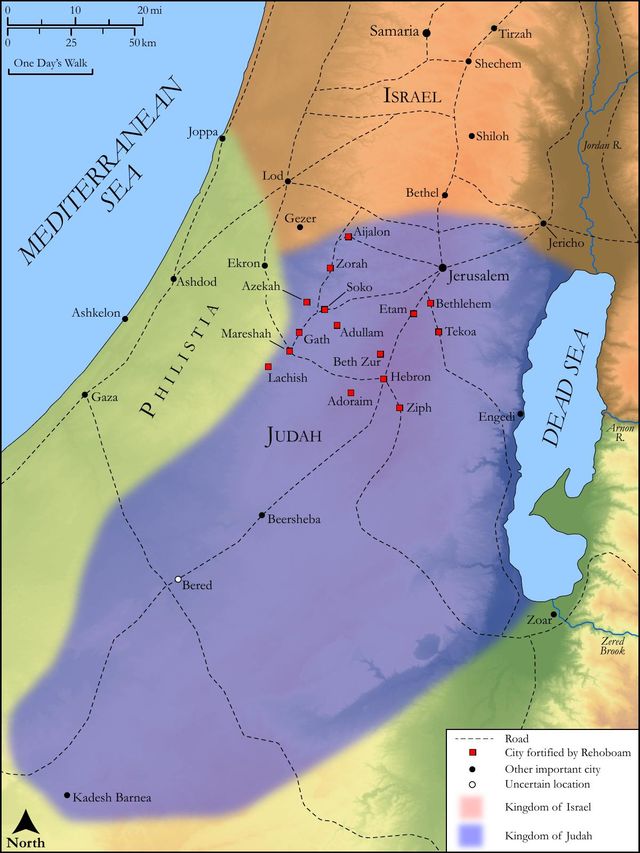
The collective "they" here refers to King Rehoboam, the faithful priests and Levites, and the devout Israelites who migrated from the northern kingdom. Their combined efforts, guided by divine favor, led to the fortification and consolidation of the Southern Kingdom. This strengthening was multi-faceted, encompassing military defenses (as detailed in 2 Chronicles 11:5-12), economic stability through increased population and resources, and, most importantly, spiritual vitality due to the presence of God's faithful people and legitimate worship at the Jerusalem Temple.
"and made Rehoboam the son of Solomon strong, three years"
This clause highlights the direct impact on Rehoboam's personal authority and reign. For this specific three-year duration, his kingship was not only secure but also prosperous and divinely endorsed. This period stands in stark contrast to his initial folly and later decline, marking a unique window of stability and success attributed to the kingdom's, and by extension, his own, temporary adherence to God's ways. The "three years" is a precise temporal marker, emphasizing the limited nature of this period of faithfulness and its resultant blessing.
"for three years they walked in the way of David and Solomon."
This final clause provides the crucial reason and condition for the preceding strengthening. The repetition of "three years" for emphasis underscores the precise duration of this period of obedience. "Walking in the way of David and Solomon" signifies their adherence to the Mosaic covenant, the exclusive worship of Yahweh at the Temple in Jerusalem, and the righteous governance that characterized the best periods of David's and Solomon's reigns. It implies a conscious commitment to God's laws and a rejection of the idolatry that was simultaneously corrupting the northern kingdom, thereby securing divine blessing and stability for Judah.
Literary Devices
ShowHideThe verse employs several significant literary devices to convey its message. Idiom is prominently featured in the phrase "walked in the way of David and Solomon," which is a well-established biblical expression signifying a particular pattern of life or conduct, here specifically referring to adherence to righteous covenant principles and the legacy of faithful kingship. The use of Repetition ("three years") serves to emphasize the specific, limited duration of this period of faithfulness and strength, subtly hinting at its temporary nature and foreshadowing Rehoboam's later departure from God's ways. There is also an implicit Contrast with the northern kingdom under Jeroboam, whose immediate establishment of idolatry led to spiritual decline and instability, highlighting Judah's initial, albeit brief, commitment to true worship. Finally, the verse clearly exhibits Causality, directly linking the kingdom's strength and Rehoboam's stability to their righteous conduct, thereby reinforcing the Chronicler's overarching theological principle that obedience to God brings blessing and disobedience leads to judgment.
Theological and Thematic Connections
ShowHideThis verse powerfully articulates the foundational biblical principle that national and personal well-being are intrinsically linked to covenant faithfulness. The strengthening of Judah and Rehoboam's reign is presented as a direct consequence of their collective decision to "walk in the way of David and Solomon," signifying adherence to God's commands and true worship. This period serves as a historical testament to God's faithfulness to His covenant promises, demonstrating that when His people align themselves with His will, He grants strength, stability, and blessing. It underscores the ongoing tension between human choice and divine response, revealing that even a flawed leader like Rehoboam can experience God's favor when he and his people choose obedience, even if only for a season. This theological truth resonates throughout Scripture, affirming God's consistent character as one who rewards righteousness and holds His people accountable to His standards, while also highlighting the fragility of human commitment.
Reflection and Application
ShowHideThe brief period of strength and stability in Judah under Rehoboam, directly attributed to their faithfulness, offers profound lessons for believers and communities today. It reminds us that spiritual vitality and genuine flourishing—whether in an individual life, a family, a church, or even a nation—are inextricably linked to our collective and individual commitment to God's revealed will. Just as Judah was strengthened by walking in the "way of David and Solomon," we are called to walk in the "way" of Christ, whose perfect obedience and example provide the ultimate pattern for life. This verse challenges us to consider the areas where we, like Rehoboam, might be prone to initial folly, yet are given opportunities to turn back to God's path. It also highlights the transformative power of faithful individuals: the priests, Levites, and other devout Israelites who migrated to Judah were instrumental in its strengthening, demonstrating that personal choices for righteousness, even when costly, can have a profound and positive impact on the larger community. The "three years" also serves as a subtle warning: faithfulness must be sustained, for spiritual complacency and eventual departure from God's ways, as seen in Rehoboam's later reign (2 Chronicles 12:1), inevitably lead to weakness and decline. We are therefore called to vigilant, consistent obedience, understanding that our strength, joy, and purpose are found in steadfastly following the Lord.
Questions for Reflection
ShowHideFAQ
ShowHideWhy is the "three years" significant in 2 Chronicles 11:17?
ShowHideThe "three years" is significant because it marks a specific, limited period of initial faithfulness, strength, and divine favor in Rehoboam's reign. The Chronicler emphasizes this duration to highlight that the kingdom's prosperity and stability were conditional upon its obedience. It serves as a stark contrast to Rehoboam's subsequent departure from God's ways, which is detailed in 2 Chronicles 12:1-2, leading to a swift decline and foreign invasion. Thus, the "three years" underscores the temporary nature of this blessing and implicitly warns against spiritual complacency, emphasizing that sustained obedience is required for lasting strength and blessing.
What does "walked in the way of David and Solomon" specifically mean here, given Solomon's later apostasy?
ShowHideWhen the text states that "they walked in the way of David and Solomon," it refers to the righteous and faithful aspects of their reigns, particularly their commitment to the Mosaic Law, the covenant with Yahweh, and the pure worship at the Temple in Jerusalem. For David, this meant his wholehearted devotion to God and his establishment of a righteous kingdom. For Solomon, it specifically refers to his early wisdom, his dedication to building the Temple, and his initial obedience before his later decline into idolatry and syncretism, which is well-documented in 1 Kings 11:1-8. The phrase is an idealized reference to the golden age of the united monarchy, serving as a benchmark for what true, God-honoring kingship and national conduct should entail, in direct opposition to the idolatrous practices adopted by the northern kingdom under Jeroboam.
How did the migration of priests and Levites, mentioned earlier in the chapter, strengthen the kingdom of Judah?
ShowHideThe migration of priests, Levites, and other faithful Israelites from the northern kingdom to Judah (2 Chronicles 11:13-16) significantly strengthened Judah in several crucial ways. Spiritually, it ensured the continued presence of those committed to the legitimate worship of Yahweh at the Temple, providing a moral and theological backbone that resisted Jeroboam's idolatry. Numerically, it brought a substantial influx of devout people, increasing Judah's population and tax base, thereby strengthening its economic and military capacity. Furthermore, these individuals brought with them a deep commitment to the covenant and the Law, reinforcing Judah's identity as the true custodian of God's promises and providing a strong, unified front against the spiritual apostasy that was engulfing the rest of Israel.
Christ-Centered Fulfillment
ShowHideThe strengthening of Judah under Rehoboam, contingent upon walking in the "way of David and Solomon," finds its ultimate and perfect fulfillment in Jesus Christ. While Rehoboam's faithfulness was temporary and flawed, leading to a brief period of strength, Christ is the eternal, perfectly righteous King who never deviates from the Father's will. He is the true Son of David, whose kingdom is not merely strengthened for three years but is established forever, as prophesied in the Davidic Covenant (2 Samuel 7:16). The "way" that Judah was called to walk in, representing obedience to God's covenant, is perfectly embodied in Christ, who declared, "I am the way, the truth, and the life". His life of perfect obedience, even to the point of death on a cross (Philippians 2:8), fulfills all the righteous requirements of the Law, something no earthly king could perfectly achieve. Through His atoning sacrifice, believers are enabled by the Holy Spirit to "walk in His way," experiencing a spiritual strengthening and stability far greater than any earthly kingdom could offer. His kingdom, the Church, is built upon His unshakeable faithfulness, and its strength is derived not from human efforts or temporary obedience but from the enduring power of His resurrection and the indwelling Spirit, ensuring that "the gates of hell shall not prevail against it" (Matthew 16:18). Thus, 2 Chronicles 11:17, with its conditional strength based on a temporary human adherence, ultimately points to the absolute and eternal strength found only in the perfect reign and unwavering faithfulness of Christ, the true King of kings, who continually strengthens His people and His eternal kingdom.