


2 Chronicles 11:13
Bible text: King James Version (1769 Blayney text) · Public domain
Bible text: Berean Standard Bible · Public domain
Bible text: American Standard Version (1901) · Public domain
Bible text: World English Bible, Messianic edition · Public domain
Bible text: Geneva Bible (1599) · Public domain
Bible text: Young's Literal Translation · Public domain
- וְהַכֹּהֲנִיםve·ha·ko·ha·Nimand the priestsH3548Conj-w ¦ Art ¦ N-mpNoun Plural Masculine Absoluteוְandהַtheכֹּהֲנִיםpriests
- וְהַלְוִיִּםve·hal·vi·Yimand the LevitesH3881Conj-w ¦ Art ¦ N-mpNoun Gentilic Plural Masculine AbsoluteוְandהַtheלְוִיִּםLevites
- אֲשֶׁר'a·SherwhoH834RelParticle Relative
- בְּכָלbe·khol[were] in allH3605Prep-b ¦ N-mscNoun Singular Masculine Constructבְּ[were] inכָלall
- יִשְׂרָאֵלYis·ra·'ElIsraelH3478N-properNoun Proper Location
- הִתְיַצְּבוּhit·ya·tze·Vuthey took their standH3320V-Hithpael-Perf-3cpVerb Hithpael Perfect 3rd Plural common gender
- עָלָיו'a·Lavat himH5921Prep ¦ 3msPrepositionעָלָיatוhim
- מִכָּלmi·kolfrom allH3605Prep-m ¦ N-mscNoun Singular Masculine Constructמִfromכָּלall
- גְּבוּלָםge·vu·Lamtheir territoryH1366N-msc ¦ 3mpNoun Singular Masculine Constructגְּבוּלָterritoryםtheir
English is a literal word-by-word gloss of the Hebrew, not the KJV's wording. Why?
This is the original text the KJV's translators worked from — each Hebrew word with its own literal English meaning in this verse, prepared by scholars at Tyndale House, Cambridge. The KJV translates whole sentences, not word by word, so its wording differs: one Hebrew word can become several English words, and the KJV may choose “the LORD” where the gloss reads “Yahweh”. Both are faithful — they answer different questions. For the KJV's own rendering, switch to the KJV text.
Details
See on the biblical-era map
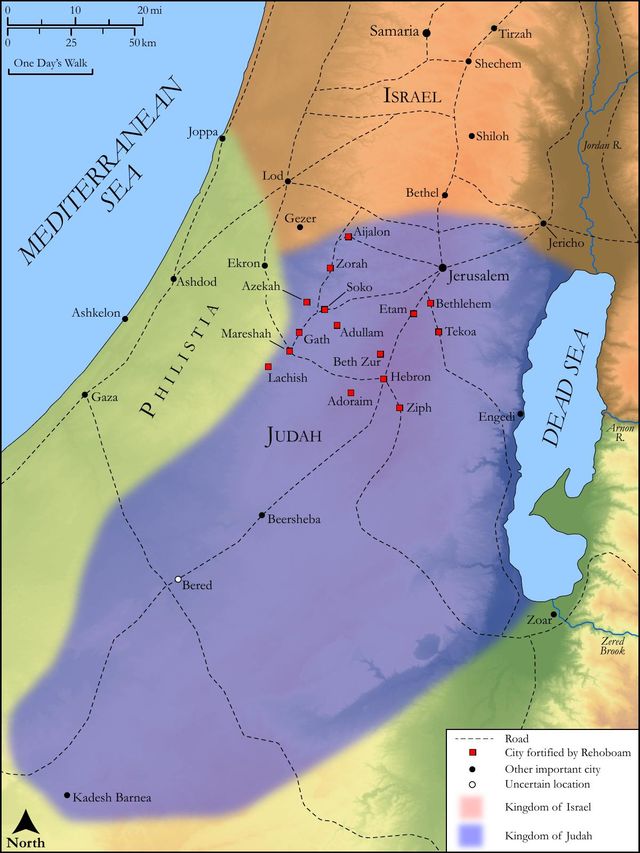
Study this verse
Public-domain commentary
Matthew Henry
From his Commentary on the Whole Bible. Henry comments on passages, not single verses — this entry covers 2 Chronicles 11:13–23. His three-level outline is real structure in the source text, so it is rendered as structure.
See here,
I.How Rehoboam was strengthened by the accession of the priests and Levites, and all the devout and pious Israelites, to him, even all that were true to their God and their religion.
1.Jeroboam cast them off, that is, he set up such a way of worship as he knew they could not in conscience comply with, which obliged them to withdraw from his altar, and at the same time he would not allow them to go up to Jerusalem to worship at the altar there; so that he totally cast them off from executing the priest's office, Ch2 11:14. And very willing he was that they should turn themselves out of their places, that room might be made for those mean and scandalous persons whom he ordained priests for the high places, Ch2 11:15. Compare Kg1 12:31. No marvel if he that cast off God cast off his ministers; they were not for his purpose, would not do whatever he might bid them do, would not serve his gods, nor worship the golden image which he had set up.
2.They thereupon left their suburbs and possessions, Ch2 11:14. Out of the lot of each tribe the Levites had cities allowed them, where they were comfortable provided for and had opportunity of doing much good. But now they were driven out of all their cities except those in Judah and Benjamin. One would think their maintenance well settled, and yet they lost it. It was a comfort to them that the law so often reminded them that the Lord was their inheritance, and so they should find him when they were turned out of their house and possessions. But why did they leave their possessions?
(1.)Because they saw they could do no good among their neighbours, in whom (now that Jeroboam set up his calves) the old proneness to idolatry revived.
(2.)Because they themselves would be in continual temptation to some base compliances, and in danger of being drawn insensibly to that which was evil. If we pray, in sincerity, not to be led into temptation, we shall get and keep as far as we can out of the way of it.
(3.)Because, if they retained their integrity, they had reason to expect persecution from Jeroboam and his sons. The priests they made for the devils would not let the Lord's priests be long among them. No secular advantages whatsoever should draw us thither, or detain us there, where we are in danger of making shipwreck of faith and a good conscience.
3.They came to Judah and Jerusalem (Ch2 11:14) and presented themselves to Rehoboam, Ch2 11:13, margin. Where should God's priests and Levites be, but where his altar was? Thither they came because it was their business to attend at the times appointed.
(1.)It was a mercy to them that they had a place of refuge to flee to, and that when Jeroboam cast them off there were those so near that would entertain them, and bid them welcome, and they were not forced into the lands of the heathen.
(2.)It was an evidence that they loved their work better than their maintenance, in that they left their suburbs and possessions in the country (where they might have lived at ease upon their own), because they were restrained from serving God there, and cast themselves upon God's providence and the charity of their brethren in coming to a place where they might have the free enjoyment of God's ordinances, according to his institution. Poverty in the way of duty is to be chosen rather than plenty in the way of sin. Better live upon alms, or die in a prison, with a good conscience, than roll in wealth and pleasure with a prostituted one.
(3.)It was the wisdom and praise of Rehoboam and his people that they bade them welcome, though they crowded themselves perhaps to make room for them. Conscientious refugees will bring a blessing along with them to the countries that entertain them, as they leave a curse behind them with those that expel them. Open the gates, that the righteous nation, which keepeth truth, may enter in; it will be good policy. See Isa 26:1, Isa 26:2.
4.When the priests and Levites came to Jerusalem all the devout pious Israelites of every tribe followed them. Such as set their hearts to seek the Lord God of Israel, that made conscience of their duty to God and were sincere and resolute in it, left the inheritance of their fathers and went and took houses in Jerusalem, that they might have free access to the altar of God and be out of the temptation to worship the calves, Ch2 11:16. Note,
(1.)That is best for us which is best for our souls; and, in all our choices, advantages for religion must take place of all outward conveniences.
(2.)Where God's faithful priests are his faithful people should be. If Jeroboam cast off God's ministers, every true-born Israelite will think himself obliged to own them and stand by them. Forsake not the Levite, the out-cast Levite, as long as thou livest. When the ark removes do you remove and go after it, Jos 3:3.
5.They strengthened the kingdom of Judah (Ch2 11:17), not only by the addition of so many persons to it, who, it is likely, brought what they could of their effects with them, but by their piety and their prayers they procured a blessing upon the kingdom which was a sanctuary to them. See Zac 12:5. It is the interest of a nation to protect and encourage religion and religious people, and adds more than any thing to its strength. They made him and his people strong three years; for so long they walked in the way of David and Solomon, their good way. But when they forsook that, and so threw themselves out of God's favour and protection, the best friends they had could no longer help to strengthen them. We retain our strength while we cleave to God and our duty, and no longer.
II.How Rehoboam was weakened by indulging himself in his pleasures. He desired many wives, as his father did (Ch2 11:23), yet,
1.In this he was more wise than his father, that he does not appear to have married strange wives. The wives mentioned here were not only daughters of Israel, but of the family of David; one was a descendant from Eliab, David's brother (Ch2 11:18), another from Absalom, probably that Absalom who was David's son (Ch2 11:20), another from Jerimoth, David's son.
2.In this he was more happy than his father, that he had many sons and daughters; whereas we read not of more than one son that his father had. One can scarcely imagine that he had no more; but, if he had, they were not worth mentioning; whereas several of Rehoboam's sons are here named (Ch2 11:19, Ch2 11:20) as men of note, and such active men that he thought it his wisdom to disperse them throughout the countries of Judah and Benjamin (Ch2 11:23), either,
(1.)That they might not be rivals with his son Abijah, whom he designed for his successor, or rather,
(2.)Because he could repose a confidence in them for the preserving of the public peace and safety, could trust them with fenced cities, which he took care to have well victualled, that they might stand him in stead in case of an invasion. After-wisdom is better than none at all; nay, they say, "Wit is never good till it is bought;" though he was dearly bought with the loss of a kingdom.
Continue studying 2 Chronicles 11:13 across the web’s major study libraries — every link below opens this exact verse, chapter, or book on the destination site.
Read & Compare
 BibleGatewayThis verse in more than 200 translations and 70 languages.
 Bible.comThe YouVersion reader — hundreds of translations, reading plans, and highlights.
 ESV.orgCrossway's official English Standard Version reader.
 NET BibleThe NET translation with 60,000+ translators' notes on every rendering decision.
 STEP BibleTyndale House's free study tool — original text, vocabulary, and scholarly resources.
 BibliaLogos Bible Software's free web reader.
 USCCBThe New American Bible (Revised Edition) with the U.S. bishops' study notes.
Commentaries
 BibleHub CommentariesDozens of classic commentaries on this verse, gathered on one page.
 StudyLightMore than 100 commentary sets — the largest collection on the web.
 BibleRefPlain-English commentary on what this verse means, verse by verse.
 Enduring WordDavid Guzik's free commentary on this chapter, widely used by Bible teachers.
 Bible Study ToolsVerse commentary alongside Greek and Hebrew study aids.
Original Language & Research
- BibleHub InterlinearThe verse word by word — original language, transliteration, and English.
- BibleHub LexiconEvery word's original-language definition and Strong's entry.
 Blue Letter BibleDeep-study tools — Strong's numbers, concordance, and word studies.
 SefariaThe Hebrew text with Rashi and centuries of Jewish commentary.
Sermons, Hymns & Audio


TrulyRandomVerse is not affiliated with these sites and doesn’t control their content. They’re linked because they’re genuinely useful.
Summary
2 Chronicles 11:13 records a pivotal moment in the early history of the divided kingdom of Israel, detailing the voluntary migration of the priests and Levites from the newly formed Northern Kingdom, under King Jeroboam, to the Southern Kingdom of Judah, ruled by Rehoboam. This significant exodus was a direct response to Jeroboam's establishment of idolatrous worship centers and his rejection of the divinely appointed Levitical priesthood, highlighting the profound spiritual and political schism that defined this era. These spiritual leaders chose unwavering loyalty to God's covenant and His prescribed worship over their established homes and livelihoods, thereby strengthening the legitimate worship in Judah and preserving the true faith for future generations.
Context
ShowHideLiterary Context
This verse immediately follows the account of the kingdom's division (2 Chronicles 10) and Jeroboam's subsequent religious innovations (2 Chronicles 11:1-12). Having secured the allegiance of ten tribes, Jeroboam's primary concern was preventing his subjects from returning to Jerusalem for worship, which he feared would shift their loyalty back to Rehoboam and the house of David. To counteract this, he established alternative worship sites in Dan and Bethel, complete with golden calves, and appointed non-Levitical priests from "the lowest of the people" (1 Kings 12:31). Verse 13 marks the immediate, faithful response to this apostasy, setting the stage for the strengthening of Judah's spiritual and physical defenses, as detailed in the subsequent verses of 2 Chronicles 11. The departure of the legitimate priesthood underscores the severity of Jeroboam's sin and the clear choice presented to the people of Israel: true worship in Jerusalem or idolatry in the north.
Historical & Cultural Context
Following the death of Solomon, the united monarchy fractured, largely due to Rehoboam's harsh policies and long-standing tribal tensions. Jeroboam's establishment of golden calves in Dan and Bethel directly mimicked the idolatry of Aaron at Mount Sinai (Exodus 32:4). This act was a profound violation of the Mosaic Law, which mandated centralized worship at the Temple in Jerusalem and designated the descendants of Levi as the sole legitimate priests (Deuteronomy 12:5-14). The priests and Levites, scattered throughout all Israel to teach the law and facilitate worship, held a unique and sacred position. For them to abandon their "coasts" (assigned territories and sources of income) was a monumental act of faith and sacrifice, demonstrating their unwavering commitment to the covenant and the purity of Israelite worship.
Key Themes
ShowHideThe passage powerfully illustrates several key themes. First, Faithfulness to God's Covenant is paramount, as the priests and Levites chose obedience to God's law regarding worship and priesthood over personal comfort and security. Their migration highlights the principle of Separation from Apostasy, demonstrating that true worship cannot coexist with idolatry and spiritual compromise. By leaving the Northern Kingdom, they physically and spiritually distanced themselves from Jeroboam's rebellion against God. Finally, this event contributes to the theme of Divine Preservation and Strengthening of the Remnant. Their arrival in Judah significantly bolstered Rehoboam's kingdom, not just numerically, but spiritually, ensuring the continuation of legitimate worship and the Davidic line in Jerusalem, which was crucial for God's redemptive plan, as seen in 2 Chronicles 11:17.
Exposition and Analysis
ShowHideKey Word Analysis
ShowHideThis term refers to those consecrated to officiate in sacred rites, specifically the descendants of Aaron from the tribe of Levi. Their role was divinely ordained, involving the offering of sacrifices, teaching the Law, and mediating between God and the people. Jeroboam's dismissal of these legitimate priests and his appointment of unauthorized individuals underscored the severity of his apostasy, as it directly undermined God's established order for worship.
From a primitive root meaning "to place (anything so as to stay)," or reflexively, "to station oneself," "to stand forth," or "to present oneself." The use of this word here indicates a deliberate, voluntary, and decisive action on the part of the priests and Levites. It was not a forced relocation but a conscious choice to take a stand for legitimate worship and align themselves with the kingdom where God's covenant was still honored. This verb emphasizes their active participation and resolve.
Properly, a "boundary" or "limit," and by extension, the "territory enclosed" or "quarter." In this context, it refers to the specific Levitical cities and their surrounding pasturelands scattered throughout the tribal territories of Israel, which were assigned to the priests and Levites as their inheritance and means of sustenance (Numbers 35:1-8). To leave their "coasts" meant abandoning their homes, their sources of income (tithes and offerings from the people they served), and their established positions, underscoring the profound personal sacrifice and conviction behind their migration.
Verse Breakdown
ShowHide"And the priests and the Levites that [were] in all Israel"
This clause identifies the subjects as the divinely appointed spiritual leaders from the tribe of Levi, specifically those serving as priests (descendants of Aaron) and Levites (other members of the tribe responsible for Temple service and teaching). The phrase "in all Israel" emphasizes their widespread presence throughout the ten northern tribes, indicating that Jeroboam's apostasy impacted the entire nation and that the faithful response was broad, not isolated.
"resorted to him"
This signifies a deliberate and collective movement towards Rehoboam, the king of Judah. "Him" refers to Rehoboam, who, despite his own flaws, represented the legitimate Davidic dynasty and the continuation of centralized worship at the Temple in Jerusalem. Their "resorting" was an act of allegiance to God's covenant and His ordained system of worship, choosing the path of faithfulness over convenience or compromise.
"out of all their coasts"
This phrase highlights the significant personal cost of their decision. The priests and Levites were abandoning their assigned towns and territories, which were their homes and sources of sustenance, to join Rehoboam in Judah. This act demonstrates their unwavering commitment to the Lord and His law, prioritizing spiritual integrity over material security and illustrating a profound trust in God's provision.
Literary Devices
ShowHideThe passage employs Contrast as a primary literary device, starkly juxtaposing Jeroboam's apostasy and the Levites' faithfulness. Jeroboam's actions, driven by political expediency and fear, represent a profound turning away from God, while the Levites' response embodies unwavering devotion and adherence to divine law. This contrast highlights the moral and spiritual divide between the two kingdoms. Furthermore, the migration itself serves as Symbolism, representing the separation of the faithful remnant from spiritual corruption. Their physical movement from the north to the south symbolizes a spiritual alignment with God's will and the preservation of pure worship. The strengthening of Judah through their arrival also carries elements of Divine Providence, showing God's hand in preserving a people and a place where His true worship could continue.
Theological and Thematic Connections
ShowHideThe exodus of the priests and Levites from the Northern Kingdom to Judah is a profound theological statement on the nature of true worship and the cost of faithfulness. It underscores God's unwavering commitment to His covenant and His people, even when human leadership falters. The Levites' actions demonstrate that allegiance to God's truth must supersede all other loyalties, including national identity or personal comfort. Their sacrifice ensured the continuation of legitimate worship and the preservation of God's law within Judah, serving as a beacon of faithfulness in a time of widespread apostasy. This event illustrates that God always preserves a remnant who will remain true to Him, and that obedience to His commands, even when costly, ultimately leads to strength and blessing.
Reflection and Application
ShowHideThe example of the priests and Levites in 2 Chronicles 11:13 offers a powerful challenge for believers today. Their willingness to abandon their homes and livelihoods for the sake of true worship calls us to examine our own priorities and allegiances. In a world often characterized by spiritual compromise and diluted truth, we are summoned to a similar radical faithfulness. This means prioritizing God's Word and His glory above cultural trends, personal convenience, or even institutional pressures. It compels us to discern carefully the spiritual environments we inhabit and support, seeking out communities that genuinely uphold biblical truth and pure worship. The Levites' costly obedience reminds us that following Christ often involves sacrifice, but it is in such surrender that we find true spiritual security and contribute to the flourishing of God's kingdom.
Questions for Reflection
ShowHideFAQ
ShowHideWhy was it so critical for the priests and Levites to leave the Northern Kingdom?
ShowHideIt was critical because Jeroboam's religious reforms directly violated God's covenant and the Mosaic Law. God had specifically ordained the tribe of Levi for priestly service and commanded that worship be centralized at the Temple in Jerusalem (Deuteronomy 12:5). By establishing golden calves and appointing non-Levitical priests (1 Kings 12:28-31), Jeroboam introduced idolatry and illegitimate worship, making it impossible for the faithful priests and Levites to fulfill their divinely appointed duties. Remaining would have meant complicity in apostasy, so their departure was an act of obedience and a testimony to the purity of God's worship.
What was the significance of their coming to Rehoboam in Judah?
ShowHideTheir arrival in Judah was highly significant for several reasons. Spiritually, it strengthened Rehoboam's kingdom by bringing a concentrated body of faithful spiritual leaders who upheld legitimate worship according to God's law. This ensured the continuation of the Temple service and the teaching of the Law in Judah, in stark contrast to the spiritual decline in the north. Politically, it added a substantial number of committed individuals to Judah's population, as noted in 2 Chronicles 11:14-16). This influx contributed to Judah's stability and power, reinforcing the Davidic dynasty's claim as the legitimate line chosen by God, which was crucial for the unfolding of God's redemptive plan through the lineage of David.
Christ-Centered Fulfillment
ShowHideThe faithful migration of the priests and Levites in 2 Chronicles 11:13 foreshadows the ultimate call to follow Christ, the true Temple and High Priest, even at great personal cost. Just as the Levites abandoned their earthly "coasts" to align with legitimate worship in Jerusalem, believers are called to forsake the idols of this world and separate themselves from spiritual compromise to follow Jesus, who is the Way, the Truth, and the Life (John 14:6). Their sacrifice prefigures Christ's own ultimate sacrifice, by which He established a new covenant and became the perfect and final High Priest, offering Himself once for all (Hebrews 9:11-14). Furthermore, the strengthening of Judah through the faithful remnant points to the building of Christ's church, His spiritual kingdom, which is comprised of all who, by faith, abandon the ways of the world to gather to Him, the cornerstone (Ephesians 2:19-22). Their story is a testament to the enduring truth that true allegiance to God always finds its fulfillment in Christ, who calls us to take up our cross and follow Him (Luke 9:23), promising eternal life to those who prioritize Him above all else.