


1 Kings 5:14
Bible text: King James Version (1769 Blayney text) · Public domain
Bible text: King James Version with Strong's numbers · Public domain
Bible text: Berean Standard Bible · Public domain
Bible text: American Standard Version (1901) · Public domain
Bible text: World English Bible, Messianic edition · Public domain
Bible text: Geneva Bible (1599) · Public domain
Bible text: Young's Literal Translation · Public domain
- וַיִּשְׁלָחֵםvai·yish·la·Chemand he sent themH7971Conj-w ¦ V-Qal-ConsecImperf-3ms ¦ 3mpVerb Qal Consecutive Imperfect 3rd Singular Masculineוַandיִּשְׁלָחֵhe sentםthem
- לְבָנוֹנָהle·va·No·nahLebanon towardsH3844N-proper ¦ SfxNoun Proper LocationלְבָנוֹנָLebanonהtowards
- עֲשֶׂרֶת'a·Se·rettenH6235N-fscNoun Singular Feminine Construct
- אֲלָפִים'a·la·Fimthousand<s>H505N-cpNoun Plural common gender Absolute
- בַּחֹדֶשׁba·Cho·deshin the monthH2320Prep-b ¦ N-msNoun Singular Masculine Absoluteבַּin theחֹדֶשׁmonth
- חֲלִיפוֹתcha·li·FotrelaysH2487N-fpNoun Plural Feminine Absolute
- חֹדֶשׁCho·desha monthH2320N-msNoun Singular Masculine Absolute
- יִהְיוּyih·Yuthey wereH1961V-Qal-Imperf-3mpVerb Qal Imperfect 3rd Plural Masculine
- בַלְּבָנוֹןva·le·va·Nonin <the> LebanonH3844Prep-b ¦ N-properNoun Proper Locationבַin <the>לְּבָנוֹןLebanon
- שְׁנַיִםshe·Na·yimtwoH8147N-cdNoun Dual common gender Absolute
- חֳדָשִׁיםcho·da·ShimmonthsH2320N-mpNoun Plural Masculine Absolute
- בְּבֵיתוֹbe·vei·Toin his homeH1004Prep-b ¦ N-msc ¦ 3msNoun Singular Masculine Constructבְּinבֵיתhomeוֹhis
- וַאֲדֹנִירָםva·'a·do·ni·Ramand AdoniramH141Conj-w ¦ N-proper-mNoun Proper MasculineוַandאֲדֹנִירָםAdoniram
- עַל'al[was] overH5921PrepPreposition
- הַמַּסha·Masthe forced laborH4522Art ¦ N-msNoun Singular Masculine Absoluteהַtheמַּסforced labor
English is a literal word-by-word gloss of the Hebrew, not the KJV's wording. Why?
This is the original text the KJV's translators worked from — each Hebrew word with its own literal English meaning in this verse, prepared by scholars at Tyndale House, Cambridge. The KJV translates whole sentences, not word by word, so its wording differs: one Hebrew word can become several English words, and the KJV may choose “the LORD” where the gloss reads “Yahweh”. Both are faithful — they answer different questions. For the KJV's own rendering, switch to the KJV text.
Details
See on the biblical-era maps
Study this verse
Public-domain commentary
Matthew Henry
From his Commentary on the Whole Bible. Henry comments on passages, not single verses — this entry covers 1 Kings 5:10–18. His two-level outline is real structure in the source text, so it is rendered as structure.
Here is, I. The performance of the agreement between Solomon and Hiram. Each of the parties made good his engagement. 1. Hiram delivered Solomon the timber, according to his bargain, Kg1 5:10. The trees were Solomon's, but perhaps - Materiam superabat opus - The workmanship was of more value than the article. Hiram is therefore said to deliver the trees. 2. Solomon conveyed to Hiram the corn which he had promised him, Kg1 5:11. Thus let justice be followed (as the expression is, Deu 16:20), justice on both sides, in every bargain.
II.The confirmation of the friendship that was between them hereby.
God gave Solomon wisdom (Kg1 5:12), which was more and better than any thing Hiram did or could give him; but this made Hiram love him, and enabled Solomon to improve his kindness, so that they were both willing to ripen their mutual love into a mutual league, that it might be lasting. It is wisdom to strengthen our friendship with those whom we find to be honest and fair, lest new friends prove not so firm and so kind as old ones.
III.The labourers whom Solomon employed in preparing materials for the temple.
1.Some were Israelites, who were employed in the more easy and honourable part of the work, felling trees and helping to square them, in conjunction with Hiram's servants; for this he appointed 30,000, but employed only 10,000 at a time, so that for one month's work they had two months' vacation, both for rest and for the despatch of their own affairs at home, Kg1 5:13, Kg1 5:14. It was temple service, yet Solomon takes care that they shall not be over-worked. Great men ought to consider that their servants must rest as well as they.
2.Others were captives of other nations, who were to bear burdens and to hew stone (Kg1 5:15), and we read not that these had their resting times as the other had, for they were doomed to servitude.
3.There were some employed as directors and overseers (Kg1 5:16), 3300 that ruled over the people, and they were as necessary and useful in their place as the labourers in theirs; here were many hands and many eyes employed, for preparation was now to be made, not only for the temple, but for all the rest of Solomon's buildings, at Jerusalem, and here in the forest of Lebanon, and in other places of his dominion, of which see Kg1 9:17-19. He speaks of the vastness of his undertakings (Ecc 2:4, I made me great works), which required this vast number of workmen.
IV.The laying of the foundation of the temple; for that is the building his heart is chiefly upon, and therefore he begins with that, Kg1 5:17, Kg1 5:18. It should seem, Solomon was himself present, and president, at the founding of the temple, and that the first stone (as has been usual in famous buildings) was laid with some solemnity. Solomon commanded and they brought costly stones for the foundation; he would do every thing like himself, generously, and therefore would have some of the costliest stones laid, or buried rather, in the foundation, though, being out of sight, worse might have served. Christ, who is laid for a foundation, is an elect and precious stone (Isa 28:16), and the foundations of the church are said to be laid with sapphires, Isa 54:11, compare Rev 21:19. That sincerity which is our gospel perfection obliges us to lay our foundation firm and to bestow most pains on that part of our religion which lies out of the sight of men.
Historical interpretation
Historical reception
1 surviving comment on this verse from the historical church.
The first thing to note here is that it was not for nothing that Solomon chose workmen from all Israel, nor was there any section of the people from which men fit for such a great task were not taken, because, of course, priests nowadays are not to be chosen from the stock of Aaron alone; rather, people are to be sought from the whole church who, whether by example or word, are competent to build the house of the Lord, and wherever they are found they are to be promoted to the office of teachers without any exception of persons. And when such people are ordained to instruct the infidel and those who are to be called into the joint pastorate of the church, they are sent as energetic and picked men, as it were, to hew in Lebanon the materials for the temple. And indeed the number of thirty thousand, which was the tally of the hewers of wood, can be aptly applied figuratively to those who are perfect in the faith of the holy Trinity, because it is most appropriate for teachers.
Continue studying 1 Kings 5:14 across the web’s major study libraries — every link below opens this exact verse, chapter, or book on the destination site.
Read & Compare
 BibleGatewayThis verse in more than 200 translations and 70 languages.
 Bible.comThe YouVersion reader — hundreds of translations, reading plans, and highlights.
 ESV.orgCrossway's official English Standard Version reader.
 NET BibleThe NET translation with 60,000+ translators' notes on every rendering decision.
 STEP BibleTyndale House's free study tool — original text, vocabulary, and scholarly resources.
 BibliaLogos Bible Software's free web reader.
 USCCBThe New American Bible (Revised Edition) with the U.S. bishops' study notes.
Commentaries
 BibleHub CommentariesDozens of classic commentaries on this verse, gathered on one page.
 StudyLightMore than 100 commentary sets — the largest collection on the web.
 BibleRefPlain-English commentary on what this verse means, verse by verse.
 Enduring WordDavid Guzik's free commentary on this chapter, widely used by Bible teachers.
 Bible Study ToolsVerse commentary alongside Greek and Hebrew study aids.
Original Language & Research
- BibleHub InterlinearThe verse word by word — original language, transliteration, and English.
- BibleHub LexiconEvery word's original-language definition and Strong's entry.
 Blue Letter BibleDeep-study tools — Strong's numbers, concordance, and word studies.
 SefariaThe Hebrew text with Rashi and centuries of Jewish commentary.
Sermons, Hymns & Audio


TrulyRandomVerse is not affiliated with these sites and doesn’t control their content. They’re linked because they’re genuinely useful.
Summary
1 Kings 5:14 offers a precise administrative insight into King Solomon's vast labor force, detailing the highly organized rotational system for the thirty thousand men conscripted to fell timber in Lebanon for the Temple's construction. This verse vividly portrays Solomon's exceptional organizational capabilities, the extensive mobilization of national resources for his monumental building projects, and the critical role of dedicated oversight officials like Adoniram, underscoring the practical arrangements and the king's pervasive authority.
Context
ShowHideLiterary Context
This verse is strategically placed within the narrative of King Solomon's meticulous preparations for constructing the Lord's Temple, a sacred endeavor long envisioned by his father, David, but reserved for Solomon. Immediately preceding this verse, 1 Kings 5:13 introduces the total number of the levy—thirty thousand men—and specifies that Solomon raised them from "all Israel." Verse 14 then elaborates on the precise deployment system for this immense workforce, highlighting a sophisticated rotational schedule designed for efficiency and sustainability. The subsequent verses, such as 1 Kings 5:15-18, further delineate other categories of laborers, including foreign residents and skilled craftsmen, providing a comprehensive picture of the unprecedented scale and diverse composition of the workforce assembled for this monumental, divinely-ordained undertaking. The meticulous administrative details throughout these chapters underscore the unparalleled nature of the Temple construction and Solomon's profound administrative acumen.
Historical & Cultural Context
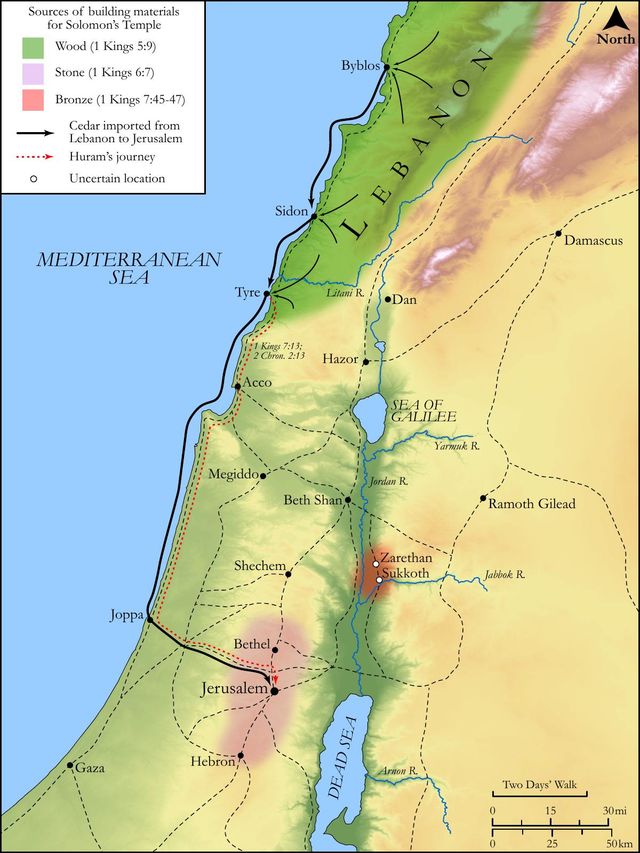
The practice of a "levy" or corvée labor—compulsory, temporary labor for public works—was a deeply ingrained feature of the kingdoms of that day, prevalent in societies such as Egypt, Mesopotamia, and various Canaanite states. Kings routinely conscripted a segment of their male population for military service, agricultural duties, or, as in this significant instance, for large-scale building projects. This form of labor was distinct from chattel slavery, as the laborers were typically citizens serving a mandatory, finite term for the state, often receiving provisions or sustenance in return. Solomon's levy for the Temple and other extensive royal buildings, as further elaborated in 1 Kings 9:15, represented an unprecedented mobilization of human resources in Israelite history, reflecting the newfound wealth, centralized power, and administrative sophistication of the united monarchy. Lebanon, particularly its famed cedar forests, was renowned among the nations for its superior quality timber, an indispensable material for grand architectural constructions. Securing access to these vital resources through a strategic alliance with Hiram, King of Tyre, as detailed in 1 Kings 5:1, was a critical geopolitical and logistical necessity for Solomon's ambitious plans.
Key Themes
ShowHideThis verse powerfully illustrates several pivotal themes central to the narrative of Solomon's reign and the broader scope of 1 Kings. Firstly, it prominently highlights Solomon's Administrative Prowess and Wisdom, demonstrating his remarkable capacity to organize and manage a massive national undertaking with extraordinary efficiency and foresight. This meticulous organization serves as a tangible testament to the divine wisdom divinely granted to him, as explicitly promised in 1 Kings 3:12. Secondly, the theme of Royal Authority and National Service is profoundly evident, as the king's unquestionable power to conscript his subjects for national projects is clearly exercised. This "levy" underscores the significant demands placed upon the populace for the sake of the kingdom's grandeur and, more profoundly, for the sacred purpose of constructing God's house. Lastly, the verse contributes significantly to the overarching theme of Communal Effort for a Sacred Purpose. Despite the inherent burden of the labor, the entire nation, through this highly organized system, contributed directly to the construction of the Temple. This collective contribution symbolized a unified commitment to the worship of Yahweh and the establishment of His sacred dwelling place among His chosen people, showcasing a profound national dedication to a divine mandate.
Exposition and Analysis
ShowHideKey Word Analysis
ShowHideThe Hebrew word מַס (maç', H4522) refers to a burden or tax, specifically denoting forced labor or corvée. It signifies a compulsory service or payment exacted by a sovereign from his subjects for public works. In this context, it precisely describes the conscripted workforce mobilized for state projects. The use of maç' here underscores the king's absolute authority to command the labor of his people for national endeavors, distinguishing it sharply from voluntary service or hired labor. This term inherently carries connotations of obligation and burden, which would later become a significant point of contention and contribute to the political unrest in Israel's history.
The Hebrew word חֲלִיפָה (ḥălîfâ', H2487) signifies "alternation," "change," or "succession." In this specific context, it meticulously describes the sophisticated rotational system by which the laborers were deployed. The phrase "by courses" indicates a highly organized and systematic approach to managing such a vast workforce, ensuring that each contingent of men served for a precise period (one month) before being relieved and returning home for a longer duration (two months). This remarkably sophisticated system speaks volumes about Solomon's administrative genius, designed not only to maintain high productivity for the monumental building project but also to provide necessary rest and time at home for the laborers, thereby preventing complete exhaustion, mitigating potential unrest, and ensuring the long-term sustainability of the workforce.
Verse Breakdown
ShowHide"And he sent them to Lebanon, ten thousand a month by courses"
This initial clause meticulously outlines the deployment strategy for the thirty thousand men comprising the levy. "He" unequivocally refers to King Solomon, the orchestrator of this colossal undertaking. The designated destination, Lebanon, was critically chosen for its abundant and prized cedar and fir timber, essential for the Temple's construction. The precise numerical detail, "ten thousand," specifies the exact size of each rotating group, vividly emphasizing the immense scale of the operation. The phrase "a month by courses" highlights the precise, systematic rotation, indicating that a fresh contingent of ten thousand men was dispatched each month, effectively replacing the group that had just completed its arduous term of service.
"a month they were in Lebanon, [and] two months at home"
This segment provides the exact schedule and duration of the rotational cycle. Each group of ten thousand men was required to serve for one demanding month in the challenging environment of the Lebanese forests, engaged in the strenuous tasks of felling and transporting timber. Following this arduous period, they were granted a two-month respite, during which they would return to their homes, allowing them to rest, attend to their families and personal livelihoods, and recuperate before their next scheduled turn of service. This meticulously structured cycle demonstrates a pragmatic and humane approach to labor management, effectively balancing the immense demands of the project with the essential welfare and long-term sustainability of the workforce.
"and Adoniram [was] over the levy"
This concluding clause identifies the pivotal official entrusted with the comprehensive oversight of this massive labor force. Adoniram (also known as Adoram or Hadoram in other biblical passages) held a position of profound administrative authority and responsibility within Solomon's kingdom. His role as "over the levy" entailed the meticulous management of the conscription, deployment, logistical support, and overall welfare for these thirty thousand men, ensuring the seamless and efficient operation of this vital component of Solomon's ambitious building program. His notable tenure, extending from King David's reign into the reign of Rehoboam, underscores his enduring importance and the continuity of this crucial administrative function within the Israelite monarchy.
Literary Devices
ShowHideThe verse primarily employs Administrative Detail to convey the meticulous planning and immense scale of King Solomon's kingdom. The precise numbers ("ten thousand," "a month," "two months") and the explicit mention of the rotational system ("by courses") serve to impress upon the reader the logistical complexity and the king's sophisticated organizational capacity. This pervasive focus on detail lends a strong sense of Realism to the narrative, grounding the grand, divinely-ordained project of Temple building in the practicalities of human labor and rigorous management. Furthermore, the specific naming of Adoniram functions as a form of Metonymy, where the individual administrator stands as a representative for the entire administrative apparatus responsible for overseeing the vast labor levy. For a discerning reader familiar with later Israelite history, Adoniram's mention also serves as subtle Foreshadowing, as his continued, and ultimately fatal, role "over the levy" under Rehoboam directly contributes to his demise and the tragic division of the kingdom, thereby highlighting the long-term societal impact and potential burdens inherent in such extensive royal demands.
Theological and Thematic Connections
ShowHideThe meticulous organization of labor for the Temple's construction, as so precisely detailed in 1 Kings 5:14, profoundly highlights the enduring theological principle that significant divine undertakings often necessitate immense human effort, personal sacrifice, and meticulous planning. While the method of conscription (the levy) was a common practice among the kingdoms of that day, the ultimate purpose—to construct a sacred dwelling place for God's manifest presence—elevated this labor to a profound sacred calling. It vividly demonstrates a national commitment to God's explicit mandate, where every individual, through their contribution, however burdensome or demanding, played an integral part in establishing the central hub of Israelite worship. This communal effort for a sacred purpose powerfully foreshadows the New Testament concept of the church as God's spiritual temple, a living edifice built by the collective contributions of believers, each serving faithfully according to their unique gifts and divine calling.
Reflection and Application
ShowHideThe detailed account of Solomon's labor force in 1 Kings 5:14 offers a profound glimpse into the dedication, meticulous planning, and sacrifice often required for monumental, divinely-ordained projects. It serves as a potent reminder that building God's kingdom, whether in ancient Israel or in our contemporary context, frequently demands significant communal effort, strategic foresight, and unwavering personal commitment. While we no longer operate under a system of forced labor, the underlying principle of contributing our time, unique talents, and material resources to God's work remains profoundly relevant and eternally significant. This verse challenges us to deeply consider the "cost" of our discipleship and our genuine willingness to participate actively in God's grand purposes, even when such participation requires personal sacrifice, diligent effort, or sustained perseverance. It encourages us to wholeheartedly embrace our distinct roles within the larger body of Christ, recognizing that every contribution, no matter how seemingly small or laborious, is absolutely vital for the collective advancement of God's mission in the world. Our labor, when offered willingly, cheerfully, and with a heart devoted to the glory of God, transcends mere effort and becomes a profound act of worship and a powerful testament to our living faith.
Questions for Reflection
ShowHideFAQ
ShowHideWhat was the primary purpose of this specific levy mentioned in 1 Kings 5:14?
ShowHideThe levy meticulously described in 1 Kings 5:14 was specifically established for the monumental and demanding task of felling and transporting vast quantities of timber from the renowned forests of Lebanon. This timber, primarily high-quality cedar and fir, was absolutely essential for the construction of the magnificent Temple in Jerusalem, which was the central focus of Solomon's reign, as well as for his own opulent palace and other significant royal building projects. The highly efficient rotational system implemented for this levy ensured a continuous and steady supply of these crucial materials while simultaneously managing the welfare and sustainability of the thirty thousand Israelite laborers involved.
Who was Adoniram, and why is his role in this passage particularly significant?
ShowHideAdoniram (also known by the names Adoram or Hadoram in other biblical accounts) was a high-ranking and exceptionally influential official within the Israelite administration, specifically holding the critical position of being "over the levy," meaning he was responsible for the forced labor. His significance lies in his crucial and long-standing role in overseeing the massive workforce that was indispensable for Solomon's extensive and ambitious building projects, including the sacred Temple. He appears to have served in this demanding capacity from the reign of King David, through the entirety of Solomon's reign, and tragically, into the tumultuous early reign of Solomon's son, Rehoboam. His continued presence in this role highlights the administrative continuity of this vital function across multiple reigns. Tragically, his unwavering role in enforcing the burdensome levy under Rehoboam directly led to his stoning by the disgruntled and rebellious Israelites, an event that became a pivotal catalyst contributing to the division of the kingdom.
Christ-Centered Fulfillment
ShowHideWhile 1 Kings 5:14 meticulously details the physical labor undertaken for the construction of a physical temple, it profoundly foreshadows the ultimate spiritual building project centered entirely on Jesus Christ. The vast, organized effort to construct a dwelling place for God's manifest presence in Jerusalem powerfully points to Jesus Christ Himself as the true and ultimate Temple, the unique and perfect place where God fully dwells among humanity in the person of His Son (John 2:19-21). Just as the ancient levy involved the immense sacrifice and arduous labor of many for a divine purpose, Christ Himself bore the ultimate burden and performed the ultimate labor of redemption, offering His very life as the perfect, once-for-all sacrifice to reconcile fallen humanity to a holy God (Hebrews 9:11-14). Furthermore, the communal effort of building the physical Temple in Solomon's day finds its glorious fulfillment in the New Testament concept of the Church, which is divinely described as a spiritual house, a living temple built upon the unshakeable foundation of the apostles and prophets, with Christ Jesus Himself as the indispensable chief cornerstone (Ephesians 2:19-22). We, as individual believers, are living stones being actively built into this vibrant spiritual temple, each contributing our unique gifts and willing service under the perfect divine leadership of Christ, the true Adoniram, who perfectly oversees, empowers, and unites His people to participate in His ongoing work of building His eternal kingdom, not through forced labor or obligation, but through willing love, abounding grace, and the empowering presence of His Spirit (1 Peter 2:4-5).