


1 Kings 5:15
- וַיְהִיvay·Hiand it belongedH1961Conj-w ¦ V-Qal-ConsecImperf-3msVerb Qal Consecutive Imperfect 3rd Singular Masculineוַandיְהִיit belonged
- לִשְׁלֹמֹהlish·lo·Mohto SolomonH8010Prep-l ¦ N-proper-mNoun Proper MasculineלִtoשְׁלֹמֹהSolomon
- שִׁבְעִיםshiv·'ImseventyH7657N-mpNoun Plural Masculine Absolute
- אֶלֶף'E·lefthousandH505N-csNoun Singular common gender Absolute
- נֹשֵׂאno·Se'carrier[s]H5375V-Qal-Prtcpl-msVerb Qal Participle Singular Masculine Absolute
- סַבָּלsa·Balburden-bearer[s]H5449N-msNoun Singular Masculine Absolute
- וּשְׁמֹנִיםu·she·mo·Nimand eightyH8084Conj-w ¦ N-mpNoun Plural Masculine Absoluteוּandשְׁמֹנִיםeighty
- אֶלֶף'E·lefthousandH505N-csNoun Singular common gender Absolute
- חֹצֵבcho·Tzevstone-cutter[s]H2672V-Qal-Prtcpl-msVerb Qal Participle Singular Masculine Absolute
- בָּהָרba·Harin the hill countryH2022Prep-b ¦ N-msNoun Singular Masculine Absoluteבָּin theהָרhill country
English is a literal word-by-word gloss of the Hebrew, not the KJV's wording. Why?
This is the original text the KJV's translators worked from — each Hebrew word with its own literal English meaning in this verse, prepared by scholars at Tyndale House, Cambridge. The KJV translates whole sentences, not word by word, so its wording differs: one Hebrew word can become several English words, and the KJV may choose “the LORD” where the gloss reads “Yahweh”. Both are faithful — they answer different questions. For the KJV's own rendering, switch to the KJV text.
Details
See on the biblical-era map
Study this verse
Public-domain commentary
Matthew Henry
From his Commentary on the Whole Bible. Henry comments on passages, not single verses — this entry covers 1 Kings 5:10–18. His two-level outline is real structure in the source text, so it is rendered as structure.
Here is, I. The performance of the agreement between Solomon and Hiram. Each of the parties made good his engagement. 1. Hiram delivered Solomon the timber, according to his bargain, Kg1 5:10. The trees were Solomon's, but perhaps - Materiam superabat opus - The workmanship was of more value than the article. Hiram is therefore said to deliver the trees. 2. Solomon conveyed to Hiram the corn which he had promised him, Kg1 5:11. Thus let justice be followed (as the expression is, Deu 16:20), justice on both sides, in every bargain.
II.The confirmation of the friendship that was between them hereby.
God gave Solomon wisdom (Kg1 5:12), which was more and better than any thing Hiram did or could give him; but this made Hiram love him, and enabled Solomon to improve his kindness, so that they were both willing to ripen their mutual love into a mutual league, that it might be lasting. It is wisdom to strengthen our friendship with those whom we find to be honest and fair, lest new friends prove not so firm and so kind as old ones.
III.The labourers whom Solomon employed in preparing materials for the temple.
1.Some were Israelites, who were employed in the more easy and honourable part of the work, felling trees and helping to square them, in conjunction with Hiram's servants; for this he appointed 30,000, but employed only 10,000 at a time, so that for one month's work they had two months' vacation, both for rest and for the despatch of their own affairs at home, Kg1 5:13, Kg1 5:14. It was temple service, yet Solomon takes care that they shall not be over-worked. Great men ought to consider that their servants must rest as well as they.
2.Others were captives of other nations, who were to bear burdens and to hew stone (Kg1 5:15), and we read not that these had their resting times as the other had, for they were doomed to servitude.
3.There were some employed as directors and overseers (Kg1 5:16), 3300 that ruled over the people, and they were as necessary and useful in their place as the labourers in theirs; here were many hands and many eyes employed, for preparation was now to be made, not only for the temple, but for all the rest of Solomon's buildings, at Jerusalem, and here in the forest of Lebanon, and in other places of his dominion, of which see Kg1 9:17-19. He speaks of the vastness of his undertakings (Ecc 2:4, I made me great works), which required this vast number of workmen.
IV.The laying of the foundation of the temple; for that is the building his heart is chiefly upon, and therefore he begins with that, Kg1 5:17, Kg1 5:18. It should seem, Solomon was himself present, and president, at the founding of the temple, and that the first stone (as has been usual in famous buildings) was laid with some solemnity. Solomon commanded and they brought costly stones for the foundation; he would do every thing like himself, generously, and therefore would have some of the costliest stones laid, or buried rather, in the foundation, though, being out of sight, worse might have served. Christ, who is laid for a foundation, is an elect and precious stone (Isa 28:16), and the foundations of the church are said to be laid with sapphires, Isa 54:11, compare Rev 21:19. That sincerity which is our gospel perfection obliges us to lay our foundation firm and to bestow most pains on that part of our religion which lies out of the sight of men.
Historical interpretation
Historical reception
2 surviving comments on this verse. Each one is dated, so this reads as a timeline rather than a list.
Select a marker to jump to its quote. Markers stagger vertically where authors wrote within a few decades of each other.
These thousands of men employed in the cutting and transportation of the wooden beams and the stones signify the thousands of thousands of assistant spirits sent for our salvation. In the first place, [we see that] God ordered his angels to cut from the rock of the world and to polish and direct accurately the souls of the saints.… Second, in this same symbol, we can observe the toils of the saints for the conversion and salvation of souls, either when they endeavor to drive human beings away from the love of the world or when, after they have accomplished that, they begin to polish the stones cut from the rock until they provide them with luster by a thorough polishing and make them worthy of the heavenly building. Then they are taken and employed by the supreme builder.… Finally we can interpret the workers of Solomon to be the angels sent to accomplish their ministry, as well as the prophets and the apostles chosen from the old people to build the church.… The builders sent by the king of Tyre symbolize those strong in doctrine and holiness, whom the nation of the Gentiles abundantly supplied for the same purpose.
Listen to even greater mysteries. At the time when Solomon built the temple, it was our peacemaker who says, “Peace I leave with you, my peace I give to you,” “for he himself is our peace,” “the peace of God that surpasses all understanding,” who himself built the temple for God. Observe what Scripture says about the building of the temple by Solomon: “And there were seventy thousand quarrymen and eighty thousand carriers.” Mark the number. The masons who were cutting stones, who were preparing, as it were, the foundations of the buildings, who were taking up stones from the ground to build the temple of God, are reckoned in the number seven, in the prophets, in the patriarchs, for while they seemingly were driving the human race from off the earth, they were making preparations for the temple of the Lord. The latter, the eighty thousand, symbolize the apostolic preaching and the Gospels; these are they who with the Lord Savior and Solomon were carrying the heavy burden of the nations. This surely is the height of mystery, but hear of even deeper mysteries! “And the overseers over the works and the temple were three thousand.” They cannot be greater, not even the overseers in charge of the work, except that they proclaim the Trinity.
Continue studying 1 Kings 5:15 across the web’s major study libraries — every link below opens this exact verse, chapter, or book on the destination site.
Read & Compare
 BibleGatewayThis verse in more than 200 translations and 70 languages.
 Bible.comThe YouVersion reader — hundreds of translations, reading plans, and highlights.
 ESV.orgCrossway's official English Standard Version reader.
 NET BibleThe NET translation with 60,000+ translators' notes on every rendering decision.
 STEP BibleTyndale House's free study tool — original text, vocabulary, and scholarly resources.
 BibliaLogos Bible Software's free web reader.
 USCCBThe New American Bible (Revised Edition) with the U.S. bishops' study notes.
Commentaries
 BibleHub CommentariesDozens of classic commentaries on this verse, gathered on one page.
 StudyLightMore than 100 commentary sets — the largest collection on the web.
 BibleRefPlain-English commentary on what this verse means, verse by verse.
 Enduring WordDavid Guzik's free commentary on this chapter, widely used by Bible teachers.
 Bible Study ToolsVerse commentary alongside Greek and Hebrew study aids.
Original Language & Research
- BibleHub InterlinearThe verse word by word — original language, transliteration, and English.
- BibleHub LexiconEvery word's original-language definition and Strong's entry.
 Blue Letter BibleDeep-study tools — Strong's numbers, concordance, and word studies.
 SefariaThe Hebrew text with Rashi and centuries of Jewish commentary.
Sermons, Hymns & Audio


TrulyRandomVerse is not affiliated with these sites and doesn’t control their content. They’re linked because they’re genuinely useful.
Summary
1 Kings 5:15 provides a precise numerical account of the vast non-Israelite labor force mobilized by King Solomon for the monumental construction of the First Temple in Jerusalem. This verse details two distinct groups: seventy thousand individuals designated as "burden bearers," responsible for transporting raw materials, and eighty thousand "hewers in the mountains," who were skilled stonecutters and quarrymen. These immense figures underscore the unprecedented scale of the Temple project, reflecting Solomon's administrative capacity and the considerable resources of his kingdom, all meticulously directed towards fulfilling God's divine purpose for a permanent dwelling place for His name among His people.
Context
ShowHideLiterary Context
This verse is deeply embedded within the broader narrative of Solomon's extensive preparations for building the Temple. It immediately follows the description of a levy of 30,000 Israelites dispatched to Lebanon in rotational shifts to assist with timber (1 Kings 5:13-14). While the preceding verses detail the Israelite contribution, 1 Kings 5:15 shifts focus to the much larger, non-Israelite workforce, providing a more comprehensive picture of the human resources dedicated to this colossal endeavor. The subsequent verse, 1 Kings 5:16, further illustrates the meticulous organization by mentioning the 3,300 chief officers responsible for overseeing these laborers. This entire chapter, 1 Kings 5, meticulously sets the stage for the actual commencement of construction, which is detailed in 1 Kings 6.
Historical & Cultural Context
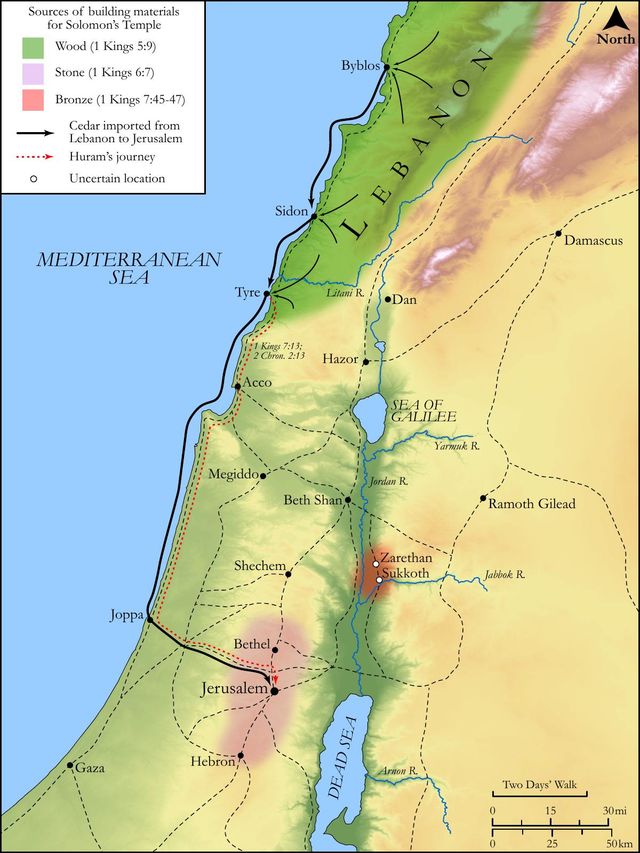
The mobilization of such a massive labor force was a characteristic feature of large-scale building projects throughout the ancient Near East, frequently involving conscripted labor from conquered or vassal peoples. While Israelites were explicitly exempt from forced labor of this nature (1 Kings 9:22), the non-Israelite populations within Solomon's dominion, particularly those inherited from his father David's conquests, were subject to such levies (1 Kings 9:20-21). The "hewers in the mountains" likely worked in the renowned quarries of Lebanon, celebrated for their high-quality stone, especially given Solomon's strategic alliance with King Hiram of Tyre, who also provided skilled craftsmen and timber (1 Kings 5:6-10). This intricate system reflects the immense power, wealth, and sophisticated administrative capabilities of Solomon's kingdom at its zenith, enabling him to orchestrate such a demanding logistical operation.
Key Themes
ShowHideThis verse significantly contributes to several key themes within the book of 1 Kings and the broader Deuteronomistic History. Firstly, it highlights the Monumental Scale of the Temple Project, emphasizing that the construction of God's dwelling was an undertaking of unprecedented magnitude, requiring vast human and material resources. Secondly, it underscores Solomon's Administrative Prowess, showcasing his remarkable ability to organize, provision, and manage an enormous, diverse workforce over many years, a testament to his divinely granted wisdom and the kingdom's prosperity (1 Kings 4:29-34). Finally, and most importantly, this massive effort represents the Fulfillment of Divine Purpose, as the Temple's construction was a pivotal moment in Israelite history, realizing God's promise to establish a permanent place for His name and presence among His people, a task specifically reserved for Solomon after his father David's desire (2 Samuel 7:13).
Exposition and Analysis
ShowHideKey Word Analysis
ShowHideThis archaic English expression from the KJV accurately translates to "seventy thousand" (from H7657, shibʻîym, "seventy," and H505, ʼeleph, "thousand"). The sheer numerical value immediately conveys the immense scale of this segment of the workforce. These individuals were primarily responsible for the arduous task of transporting heavy raw materials, signifying a vast, organized logistical operation critical for the Temple's construction.
The phrase "bare burdens" describes the laborers engaged in physically demanding work. The Hebrew verb nâsâʾ (H5375) means "to lift, to bear, to carry," while çabbâl (H5449) refers to a "porter" or "burden-bearer." Combined, they denote those who carried heavy loads of stone, timber, and other supplies from quarries and forests to the construction site in Jerusalem. Their role, though seemingly unskilled, was foundational and indispensable to the entire project's success.
This term refers to "stonecutters" or "quarrymen." Unlike the burden bearers, these individuals possessed specialized skills in extracting and shaping large stones. Their work was crucial for preparing the precise, massive blocks required for the Temple's foundations and walls, often involving intricate techniques to ensure a perfect fit, as noted by the fact that no iron tools were used on the building site itself (1 Kings 6:7).
Verse Breakdown
ShowHide"And Solomon had threescore and ten thousand that bare burdens"
This initial clause introduces the first major contingent of Solomon's labor force, numbering 70,000 individuals. These were the porters and transporters, tasked with the physically demanding work of moving raw materials. This highlights the vast logistical undertaking and the sheer volume of materials required for the Temple's construction.
"and fourscore thousand hewers in the mountains;"
This second clause details another enormous group, 80,000 skilled laborers. These "hewers" were stonecutters and quarrymen, whose specialized work in the mountains (likely the quarries of Lebanon) involved extracting and shaping the massive stones needed for the Temple. This emphasizes both the precision and craftsmanship involved, as well as the broad geographical scope of the project.
Literary Devices
ShowHideThe verse employs Enumeration and Hyperbole (or at least a representation of immense scale) to impress upon the reader the monumental nature of the Temple project and Solomon's extraordinary organizational capabilities. The precise, round numbers (70,000 and 80,000) serve to quantify the immense human effort involved, creating a sense of awe and grandeur. The clear distinction between "burden bearers" and "hewers" utilizes Categorization to highlight the division of labor and the specialized skills required, even within such a vast workforce. The phrase "in the mountains" provides a vivid, albeit concise, Setting, grounding the arduous labor in its natural, demanding environment.
Theological and Thematic Connections
ShowHideThe immense labor force detailed in 1 Kings 5:15 serves as a powerful testament to the scale of God's purposes and the human effort required to bring them to fruition. The construction of the Temple was not merely a royal building project but the fulfillment of a divine promise and the establishment of a central place for God's presence among His people. This verse, therefore, underscores the theological principle that significant divine undertakings often demand substantial human commitment, organization, and sacrifice. While the conscription of non-Israelite labor might seem harsh by modern standards, it reflects the ancient Near Eastern geopolitical realities and Solomon's divinely granted authority and prosperity, all channeled towards a sacred end. The sheer numbers evoke the idea that when God's will is being accomplished, resources and personnel can be marshaled in extraordinary ways, demonstrating His enabling power and the collective effort involved in His grand designs.
Reflection and Application
ShowHideThe detailed account of Solomon's vast workforce for the Temple's construction offers profound lessons for contemporary believers. Just as every "burden bearer" and "hewer" played an indispensable role in building the physical dwelling for God's name, so too does every member of the body of Christ have a unique and vital function in constructing God's spiritual house, the Church. This verse reminds us that great visions, especially those aligned with God's purposes, demand not only strategic leadership but also the coordinated and dedicated efforts of many individuals, each contributing their distinct gifts and labor. It challenges us to consider our own role within God's ongoing work, recognizing that even seemingly mundane or physically demanding tasks contribute to the larger, divine masterpiece. No contribution is too small or insignificant when it is offered in service to God's kingdom. We are called to participate wholeheartedly, knowing that our collective efforts, guided by divine wisdom, build something far greater than ourselves, a testament to God's enduring presence and power.
Questions for Reflection
ShowHideFAQ
ShowHideWere these laborers Israelites or foreigners?
ShowHideWhile 1 Kings 5:13-14 mentions a levy of 30,000 Israelites who worked in Lebanon on a rotational basis, the much larger numbers in 1 Kings 5:15 are generally understood to refer to non-Israelite populations. This is explicitly confirmed later in 1 Kings 9:20-21, which states that "all the people that were left of the Amorites, Hittites, Perizzites, Hivites, and Jebusites, which were not of the children of Israel... upon those did Solomon levy a tribute of bondservice unto this day." Israelites, by contrast, were not enslaved for such labor (1 Kings 9:22). This distinction highlights the nature of Solomon's kingdom, leveraging the resources and populations within its dominion for major state projects, particularly those inherited from David's conquests.
Christ-Centered Fulfillment
ShowHideThe vast, arduous labor involved in constructing Solomon's Temple, as detailed in 1 Kings 5:15, finds its ultimate Christ-centered fulfillment not in a physical edifice, but in the person and work of Jesus Christ. While the earthly Temple was a dwelling place for God's presence, a place of sacrifice and worship, Jesus declared Himself to be the true Temple, stating, "Destroy this temple, and in three days I will raise it up" (John 2:19). John clarifies that He "spake of the temple of his body" (John 2:21). The immense human effort to build Solomon's Temple, even with its seventy thousand burden bearers and eighty thousand hewers, pales in comparison to the divine labor of Christ, who, through His perfect life, atoning death, and glorious resurrection, built the ultimate dwelling place for God's Spirit—His own body, and by extension, the Church. We, as believers, are now "living stones" being "built up a spiritual house" (1 Peter 2:5), with Christ Himself as the chief cornerstone (Ephesians 2:20). The laborious quarrying and transporting of materials for the Old Testament Temple foreshadow the profound and costly work of grace by which God gathers and shapes His people into a holy temple, a habitation for God through the Spirit (Ephesians 2:22). Thus, the physical Temple, built with human hands and immense effort, points to the spiritual Temple, built by the divine hand of Christ through His ultimate sacrifice and the ongoing work of the Holy Spirit, a dwelling infinitely more glorious and eternal.