


1 Kings 5:10
Bible text: King James Version (1769 Blayney text) · Public domain
Bible text: Berean Standard Bible · Public domain
Bible text: American Standard Version (1901) · Public domain
Bible text: World English Bible, Messianic edition · Public domain
Bible text: Geneva Bible (1599) · Public domain
Bible text: Young's Literal Translation · Public domain
- וַיְהִיvay·Hiand he wasH1961Conj-w ¦ V-Qal-ConsecImperf-3msVerb Qal Consecutive Imperfect 3rd Singular Masculineוַandיְהִיhe was
- חִירוֹםchi·RomHiramH2438N-proper-mNoun Proper Masculine
- נֹתֵןno·TengivingH5414V-Qal-Prtcpl-msVerb Qal Participle Singular Masculine Absolute
- לִשְׁלֹמֹהlish·lo·Mohto SolomonH8010Prep-l ¦ N-proper-mNoun Proper MasculineלִtoשְׁלֹמֹהSolomon
- עֲצֵי'a·Tzeiwood<s> ofH6086N-mpcNoun Plural Masculine Construct
- אֲרָזִים'a·ra·Zimcedar<s>H730N-mpNoun Plural Masculine Absolute
- וַעֲצֵיva·'a·Tzeiand wood<s> ofH6086Conj-w ¦ N-mpcNoun Plural Masculine Constructוַandעֲצֵיwood<s> of
- בְרוֹשִׁיםve·ro·Shimcypress<es>H1265N-mpNoun Plural Masculine Absolute
- כָּלkolallH3605N-mscNoun Singular Masculine Construct
- חֶפְצוֹchef·Tzohis desireH2656N-msc ¦ 3msNoun Singular Masculine Constructחֶפְצdesireוֹhis
English is a literal word-by-word gloss of the Hebrew, not the KJV's wording. Why?
This is the original text the KJV's translators worked from — each Hebrew word with its own literal English meaning in this verse, prepared by scholars at Tyndale House, Cambridge. The KJV translates whole sentences, not word by word, so its wording differs: one Hebrew word can become several English words, and the KJV may choose “the LORD” where the gloss reads “Yahweh”. Both are faithful — they answer different questions. For the KJV's own rendering, switch to the KJV text.
Details
See on the biblical-era maps

Study this verse
Public-domain commentary
Matthew Henry
From his Commentary on the Whole Bible. Henry comments on passages, not single verses — this entry covers 1 Kings 5:10–18. His two-level outline is real structure in the source text, so it is rendered as structure.
Here is, I. The performance of the agreement between Solomon and Hiram. Each of the parties made good his engagement. 1. Hiram delivered Solomon the timber, according to his bargain, Kg1 5:10. The trees were Solomon's, but perhaps - Materiam superabat opus - The workmanship was of more value than the article. Hiram is therefore said to deliver the trees. 2. Solomon conveyed to Hiram the corn which he had promised him, Kg1 5:11. Thus let justice be followed (as the expression is, Deu 16:20), justice on both sides, in every bargain.
II.The confirmation of the friendship that was between them hereby.
God gave Solomon wisdom (Kg1 5:12), which was more and better than any thing Hiram did or could give him; but this made Hiram love him, and enabled Solomon to improve his kindness, so that they were both willing to ripen their mutual love into a mutual league, that it might be lasting. It is wisdom to strengthen our friendship with those whom we find to be honest and fair, lest new friends prove not so firm and so kind as old ones.
III.The labourers whom Solomon employed in preparing materials for the temple.
1.Some were Israelites, who were employed in the more easy and honourable part of the work, felling trees and helping to square them, in conjunction with Hiram's servants; for this he appointed 30,000, but employed only 10,000 at a time, so that for one month's work they had two months' vacation, both for rest and for the despatch of their own affairs at home, Kg1 5:13, Kg1 5:14. It was temple service, yet Solomon takes care that they shall not be over-worked. Great men ought to consider that their servants must rest as well as they.
2.Others were captives of other nations, who were to bear burdens and to hew stone (Kg1 5:15), and we read not that these had their resting times as the other had, for they were doomed to servitude.
3.There were some employed as directors and overseers (Kg1 5:16), 3300 that ruled over the people, and they were as necessary and useful in their place as the labourers in theirs; here were many hands and many eyes employed, for preparation was now to be made, not only for the temple, but for all the rest of Solomon's buildings, at Jerusalem, and here in the forest of Lebanon, and in other places of his dominion, of which see Kg1 9:17-19. He speaks of the vastness of his undertakings (Ecc 2:4, I made me great works), which required this vast number of workmen.
IV.The laying of the foundation of the temple; for that is the building his heart is chiefly upon, and therefore he begins with that, Kg1 5:17, Kg1 5:18. It should seem, Solomon was himself present, and president, at the founding of the temple, and that the first stone (as has been usual in famous buildings) was laid with some solemnity. Solomon commanded and they brought costly stones for the foundation; he would do every thing like himself, generously, and therefore would have some of the costliest stones laid, or buried rather, in the foundation, though, being out of sight, worse might have served. Christ, who is laid for a foundation, is an elect and precious stone (Isa 28:16), and the foundations of the church are said to be laid with sapphires, Isa 54:11, compare Rev 21:19. That sincerity which is our gospel perfection obliges us to lay our foundation firm and to bestow most pains on that part of our religion which lies out of the sight of men.
Historical interpretation
Historical reception
1 surviving comment on this verse from the historical church.
Here we do not need to work around any concealed meaning; indeed, in this event there is a clear analogy with Christ and the actions he undertook for the building of the church. As Solomon ordered timbers to be cut from the mountains of Lebanon and stones to be shipped by sea, and employed them after they had been brought to the builder’s yard of the temple, so Christ, after receiving the Jews and the Gentiles from the timbers of infidelity, transported them to the builder’s yard of the temple which is not made by human hands.
Continue studying 1 Kings 5:10 across the web’s major study libraries — every link below opens this exact verse, chapter, or book on the destination site.
Read & Compare
 BibleGatewayThis verse in more than 200 translations and 70 languages.
 Bible.comThe YouVersion reader — hundreds of translations, reading plans, and highlights.
 ESV.orgCrossway's official English Standard Version reader.
 NET BibleThe NET translation with 60,000+ translators' notes on every rendering decision.
 STEP BibleTyndale House's free study tool — original text, vocabulary, and scholarly resources.
 BibliaLogos Bible Software's free web reader.
 USCCBThe New American Bible (Revised Edition) with the U.S. bishops' study notes.
Commentaries
 BibleHub CommentariesDozens of classic commentaries on this verse, gathered on one page.
 StudyLightMore than 100 commentary sets — the largest collection on the web.
 BibleRefPlain-English commentary on what this verse means, verse by verse.
 Enduring WordDavid Guzik's free commentary on this chapter, widely used by Bible teachers.
 Bible Study ToolsVerse commentary alongside Greek and Hebrew study aids.
Original Language & Research
- BibleHub InterlinearThe verse word by word — original language, transliteration, and English.
- BibleHub LexiconEvery word's original-language definition and Strong's entry.
 Blue Letter BibleDeep-study tools — Strong's numbers, concordance, and word studies.
 SefariaThe Hebrew text with Rashi and centuries of Jewish commentary.
Sermons, Hymns & Audio


TrulyRandomVerse is not affiliated with these sites and doesn’t control their content. They’re linked because they’re genuinely useful.
Summary
This verse concisely states that King Hiram of Tyre generously supplied King Solomon of Israel with an immense quantity of cedar and fir timber, precisely fulfilling "all his desire," for the monumental construction of the Temple in Jerusalem. It highlights the successful diplomatic and economic alliance between the two kingdoms, underscoring both God's abundant provision for His sacred work and the meticulous preparation involved in building a dwelling place for the Lord. The passage signifies a period of peace and prosperity under Solomon's reign, where divine favor enabled the realization of a long-held vision for God's house.
Context
ShowHideLiterary Context
1 Kings 5:10 is situated within the broader narrative of King Solomon's early reign, specifically detailing the meticulous preparations for the construction of the First Temple in Jerusalem. The chapter opens with Hiram, King of Tyre, sending envoys to Solomon upon hearing of his anointing, indicating an established friendly relationship between their kingdoms, which had been fostered during King David's reign. Solomon then leverages this relationship, sending a formal request to Hiram for cedar and fir timber from Lebanon, acknowledging his father David's inability to build the Temple and his own divine mandate to do so, as recounted in 1 Kings 5:3-5. Hiram responds with great enthusiasm, praising the Lord for granting David a wise son in 1 Kings 5:7. Our verse then immediately follows Hiram's commitment to supply the timber in exchange for food provisions, marking the tangible beginning of the Temple's material acquisition phase. This sets the stage for the detailed accounts of the Temple's construction found in 1 Kings 6 and the description of its furnishings and Solomon's palace in 1 Kings 7.
Historical & Cultural Context
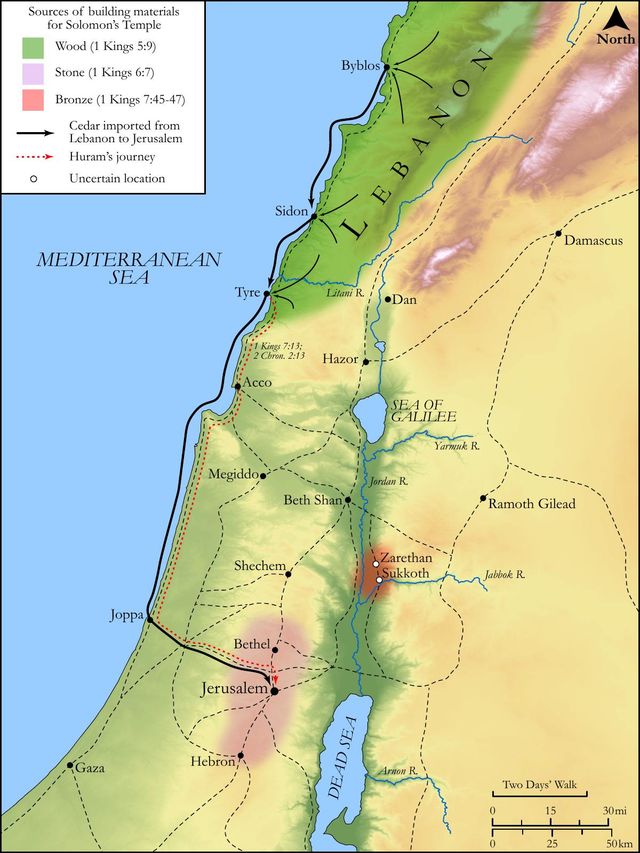
Historically, the Phoenician city-state of Tyre, located to Israel's north along the Mediterranean coast, was renowned for its abundant cedar and fir forests in Lebanon, as well as its highly skilled craftsmen in timber work, masonry, and metalwork. Israel, while a burgeoning regional power under Solomon, lacked these specialized resources and expertise on the scale required for a project as grand as the Temple. The alliance between Solomon and Hiram, therefore, was a strategic and mutually beneficial one, in which the two kings exchanged resources, labor, and gifts to solidify political and economic ties, until "they two made a league together." This partnership allowed Israel to access premium building materials and skilled labor, while Tyre gained a stable trading partner and access to Israel's agricultural produce. The construction of the Temple itself was not merely a religious endeavor but a monumental national project, symbolizing Israel's consolidated power, divine favor, and the establishment of a central place of worship for the Lord, fulfilling a vision initiated by King David.
Key Themes
ShowHideSeveral key themes emerge from 1 Kings 5:10. Firstly, it powerfully illustrates Divine Provision and Abundance. The phrase "according to all his desire" underscores God's faithfulness in equipping Solomon for the immense task of building the Temple, far beyond mere sufficiency, aligning with God's earlier promises of riches and honor to Solomon in 1 Kings 3:13. Secondly, the verse highlights the critical theme of International Cooperation and Strategic Alliances. The partnership between Israel and Tyre was essential for the Temple's construction, demonstrating how God can use relationships with those outside the immediate covenant community to accomplish His purposes. This collaboration was a hallmark of Solomon's peaceful and prosperous reign, as prophesied in 1 Chronicles 22:9-10. Finally, it emphasizes the theme of Diligent Preparation for God's Work. The vast quantities of high-quality timber signify the meticulous planning, substantial resources, and extensive coordination required for a project dedicated to the Lord, setting a precedent for the importance of intentionality and excellence in sacred undertakings.
Exposition and Analysis
ShowHideKey Word Analysis
ShowHideThis term refers to a type of coniferous tree, often identified as cypress or juniper. While perhaps less prestigious than cedar, fir wood was a valuable timber in that day, used for various construction purposes, including flooring, paneling, and musical instruments. Its inclusion alongside cedar indicates a comprehensive provision of necessary timbers for the diverse structural and aesthetic requirements of the Temple, demonstrating the completeness of Hiram's supply.
This refers specifically to the Cedars of Lebanon (Cedrus libani), a highly prized and majestic timber among the nations. Renowned for its durability, resistance to decay, aromatic qualities, and grand appearance, cedar was considered a luxury building material reserved for royal palaces and sacred temples. Its prominent mention here emphasizes the premium quality of materials used for God's dwelling, symbolizing strength, permanence, and divine favor.
This word conveys pleasure, delight, or strong inclination. In this context, the phrase "according to all his desire" signifies that Hiram's provision was not merely adequate but precisely matched or even exceeded Solomon's every wish and requirement for the Temple project. It speaks to the extraordinary generosity of the gift and, more profoundly, to God's abundant provision that perfectly aligns with the needs of His chosen servant for His sacred work, ensuring complete satisfaction of the need.
Verse Breakdown
ShowHide"So Hiram gave Solomon cedar trees and fir trees"
This clause directly states the action and the primary actors, marking the fulfillment of the agreement between the two kings. King Hiram of Tyre, in response to Solomon's request, initiated the delivery of the specified timber from the renowned forests of Lebanon. The explicit mention of "cedar trees and fir trees" highlights the specific, high-quality materials essential for the Temple's construction. This act signifies the tangible commencement of the material acquisition phase for the Temple, marking a pivotal moment in the narrative of its building and underscoring the vital international cooperation involved.
"[according to] all his desire"
This crucial phrase emphasizes the remarkable generosity and completeness of Hiram's provision. It indicates that the quantity and quality of timber supplied by Hiram perfectly matched, or even surpassed, every specification and aspiration Solomon had for the Temple. Beyond a simple transaction, this phrase underscores the divine orchestration behind the provision, reflecting God's abundant grace and faithfulness in equipping Solomon with precisely what was needed to accomplish the monumental task of building His house. It implies not just sufficiency, but overflowing abundance and the full satisfaction of Solomon's needs and vision.
Literary Devices
ShowHideThe verse employs several subtle but significant literary devices. The phrase "according to all his desire" can be interpreted as a form of Hyperbole, emphasizing the extraordinary generosity and completeness of Hiram's provision. While perhaps not literally every single desire, it powerfully conveys that the supply was overwhelmingly abundant and perfectly suited to Solomon's needs, underscoring the divine hand in orchestrating such provision. The specific mention of Symbolism in "cedar trees and fir trees" is also noteworthy. Cedar, in particular, was a symbol of strength, permanence, and majesty in Scripture, often associated with royal and divine structures. Its use here elevates the Temple's significance, associating it with enduring quality and divine favor. Furthermore, the narrative implicitly uses Irony or Contrast by showing a Gentile king, Hiram, acting as a crucial instrument in the building of the Lord's Temple, demonstrating God's sovereign ability to use anyone, even outside the covenant, to achieve His sacred purposes.
Theological and Thematic Connections
ShowHideThis verse serves as a profound theological statement on God's abundant provision for His divinely appointed tasks. When God calls His people to a specific work, He also faithfully provides the necessary resources, wisdom, and even unexpected alliances to accomplish it. Hiram's generosity, described as fulfilling "all his desire," is a tangible manifestation of God's overflowing grace and faithfulness to Solomon, echoing the earlier promises of prosperity and wisdom. It underscores that God's plans are never hindered by lack of resources, for He is sovereign over all creation and can orchestrate circumstances, including the cooperation of foreign nations, to bring about His purposes. This principle extends beyond material provision to spiritual and relational enablement, demonstrating that God is always at work, equipping His servants for His glory and ensuring His will is accomplished.
Reflection and Application
ShowHide1 Kings 5:10 offers profound insights for contemporary believers, encouraging a robust faith in God's boundless provision. Just as Solomon's grand vision for the Temple was met with an abundance "according to all his desire," we are reminded that when God calls us to a task, He faithfully supplies the necessary resources, connections, and wisdom. This verse challenges us to move beyond a scarcity mindset, trusting that God's resources are limitless and His desire to equip His people for His purposes is unwavering. Furthermore, it underscores the value of strategic partnerships and collaboration, even with those who may not share our exact theological convictions, when such alliances serve God's broader redemptive plan. It calls us to diligent preparation, faithful stewardship, and a commitment to excellence in all our endeavors for the Lord, recognizing that our work, like the Temple, is ultimately for His glory and should reflect His magnificent character.
Questions for Reflection
ShowHideFAQ
ShowHideWhy was Hiram so willing to help Solomon build the Temple?
ShowHideHiram's willingness stemmed from a combination of factors. Historically, there was an existing friendly relationship and trade alliance between Tyre and Israel, established during King David's reign, as noted in 2 Samuel 5:11. Hiram also expressed admiration for Solomon's wisdom, recognizing God's favor upon him, which he articulates in 1 Kings 5:7. Economically, the arrangement was mutually beneficial: Tyre provided valuable timber and skilled labor, while Israel supplied essential food provisions (wheat and olive oil), which Tyre needed, as detailed in 1 Kings 5:11. Beyond the practical, Hiram's actions can be seen as divinely orchestrated, as God sovereignly used this alliance to ensure the Temple's construction.
What was the significance of "cedar trees and fir trees" for the Temple?
ShowHideCedar and fir were highly prized building materials of that day, particularly the cedars from Lebanon. Cedar (Hebrew: ʼerez) was known for its exceptional durability, aromatic qualities, resistance to decay, and majestic appearance, making it ideal for the Temple's main structure, paneling, and beams, as described in 1 Kings 6:9-10. Fir (Hebrew: bᵉrôwsh) was also valuable, often used for flooring, doors, and other structural elements, as seen in 1 Kings 6:15. The use of these premium, long-lasting timbers symbolized the importance and permanence of the Temple as God's dwelling place, reflecting the reverence and excellence due to Him. Their acquisition from Tyre also highlighted the extensive resources and international cooperation involved in this monumental sacred project, emphasizing its unparalleled significance.
How does Hiram's provision relate to God's promises to Solomon?
ShowHideHiram's generous provision directly fulfills and exemplifies God's promises to Solomon. God had promised Solomon wisdom, riches, and honor precisely because he did not ask for long life or wealth for himself, as recorded in 1 Kings 3:11-13. The abundance of timber, given "according to all his desire," is a tangible demonstration of this promised prosperity and divine favor. Furthermore, God had promised David that his son would build a house for His name, a covenant established in 2 Samuel 7:13. Hiram's contribution was a crucial element in the fulfillment of that prophecy, showing God's faithfulness in providing all that is necessary for His plans to be realized, even through unexpected means and foreign alliances.
Christ-Centered Fulfillment
ShowHideWhile 1 Kings 5:10 describes the material provision for a physical temple, it profoundly foreshadows the ultimate divine provision for the spiritual Temple, which is the Church, built upon Christ. Just as Hiram generously supplied Solomon's every desire for the first Temple, God the Father provided His Son, Jesus Christ, as the ultimate and perfect "material" for the spiritual house. Jesus is the chief cornerstone upon whom the entire structure rests, and believers are living stones being built into a spiritual dwelling for God. The lavishness of Hiram's gift points to the immeasurable richness of God's grace in Christ, who is given "according to all our desire" for salvation and spiritual life, indeed, far more abundantly than all that we ask or think. The cooperation between Israel and Tyre, a Gentile nation, also subtly prefigures the inclusion of Gentiles into God's spiritual temple, the Church, where there is neither Jew nor Gentile, but all are united in Christ, forming one body, the temple of the Holy Spirit. Thus, the provision of timber for Solomon's Temple ultimately points to God's ultimate provision of Christ for His eternal, spiritual Temple.