


2 Chronicles 11:11
Bible text: King James Version (1769 Blayney text) · Public domain
Bible text: Berean Standard Bible · Public domain
Bible text: American Standard Version (1901) · Public domain
Bible text: World English Bible, Messianic edition · Public domain
Bible text: Geneva Bible (1599) · Public domain
Bible text: Young's Literal Translation · Public domain
- וַיְחַזֵּקvay·cha·Zekand he strengthenedH2388Conj-w ¦ V-Piel-ConsecImperf-3msVerb Piel Consecutive Imperfect 3rd Singular Masculineוַandיְחַזֵּקhe strengthened
- אֶת'et<obj.>H853DirObjMParticle Object Indicator
- הַמְּצֻרוֹתha·me·tzu·Rotthe fortificationsH4694Art ¦ N-fpNoun Plural Feminine Absoluteהַtheמְּצֻרוֹתfortifications
- וַיִּתֵּןvai·yi·Tenand he putH5414Conj-w ¦ V-Qal-ConsecImperf-3msVerb Qal Consecutive Imperfect 3rd Singular Masculineוַandיִּתֵּןhe put
- בָּהֶםba·Hemin themPrep-b ¦ 3mpSuffix Personal 3rd Plural Masculineבָּinהֶםthem
- נְגִידִיםne·gi·DimcommandersH5057N-mpNoun Plural Masculine Absolute
- וְאֹצְרוֹתve·'o·tze·Rotand supplies ofH214Conj-w ¦ N-fpcNoun Plural Feminine Constructוְandאֹצְרוֹתsupplies of
- מַאֲכָלma·'a·KhalfoodH3978N-msNoun Singular Masculine Absolute
- וְשֶׁמֶןve·She·menand oilH8081Conj-w ¦ N-msNoun Singular Masculine Absoluteוְandשֶׁמֶןoil
- וָיָיִןva·Ya·yinand wineH3196Conj-w ¦ N-msNoun Singular Masculine Absoluteוָandיָיִןwine
English is a literal word-by-word gloss of the Hebrew, not the KJV's wording. Why?
This is the original text the KJV's translators worked from — each Hebrew word with its own literal English meaning in this verse, prepared by scholars at Tyndale House, Cambridge. The KJV translates whole sentences, not word by word, so its wording differs: one Hebrew word can become several English words, and the KJV may choose “the LORD” where the gloss reads “Yahweh”. Both are faithful — they answer different questions. For the KJV's own rendering, switch to the KJV text.
Details
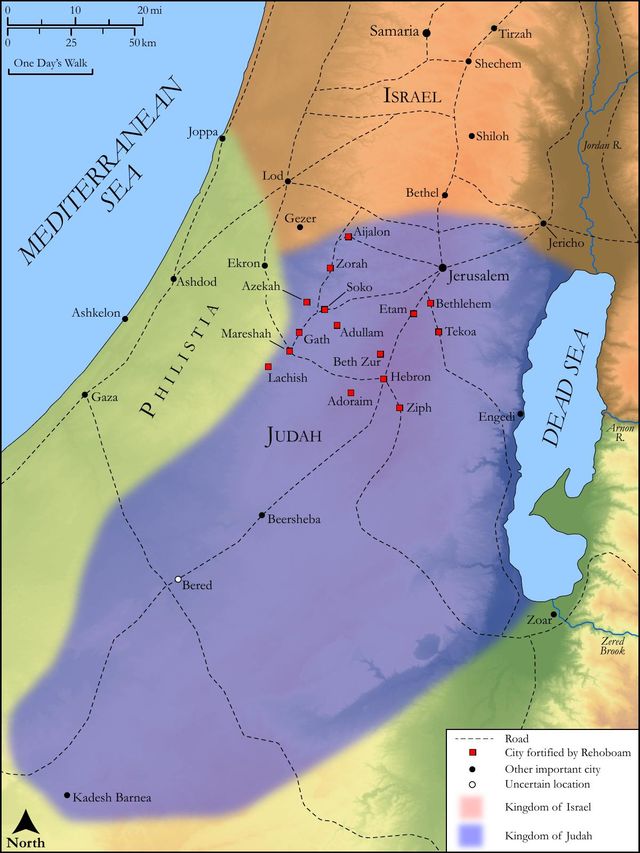
See on the biblical-era map
Study this verse
Public-domain commentary
Matthew Henry
From his Commentary on the Whole Bible. Henry comments on passages, not single verses — this entry covers 2 Chronicles 11:1–12.
How the ten tribes deserted the house of David we read in the foregoing chapter. They had formerly sat loose to that family (Sa2 20:1, Sa2 20:2), and now they quite threw it off, not considering how much it would weaken the common interest and take Israel down from that pitch of glory at which it had arrived in the last reign. But thus the kingdom must be corrected as well as the house of David. 1. Rehoboam at length, like a bold man, raises an army, with a design to reduce the revolters, Ch2 11:1. Judah and Benjamin were not only resolved to continue their allegiance to him, but ready to give him the best assistance they could for the recovery of his right. Judah was his own tribe, that owned him some years before the rest did; Benjamin was the tribe in which Jerusalem, or the greatest part of it, stood, which perhaps was one reason why that tribe clave to him. 2. Yet, like a conscientious man, when God forbade him to prosecute this design, in obedience to him he let it fall, either because he reverenced the divine authority or because he knew that he should not prosper if he should go contrary to God's command, but instead of retrieving what was lost would be in danger of losing what he had. It is dangerous undertaking any thing, but especially undertaking a war, contrary to the will of God. God calls him (Ch2 11:3), Rehoboam the son of Solomon, to intimate that this was determined for the sin of Solomon, and it would be to no purpose to oppose a decree that had gone forth. They obeyed the words of the Lord; and though it looked mean, and would turn to their reproach among their neighbours, yet, because God would have it so, they laid down their arms. 3. Like a discreet man, he fortified his own country. He saw it was to no purpose to think of reducing those that had revolted. A few good words might have prevented their defection, but now all the forces of his kingdom cannot bring them back. The think is done, and so it must rest; it is his wisdom to make the best of it. Perhaps the same young counsellors that had advised him to answer them roughly urged him to fight them, notwithstanding the divine inhibition; but he had paid dearly enough for being advised by them, and therefore now, we may suppose, his aged and experienced counsellors were hearkened to, and they advised him to submit to the will of God concerning what was lost, and to make it his business to keep what he had. It was probably by their advice that, (1.) He fortified his frontiers, and many of the principal cities of his kingdom, which, in Solomon's peaceable reign, no care had been taken for the defence of. (2.) He furnished them with good stores of victuals and arms, Ch2 11:11, Ch2 11:12. Because God forbade him to fight, he did not therefore sit down sullenly, and say that he would do nothing for the public safety if he might not do that, but prudently provided against an attack. Those that may not be conquerors, yet may be builders.
Continue studying 2 Chronicles 11:11 across the web’s major study libraries — every link below opens this exact verse, chapter, or book on the destination site.
Read & Compare
 BibleGatewayThis verse in more than 200 translations and 70 languages.
 Bible.comThe YouVersion reader — hundreds of translations, reading plans, and highlights.
 ESV.orgCrossway's official English Standard Version reader.
 NET BibleThe NET translation with 60,000+ translators' notes on every rendering decision.
 STEP BibleTyndale House's free study tool — original text, vocabulary, and scholarly resources.
 BibliaLogos Bible Software's free web reader.
 USCCBThe New American Bible (Revised Edition) with the U.S. bishops' study notes.
Commentaries
 BibleHub CommentariesDozens of classic commentaries on this verse, gathered on one page.
 StudyLightMore than 100 commentary sets — the largest collection on the web.
 BibleRefPlain-English commentary on what this verse means, verse by verse.
 Enduring WordDavid Guzik's free commentary on this chapter, widely used by Bible teachers.
 Bible Study ToolsVerse commentary alongside Greek and Hebrew study aids.
Original Language & Research
- BibleHub InterlinearThe verse word by word — original language, transliteration, and English.
- BibleHub LexiconEvery word's original-language definition and Strong's entry.
 Blue Letter BibleDeep-study tools — Strong's numbers, concordance, and word studies.
 SefariaThe Hebrew text with Rashi and centuries of Jewish commentary.
Sermons, Hymns & Audio


TrulyRandomVerse is not affiliated with these sites and doesn’t control their content. They’re linked because they’re genuinely useful.
Summary
Following the tumultuous division of the united monarchy, 2 Chronicles 11:11 details King Rehoboam's strategic and practical efforts to consolidate and secure the newly formed southern kingdom of Judah. This verse highlights his prudent foresight in fortifying key cities, appointing capable leaders, and ensuring ample provisions of food and essential goods, thereby establishing a robust defense against potential threats and demonstrating a crucial aspect of responsible governance in a time of political instability.
Context
ShowHideLiterary Context
This verse is situated within a broader passage (2 Chronicles 11:5-12) that meticulously chronicles Rehoboam's defensive measures immediately after the catastrophic schism of the Israelite kingdom. The preceding chapter, 2 Chronicles 10, vividly recounts Rehoboam's disastrous rejection of the elders' counsel and his subsequent harsh response to the people's pleas, which directly led to the rebellion of the ten northern tribes and the establishment of Jeroboam's kingdom. Faced with this new geopolitical reality, Rehoboam, now ruling only over Judah and Benjamin, shifted his focus from an ill-fated attempt to reclaim the northern tribes by force (2 Chronicles 11:1-4) to strengthening his remaining territory. Verse 11 specifically elaborates on the internal organization and provisioning of the strongholds mentioned in 2 Chronicles 11:5, emphasizing that these cities were not merely physical barriers but self-sufficient military and logistical hubs, equipped with both leadership and sustenance.
Historical & Cultural Context
The period immediately following Solomon's death (c. 931 BCE) was marked by profound political fragmentation and insecurity. The division of Israel into two rival kingdoms—Israel in the north and Judah in the south—created an immediate need for defensive strategies. Rehoboam's fortifications were a direct response to the threat posed by Jeroboam's northern kingdom, which could potentially invade Judah. Fortified cities were the backbone of a kingdom's defense in Rehoboam's day, serving as administrative centers, refugee havens, and military strongpoints. The practice of appointing "captains" (military commanders or governors) within these strongholds was standard for maintaining order and readiness. Furthermore, the meticulous provisioning of "victual, and of oil and wine" was critical for enduring sieges, as cities could be cut off from external supplies for extended periods. These provisions were not luxuries but essential staples, reflecting the practical realities of sustaining a population and military force in a time of potential conflict.
Key Themes
ShowHideRehoboam's actions in this verse contribute to several overarching themes within 2 Chronicles. Firstly, it underscores Strategic Preparedness and Prudent Leadership, demonstrating a practical, albeit belated, wisdom in anticipating threats and securing the kingdom's borders. Despite his earlier spiritual and political failures, this passage shows Rehoboam exercising a measure of practical foresight. Secondly, the emphasis on "strong holds" and "captains" highlights the theme of National Security and Protection, reflecting the monarch's fundamental responsibility to safeguard his people and territory, a duty often emphasized in wisdom literature (e.g., Proverbs 21:31). Thirdly, the detailed mention of "store of victual, and of oil and wine" speaks to the critical theme of Resource Management and Stewardship. It illustrates the necessity of diligent planning and comprehensive provisioning to sustain a community, a principle echoed in various biblical narratives concerning famine and abundance (e.g., Genesis 41:33-36). These actions, while purely defensive, represent a necessary effort to stabilize the kingdom after a period of significant upheaval.
Exposition and Analysis
ShowHideKey Word Analysis
ShowHideThis term refers to a "hemming in," a "rampart of protection," or a "fortification." In this context, mᵉtsûwrâh signifies more than mere walled cities; they were strategically chosen military outposts designed to withstand prolonged attacks, serve as logistical centers, and project power. Rehoboam's focus on these "strong holds" indicates a shift from offensive ambition to a defensive posture, aiming to secure his remaining territory.
Denoting a "commander," "chief," "governor," or "ruler." The placement of these high-ranking officials within the fortified cities indicates a structured chain of command and delegated authority. It suggests that Rehoboam not only built physical defenses but also established a human infrastructure of leadership and management, ensuring that these strongholds were effectively governed, garrisoned, and maintained, rather than being mere empty fortresses.
Meaning a "depository," "store-house," or "treasure-house." This term emphasizes the deliberate act of accumulating and safeguarding resources. Coupled with "victual" (H3978, maʼăkâl, meaning "eatable" or "food") and the specific mention of "oil" (H8081, shemen) and "wine" (H3196, yayin), it underscores the meticulous logistical planning and comprehensive provisioning. These were fundamental staples in ancient Israel, essential for sustaining a population and military force through a siege or prolonged isolation.
Verse Breakdown
ShowHide"And he fortified the strong holds"
This clause describes Rehoboam's primary action—the construction or reinforcement of defensive cities. This was a direct, practical response to the political fragmentation of the kingdom, indicating a strategic shift from attempting to reclaim the northern tribes by force to securing his existing territory. The act of fortification signifies a commitment to national defense and the protection of the remaining populace in Judah and Benjamin.
"and put captains in them"
Beyond physical structures, Rehoboam established a human element of defense. The appointment of "captains" (military and administrative leaders) in each stronghold demonstrates a systematic approach to governance and military readiness. This ensured that each fortified city had responsible leadership to manage its defenses, its garrison, and its inhabitants, providing order and command in times of peace and conflict.
"and store of victual, and of oil and wine"
This final clause details the logistical preparations, emphasizing the comprehensive provisioning of the strongholds. "Victual" represents general food supplies, while "oil and wine" specify two critical staples of the ancient diet and economy. This meticulous stocking of provisions was crucial for the long-term sustainability of the garrisons and the civilian populations within the fortified cities, enabling them to withstand sieges or prolonged periods of isolation without external supply.
Literary Devices
ShowHideThe verse employs several literary devices to convey its message of strategic preparation. Merism is evident in the phrase "oil and wine," which, while specific, collectively represents the full range of essential provisions, indicating a complete and thorough stocking of all necessary supplies. The mention of "captains" can be seen as a form of Synecdoche, where the leaders represent the entire military and administrative personnel placed within the strongholds, signifying the establishment of a complete functional infrastructure. The structure of the verse, with its repeated "and" ("and he fortified... and put... and store of..."), creates a sense of Accumulation and Emphasis, highlighting the comprehensive and multi-faceted nature of Rehoboam's defensive efforts. This methodical listing underscores the diligence and thoroughness of his preparations, presenting a picture of a leader systematically addressing the immediate security needs of his kingdom.
Theological and Thematic Connections
ShowHideWhile Rehoboam's reign is often characterized by his spiritual failings and the tragic division of the kingdom, this particular verse offers a glimpse into a moment of practical wisdom and responsible stewardship. The meticulous fortification and provisioning reflect a biblical principle that, while God is sovereign and the ultimate protector, human beings are called to exercise prudence, foresight, and diligence in their responsibilities. It speaks to the importance of good governance, the wise management of resources, and the preparedness necessary to safeguard what has been entrusted. This practical wisdom, even from a flawed leader, reminds us that faith does not negate the need for responsible action and planning. It's a testament to the idea that God often works through human effort and preparation, even when that effort is imperfect.
Reflection and Application
ShowHideRehoboam's actions in 2 Chronicles 11:11, despite his overall flawed reign, provide valuable lessons for contemporary believers and leaders. This verse underscores the importance of diligent preparation and wise stewardship in all areas of life. Just as Rehoboam secured his kingdom against external threats, we are called to be proactive in safeguarding our spiritual, emotional, and physical well-being, as well as the resources God has entrusted to us. This means not only building strong foundations in our faith but also prudently managing our finances, investing in healthy relationships, and preparing for future challenges. For those in leadership, whether in a family, church, or workplace, it highlights the responsibility to anticipate needs, delegate effectively, and ensure that those under our care are well-equipped and sustained. It's a call to combine fervent prayer and reliance on God's sovereignty with practical, disciplined action, recognizing that faith without works is dead.
Questions for Reflection
ShowHideFAQ
ShowHideWhat was the primary motivation for Rehoboam's fortifications?
ShowHideRehoboam's primary motivation for fortifying the strongholds was to establish a robust defensive posture against the newly formed northern kingdom of Israel under Jeroboam. Following the division of the kingdom, Rehoboam initially considered military action to reclaim the northern tribes, but was divinely restrained (2 Chronicles 11:1-4). His focus then shifted to securing and consolidating his remaining territory of Judah and Benjamin, recognizing the ongoing threat of conflict with the north. The fortifications were a strategic measure to protect his borders, key cities, and populace from potential invasion.
How do "oil and wine" represent comprehensive provisions in this context?
ShowHideIn ancient Israel, "oil and wine" were not merely luxuries but fundamental staples of daily life and the economy. Oil (primarily olive oil) was used for cooking, fuel for lamps, anointing, and medicinal purposes. Wine was a common beverage, a source of calories, and used in various social and religious contexts. By specifically mentioning "oil and wine" alongside "victual" (general food supplies), the text employs a form of merism, where two significant parts represent the whole. It signifies that Rehoboam's provisioning was comprehensive and thorough, ensuring that the fortified cities had not just basic food but also essential liquids and other critical supplies necessary for sustaining a population and military garrison during a siege or prolonged period of isolation.
Does this passage commend Rehoboam's overall reign?
ShowHideNo, this passage does not commend Rehoboam's overall reign. The book of Chronicles, while often presenting a more positive view of the Davidic line than Kings, is clear about Rehoboam's initial spiritual and political failures that led to the kingdom's division (2 Chronicles 10). This verse highlights a specific, prudent act of governance—his strategic defensive preparations—which contrasts with his earlier folly. Later in his reign, Rehoboam and Judah would again abandon the Lord, leading to an invasion by Shishak, king of Egypt (2 Chronicles 12:1-9). Thus, 2 Chronicles 11:11 showcases a moment of practical wisdom and responsibility, but it does not serve as an endorsement of his entire kingship.
Christ-Centered Fulfillment
ShowHideWhile Rehoboam's efforts in 2 Chronicles 11:11 represent a human king's attempt to secure an earthly kingdom through physical fortifications and provisions, they ultimately point to the far superior and eternally secure kingdom established by Jesus Christ. Rehoboam's strongholds were vulnerable to attack and his provisions finite, yet Christ builds a kingdom that the "gates of hell shall not prevail against" (Matthew 16:18). He is the ultimate "captain" or leader, not merely appointing others, but Himself being the Good Shepherd who lays down His life for His sheep (John 10:11). Furthermore, Christ is the perfect provider, offering not just temporary "victual, and of oil and wine," but the "bread of life" that satisfies eternal hunger (John 6:35) and the "living water" that quenches spiritual thirst (John 4:14). Through His sacrifice, believers are delivered from the dominion of darkness and transferred into His unshakable kingdom (Colossians 1:13), where their security is not in walls of stone but in the eternal power and faithfulness of their King.