


2 Chronicles 26:13
Bible text: King James Version (1769 Blayney text) · Public domain
Bible text: King James Version with Strong's numbers · Public domain
Bible text: Berean Standard Bible · Public domain
Bible text: American Standard Version (1901) · Public domain
Bible text: World English Bible, Messianic edition · Public domain
Bible text: Geneva Bible (1599) · Public domain
Bible text: Young's Literal Translation · Public domain
- וְעַלve·'aland [was] onH5921Conj-w ¦ PrepPrepositionוְandעַל[was] on
- יָדָםya·Damtheir handH3027N-csc ¦ 3mpNoun Singular common gender Constructיָדָhandםtheir
- חֵילcheilan army ofH2428N-mscNoun Singular Masculine Construct
- צָבָאtza·Va'warH6635N-msNoun Singular Masculine Absolute
- שְׁלֹשׁshe·LoshthreeH7969N-cscNoun Singular common gender Construct
- מֵאוֹתme·'othundred<s>H3967N-fpNoun Plural Feminine Absolute
- אֶלֶף'E·lefthousandH505N-csNoun Singular common gender Absolute
- וְשִׁבְעַתve·shiv·'Atand sevenH7651Conj-w ¦ N-cscNoun Singular common gender Constructוְandשִׁבְעַתseven
- אֲלָפִים'a·la·Fimthousand<s>H505N-cpNoun Plural common gender Absolute
- וַחֲמֵשׁva·cha·Meshand fiveH2568Conj-w ¦ N-cscNoun Singular common gender Constructוַandחֲמֵשׁfive
- מֵאוֹתme·'othundred<s>H3967N-fpNoun Plural Feminine Absolute
- עוֹשֵׂיo·Seidoers ofH6213V-Qal-Prtcpl-mpVerb Qal Participle Plural Masculine Construct
- מִלְחָמָהmil·cha·MahbattleH4421N-fsNoun Singular Feminine Absolute
- בְּכֹחַbe·Kho·achwith power ofH3581Prep-b ¦ N-mscNoun Singular Masculine Constructבְּwithכֹחַpower of
- חָיִלCha·yilstrengthH2428N-msNoun Singular Masculine Absolute
- לַעְזֹרla'·Zorto helpH5826Prep-l ¦ V-Qal-InfVerb Qal Infinitive Constructלַtoעְזֹרhelp
- לַמֶּלֶךְla·Me·lekh<to> the kingH4428Prep-l ¦ N-msNoun Singular Masculine Absoluteלַ<to> theמֶּלֶךְking
- עַל'alonH5921PrepPreposition
- הָאוֹיֵבha·'o·Yevthe enemyH341Art ¦ V-Qal-Prtcpl-msVerb Qal Participle Singular Masculine Absoluteהָtheאוֹיֵבenemy
English is a literal word-by-word gloss of the Hebrew, not the KJV's wording. Why?
This is the original text the KJV's translators worked from — each Hebrew word with its own literal English meaning in this verse, prepared by scholars at Tyndale House, Cambridge. The KJV translates whole sentences, not word by word, so its wording differs: one Hebrew word can become several English words, and the KJV may choose “the LORD” where the gloss reads “Yahweh”. Both are faithful — they answer different questions. For the KJV's own rendering, switch to the KJV text.
Details
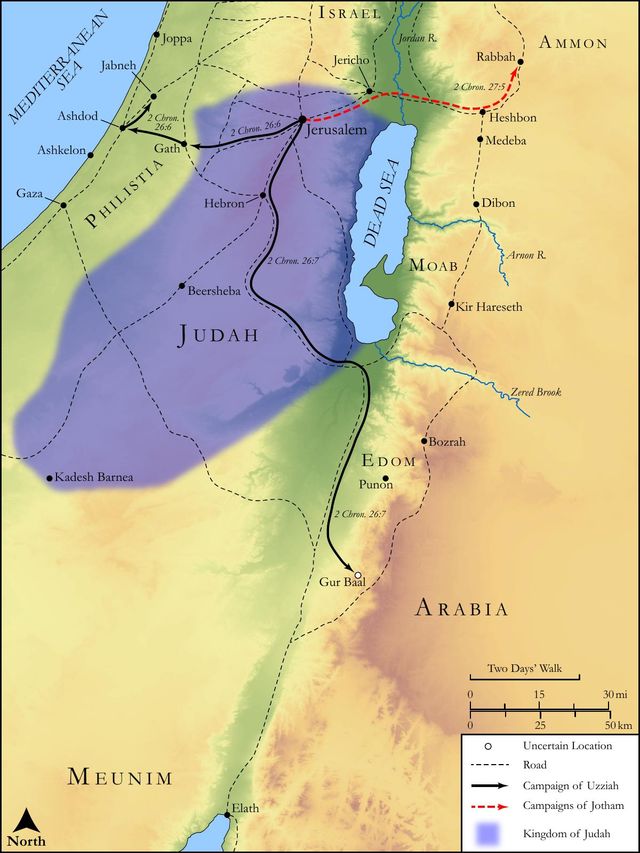
See on the biblical-era map
Study this verse
Public-domain commentary
Matthew Henry
From his Commentary on the Whole Bible. Henry comments on passages, not single verses — this entry covers 2 Chronicles 26:1–15. His three-level outline is real structure in the source text, so it is rendered as structure.
We have here an account of two things concerning Uzziah: -
I.His piety.
In this he was not very eminent or zealous; yet he did that which was right in the sight of the Lord. He kept up the pure worship of the true God as his father did, and was better than his father, inasmuch as we have no reason to think he ever worshipped idols as his father did, no, not in his latter days, when his heart was lifted up. It is said (Ch2 26:5), He sought God in the days of Zechariah, who, some think, was the son of the Zechariah whom his grandfather Joash slew. This Zechariah was one that had understanding in the visions of God, either the visions which he himself was favoured with or the visions of the preceding prophets. He was well versed in prophecy, and conversed much with the upper world, was an intelligent, devout, good man; and, it seems, had great influence with Uzziah. Happy are the great men who have such about them and are willing to be advised by them; but unhappy those who seek God only while they have such with them and have not a principle in themselves to bear them out to the end.
II.His prosperity.
1.In general, as long as he sought the Lord, and minded religion, God made him to prosper. Note,
(1.)Those only prosper whom God makes to prosper; for prosperity is his gift.
(2.)Religion and piety are very friendly to outward prosperity. Many have found and owned this, that as long as they sought the Lord and kept close to their duty they prospered; but since they forsook God every thing has gone cross.
2.Here are several particular instances of his prosperity: - (1.) His success in his wars: God helped him (Ch2 26:7), and then he triumphed over the Philistines (those old enemies of God's people), demolished the fortifications of their cities, and put garrisons of his own among them, Ch2 26:6. He obliged the Ammonites to pay him tribute, Ch2 26:8. He made all quiet about him, and kept them in awe. (2.) The greatness of his fame and reputation. His name was celebrated throughout all the neighbouring countries (Ch2 26:8) and it was a good name, a name for good things with God and good people. This is true fame, and makes a man truly honourable. (3.) His buildings. While he acted offensively abroad, he did not neglect the defence of his kingdom at home, but built towers in Jerusalem and fortified them, Ch2 26:9. Much of the wall of Jerusalem was in his father's time broken down, particularly at the corner gate. But his best fortification of Jerusalem was his close adherence to the worship of God: if his father had not forsaken this the wall of Jerusalem would not have been broken down. While he fortified the city, he did not forget the country, but built towers in the desert too (Ch2 26:10), to protect the country people from the inroads of the plunderers, bands of whom sometimes alarmed them and plundered them, as Ch2 21:16. (4.) His husbandry. He dealt much in cattle and corn, employed many hands, and got much wealth by his dealing; for he took a pleasure in it: he loved husbandry (Ch2 21:10), and probably did himself inspect his affairs in the country, which was no disparagement to him, but an advantage, as it encouraged industry among his subjects. It is an honour to the husbandman's calling that one of the most illustrious princes of the house of David followed it and loved it. He was not one of those that delight in war, nor did he addict himself to sport and pleasure, but delighted in the innocent and quiet employments of the husbandman. (5.) His standing armies. He had, as it should seem, two military establishments. [1.] A host of fighting men that were to make excursions abroad. These went out to war by bands, Ch2 21:11. They fetched in spoil from the neighbouring countries by way of reprisal for the depredations they had so often made upon Judah, [2.] Another army for guards and garrisons, that were ready to defend the country in case it should be invaded, Ch2 21:12, Ch2 21:13. So great were their number and valour that they made war with mighty power; no enemy durst face them, or, at least, could stand before them. Men unarmed can do little in war. Uzziah therefore furnished himself with a great armoury, whence his soldiers were supplied with arms offensive and defensive (Ch2 21:14), spears, bows, and slings, shields, helmets, and habergeons: swords are not mentioned, because it is probable that every man had a sword of his own, which he wore constantly. Engines were invented, in his time, for annoying besiegers with darts and stones shot from the towers and bulwarks, Ch2 21:15. What a pity it is that the wars and fightings which come from men's lusts have made it necessary for cunning men to employ their skill in inventing instruments of death.
Continue studying 2 Chronicles 26:13 across the web’s major study libraries — every link below opens this exact verse, chapter, or book on the destination site.
Read & Compare
 BibleGatewayThis verse in more than 200 translations and 70 languages.
 Bible.comThe YouVersion reader — hundreds of translations, reading plans, and highlights.
 ESV.orgCrossway's official English Standard Version reader.
 NET BibleThe NET translation with 60,000+ translators' notes on every rendering decision.
 STEP BibleTyndale House's free study tool — original text, vocabulary, and scholarly resources.
 BibliaLogos Bible Software's free web reader.
 USCCBThe New American Bible (Revised Edition) with the U.S. bishops' study notes.
Commentaries
 BibleHub CommentariesDozens of classic commentaries on this verse, gathered on one page.
 StudyLightMore than 100 commentary sets — the largest collection on the web.
 BibleRefPlain-English commentary on what this verse means, verse by verse.
 Enduring WordDavid Guzik's free commentary on this chapter, widely used by Bible teachers.
 Bible Study ToolsVerse commentary alongside Greek and Hebrew study aids.
Original Language & Research
- BibleHub InterlinearThe verse word by word — original language, transliteration, and English.
- BibleHub LexiconEvery word's original-language definition and Strong's entry.
 Blue Letter BibleDeep-study tools — Strong's numbers, concordance, and word studies.
 SefariaThe Hebrew text with Rashi and centuries of Jewish commentary.
Sermons, Hymns & Audio


TrulyRandomVerse is not affiliated with these sites and doesn’t control their content. They’re linked because they’re genuinely useful.
Summary
2 Chronicles 26:13 provides a precise and impressive account of the vast military strength commanded by King Uzziah, detailing an army of 307,500 highly organized and capable soldiers operating under the direct supervision of his appointed officers. This meticulous enumeration underscores the immense power and administrative prowess that characterized Judah during Uzziah's reign, enabling the king to effectively defend his kingdom, project influence, and engage his adversaries with formidable strength, all attributed to God's blessing upon his early faithfulness.
Context
ShowHideLiterary Context
This verse is intricately woven into the Chronicler's narrative of King Uzziah's reign (also known as Azariah), a period predominantly marked by prosperity, military expansion, and significant building projects. The Chronicler attributes this success to Uzziah's initial devotion to God, particularly his diligent seeking of God through the prophet Zechariah, as noted in 2 Chronicles 26:5. Immediately preceding this verse, 2 Chronicles 26:11-12 details the meticulous organization of Uzziah's fighting force, mentioning the "number of their host" and the leadership structure under "Hananiah, one of the king's captains," along with "two thousand and six hundred chief of the fathers." Verse 13 then delivers the exact numerical strength of this formidable army, serving as the culmination of the description of Uzziah's divinely blessed and strategically astute military leadership. This detailed enumeration not only highlights the tangible results of his reign but also subtly sets the stage for the dramatic and tragic shift in his fortune later in the chapter due to pride.
Historical & Cultural Context
King Uzziah's reign, spanning approximately 792-740 BC, was one of the most extended and prosperous in the history of the Southern Kingdom of Judah. This era was characterized by relative stability among the nations round about, allowing Judah to consolidate its power. Unlike larger regional empires such as Assyria or Egypt, Judah, a smaller kingdom, often relied on strategic fortifications, alliances, and divine favor for its security. The military might described in this verse, including successful campaigns against traditional adversaries like the Philistines and Arabs (2 Chronicles 26:6-7), enabled Judah to assert its influence, secure vital trade routes, and receive tribute from surrounding peoples, signifying a period of robust national strength and economic flourishing. The practice of meticulously counting and organizing troops was a common and essential aspect of warfare in that day, reflecting a monarch's administrative capabilities and the overall resources and stability of the kingdom.
Key Themes
ShowHideThis verse significantly contributes to several overarching themes within 2 Chronicles and the broader narrative of Uzziah's reign. Firstly, it exemplifies the theme of Divine Blessing and Empowerment. The Chronicler consistently links Uzziah's early successes, including the formidable strength and organization of his army, to his initial faithfulness and his seeking of God (2 Chronicles 26:5). This illustrates the theological principle that God grants resources, protection, and power to those who walk in obedience. Secondly, it highlights Military Preparedness and National Security. Uzziah's reign was defined by extensive strategic fortifications and a highly organized, well-equipped military, demonstrating a profound commitment to safeguarding Judah's sovereignty and deterring foreign aggression. The sheer number and "mighty power" of the army underscore Judah's formidable presence in the region. Finally, while celebrating Uzziah's strength, the verse subtly foreshadows the theme of Pride and Downfall. The Chronicler's audience would be acutely aware of Uzziah's eventual transgression (2 Chronicles 26:16), making this description of immense power a poignant setup for the dangers of human hubris when divine dependence is abandoned.
Exposition and Analysis
ShowHideKey Word Analysis
ShowHideThis primitive word refers to the open hand, indicating power, means, direction, or dominion. In the phrase "under their hand," it signifies direct command, authority, or supervision. It emphasizes that the vast army was meticulously structured and operated under the immediate control and leadership of the chief officers and heads of families previously enumerated, highlighting the disciplined and hierarchical nature of Uzziah's military organization.
This term denotes a force, whether of men, means, or other resources, encompassing concepts like strength, valor, and wealth. Here, it refers to a formidable military force, emphasizing not just numerical strength but also the inherent capability, courage, and overall effectiveness of Uzziah's fighting men. It describes a force that was not merely numerous but also qualitatively strong and able to achieve its objectives.
This word signifies vigor, force, capacity, or might. When combined with chayil in "mighty power," it further underscores the exceptional strength, effectiveness, and formidable nature of Uzziah's army. It points to their inherent ability and robust capacity to engage in war and achieve victory, reflecting the high caliber and prowess of the soldiers.
Verse Breakdown
ShowHide"And under their hand [was] an army, three hundred thousand and seven thousand and five hundred,"
This clause precisely quantifies King Uzziah's military force at 307,500 soldiers. The opening phrase, "under their hand," immediately establishes the direct link between this vast contingent and the command structure and leadership detailed in the preceding verses, indicating that this massive army was not a disorganized mob but meticulously organized and directed by appointed officers. This exact figure underscores the immense scale of Uzziah's military establishment, testifying to Judah's prosperity and his remarkable administrative capacity.
"that made war with mighty power,"
This segment describes the operational effectiveness and qualitative strength of the army. The phrase "made war" indicates their active engagement in military campaigns, while "with mighty power" (literally, "with strength and valor" or "valiant warriors") emphasizes their formidable strength, exceptional skill, and consistent success in battle. It conveys that this army was not merely large but also highly capable, well-trained, courageous, and victorious in its endeavors, reflecting the prowess and valor of Uzziah's fighting men.
"to help the king against the enemy."
This final clause clarifies the explicit purpose and strategic function of this formidable army. Their primary role was to provide military assistance and defense for King Uzziah, enabling him to effectively counter and overcome any adversaries or threats to the kingdom of Judah. This highlights the army's critical strategic importance in securing national borders, projecting royal authority, and ensuring the safety, stability, and prosperity of the realm.
Literary Devices
ShowHideThe Chronicler masterfully employs several literary devices in 2 Chronicles 26:13 to convey the extraordinary nature of Uzziah's army and its significance. Enumeration is prominently featured, providing the exact numerical figure of 307,500 soldiers. This precise statistical detail serves to emphasize the sheer magnitude and scale of Uzziah's military might, making the description concrete, verifiable, and impactful. This detailed counting also contributes to Emphasis, highlighting the extraordinary resources, organizational capabilities, and overall strength of Judah under Uzziah's reign. The phrase "mighty power" (חיל גבורים, chayil gibborim) functions as a form of Hyperbole or strong descriptive language, underscoring the exceptional valor, effectiveness, and formidable nature of the troops beyond mere numerical strength, suggesting they were truly a force to be reckoned with. Furthermore, within the broader narrative of Uzziah's reign, this entire description functions as a poignant Foreshadowing; the immense power and success described here set up the subsequent narrative of Uzziah's pride and fall (2 Chronicles 26:16), subtly suggesting that even great human strength, if not rooted in humility and continued divine dependence, can lead to catastrophic ruin.
Theological and Thematic Connections
ShowHideThe formidable army of King Uzziah, as meticulously detailed in 2 Chronicles 26:13, stands as a tangible testament to God's blessing upon a king who initially sought Him. The Chronicler consistently attributes Uzziah's prosperity and strength, including his remarkable military might, to his faithfulness and seeking of God (2 Chronicles 26:5). This verse powerfully illustrates a profound theological principle: when leaders and nations align themselves with God's will and walk in obedience, He can grant them extraordinary resources, protection, and success. It underscores divine sovereignty over human affairs and the practical, tangible benefits that flow from a right relationship with the Almighty. However, it also subtly introduces the critical theme of the inherent dangers of human pride that can arise from such blessings, a theme tragically realized in Uzziah's later life (2 Chronicles 26:16). The true source of all enduring strength is always God, and human power, no matter how great or impressive, is ultimately contingent upon and dependent on His sustaining hand.
Reflection and Application
ShowHideThe account of Uzziah's mighty army in 2 Chronicles 26:13 offers profound and enduring lessons for contemporary believers. It serves as a powerful reminder that God is the ultimate source of all strength, resources, and success in our lives. Just as He empowered Uzziah with a formidable military to protect his kingdom and fulfill his purposes, God equips each of us with unique gifts, talents, opportunities, and resources for the spiritual, relational, and professional "battles" we face. Our effectiveness and fruitfulness in any endeavor are not solely dependent on our natural abilities or human ingenuity but fundamentally on our willingness to seek God, rely on His empowering presence, and steward what He has given us. This verse challenges us to soberly consider how we are stewarding the "armies"—the strengths, opportunities, influence, and material blessings—God has placed "under our hand." Are we using them for His glory, for the defense of truth, for the advancement of His kingdom, and for the good of others? Or are we, like Uzziah eventually did, allowing success and perceived strength to breed self-reliance, arrogance, and a forgetfulness of the true source of our power? The call is to cultivate deep humility, acknowledge God's sovereign hand in all our successes, and continually seek His guidance, ensuring that our "might" remains consecrated to His divine purposes, preventing the very pride that led to Uzziah's downfall.
Questions for Reflection
ShowHideFAQ
ShowHideWhat was the significance of such a large army for King Uzziah?
ShowHideThe army of 307,500 soldiers was profoundly significant for several reasons during Uzziah's reign. Firstly, it demonstrated Uzziah's remarkable administrative and organizational skills, as managing such a large and complex force required extensive logistics, training, and a sophisticated command structure. Secondly, it unequivocally signaled Judah's formidable national strength and security during his reign. This immense military might allowed Uzziah to successfully defend his borders, conquer surrounding territories like the Philistines and Arabs (2 Chronicles 26:6-7), and even receive tribute from the Ammonites (2 Chronicles 26:8). Among the kings of that day, military power was directly correlated with a kingdom's influence, stability, and economic prosperity, making Uzziah's army a key indicator of Judah's flourishing state and serving as a powerful deterrent to potential enemies, ensuring a period of relative peace and prosperity for the nation.
How does this verse relate to Uzziah's overall reign and character?
ShowHideThis verse is crucial for understanding the zenith of Uzziah's power and the initial, divinely blessed phase of his reign, which the Chronicler portrays as a direct consequence of the king's faithfulness. The massive army and its "mighty power" are presented as a tangible result of Uzziah "seeking God in the days of Zechariah" (2 Chronicles 26:5). However, the Chronicler's narrative is not solely celebratory. This detailed description of Uzziah's immense strength and success also serves as a poignant and ironic contrast to his later downfall. After achieving such great power and widespread success, Uzziah's heart became "lifted up to his destruction" (2 Chronicles 26:16), leading him to presumptuously enter the temple to burn incense, a sacred duty reserved exclusively for the priests. Thus, while 2 Chronicles 26:13 highlights the glorious outcome of his early obedience and divine favor, it simultaneously sets the stage for the tragic consequences of pride that would ultimately mar his otherwise illustrious reign.
Christ-Centered Fulfillment
ShowHideWhile 2 Chronicles 26:13 vividly describes the impressive physical military might of an earthly king, it profoundly foreshadows a far greater and more enduring spiritual reality found in Jesus Christ. Uzziah's army, vast and powerful, was assembled "to help the king against the enemy," securing a temporal kingdom. In the New Testament, Jesus Christ is revealed as the ultimate King of Kings and Lord of Lords, and His "army" is not one of flesh and blood, but a spiritual host empowered by the Holy Spirit. Just as Uzziah's strength and success came from God's blessing, the true power of the believer and the Church comes from Christ, who has already decisively disarmed the spiritual forces of evil and triumphed over them on the cross (Colossians 2:15). We are called to be strong in the Lord and in the power of His might (Ephesians 6:10), donning the full armor of God not to fight human adversaries, but spiritual ones (Ephesians 6:11-17). The victories that Uzziah's army achieved were temporal and limited; the victory Christ secured on the cross is eternal, absolute, and comprehensive, overcoming sin, death, and the devil himself. He leads a triumphant procession, not of earthly soldiers, but of redeemed saints who, through Him, are more than conquerors (Romans 8:37). Thus, Uzziah's impressive military might, a testament to God's blessing and the dangers of pride, ultimately points us to the infinitely superior, eternally victorious, and spiritually empowering reign of King Jesus, who truly helps His people against their ultimate enemy, securing a lasting peace and an unshakable kingdom that will never end.