


2 Chronicles 26:14
Bible text: King James Version (1769 Blayney text) · Public domain
Bible text: Berean Standard Bible · Public domain
Bible text: American Standard Version (1901) · Public domain
Bible text: World English Bible, Messianic edition · Public domain
Bible text: Geneva Bible (1599) · Public domain
Bible text: Young's Literal Translation · Public domain
- וַיָּכֶןvai·ya·Khenand he preparedH3559Conj-w ¦ V-Hiphil-ConsecImperf-3msVerb Hiphil Consecutive Imperfect 3rd Singular Masculineוַandיָּכֶןhe prepared
- לָהֶםla·Hemfor themPrep-l ¦ 3mpSuffix Personal 3rd Plural Masculineלָforהֶםthem
- עֻזִּיָּהוּ'u·zi·Ya·huUzziahH5818N-proper-mNoun Proper Masculine
- לְכָלle·kholfor allH3605Prep-l ¦ N-mscNoun Singular Masculine Constructלְforכָלall
- הַצָּבָאha·tza·Va'the armyH6635Art ¦ N-msNoun Singular Masculine Absoluteהַtheצָּבָאarmy
- מָגִנִּיםma·gi·NimshieldsH4043N-mpNoun Plural Masculine Absolute
- וּרְמָחִיםu·re·ma·Chimand spearsH7420Conj-w ¦ N-mpNoun Plural Masculine Absoluteוּandרְמָחִיםspears
- וְכוֹבָעִיםve·Khoa·'Imand helmetsH3553Conj-w ¦ N-mpNoun Plural Masculine Absoluteוְandכוֹבָעִיםhelmets
- וְשִׁרְיֹנוֹתve·shir·yo·Notand body armor<s>H8302Conj-w ¦ N-fpNoun Plural Feminine Absoluteוְandשִׁרְיֹנוֹתbody armor<s>
- וּקְשָׁתוֹתu·ke·sha·Totand bowsH7198Conj-w ¦ N-fpNoun Plural Feminine Absoluteוּandקְשָׁתוֹתbows
- וּלְאַבְנֵיu·le·'av·Neiand <to> stones ofH68Conj-w ¦ Prep-l ¦ N-fpcNoun Plural Feminine Constructוּandלְ<to>אַבְנֵיstones of
- קְלָעִיםke·la·'ImslingsH7050N-mpNoun Plural Masculine Absolute
English is a literal word-by-word gloss of the Hebrew, not the KJV's wording. Why?
This is the original text the KJV's translators worked from — each Hebrew word with its own literal English meaning in this verse, prepared by scholars at Tyndale House, Cambridge. The KJV translates whole sentences, not word by word, so its wording differs: one Hebrew word can become several English words, and the KJV may choose “the LORD” where the gloss reads “Yahweh”. Both are faithful — they answer different questions. For the KJV's own rendering, switch to the KJV text.
Details
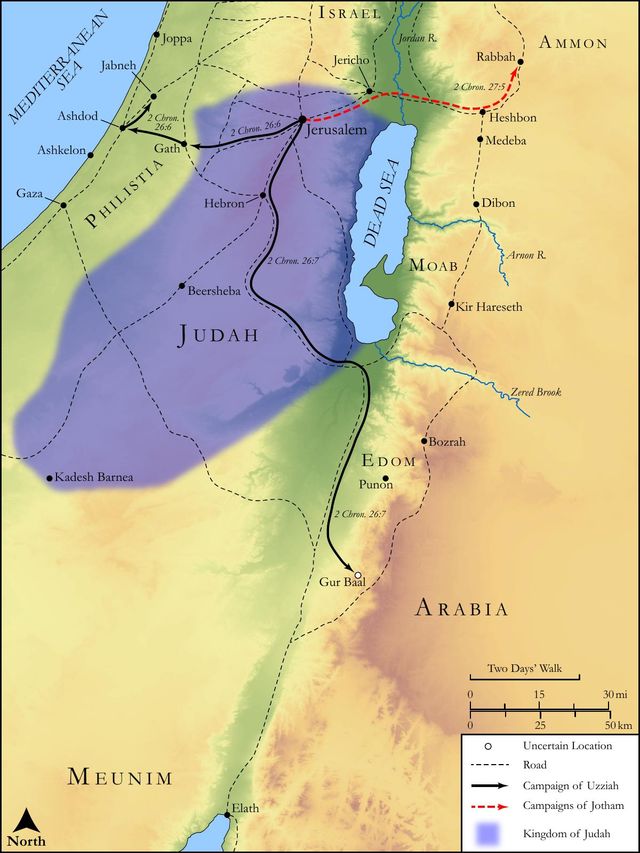
See on the biblical-era map
Study this verse
Public-domain commentary
Matthew Henry
From his Commentary on the Whole Bible. Henry comments on passages, not single verses — this entry covers 2 Chronicles 26:1–15. His three-level outline is real structure in the source text, so it is rendered as structure.
We have here an account of two things concerning Uzziah: -
I.His piety.
In this he was not very eminent or zealous; yet he did that which was right in the sight of the Lord. He kept up the pure worship of the true God as his father did, and was better than his father, inasmuch as we have no reason to think he ever worshipped idols as his father did, no, not in his latter days, when his heart was lifted up. It is said (Ch2 26:5), He sought God in the days of Zechariah, who, some think, was the son of the Zechariah whom his grandfather Joash slew. This Zechariah was one that had understanding in the visions of God, either the visions which he himself was favoured with or the visions of the preceding prophets. He was well versed in prophecy, and conversed much with the upper world, was an intelligent, devout, good man; and, it seems, had great influence with Uzziah. Happy are the great men who have such about them and are willing to be advised by them; but unhappy those who seek God only while they have such with them and have not a principle in themselves to bear them out to the end.
II.His prosperity.
1.In general, as long as he sought the Lord, and minded religion, God made him to prosper. Note,
(1.)Those only prosper whom God makes to prosper; for prosperity is his gift.
(2.)Religion and piety are very friendly to outward prosperity. Many have found and owned this, that as long as they sought the Lord and kept close to their duty they prospered; but since they forsook God every thing has gone cross.
2.Here are several particular instances of his prosperity: - (1.) His success in his wars: God helped him (Ch2 26:7), and then he triumphed over the Philistines (those old enemies of God's people), demolished the fortifications of their cities, and put garrisons of his own among them, Ch2 26:6. He obliged the Ammonites to pay him tribute, Ch2 26:8. He made all quiet about him, and kept them in awe. (2.) The greatness of his fame and reputation. His name was celebrated throughout all the neighbouring countries (Ch2 26:8) and it was a good name, a name for good things with God and good people. This is true fame, and makes a man truly honourable. (3.) His buildings. While he acted offensively abroad, he did not neglect the defence of his kingdom at home, but built towers in Jerusalem and fortified them, Ch2 26:9. Much of the wall of Jerusalem was in his father's time broken down, particularly at the corner gate. But his best fortification of Jerusalem was his close adherence to the worship of God: if his father had not forsaken this the wall of Jerusalem would not have been broken down. While he fortified the city, he did not forget the country, but built towers in the desert too (Ch2 26:10), to protect the country people from the inroads of the plunderers, bands of whom sometimes alarmed them and plundered them, as Ch2 21:16. (4.) His husbandry. He dealt much in cattle and corn, employed many hands, and got much wealth by his dealing; for he took a pleasure in it: he loved husbandry (Ch2 21:10), and probably did himself inspect his affairs in the country, which was no disparagement to him, but an advantage, as it encouraged industry among his subjects. It is an honour to the husbandman's calling that one of the most illustrious princes of the house of David followed it and loved it. He was not one of those that delight in war, nor did he addict himself to sport and pleasure, but delighted in the innocent and quiet employments of the husbandman. (5.) His standing armies. He had, as it should seem, two military establishments. [1.] A host of fighting men that were to make excursions abroad. These went out to war by bands, Ch2 21:11. They fetched in spoil from the neighbouring countries by way of reprisal for the depredations they had so often made upon Judah, [2.] Another army for guards and garrisons, that were ready to defend the country in case it should be invaded, Ch2 21:12, Ch2 21:13. So great were their number and valour that they made war with mighty power; no enemy durst face them, or, at least, could stand before them. Men unarmed can do little in war. Uzziah therefore furnished himself with a great armoury, whence his soldiers were supplied with arms offensive and defensive (Ch2 21:14), spears, bows, and slings, shields, helmets, and habergeons: swords are not mentioned, because it is probable that every man had a sword of his own, which he wore constantly. Engines were invented, in his time, for annoying besiegers with darts and stones shot from the towers and bulwarks, Ch2 21:15. What a pity it is that the wars and fightings which come from men's lusts have made it necessary for cunning men to employ their skill in inventing instruments of death.
Continue studying 2 Chronicles 26:14 across the web’s major study libraries — every link below opens this exact verse, chapter, or book on the destination site.
Read & Compare
 BibleGatewayThis verse in more than 200 translations and 70 languages.
 Bible.comThe YouVersion reader — hundreds of translations, reading plans, and highlights.
 ESV.orgCrossway's official English Standard Version reader.
 NET BibleThe NET translation with 60,000+ translators' notes on every rendering decision.
 STEP BibleTyndale House's free study tool — original text, vocabulary, and scholarly resources.
 BibliaLogos Bible Software's free web reader.
 USCCBThe New American Bible (Revised Edition) with the U.S. bishops' study notes.
Commentaries
 BibleHub CommentariesDozens of classic commentaries on this verse, gathered on one page.
 StudyLightMore than 100 commentary sets — the largest collection on the web.
 BibleRefPlain-English commentary on what this verse means, verse by verse.
 Enduring WordDavid Guzik's free commentary on this chapter, widely used by Bible teachers.
 Bible Study ToolsVerse commentary alongside Greek and Hebrew study aids.
Original Language & Research
- BibleHub InterlinearThe verse word by word — original language, transliteration, and English.
- BibleHub LexiconEvery word's original-language definition and Strong's entry.
 Blue Letter BibleDeep-study tools — Strong's numbers, concordance, and word studies.
 SefariaThe Hebrew text with Rashi and centuries of Jewish commentary.
Sermons, Hymns & Audio


TrulyRandomVerse is not affiliated with these sites and doesn’t control their content. They’re linked because they’re genuinely useful.
Summary
Second Chronicles 26:14 provides a vivid and detailed account of King Uzziah's comprehensive efforts to bolster the military strength of Judah, meticulously listing the specific armaments he supplied to his entire army. This verse highlights Uzziah's strategic foresight and unwavering commitment to national defense, detailing the essential equipment—shields, spears, helmets, coats of mail, bows, and slings for casting stones—that ensured his forces were exceptionally well-prepared for both offensive and defensive engagements, thereby contributing significantly to the prosperity and formidable power that characterized his early reign.
Context
ShowHideLiterary Context
This verse is intricately woven into the broader narrative of King Uzziah's extensive and impactful reign, as meticulously chronicled in 2 Chronicles 26. The preceding verses establish Uzziah's early devotion to God, emphasizing that his seeking the Lord resulted in divine blessing and remarkable prosperity, as seen in 2 Chronicles 26:5. Verse 14 specifically follows a description of his significant military triumphs against the Philistines, Arabians, and Meunites, alongside the tribute he successfully exacted from the Ammonites (2 Chronicles 26:6-8). The detailed enumeration of weaponry here serves as a foundational element, immediately preceding and setting the stage for the Chronicler's account of Uzziah's innovative military engineering, including the invention of sophisticated war machines (2 Chronicles 26:15). This formidable military strength, however, ultimately stands in stark contrast to his later descent into pride and subsequent divine judgment, manifest in his unlawful intrusion into the temple to burn incense (2 Chronicles 26:16-21).
Historical & Cultural Context
King Uzziah's impressive 52-year reign over Judah (circa 792-740 BC) occurred during a period characterized by significant geopolitical flux and persistent threats from formidable neighboring kingdoms. The 8th century BC witnessed the ominous rise of the Assyrian Empire, creating an pervasive atmosphere of instability that necessitated robust national defense strategies. As a relatively smaller kingdom, Judah was compelled to maintain a high state of military preparedness to safeguard its borders and protect its populace. The specific types of armaments enumerated in the verse—shields, spears, helmets, coats of mail (habergeons), bows, and slings—represent the standard military equipment employed by the armies of that day, reflecting the prevalent modes of warfare that encompassed both intense close-quarters combat and effective long-range projectile attacks. Uzziah's provision of these items "throughout all the host" vividly illustrates a highly organized and centrally managed military infrastructure, indicative of a powerful monarch who profoundly understood the critical importance of logistics, supply chains, and constant readiness in an era of frequent and unpredictable conflict.
Key Themes
ShowHideThis verse profoundly contributes to several pivotal themes within 2 Chronicles 26 and the broader Deuteronomistic history. One preeminent theme is Military Preparedness and Strength, which is vividly showcased by Uzziah's unwavering dedication to equipping his army with a comprehensive array of defensive and offensive gear, spanning from personal armor to long-range projectile weapons. This meticulous provisioning underscores his strategic foresight and substantial investment in national security. Another significant theme is Strategic Leadership and Innovation, as Uzziah's actions here transcend mere combat; they involve systematic provisioning and, as described subsequently, technological advancement in military engineering (2 Chronicles 26:15). This demonstrates his exceptional capacity to effectively manage large-scale military operations. Crucially, the overarching theme that permeates Uzziah's early reign is Divine Blessing and Prosperity as a Result of Seeking God. While the verse explicitly details Uzziah's human efforts, the Chronicler consistently attributes Uzziah's remarkable success and his ability to amass such extensive resources and maintain a formidable army to the Lord's direct help and enduring blessing, contingent upon Uzziah's faithfulness (2 Chronicles 26:5 and 2 Chronicles 26:15).
Exposition and Analysis
ShowHideKey Word Analysis
ShowHideVerse Breakdown
ShowHide"And Uzziah prepared for them"
This opening clause immediately establishes King Uzziah as the central and active agent behind the extensive military buildup. The verb "prepared" (כּוּן, kûwn) denotes a deliberate, intentional, and thorough process, underscoring Uzziah's foresight and dedication to national defense. It highlights his role as a proactive, strategic, and responsible leader.
"throughout all the host"
This crucial phrase emphasizes the comprehensive and widespread nature of Uzziah's arming efforts. It was not a partial or limited provision for an elite guard, but extended to every part of his army, ensuring that all soldiers, across various units and ranks, were properly and uniformly equipped. This speaks volumes about the scale and meticulous organization of his military administration.
"shields, and spears, and helmets, and habergeons, and bows, and slings [to cast] stones"
This detailed enumeration provides a clear and exhaustive inventory of the armaments Uzziah supplied. The list covers a full spectrum of military gear, demonstrating a balanced approach to both defense and offense, and close-quarters and long-range combat:
Shields
Essential primary defensive equipment for personal protection against various attacks.
Spears
Common offensive weapons used for thrusting in close combat or for throwing as projectiles.
Helmets
Crucial head protection, safeguarding against blows in battle.
Habergeons (coats of mail)
Advanced body armor providing significant protection for the torso, indicating a higher level of investment in soldier safety.
Bows
Long-range projectile weapons, enabling engagement with the enemy from a distance and providing offensive versatility.
Slings [to cast] stones
Another effective long-range projectile weapon, often utilized by light infantry or skirmishers, demonstrating the continued relevance of traditional, yet potent, weaponry. The inclusion of both bows and slings shows a diverse and adaptable approach to ranged combat.
Literary Devices
ShowHideThe primary literary device prominently featured in 2 Chronicles 26:14 is Enumeration (also known as a catalog or list). The verse provides a precise, itemized list of the various military armaments Uzziah supplied: "shields, and spears, and helmets, and habergeons, and bows, and slings [to cast] stones." This meticulous listing serves to underscore and emphasize the thoroughness and comprehensiveness of Uzziah's preparations. It moves beyond a vague assertion of military strength to offer a concrete and tangible demonstration of his diligence and foresight. The cumulative effect of this detailed inventory impresses upon the reader the sheer scale and meticulousness of his efforts to equip "all the host." Furthermore, the specific types of weapons mentioned, ranging from close-quarters defense (shields, helmets, habergeons) to offensive melee (spears) and long-range projectile capabilities (bows, slings), creates a subtle sense of Merism, indicating the full spectrum of military readiness from every conceivable angle of engagement. This comprehensive inventory also subtly functions as a form of Foreshadowing for the innovative military engineering described in the very next verse (2 Chronicles 26:15), as it firmly establishes the foundation of a well-equipped and strategically prepared army upon which further technological advancements could be effectively built.
Theological and Thematic Connections
ShowHideKing Uzziah's diligent preparation of his army, as meticulously detailed in 2 Chronicles 26:14, vividly illustrates a profound theological principle: while God is undeniably sovereign and ultimately grants success, human diligence, strategic planning, and responsible stewardship are not only permissible but essential. Uzziah's remarkable prosperity and military strength were explicitly linked to his seeking the Lord, yet divine blessing did not negate the need for practical, human effort. This verse powerfully demonstrates that divine favor often empowers, enables, and works through human action, rather than replacing it entirely. It highlights the critical importance of being "prepared" (כּוּן, kûwn) in all aspects of life, recognizing that God works most effectively through our diligent efforts when they are aligned with His divine will. This principle extends far beyond mere military readiness to encompass spiritual preparedness, calling believers to be thoroughly equipped for the manifold challenges of faith and life in a fallen world.
Reflection and Application
ShowHideThe detailed account of Uzziah's meticulous military preparations in 2 Chronicles 26:14 offers a powerful and enduring metaphor for spiritual preparedness and diligent stewardship in the life of a believer. Just as King Uzziah meticulously equipped his army for physical battles against earthly foes, Christians are called to be thoroughly prepared and equipped for the relentless spiritual warfare that defines their existence. This involves actively and intentionally engaging with the divine resources God graciously provides: His infallible Word, fervent prayer, supportive community, and the indwelling power of the Holy Spirit. We are not called to be passive recipients of God's grace but rather active participants in our faith journey, diligently "putting on the full armor of God" as exhorted by the Apostle Paul. Furthermore, Uzziah's story serves as a poignant reminder that even divinely blessed success requires ongoing humility and absolute dependence on God; earthly strength, if not continually rooted in a vibrant and humble relationship with the Lord, can tragically lead to debilitating pride and ultimate downfall. Therefore, our diligence in preparation should always be coupled with a profound and humble reliance on God's ultimate power and sovereignty, recognizing that true and lasting victory comes solely from Him.
Questions for Reflection
ShowHideFAQ
ShowHideWhat was a "habergeon" and why is its inclusion significant?
ShowHideA "habergeon" (Hebrew: שִׁרְיֹנֹת, shiryôwn) refers to a coat of mail or a breastplate, a crucial piece of defensive armor specifically designed to protect the torso. Its inclusion in the detailed list of armaments is highly significant because it indicates a higher, more comprehensive level of personal protection for Uzziah's soldiers, extending beyond basic shields and helmets. It strongly suggests that Uzziah was investing in advanced and effective body armor for his entire army, demonstrating his profound commitment to the safety, resilience, and overall combat effectiveness of his troops, thereby highlighting the sophisticated nature of his military provisioning.
Why does the Chronicler provide such a detailed list of weapons in this verse?
ShowHideThe Chronicler's detailed enumeration of "shields, and spears, and helmets, and habergeons, and bows, and slings [to cast] stones" serves a crucial purpose: to emphasize the thoroughness, comprehensiveness, and strategic depth of King Uzziah's military preparations. It highlights his exceptional leadership and diligence in equipping "all the host," not merely an elite few. This meticulous detail underscores the impressive scale of Uzziah's success and the formidable strength of Judah's army under his reign, effectively setting the stage for the innovative war machines mentioned in the very next verse (2 Chronicles 26:15). It visually reinforces the powerful idea that Uzziah left no stone unturned in ensuring his kingdom's robust defense.
How does Uzziah's military success, as described here, relate to his spiritual life?
ShowHideThe Chronicler explicitly and consistently links Uzziah's early military success and overall prosperity to his spiritual devotion and faithfulness. 2 Chronicles 26:5 unequivocally states that "as long as he sought the LORD, God made him to prosper." This verse, describing his meticulous military preparations, is a tangible and direct manifestation of that divine blessing and enablement. God's favor empowered Uzziah to gather vast resources and implement highly effective strategies. However, the narrative also serves as a profound cautionary tale: Uzziah's later pride, which tragically led him to usurp the sacred priestly role (2 Chronicles 26:16), powerfully demonstrates that even divinely blessed earthly strength and success must be continually submitted to God's will and must never become a source of self-reliance or dangerous arrogance.
Christ-Centered Fulfillment
ShowHideWhile 2 Chronicles 26:14 vividly describes King Uzziah's earthly preparations for military defense against tangible foes, it subtly yet profoundly points to a far greater and eternal reality perfectly fulfilled in Jesus Christ. Uzziah, as a human king, diligently equipped his army with physical armor and weaponry for temporal battles. Yet, the New Testament majestically reveals Jesus Christ as the ultimate, eternal King who perfectly prepares and equips His people for an eternal spiritual warfare, not with carnal weapons but with divine power, truth, and grace. Just as Uzziah's meticulous efforts provided comprehensive protection for his soldiers, Christ provides His followers with the "full armor of God" (Ephesians 6:10-18), enabling them to stand firm, unwavering, and victorious against all spiritual adversaries. He is the one who has already triumphed decisively over all "principalities and powers" (Colossians 2:15), disarming them completely through the unparalleled victory of His cross. Furthermore, Christ Himself is the ultimate "prepared" one, the spotless Lamb of God "prepared before the foundation of the world" (1 Peter 1:19-20), whose perfect and singular sacrifice utterly defeats the power of sin, death, and the devil (Hebrews 2:14-15). Thus, Uzziah's earthly provision, though significant, serves as a powerful foreshadowing of Christ's perfect, complete, and eternally sufficient spiritual provision for His church, guaranteeing ultimate victory through Him alone.