


Deuteronomy 3:23
Bible text: King James Version (1769 Blayney text) · Public domain
Bible text: Berean Standard Bible · Public domain
Bible text: American Standard Version (1901) · Public domain
Bible text: World English Bible, Messianic edition · Public domain
Bible text: Geneva Bible (1599) · Public domain
Bible text: Young's Literal Translation · Public domain
- וָאֶתְחַנַּןva·'et·cha·Nanand I sought favorH2603Conj-w ¦ V-Hithpael-ConsecImperf-1csVerb Hithpael Consecutive Imperfect 1st Singular common genderוָandאֶתְחַנַּןI sought favor
- אֶל'eltoH413PrepPreposition
- יְהוָהYah·wehYahwehH3068N-properNoun Proper Title
- בָּעֵתba·'Etat the timeH6256Prep-b ¦ N-csNoun Singular common gender Absoluteבָּat theעֵתtime
- הַהִואha·Hiv'<the> thatH1931Art ¦ Pro-3fsPronoun Personal 3rd Singular Feminineהַ<the>הִואthat
- לֵאמֹרle·Mor<to> sayingH559Prep-l ¦ V-Qal-InfVerb Qal Infinitive Constructלֵ<to>אמֹרsaying
English is a literal word-by-word gloss of the Hebrew, not the KJV's wording. Why?
This is the original text the KJV's translators worked from — each Hebrew word with its own literal English meaning in this verse, prepared by scholars at Tyndale House, Cambridge. The KJV translates whole sentences, not word by word, so its wording differs: one Hebrew word can become several English words, and the KJV may choose “the LORD” where the gloss reads “Yahweh”. Both are faithful — they answer different questions. For the KJV's own rendering, switch to the KJV text.
Details
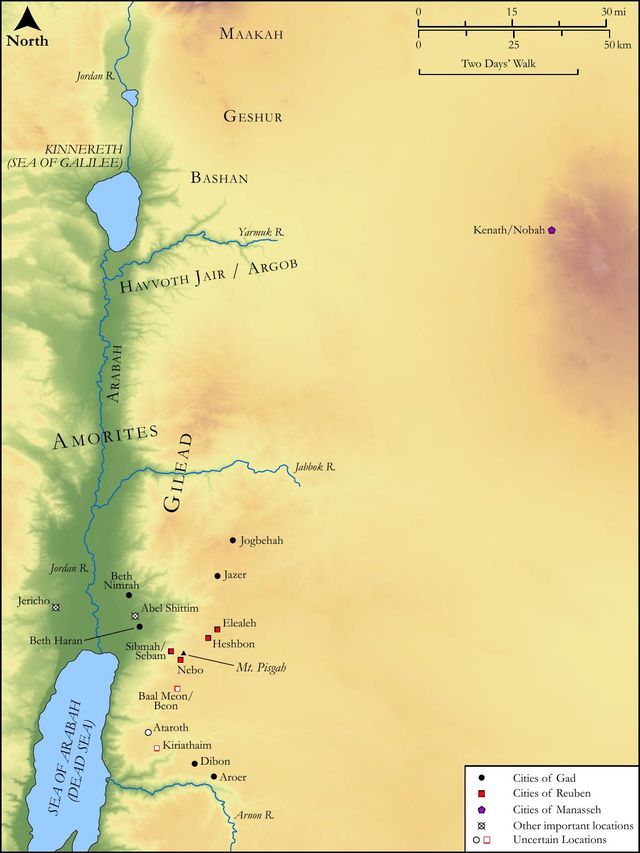
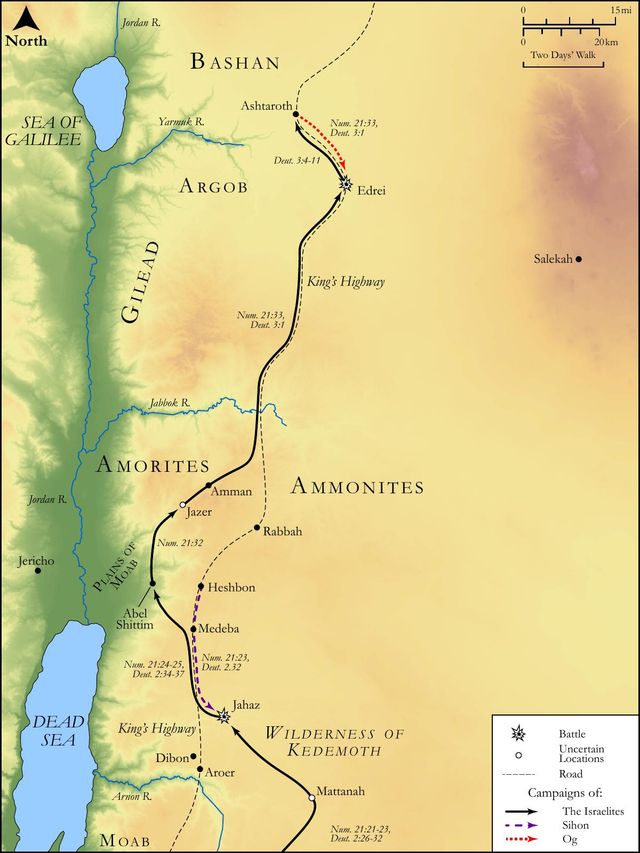
See on the biblical-era maps
Study this verse
Public-domain commentary
Matthew Henry
From his Commentary on the Whole Bible. Henry comments on passages, not single verses — this entry covers Deuteronomy 3:21–29. His four-level outline is real structure in the source text, so it is rendered as structure.
Here is I. The encouragement which Moses gave to Joshua, who was to succeed him in the government, Deu 3:21, Deu 3:22. He commanded him not to fear. This those that are aged and experienced in the service of God should do all they can to strengthen the hands of those that are young, and setting out in religion. Two things he would have him consider for his encouragement: - 1. What God has done. Joshua had seen what a total defeat God had given by the forces of Israel to these two kings, and thence he might easily infer, so shall the Lord do to all the rest of the kingdoms upon which we are to make war. He must not only infer thence that thus the Lord can do with them all, for his arm is not shortened, but thus he will do, for his purpose is not changed; he that has begun will finish; as for God, his work is perfect. Joshua had seen it with his own eyes. And the more we have seen of the instances of divine wisdom, power, and goodness, the more inexcusable we are if we fear what flesh can do unto us. 2. What God had promised. The Lord your God he shall fight for you; and that cause cannot but be victorious which the Lord of hosts fights for. If God be for us, who can be against us so as to prevail? We reproach our leader if we follow him trembling.
II.The prayer which Moses made for himself, and the answer which God gave to that prayer.
1.His prayer was that, if it were God's will, he might go before Israel over Jordan into Canaan. At that time, when he had been encouraging Joshua to fight Israel's battles, taking it for granted that he must be their leader, he was touched with an earnest desire to go over himself, which expresses itself not in any passionate and impatient complaints, or reflections upon the sentence he was under, but in humble prayers to God for a gracious reversing of it. I besought the Lord. Note, We should never allow any desires in our hearts which we cannot in faith offer up to God by prayer; and what desires are innocent, let them be presented to God. We have not because we ask not. Observe,
(1.)What he pleads here. Two things: - [1.] The great experience which he had had of God's goodness to him in what he had done for Israel: "Thou hast begun to show thy servant thy greatness. Lord, perfect what thou hast begun. Thou hast given me to see thy glory in the conquest of these two kings, and the sight has affected me with wonder and thankfulness. O let me see more of the outgoings of my God, my King! This great work, no doubt, will be carried on and completed; let me have the satisfaction of seeing it." Note, the more we see of God's glory in his works the more we shall desire to see. The works of the Lord are great, and therefore are sought out more and more of all those that have pleasure therein. [2.] The good impressions that had been made upon his heart by what he had seen: For what God is there in heaven or earth that can do according to thy works? The more we are affected with what we have seen of God, of his wisdom, power, and goodness, the better we are prepared for further discoveries. Those shall see the works of God that admire him in them. Moses had thus expressed himself concerning God and his works long before (Exo 15:11), and he still continues of the same mind, that there are no works worthy to be compared with God's works, Psa 86:8.
(2.)What he begs: I pray thee let me go over, Deu 3:25. God had said he should not go over; yet he prays that he might, not knowing but that the threatening was conditional, for it was not ratified with an oath, as that concerning the people was, that they should not enter. Thus Hezekiah prayed for his own life, and David for the life of his child, after both had ben expressly threatened; and the former prevailed, though the latter did not. Moses remembered the time when he had by prayer prevailed with God to recede from the declarations which he had made of his wrath against Israel, Exo 32:14. And why might he not hope in like manner to prevail for himself? Let me go over and see the good land. Not, "Let me go over and be a prince and a ruler there;" he seeks not his own honour, is content to resign the government to Joshua; but, "Let me go to be a spectator of thy kindness to Israel, to see what I believe concerning the goodness of the land of promise." How pathetically does he speak of Canaan, that good land, that goodly mountain! Note, Those may hope to obtain and enjoy God's favours that know how to value them. What he means by that goodly mountain we may learn from Psa 78:54, where it is said of God's Israel that he brought them to the border of his sanctuary, even to this mountain which his right hand had purchased, where it is plainly to be understood of the whole land of Canaan, yet with an eye to the sanctuary, the glory of it.
2.God's answer to this prayer had in it a mixture of mercy and judgment, that he might sing unto God of both.
(1.)There was judgment in the denial of his request, and that in something of anger too: The Lord was wroth with me for your sakes, Deu 3:26. God not only sees sin in his people, but is much displeased with it; and even those that are delivered from the wrath to come may yet lie under the tokens of God's wrath in this world, and may be denied some particular favour which their hearts are much set upon. God is a gracious, tender, loving Father; but he is angry with his children when they do amiss, and denies them many a thing that they desire and are ready to cry for. But how was he wroth with Moses for the sake of Israel? Either,
[1.]For that sin which they provoked him to; see Psa 106:32, Psa 106:33. Or,
[2.]The removal of Moses at that time, when he could so ill be spared, was a rebuke to all Israel, and a punishment of their sin. Or,
[3.]It was for their sakes, that it might be a warning to them to take heed of offending God by passionate and unbelieving speeches at any time, after the similitude of his transgression; for, if this were done to such a green tree, what should be done to the dry? He acknowledges that God would not hear him. God had often heard him for Israel, yet he would not hear him for himself. It was the prerogative of Christ, the great Intercessor, to be heard always; yet of him his enemies said, He saved others, himself he could not save, which the Jews would not have upbraided him with had they considered that Moses, their great prophet, prevailed for others, but for himself he could not prevail. Though Moses, being one of the wrestling seed of Jacob, did not seek in vain, yet he had not the thing itself which he sought for. God may accept our prayers, and yet not grant us the very thing we pray for.
(2.)Here is mercy mixed with this wrath in several things: - [1.] God quieted the spirit of Moses under the decree that had gone forth by that word (Deu 3:26), Let it suffice thee. With this word, no doubt, a divine power went to reconcile Moses to the will of God, and to bring him to acquiesce in it. If God does not by his providence give us what we desire, yet, if by his grace he makes us content without it, it comes much to one. "Let it suffice thee to have God for they father, and heaven for thy portion, though thou hast not every thing thou wouldest have in this world. Be satisfied with this, God is all-sufficient." [2.] He put an honour upon his prayer in directing him not to insist upon this request: Speak no more to me of this matter. It intimates that what God does not think fit to grant we should not think fit to ask, and that God takes such a pleasure in the prayer of the upright that it is no pleasure to him, no, not in any particular instance, to give a denial to it. [3.] He promised him a sight of Canaan from the top of Pisgah, Deu 3:27. Though he should not have the possession of it, he should have the prospect of it; not to tantalize him, but such a sight of it as would yield him true satisfaction, and would enable him to form a very clear and pleasing idea of that promised land. Probably Moses had not only his sight preserved for other purposes, but greatly enlarged for this purpose; for, if he had not had such a sight of it as others could not have from the same place, it would have been no particular favour to Moses, nor the matter of a promise. Even great believers, in this present state, see heaven but at a distance. [4.] He provided him a successor, one who should support the honour of Moses and carry on and complete that glorious work which the heart of Moses was so much upon, the bringing of Israel to Canaan, and settling them there (Deu 3:28): Charge Joshua and encourage him in this work. Those to whom God gives a charge, he will be sure to give encouragement to. And it is a comfort to the church's friends (when they are dying and going off) to see God's work likely to be carried on by other hands, when they are silent in the dust.
Continue studying Deuteronomy 3:23 across the web’s major study libraries — every link below opens this exact verse, chapter, or book on the destination site.
Read & Compare
 BibleGatewayThis verse in more than 200 translations and 70 languages.
 Bible.comThe YouVersion reader — hundreds of translations, reading plans, and highlights.
 ESV.orgCrossway's official English Standard Version reader.
 NET BibleThe NET translation with 60,000+ translators' notes on every rendering decision.
 STEP BibleTyndale House's free study tool — original text, vocabulary, and scholarly resources.
 BibliaLogos Bible Software's free web reader.
 USCCBThe New American Bible (Revised Edition) with the U.S. bishops' study notes.
Commentaries
 BibleHub CommentariesDozens of classic commentaries on this verse, gathered on one page.
 StudyLightMore than 100 commentary sets — the largest collection on the web.
 BibleRefPlain-English commentary on what this verse means, verse by verse.
 Enduring WordDavid Guzik's free commentary on this chapter, widely used by Bible teachers.
 Bible Study ToolsVerse commentary alongside Greek and Hebrew study aids.
Original Language & Research
- BibleHub InterlinearThe verse word by word — original language, transliteration, and English.
- BibleHub LexiconEvery word's original-language definition and Strong's entry.
 Blue Letter BibleDeep-study tools — Strong's numbers, concordance, and word studies.
 SefariaThe Hebrew text with Rashi and centuries of Jewish commentary.
Sermons, Hymns & Audio


TrulyRandomVerse is not affiliated with these sites and doesn’t control their content. They’re linked because they’re genuinely useful.
Summary
Deuteronomy 3:23 serves as the poignant opening to Moses' personal and earnest appeal to the LORD, expressing his deep desire to enter the Promised Land. This brief yet powerful statement encapsulates a moment of profound vulnerability and fervent supplication from Israel's venerable leader, setting the stage for a divine response that underscores God's unwavering sovereignty and the consequences of disobedience, even for His most faithful servants.
Context
ShowHideLiterary Context
This verse is situated within Moses' second discourse in the book of Deuteronomy, specifically as he recounts the recent history of Israel's journey from the wilderness to the plains of Moab. Having just described the victories over Sihon and Og and the allocation of their lands to the Reubenites, Gadites, and half-tribe of Manasseh (Deuteronomy 3:1-22), Moses shifts from a historical narrative of God's power and Israel's conquest to a deeply personal intercession. He is preparing the people for their entry into Canaan, knowing he will not accompany them. This personal plea, followed by God's firm refusal and the subsequent instruction to commission Joshua (Deuteronomy 3:24-29), highlights the transition of leadership and the finality of God's decree regarding Moses' fate. The verse acts as a bridge, transforming the narrative from a recounting of past events to a direct, emotional interaction between Moses and God concerning his future.
Historical & Cultural Context
The Israelites are encamped on the plains of Moab, east of the Jordan River, with the Promised Land visible across the valley. Forty years of wilderness wandering are concluding, and a new generation is poised to inherit the land promised to their ancestors. Moses, now 120 years old, has led the people through immense challenges and triumphs. Among the peoples of that day, a leader's authority was often tied to their ability to successfully bring their people to their destiny. Moses' inability to enter Canaan, stemming from his act of striking the rock at Meribah (Numbers 20:1-13), was a significant theological and historical marker. This act of disobedience, though seemingly minor in human eyes, represented a failure to sanctify God before the people, undermining His authority. Moses' plea in Deuteronomy 3:23 reflects the profound cultural and personal significance of the Promised Land as the culmination of God's covenant promises and the ultimate destination for the nation.
Key Themes
ShowHideDeuteronomy 3:23 introduces several profound theological and narrative themes. Firstly, it powerfully illustrates the theme of earnest prayer and supplication, showcasing Moses' deep personal longing and his direct, intense appeal to God. This highlights the biblical principle that believers are to bring their deepest desires and petitions before the Lord, even when the outcome is uncertain (compare Philippians 4:6). Secondly, the verse subtly introduces the tension between divine sovereignty and human desire. Moses' fervent request comes face-to-face with God's established and unchangeable will, demonstrating that God's plans are ultimate and often transcend human understanding or heartfelt wishes. This tension is further developed in God's subsequent firm denial in Deuteronomy 3:26. Finally, though not explicitly stated, the underlying theme of consequences for disobedience is powerfully present. Moses' prior sin at Meribah is the unspoken reason for his exclusion, serving as a solemn reminder that even great leaders face accountability for their actions and that God's righteous governance includes consequences, even when painful (see Numbers 20:12).
Exposition and Analysis
ShowHideKey Word Analysis
ShowHideThe King James Version's translation "besought" accurately captures the intensity of the Hebrew verb חָנַן (ḥānan), which conveys a deep sense of imploring, seeking grace, favor, or mercy. It is not merely a casual request but an earnest, humble, and often desperate appeal for a change of disposition or a special dispensation. This term is frequently used in contexts where one is seeking unmerited favor from a superior. In Moses' mouth, it indicates a profound and heartfelt plea, reflecting his intimate relationship with the LORD and his hope that God might relent from His earlier decree. It underscores the sincerity and emotional weight of Moses' prayer, revealing a man who, despite his unique relationship with God, still approaches Him with humility and a recognition of God's ultimate authority.
This is the sacred covenant name of God, often transliterated as Yahweh, signifying "the self-Existent One" or "the Eternal." Its use here emphasizes the intimate, personal, and covenantal relationship Moses had with God. Moses is not appealing to a generic deity, but to the specific God who had revealed Himself to Israel, made promises to their ancestors, and faithfully led them through the wilderness. This name underscores God's unchanging nature and His sovereign authority, making Moses' humble plea for a change in decree all the more poignant.
While seemingly a simple verb, ʼâmar carries a broad semantic range, encompassing not just casual speech but also declarations, commands, promises, and earnest communication. In this context, it introduces Moses' direct and impassioned address to the LORD, signaling that what follows is not a mere thought but a vocalized, deliberate, and deeply felt petition. Its presence here sets the stage for the specific content of Moses' prayer, highlighting its intentionality and the weight of the words spoken.
Verse Breakdown
ShowHide"And I besought the LORD"
This opening phrase immediately establishes the personal nature of the prayer. The "I" refers to Moses, shifting the narrative from the collective experience of Israel to his individual, deeply felt desire. The verb "besought" (חָנַן, ḥānan) signifies an earnest, intense, and humble plea for favor or mercy, indicating that Moses was not making a casual request but was truly imploring God. Addressing "the LORD" (Yahweh, the covenant name of God) highlights the personal and covenantal relationship Moses had with God, implying a boldness in approaching Him, yet with reverence.
"at that time"
This temporal phrase anchors the prayer to a specific period in the narrative, immediately following the victories over Sihon and Og and the allocation of land east of the Jordan. It signifies the critical juncture when the Israelites were on the cusp of entering the Promised Land, making Moses' exclusion particularly poignant and urgent. It emphasizes that this was not an abstract or general prayer, but one born out of the immediate circumstances and the impending fulfillment of God's promise to Israel.
"saying,"
This simple word introduces the direct speech that follows in the subsequent verses (Deuteronomy 3:24-25). It signals that the reader is about to hear the very words of Moses' passionate appeal, inviting empathy and understanding for his profound longing. It sets the stage for the content of his prayer, which expresses both his acknowledgment of God's power and his personal desire.
Literary Devices
ShowHideDeuteronomy 3:23, though brief, employs several significant literary devices. The most prominent is Apostrophe, where Moses directly addresses the LORD, creating an intimate and immediate sense of communication with the divine. This personal address elevates the passage from a mere historical recounting to a deeply spiritual and emotional encounter. Furthermore, the verse initiates a powerful instance of Personal Narrative or Recounting, as Moses shares his own private struggle and prayer with the new generation of Israelites. This personal touch makes the historical account more relatable and impactful, demonstrating the human side of even the greatest biblical figures. There is also an element of Pathos, as the reader is drawn into Moses' earnest desire and the impending disappointment, evoking sympathy for his situation. Finally, the verse serves as a subtle Foreshadowing of the divine refusal that follows, building anticipation for God's response to such a fervent plea.
Theological and Thematic Connections
ShowHideDeuteronomy 3:23 powerfully illustrates the complex interplay between divine sovereignty, human agency, and the nature of prayer. Moses, the greatest prophet and mediator of the Old Covenant, demonstrates profound humility and earnestness in bringing his deepest desire before God. Yet, his plea is met with a firm "no," revealing that God's decrees are unchangeable, even in the face of sincere supplication from His most beloved servants. This highlights God's absolute authority and righteousness, where even the consequences of sin, however painful, are upheld. It underscores that while God invites and desires our prayers, His ultimate will and purposes remain supreme, often transcending our immediate understanding or desires. This moment serves as a profound theological lesson on submission to divine providence, even when it involves personal disappointment or the acceptance of unfulfilled earthly longings.
Reflection and Application
ShowHideMoses' earnest plea in Deuteronomy 3:23 offers a profound mirror for our own lives of faith. It reminds us that even the most devoted servants of God experience deep personal longings and disappointments. Moses, who had communed with God face-to-face, still wrestled with unfulfilled desires. His example encourages us to bring our deepest petitions before the LORD with sincerity and persistence, holding nothing back. Yet, it also calls us to cultivate a spirit of ultimate submission, recognizing that God's wisdom and sovereign plan are always superior to our own. This passage challenges us to trust God's "no" as much as His "yes," understanding that His purposes, even when they involve personal sacrifice or unfulfilled dreams, are always for a greater good and His ultimate glory. It invites us to find peace not in the fulfillment of our desires, but in the unwavering faithfulness and perfect will of God.
Questions for Reflection
ShowHideFAQ
ShowHideWhy was Moses not allowed to enter the Promised Land, despite his earnest prayer?
ShowHideMoses was forbidden from entering the Promised Land due to an act of disobedience at Meribah, recorded in Numbers 20:1-13. God had commanded Moses to speak to the rock to bring forth water for the thirsty Israelites. Instead, in a moment of frustration and anger, Moses struck the rock twice with his staff, saying, "Hear now, you rebels: shall we bring water for you out of this rock?" (Numbers 20:10). God declared that because Moses did not "believe in me, to uphold me as holy in the eyes of the people of Israel," he would not bring the assembly into the land (Numbers 20:12). Moses' sin was not merely striking the rock, but doing so in anger, taking credit for the miracle, and failing to properly sanctify God's name before the people, thereby misrepresenting God's holiness and power. Despite his fervent plea in Deuteronomy 3:23-25, God's decree was firm, demonstrating that even great leaders are held accountable for their actions and that God's justice is unwavering.
Christ-Centered Fulfillment
ShowHideMoses' earnest plea to enter the Promised Land, and God's subsequent refusal, finds profound Christ-centered fulfillment in the New Testament. Moses, the great mediator of the Old Covenant, could lead Israel to the very border of the promised inheritance but could not bring them in, symbolizing the Law's inability to bring ultimate rest or salvation. His personal longing to enter the land foreshadows humanity's deepest yearning for true rest and communion with God, a rest that the Law could not provide. It is Jesus Christ, the greater Moses, prophesied in Deuteronomy 18:15-18, who perfectly fulfills this role. Unlike Moses, who was barred due to a failure to sanctify God, Jesus perfectly glorified the Father in all His actions, even to the point of death on the cross (John 17:4). He is the one who truly leads His people into the ultimate "Promised Land"—not a physical territory, but the spiritual rest and eternal inheritance in God's presence (Hebrews 4:1-11). Where Moses' intercession for himself was denied, Christ's intercession for His people is always heard and effective (Hebrews 7:25). Through His perfect obedience and atoning sacrifice, Jesus has opened the way for all who believe to enter into God's presence and experience the true and lasting rest that Moses could only glimpse from afar (Matthew 11:28-30).