


Judges 3:18
Bible text: King James Version (1769 Blayney text) · Public domain
Bible text: Berean Standard Bible · Public domain
Bible text: American Standard Version (1901) · Public domain
Bible text: World English Bible, Messianic edition · Public domain
Bible text: Geneva Bible (1599) · Public domain
Bible text: Young's Literal Translation · Public domain
- וַיְהִיvay·Hiand it wasH1961Conj-w ¦ V-Qal-ConsecImperf-3msVerb Qal Consecutive Imperfect 3rd Singular Masculineוַandיְהִיit was
- כַּאֲשֶׁרka·'a·Sherjust whenH834Prep-k ¦ RelParticle Relativeכַּjustאֲשֶׁרwhen
- כִּלָּהki·Lahhe had finishedH3615V-Piel-Perf-3msVerb Piel Perfect 3rd Singular Masculine
- לְהַקְרִיבle·hak·Rivto bring nearH7126Prep-l ¦ V-Hiphil-InfVerb Hiphil Infinitive Constructלְtoהַקְרִיבbring near
- אֶת'et<obj.>H853DirObjMParticle Object Indicator
- הַמִּנְחָהha·min·Chahthe tributeH4503Art ¦ N-fsNoun Singular Feminine Absoluteהַtheמִּנְחָהtribute
- וַיְשַׁלַּחvay·sha·Lachand he sent awayH7971Conj-w ¦ V-Piel-ConsecImperf-3msVerb Piel Consecutive Imperfect 3rd Singular Masculineוַandיְשַׁלַּחhe sent away
- אֶת'et<obj.>H853DirObjMParticle Object Indicator
- הָעָםha·'Amthe peopleH5971Art ¦ N-msNoun Singular Masculine Absoluteהָtheעָםpeople
- נֹשְׂאֵיno·se·'Ei[who] boreH5375V-Qal-Prtcpl-mpVerb Qal Participle Plural Masculine Construct
- הַמִּנְחָהha·min·Chah<of> the tributeH4503Art ¦ N-fsNoun Singular Feminine Absoluteהַ<of> theמִּנְחָהtribute
English is a literal word-by-word gloss of the Hebrew, not the KJV's wording. Why?
This is the original text the KJV's translators worked from — each Hebrew word with its own literal English meaning in this verse, prepared by scholars at Tyndale House, Cambridge. The KJV translates whole sentences, not word by word, so its wording differs: one Hebrew word can become several English words, and the KJV may choose “the LORD” where the gloss reads “Yahweh”. Both are faithful — they answer different questions. For the KJV's own rendering, switch to the KJV text.
Details
See on the biblical-era maps
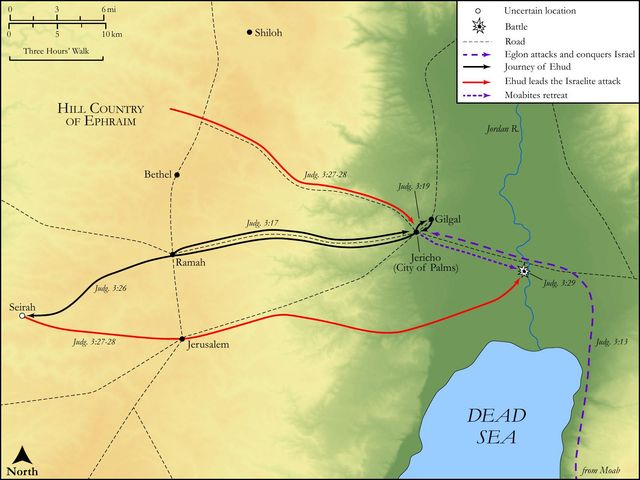
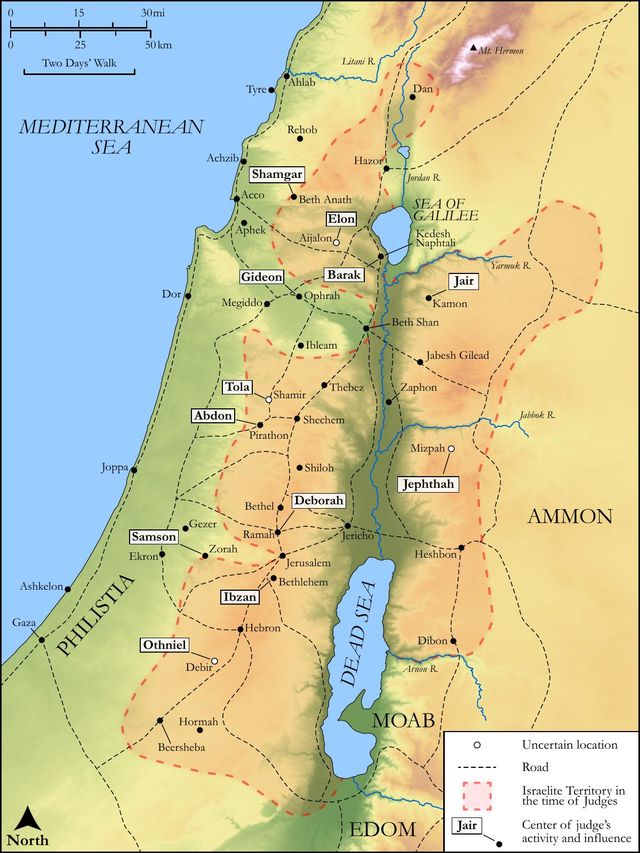
Study this verse
Public-domain commentary
Matthew Henry
From his Commentary on the Whole Bible. Henry comments on passages, not single verses — this entry covers Judges 3:12–30. His four-level outline is real structure in the source text, so it is rendered as structure.
Ehud is the next of the judges whose achievements are related in this history, and here is an account of his actions.
I.When Israel sins again God raises up a new oppressor, Jdg 3:12-14.
It was an aggravation of their wickedness that they did evil again after they had smarted so long for their former iniquities, promised so fair when Othniel judged them, and received so much mercy from God in their deliverance. What, and after all this, again to break his commandments! Was the disease obstinate to all the methods of cure, both corrosives and lenitives? It seems it was. Perhaps they thought they might make the more bold with their old sins because they saw themselves in no danger from their old oppressor; the powers of that kingdom were weakened and brought low. But God made them know that he had variety of rods wherewith to chastise them: He strengthened Eglon king of Moab against them. This oppressor lay nearer to them than the former, and therefore would be the more mischievous to them; God's judgments thus approached them gradually, to bring them to repentance. When Israel dwelt in tents, but kept their integrity, Balak king of Moab, who would have strengthened himself against them, was baffled; but now that they had forsaken God, and worshipped the gods of the nations round about them (and perhaps those of the Moabites among the rest), here was another king of Moab, whom God strengthened against them, put power into his hands, though a wicked man, that he might be a scourge to Israel. The staff in his hand with which he beat Israel was God's indignation; howbeit he meant not so, neither did his heart think so, Isa 10:6, Isa 10:7. Israelites did ill, and, we may suppose, Moabites did worse; yet because God commonly punishes the sins of his own people in this world, that, the flesh being destroyed, the spirit may be saved, Israel is weakened and Moab strengthened against them. God would not suffer the Israelites, when they were the stronger, to distress the Moabites, nor give them any disturbance, though they were idolaters (Deu 2:9); yet now he suffered the Moabites to distress Israel, and strengthened them on purpose that they might: Thy judgments, O God! are a great deep. The king of Moab took to his assistance the Ammonites and Amalekites (Jdg 3:13), and this strengthened him; and we are here told how they prevailed.
1.They beat them in the field: They went and smote Israel (Jdg 3:13), not only those tribes that lay next them on the other side Jordan, who, though first settled, being frontier-tribes, were most disturbed; but those also within Jordan, for they made themselves masters of the city of palm-trees, which, it is probable, was a strong-hold erected near the place where Jericho had stood, for that was so called (Deu 34:3), into which the Moabites put a garrison, to be a bridle upon Israel, and to secure the passes of Jordan, for the preservation of the communication with their own country. It was well for the Kenites that they had left this city (Jdg 1:16) before it fell into the hands of the enemy. See how quickly the Israelites lost that by their own sin which they had gained by miracles of divine mercy.
2.They made them to serve (Jdg 3:14), that is, exacted tribute from them, either the fruits of the earth in kind or money in lieu of them. They neglected the service of God, and did not pay him his tribute; thus therefore did God recover from them that wine and oil, that silver and gold, which they prepared for Baal, Hos 2:8. What should have been paid to the divine grace, and was not, was distrained for, and paid to the divine justice. The former servitude (Jdg 3:8) lasted but eight years, this eighteen; for, if less troubles do not do the work, God will send greater.
II.When Israel prays again God raises up a new deliverer (Jdg 3:15), named Ehud. We are here told,
1.That he was a Benjamite. The city of palm-trees lay within the lot of this tribe, by which it is probable that they suffered most, and therefore stirred first to shake off the yoke. It is supposed by the chronologers that the Israelites' war with Benjamin for the wickedness of Gibeah, by which that whole tribe was reduced to 600 men, happened before this, so that we may well think that tribe to be now the weakest of all the tribes, yet out of it God raised up this deliverer, in token of his being perfectly reconciled to them, to manifest his own power in ordaining strength out of weakness, and that he might bestow more abundant honour upon that part which lacked, Co1 12:24.
2.That he was left-handed, as it seems many of that tribe were, Jdg 20:16. Benjamin signifies the son of the right hand, and yet multitudes of them were left-handed; for men's natures do not always answer their names. The lxx. say he was an ambidexter, one that could use both hands alike, supposing that this was an advantage to him in the action he was called to; but the Hebrew phrase, that he was shut of his right hand, intimates that, either through disease of disuse, he made little or no use of that, but of his left hand only, and so was the less fit for war, because he must needs handle his sword but awkwardly; yet God chose this left-handed man to be the man of his right hand, whom he would make strong for himself, Psa 80:17. It was God's right hand that gained Israel the victory (Psa 44:3), not the right hand of the instruments he employed.
3.We are here told what Ehud did for the deliverance of Israel out of the hands of the Moabites. He saved the oppressed by destroying the oppressors, when the measure of their iniquity was full and the set time to favour Israel had come.
(1.)He put to death Eglon the king of Moab; I say, put him to death, not murdered or assassinated him, but as a judge, or minister of divine justice, executed the judgments of God upon him, as an implacable enemy to God and Israel. This story is particularly related.
[1.]He had a fair occasion of access to him. Being an ingenious active man, and fit to stand before kings, his people chose him to carry a present in the name of all Israel, over and above their tribute, to their great lord the king of Moab, that they might find favour in his eyes, Jdg 3:15. The present is called mincha in the original, which is the word used in the law for the offerings that were presented to God to obtain his favour; these the children of Israel had not offered in their season to the God that loved them; and now, to punish them for their neglect, they are laid under a necessity of bringing their offerings to a heathen prince that hated them. Ehud went on his errand to Eglon, offered his present with the usual ceremony and expressions of dutiful respect, the better to colour what he intended and to prevent suspicion.
[2.]It should seem, from the first, he designed to be the death of him, God putting it into his heart, and letting him know also that the motion was from himself, by the Spirit that came upon him, the impulses of which carried with them their own evidence, and so gave him full satisfaction both as to the lawfulness and the success of this daring attempt, of both which he would have had reason enough to doubt. If he be sure that God bids him do it, he is sure both that he may do it and that he shall do it; for a command from God is sufficient to bear us out, and bring us off, both against our consciences and against all the world. That he compassed and imagined the death of this tyrant appears by the preparation he made of a weapon for the purpose, a short dagger, but half a yard long, like a bayonet, which might easily be concealed under his clothes (Jdg 3:16), perhaps because none were suffered to come near the king with their swords by their sides. This he wore on his right thigh, that it might be the more ready to his left hand, and might be the less suspected.
[3.]He contrived how to be alone with him, which he might the more easily be now that he had not only made himself known to him, but ingratiated himself by the present, and the compliments which perhaps, on this occasion, he had passed upon him. Observe, how he laid his plot. First, He concealed his design even from his own attendants, brought them part of the way, and then ordered them to go forward towards home, while he himself, as if he had forgotten something behind him, went back to the king of Moab's court, Jdg 3:18. There needed but one hand to do the execution; had more been engaged they could not so safely have kept counsel, nor so easily have made an escape. Secondly, He returned from the quarries by Gilgal (Jdg 3:19), from the graven images (so it is in the margin) which were with Gilgal, set up perhaps by the Moabites with the twelve stones which Joshua had set up there. Some suggest that the sight of these idols stirred up in him such an indignation against the king of Moab as put him upon the execution of that design which otherwise he had thought to let fall for the present. Or, perhaps, he came so far as to these images, that, telling from what place he returned, the king of Moab might be the more apt to believe he had a message from God. Thirdly, He begged a private audience, and obtained it in a withdrawing-room, here called a summer parlour. He told the king he had a secret errand to him, who thereupon ordered all his attendants to withdraw, Jdg 3:19. Whether he expected to receive some private instructions from an oracle, or some private informations concerning the present state of Israel, as if Ehud would betray his country, it was a very unwise thing for him to be all alone with a stronger and one whom he had reason to look upon as an enemy; but those that are marked for ruin are infatuated, and their hearts hid from understanding; God deprives them of discretion.
[4.]When he had him alone he soon dispatched him. His summer parlour, where he used to indulge himself in ease and luxury, was the place of his execution. First, Ehud demands his attention to a message from God (Jdg 3:20), and that message was a dagger. God sends to us by the judgments of his hand, as well as by the judgments of his mouth. Secondly, Eglon pays respect to a message from God. Though a king, though a heathen king, though rich and powerful, though now tyrannizing over the people of God, though a fat unwieldy man that could not easily rise nor stand long, though in private and what he did was not under observation, yet, when he expected to receive orders form heaven, he rose out of his seat; whether it was low and easy, or whether it was high and stately, he quitted it, and stood up when God was about to speak to him, thereby owning God his superior. This shames the irreverence of many who are called Christians, and yet, when a message from God is delivered to them, study to show, by all the marks of carelessness, how little they regard it. Ehud, in calling what he had to do a message from God, plainly avouches a divine commission for it; and God's inclining Eglon to stand up to it did both confirm the commission and facilitate the execution. Thirdly, The message was delivered, not to his ear, but immediately, and literally, to his heart, into which the fatal knife was thrust, and was left there, Jdg 3:21, Jdg 3:22. His extreme fatness made him unable to resist or to help himself; probably it was the effect of his luxury and excess; and, when the fat closed up the blade, God would by this circumstance show how those that pamper the body do but prepare for their own misery. However, it was an emblem of his carnal security and senselessness. His heart was a fat as grease, and in that he thought himself enclosed. See Psa 119:70; Psa 17:10. Eglon signifies a calf, and he fell like a fatted calf, by the knife, an acceptable sacrifice to divine justice. Notice is taken of the coming out of the dirt or dung, that the death of this proud tyrant may appear the more ignominious and shameful. He that had been so very nice and curious about his own body, to keep it easy and clean, shall now be found wallowing in his own blood and excrements. Thus does God pour contempt upon princes. Now this act of Ehud's may justify itself because he had special direction from God to do it, and it was agreeable to the usual method which, under that dispensation, God took to avenge his people of their enemies, and to manifest to the world his own justice. But it will by no means justify any now in doing the like. No such commissions are now given, and to pretend to them is to blaspheme God, and made him patronize the worst of villanies. Christ bade Peter sheathe the sword, and we find not that he bade him draw it again.
[5.]Providence wonderfully favoured his escape, when he had done the execution. First, The tyrant fell silently, without any shriek or out-cry, which might have been overheard by his servants at a distance. How silently does he go down to the pit, choked up, it may be, with his own fat, which stifled his dying groans, though he had made so great a noise in the world, and had been the terror of the mighty in the land of the living! Secondly, The heroic executioner of this vengeance, with such a presence of mind as discovered not only no consciousness of guilt, but a strong confidence in the divine protection, shut the doors after him, took the key with him, and passed through the guards with such an air of innocence, and boldness, and unconcernedness, as made them not at all to suspect his having done any thing amiss. Thirdly, The servants that attended in the antechamber, coming to the door of the inner parlour, when Ehud had gone, to know their master's pleasure, and finding it locked and all quiet, concluded he had lain down to sleep, had covered his feet upon his couch, and gone to consult his pillow about the message he had received, and to dream upon it (Jdg 3:24), and therefore would not offer to open the door. Thus by their care not to disturb his sleep they lost the opportunity of revenging his death. See what comes of men's taking state too much, and obliging those about them to keep their distance; some time or other it may come against them more than they think of. Fourthly, The servants at length opened the door, and found their master had slept indeed his long sleep, Jdg 3:25. The horror of this tragical spectacle, and the confusion it must needs put them into, to reflect upon their own inconsideration in not opening the door sooner, quite put by the thoughts of sending pursuers after him that had done it, whom now they despaired of overtaking. Lastly, Ehud by this means made his escape to Sierath, a thick wood; so some, Jdg 3:26. It is not said any where in this story what was the place in which Eglon lived now; but, there being no mention of Ehud passing and repassing Jordan, I am inclined to think that Eglon had left his own country of Moab, on the other side Jordan, and made his principal residence at this time in the city of palm-trees, within the land of Canaan, a richer country than his own, and that there he was slain, and then the quarries by Gilgal were not far off him. There where he had settled himself, and thought he had sufficiently fortified himself to lord it over the people of God, there he was cut off, and proved to be fed for the slaughter like a lamb in a large place.
(2.)Ehud, having slain the king of Moab, gave a total rout to the forces of the Moabites that were among them, and so effectually shook off the yoke of their oppression.
[1.]He raised an army immediately in Mount Ephraim, at some distance form the headquarters of the Moabites, and headed them himself, Jdg 3:27. The trumpet he blew was indeed a jubilee-trumpet, proclaiming liberty, and a joyful sound it was to the oppressed Israelites, who for a long time had heard no other trumpets than those of their enemies.
[2.]Like a pious man, and as one that did all this in faith, he took encouragement himself, and gave encouragement to his soldiers, from the power of God engaged for them (Jdg 3:28): "Follow me, for the Lord hath delivered your enemies into your hands; we are sure to have God with us, and therefore may go on boldly, and shall go on triumphantly." [3.] Like a politic general, he first secured the fords of Jordan, set strong guards upon all those passes, to cut off the communications between the Moabites that were in the land of Israel (for upon them only his design was) and their own country on the other side Jordan, that if, upon the alarm given them, they resolved to fly, they might not escape thither, and, if they resolved to fight, they might not have assistance thence. Thus he shut them up in that land as their prison in which they were pleasing themselves as their palace and paradise. [4.] He then fell upon them, and put them all to the sword, 10,000 of them, which it seems was the number appointed to keep Israel in subjection (Jdg 3:29): There escaped not a man of them. And they were the best and choicest of all the king of Moab's forces, all lusty men, men of bulk and stature, and not only able-bodied, but high spirited too, and men of valour, Jdg 3:29. But neither their strength nor their courage stood them in any stead when the set time had come for God to deliver them into the hand of Israel. [5.] The consequence of this victory was that the power of the Moabites was wholly broken in the land of Israel. The country was cleared of these oppressors, and the land had rest eighty years, Jdg 3:30. We may hope that there was likewise a reformation among them, and a check give to idolatry, by the influence of Ehud which continued a good part of this time. It was a great while for the land to rest, fourscore years; yet what is that to the saints' everlasting rest in the heavenly Canaan?
Historical interpretation
Two Centuries of Reception
3 surviving comments on this verse. Each one is dated, so this reads as a timeline rather than a list.
Select a marker to jump to its quote. Markers stagger vertically where authors wrote within a few decades of each other.
Let’s observe how Ehud, whose name means “praise,” discharged his leadership. History teaches us, in its writings about King Eglon, how this most wise Ehud with particular skill and, if I may say, cunning but praiseworthy deception, would kill the tyrant Eglon, whose name means “round” or “circular.” It was necessary, then, to have the quality of judges of our people as was this Ehud, whose name means “praise,” so to cut through all his rolling motion and circuit of evil ways and to destroy the king of the Moabites. But Moabite is translated as “flow” or “effusion.” Who can the ruler or leader of this flowing and dissolute people be seen or understood to be, therefore, other than the word of that philosophy which adjudges pleasure to be the highest good, a philosophy which the word of the gospel, which has been compared to a sword, killed and destroyed? And this prophetic word would become enclosed within their belly and lowest stomach by means of the “ambidextrous” judge’s arguments, to extinguish the Moabites by assertion of the truth, enclosing also every sense of perverse doctrine and dull understanding “which extols itself and rises against the spiritual knowledge of Christ,” so that by acting thus and by doing battle with the word of God, each judge of the church may also become a praising Ehud, about whom the Lord would say, “Well done, good and faithful servant; you have been faithful over a few, so I will set you over many.”
What did you mean by saying, two thousand fall at the side? Naturally, when the right hand is designated and the left is not, the side is named in place of the left hand. It would not be right, certainly, for the just man to have a left hand: “If someone strikes you on the right cheek,” counsels the Lord, “turn to him the other also.” Notice that he did not say, “the left also,” for it is not the left cheek that is offered, but another right cheek. I shall express this very plainly, therefore, by saying that the just man has two right cheeks. The man, Ehud, for example, who is written of in the book of Judges, is said to have two right hands because he was a just man and killed that fat stupid king. “Though two thousand fall at your side, ten thousand at your right hand.” There are very many who lie in wait at our right hand, not so many who plot against our left; [thus], a thousand fall at our side and ten thousand at our right hand. Where there is greater combat, there is, of course, greater victory. Few lie in ambush at our side, but many at our right hand.
These are the persons, then, who are referred to in holy Scripture as amphoterodexioi—that is, as ambidextrous. Ehud, “who used either hand as if it were his right hand,” is described as such in the book of Judges. We shall also be able to possess this quality in a spiritual way if by a good and correct use we put the things which are considered fortunate and right-handed and the things which are called unfortunate and left-handed on the right side, that whatever befalls may become for us, in the words of the apostle, “the arms of righteousness.” For we see that our inner man consists in two parts or, as I might say, two hands. No holy person can be without what we call the left hand, but perfect virtue is discerned in the fact that by proper use he turns both into a right hand.
Continue studying Judges 3:18 across the web’s major study libraries — every link below opens this exact verse, chapter, or book on the destination site.
Read & Compare
 BibleGatewayThis verse in more than 200 translations and 70 languages.
 Bible.comThe YouVersion reader — hundreds of translations, reading plans, and highlights.
 ESV.orgCrossway's official English Standard Version reader.
 NET BibleThe NET translation with 60,000+ translators' notes on every rendering decision.
 STEP BibleTyndale House's free study tool — original text, vocabulary, and scholarly resources.
 BibliaLogos Bible Software's free web reader.
 USCCBThe New American Bible (Revised Edition) with the U.S. bishops' study notes.
Commentaries
 BibleHub CommentariesDozens of classic commentaries on this verse, gathered on one page.
 StudyLightMore than 100 commentary sets — the largest collection on the web.
 BibleRefPlain-English commentary on what this verse means, verse by verse.
 Enduring WordDavid Guzik's free commentary on this chapter, widely used by Bible teachers.
 Bible Study ToolsVerse commentary alongside Greek and Hebrew study aids.
Original Language & Research
- BibleHub InterlinearThe verse word by word — original language, transliteration, and English.
- BibleHub LexiconEvery word's original-language definition and Strong's entry.
 Blue Letter BibleDeep-study tools — Strong's numbers, concordance, and word studies.
 SefariaThe Hebrew text with Rashi and centuries of Jewish commentary.
Sermons, Hymns & Audio


TrulyRandomVerse is not affiliated with these sites and doesn’t control their content. They’re linked because they’re genuinely useful.
Summary
Judges 3:18 marks a pivotal, calculated moment in the narrative of Ehud, Israel's second judge. Following the successful delivery of Israel's tribute to King Eglon of Moab, Ehud deliberately dismisses his accompanying retinue. This seemingly minor act of sending away his companions is, in fact, a crucial strategic maneuver, clearing the stage of witnesses and potential obstacles, thereby setting the immediate scene for his audacious and divinely appointed mission to assassinate the oppressive Moabite king and secure Israel's deliverance from eighteen years of subjugation.
Context
ShowHideLiterary Context
This verse is intricately woven into the unfolding narrative of Ehud, a left-handed Benjamite whom God raises up to deliver Israel from Moabite tyranny. It immediately follows Ehud's initial presentation of the tribute to King Eglon, a public act of homage that serves as a cunning disguise for Ehud's true, subversive intent. The deliberate act of sending away his companions is a narrative turning point, creating a heightened sense of suspense and isolating Ehud for the dramatic, clandestine events that are about to unfold. This moment transitions the story from Ehud's public diplomatic duty to his private, covert mission, underscoring his remarkable cunning and strategic foresight. The subsequent verses reveal Ehud's return to Eglon with a "secret message" that proves to be a fatal dagger, making the dismissal of his retinue in Judges 3:18 an indispensable prelude to the assassination.
Historical & Cultural Context
For nearly two decades, Israel had suffered under the oppressive dominion of King Eglon of Moab, a period characterized by the forced payment of tribute, as detailed in Judges 3:14. The practice of delivering "the present" (tribute) was a ubiquitous custom among the nations, symbolizing the subjection of a tributary people to its overlord. Such payments were typically conveyed by a delegation, making Ehud's initial approach to Eglon entirely conventional and unsuspicious. However, Ehud's unique left-handedness, highlighted in Judges 3:15, proved to be an invaluable and unconventional asset in a culture where right-handedness was dominant, enabling him to conceal his weapon effectively. His calculated dismissal of the accompanying people underscores the absolute necessity of secrecy and the elimination of witnesses, crucial elements for a high-stakes assassination attempt within a heavily guarded royal court.
Key Themes
ShowHideJudges 3:18 significantly contributes to several overarching themes within the book of Judges and the broader biblical narrative. It powerfully illustrates the theme of Strategic Preparation and Divine Timing, as Ehud meticulously completes his public duty before executing his true, hidden agenda. This calculated move demonstrates the importance of discerning the opportune moment for decisive action, a concept echoed in wisdom literature, such as Ecclesiastes 3:1. Furthermore, the verse reinforces the pervasive theme of Divine Deliverance through Unconventional Means. Throughout Judges, God consistently employs unlikely individuals and methods to rescue His people from oppression. Ehud's cunning, resourcefulness, and unique physical attribute (left-handedness) are central to this divine strategy, showcasing God's sovereign ability to work through any circumstance or individual to achieve His purposes, a pattern evident throughout the period of the judges (Judges 2:16).
Exposition and Analysis
ShowHideKey Word Analysis
ShowHideFrom the primitive root H3615, meaning "to end," "to cease," "to be finished," or "to complete." Its use here emphasizes the definitive conclusion of the tribute presentation. Ehud has meticulously fulfilled his public, diplomatic duty. This completion marks a precise transition point, signaling that the preliminary, overt phase of his mission is over, and the covert, decisive phase is about to commence. It denotes a deliberate act of bringing something to its full conclusion.
Meaning "a donation" or "tribute," specifically a "sacrificial offering" (often bloodless). While it frequently refers to a grain offering to God in a cultic context (e.g., Leviticus 2:1), in this political and social context, it specifically denotes a "tribute" or "gift" given by an inferior to a superior. Its completion signifies the fulfillment of Israel's obligation of tribute to Moab, thus establishing Ehud's legitimate presence at Eglon's court and providing a perfect cover for his true, hidden intentions.
A primitive root meaning "to send away," "to dispatch," or "to put forth." In this context, it implies a deliberate and purposeful dismissal of the people who accompanied him. This act is not casual but profoundly strategic. By sending them away, Ehud ensures his solitude and freedom of action, effectively removing any potential witnesses or hindrances to his secret plan. It is an act of calculated isolation, meticulously preparing the ground for the dramatic confrontation that immediately follows.
Verse Breakdown
ShowHide"And when he had made an end to offer the present"
This clause establishes that Ehud has successfully completed the primary, overt purpose of his visit to King Eglon – the delivery of the tribute from Israel. The phrase "made an end" signifies a definitive conclusion to this public duty, indicating that all necessary diplomatic protocols have been observed. This completion is crucial, as it allows Ehud to pivot from his role as a mere tribute-bearer to his true identity as an assassin without raising immediate suspicion, thereby preserving the element of surprise.
"he sent away the people that bare the present"
This second clause describes Ehud's deliberate action of dismissing his accompanying retinue. These were the individuals who carried the heavy tribute and provided a public presence, lending legitimacy to the delegation. By sending them away, Ehud intentionally isolates himself. This act is a strategic maneuver designed to ensure privacy, eliminate witnesses, and gain the freedom of movement and secrecy required for the dangerous, covert mission he is about to undertake. It underscores his meticulous planning and his absolute need for discretion to execute the assassination of King Eglon.
Literary Devices
ShowHideJudges 3:18, though concise, is rich in Narrative Economy, packing significant strategic information into a brief statement. The verse functions as a crucial Transition point, moving the narrative from the public act of tribute delivery to the private, covert operation. It employs powerful Foreshadowing, as Ehud's deliberate act of sending away his companions strongly hints at a secret, dangerous purpose that necessitates solitude and secrecy. The text also utilizes Strategic Silence or Omission, as it does not explicitly state Ehud's underlying motive for dismissing the people at this juncture, thereby building suspense and inviting the reader to anticipate his next, decisive move. This understated approach effectively magnifies the dramatic impact of the events that immediately follow, revealing Ehud's cunning and the high stakes of his divinely appointed mission.
Theological and Thematic Connections
ShowHideThis seemingly simple verse offers profound theological insights into God's methods of deliverance and the interplay between divine sovereignty and human agency within His plans. Ehud's meticulous completion of his public duty and subsequent strategic isolation demonstrate that God often works through careful planning, patience, and the diligent execution of preliminary steps, even when the ultimate goal is extraordinary. It highlights that divine intervention does not negate human responsibility or strategic thought, but rather often employs them. Ehud's actions reflect a divinely inspired prudence and wisdom, reminding believers that careful timing and thoughtful preparation are virtues in God's service, preparing the way for His greater purposes and demonstrating that even seemingly mundane tasks can be part of a larger, sacred strategy.
Reflection and Application
ShowHideEhud's strategic actions in Judges 3:18 provide a powerful and enduring lesson for believers today: the profound importance of diligent preparation, discerning timing, and eliminating distractions in our own lives and ministries. Just as Ehud meticulously completed his immediate duty before pivoting to his critical mission, we are called to be faithful in the "small" things and to fulfill our responsibilities with excellence, recognizing that these may be crucial preparatory steps for larger, God-ordained purposes. This verse encourages us to cultivate patience, to think strategically about our actions, and to trust that God can sovereignly use our careful planning, our unique skills, and even our unconventional attributes to achieve His will. It reminds us that our "public" duties often serve as a necessary prelude for the "private" and more significant spiritual battles or callings God has for us, requiring us to clear away distractions and focus intently on His leading.
Questions for Reflection
ShowHideFAQ
ShowHideWhy was it important for Ehud to send the people away before meeting with Eglon again?
ShowHideEhud's decision to send his retinue away was a critical strategic maneuver, absolutely essential for the success of his covert mission. By dismissing the people who accompanied him with the tribute, Ehud ensured his solitude and freedom of action. This eliminated potential witnesses to his assassination attempt on King Eglon, drastically reduced the risk of his plan being discovered prematurely, and allowed him to approach the king alone with his fabricated "secret message" (which was, in fact, his concealed dagger). This act of calculated isolation was vital for maintaining absolute secrecy and executing his daring plan without immediate interference, as is vividly demonstrated in the immediate follow-up narrative in Judges 3:19-21.
Christ-Centered Fulfillment
ShowHideWhile Ehud's deliverance of Israel involved a physical sword and a cunning assassination, his strategic preparation and ultimate act of liberation powerfully foreshadow, in a limited and contrasting sense, the infinitely greater and fundamentally different deliverance wrought by Jesus Christ. Ehud's "present" was a deceptive tribute leading to the death of an oppressor, but Christ's ultimate "present" was His own life, offered as a perfect, atoning sacrifice for humanity. Jesus, the ultimate Deliverer, also undertook a deliberate and strategic path, not to assassinate an earthly king, but to conquer the spiritual powers of darkness and the dominion of sin and death. His journey to the cross was a meticulously planned divine mission, where He "made an end" of sin's power through His atoning work (Colossians 2:14-15). Unlike Ehud, who used a hidden weapon and secrecy, Christ's victory was achieved through open humiliation, public crucifixion, and self-sacrifice, becoming the Lamb of God who takes away the sin of the world. His strategic obedience, culminating in His triumphant cry "It is finished!" on the cross (John 19:30), marked the completion of His ultimate "present" to humanity – eternal redemption (Hebrews 9:12), freeing us from a far greater and more pervasive oppression than any earthly king could impose.