


1 Samuel 14:1
Bible text: King James Version (1769 Blayney text) · Public domain
Bible text: King James Version with Strong's numbers · Public domain
Bible text: Berean Standard Bible · Public domain
Bible text: American Standard Version (1901) · Public domain
Bible text: World English Bible, Messianic edition · Public domain
Bible text: Geneva Bible (1599) · Public domain
Bible text: Young's Literal Translation · Public domain
- וַיְהִיvay·Hiand it wasH1961Conj-w ¦ V-Qal-ConsecImperf-3msVerb Qal Consecutive Imperfect 3rd Singular Masculineוַandיְהִיit was
- הַיּוֹםhai·Yomthe dayH3117Art ¦ N-msNoun Singular Masculine Absoluteהַtheיּוֹםday
- וַיֹּאמֶרvai·Yo·merand he saidH559Conj-w ¦ V-Qal-ConsecImperf-3msVerb Qal Consecutive Imperfect 3rd Singular Masculineוַandיֹּאמֶרhe said
- יוֹנָתָןyo·na·TanJonathanH3129N-proper-mNoun Proper Masculine
- בֶּןben[the] son ofH1121N-mscNoun Singular Masculine Construct
- שָׁאוּלsha·'UlSaulH7586N-proper-mNoun Proper Masculine
- אֶל'eltoH413PrepPreposition
- הַנַּעַרha·Na·'arthe young manH5288Art ¦ N-msNoun Singular Masculine Absoluteהַtheנַּעַרyoung man
- נֹשֵׂאno·Se'[the] bearer ofH5375V-Qal-Prtcpl-msVerb Qal Participle Singular Masculine Construct
- כֵלָיוkhe·Lavhis armor<s>H3627N-mpc ¦ 3msNoun Plural Masculine Constructכֵלָיarmor<s>וhis
- לְכָהle·Khahcome !H1980V-Qal-Imp-2ms ¦ SfxVerb Qal Imperative 2nd Singular Masculineלְכָcomeה!
- וְנַעְבְּרָהve·na'·be·Rahso let us pass overH5674Conj-w ¦ V-Qal-Imperf-1cpVerb Qal Imperfect 1st Plural common genderוְsoנַעְבְּרָהlet us pass over
- אֶל'eltoH413PrepPreposition
- מַצַּבma·Tzav[the] garrison ofH4673N-mscNoun Singular Masculine Construct
- פְּלִשְׁתִּיםpe·lish·Tim[the] PhilistinesH6430N-mpNoun Gentilic Plural Masculine Absolute
- אֲשֶׁר'a·SherwhichH834RelParticle Relative
- מֵעֵבֶרme·'E·ver[is] from [the] other side ofH5676Prep-m ¦ N-mscNoun Singular Masculine Constructמֵ[is] fromעֵבֶר[the] other side of
- הַלָּזha·LazthisH1975PrtParticle Demonstrative
- וּלְאָבִיוu·le·'a·Vivand to his fatherH1Conj-w ¦ Prep-l ¦ N-msc ¦ 3msNoun Singular Masculine Constructוּandלְtoאָבִיfatherוhis
- לֹאlo'notH3808NegParticle Negative
- הִגִּידhi·Gidhe toldH5046V-Hiphil-Perf-3msVerb Hiphil Perfect 3rd Singular Masculine
English is a literal word-by-word gloss of the Hebrew, not the KJV's wording. Why?
This is the original text the KJV's translators worked from — each Hebrew word with its own literal English meaning in this verse, prepared by scholars at Tyndale House, Cambridge. The KJV translates whole sentences, not word by word, so its wording differs: one Hebrew word can become several English words, and the KJV may choose “the LORD” where the gloss reads “Yahweh”. Both are faithful — they answer different questions. For the KJV's own rendering, switch to the KJV text.
Details
See on the biblical-era map
Study this verse
Public-domain commentary
Matthew Henry
From his Commentary on the Whole Bible. Henry comments on passages, not single verses — this entry covers 1 Samuel 14:1–15. His three-level outline is real structure in the source text, so it is rendered as structure.
We must here take notice,
I.Of the goodness of God in restraining the Philistines, who had a vast army of valiant men in the field, from falling upon that little handful of timorous trembling people that Saul had with him, whom they would easily have swallowed up at once. It is an invisible power that sets bounds to the malice of the church's enemies, and suffers them not to do that which we should think there is nothing to hinder them from.
II.Of the weakness of Saul, who seems here to have been quite at a loss, and unable to help himself.
1.He pitched his tent under a tree, and had but 600 men with him, Sa1 14:2. Where were now the 3000 men he had chosen, and put such a confidence in? Sa1 13:2. Those whom he trusted too much to failed him when he most needed them. He durst not stay in Gibeah, but got into some obscure place, in the uttermost part of the city, under a pomegranate-tree, under Rimmon (so the word is), Ha-Rimmon, that Rimmon near Gibeah, in the caves of which those 600 Benjamites that escaped his themselves, Jdg 20:47. Some think that there Saul took shelter, so mean and abject was his spirit, now that he had fallen under God's displeasure, every hour expecting the Philistines upon him, and thereby the accomplishment of Samuel's threatening, Sa1 13:14. Those can never think themselves safe that see themselves cast out of God's protection.
2.Now he sent for a priest, and the ark, a priest from Shiloh, and the ark from Kirjath-jearim, Sa1 14:3, Sa1 14:18. Saul had once offended by offering sacrifice himself, Sa1 13:9. Now he resolves never to fall into that error again, and therefore sends for a priest, and hopes to compromise the matter with God Almighty by a particular reformation, as many do whose hearts are unhumbled and unchanged. Samuel, the Lord's prophet, had forsaken him, but he thinks he can make up that loss by commanding Ahiah, the Lord's priest, to attend him, and he will not make him stay for him nor reprove him, as Samuel had done, but will do just as he bids him, Sa1 14:18, Sa1 14:19. Many love to have such ministers as will be what they would have them to be, and prophesy smooth things to them; and their caressing them because they are priests, they hope, will atone for their enmity to those ministers that deal faithfully and plainly with them. He will also have the ark brought, perhaps to upbraid Samuel, who in the days of his government, for aught that appears, had not made any public use of it; or in hopes that this would make up the deficiency of his forces; one would have supposed that they would never bring the ark into the camp again, since, the last time, it not only did not save them, but did itself fall into the Philistines' hands. But it is common for those that have lost the substance of religion to be most fond of the shadows of it, as here is a deserted prince courting a deserted priest.
III.Of the bravery and piety of Jonathan, the son of Saul, who was much fitter than the father to wear the crown. "A sweet imp (says bishop Hall) out of a crab-stock."
1.He resolved to go incognito - unknown to any one, into the camp of the Philistines; he did not acquaint his father with his design, for he knew he would forbid him; nor the people, for he knew they would all discourage him, and, because he resolved not to heed their objections, he resolved not to hear them, nor ask their advice, Sa1 14:1, Sa1 14:3. Nor had he so great an opinion of the priest as to consult him, but, being conscious of a divine impulse putting him upon it, he threw himself into the mouth of danger, in hope of doing service to his country. The way of access to the enemies' camp is described (Sa1 14:4, Sa1 14:5) as being peculiarly difficult, and their natural entrenchments impregnable, yet this does not discourage him; the strength and sharpness of the rocks do but harden and whet his resolutions. Great and generous souls are animated by opposition and take a pleasure in breaking through it.
2.He encouraged his armour-bearer, a young man that attended him, to go along with him in the daring enterprise, (Sa1 14:6): "Come, and let us put our lives in our hands, and go over to the enemies' garrison, and try what we can do to put them into confusion." See whence he draws his encouragements. (1.) "They are uncircumcised, and have not the seal of the covenant in their flesh, as we have. Fear not, we shall do well enough with them, for they are not under the protection of God's covenant as we are, cannot call him theirs as we can, by the sign of circumcision." If such as are enemies to us are also strangers to God, we need not fear them. (2.) "God is able to make us two victorious over their unnumbered regiments. There is no restraint in the Lord, no limitation to the holy One of Israel, but it is all one to him to save by many or by few." This is a true easily granted in general, that it is all alike to Omnipotence what the instruments are by which it works; and yet it is not so easy to apply it to a particular case; when we are but few and feeble then to believe that God can not only save us, but save by us, this is an instance of faith, which, wherever it is, shall obtain a good report. Let this strengthen the weak and encourage the timid: let it be pleaded with God for the enforcing of our petitions and with ourselves for the silencing of our fears: It is nothing with God to help, whether with many or with those that have no power, Ch2 14:11. (3.) "Who knows but he that can use us for his glory will do it? It may be the Lord will work for us, work with us, work a sign or miracle for us." So the Chaldee. We may encourage ourselves with hope that God will appear for us, though we have not ground on which to build an assurance. An active faith will venture far in God's cause upon an it may be. Jonathan's armour-bearer, or esquire, as if he had learned to carry, not his arms only, but his heart, promised to stand by him and to follow him withersoever he went, Sa1 14:7. We have reason to think that Jonathan felt a divine impulse and impression putting him upon this bold adventure, in which he was encouraged by his servant's concurrence, otherwise the danger was so great which he ran upon that he would have tempted God rather than trusted him. And perhaps he had an actual regard to that word of Joshua (Jos 23:10), One man of you shall chase a thousand, borrowed from Moses, Deu 32:30.
3.How bold soever his resolution was, he resolved to follow Providence in the execution of it, which, he believed, would guide him with its eye (Psa 32:8), and which therefore he would carefully attend and take hints of direction from. See how he put himself upon Providence, and resolved to be determined by it. "Come" (says he to his confidant), "we will discover ourselves to the enemy, as those that are not afraid to look them in the face (Sa1 14:8), and then, if they be so cautious as to bid us stand, we will advance no further, taking it for an intimation of Providence that God would have us act defensively, and we will prepare as well as we can to give them a warm reception (Sa1 14:9); but if they be so presumptuous as to challenge us, and the first sentinel we meet with bid us march on, we will push forward, and make as brisk an onset, assuredly gathering thence that it is the will of God we should act offensively, and then not doubting but he will stand by us," Sa1 14:10. And upon this issue he puts it, firmly believing, as we all should,
(1.)That God has the governing of the hearts and tongues of all men, even of those that know him not, nor have any regard to him, and serves his own purposes by them, though they mean not so, neither do their hearts think so. Jonathan knew God could discover his mind to him if he pleased, and would do it, since he depended upon him, as surely by the mouth of a Philistine as by the mouth of a priest.
(2.)That God will, some way or other, direct the steps of those that acknowledge him in all their ways, and seek unto him for direction, with full purpose of heart to follow it. Sometimes we find most comfort in that which is least our own doing, and into which we have been led by the unexpected, but well observed, turns of Providence.
4.Providence gave him the sign he expected, and he answered the signal. He and his armour-bearer did not surprise the Philistines when they were asleep, but discovered themselves to them by day-light, Sa1 14:11. The guards of the Philistines,
(1.)Disdained them, upbraided them with the cowardice of many of their people, and looked upon them to be of the regiment of sneakers: Behold, the Hebrews come forth out of their holes. If some of Christ's soldiers play the coward, others that play the man may perhaps be upbraided with it.
(2.)They defied them (Sa1 14:12): Come, and we will show you a thing, as if they came like children to gaze about them; but meaning, as Goliath (Sa1 17:44), that they would give them as meat to the fowls of the air. They bantered them, not doubting but to make a prey of them. This greatly emboldened Jonathan. With it he encouraged his servant; he had spoken with uncertainty (Sa1 14:6): It may be the Lord will work for us; but now he speaks with assurance (Sa1 14:12): The Lord has delivered them, not into our hands (he sought not his own glory), but into the hand of Israel, for he aimed at nothing but the advantage of the public. His faith being thus strengthened, no difficulty can stand before him; he climbs up the rock upon all four (Sa1 14:13), though he has nothing to cover him, nor any but his own servant to second him, nor any human probability of any thing but death before him.
5.The wonderful success of this daring enterprise. The Philistines, instead of falling upon Jonathan, to slay him, or take him prisoner, fell before him (Sa1 14:13) unaccountably, upon the first blows he gave. They fell, that is,
(1.)They were many of them slain by him and his armour-bearer, Sa1 14:14. Twenty Philistines fell presently. It was not so much the name of Jonathan that made them yield so tamely (though some think that this had become terrible to them, since he smote one of their garrisons, Sa1 13:3), but it was God's right hand and his arm that got him this victory.
(2.)The rest were put to flight, and fell foul upon one another (Sa1 14:15): There was trembling in the host. There was no visible cause for fear; they were so numerous, bold, and advantageously posted; the Israelites had fled before them; not an enemy made head against them, but one gentleman and his man; and yet they shook like an aspen-leaf. The consternation was general: they all trembled; even the spoilers, those that had been most bold and forward, shared in the common fright, the joints of their loins were loosed, and their knees smote one against another, and yet none of them could tell why or wherefore. It is called a trembling of God (so the original phrase is), signifying not only, as we render it, a very great trembling, which they could not resist nor reason themselves clear of, but that it was supernatural, and came immediately from the hand of God. He that made the heart knows how to make it tremble. To complete the confusion, even the earth quaked, and made them ready to fear that it would sink under them. Those that will not fear the eternal God, he can make afraid of a shadow. See Pro 21:1; Isa 33:14.
Historical interpretation
Twelve Centuries of Reception
2 surviving comments on this verse. Each one is dated, so this reads as a timeline rather than a list.
Select a marker to jump to its quote. Markers stagger vertically where authors wrote within a few decades of each other.
And it happened one day, that Jonathan said, etc. For Jonathan, who is interpreted as the gift of the dove, foresaw the grace of the Spirit teachers; his young armor-bearer, the disciples obediently bearing arms not of the flesh, but powerful in God; whose youth is renewed like the eagle's (Psalm 103); a certain day begins the conflict, their sudden inspiration against the temptations of the enemy designates the inspiration of heavenly light. Jonathan encourages his armor-bearer on a certain day to go to the station of the Philistines, just as each perfect master, suddenly graced from heaven, stirs the hearts of pious helpers to overcome the assaults of vices.
The one perfectly divine thing, the one glimpse of God's paradise given on earth, is to fight a losing battle - and not lose it.
Continue studying 1 Samuel 14:1 across the web’s major study libraries — every link below opens this exact verse, chapter, or book on the destination site.
Read & Compare
 BibleGatewayThis verse in more than 200 translations and 70 languages.
 Bible.comThe YouVersion reader — hundreds of translations, reading plans, and highlights.
 ESV.orgCrossway's official English Standard Version reader.
 NET BibleThe NET translation with 60,000+ translators' notes on every rendering decision.
 STEP BibleTyndale House's free study tool — original text, vocabulary, and scholarly resources.
 BibliaLogos Bible Software's free web reader.
 USCCBThe New American Bible (Revised Edition) with the U.S. bishops' study notes.
Commentaries
 BibleHub CommentariesDozens of classic commentaries on this verse, gathered on one page.
 StudyLightMore than 100 commentary sets — the largest collection on the web.
 BibleRefPlain-English commentary on what this verse means, verse by verse.
 Enduring WordDavid Guzik's free commentary on this chapter, widely used by Bible teachers.
 Bible Study ToolsVerse commentary alongside Greek and Hebrew study aids.
Original Language & Research
- BibleHub InterlinearThe verse word by word — original language, transliteration, and English.
- BibleHub LexiconEvery word's original-language definition and Strong's entry.
 Blue Letter BibleDeep-study tools — Strong's numbers, concordance, and word studies.
 SefariaThe Hebrew text with Rashi and centuries of Jewish commentary.
Sermons, Hymns & Audio


TrulyRandomVerse is not affiliated with these sites and doesn’t control their content. They’re linked because they’re genuinely useful.
Summary
1 Samuel 14:1 introduces Jonathan, King Saul's son, initiating a remarkably audacious and faith-driven military maneuver. Without his father's knowledge or official sanction, Jonathan proposes to his armor-bearer a two-man assault on a fortified Philistine garrison. This verse sets the stage for a pivotal moment in Israel's ongoing conflict with their oppressors, highlighting Jonathan's profound courage, strategic thinking, and independent spirit, which ultimately paves the way for a miraculous divine intervention and a significant shift in the narrative focus from Saul's faltering leadership to God's redemptive power demonstrated through Jonathan.
Context
ShowHideLiterary Context
This verse immediately follows a period of intense Philistine oppression and King Saul's increasingly unstable and disobedient leadership, detailed in 1 Samuel 13. The Israelite army is depicted as small, poorly equipped, and demoralized, with many having deserted or hidden themselves. Saul himself has recently committed a grave act of disobedience by presumptuously offering a burnt offering before the prophet Samuel arrived (1 Samuel 13:8-14), leading to Samuel's pronouncement that his kingdom would not endure. Against this backdrop of national despair, military weakness, and royal failure, Jonathan's bold, unsolicited initiative in 1 Samuel 14:1 stands out as a stark and powerful contrast, shifting the narrative focus from Saul's spiritual decline to Jonathan's vibrant faith and the subsequent divine deliverance. The verse serves as the immediate catalyst for the entire dramatic episode that unfolds in the remainder of 1 Samuel 14, where God uses two men to rout a large Philistine army, demonstrating His sovereignty over human strength and numbers.
Historical & Cultural Context
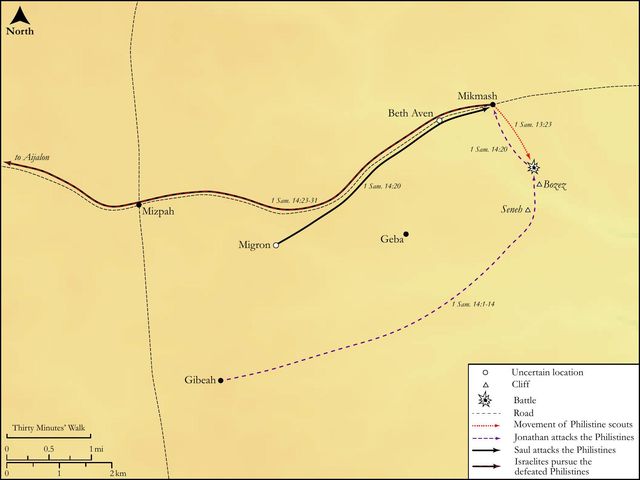
During the nascent period of the Israelite monarchy under Saul, the Philistines represented the dominant military and technological power in the region. They maintained a significant advantage, particularly in ironworking, which they famously monopolized, preventing the Israelites from forging their own weapons and agricultural tools (1 Samuel 13:19-22). This military and economic oppression included the establishment of "garrisons," or fortified outposts, strategically placed throughout Israelite territory. These garrisons symbolized Philistine control and served as constant threats, allowing them to plunder and harass the Israelites. The specific "garrison that is on the other side" likely refers to the Philistine outpost at Michmash, situated across a deep wadi or ravine from Geba, where Saul's forces were positioned. An "armor-bearer" in this era was not merely a servant but a highly trusted and skilled aide, often a close companion or even a relative, who carried the warrior's weapons, protected him in battle, and shared intimately in the dangers and glories of combat. This relationship underscores the deep bond of loyalty and mutual reliance between Jonathan and his young companion.
Key Themes
ShowHideJonathan's action in this verse introduces and develops several crucial themes that resonate throughout the book of Samuel and beyond. Firstly, it powerfully highlights Bold Initiative and Courage, showcasing a proactive stance against overwhelming odds, driven by a profound faith rather than by fear or reliance on numerical superiority. Secondly, it serves as a vivid illustration of Faith in Action, as Jonathan's subsequent declaration in 1 Samuel 14:6 explicitly links his audacious courage to an unwavering trust in God's ability to save "by many or by few." This stands in stark contrast to the prevailing fear and reliance on human strength seen in the Israelite army and King Saul. Thirdly, the verse establishes a clear Contrasting Leadership dynamic between Jonathan and his father, Saul. Jonathan's decisiveness, spiritual discernment, and proactive faith stand in opposition to Saul's often impulsive, fearful, and disobedient rule, foreshadowing the eventual shift in divine favor away from Saul's house. Finally, the significant detail "But he told not his father" introduces the theme of Secrecy and Independent Action, suggesting Jonathan's recognition that his father might oppose such a risky, faith-driven venture, or perhaps a desire to act swiftly without the delays or anxieties that might paralyze others, demonstrating a profound personal conviction.
Exposition and Analysis
ShowHideKey Word Analysis
ShowHideThis common Hebrew word, often translated as "day," refers to a period of time, whether literal (from sunrise to sunset, or a 24-hour period) or figurative (a defined space of time). In the phrase "upon a day," it functions as a typical narrative opening, signaling the beginning of a significant event or a new phase in the story. It marks a specific, though undefined, moment when Jonathan's pivotal initiative began, lending a sense of immediacy and importance to the unfolding narrative.
While often rendered as "armour," kᵉlîy is a broader term encompassing "vessel, implement, article, or equipment." In this military context, it refers to the full complement of a warrior's gear—weapons, shield, and other necessary implements for battle. The "young man that bare his armour" was therefore responsible for carrying and maintaining these vital tools, making him an essential and trusted partner in combat, not merely a servant. This highlights the close, interdependent relationship between Jonathan and his aide, who would share the dangers and fortunes of their venture.
This primitive root means "to front, i.e., stand boldly out opposite; by implication, to manifest or announce." In the phrase "But he told not his father," it signifies Jonathan's deliberate act of withholding information or failing to declare his intentions to Saul. This choice is crucial, indicating Jonathan's independent decision-making and his recognition that his father might have opposed or hindered his audacious, faith-driven plan, setting up a key contrast in their characters and approaches to leadership.
Verse Breakdown
ShowHide"Now it came to pass upon a day"
This is a common narrative opening in biblical Hebrew, functioning as a temporal marker that signals the beginning of a significant event or a new phase in the story. It sets a specific, albeit undefined, moment in time when the following action occurred, lending a sense of immediacy and importance to Jonathan's initiative.
"that Jonathan the son of Saul said unto the young man that bare his armour"
This clause introduces the protagonist, Jonathan, identifying him by his lineage to King Saul, which immediately establishes his royal status and potential for leadership. His direct address to his armor-bearer emphasizes the personal, private nature of his plan, involving only his most trusted companion, underscoring the intimate and confidential nature of their bond.
"Come, and let us go over to the Philistines' garrison, that [is] on the other side."
This is the core of Jonathan's audacious proposal. The imperative "Come" and the cohortative "let us go over" indicate a deliberate, active, and immediate movement towards the enemy. The target is specific: "the Philistines' garrison," a known point of enemy strength and a symbol of their oppressive presence. "That [is] on the other side" geographically locates the target, implying a crossing of difficult or dangerous terrain (likely the deep wadi between Geba and Michmash), further underscoring the peril and daring nature of the venture.
"But he told not his father."
This concluding phrase is crucial and highly significant. It reveals Jonathan's independent decision-making and his deliberate omission of information from King Saul. This secrecy is pivotal, suggesting either a recognition that Saul would forbid such a risky enterprise, a desire to act swiftly without the bureaucratic delays or anxieties that might paralyze others, or a growing divergence in their approaches to leadership and faith. It immediately sets up a contrast between Jonathan's faith-driven initiative and Saul's often fear-driven or disobedient actions, highlighting Jonathan's unique spiritual resolve.
Literary Devices
ShowHideThe verse employs several key literary devices that enrich its meaning and foreshadow future developments. Foreshadowing is prominently evident in Jonathan's decision to keep his plan secret from his father, which hints at the escalating tension and eventual conflict between their divergent leadership styles and approaches to discerning God's will that will unfold throughout 1 Samuel. The audacious proposal itself also foreshadows the miraculous victory that God will grant through Jonathan, despite the overwhelming numerical odds, emphasizing divine intervention over human might. Contrast is a dominant feature, as Jonathan's bold, faith-driven initiative stands in stark opposition to the general fear, disarray, and lack of initiative seen in the rest of the Israelite army and, implicitly, in King Saul himself, who has recently demonstrated a profound lack of trust in God. This serves as a powerful form of Characterization, immediately establishing Jonathan as a man of exceptional courage, spiritual insight, and decisive action, setting him apart from his father and the fearful populace. There is also an element of Irony, as the son, not the anointed king, takes the decisive initiative to confront the oppressors, acting with greater faith and strategic wisdom than the nation's divinely appointed leader.
Theological and Thematic Connections
ShowHideJonathan's solitary, faith-driven initiative in 1 Samuel 14:1 serves as a profound theological statement about God's ability to work through seemingly insignificant means to accomplish mighty purposes. It underscores that divine power is not limited by human numbers, strength, or conventional military strategy, but rather by the willingness of individuals to step out in radical trust. This verse introduces the powerful theme that God often chooses to demonstrate His sovereignty by using the few, the weak, or the unexpected, ensuring that the glory belongs to Him alone, rather than to human might or wisdom. Jonathan's courage, born of faith, challenges the human tendency to rely on visible resources and encourages a deeper dependence on the invisible hand of God, even when the path forward seems illogical or perilous. It is a testament to the power of individual conviction and obedience in the face of widespread fear and oppression, demonstrating that God's deliverance is not contingent on human strength but on His own sovereign will and the faith of His servants.
Reflection and Application
ShowHideJonathan's decision to act, despite overwhelming odds and without the king's knowledge, provides a powerful model for contemporary believers. It challenges us to consider where God might be calling us to take a bold, faith-filled step, even when conditions are imperfect, resources are scarce, or human support is lacking. In a world often paralyzed by fear, risk assessment, and the pursuit of guaranteed outcomes, Jonathan's example reminds us that true courage is often found in stepping out when the path is unclear, trusting in God's power to make a way where there seems to be none. This can apply to personal callings, ministry initiatives, or standing for truth in challenging environments. It encourages us to cultivate a spirit of initiative and to remember that God's capacity to deliver is not contingent upon our strength or numbers, but upon our willingness to act in faith. We are called to discern God's prompting and respond with courageous obedience, knowing that even a "two-man assault" can become the catalyst for a mighty work of God that brings Him glory and advances His kingdom purposes.
Questions for Reflection
ShowHideFAQ
ShowHideWhy did Jonathan not tell his father, King Saul?
ShowHideJonathan's decision to keep his plan secret from Saul was likely multi-faceted and strategically significant. Firstly, Saul's recent behavior, including his rash oath and unlawful sacrifice (1 Samuel 13:11-14), demonstrated a spiritual decline marked by a lack of faith and a tendency towards impulsive, yet ultimately fearful, actions. Jonathan, a man of deep faith and spiritual discernment, likely recognized that Saul would oppose such a high-risk, seemingly illogical venture due to his own anxieties and reliance on conventional military wisdom. Secondly, the secrecy allowed for swift, decisive action without the delays or bureaucratic processes that might have accompanied an official military order, which could have jeopardized the element of surprise. It highlights Jonathan's independent spirit and his profound trust in God's ability to deliver, contrasting sharply with Saul's wavering resolve and increasing reliance on human strategy rather than divine guidance.
What was the role of an "armor-bearer" in ancient warfare?
ShowHideAn armor-bearer in ancient warfare was far more than a mere servant; he was a highly trusted, skilled, and essential companion to a warrior. His primary duties included carrying the warrior's weapons (such as spear, shield, and sword) and other vital equipment, protecting him during battle, and assisting him in various ways, such as helping him don or remove armor. This role required immense loyalty, courage, and physical proximity to danger, as the armor-bearer often stood directly behind or beside his master in the thick of combat. The armor-bearer shared the same risks and rewards as the warrior he served, signifying a deep bond and mutual reliance. Jonathan's armor-bearer, as depicted throughout 1 Samuel 14, proves to be a loyal and courageous partner, fully committed to Jonathan's audacious and faith-driven plan.
Christ-Centered Fulfillment
ShowHideJonathan's audacious initiative in 1 Samuel 14:1, characterized by his independent courage and profound faith in God's ability to save by "many or few," powerfully foreshadows the ultimate initiative and redemptive work of Jesus Christ. Just as Jonathan stepped out without his earthly father's knowledge to confront the oppressor, Jesus, though fully God, willingly emptied Himself and took on human form, independently and perfectly fulfilling the Father's will for humanity's salvation (Philippians 2:5-8). Jonathan's willingness to risk his life for Israel's deliverance points to the Lamb of God, who willingly laid down His life to take away the sin of the world (John 1:29, John 10:18). While Jonathan's action was a single, albeit significant, military maneuver against a physical enemy, Christ's work on the cross was the decisive, once-for-all victory over sin, death, and the true spiritual oppressor, Satan (Colossians 2:15). Jonathan's faith in God's power to save regardless of numbers finds its ultimate expression in Christ, whose singular sacrifice is sufficient for all humanity, demonstrating that salvation comes not by human might or multitude, but by God's sovereign power through His Son (Ephesians 2:8-9). Jesus is the true and perfect "armor-bearer" of God's redemptive plan, perfectly executing the divine will and leading His people to ultimate, eternal victory.