


1 Samuel 13:22
Bible text: King James Version (1769 Blayney text) · Public domain
Bible text: King James Version with Strong's numbers · Public domain
Bible text: Berean Standard Bible · Public domain
Bible text: American Standard Version (1901) · Public domain
Bible text: World English Bible, Messianic edition · Public domain
Bible text: Geneva Bible (1599) · Public domain
Bible text: Young's Literal Translation · Public domain
- וְהָיָהve·ha·Yahand it wasH1961Conj-w ¦ V-Qal-ConsecPerf-3msVerb Qal Consecutive Perfect 3rd Singular Masculineוְandהָיָהit was
- בְּיוֹםbe·Yomon a day ofH3117Prep-b ¦ N-mscNoun Singular Masculine Constructבְּonיוֹםa day of
- מִלְחֶמֶתmil·Che·metbattleH4421N-fsNoun Singular Feminine Absolute
- וְלֹאve·Lo'and notH3808Conj-w ¦ NegParticle Negativeוְandלֹאnot
- נִמְצָאnim·Tza'it was foundH4672V-Niphal-Perf-3msVerb Niphal Perfect 3rd Singular Masculine
- חֶרֶבChe·reva swordH2719N-fsNoun Singular Feminine Absolute
- וַחֲנִיתva·cha·Nitand a spearH2595Conj-w ¦ N-fsNoun Singular Feminine Absoluteוַandחֲנִיתa spear
- בְּיַדbe·Yadin [the] hand ofH3027Prep-b ¦ N-cscNoun Singular common gender Constructבְּinיַד[the] hand of
- כָּלkolany ofH3605N-mscNoun Singular Masculine Construct
- הָעָםha·'Amthe peopleH5971Art ¦ N-msNoun Singular Masculine Absoluteהָtheעָםpeople
- אֲשֶׁר'a·SherwhichH834RelParticle Relative
- אֶת'et[was] withH854PrepPreposition
- שָׁאוּלsha·'UlSaulH7586N-proper-mNoun Proper Masculine
- וְאֶתve·'Etand withH854Conj-w ¦ PrepPrepositionוְandאֶתwith
- יוֹנָתָןyo·na·TanJonathanH3129N-proper-mNoun Proper Masculine
- וַתִּמָּצֵאva·ti·ma·Tze'and it was foundH4672Conj-w ¦ V-Niphal-ConsecImperf-3fsVerb Niphal Consecutive Imperfect 3rd Singular Feminineוַandתִּמָּצֵאit was found
- לְשָׁאוּלle·sha·'Ulto SaulH7586Prep-l ¦ N-proper-mNoun Proper MasculineלְtoשָׁאוּלSaul
- וּלְיוֹנָתָןu·le·yo·na·Tanand to JonathanH3129Conj-w ¦ Prep-l ¦ N-proper-mNoun Proper MasculineוּandלְtoיוֹנָתָןJonathan
- בְּנוֹbe·Nohis sonH1121N-msc ¦ 3msNoun Singular Masculine Constructבְּנsonוֹhis
English is a literal word-by-word gloss of the Hebrew, not the KJV's wording. Why?
This is the original text the KJV's translators worked from — each Hebrew word with its own literal English meaning in this verse, prepared by scholars at Tyndale House, Cambridge. The KJV translates whole sentences, not word by word, so its wording differs: one Hebrew word can become several English words, and the KJV may choose “the LORD” where the gloss reads “Yahweh”. Both are faithful — they answer different questions. For the KJV's own rendering, switch to the KJV text.
Details
See on the biblical-era map
Study this verse
Public-domain commentary
Matthew Henry
From his Commentary on the Whole Bible. Henry comments on passages, not single verses — this entry covers 1 Samuel 13:15–23.
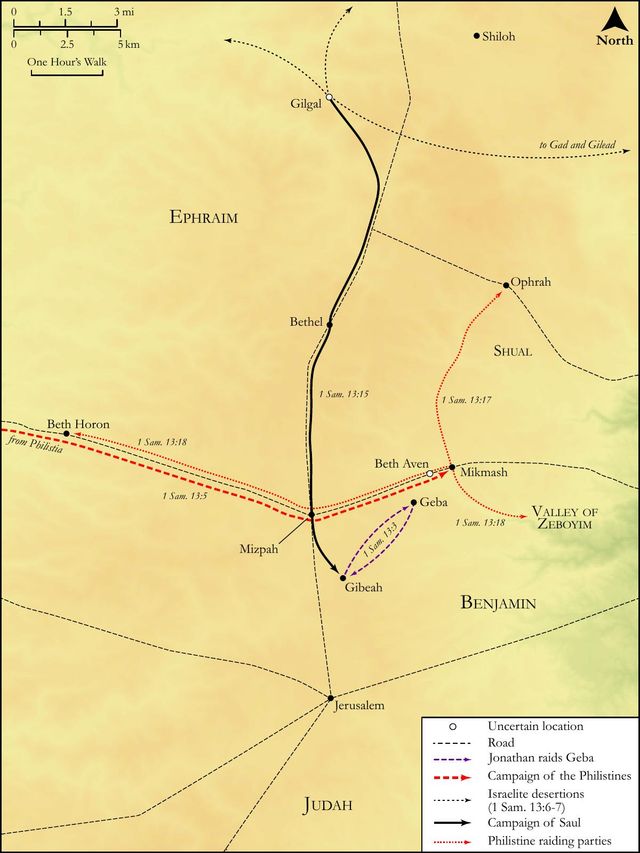
Here, 1. Samuel departs in displeasure. Saul has set up for himself, and now he is left to himself: Samuel gat him from Gilgal (Sa1 13:15), and it does not appear that he either prayed with Saul or directed him. Yet in going up to Gibeah of Benjamin, which was Saul's city, he intimated that he had not quite abandoned him, but waited to do him a kindness another time. Or he went to the college of the prophets there, to pray for Saul when he did not think fit to pray with him. 2. Saul goes after him to Gibeah, and there musters his army, and finds his whole number to be but 600 men, Sa1 13:15, Sa1 13:16. Thus were they for their sin diminished and brought low. 3. The Philistines ravage the country, and put all the adjacent parts under contribution. The body of their army, or standing camp (as it is called in the margin, Sa1 13:23), lay in an advantageous pass at Michmash, but thence they sent out three separate parties or detachments that took several ways, to plunder the country, and bring in provisions for the army, Sa1 13:17, Sa1 13:18. By these the land of Israel was both terrified and impoverished, and the Philistines were animated and enriched. This the sin of Israel brought upon them, Isa 42:24. 4. The Israelites that take the field with Saul are unarmed, having only slings and clubs, not a sword or spear among them all, except what Saul and Jonathan themselves have, Sa1 13:19, Sa1 13:22. See here, (1.) How politic the Philistines were, when they had power in their hands, and did what they pleased in Israel. They put down all the smiths' shops, transplanted the smiths into their own country, and forbade any Israelite, under severe penalties, to exercise the trade or mystery of working in brass or iron, though they had rich mines of both (Deu 8:9) in such plenty that it was said of Asher, his shoes shall be iron and brass, Deu 33:25. This was subtilely done of the Philistines, for hereby they not only prevented the people of Israel from making themselves weapons of war (by which they would be both disused to military exercises and unfurnished when there was occasion), but obliged them to a dependence upon them even for the instruments of husbandry; they must go to them, that is, to some or other of their garrisons, which were dispersed in the country, to have all their iron-work done, and no more might an Israelite do than use a file (Sa1 13:20, Sa1 13:21), and no doubt the Philistines' smiths brought the Israelites long bills for work done. (2.) How impolitic Saul was, that did not, in the beginning of his reign, set himself to redress this grievance. Samuel's not doing it was very excusable; he fought with other artillery; thunder and lightning, in answer to his prayer, were to him instead of sword and spear; but for Saul, that pretended to be a king like the kings of the nations, to leave his soldiers without swords and spears, and take no care to provide them, especially when he might have done it out of the spoils of the Ammonites whom he conquered in the beginning of his reign, was such a piece of negligence as could by no means be excused. (3.) How slothful and mean-spirited the Israelites were, that suffered the Philistines thus to impose upon them and had no thought nor spirit to help themselves. It was reckoned very bad with them when there was not a shield or spear found among 40,000 in Israel (Jdg 5:8), and it was not better now, when there was never an Israelite with a sword by his side but the king and his son, never a soldier, never a gentleman; surely they were reduced to this, or began to be so, in Samuel's time, for we never find him with sword or spear in his hand. If they had not been dispirited, they could not have been disarmed, but it was sin that made them naked to their shame.
Historical interpretation
Historical reception
1 surviving comment on this verse from the historical church.
And when the day of battle came, neither sword nor spear was found, etc. When the day of battle against adversarial powers is a daily occurrence, many content with their rusticity, very few proceed properly armed for this battle with a fitting reading or hearing of the Scriptures; hence, aided by our lethargy, the spiritual adversary now does to us what it is described the carnal adversary did to Israel then.
Continue studying 1 Samuel 13:22 across the web’s major study libraries — every link below opens this exact verse, chapter, or book on the destination site.
Read & Compare
 BibleGatewayThis verse in more than 200 translations and 70 languages.
 Bible.comThe YouVersion reader — hundreds of translations, reading plans, and highlights.
 ESV.orgCrossway's official English Standard Version reader.
 NET BibleThe NET translation with 60,000+ translators' notes on every rendering decision.
 STEP BibleTyndale House's free study tool — original text, vocabulary, and scholarly resources.
 BibliaLogos Bible Software's free web reader.
 USCCBThe New American Bible (Revised Edition) with the U.S. bishops' study notes.
Commentaries
 BibleHub CommentariesDozens of classic commentaries on this verse, gathered on one page.
 StudyLightMore than 100 commentary sets — the largest collection on the web.
 BibleRefPlain-English commentary on what this verse means, verse by verse.
 Enduring WordDavid Guzik's free commentary on this chapter, widely used by Bible teachers.
 Bible Study ToolsVerse commentary alongside Greek and Hebrew study aids.
Original Language & Research
- BibleHub InterlinearThe verse word by word — original language, transliteration, and English.
- BibleHub LexiconEvery word's original-language definition and Strong's entry.
 Blue Letter BibleDeep-study tools — Strong's numbers, concordance, and word studies.
 SefariaThe Hebrew text with Rashi and centuries of Jewish commentary.
Sermons, Hymns & Audio


TrulyRandomVerse is not affiliated with these sites and doesn’t control their content. They’re linked because they’re genuinely useful.
Summary
1 Samuel 13:22 vividly portrays the severe military vulnerability of King Saul and the Israelite army on the eve of a crucial battle against the Philistines. This verse highlights a critical moment in Israel's early monarchy, emphasizing their dire lack of offensive weaponry—specifically swords and spears—among the common soldiers. This disarmed state was a direct consequence of prolonged Philistine oppression and their strategic monopoly over ironworking technology, underscoring Israel's profound dependence and setting the stage for God's miraculous intervention in seemingly insurmountable circumstances.
Context
ShowHideLiterary Context
This verse serves as the stark culmination of the Philistines' strategic disarmament policy, which the narrative meticulously introduced in 1 Samuel 13:19-21. Those preceding verses explain in detail how the Philistines had systematically eliminated Israelite blacksmiths and controlled access to metalworking, forcing Israelites to rely on Philistine smiths even for sharpening basic farm implements. This deliberate economic and military control directly led to the dire situation described in 1 Samuel 13:22. The immediate narrative context is the ongoing conflict with the Philistines, following King Saul's rash and disobedient act of offering a burnt offering without waiting for Samuel (1 Samuel 13:8-14), which resulted in Samuel's pronouncement that Saul's kingdom would not endure. The utterly disarmed state of the army thus sets the stage for Jonathan's daring, faith-filled raid in the subsequent chapter, where God grants a miraculous victory despite overwhelming odds (1 Samuel 14).
Historical & Cultural Context
The Philistines, a powerful group of "Sea Peoples" who had settled along the coastal plains of Canaan, possessed a significant technological advantage over the Israelites. Their mastery of ironworking, a relatively new and advanced technology for the region at the time, gave them military supremacy over the Israelites, who were still largely operating with weapons of bronze. By controlling access to iron and prohibiting Israelite smiths, the Philistines effectively disarmed the Israelite population, preventing any large-scale rebellion and ensuring their continued subjugation. This policy was not merely about military superiority but was a comprehensive strategy for maintaining political and economic dominance. The Israelites were reduced to a state of profound dependency, unable to forge their own tools or weapons, a deep humiliation for a people called to be sovereign under God. This historical reality underscores the dire straits Israel found itself in, making any direct military confrontation with the Philistines seem not just difficult, but suicidal.
Key Themes
ShowHideThe stark absence of basic weaponry among the Israelite forces powerfully depicts their subjugated status under Philistine rule, highlighting the pervasive theme of Military Disadvantage and Oppression. This lack of swords and spears signifies not merely a tactical weakness but serves as a profound symbol of their national humiliation and dependence. While the Philistines' disarmament strategy was a calculated human maneuver, it inadvertently provided the perfect backdrop for God to demonstrate His power and faithfulness, illustrating the theme of Divine Sovereignty Amidst Human Weakness. The dire circumstances forced Israel to rely not on military might but on divine intervention, as later seen in Jonathan's faith-filled courage and declaration in 1 Samuel 14:6. Furthermore, this verse underscores the immense pressures and obstacles faced by Israel's first king, contributing to the overall theme of Saul's Early Reign Challenges. His army's lack of equipment contributed to the overall sense of vulnerability and impending doom, a situation exacerbated by Saul's earlier act of impatience and disobedience in offering an unauthorized burnt offering.
Exposition and Analysis
ShowHideKey Word Analysis
ShowHideAccording to H2719, ḥereḇ refers to a cutting instrument, like a knife, sword, or other sharp implement, primarily from its destructive effect. As a primary offensive weapon, its complete absence among the common soldiers signifies a total lack of offensive capability, rendering them defenseless in direct combat. The sword was a potent symbol of military power and national sovereignty; its scarcity indicated Israel's subjugated and humiliated status.
H2595 defines ḥănîṯ as a lance for thrusting, akin to pitching a tent. This long-shafted weapon with a pointed head, used for thrusting or throwing, was often associated with leaders and champions. Its absence among the general populace further emphasizes the thoroughness of the Philistine disarmament policy. The fact that only Saul and Jonathan possessed one highlights their unique, isolated position of military readiness, underscoring the severity of the army's disarmed state.
The verb māṣāʾ (H4672) means "to come forth to, i.e., appear or exist; transitively, to attain, i.e., find or acquire; figuratively, to occur, meet or be present." In this verse, it is used in the negative ("neither...nor...found"), which powerfully emphasizes the absolute and pervasive nature of the disarmament. It wasn't merely that weapons were scarce or difficult to obtain; they were entirely absent from the hands of the ordinary Israelite soldier, indicating a systematic and successful Philistine policy to strip Israel of its means of defense and offense.
Verse Breakdown
ShowHide"So it came to pass in the day of battle"
This opening clause immediately sets the scene and establishes the critical timing. The Philistine threat was not theoretical but imminent, with the armies arrayed for conflict. The phrase underscores the extreme vulnerability of Israel precisely at the moment they needed to be militarily strong and prepared.
"that there was neither sword nor spear found"
This is the core declaration of the verse, stating the absolute lack of the two most fundamental offensive and defensive weapons. The emphatic double negative ("neither...nor") leaves no ambiguity, highlighting the complete and utter absence of these crucial armaments among the Israelite forces.
"in the hand of any of the people that [were] with Saul and Jonathan:"
This specifies the widespread scope of the disarmament. It affected the entire Israelite fighting force, excluding only the king and his heir. This detail underscores the pervasive nature of Philistine control and the profound helplessness of the common soldier in the face of their enemy.
"but with Saul and with Jonathan his son was there found."
This final clause provides the sole exception to the general disarmament. The king and his son, as the primary military leaders and symbols of Israel's nascent monarchy, possessed the necessary armaments. However, this exception only serves to highlight the isolation of their preparedness and the dire situation of the rest of their army, setting the narrative stage for Jonathan's individual act of faith in the subsequent chapter.
Literary Devices
ShowHideThe passage employs several potent literary devices to convey Israel's dire situation. Irony is prominently displayed, as the newly established kingdom of Israel, chosen by God to lead His people, finds itself utterly disarmed and dependent on its oppressors for basic tools, let alone weapons. This contrasts sharply with the expectation of a powerful, divinely-backed monarchy capable of defending its people. The pervasive lack of swords and spears functions as powerful Symbolism, representing not just military weakness but the profound national humiliation, subjugation, and even spiritual unpreparedness of Israel. It symbolizes their inability to defend themselves in their own strength, relying instead on the oppressors for their very means of livelihood. Furthermore, this dire situation serves as compelling Foreshadowing, setting the stage for divine intervention. By stripping Israel of its human means of achieving victory, God prepares the way to demonstrate His own power through unlikely circumstances, as seen in Jonathan's subsequent faith-filled victory in the very next chapter.
Theological and Thematic Connections
ShowHide1 Samuel 13:22 powerfully illustrates the profound theological principle that God often chooses to work most effectively through human weakness and inadequacy. The disarmed state of Israel's army was a profound military disadvantage, yet it became the very backdrop against which God's power could be most clearly displayed. This situation forces reliance not on human might, technological superiority, or strategic brilliance, but on divine intervention and faithfulness. It teaches that true victory belongs to the Lord, and His methods often defy human logic, ensuring that His glory, not human strength or ingenuity, is magnified. This theme resonates throughout Scripture, reminding believers that our limitations are not obstacles to God's work but rather opportunities for Him to demonstrate His boundless power and unwavering commitment to His people.
Reflection and Application
ShowHideThe scene depicted in 1 Samuel 13:22 offers profound and enduring lessons for contemporary believers. We often find ourselves in situations where we feel "disarmed" – lacking the necessary resources, skills, connections, or even inner strength to face overwhelming challenges, whether they are personal struggles, professional obstacles, or spiritual battles. This verse serves as a powerful reminder that our perceived weaknesses or disadvantages are not necessarily impediments to God's work; rather, they can become the very conduits through which His power is made manifest. It calls us to a radical trust in God's sovereignty, recognizing that His ability to deliver is not contingent on our human preparedness or the abundance of our resources. Instead, it invites us to lean into our dependence on Him, understanding that when we are weak, He is strong. This perspective shifts our focus from what we lack to the limitless power of the One who fights for us, encouraging us to step out in faith even when the odds seem impossibly stacked against us, just as Jonathan courageously did in the face of a disarmed army.
Questions for Reflection
ShowHideFAQ
ShowHideWhy were only Saul and Jonathan armed, and not the rest of the Israelite army?
ShowHideThe Philistines maintained a strict and oppressive monopoly over ironworking technology in Israel, as meticulously detailed in 1 Samuel 13:19-21. They deliberately ensured that no Israelite blacksmiths could operate, forcing the Israelites to rely on Philistine smiths even for sharpening basic farm tools. This strategic disarmament was a calculated policy to prevent any widespread rebellion and maintain control. Saul and Jonathan, as the king and his heir, likely possessed their weapons due to their unique royal status and the inherent necessity of their roles as military leaders. Their armaments were probably acquired through special means, perhaps as part of their personal regalia or through limited, sanctioned access, making them the only exceptions to this pervasive Philistine policy.
How did the Israelite army fight if they had no swords or spears?
ShowHideThe text highlights an extreme military disadvantage, not an absolute inability to fight. While the common soldiers lacked standard offensive weapons like swords and spears, they would have likely used improvised weapons such as sharpened farm implements (which, ironically, they had to get sharpened by Philistines), slings (famously used by David against Goliath), bows and arrows, clubs, or even rocks. The narrative in 1 Samuel 14 shows Jonathan and his armor-bearer initiating a raid, relying on God's intervention rather than superior weaponry. The Philistines' subsequent panic and internal strife, divinely orchestrated, led to their defeat, demonstrating that God's power transcends human military might and conventional armaments.
What was the broader significance of the Philistine monopoly on ironworking for Israel?
ShowHideThe Philistine monopoly on ironworking was a critical and multifaceted tool for their comprehensive control over Israel. Militarily, it effectively disarmed the population, preventing any effective armed resistance and ensuring Philistine military supremacy. Economically, it created a system of dependence, as Israelites had to pay the Philistines for essential services like sharpening tools, siphoning off resources. Politically, it underscored Israel's subjugated status, denying them the autonomy to develop their own military and industrial capabilities, thus maintaining a state of national humiliation. This pervasive situation was a constant reminder of Israel's oppression and their desperate need for divine deliverance, setting the stage for God to demonstrate His power through seemingly impossible circumstances and to establish a true king for His people.
Christ-Centered Fulfillment
ShowHideThe disarmed state of Israel in 1 Samuel 13:22, where human strength and conventional weaponry are utterly absent, powerfully foreshadows the nature of Christ's ultimate victory and the character of His kingdom. Just as God delivered Israel not through overwhelming military might but through unexpected means and the faith of a few, so too Christ's triumph over sin, death, and the powers of darkness was not achieved through physical power or earthly armies. Jesus explicitly stated, "My kingdom is not of this world. If My kingdom were of this world, My servants would fight, so that I would not be delivered to the Jews; but now My kingdom is not from here." His victory was secured through self-sacrifice, humility, and perfect obedience, embracing weakness and the cross to demonstrate divine strength. The Apostle Paul echoes this profound principle, declaring, "My grace is sufficient for you, for My strength is made perfect in weakness." Through His death and resurrection, Christ disarmed the spiritual powers of darkness, triumphing over them not with a sword or spear, but with the cross itself, "disarming the powers and authorities, He made a public spectacle of them, triumphing over them by the cross." He became the true Lamb of God who, by laying down His life, "destroyed him who had the power of death, that is, the devil," liberating humanity not through physical warfare but through spiritual redemption and eternal life. Thus, 1 Samuel 13:22, in its depiction of human inadequacy paving the way for divine intervention, points to the ultimate and perfect fulfillment found in Christ's non-military, yet eternally decisive, victory over all opposing forces.