


1 Samuel 13:21
Bible text: King James Version (1769 Blayney text) · Public domain
Bible text: Berean Standard Bible · Public domain
Bible text: American Standard Version (1901) · Public domain
Bible text: World English Bible, Messianic edition · Public domain
Bible text: Geneva Bible (1599) · Public domain
Bible text: Young's Literal Translation · Public domain
- וְהָיְתָהve·ha·ye·Tahand it wasH1961Conj-w ¦ V-Qal-ConsecPerf-3fsVerb Qal Consecutive Perfect 3rd Singular Feminineוְandהָיְתָהit was
- הַפְּצִירָהha·pe·Tzi·rahthe chargeH6477Art ¦ N-fsNoun Singular Feminine Absoluteהַtheפְּצִירָהcharge
- פִיםFimtwo thirds of a shekelH6310N-msNoun Singular Masculine Absolute
- לַמַּחֲרֵשֹׁתla·ma·cha·re·Shotfor the plowsharesH4281Prep-l ¦ N-fpNoun Plural Feminine Absoluteלַfor theמַּחֲרֵשֹׁתplowshares
- וְלָאֵתִיםve·La·'e·Timand for the mattocksH855Conj-w ¦ Prep-l ¦ N-mpNoun Plural Masculine Absoluteוְandלָfor theאֵתִיםmattocks
- וְלִשְׁלֹשׁve·lish·Loshand for threeH7969Conj-w ¦ Prep-l ¦ N-cscNoun Singular common gender Constructוְandלִforשְׁלֹשׁthree
- קִלְּשׁוֹןki·le·ShonforkH7053N-msNoun Singular Masculine Absolute
- וּלְהַקַּרְדֻּמִּיםu·le·hak·kar·du·Mimand for the axesH7134Conj-w ¦ Prep-l ¦ Art ¦ N-mpNoun Plural Masculine Absoluteוּandלְforהַtheקַּרְדֻּמִּיםaxes
- וּלְהַצִּיבu·le·ha·Tzivand to make straightH5324Conj-w ¦ Prep-l ¦ V-Hiphil-InfVerb Hiphil Infinitive Constructוּandלְtoהַצִּיבmake straight
- הַדָּרְבָןha·da·re·Vanthe goad[s]H1861Art ¦ N-msNoun Singular Masculine Absoluteהַtheדָּרְבָןgoad[s]
English is a literal word-by-word gloss of the Hebrew, not the KJV's wording. Why?
This is the original text the KJV's translators worked from — each Hebrew word with its own literal English meaning in this verse, prepared by scholars at Tyndale House, Cambridge. The KJV translates whole sentences, not word by word, so its wording differs: one Hebrew word can become several English words, and the KJV may choose “the LORD” where the gloss reads “Yahweh”. Both are faithful — they answer different questions. For the KJV's own rendering, switch to the KJV text.
Details
See on the biblical-era map
Study this verse
Public-domain commentary
Matthew Henry
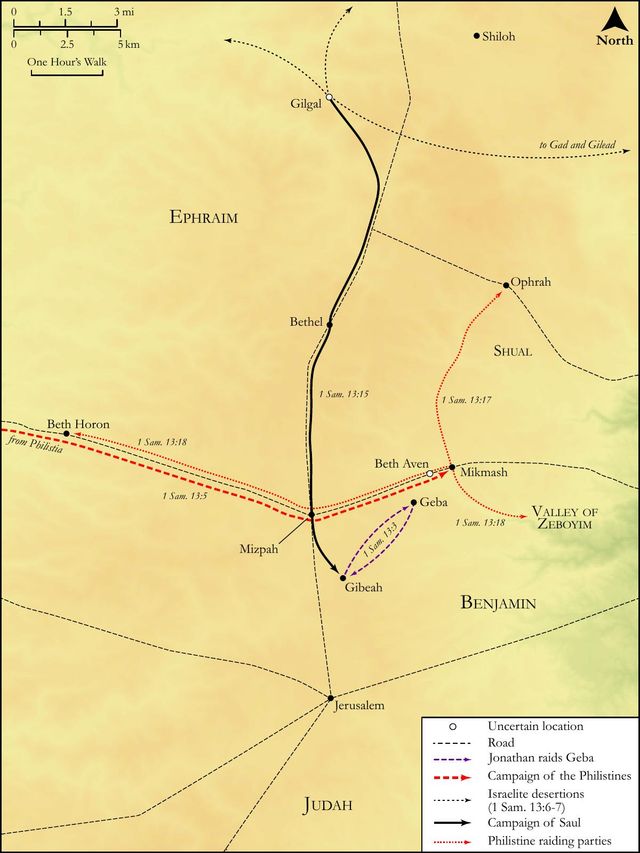
From his Commentary on the Whole Bible. Henry comments on passages, not single verses — this entry covers 1 Samuel 13:15–23.
Here, 1. Samuel departs in displeasure. Saul has set up for himself, and now he is left to himself: Samuel gat him from Gilgal (Sa1 13:15), and it does not appear that he either prayed with Saul or directed him. Yet in going up to Gibeah of Benjamin, which was Saul's city, he intimated that he had not quite abandoned him, but waited to do him a kindness another time. Or he went to the college of the prophets there, to pray for Saul when he did not think fit to pray with him. 2. Saul goes after him to Gibeah, and there musters his army, and finds his whole number to be but 600 men, Sa1 13:15, Sa1 13:16. Thus were they for their sin diminished and brought low. 3. The Philistines ravage the country, and put all the adjacent parts under contribution. The body of their army, or standing camp (as it is called in the margin, Sa1 13:23), lay in an advantageous pass at Michmash, but thence they sent out three separate parties or detachments that took several ways, to plunder the country, and bring in provisions for the army, Sa1 13:17, Sa1 13:18. By these the land of Israel was both terrified and impoverished, and the Philistines were animated and enriched. This the sin of Israel brought upon them, Isa 42:24. 4. The Israelites that take the field with Saul are unarmed, having only slings and clubs, not a sword or spear among them all, except what Saul and Jonathan themselves have, Sa1 13:19, Sa1 13:22. See here, (1.) How politic the Philistines were, when they had power in their hands, and did what they pleased in Israel. They put down all the smiths' shops, transplanted the smiths into their own country, and forbade any Israelite, under severe penalties, to exercise the trade or mystery of working in brass or iron, though they had rich mines of both (Deu 8:9) in such plenty that it was said of Asher, his shoes shall be iron and brass, Deu 33:25. This was subtilely done of the Philistines, for hereby they not only prevented the people of Israel from making themselves weapons of war (by which they would be both disused to military exercises and unfurnished when there was occasion), but obliged them to a dependence upon them even for the instruments of husbandry; they must go to them, that is, to some or other of their garrisons, which were dispersed in the country, to have all their iron-work done, and no more might an Israelite do than use a file (Sa1 13:20, Sa1 13:21), and no doubt the Philistines' smiths brought the Israelites long bills for work done. (2.) How impolitic Saul was, that did not, in the beginning of his reign, set himself to redress this grievance. Samuel's not doing it was very excusable; he fought with other artillery; thunder and lightning, in answer to his prayer, were to him instead of sword and spear; but for Saul, that pretended to be a king like the kings of the nations, to leave his soldiers without swords and spears, and take no care to provide them, especially when he might have done it out of the spoils of the Ammonites whom he conquered in the beginning of his reign, was such a piece of negligence as could by no means be excused. (3.) How slothful and mean-spirited the Israelites were, that suffered the Philistines thus to impose upon them and had no thought nor spirit to help themselves. It was reckoned very bad with them when there was not a shield or spear found among 40,000 in Israel (Jdg 5:8), and it was not better now, when there was never an Israelite with a sword by his side but the king and his son, never a soldier, never a gentleman; surely they were reduced to this, or began to be so, in Samuel's time, for we never find him with sword or spear in his hand. If they had not been dispirited, they could not have been disarmed, but it was sin that made them naked to their shame.
Historical interpretation
Historical reception
1 surviving comment on this verse from the historical church.
For, as a result of the king’s sin [Saul’s offering of the sacrifice], fear had pervaded the whole army. The camp of the enemy, which was lying at no great distance, showed them how real the danger was, and no one had the courage to think of going out to battle: most had absconded to the marshes. For besides the lack of courage on the part of those who felt that God was alienated from them on account of the king’s sin, the army was in the greatest need of iron weapons; so much so that nobody, except Saul and Jonathan his son, is said to have possessed either sword or spear. For the Philistines, as conquerors in the former wars, had deprived the Hebrews of the use of arms, and no one had had the power of forging any weapon of war or even making any implement for rural purposes.
Continue studying 1 Samuel 13:21 across the web’s major study libraries — every link below opens this exact verse, chapter, or book on the destination site.
Read & Compare
 BibleGatewayThis verse in more than 200 translations and 70 languages.
 Bible.comThe YouVersion reader — hundreds of translations, reading plans, and highlights.
 ESV.orgCrossway's official English Standard Version reader.
 NET BibleThe NET translation with 60,000+ translators' notes on every rendering decision.
 STEP BibleTyndale House's free study tool — original text, vocabulary, and scholarly resources.
 BibliaLogos Bible Software's free web reader.
 USCCBThe New American Bible (Revised Edition) with the U.S. bishops' study notes.
Commentaries
 BibleHub CommentariesDozens of classic commentaries on this verse, gathered on one page.
 StudyLightMore than 100 commentary sets — the largest collection on the web.
 BibleRefPlain-English commentary on what this verse means, verse by verse.
 Enduring WordDavid Guzik's free commentary on this chapter, widely used by Bible teachers.
 Bible Study ToolsVerse commentary alongside Greek and Hebrew study aids.
Original Language & Research
- BibleHub InterlinearThe verse word by word — original language, transliteration, and English.
- BibleHub LexiconEvery word's original-language definition and Strong's entry.
 Blue Letter BibleDeep-study tools — Strong's numbers, concordance, and word studies.
 SefariaThe Hebrew text with Rashi and centuries of Jewish commentary.
Sermons, Hymns & Audio


TrulyRandomVerse is not affiliated with these sites and doesn’t control their content. They’re linked because they’re genuinely useful.
Summary
1 Samuel 13:21 offers a profound and poignant glimpse into Israel's severe economic and military subjugation under Philistine rule during the early reign of King Saul. This verse meticulously lists common agricultural implements—mattocks, coulters, forks, axes, and goads—that required sharpening, vividly illustrating the Philistine monopoly over vital ironworking and metal tool production. It powerfully underscores Israel's complete dependence on their oppressors for even the most basic necessities of farming and daily life, thereby highlighting their strategic vulnerability and the oppressive nature of Philistine control.
Context
ShowHideLiterary Context
This verse is strategically placed within a pivotal narrative segment detailing the nascent challenges of Saul's kingship and his initial confrontation with the formidable Philistines. Immediately preceding 1 Samuel 13:21 are 1 Samuel 13:19-20, which explicitly articulate the Philistine policy designed to disarm Israel: "Now there was no smith found throughout all the land of Israel: for the Philistines said, Lest the Hebrews make them swords or spears: But all the Israelites went down to the Philistines, to sharpen every man his share, and his coulter." Verse 21 then serves as a concrete, illustrative inventory, demonstrating the specific tools that necessitated Philistine service, thus making the abstract policy tangible. Following this, 1 Samuel 13:22 emphasizes the dire military consequence, noting that "there was neither sword nor spear found in the hand of any of the people that were with Saul and Jonathan: but with Saul and with Jonathan his son was there found." Therefore, 1 Samuel 13:21 functions as a crucial narrative link, revealing the economic mechanism by which the Philistines maintained their overwhelming military dominance over Israel.
Historical & Cultural Context
The historical period described in 1 Samuel falls in the days of Saul and David, a transformative era marked by the widespread adoption of iron technology. The Philistines, believed to have originated from the Aegean Sea region (often identified with the "Sea Peoples"), were technologically advanced, having mastered iron smelting and smithing techniques. This mastery afforded them a significant military and economic advantage over the Israelites, who were still largely dependent on bronze. By monopolizing access to iron production and skilled smiths, the Philistines implemented a deliberate and effective policy to disarm and debilitate the Israelite population. This control extended beyond merely sharpening tools; it was a comprehensive strategy to prevent the Israelites from forging their own weapons, repairing critical equipment independently, or developing a self-sufficient metal industry. This strategic stranglehold ensured Israel's subservience, stifled any large-scale rebellion, and forced them into a state of perpetual dependency and vulnerability, particularly in the fertile central highlands where agricultural tools were indispensable for survival.
Key Themes
ShowHide1 Samuel 13:21 powerfully contributes to several overarching themes within the book of 1 Samuel and the broader biblical narrative. Firstly, it starkly highlights the theme of economic and military subjugation, demonstrating how an oppressive power can maintain control not only through overt force but also through the monopolization of essential resources and advanced technologies. This technological and economic control effectively ensured Israel's continued weakness and prevented them from asserting true sovereignty, standing in stark contrast to God's covenantal promise of a land where Israel would dwell securely and freely. Secondly, the verse vividly underscores Israel's profound dependence on their enemies for fundamental services, illustrating their oppressed state and acute lack of self-sufficiency. This forced dependency served as a constant, humiliating reminder of their precarious position and the urgent need for divine intervention. Lastly, it emphasizes the strategic military disadvantage Israel faced. While Philistine warriors were equipped with superior iron weaponry, Israel's army was notoriously poorly armed, a situation explicitly detailed in 1 Samuel 13:22. This technological disparity sets the stage for understanding the often miraculous nature of God's deliverance, which is frequently achieved not through human might or superior weaponry, but through His own sovereign power and chosen instruments, as dramatically illustrated by David's later, seemingly impossible victory over Goliath in 1 Samuel 17.
Exposition and Analysis
ShowHideKey Word Analysis
ShowHideDerived from a root meaning "to plow" or "to engrave," this term refers to a pick-axe or digging implement. Its inclusion in the list signifies a fundamental agricultural tool used for breaking up hard ground, tilling, and preparing fields for planting. The Philistine control over the maintenance of such basic tools meant that even the foundational act of farming, essential for survival, was subject to their oversight and economic exploitation.
This primitive root means "to station," "to set up," or "to establish," but in the Hiphil stem (causative) and in this context, it takes on the meaning of "to sharpen" or "to make stand upright" (i.e., making an edge stand keen). The need to "sharpen" these tools highlights their constant use and the necessity of maintaining their effectiveness for agricultural labor. The Philistine monopoly on this process was not just about making an edge keen, but about controlling the entire skilled process of metalworking that ensured tools remained functional and durable.
Of uncertain derivation, this word refers to a long stick with a pointed or spiked end, used by farmers to prod and guide oxen while plowing or working. The goad was an indispensable tool for controlling draft animals, crucial for efficient agriculture. Its inclusion in the list further emphasizes the pervasive nature of Philistine control, extending even to the simple implements necessary for managing livestock and ensuring agricultural productivity.
Verse Breakdown
ShowHide"Yet they had a file"
This opening phrase introduces a nuance, suggesting a limited allowance or a slight exception within the broader context of severe Philistine control. It implies that the Israelites might have possessed a basic, rudimentary sharpening tool, likely for minor touch-ups or temporary maintenance. However, as the preceding verses (1 Samuel 13:19-20) make clear, this "file" was insufficient for the comprehensive and skilled work of a blacksmith, such as re-forging, re-tempering, or major repairs that required a forge and advanced metalworking techniques. Thus, it did not grant them true independence in metalworking.
"for the mattocks, and for the coulters, and for the forks, and for the axes, and to sharpen the goads"
This detailed and comprehensive enumeration serves as an inventory of the essential agricultural tools that required regular sharpening and maintenance. Each item represents a crucial aspect of daily life and farming in ancient Israel. "Mattocks" were digging implements, "coulters" were the cutting blades of plows, "forks" were likely agricultural implements for turning soil or handling crops, "axes" for felling timber and preparing wood, and "goads" for guiding oxen. The exhaustive nature of this list underscores that the Philistine monopoly extended to virtually every metal tool necessary for the Israelite economy, vividly illustrating their complete economic vulnerability and the strategic disadvantage they faced.
Literary Devices
ShowHideThe primary literary device at play in 1 Samuel 13:21 is Enumeration or Listing. The detailed cataloging of "mattocks, and for the coulters, and for the forks, and for the axes, and to sharpen the goads" serves to powerfully emphasize the pervasive and comprehensive nature of the Philistine control over Israelite daily life and economy. This specific listing transforms the abstract concept of "no smith in Israel" into a concrete and relatable reality, showing the tangible, burdensome impact on every farmer and household. There is also a subtle but potent element of Irony present: a nation chosen by God to be sovereign in their own land, promised prosperity and independence, is reduced to humiliating dependence on their oppressors for the most basic implements of survival. This situation subtly highlights the Symbolism of the tools themselves, which represent not just agricultural implements but also Israel's overall state of impotence, subjugation, and lack of self-determination, unable to forge their own destiny or defend themselves without external, hostile assistance.
Theological and Thematic Connections
ShowHideThe dire situation depicted in 1 Samuel 13:21, where Israel is disarmed and dependent on their enemies for basic tools, serves as a profound theological commentary on the consequences of disobedience and the nature of divine sovereignty. It illustrates how a nation that strays from full reliance on God can find itself in a state of vulnerability and oppression, fulfilling the warnings of the Deuteronomic covenant. Yet, even in this state of profound weakness, God's ultimate plan for His people persists. The lack of human means and military might sets the stage for God to demonstrate His power, not through Israel's technological superiority or military strength, but through unexpected victories that magnify His name alone. This passage underscores that true security, prosperity, and freedom come from divine favor and obedience, not from self-sufficiency or worldly strength.
Reflection and Application
ShowHideThe historical account of Israel's forced dependence on the Philistines for basic tools in 1 Samuel 13:21 offers profound and enduring lessons for contemporary believers. In a world that often values self-reliance, technological advancement, and economic independence as ultimate measures of success and security, this passage serves as a sobering reminder of the dangers of strategic dependencies—not just on human systems, but on anything that inadvertently supplants our ultimate reliance on God. Just as Israel's lack of ironworking skills and access to smiths left them vulnerable and subservient, so too can our spiritual lives become compromised when we depend more on worldly resources, human wisdom, or personal strength than on the Lord's divine provision and guidance. This passage calls us to a posture of spiritual self-examination, prompting us to identify areas where we might be inadvertently ceding "control" to external forces, cultural idols, or our own limited abilities, thereby hindering our spiritual freedom and effectiveness. It encourages a posture of humility and radical trust, recognizing that true strength, abundant provision, and ultimate victory come from God alone. Even in states of apparent weakness, disadvantage, or resource limitation, He is able to work powerfully for those who trust Him. Our resourcefulness in adversity should be rooted in unwavering faith, knowing that God can equip us and enable us to thrive even when circumstances seem to limit our "tools" or "resources."
Questions for Reflection
ShowHideFAQ
ShowHideWhy did the Philistines specifically control ironworking and tool sharpening?
ShowHideThe Philistines maintained this monopoly as a deliberate, highly effective, and multi-faceted strategy to ensure Israel's subjugation and prevent any significant rebellion. By controlling access to advanced iron technology and skilled smiths, they achieved several critical objectives: Firstly, they prevented the Israelites from forging their own weapons (swords and spears, as explicitly noted in 1 Samuel 13:19), thereby disarming them militarily and severely limiting their capacity for organized resistance. Secondly, they created an economic dependency, forcing Israelites to pay the Philistines for essential agricultural tool maintenance. This not only extracted wealth from the Israelite economy but also maintained a constant leverage over their daily lives and means of subsistence. This comprehensive control was a cornerstone of their oppressive rule, ensuring Israel remained weak, economically exploited, and unable to challenge Philistine dominance.
If the Israelites had a "file," why did they still need to go to the Philistines for sharpening?
ShowHideThe mention of a "file" (פְּצִירָה, p'tzirah) suggests that the Israelites might have possessed a basic, rudimentary tool for minor, superficial sharpening or temporary maintenance of their implements. However, a simple file is fundamentally insufficient for the comprehensive and skilled work of a blacksmith. Metal tools, especially those used in demanding agricultural tasks like plowshares, axes, and mattocks, require periodic re-forging, re-tempering, and major repairs that involve heating the metal in a forge to high temperatures and skilled hammering to reshape and strengthen the blade. The Philistines' monopoly wasn't merely on basic sharpening, but on the entire, complex process of iron production, skilled smithing, and the advanced labor required for proper tool fabrication, durable maintenance, and significant repair. Therefore, while a file might offer a temporary, superficial edge, it did not negate the fundamental and critical need for Philistine smiths for true and lasting repair, re-forging, or expert sharpening, vividly highlighting the depth of Israel's technological and economic disadvantage as described in 1 Samuel 13:19-20.
Christ-Centered Fulfillment
ShowHideThe vivid depiction of Israel's weakness and profound dependence on their Philistine oppressors for basic tools in 1 Samuel 13:21 finds a rich and profound Christ-centered fulfillment. Israel's inability to forge their own weapons or even maintain their agricultural implements without external, hostile assistance powerfully foreshadows humanity's utter inability to save itself from the bondage of sin and death. Just as Israel lacked the "smith" and the "iron" for self-sufficiency, so too are we spiritually disarmed and utterly dependent, unable to forge our own righteousness, overcome the spiritual enemies of sin, Satan, and death, or secure our own salvation. This desperate need points directly to Jesus Christ, who is the ultimate "Divine Smith" and "Equipper" for His people. He does not merely sharpen our dull tools; He transforms us, forging new hearts and minds through His atoning sacrifice on the cross. His decisive victory over sin and death was achieved not through worldly might or superior weaponry, but through apparent weakness and vulnerability, as described in 2 Corinthians 13:4. Through Christ, we are provided with the complete spiritual "armor of God" (Ephesians 6:10-17), equipping us for spiritual warfare against principalities and powers, a stark contrast to Israel's material disarmament. Our dependence is now perfectly placed in Him, the one who disarmed the powers and authorities on the cross (Colossians 2:15), ensuring that our true strength, victory, and eternal provision come solely from Him, the true source of all power and salvation.