


1 Samuel 13:23
Bible text: King James Version (1769 Blayney text) · Public domain
Bible text: Berean Standard Bible · Public domain
Bible text: American Standard Version (1901) · Public domain
Bible text: World English Bible, Messianic edition · Public domain
Bible text: Geneva Bible (1599) · Public domain
Bible text: Young's Literal Translation · Public domain
- וַיֵּצֵאvai·ye·Tze'and it came outH3318Conj-w ¦ V-Qal-ConsecImperf-3msVerb Qal Consecutive Imperfect 3rd Singular Masculineוַandיֵּצֵאit came out
- מַצַּבma·Tzav[the] garrison ofH4673N-mscNoun Singular Masculine Construct
- פְּלִשְׁתִּיםpe·lish·Tim[the] PhilistinesH6430N-mpNoun Gentilic Plural Masculine Absolute
- אֶל'eltoH413PrepPreposition
- מַעֲבַרma·'a·Var[the] pass ofH4569N-mscNoun Singular Masculine Construct
- מִכְמָשׂmikh·MasMicmashH4363N-properNoun Proper Location
English is a literal word-by-word gloss of the Hebrew, not the KJV's wording. Why?
This is the original text the KJV's translators worked from — each Hebrew word with its own literal English meaning in this verse, prepared by scholars at Tyndale House, Cambridge. The KJV translates whole sentences, not word by word, so its wording differs: one Hebrew word can become several English words, and the KJV may choose “the LORD” where the gloss reads “Yahweh”. Both are faithful — they answer different questions. For the KJV's own rendering, switch to the KJV text.
Details
See on the biblical-era map
Study this verse
Public-domain commentary
Matthew Henry
From his Commentary on the Whole Bible. Henry comments on passages, not single verses — this entry covers 1 Samuel 13:15–23.
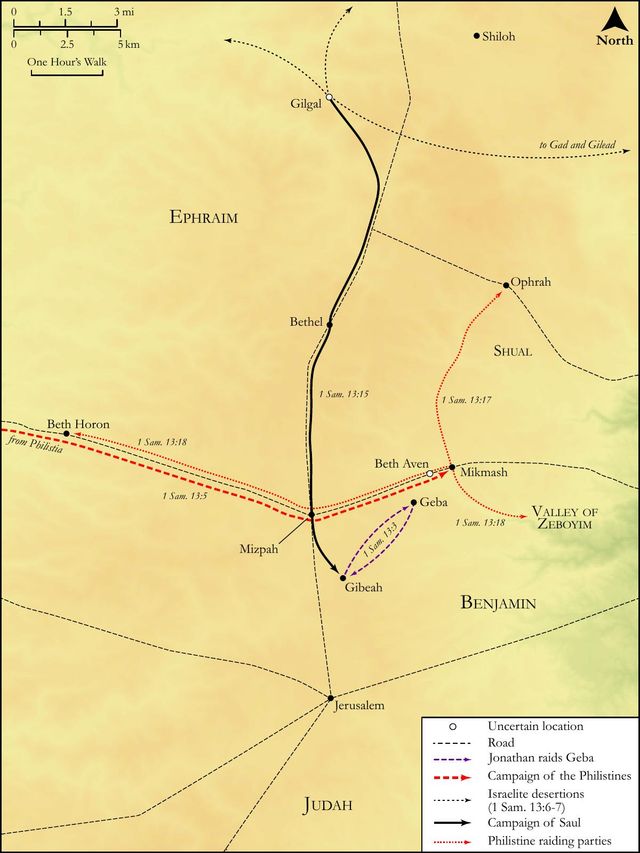
Here, 1. Samuel departs in displeasure. Saul has set up for himself, and now he is left to himself: Samuel gat him from Gilgal (Sa1 13:15), and it does not appear that he either prayed with Saul or directed him. Yet in going up to Gibeah of Benjamin, which was Saul's city, he intimated that he had not quite abandoned him, but waited to do him a kindness another time. Or he went to the college of the prophets there, to pray for Saul when he did not think fit to pray with him. 2. Saul goes after him to Gibeah, and there musters his army, and finds his whole number to be but 600 men, Sa1 13:15, Sa1 13:16. Thus were they for their sin diminished and brought low. 3. The Philistines ravage the country, and put all the adjacent parts under contribution. The body of their army, or standing camp (as it is called in the margin, Sa1 13:23), lay in an advantageous pass at Michmash, but thence they sent out three separate parties or detachments that took several ways, to plunder the country, and bring in provisions for the army, Sa1 13:17, Sa1 13:18. By these the land of Israel was both terrified and impoverished, and the Philistines were animated and enriched. This the sin of Israel brought upon them, Isa 42:24. 4. The Israelites that take the field with Saul are unarmed, having only slings and clubs, not a sword or spear among them all, except what Saul and Jonathan themselves have, Sa1 13:19, Sa1 13:22. See here, (1.) How politic the Philistines were, when they had power in their hands, and did what they pleased in Israel. They put down all the smiths' shops, transplanted the smiths into their own country, and forbade any Israelite, under severe penalties, to exercise the trade or mystery of working in brass or iron, though they had rich mines of both (Deu 8:9) in such plenty that it was said of Asher, his shoes shall be iron and brass, Deu 33:25. This was subtilely done of the Philistines, for hereby they not only prevented the people of Israel from making themselves weapons of war (by which they would be both disused to military exercises and unfurnished when there was occasion), but obliged them to a dependence upon them even for the instruments of husbandry; they must go to them, that is, to some or other of their garrisons, which were dispersed in the country, to have all their iron-work done, and no more might an Israelite do than use a file (Sa1 13:20, Sa1 13:21), and no doubt the Philistines' smiths brought the Israelites long bills for work done. (2.) How impolitic Saul was, that did not, in the beginning of his reign, set himself to redress this grievance. Samuel's not doing it was very excusable; he fought with other artillery; thunder and lightning, in answer to his prayer, were to him instead of sword and spear; but for Saul, that pretended to be a king like the kings of the nations, to leave his soldiers without swords and spears, and take no care to provide them, especially when he might have done it out of the spoils of the Ammonites whom he conquered in the beginning of his reign, was such a piece of negligence as could by no means be excused. (3.) How slothful and mean-spirited the Israelites were, that suffered the Philistines thus to impose upon them and had no thought nor spirit to help themselves. It was reckoned very bad with them when there was not a shield or spear found among 40,000 in Israel (Jdg 5:8), and it was not better now, when there was never an Israelite with a sword by his side but the king and his son, never a soldier, never a gentleman; surely they were reduced to this, or began to be so, in Samuel's time, for we never find him with sword or spear in his hand. If they had not been dispirited, they could not have been disarmed, but it was sin that made them naked to their shame.
Historical interpretation
Historical reception
1 surviving comment on this verse from the historical church.
But the station of the Philistine went out to pass over into Michmash. Indeed, by not having arms, Israel betrayed the country to the enemies; and through our neglect of reading or of inquiring from spiritual teachers, like the negligence of forging arms or of seeking out Israelite blacksmiths, we give the enemies the opportunity, after overcoming the humility which the besieged Michmash signifies, to also bring weapons of impiety to the rest of the virtues, as to the boundaries of the holy land. But to repel these most terrible weapons of the enemy, not the skill of human art, but aided by the grace of the Holy Spirit, the exhortation of heavenly teachers must be sought. Hence it follows:
Continue studying 1 Samuel 13:23 across the web’s major study libraries — every link below opens this exact verse, chapter, or book on the destination site.
Read & Compare
 BibleGatewayThis verse in more than 200 translations and 70 languages.
 Bible.comThe YouVersion reader — hundreds of translations, reading plans, and highlights.
 ESV.orgCrossway's official English Standard Version reader.
 NET BibleThe NET translation with 60,000+ translators' notes on every rendering decision.
 STEP BibleTyndale House's free study tool — original text, vocabulary, and scholarly resources.
 BibliaLogos Bible Software's free web reader.
 USCCBThe New American Bible (Revised Edition) with the U.S. bishops' study notes.
Commentaries
 BibleHub CommentariesDozens of classic commentaries on this verse, gathered on one page.
 StudyLightMore than 100 commentary sets — the largest collection on the web.
 BibleRefPlain-English commentary on what this verse means, verse by verse.
 Enduring WordDavid Guzik's free commentary on this chapter, widely used by Bible teachers.
 Bible Study ToolsVerse commentary alongside Greek and Hebrew study aids.
Original Language & Research
- BibleHub InterlinearThe verse word by word — original language, transliteration, and English.
- BibleHub LexiconEvery word's original-language definition and Strong's entry.
 Blue Letter BibleDeep-study tools — Strong's numbers, concordance, and word studies.
 SefariaThe Hebrew text with Rashi and centuries of Jewish commentary.
Sermons, Hymns & Audio


TrulyRandomVerse is not affiliated with these sites and doesn’t control their content. They’re linked because they’re genuinely useful.
Summary
This serves as a pivotal geographical and strategic marker in the escalating conflict between Israel and the Philistines, detailing the Philistine military's advance into the strategically vital passage of Michmash. This seemingly simple statement of movement underscores the Philistine's dominant military posture and their intent to solidify control over key Israelite territories, thereby setting the immediate stage for the dramatic confrontation and divine intervention that will unfold in the subsequent chapter, highlighting Israel's vulnerability and God's sovereign plan.
Context
ShowHideLiterary Context
This verse concludes a chapter fraught with tension, disobedience, and Israelite vulnerability, serving as a critical setup for the dramatic events of the next chapter. Preceding 1 Samuel 13:23, King Saul had already demonstrated a critical failure of obedience by presumptuously offering a burnt offering without waiting for the prophet Samuel, leading to Samuel's stern rebuke and the declaration that Saul's kingdom would not endure (1 Samuel 13:13-14). Furthermore, the Philistines had strategically disarmed Israel, preventing them from having smiths and weapons, leaving only Saul and his son Jonathan with swords (1 Samuel 13:19-22). The Philistine move to Michmash, therefore, is the culmination of their aggressive posture and Israel's weakened state, directly preceding Jonathan's audacious act of faith and God's miraculous deliverance in 1 Samuel 14.
Historical & Cultural Context
At this period, the Philistines were the dominant regional power, having established garrisons and control over much of the Israelite territory, particularly in the central highlands. Their military superiority was evident in their advanced iron technology, which they deliberately withheld from the Israelites, creating a significant technological and strategic disadvantage. The "passage of Michmash" (Wadi Suweinit) was a well-known, formidable geographical feature—a deep, steep-sided ravine with precipitous cliffs, serving as a natural barrier and a critical choke-point controlling access between the central Benjaminite plateau and the Jordan Valley. Its strategic importance made it an ideal location for a military outpost, allowing the Philistines to monitor and control movement, threatening Israel's heartland and solidifying their hegemony.
Key Themes
ShowHideThe verse significantly contributes to several overarching themes within 1 Samuel. Firstly, it highlights Philistine Hegemony and Oppression, vividly illustrating their military might and the subjugated state of Israel. Their ability to freely position a garrison in such a strategic location underscores Israel's vulnerability and lack of true sovereignty under Saul's early reign. Secondly, it emphasizes Strategic Positioning and Military Tension, setting the stage for a critical confrontation. The Philistines' calculated move to Michmash was not merely an advance but a consolidation of power, designed to provoke and control. Lastly, and perhaps most profoundly, this verse serves as a dramatic Setup for Divine Intervention and Deliverance. Despite the overwhelming Philistine presence and Israel's dire circumstances, the very act of the Philistines entrenching themselves at Michmash inadvertently prepares the scene for God to display His power through Jonathan's faith, demonstrating that God's deliverance is not dependent on human strength or numbers, a truth powerfully echoed in passages like Judges 7:2-7 and Psalm 44:6-7.
Exposition and Analysis
ShowHideKey Word Analysis
ShowHideThe Hebrew word מַצָּב (matstsâb) refers to a "fixed spot," a "military post," or "station." In this context, it denotes a permanent outpost or an established military force positioned to maintain control over a specific area. Its use here signifies more than a temporary encampment; it implies an authoritative, controlling Philistine military presence, signaling their intent to maintain a firm grip on the region and exert their dominance over the Israelites.
The verb יָצָא (yâtsâʼ) is a primitive root meaning "to go out" or "to bring out," with a wide variety of applications. Here, it denotes a purposeful, aggressive movement, an advance from their previous position (likely Geba or a nearby Philistine stronghold) towards a specific strategic objective. This action signifies a deliberate military maneuver designed to assert control and pressure Israel, rather than a casual departure.
The term מַעֲבָר (maʻăbâr) refers to a "crossing-place," "ford," or "pass." In the context of Michmash, it describes a specific, narrow, and difficult defile or ravine. This was not just any path but a strategic choke-point, characterized by steep, rocky slopes and cliffs (such as "Bozez" and "Seneh" mentioned in 1 Samuel 14:4). Its designation as a "passage" emphasizes its critical role in controlling movement and its natural defensive advantages, making it an ideal location for a military garrison to block or monitor access.
Verse Breakdown
ShowHide"And the garrison of the Philistines went out"
This clause identifies the subject—the "garrison of the Philistines"—a formidable, established military contingent, not merely a scouting party. The verb "went out" indicates a purposeful and aggressive movement, an advance from their previous position (likely Geba or a nearby Philistine stronghold) towards a specific strategic objective. This movement signifies an aggressive posture, a deliberate military maneuver designed to assert control and pressure Israel, reinforcing the Philistine's military dominance.
"to the passage of Michmash"
This specifies the destination, highlighting its crucial geographical and strategic importance. Michmash was known for its deep, rugged wadi (Wadi Suweinit), which formed a natural barrier. By positioning their garrison here, the Philistines were not just advancing; they were occupying a key defensive and offensive position. This move effectively cut off potential Israelite movements, solidified Philistine control over the central Benjaminite territory, and prepared for further engagement, setting the immediate stage for the dramatic events of the next chapter.
Literary Devices
ShowHideThe verse employs several literary devices to heighten its impact and foreshadow future events. Strategic Imagery is prominent, painting a vivid picture of military maneuvering and the Philistine's calculated advance. The mention of "garrison" and "passage of Michmash" immediately evokes a sense of military occupation and the critical strategic importance of the terrain, underscoring Israel's vulnerable position. There is also a strong element of Foreshadowing. While seemingly a simple statement of fact, this verse is a deliberate setup for the dramatic events of 1 Samuel 14, where Jonathan and his armor-bearer will bravely confront this very Philistine garrison in this very passage. The Philistine's entrenchment, intended to solidify their power, ironically becomes the location for their unexpected defeat. Furthermore, the verse contributes to the Dramatic Irony of the narrative, as the reader knows (or soon will know) that this seemingly advantageous Philistine move will ultimately lead to their undoing by God's hand through a small, unexpected force, emphasizing divine sovereignty over human plans.
Theological and Thematic Connections
ShowHide1 Samuel 13:23, though brief, powerfully illustrates the theological truth that even in moments of overwhelming human disadvantage and strategic vulnerability, God remains sovereign and active. The Philistine garrison's strategic occupation of Michmash represented a seemingly insurmountable barrier for Israel, a testament to their military and technological superiority and Israel's dire straits under Saul's faltering leadership. Yet, this very act of enemy consolidation becomes the precise setting for God to display His power, not through Israel's strength or numbers, but through the unexpected faith of one man, Jonathan. It underscores that God often works through weakness to demonstrate His might, turning humanly impossible situations into arenas for divine intervention. This verse sets the stage for a profound lesson in trusting God's deliverance even when all human odds are stacked against His people, reminding us that His ways are higher than our ways, and His power is perfected in weakness.
Reflection and Application
ShowHideThe scene at Michmash, where the Philistine garrison confidently entrenched itself, serves as a powerful metaphor for the "impossible" situations we often face in life. Whether it's a daunting personal challenge, an overwhelming professional obstacle, or a seemingly insurmountable spiritual battle, we can feel surrounded and outmatched, much like Israel was at this moment. This verse invites us to consider where our "Michmash passages" are—those strategic choke-points where our adversaries seem to hold all the cards. Yet, the subsequent narrative reveals that God often uses these very points of vulnerability to demonstrate His power. It encourages us to cultivate a faith that looks beyond the visible odds, to recognize that God's strategic genius often unfolds in ways that defy human logic, and that He can use the most unlikely individuals or circumstances to bring about His purposes. Our response to overwhelming odds should not be despair, but a renewed trust in the God who specializes in turning the tables and accomplishing His will through unexpected means.
Questions for Reflection
ShowHideFAQ
ShowHideWhat was the significance of the "passage of Michmash" in ancient Israelite warfare?
ShowHideThe "passage of Michmash" (likely the Wadi Suweinit) was a highly significant geographical feature in ancient Israel, particularly in the central Benjaminite territory. It was a deep, rugged ravine with steep, often impassable cliffs on either side, making it a natural defensive barrier and a critical choke-point for controlling movement between the central plateau and the Jordan Valley. In warfare, occupying this passage allowed an army to effectively block enemy advances, control trade routes, and launch strategic attacks. For the Philistines, establishing a garrison here, as described in 1 Samuel 13:23, was a calculated move to solidify their control over Israelite territory and exert pressure on Saul's nascent kingdom, making it a pivotal location for the subsequent battle and Jonathan's heroic act in 1 Samuel 14.
Christ-Centered Fulfillment
ShowHideThe strategic positioning of the Philistine garrison at the passage of Michmash, a seemingly impregnable stronghold of the enemy, powerfully foreshadows the ultimate spiritual battle and the decisive victory won by Christ. Just as Israel faced an overwhelming physical enemy entrenched in a strategic location, humanity was enslaved by sin and death, with the "strongman" (Satan) holding dominion over the "passage" to life and freedom. The Old Testament narrative of 1 Samuel points to a temporary, human deliverance through Jonathan, yet it ultimately falls short of a complete and lasting solution. This sets the stage for the true and eternal deliverer, Jesus Christ. He did not come as a military king to conquer physical garrisons, but as the Lamb of God who takes away the sin of the world, confronting the spiritual forces of darkness not with swords, but with self-sacrificial love on the cross. His death and resurrection represent the ultimate "going out" to the enemy's stronghold (hell and the grave), conquering sin and death where they seemed most entrenched (Colossians 2:15). Through His victory, the "passage" to eternal life, once blocked by sin, is now opened for all who believe, fulfilling the temporary deliverance at Michmash with an everlasting triumph that secures true freedom for God's people (Hebrews 2:14-15). This ultimate victory ensures that no "garrison" of sin or death can stand against those who are in Christ, for He has disarmed the powers and authorities, making a public spectacle of them.