


1 Samuel 13:2
Bible text: King James Version (1769 Blayney text) · Public domain
Bible text: King James Version with Strong's numbers · Public domain
Bible text: Berean Standard Bible · Public domain
Bible text: American Standard Version (1901) · Public domain
Bible text: World English Bible, Messianic edition · Public domain
Bible text: Geneva Bible (1599) · Public domain
Bible text: Young's Literal Translation · Public domain
- וַיִּבְחַרvai·yiv·charand he choseH977Conj-w ¦ V-Qal-ConsecImperf-3msVerb Qal Consecutive Imperfect 3rd Singular Masculineוַandיִּבְחַרhe chose
- לוֹlofor <the> himselfPrep-l ¦ 3msSuffix Personal 3rd Singular Masculineלfor <the>וֹhimself
- שָׁאוּלsha·'UlSaulH7586N-proper-mNoun Proper Masculine
- שְׁלֹשֶׁתshe·Lo·shetthreeH7969N-cscNoun Singular common gender Construct
- אֲלָפִים'a·la·Fimthousand<s>H505N-cpNoun Plural common gender Absolute
- מִיִּשְׂרָאֵלmi·Yis·ra·'Elfrom IsraelH3478Prep-m ¦ N-properNoun Proper LocationמִfromיִּשְׂרָאֵלIsrael
- וַיִּהְיוּvai·yih·Yuand they wereH1961Conj-w ¦ V-Qal-ConsecImperf-3mpVerb Qal Consecutive Imperfect 3rd Plural Masculineוַandיִּהְיוּthey were
- עִם'imwithH5973PrepPreposition
- שָׁאוּלsha·'UlSaulH7586N-proper-mNoun Proper Masculine
- אַלְפַּיִם'al·Pa·yimtwo thousandH505N-cdNoun Dual common gender Absolute
- בְּמִכְמָשׂbe·mikh·Masat MicmashH4363Prep-b ¦ N-properNoun Proper LocationבְּatמִכְמָשׂMicmash
- וּבְהַרu·ve·Harand in [the] hill country ofH2022Conj-w ¦ Prep-b ¦ N-mscNoun Singular Masculine Constructוּandבְinהַר[the] hill country of
- בֵּיתbeitBeth-H1008N-properNoun Proper Location
- אֵל'El-elH1008N-properNoun Proper Location
- וְאֶלֶףve·'E·lefand one thousandH505Conj-w ¦ N-csNoun Singular common gender Absoluteוְandאֶלֶףone thousand
- הָיוּha·Yuthey wereH1961V-Qal-Perf-3cpVerb Qal Perfect 3rd Plural common gender
- עִם'imwithH5973PrepPreposition
- יוֹנָתָןyo·na·TanJonathanH3129N-proper-mNoun Proper Masculine
- בְּגִבְעַתbe·giv·'Atat Gibeah ofH1390Prep-b ¦ N-fscNoun Singular Feminine ConstructבְּatגִבְעַתGibeah of
- בִּנְיָמִיןbin·ya·MinBenjaminH1144N-proper-mNoun Proper Masculine
- וְיֶתֶרve·Ye·terand [the] rest ofH3499Conj-w ¦ N-mscNoun Singular Masculine Constructוְandיֶתֶר[the] rest of
- הָעָםha·'Amthe peopleH5971Art ¦ N-msNoun Singular Masculine Absoluteהָtheעָםpeople
- שִׁלַּחshi·Lachhe sent awayH7971V-Piel-Perf-3msVerb Piel Perfect 3rd Singular Masculine
- אִישׁ'isheach manH376N-msNoun Singular Masculine Absolute
- לְאֹהָלָיוle·'o·ha·Lavto his tentsH168Prep-l ¦ N-mpc ¦ 3msNoun Plural Masculine Constructלְtoאֹהָלָיtentsוhis
English is a literal word-by-word gloss of the Hebrew, not the KJV's wording. Why?
This is the original text the KJV's translators worked from — each Hebrew word with its own literal English meaning in this verse, prepared by scholars at Tyndale House, Cambridge. The KJV translates whole sentences, not word by word, so its wording differs: one Hebrew word can become several English words, and the KJV may choose “the LORD” where the gloss reads “Yahweh”. Both are faithful — they answer different questions. For the KJV's own rendering, switch to the KJV text.
Details
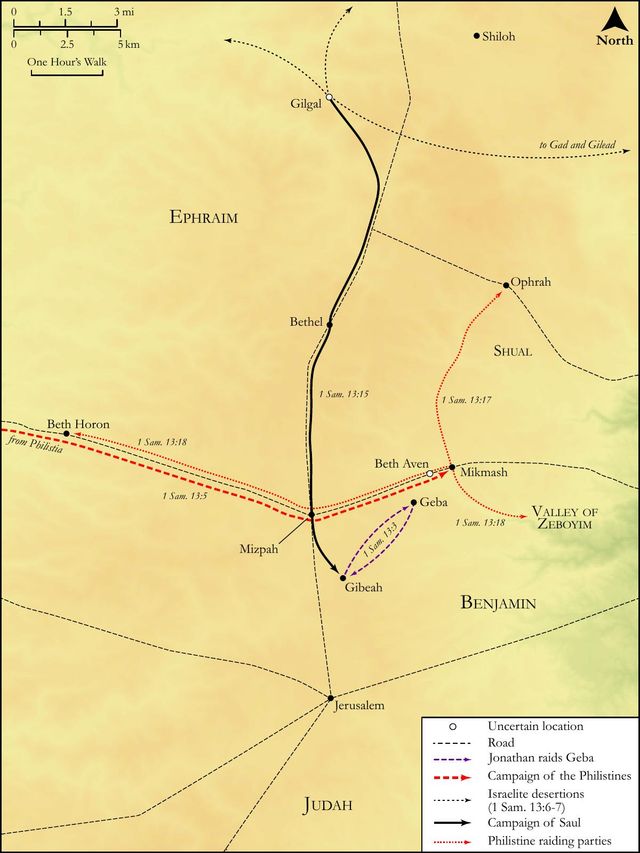
See on the biblical-era map
Study this verse
Public-domain commentary
Matthew Henry
From his Commentary on the Whole Bible. Henry comments on passages, not single verses — this entry covers 1 Samuel 13:1–7. His two-level outline is real structure in the source text, so it is rendered as structure.
We are not told wherein it was that the people of Israel offended God, so as to forfeit his presence and turn his hand against them, as Samuel had threatened (Sa1 12:15); but doubtless they left God, else he would not have left them, as here it appears he did; for,
I.Saul was very weak and impolitic, and did not order his affairs with discretion.
Saul was the son of one year (so the first words are in the original), a phrase which we make to signify the date of his reign, but ordinarily it signifies the date of one's birth, and therefore some understand it figuratively - he was as innocent and good as a child of a year old; so the Chaldee paraphrase: he was without fault, like the son of a year. But, if we admit a figurative sense, it may as well intimate that he was ignorant and imprudent, and as unfit for business as a child of a year old: and the subsequent particulars make this more accordant with his character than the former. But we take it rather, as our own translation has it, Saul reigned one year, and nothing happened that was considerable, it was a year of no action; but in his second year he did as follows: - 1. he chose a band of 3000 men, of whom he himself commanded 2000, and his son Jonathan 1000, Sa1 13:2. The rest of the people he dismissed to their tents. If he intended these only for the guard of his person and his honorary attendants, it was impolitic to have so many, if for a standing army, in apprehension of danger from the Philistines, it was no less impolitic to have so few; and perhaps the confidence he put in this select number, and his disbanding the rest of that brave army with which he had lately beaten the Ammonites (Sa1 11:8-11), was looked upon as an affront to the kingdom, excited general disgust, and was the reason he had so few at his call when he had occasion for them. The prince that relies on a particular party weakens his own interest in the whole community. 2. He ordered his son Jonathan to surprise and destroy the garrison of the Philistines that lay near him in Geba, Sa1 13:3. I wish there were no ground for supposing that this was a violation or infraction of some articles with the Philistines, and that it was done treacherously and perfidiously. The reason why I suspect it is because it is said that, for doing it, Israel was had in abomination, or, as the word is, did stink with the Philistines (Sa1 13:4), as men void of common honesty and whose word could not be relied on. If it was so, we will lay the blame, not on Jonathan who did it, but on Saul, his prince and father, who ordered him to do it, and perhaps kept him in ignorance of the truth of the matter. Nothing makes the name of Israel odious to those that are without so much as the fraud and dishonesty of those that are called by that worthy name. If professors of religion cheat and over-reach, break their word and betray their trust, religion suffers by it, and is had in abomination with the Philistines. Whom may one trust if not an Israelite, one that, it is expected, should be without guile? 3. When he had thus exasperated the Philistines, then he began to raise forces, which, if he had acted wisely, he would have done before. When the Philistines had a vast army ready to pour in upon him, to avenge the wrong he had done them, then was he blowing the trumpet through the land, among a careless, if not a disaffected people, saying, Let the Hebrews hear (Sa1 13:3), and so as many as thought fit came to Saul to Gilgal, Sa1 13:4. But now the generality, we may suppose, drew back (either in dislike of Saul's politics or in dread of the Philistines' power), who, if he had summoned them sooner, would have been as ready at his beck as they were when he marched against the Ammonites. We often find that after-wit would have done much better before and have prevented much inconvenience.
II.Never did the Philistines appear in such a formidable body as they did now, upon this provocation which Saul gave them.
We may suppose they had great assistance from their allies, for (Sa1 13:5), besides 6000 horse, which in those times, when horses were not so much used in war as they are now, was a great body, they had an incredible number of chariots, 30,000 in all: most of them, we may suppose, were carriages for the bag and baggage of so vast an army, not chariots of war. But their foot was innumerable as the sand of the sea-shore, so jealous were they for the honour of their nation and so much enraged at the baseness of the Israelites in destroying their garrison. If Saul had asked counsel of God before he had given the Philistines this provocation, he and his people might the better have borne this threatening trouble which they had now brought on themselves by their own folly.
III.Never were the people of Israel so faint-hearted, so sneaking, so very cowardly, as they were now.
Some considerable numbers, it may be, came to Saul to Gilgal; but, hearing of the Philistines' numbers and preparations, their spirits sunk within them, some think because they did not find Samuel there with Saul. Those that, awhile ago, were weary of him, and wished for a king, now had small joy of their king unless they could see him under Samuel's direction. Sooner or later, men will be made to see that God and his prophets are their best friends. Now that they saw the Philistines making war upon them, and Samuel not coming in to help them, they knew not what to do; men's hearts failed them for fear. And.
1.Some absconded. Rather than run upon death among the Philistines, they buried themselves alive in caves and thickets, Sa1 13:6. See what work sin makes; it exposes men to perils, and then robs them of their courage and dispirits them. A single person, by faith, can say, I will not be afraid of 10,000 (Psa 3:6); but here thousands of degenerate Israelites tremble at the approach of a great crowd of Philistines. Guilt makes men cowards.
2.Others fled (Sa1 13:7): They went over Jordan to the land of Gilead, as far as they could from the danger, and to a place where they had lately been victorious over the Ammonites. Where they had triumphed they hoped to be sheltered.
3.Those that staid with Saul followed him trembling, expecting no other than to be cut off, and having their hands and hearts very much weakened by the desertion of so many of their troops. And perhaps Saul himself, though he had so much honour as to stand his ground, yet had no courage to spare wherewith to inspire his trembling soldiers.
Historical interpretation
Historical reception
1 surviving comment on this verse from the historical church.
And there were with Saul two thousand in Michmash, etc. The Church chooses for itself the strongest and those worthy of a thousand in number, by whose sword of the word and shield of faith it is fortified; furthermore, it sends back the weaker in faith to protect the tabernacles of their own conscience, in which they are strangers to the Lord. However, since both Saul and Jonathan pertain to the kingdom, but the merit of both is not the same; of whom, to pass over other things in silence, one persecutes God's chosen David as an enemy, while the other loves him as his own soul, a dual order of believers or preachers seems to be signified in them. One of them says: Lord, Lord, did we not prophesy in your name (Matthew VII)? The other hears: But you are those who have remained with me in my temptations (Luke XXII). Hence, Saul is rightly called "desired," without doubt referring to him about whom the Lord speaks to the apostles: Behold, Satan has desired to sift you as wheat (ibid.). Jonathan, however, is interpreted as the gift of the dove, or he gave the dove, or the gift of the Lord: signifying those who attribute all virtue they have to the spirit of grace and confess they have received it from him. And Saul remained in Michmash and in the mountain of Bethel, that is, in humility and in the mountain of the house of God: Jonathan, however, in Gibeah of Benjamin, that is, on the hill of the son of the right hand with his soldiers. Because even the reprobate sometimes seem to exercise or even teach spiritual virtues with a left or unstable mind, but only those endowed with dove-like simplicity are proven to belong to the exalted kingdom of Christ, who is at the right hand of God. Also, the fact that there were two thousand with Saul, but a thousand with Jonathan, surely teaches that the more perfect they are, the fewer they are. Or certainly, the two thousand are devoted in humility and on the mountain of the house of God, by the purity of faith and advanced in the height of hope: while the thousand in the hill of the Son of the right hand are glorious in the perfection of charity, which never fails.
Continue studying 1 Samuel 13:2 across the web’s major study libraries — every link below opens this exact verse, chapter, or book on the destination site.
Read & Compare
 BibleGatewayThis verse in more than 200 translations and 70 languages.
 Bible.comThe YouVersion reader — hundreds of translations, reading plans, and highlights.
 ESV.orgCrossway's official English Standard Version reader.
 NET BibleThe NET translation with 60,000+ translators' notes on every rendering decision.
 STEP BibleTyndale House's free study tool — original text, vocabulary, and scholarly resources.
 BibliaLogos Bible Software's free web reader.
 USCCBThe New American Bible (Revised Edition) with the U.S. bishops' study notes.
Commentaries
 BibleHub CommentariesDozens of classic commentaries on this verse, gathered on one page.
 StudyLightMore than 100 commentary sets — the largest collection on the web.
 BibleRefPlain-English commentary on what this verse means, verse by verse.
 Enduring WordDavid Guzik's free commentary on this chapter, widely used by Bible teachers.
 Bible Study ToolsVerse commentary alongside Greek and Hebrew study aids.
Original Language & Research
- BibleHub InterlinearThe verse word by word — original language, transliteration, and English.
- BibleHub LexiconEvery word's original-language definition and Strong's entry.
 Blue Letter BibleDeep-study tools — Strong's numbers, concordance, and word studies.
 SefariaThe Hebrew text with Rashi and centuries of Jewish commentary.
Sermons, Hymns & Audio


TrulyRandomVerse is not affiliated with these sites and doesn’t control their content. They’re linked because they’re genuinely useful.
Summary
1 Samuel 13:2 details King Saul's initial strategic organization of a standing army, a significant departure from Israel's prior reliance on spontaneous tribal levies. This verse highlights the nascent monarchy's effort to establish a more permanent military force, dividing 3,000 chosen men between Saul himself and his son Jonathan, positioning them at key strategic locations in preparation for the inevitable confrontation with the Philistines. It sets the immediate stage for the escalating conflict and reveals the early dynamics of Saul's reign and his son's emerging leadership, underscoring the transition from a tribal confederacy to a centralized monarchy.
Context
ShowHideLiterary Context
This verse immediately follows Saul's anointing and public confirmation as king over Israel in 1 Samuel 10 and his decisive military victory in delivering Jabesh-Gilead in 1 Samuel 11. Having established his authority through this initial success, Saul now turns his attention to the persistent and oppressive Philistine threat, which has plagued Israel for generations. The organization of this small standing army is a direct and necessary response to this ongoing geopolitical reality, setting the stage for the dramatic events of 1 Samuel 13. Specifically, Jonathan's strike against a Philistine garrison, mentioned in 1 Samuel 13:3, is a direct consequence of this military deployment, provoking a massive Philistine counter-mobilization that leads to Saul's fateful act of disobedience and rejection by God. Thus, 1 Samuel 13:2 is not merely a logistical detail but the foundational act that precipitates the chapter's central conflict and profound theological lessons regarding obedience and divine sovereignty.
Historical & Cultural Context
For centuries, Israel had been under varying degrees of Philistine subjugation, particularly concerning military technology, as the Philistines maintained a strict monopoly on ironworking, preventing Israelites from forging their own weapons and tools (1 Samuel 13:19-22). Prior to the monarchy, Israelite warfare typically involved the rallying of temporary tribal militias, often led by charismatic judges or divinely appointed deliverers who would gather forces for specific campaigns. The establishment of a standing army, even a modest one of 3,000 men, marked a significant and revolutionary shift towards a centralized, monarchical state, mirroring the more structured military systems of surrounding nations. Michmash and Mount Bethel were strategically vital locations in the central Benjaminite territory, controlling key passes and routes that were crucial for defending the heartland from Philistine incursions. Gibeah of Benjamin was Saul's hometown and served as his de facto capital, making it a natural and secure base for a portion of his forces. This strategic deployment reflects a sophisticated understanding of the Philistine threat and the challenging terrain.
Key Themes
ShowHideThis verse introduces and reinforces several key themes that will be developed throughout Saul's reign and the broader narrative of 1 Samuel. Firstly, it underscores the theme of Kingship and National Security, demonstrating Saul's immediate and primary responsibility to protect Israel from its enemies, a fundamental expectation of a king (1 Samuel 8:20). Secondly, it highlights the Transition from Tribal Confederacy to Monarchy, as the formation of a permanent, organized military force symbolizes the institutionalization and centralization of Israelite governance, moving away from the more decentralized tribal system. Thirdly, the division of forces between Saul and Jonathan foreshadows the theme of Shared Leadership and Emerging Roles, even as Jonathan's independent command hints at his own military prowess and significant, albeit tragic, role in the unfolding narrative. Finally, the entire setup serves as a crucial prelude to the overarching theme of Divine Sovereignty vs. Human Initiative, as Saul's subsequent actions in 1 Samuel 13 will critically test whether he trusts in God's deliverance and timing or relies solely on his own military preparations and strategic acumen, ultimately revealing the limits of human power without divine sanction.
Exposition and Analysis
ShowHideKey Word Analysis
ShowHideFrom the primitive root H977, meaning "to try, i.e. (by implication) select; acceptable, appoint, choose (choice), excellent, join, be rather, require." This verb implies a deliberate and intentional act on Saul's part, indicating that these 3,000 men were not merely conscripted but were specifically selected, likely for their strength, skill, loyalty, or previous military experience. This highlights Saul's agency and discerning leadership in building his initial military force, underscoring the qualitative nature of this nascent army rather than a mere quantitative gathering.
Meaning "prop, the same as אֶלֶף; hence (the ox's head being the first letter of the alphabet, and this eventually used as a numeral) a thousand." While the precise numerical value of "thousand" in ancient Hebrew contexts can sometimes be debated (potentially referring to a military unit or clan), in this context, 3,000 represents a substantial and organized fighting force for a newly established kingdom. It signifies a significant commitment to military readiness and marks a clear departure from the ad-hoc militias of the Judges period, representing a concrete step in establishing a professional army.
Meaning "a tent (as clearly conspicuous from a distance); covering, (dwelling) (place), home, tabernacle, tent." This word, used in the phrase "sent every man to his tent," signifies the dismissal of the general populace back to their homes or temporary encampments. It emphasizes that the 3,000 chosen men constituted a distinct, professional core of the army, separate from the broader population who were not part of this standing force, but rather returned to their domestic lives or tribal units.
Verse Breakdown
ShowHide"Saul chose him three thousand [men] of Israel;"
This opening clause establishes King Saul's proactive leadership and authority in the nascent monarchy. The act of "choosing" signifies a deliberate and selective process, implying that these were not just any men, but likely the most capable, loyal, or experienced warriors available. This marks the formal beginning of a standing army for Israel under its first king, a significant new development for a nation previously reliant on temporary tribal levies.
"[whereof] two thousand were with Saul in Michmash and in mount Bethel,"
This clause details the larger portion of the newly formed force, directly under Saul's personal command. Their strategic deployment in Michmash and Mount Bethel highlights the critical importance of these locations. Michmash, a narrow and vital pass, and Mount Bethel, a nearby elevated position, formed a crucial defensive line against potential Philistine advances from the west into the central highlands of Israel. This demonstrates Saul's immediate focus on securing his territory and preparing for the inevitable conflict.
"and a thousand were with Jonathan in Gibeah of Benjamin"
This clause reveals the division of the army and the significant trust placed in Saul's son, Jonathan, by entrusting him with a substantial contingent. Gibeah, Saul's hometown and de facto capital, served as a central base. Placing a thousand men there under Jonathan's command not only demonstrates confidence in his emerging military leadership but also suggests a strategic role for his contingent, possibly as a flanking force, a reserve, or a rapid-response unit for the Benjaminite heartland.
"and the rest of the people he sent every man to his tent."
This final clause clarifies that the 3,000 chosen men constituted a distinct, professional military core, separate from the general populace. The "rest of the people" were not dismissed entirely from military service in perpetuity, but rather sent back to their homes and civilian lives, implying they were not part of this immediate, active standing force. This reinforces the concept of a specialized, professional army being established, rather than a universal mobilization, marking a new phase in Israel's national development under the monarchy.
Literary Devices
ShowHideThe verse primarily employs Descriptive Narration, providing a concise yet highly informative account of Saul's initial military organization. The inclusion of precise numbers ("three thousand," "two thousand," "a thousand") and specific geographical locations (Michmash, Mount Bethel, Gibeah of Benjamin) lends a strong sense of Realism and historical grounding to the narrative, allowing the reader to visualize the strategic deployment. The division of forces between Saul and Jonathan serves as a subtle yet significant Foreshadowing, hinting at Jonathan's independent military prowess and his crucial, heroic role in the unfolding conflict, particularly in the very next verse (1 Samuel 13:3). Furthermore, the Contrast drawn between the "three thousand chosen men" and "the rest of the people" who were sent "every man to his tent" underscores the formation of a distinct, professional military core, marking a new and institutionalized phase in Israel's national development under the monarchy, moving away from the ad-hoc tribal levies of the past.
Theological and Thematic Connections
ShowHide1 Samuel 13:2, while seemingly a logistical detail, carries significant theological weight by illustrating the human attempt to establish security and order through military strength. This is a natural and often necessary response to external threats, such as the persistent Philistine oppression. However, the subsequent narrative will powerfully reveal the inherent limitations and ultimate insufficiency of human planning and power when not coupled with unwavering obedience and trust in God's divine timing and methods. Saul's choice to organize an army is not inherently wrong or disobedient in itself; indeed, a king is expected to provide national defense. Yet, his subsequent reliance on this human strength, to the exclusion of divine instruction and patience, will prove to be his tragic downfall. The verse thus sets up a foundational tension between human preparedness and divine deliverance, a recurring theological theme throughout Israel's history. It serves as a profound reminder that while strategic planning and diligent effort are wise and commendable, ultimate victory, security, and true success come from the Lord alone, not from the might of armies or the wisdom of men.
Reflection and Application
ShowHideThis verse, detailing King Saul's practical steps in establishing national security, offers valuable and enduring lessons for contemporary believers. It underscores the profound importance of wise planning, meticulous organization, and the strategic deployment of resources in any endeavor, whether in personal life, church ministry, or professional work. Saul's initiative to "choose" and organize his men demonstrates proactive and responsible leadership in the face of a clear and present threat. Spiritually, we are similarly called to be prepared for the challenges of life and the spiritual battles we inevitably face, not with a naive passivity or fatalism, but with thoughtful preparation, diligent effort, and the responsible stewardship of the gifts, talents, and resources God has graciously given us. However, the subsequent narrative in 1 Samuel 13 serves as a crucial and sobering caveat: our preparation, our plans, and our efforts must always be submitted to God's sovereign will and accompanied by unwavering faith and obedient reliance on Him. Our greatest strength is not ultimately in our numbers, our strategic genius, or our human resources, but in our humble and obedient reliance on the Lord, for He alone is our true defense and ultimate deliverer.
Questions for Reflection
ShowHideFAQ
ShowHideWhat was the significance of 3,000 men for Saul's army?
ShowHideWhile 3,000 men might seem small by modern standards, for the nascent Israelite monarchy emerging from a tribal society, it represented a highly significant and organized standing army. It constituted a professional core, distinct from the general populace, and marked a clear and revolutionary step towards a more centralized military structure. This force signaled Israel's readiness to directly confront the long-standing Philistine threat and was a substantial military commitment for its time, especially given the Philistine monopoly on iron weaponry which limited Israel's own military capabilities (1 Samuel 13:19).
Why were the forces divided between Saul and Jonathan, and what was the strategic importance of their locations?
ShowHideThe division of forces between King Saul and his son Jonathan underscored their joint leadership and the trust placed in Jonathan's emerging military capabilities. Saul's larger contingent of 2,000 men was strategically positioned in Michmash and Mount Bethel, locations that were critically vital for controlling key passes and routes in the central highlands of Benjaminite territory. These positions were essential for defending against potential Philistine incursions from the west. Jonathan's 1,000 men were stationed in Gibeah of Benjamin, Saul's hometown and capital. This served as a secure central base and likely functioned as a flanking force, a reserve, or a rapid-response unit, demonstrating a well-thought-out defensive and offensive strategy against the Philistines.
Christ-Centered Fulfillment
ShowHide1 Samuel 13:2, with its depiction of King Saul establishing a human army for national security, ultimately points to the greater King, Jesus Christ, who establishes His eternal kingdom not by earthly might or military prowess, but by divine power and sacrificial love. Saul's attempt to secure Israel through chosen men and strategic locations foreshadows humanity's inherent desire for security and control through its own means. Yet, as the narrative of Saul unfolds, his reliance on his own strength and his subsequent disobedience reveal the profound insufficiency and ultimate failure of human kingship and military might to secure true and lasting peace. In stark contrast, Christ, the true and eternal King, does not gather a physical army to conquer nations or defend earthly borders; rather, He calls disciples to join a spiritual kingdom that is "not of this world" (John 18:36). He is the ultimate Commander who has already secured decisive victory over sin, death, and all spiritual powers through His cross and resurrection (Colossians 2:15). While Saul organized men for earthly battle, Christ equips His followers with the "full armor of God" for spiritual warfare (Ephesians 6:10-18), leading them to victory not through physical force but through faith, truth, and righteousness. His reign is eternal, and His kingdom, unlike Saul's temporary and flawed monarchy, will never be overthrown or come to an end (Daniel 7:14). He is our true security, our victorious King, and the one in whom all our trust should ultimately rest.