


1 Samuel 13:1
Bible text: King James Version (1769 Blayney text) · Public domain
Bible text: Berean Standard Bible · Public domain
Bible text: American Standard Version (1901) · Public domain
Bible text: World English Bible, Messianic edition · Public domain
Bible text: Geneva Bible (1599) · Public domain
Bible text: Young's Literal Translation · Public domain
- בֶּןben[was] a son ofH1121N-mscNoun Singular Masculine Construct
- שָׁנָהsha·Nahyear[s]H8141N-fsNoun Singular Feminine Absolute
- שָׁאוּלsha·'UlSaulH7586N-proper-mNoun Proper Masculine
- בְּמָלְכוֹbe·ma·le·Khowhen he became kingH4427Prep-b ¦ V-Qal-Inf ¦ 3msVerb Qal Infinitive Constructבְּwhenמָלְכbecame kingוֹhe
- וּשְׁתֵּיu·she·Teiand twoH8147Conj-w ¦ N-fdcNoun Dual Feminine Constructוּandשְׁתֵּיtwo
- שָׁנִיםsha·NimyearsH8141N-mpNoun Plural Masculine Absolute
- מָלַךְma·Lakhhe reignedH4427V-Qal-Perf-3msVerb Qal Perfect 3rd Singular Masculine
- עַל'aloverH5921PrepPreposition
- יִשְׂרָאֵלYis·ra·'ElIsraelH3478N-properNoun Proper Location
- שְׁלֹשִׁיםshe·lo·ShimthirtyH7970Adj-mpAdjective Numerical Plural Masculine Absolute
- וְאַרְבָּעִיםve·'ar·ba·'Imand fortyH705Conj-w ¦ N-mpNoun Plural Masculine Absoluteוְandאַרְבָּעִיםforty
English is a literal word-by-word gloss of the Hebrew, not the KJV's wording. Why?
This is the original text the KJV's translators worked from — each Hebrew word with its own literal English meaning in this verse, prepared by scholars at Tyndale House, Cambridge. The KJV translates whole sentences, not word by word, so its wording differs: one Hebrew word can become several English words, and the KJV may choose “the LORD” where the gloss reads “Yahweh”. Both are faithful — they answer different questions. For the KJV's own rendering, switch to the KJV text.
Details
See on the biblical-era map
Study this verse
Public-domain commentary
Matthew Henry
From his Commentary on the Whole Bible. Henry comments on passages, not single verses — this entry covers 1 Samuel 13:1–7. His two-level outline is real structure in the source text, so it is rendered as structure.
We are not told wherein it was that the people of Israel offended God, so as to forfeit his presence and turn his hand against them, as Samuel had threatened (Sa1 12:15); but doubtless they left God, else he would not have left them, as here it appears he did; for,
I.Saul was very weak and impolitic, and did not order his affairs with discretion.
Saul was the son of one year (so the first words are in the original), a phrase which we make to signify the date of his reign, but ordinarily it signifies the date of one's birth, and therefore some understand it figuratively - he was as innocent and good as a child of a year old; so the Chaldee paraphrase: he was without fault, like the son of a year. But, if we admit a figurative sense, it may as well intimate that he was ignorant and imprudent, and as unfit for business as a child of a year old: and the subsequent particulars make this more accordant with his character than the former. But we take it rather, as our own translation has it, Saul reigned one year, and nothing happened that was considerable, it was a year of no action; but in his second year he did as follows: - 1. he chose a band of 3000 men, of whom he himself commanded 2000, and his son Jonathan 1000, Sa1 13:2. The rest of the people he dismissed to their tents. If he intended these only for the guard of his person and his honorary attendants, it was impolitic to have so many, if for a standing army, in apprehension of danger from the Philistines, it was no less impolitic to have so few; and perhaps the confidence he put in this select number, and his disbanding the rest of that brave army with which he had lately beaten the Ammonites (Sa1 11:8-11), was looked upon as an affront to the kingdom, excited general disgust, and was the reason he had so few at his call when he had occasion for them. The prince that relies on a particular party weakens his own interest in the whole community. 2. He ordered his son Jonathan to surprise and destroy the garrison of the Philistines that lay near him in Geba, Sa1 13:3. I wish there were no ground for supposing that this was a violation or infraction of some articles with the Philistines, and that it was done treacherously and perfidiously. The reason why I suspect it is because it is said that, for doing it, Israel was had in abomination, or, as the word is, did stink with the Philistines (Sa1 13:4), as men void of common honesty and whose word could not be relied on. If it was so, we will lay the blame, not on Jonathan who did it, but on Saul, his prince and father, who ordered him to do it, and perhaps kept him in ignorance of the truth of the matter. Nothing makes the name of Israel odious to those that are without so much as the fraud and dishonesty of those that are called by that worthy name. If professors of religion cheat and over-reach, break their word and betray their trust, religion suffers by it, and is had in abomination with the Philistines. Whom may one trust if not an Israelite, one that, it is expected, should be without guile? 3. When he had thus exasperated the Philistines, then he began to raise forces, which, if he had acted wisely, he would have done before. When the Philistines had a vast army ready to pour in upon him, to avenge the wrong he had done them, then was he blowing the trumpet through the land, among a careless, if not a disaffected people, saying, Let the Hebrews hear (Sa1 13:3), and so as many as thought fit came to Saul to Gilgal, Sa1 13:4. But now the generality, we may suppose, drew back (either in dislike of Saul's politics or in dread of the Philistines' power), who, if he had summoned them sooner, would have been as ready at his beck as they were when he marched against the Ammonites. We often find that after-wit would have done much better before and have prevented much inconvenience.
II.Never did the Philistines appear in such a formidable body as they did now, upon this provocation which Saul gave them.
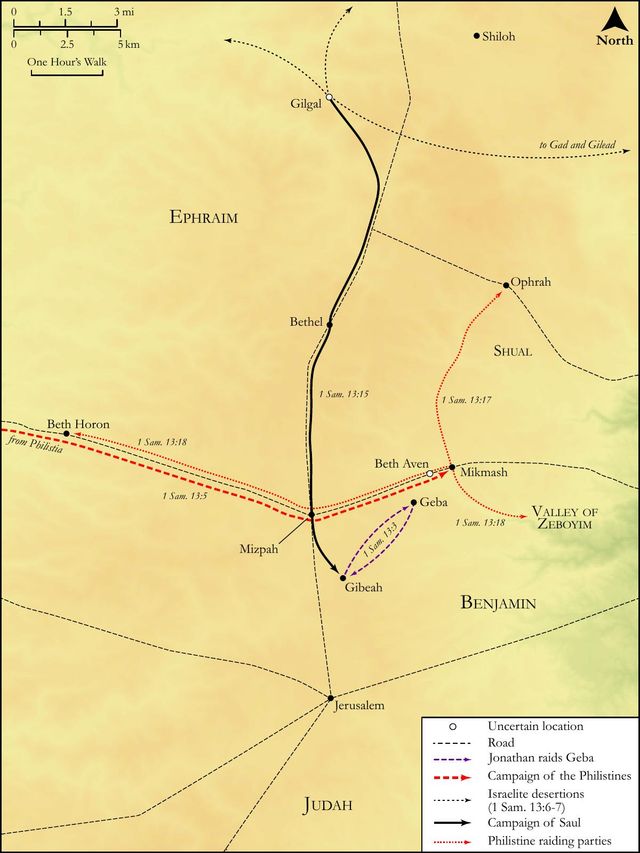
We may suppose they had great assistance from their allies, for (Sa1 13:5), besides 6000 horse, which in those times, when horses were not so much used in war as they are now, was a great body, they had an incredible number of chariots, 30,000 in all: most of them, we may suppose, were carriages for the bag and baggage of so vast an army, not chariots of war. But their foot was innumerable as the sand of the sea-shore, so jealous were they for the honour of their nation and so much enraged at the baseness of the Israelites in destroying their garrison. If Saul had asked counsel of God before he had given the Philistines this provocation, he and his people might the better have borne this threatening trouble which they had now brought on themselves by their own folly.
III.Never were the people of Israel so faint-hearted, so sneaking, so very cowardly, as they were now.
Some considerable numbers, it may be, came to Saul to Gilgal; but, hearing of the Philistines' numbers and preparations, their spirits sunk within them, some think because they did not find Samuel there with Saul. Those that, awhile ago, were weary of him, and wished for a king, now had small joy of their king unless they could see him under Samuel's direction. Sooner or later, men will be made to see that God and his prophets are their best friends. Now that they saw the Philistines making war upon them, and Samuel not coming in to help them, they knew not what to do; men's hearts failed them for fear. And.
1.Some absconded. Rather than run upon death among the Philistines, they buried themselves alive in caves and thickets, Sa1 13:6. See what work sin makes; it exposes men to perils, and then robs them of their courage and dispirits them. A single person, by faith, can say, I will not be afraid of 10,000 (Psa 3:6); but here thousands of degenerate Israelites tremble at the approach of a great crowd of Philistines. Guilt makes men cowards.
2.Others fled (Sa1 13:7): They went over Jordan to the land of Gilead, as far as they could from the danger, and to a place where they had lately been victorious over the Ammonites. Where they had triumphed they hoped to be sheltered.
3.Those that staid with Saul followed him trembling, expecting no other than to be cut off, and having their hands and hearts very much weakened by the desertion of so many of their troops. And perhaps Saul himself, though he had so much honour as to stand his ground, yet had no courage to spare wherewith to inspire his trembling soldiers.
Historical interpretation
Ten Centuries of Reception
2 surviving comments on this verse. Each one is dated, so this reads as a timeline rather than a list.
Select a marker to jump to its quote. Markers stagger vertically where authors wrote within a few decades of each other.
Saul was one year old when he began to reign, etc. The sense is this: after Saul was elected, and anointed by the blessed Samuel with holy oil as king, he remained humble and similar to a private person for the whole first year, nor did he care to dress in royal attire and take up the other insignia of the kingdom: which was also proven above at the time of the Ammonite war where he was driving oxen from the field as a rustic, the beginning of which war Josephus reports happened after a month of all his honor. However, in the second and third years, he indeed assumed a royal mindset and ruled the people with royal care. Yet, he did not choose soldiers from the people who would adhere more familiarly to his side until the beginning of the fourth year. Allegorically, the son of one year represents the people of the faithful, whether in the Synagogue or in the Church, when they begin to reign, because anyone becomes associated with the kingdom of faith, and can be incorporated into the members of the eternal king, when they have first learned that there is one Lord, one faith, one baptism, one God and Father of all. He reigns for two years and thus chooses three thousand soldiers for himself from Israel: because when he has learned to unite hope and love with the unity of faith, he immediately chooses teachers for himself who diligently teach that same faith, hope, and charity to him and his own, and protect them from the enemy's raid. This is to be understood in two ways; namely, we choose both the ancient teachers of the Church, who reigned with Christ long ago and are now masters to us, whose writings or examples we follow, and we appoint new ones daily in place of those who preceded, whom we deem worthy to defend the believers, the hopeful, and the loving from the enemy.
Of one year: That is, he was good and like an innocent child, and for two years continued in that innocency.
Continue studying 1 Samuel 13:1 across the web’s major study libraries — every link below opens this exact verse, chapter, or book on the destination site.
Read & Compare
 BibleGatewayThis verse in more than 200 translations and 70 languages.
 Bible.comThe YouVersion reader — hundreds of translations, reading plans, and highlights.
 ESV.orgCrossway's official English Standard Version reader.
 NET BibleThe NET translation with 60,000+ translators' notes on every rendering decision.
 STEP BibleTyndale House's free study tool — original text, vocabulary, and scholarly resources.
 BibliaLogos Bible Software's free web reader.
 USCCBThe New American Bible (Revised Edition) with the U.S. bishops' study notes.
Commentaries
 BibleHub CommentariesDozens of classic commentaries on this verse, gathered on one page.
 StudyLightMore than 100 commentary sets — the largest collection on the web.
 BibleRefPlain-English commentary on what this verse means, verse by verse.
 Enduring WordDavid Guzik's free commentary on this chapter, widely used by Bible teachers.
 Bible Study ToolsVerse commentary alongside Greek and Hebrew study aids.
Original Language & Research
- BibleHub InterlinearThe verse word by word — original language, transliteration, and English.
- BibleHub LexiconEvery word's original-language definition and Strong's entry.
 Blue Letter BibleDeep-study tools — Strong's numbers, concordance, and word studies.
 SefariaThe Hebrew text with Rashi and centuries of Jewish commentary.
Sermons, Hymns & Audio


TrulyRandomVerse is not affiliated with these sites and doesn’t control their content. They’re linked because they’re genuinely useful.
Summary
1 Samuel 13:1 presents a notoriously challenging chronological statement within the Masoretic Text, describing the early reign of Israel's first king, Saul. Its enigmatic phrasing, particularly concerning the duration of his rule, has prompted extensive scholarly discussion, suggesting a possible textual lacuna, an omission of Saul's age at accession, or a highly condensed summary of his initial period. Narratively, this verse serves as a critical transition, moving the story from Saul's initial anointing and popular affirmation to a defining phase of his kingship characterized by escalating conflict with the Philistines and a pivotal test of his obedience to God.
Context
ShowHideLiterary Context
This verse initiates a crucial chapter in the narrative of Israel's fledgling monarchy, immediately following Saul's initial successes and the consolidation of his rule. The preceding chapters detail his divine selection, the anointing by Samuel, the empowering of the Spirit of the Lord, and his decisive victory over the Ammonites at Jabesh-Gilead, which solidified his public acceptance as king (see 1 Samuel 10:1 and 1 Samuel 11:15). 1 Samuel 13:1 acts as a chronological pivot, introducing a new phase of Saul's reign that is immediately marked by significant military confrontation with the Philistines and, more critically, a profound test of his faithfulness to God's commands delivered through the prophet Samuel. The events that directly follow in 1 Samuel 13:2-15 recount Saul's rash act of offering a burnt offering, a priestly prerogative forbidden to him, which directly precipitates Samuel's pronouncement of the rejection of Saul's dynastic aspirations.
Historical & Cultural Context
The early monarchical period in Israel was defined by persistent external threats, most notably from the Philistines, a formidable military power possessing superior iron technology (as highlighted in 1 Samuel 13:19-22). Israel, a nascent kingdom, was still in the process of establishing its military and administrative infrastructure. The Philistines maintained garrisons within Israelite territory, exerting control and suppressing Israel's military capabilities, particularly in weaponry. Saul's ascension to kingship was, in large part, a direct response to this existential threat, as the people had desired a king "to go out before us and fight our battles" (1 Samuel 8:20). Culturally, the role of the king was still being shaped, involving a delicate balance of power among the monarch, the prophet (Samuel), and the divine will. The king was expected to be a military leader and a faithful steward of God's covenant, not to usurp sacred priestly functions.
Key Themes
ShowHideDespite its brevity and textual complexities, this verse contributes significantly to several overarching themes in the book of 1 Samuel. Firstly, it subtly introduces the theme of textual ambiguity and transmission, reminding readers that ancient biblical texts, while divinely inspired, were copied by human hands and can present challenges in reconstruction. Secondly, it underscores the establishment and testing of the monarchy. Saul's reign, though divinely initiated, is immediately plunged into trials, demonstrating that leadership, especially divinely appointed leadership, comes with immense responsibility and immediate challenges. The verse sets the stage for the crucial theme of obedience versus disobedience, as Saul's actions in the subsequent verses directly lead to the unraveling of his kingdom and the divine search for "a man after His own heart" (1 Samuel 13:14). Finally, it highlights the ongoing Philistine threat, which serves as the primary catalyst for many of the narrative's key events and tests of Saul's character and leadership.
Exposition and Analysis
ShowHideKey Word Analysis
ShowHideThis word, meaning "son," is crucial for understanding the enigmatic first clause. In the Hebrew text, the phrase reads "Saul was a son of a year in his reigning." The term "son of" is a common Hebrew idiom used to denote age (e.g., "son of X years" means X years old). Its presence here, without a preceding numeral indicating Saul's age, strongly suggests a textual omission. When combined with "year," it forms a construct that would typically be completed with a number, for instance, "Saul was thirty years old when he began to reign."
This primitive root means "to reign," "to ascend the throne," or "to be (make, set a) king." It is the central verb describing Saul's activity. The repetition of this verb, "reigned" (H4427) in both clauses, emphasizes the chronological aspect of his rule. The form in the first clause (H8800) is a participle, indicating an ongoing state of reigning, while the second (H8804) is an infinitive construct, signifying the act or period of reigning.
This word, meaning "two," is the numerical core of the second clause. Its presence, combined with "years" (shâneh), forms the phrase "two years." Unlike the first clause, this phrase is grammatically complete and clearly indicates a duration. The interpretive challenge lies in understanding what these "two years" signify in relation to the overall length of Saul's reign and the events of the chapter.
Verse Breakdown
ShowHide"¶ Saul reigned one year;"
This initial clause in the King James Version is an interpretive rendering of the Hebrew "Saul was a son of a year in his reigning." As noted in the key word analysis, the Hebrew construction "son of a year" (בן שנה) is incomplete and typically requires a number indicating the king's age at accession. The KJV's "reigned one year" attempts to make sense of this fragmented text by supplying a duration, but this creates a chronological puzzle when read alongside the subsequent clause and the broader narrative, which implies a more established reign. The scholarly consensus is that a numeral indicating Saul's age at the start of his reign has likely been lost from the Masoretic Text.
"and when he had reigned two years over Israel,"
This second clause, "and two years he reigned over Israel," is grammatically clearer. While the KJV translates "when he had reigned," the Hebrew can also be read as "and two years he reigned over Israel." The most widely accepted scholarly interpretation is that this phrase marks the point in time, specifically two years into Saul's reign, when the significant events described in 1 Samuel 13—the intense Philistine conflict and Saul's defining act of disobedience—commence. It functions as a chronological marker for the beginning of the major turning point in Saul's kingship, rather than indicating the total length of his rule (which was much longer, likely 40 years according to Acts 13:21). This interpretation provides a coherent narrative flow, indicating that after two years, Saul faced a critical test that would determine the future of his dynasty.
Literary Devices
ShowHideThe verse primarily functions as a Chronological Marker, attempting to situate the pivotal narrative events of 1 Samuel 13 within the timeline of Saul's reign. However, due to its widely acknowledged textual corruption or ambiguity, it also exemplifies Ellipsis, where crucial information (most likely Saul's age at accession) has been omitted or lost from the Masoretic Text, creating a gap in the precise historical detail. This textual anomaly subtly introduces a degree of Foreshadowing, as the very difficulty and abruptness of the opening statement, especially in its English rendering, can be seen to hint at the turbulent, unstable, and ultimately truncated nature of Saul's reign, which would not establish a lasting dynasty. The textual instability itself mirrors the instability of Saul's kingship.
Theological and Thematic Connections
ShowHideWhile 1 Samuel 13:1 presents a textual puzzle for scholars, its presence in the biblical canon underscores profound theological truths regarding divine inspiration and the human process of textual transmission. The existence of minor textual difficulties does not undermine the Bible's authority or truthfulness; rather, it highlights the reality of its historical preservation and the meticulous care with which it has been transmitted. The verse, despite its ambiguity, effectively sets the stage for a critical theological theme: the testing of leadership and the absolute necessity of unwavering obedience to God's revealed will. Saul's subsequent failure, which immediately follows this chronological marker, serves as a stark reminder that even divinely appointed leaders are held accountable to God's commands, and disobedience carries severe consequences for both the individual and the nation. It also subtly introduces the theme of divine sovereignty in choosing and rejecting kings, a theme that will culminate in the anointing of David.
Reflection and Application
ShowHideThe textual challenge presented by 1 Samuel 13:1 invites us to deeply consider the nature of biblical inspiration and the complex process of textual transmission throughout history. It serves as a valuable reminder that while the Bible is the infallible Word of God in its original autographs, its journey through millennia involved human scribes, leading to occasional minor variations or ambiguities. Crucially, none of these minor issues obscure its central message of salvation, God's unchanging character, or His redemptive plan. For the believer, this verse functions as a narrative gateway to a profound lesson in leadership and obedience. Saul's early reign, marked by this chronological pivot, quickly descends into a crisis of faith and authority. We are called to learn from his example: that true leadership, whether in the church, at home, or in the workplace, is characterized not merely by power or position, but by humble, consistent, and unwavering obedience to God's commands. Our "two years"—the initial period of our calling, a new responsibility, or a season of blessing—are often when our character is most profoundly tested, and our foundational commitments are truly revealed. This verse, therefore, is a powerful call to vigilance, reminding us that even after initial successes, the most significant tests of faith often lie just ahead, demanding our full reliance on God and His Word.
Questions for Reflection
ShowHideFAQ
ShowHideWhy is 1 Samuel 13:1 so difficult to interpret, especially in translations like the King James Version?
ShowHideThe difficulty in 1 Samuel 13:1 primarily stems from the underlying Hebrew Masoretic Text (MT). The first part of the verse, "Saul reigned one year," translates a Hebrew phrase that literally reads "Saul was a son of a year in his reigning." This is an incomplete grammatical construction, as it typically requires a preceding numeral to indicate the king's age at the start of his reign (e.g., "Saul was [X] years old when he began to reign..."). Most scholars widely agree that a number has likely fallen out of the text during its ancient transmission. The second part, "and when he had reigned two years over Israel," is grammatically sound, but its relationship to the first clause and the overall length of Saul's reign (which was much longer than two years, as indicated in Acts 13:21) creates confusion. The most common scholarly interpretation is that the "two years" marks the duration of his reign up to the point of the critical events described in 1 Samuel 13, particularly his act of disobedience, rather than his total reign. This makes the KJV's rendering appear contradictory and incomplete without this contextual understanding.
Does the textual issue in 1 Samuel 13:1 undermine the Bible's reliability or divine inspiration?
ShowHideNo, the textual issue in 1 Samuel 13:1 does not undermine the Bible's overall reliability or divine inspiration. This is considered a minor scribal difficulty, most likely a missing numeral, which does not affect any core doctrine, theological truth, or the central narrative of God's redemptive plan. Such textual variants are common in ancient manuscripts of all kinds, and biblical scholarship, through the discipline of textual criticism, works diligently to reconstruct the most probable original text by comparing various ancient manuscripts (such as the Septuagint, Dead Sea Scrolls, and other early versions). The overwhelming majority of the biblical text is clear, consistent, and well-attested across thousands of manuscripts. The presence of such a minor ambiguity in no way diminishes the Bible's authority as the infallible Word of God, which perfectly accomplishes its purpose of revealing God and guiding humanity to salvation. The essential message and historical truth of Saul's rise, his failures, and God's sovereign hand in Israel's history are fully preserved and clearly communicated.
Christ-Centered Fulfillment
ShowHideWhile 1 Samuel 13:1 serves as a historical marker in the tumultuous early reign of Israel's first king, it subtly points forward to the ultimate, perfect King, Jesus Christ. Saul's kingship, though divinely initiated, quickly faltered due to his profound disobedience, leading to the rejection of his dynasty and the divine search for "a man after His own heart" (1 Samuel 13:14). This narrative arc powerfully foreshadows the critical need for a perfect King, one who would never fail in obedience or compromise His divine commission. Jesus, the true Son of David and the promised Messiah, did not begin His reign with a period of uncertainty or a test of obedience that He might fail. From His very incarnation, through His life, ministry, and ultimate sacrifice, He was perfectly obedient to the Father's will, even to the point of death on a cross (Philippians 2:8). Unlike Saul, whose earthly kingship was marked by human weakness, pride, and eventual rejection, Christ's kingdom is eternal, unshakable, and righteous (Hebrews 1:8). The textual ambiguity of 1 Samuel 13:1, highlighting the inherent imperfection and transience of human kingship, serves to magnify the flawless, eternally perfect, and fully authoritative reign of the King of kings, whose "years" of rule are from everlasting to everlasting (Revelation 11:15). He is the one whose authority and reign are never in question, and whose perfect obedience secured salvation and righteousness for all who believe (Romans 5:19).