


1 Samuel 14:23
Bible text: King James Version (1769 Blayney text) · Public domain
Bible text: Berean Standard Bible · Public domain
Bible text: American Standard Version (1901) · Public domain
Bible text: World English Bible, Messianic edition · Public domain
Bible text: Geneva Bible (1599) · Public domain
Bible text: Young's Literal Translation · Public domain
- וַיּוֹשַׁעvai·Yo·o·sha'and he deliveredH3467Conj-w ¦ V-Hiphil-ConsecImperf-3msVerb Hiphil Consecutive Imperfect 3rd Singular Masculineוַandיּוֹשַׁעhe delivered
- יְהוָהYah·wehYahwehH3068N-properNoun Proper Title
- בַּיּוֹםbai·Yomon the dayH3117Prep-b ¦ N-msNoun Singular Masculine Absoluteבַּon theיּוֹםday
- הַהוּאha·Hu'<the> thatH1931Art ¦ Pro-3msPronoun Personal 3rd Singular Masculineהַ<the>הוּאthat
- אֶת'et<obj.>H853DirObjMParticle Object Indicator
- יִשְׂרָאֵלYis·ra·'ElIsraelH3478N-properNoun Proper Location
- וְהַמִּלְחָמָהve·Ha·mil·cha·Mahand the battleH4421Conj-w ¦ Art ¦ N-fsNoun Singular Feminine Absoluteוְandהַtheמִּלְחָמָהbattle
- עָבְרָה'a·ve·Rahit passed beyondH5674V-Qal-Perf-3fsVerb Qal Perfect 3rd Singular Feminine
- אֶת'et<obj.>H853DirObjMParticle Object Indicator
- בֵּיתbeitBethH1007N-properNoun Proper Location
- אָוֶן'A·venAvenH1007N-properNoun Proper Location
English is a literal word-by-word gloss of the Hebrew, not the KJV's wording. Why?
This is the original text the KJV's translators worked from — each Hebrew word with its own literal English meaning in this verse, prepared by scholars at Tyndale House, Cambridge. The KJV translates whole sentences, not word by word, so its wording differs: one Hebrew word can become several English words, and the KJV may choose “the LORD” where the gloss reads “Yahweh”. Both are faithful — they answer different questions. For the KJV's own rendering, switch to the KJV text.
Details
See on the biblical-era map
Study this verse
Public-domain commentary
Matthew Henry
From his Commentary on the Whole Bible. Henry comments on passages, not single verses — this entry covers 1 Samuel 14:16–23. His three-level outline is real structure in the source text, so it is rendered as structure.
We have here the prosecution and improvement of the wonderful advantages which Jonathan and his armour-bearer gained against the Philistines.
I.The Philistines were, by the power of God, set against one another.
They melted away like snow before the sun, and went on beating down one another (Sa1 14:16), for (Sa1 14:20) every man's sword was against his fellow. When they fled for fear, instead of turning back upon those that chased them, they reckoned those only their enemies that stood in their way, and treated them accordingly. The Philistines were very secure, because all the swords and spears were in their hands. Israel had none except what Saul and Jonathan had. But now God showed them the folly of that confidence, by making their own swords and spears the instruments of their own destruction, and more fatal in their own hands than if they had been in the hands of Israel. See the like done, Jdg 7:22; Ch2 20:23.
II.The Israelites were hereby animated against them.
1.Notice was soon taken of it by the watchmen of Saul, those that stood sentinel at Gibeah, Sa1 14:16. They were aware that the host of the enemy was in great confusion, and that a great slaughter was made among them, and yet, upon search, they found none of their own forces absent, but only Jonathan and his servant (Sa1 14:17), which no doubt greatly animated them, and assured them that it could be no other than the Lord's doing, when there was no more of man's doing than what those two could do against a great host.
2.Saul began to enquire of God, but soon desisted. His spirit had not come down so far as to allow him to consult Samuel, though, it is probable, he was near him; for we read (Sa1 13:15) that he had come to Gibeah of Benjamin; but he called for the ark (Sa1 14:18), desiring to know whether it would be safe for him to attack the Philistines, upon the disorder they perceived them to be in. Many will consult God about their safety that would never consult him about their duty. But, perceiving by his scouts that the noise in the enemy's camp increased, he commanded the priest that officiated to break off abruptly: "Withdraw thy hand (Sa1 14:19), consult no more, wait no longer for an answer." He was very unwise indeed if (as some think) he forbade him to lift up his hands in prayer; for when Joshua was actually engaged with Amalek Moses continued still to lift up his hands. It is rather a prohibition to his enquiring of the Lord, either,
(1.)Because now he thought he did not need an answer, the case was plain enough. And yet the more evident it was that God did all the more reason he had to enquire whether he would give him leave to do any thing. Or,
(2.)Because now he would not stay for it; he was in such haste to fight a falling enemy that he would not stay to make and end of his devotions, nor hear what answer God would give him. A little thing will divert a vain and carnal mind from religious exercises. He that believeth will not make haste, such haste as this, nor reckon any business so urgent as not to allow time to take God along with him.
3.He, and all the little force he had, made a vigorous attack upon the enemy; and all the people were cried together (so the word is, Sa1 14:20), for want of the silver trumpets wherewith God appointed them to sound an alarm in the day of battle, Num 10:9. They summoned them together by shouting, and their number was not so great but that they might soon be got together. And now they seem bold and brave when the work is done to their hands. Our Lord Jesus had conquered our spiritual enemies, routed and dispersed them, so that we are cowards indeed if we will not stand to our arms when it is only to pursue the victory and to divide the spoil.
4.Every Hebrew, even those from whom one would least have expected it, now turned his hand against the Philistines.
(1.)Those that had deserted and gone over to the enemy, and were among them, now fought against them, Sa1 14:21. Some think, they were such as had been taken prisoners by them, and now they were goads in their sides. It rather seems that they went in to them voluntarily, but, now that they saw them falling, recovered the hearts of Israelites, and did valiantly for their country.
(2.)Those that had fled their colours, and hid themselves in the mountains, returned to their posts, and joined in with the pursuers (Sa1 14:22), hoping by their great zeal and officiousness, now that the danger was over and the victory sure, to atone for their former cowardice. It was not much to their praise to appear now, but it would have been more their reproach if they had not appeared. Those that are remiss and faint-hearted indeed that will not act in the cause of God when they see it victorious, as well as righteous. Thus all hands were at work against the Philistines, and every Israelite slew as many as he could, without sword or spear; yet it is said (Sa1 14:23), it was the Lord that saved Israel that day. He did it by them, for without him they could do nothing. Salvation is of the Lord.
Historical interpretation
Twelve Centuries of Reception
2 surviving comments on this verse. Each one is dated, so this reads as a timeline rather than a list.
Select a marker to jump to its quote. Markers stagger vertically where authors wrote within a few decades of each other.
The battle, however, reached as far as Bethaven. Bethaven is called the house of idols or the useless house. And thus the Church pursues heretics by arguing, until it convinces them that in many things they have blasphemed equal to the madness of pagans, and it extends the sword of the word until it restores the impious and faithless to piety and faith.
The one perfectly divine thing, the one glimpse of God's paradise given on earth, is to fight a losing battle - and not lose it.
Continue studying 1 Samuel 14:23 across the web’s major study libraries — every link below opens this exact verse, chapter, or book on the destination site.
Read & Compare
 BibleGatewayThis verse in more than 200 translations and 70 languages.
 Bible.comThe YouVersion reader — hundreds of translations, reading plans, and highlights.
 ESV.orgCrossway's official English Standard Version reader.
 NET BibleThe NET translation with 60,000+ translators' notes on every rendering decision.
 STEP BibleTyndale House's free study tool — original text, vocabulary, and scholarly resources.
 BibliaLogos Bible Software's free web reader.
 USCCBThe New American Bible (Revised Edition) with the U.S. bishops' study notes.
Commentaries
 BibleHub CommentariesDozens of classic commentaries on this verse, gathered on one page.
 StudyLightMore than 100 commentary sets — the largest collection on the web.
 BibleRefPlain-English commentary on what this verse means, verse by verse.
 Enduring WordDavid Guzik's free commentary on this chapter, widely used by Bible teachers.
 Bible Study ToolsVerse commentary alongside Greek and Hebrew study aids.
Original Language & Research
- BibleHub InterlinearThe verse word by word — original language, transliteration, and English.
- BibleHub LexiconEvery word's original-language definition and Strong's entry.
 Blue Letter BibleDeep-study tools — Strong's numbers, concordance, and word studies.
 SefariaThe Hebrew text with Rashi and centuries of Jewish commentary.
Sermons, Hymns & Audio


TrulyRandomVerse is not affiliated with these sites and doesn’t control their content. They’re linked because they’re genuinely useful.
Summary
1 Samuel 14:23 provides a profound theological declaration, serving as the interpretive key to the chaotic and dramatic events of the day. It unequivocally attributes Israel's decisive victory over the Philistines not to human strategy, valor, or strength, but directly and solely to the sovereign intervention of the LORD, thereby emphasizing His active presence, ultimate control, and unfailing faithfulness in the midst of intense conflict and significant human failings.
Context
ShowHideLiterary Context
This verse provides a powerful concluding summary to a chaotic and pivotal day of battle. It immediately follows the account of Jonathan's daring, faith-filled initiative with his armor-bearer, which ignited panic among the Philistines at Michmash, as detailed in 1 Samuel 14:1-15. The Philistines, thrown into disarray by God-sent terror and internal strife, began fighting each other. Saul's army, previously demoralized and scattered, then joined the pursuit, turning a desperate situation into a rout. However, Saul's rash oath, prohibiting his soldiers from eating until evening, introduced a significant human element of folly and distress, hindering the full extent of the victory and endangering Jonathan's life, as narrated in 1 Samuel 14:24-46. Despite these complex human actions and their consequences, verse 23 cuts through the noise to declare the ultimate divine agency behind the day's success, setting the stage for the subsequent narrative of Saul's declining kingship and God's continued work.
Historical & Cultural Context
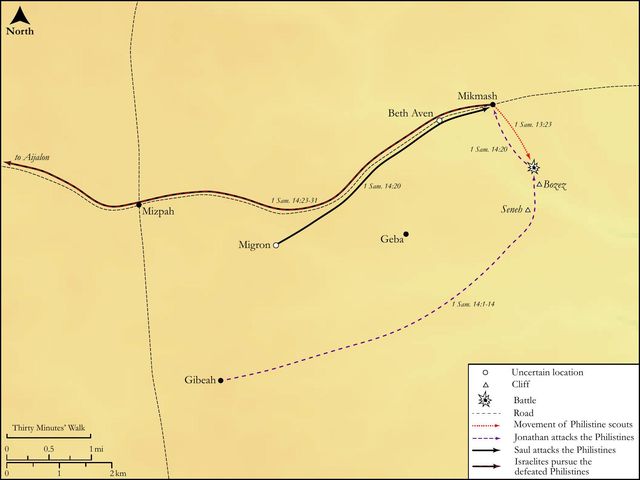
At this point in Israel's history, the Philistines were a dominant military and political power, frequently oppressing Israel, even disarming them to prevent rebellion (see 1 Samuel 13:19-22). Israel was in its early stages of monarchy, with Saul struggling to consolidate power and provide effective leadership against this formidable enemy. The battle at Michmash was critical, as it represented a direct challenge to Philistine control over central Israelite territory. The practice of making vows before battle was common, often intended to secure divine favor or motivate troops, but Saul's specific vow proved counterproductive, revealing his impulsiveness and lack of wisdom, contrasting sharply with Jonathan's faith. The mention of "Bethaven" as the extent of the battle's reach underscores the significant territorial gain and the thoroughness of the Philistine defeat, pushing them back from strategic positions.
Key Themes
ShowHideThe primary theme underscored by 1 Samuel 14:23 is Divine Deliverance and Sovereignty. Even when human agents like Jonathan act with extraordinary faith and courage, or when leaders like Saul make grave errors, the ultimate source of Israel's salvation is God. The narrative emphasizes that the victory was not merely a result of military strategy or human valor, but a direct act of the LORD, who instilled panic among the Philistines (as seen in 1 Samuel 14:15). This highlights God's active involvement in the affairs of His people and His ability to turn the tide of battle regardless of human weakness or strength. Another significant theme is the Contrast Between Human Folly and Divine Wisdom/Power. Saul's rash oath in 1 Samuel 14:24 nearly sabotages the victory and reveals his flawed leadership, yet God's purpose prevails. This sets up a recurring motif in Samuel, where human kingship is constantly evaluated against God's perfect rule, foreshadowing the need for a king after God's own heart.
Exposition and Analysis
ShowHideKey Word Analysis
ShowHideFrom the root meaning "to be," this name signifies "(the) self-Existent or Eternal," the Jewish national name of God, Jehovah. Its prominent placement here emphasizes that the victory was not a mere stroke of luck or human achievement, but a direct, intentional act of the sovereign God of Israel, fulfilling His covenant promises to protect His people.
A primitive root meaning "to be open, wide or free, i.e. (by implication) to be safe; causatively, to free or succor." It carries a strong connotation of liberation from oppression or danger. In this context, it specifically refers to military deliverance from the Philistine threat, but it also resonates with the broader concept of God's redemptive acts throughout Israel's history, pointing to a salvation that is comprehensive and divinely initiated.
From the Hebrew words for "house" and "vanity" or "wickedness," meaning "house of vanity." While often used in prophetic literature (e.g., Hosea 4:15) as a derogatory term for Bethel ("house of God"), here it functions primarily as a geographical marker. Its inclusion emphasizes the thoroughness of the victory, pushing the enemy far back into their territory or beyond a significant landmark, signifying the complete dispersal of their forces.
Verse Breakdown
ShowHide"So the LORD saved Israel that day"
This declarative statement serves as the theological climax and interpretive key for the entire preceding narrative of the battle. It explicitly attributes the deliverance from the Philistine threat directly and solely to the LORD. Despite Jonathan's bravery and the Israelite army's eventual engagement, the text asserts that the ultimate agency for Israel's salvation was divine. This phrase underscores God's sovereignty over military outcomes and His faithfulness to His covenant people, even when they are weak or their leaders are flawed.
"and the battle passed over unto Bethaven"
This clause describes the geographical extent and completeness of the Philistine defeat. "Passed over" implies a rout, a pursuit that drove the enemy beyond a significant landmark. Bethaven, likely near Bethel, signifies a deep penetration into previously Philistine-controlled or threatened territory, or a complete dispersal of their forces, confirming the decisive nature of the divine deliverance. It marks the physical manifestation of the salvation declared in the first clause.
Literary Devices
ShowHideThe verse employs several significant literary devices. Conciseness is paramount, as it distills a complex day of battle into a succinct theological summary. This brevity lends it a declarative power, emphasizing the core message without distraction. Attribution is central, as the verse explicitly attributes the victory to "the LORD," serving as a theological statement that overrides any human-centric interpretations of the battle's outcome. This functions as a form of Divine Commentary, guiding the reader's understanding of the preceding events. Furthermore, the phrase "the battle passed over unto Bethaven" uses Metonymy, where "the battle" stands for the Philistine forces being routed, and the geographical marker "Bethaven" signifies the extensive reach of the pursuit and the completeness of the Philistine defeat.
Theological and Thematic Connections
ShowHide1 Samuel 14:23 profoundly articulates the biblical principle that salvation, whether military, spiritual, or personal, ultimately originates from God. It stands as a testament to God's active involvement in human affairs, demonstrating His ability to deliver His people even when their circumstances seem dire or their human leadership is flawed. This verse reminds us that while human effort and obedience are called for, the decisive factor in any true victory is divine power. It counters any notion of self-sufficiency and continually points to God as the ultimate source of hope and deliverance, reinforcing the theological truth that "Salvation belongs to the LORD" (Psalm 3:8).
Reflection and Application
ShowHideThis powerful verse serves as a timeless reminder that our ultimate victories and deliverances come from God alone. In a world that often celebrates human achievement and self-reliance, 1 Samuel 14:23 redirects our gaze to the divine source of all true salvation. It encourages us to engage in our battles—whether personal struggles, spiritual warfare, or communal challenges—with faith and diligence, knowing that our efforts are meaningful within God's larger plan. Yet, it simultaneously calls us to humble dependence, acknowledging that the decisive breakthrough, the true "saving," is His work. This perspective fosters both active participation and profound trust, freeing us from the burden of having to secure victory solely by our own strength and inviting us to rest in the sovereign power of the LORD, who is able to do far more than we can ask or imagine.
Questions for Reflection
ShowHideFAQ
ShowHideWhat does "Bethaven" signify in this verse?
ShowHideWhile "Bethaven" literally means "house of wickedness" or "house of vanity" and is sometimes used as a derogatory term for Bethel (meaning "house of God") in later prophetic writings (e.g., Hosea 4:15), in 1 Samuel 14:23, it primarily functions as a geographical marker. It indicates the extent of the Philistine rout, signifying that the battle's pursuit drove the enemy far back from Michmash, possibly into their own territory or past a significant landmark, demonstrating the thoroughness of their defeat and the breadth of Israel's deliverance.
Christ-Centered Fulfillment
ShowHideThe salvation of Israel "that day" by the LORD in 1 Samuel 14:23 serves as a powerful Old Testament type and shadow, pointing forward to the ultimate and definitive salvation wrought by Jesus Christ. Just as the LORD delivered Israel from physical oppression, so too does Christ deliver humanity from the spiritual oppression of sin and death. The military victory, though significant, was temporary and incomplete, requiring ongoing deliverance. In contrast, Christ's victory on the cross, His death and resurrection, secured an eternal and comprehensive salvation, conquering the true enemies of humanity: sin, death, and the devil (as articulated in Hebrews 2:14-15). He is the true Lamb of God who takes away the sin of the world, the one through whom all who believe are saved (see Romans 10:9-10). Thus, the temporary military "saving" in 1 Samuel 14:23 finds its glorious and eternal fulfillment in the person and work of Jesus Christ, the ultimate Savior of the world.