


Exodus 14:30
“The LORD Saves Israel at the Sea”Exodus 14:27–31
Bible text: King James Version (1769 Blayney text) · Public domain
Bible text: Berean Standard Bible · Public domain
Bible text: American Standard Version (1901) · Public domain
Bible text: World English Bible, Messianic edition · Public domain
Bible text: Geneva Bible (1599) · Public domain
Bible text: Young's Literal Translation · Public domain
- וַיּוֹשַׁעvai·Yo·o·sha'and he deliveredH3467Conj-w ¦ V-Hiphil-ConsecImperf-3msVerb Hiphil Consecutive Imperfect 3rd Singular Masculineוַandיּוֹשַׁעhe delivered
- יְהוָהYah·wehYahwehH3068N-properNoun Proper Title
- בַּיּוֹםbai·Yomon the dayH3117Prep-b ¦ N-msNoun Singular Masculine Absoluteבַּon theיּוֹםday
- הַהוּאha·Hu'[the] thatH1931Art ¦ Pro-3msPronoun Personal 3rd Singular Masculineהַ[the]הוּאthat
- אֶת'et[obj.]H853DirObjMParticle Object Indicator
- יִשְׂרָאֵלYis·ra·'ElIsraelH3478N-properNoun Proper Location
- מִיַּדmi·Yadfrom [the] hand ofH3027Prep-m ¦ N-cscNoun Singular common gender Constructמִfromיַּד[the] hand of
- מִצְרָיִםmitz·Ra·yimEgyptH4714N-properNoun Proper Location
- וַיַּרְאvai·Yar'and it sawH7200Conj-w ¦ V-Qal-ConsecImperf-3msVerb Qal Consecutive Imperfect 3rd Singular Masculineוַandיַּרְאit saw
- יִשְׂרָאֵלYis·ra·'ElIsraelH3478N-properNoun Proper Location
- אֶת'et[obj.]H853DirObjMParticle Object Indicator
- מִצְרַיִםmitz·Ra·yimEgyptH4714N-properNoun Proper Location
- מֵתmetdeadH4191V-Qal-Prtcpl-msVerb Qal Participle Singular Masculine Absolute
- עַל'alonH5921PrepPreposition
- שְׂפַתse·Fat[the] shore ofH8193N-fscNoun Singular Feminine Construct
- הַיָּםhai·Yamthe seaH3220Art ¦ N-msNoun Singular Masculine Absoluteהַtheיָּםsea
English is a literal word-by-word gloss of the Hebrew, not the KJV's wording. Why?
This is the Hebrew Masoretic text, the same tradition the KJV’s translators worked from, with each word given its own literal English meaning in this verse. The word-by-word meanings were prepared by scholars at Tyndale House, Cambridge. The KJV translates whole sentences rather than single words, so its wording often differs: one Hebrew word can become several English words, and the KJV may say “the LORD” where the word-by-word meaning reads “Yahweh”. The two are made for different purposes, and both are faithful to the Hebrew. To read the KJV’s own wording, switch to the KJV text.
Words in [ ] are added by the English.
Details
See on the biblical-era maps
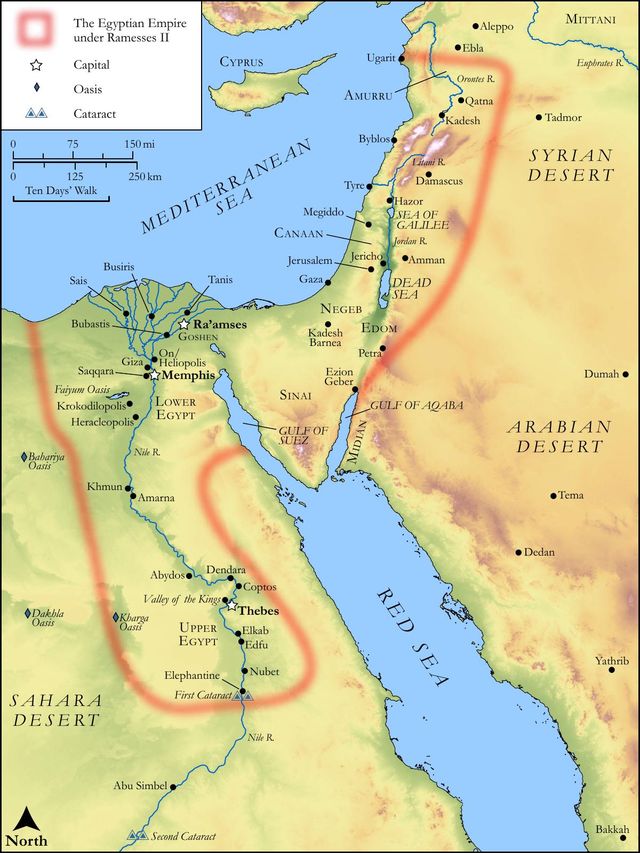
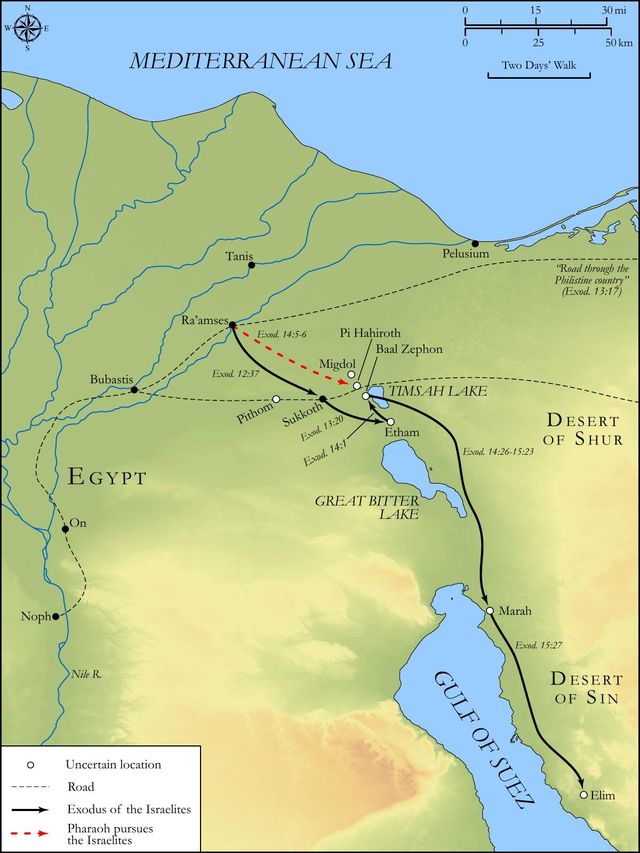
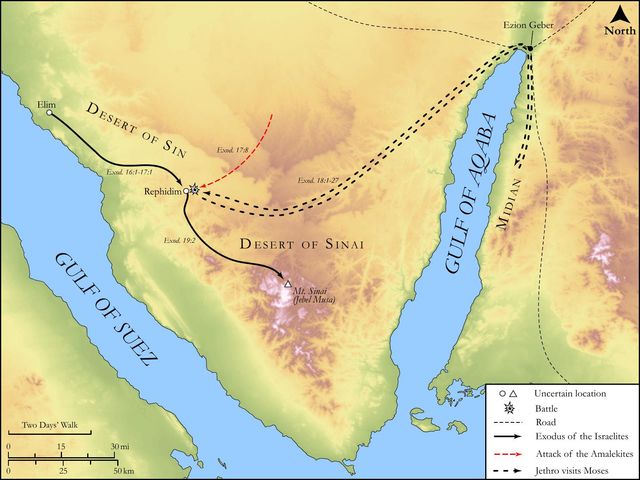
Study this verse
Public-domain commentary
Matthew Henry
From his Commentary on the Whole Bible. Henry wrote on whole passages, and this entry covers Exodus 14:21–31. He set out his notes in a three-level outline, kept here as he numbered it.
We have here the history of that work of wonder which is so often mentioned both in the Old and New Testament, the dividing of the Red Sea before the children of Israel. It was the terror of the Canaanites (Joshua 2:9, Joshua 2:10), the praise and triumph of the Israelites, Psalm 114:3; Psalm 106:9; Psalm 136:13, Psalm 136:14. It was a type of baptism, 1 Corinthians 10:1, 1 Corinthians 10:2. Israel's passage through it was typical of the conversion of souls (Isaiah 11:15), and the Egyptians' perdition in it was typical of the final ruin of all impenitent sinners, Revelation 20:14. Here we have,
I.An instance of God's almighty power in the kingdom of nature, in dividing the sea, and opening a passage through the waters.
It was a bay, or gulf, or arm of the sea, two or three leagues over, which was divided, Exodus 14:21. The instituted sign made use of was Moses's stretching out his hand over it, to signify that it was done in answer to his prayer, for the confirmation of his mission, and in favour to the people whom he led. The natural sign was a strong east wind, signifying that it was done by the power of God, whom the winds and the seas obey. If there be any passage in the book of Job which has reference to the miracles wrought for Israel's deliverance out of Egypt, it is that in Job 26:12, He divideth the sea with his power, and by his understanding he smileth through Rahab (so the word is), that is, Egypt. Note, God can bring his people through the greatest difficulties, and force a way where he does not find it. The God of nature has not tied himself to its laws, but, when he pleases, dispenses with them, and then the fire does not burn, nor the water flow.
II.An instance of his wonderful favour to his Israel.
They went through the sea to the opposite shore, for I cannot suppose, with some, that they fetched a compass, and came out again on the same side, Exodus 14:22. They walked upon dry land in the midst of the sea, Exodus 14:29. And the pillar of cloud, that glory of the Lord, being their rearward (Isaiah 58:8), that the Egyptians might not charge them in the flank, the waters were a wall to them (it is twice mentioned) on their right hand and on their left. Moses and Aaron, it is probable, ventured first into this untrodden path, and then all Israel after them; and this march through the paths of the great waters would make their march afterwards, through the wilderness, less formidable. Those who had followed God through the sea needed not to fear following him whithersoever he led them. This march through the sea was in the night, and not a moon-shiny night, for it was seven days after the full moon, so that they had no light but what they had from the pillar of cloud and fire. This made it the more awful; but where God leads us he will light us; while we follow his conduct, we shall not want his comforts.
This was done, and recorded, in order to encourage God's people in all ages to trust in him in the greatest straits. What cannot he do who did this? What will not he do for those hat fear and love him who did this for these murmuring unbelieving Israelis, who yet were beloved for their fathers' sake, and for the sake of a remnant among them? We find the saints, long afterwards, making themselves sharers in the triumphs of this march (Psalm 66:6): They went through the flood on foot; there did we rejoice in him: and see how this work of wonder is improved, Psalm 77:11, Psalm 77:16, Psalm 77:19.
III.An instance of his just and righteous wrath upon his and his people's enemies, the Egyptians. Observe here,
1.How they were infatuated. In the heat of their pursuit, they went after the Israelites into the midst of the sea, Exodus 14:23. "Why," thought they, "may not we venture where Israel did?" Once or twice the magicians of Egypt had done what Moses did, with their enchantments; Pharaoh remembered this, but forgot how they were nonplussed at last. They were more advantageously provided with chariots and horses, while the Israelites were on foot. Pharaoh had said, I know not the Lord; and by this it appeared he did not, else he would not have ventured thus. None so bold as those that are blind. Rage against Israel made them thus daring and inconsiderate: they had long hardened their own hearts; and now God hardened them to their ruin, and hid from their eyes the things that belonged to their peace and safety. Surely in vain is the net spread in the sight of any bird (Proverbs 1:17); yet so blind where the Egyptians that they hastened to the snare, Proverbs 7:23. Note, The ruin of sinners is brought on by their own presumption, which hurries them headlong into the pit. They are self-destroyers.
2.How they were troubled and perplexed, Exodus 14:24, Exodus 14:25. For some hours they marched through the divided waters as safely and triumphantly as Israel did, not doubting but, that, in a little time, they should gain their point. But, in the morning watch, the Lord looked upon the host of the Egyptians, and troubled them. Something or other they saw or heard from the pillar of cloud and fire which put them into great consternation, and gave them an apprehension of their ruin before it was brought upon them. Now it appeared that the triumphing of the wicked is short, and that God has ways to frighten sinners into despair, before he plunges them into destruction. He cuts off the spirit of princes, and is terrible to the kings of the earth.
(1.)They had hectored and boasted as if the day were their own; but now they were troubled and dismayed, struck with a panic-fear.
(2.)They had driven furiously; but now they drove heavily, and found themselves plugged and embarrassed at every step; the way grew deep, their hearts grew sad, their wheels dropped off, and the axle-trees failed. Thus can God check the violence of those that are in pursuit of his people.
(3.)They had been flying upon the back of Israel, as the hawk upon the trembling dove; but now they cried, Let us flee from the face of Israel, which had become to them like a torch of fire in a sheaf, Zechariah 12:6. Israel has now, all of a sudden, become as much a terror to them as they had been to Israel. They might have let Israel alone and would not; now they would flee from the face of Israel and cannot. Men will not be convinced, till it is too late, that those who meddle with God's people meddle to their own hurt; when the Lord shall come with ten thousands of his saints, to execute judgment, the mighty men will in vain seek to shelter themselves under rocks and mountains from the face of Israel and Israel's King, Revelation 6:15. Compare with this story, Job 27:20, etc.
3.How they were all drowned. As soon as ever the children of Israel had got safely to the shore, Moses was ordered to stretch out his hand over the sea, and thereby give a signal to the waters to close again, as before, upon he word of command, they had opened to the right and the left, Exodus 14:29. He did so, and immediately the waters returned to their place, and overwhelmed all the host of the Egyptians, Exodus 14:27, Exodus 14:28. Pharaoh and his servants, who had hardened one another in sin, now fell together, and not one escaped. An ancient tradition says that Pharaoh's magicians, Jannes and Jambres, perished with the rest, as Balaam with the Midianites whom he had seduced, Numbers 31:8. And now,
(1.)God avenged upon the Egyptians the blood of the firstborn whom they had drowned: and the principal is repaid with interest, it is recompensed double, full-grown Egyptians for newborn Israelites; thus the Lord is righteous, and precious is his people's blood in his sight, Psalm 72:14.
(2.)God reckoned with Pharaoh for all his proud and insolent conduct towards Moses his ambassador. Mocking the messengers of the Lord, and playing the fool with them, bring ruin without remedy. Now God got him honour upon Pharaoh, looking upon that proud man, and abasing him, Job 40:12. Come and see the desolations he made, and write it, not in water, but with an iron pen in the rock for ever. Here lies that bloody tyrant who bade defiance to his Maker, to his demands, threatenings, and judgments; a rebel to God, and a slave to his own barbarous passions; perfectly lost to humanity, virtue, and all true honour; here he lies, buried in the deep, a perpetual monument of divine justice. Here he went down to the pit, though he was the terror of the mighty in the land of the living. This is Pharaoh and all his multitude, Ezekiel 31:18.
IV.Here is the notice which the Israelites took of this wonderful work which God wrought for them, and the good impressions which it made upon them for the present.
1.They saw the Egyptians dead upon the sands, Exodus 14:30. Providence so ordered it that the next tide threw up the dead bodies,
(1.)For the greater disgrace of the Egyptians. Now the beasts and birds of prey were called to eat the flesh of the captains and mighty men, Revelation 19:17, Revelation 19:18. The Egyptians were very nice and curious in embalming and preserving the bodies of their great men, but here the utmost contempt is poured upon all the grandees of Egypt; see how they lie, heaps upon heaps, as dung upon the face of the earth.
(2.)For the greater triumph of the Israelites, and to affect them the more with their deliverance; for the eye affects the heart. See Isaiah 66:24, They shall go forth, and look upon the carcases of the men that have transgressed against me. Probably they stripped the slain and, having borrowed jewels of their neighbours before, which (the Egyptians having by this hostile pursuit of them broken their faith with them) henceforward they were not under any obligation to restore, they now got arms from them, which, some think, they were not before provided with. Thus, when God broke the heads of Leviathan in pieces, he gave him to be meat to the people inhabiting the wilderness, Psalm 74:14.
2.The sight of this great work greatly affected them, and now they feared the Lord, and believed the Lord, and his servant Moses, Exodus 14:31. Now they were ashamed of their distrusts and murmurings, and, in the good mind they were in, they would never again despair of help from Heaven, no, not in the greatest straits; they would never again quarrel with Moses, nor talk of returning to Egypt. They were now baptized unto Moses in the sea, 1 Corinthians 10:2. This great work which God wrought for them by the ministry of Moses bound them effectually to follow his directions, under God. This confirmed their faith in the promises that were yet to be fulfilled; and, being brought thus triumphantly out of Egypt, they did not doubt that they should be in Canaan shortly, having such a God to trust to, and such a mediator between them and him. O that there had been such a heart in them as now there seemed to be! Sensible mercies, when they are fresh, make sensible impressions; but with many these impressions soon wear off: while they see God's works, and feel the benefit of them, they fear him and trust in him; but they soon forget his works, and then they slight him. How well were it for us if we were always in as good a frame as we are in sometimes!
Continue studying Exodus 14:30 across the web’s major study libraries — every link below opens this exact verse, chapter, or book on the destination site.
Read & Compare
 BibleGatewayThis verse in more than 200 translations and 70 languages.
 Bible.comThe YouVersion reader — hundreds of translations, reading plans, and highlights.
 ESV.orgCrossway's official English Standard Version reader.
 NET BibleThe NET translation with 60,000+ translators' notes on every rendering decision.
 STEP BibleTyndale House's free study tool — original text, vocabulary, and scholarly resources.
 BibliaLogos Bible Software's free web reader.
 USCCBThe New American Bible (Revised Edition) with the U.S. bishops' study notes.
Commentaries
 BibleHub CommentariesDozens of classic commentaries on this verse, gathered on one page.
 StudyLightMore than 100 commentary sets — the largest collection on the web.
 BibleRefPlain-English commentary on what this verse means, verse by verse.
 Enduring WordDavid Guzik's free commentary on this chapter, widely used by Bible teachers.
 Bible Study ToolsVerse commentary alongside Greek and Hebrew study aids.
Original Language & Research
- BibleHub InterlinearThe verse word by word — original language, transliteration, and English.
- BibleHub LexiconEvery word's original-language definition and Strong's entry.
 Blue Letter BibleDeep-study tools — Strong's numbers, concordance, and word studies.
 SefariaThe Hebrew text with Rashi and centuries of Jewish commentary.
Sermons, Hymns & Audio


TrulyRandomVerse is not affiliated with these sites and does not control their content.
Written with AI assistance. Always check it against Scripture.
This verse
The LORD rescues Israel that day from the power of Egypt, and Israel sees their oppressors lying dead on the shore.
“Thus the LORD saved Israel”
The summary of the whole event, with the LORD as the one who saves.
“that day”
“Day” is yôwm. One day’s work ended Egypt’s grip on Israel.
“out of the hand of the Egyptians;”
Out of Egypt’s power and control.
“and Israel saw the Egyptians dead upon the sea shore.”
“Dead” is mûwth, to die. The army that had chased them lay dead at the water’s edge, in full view.
Passage studyExodus 14:27–31
The LORD Saves Israel at the Sea
Summary
At the LORD’s word Moses stretches his hand over the sea again, and as morning breaks the waters come back over the Egyptian army that had followed Israel onto the seabed. The chariots, the horsemen and all of Pharaoh’s host are covered, and “there remained not so much as one of them.” Israel has already walked through the middle of the sea on dry ground, with the waters standing as a wall on either side. Then comes the verdict on the whole event: “Thus the LORD saved Israel that day out of the hand of the Egyptians.” When the people saw their oppressors dead on the shore and the great work the LORD had done, they feared the LORD and believed him and his servant Moses. In five verses God judges an oppressor and rescues his people in a single act, and a people who had been terrified at the water’s edge come out on the far side in awe of him and trusting him.
One Act That Judged Egypt and Saved Israel
The sea that opened a road for Israel closed over the Egyptians, and the LORD did both. Israel’s rescue and Egypt’s judgment are one event, and in it we see God as Deliverer and Judge at once. Pharaoh had stayed stubborn through all the plagues, and he chased the freed slaves with the best of his army until they were trapped between his chariots and the sea. The waters that let God’s people pass became the means of their enemies’ destruction.
In this God kept his word. Before the plagues he told Moses that he would bring his people out of Egypt and that the Egyptians would know that he is the LORD (Exodus 7:4–5), and he promised Israel that he would redeem them and bring them into the land he had sworn to Abraham, Isaac and Jacob (Exodus 6:6–8). Long before that, he told Abraham that his descendants would be strangers and servants in another nation’s land, and that he would judge the nation they served (Genesis 15:13–14). After centuries of slavery that judgment fell at the sea, and the people who had come out of Egypt after the Passover (Exodus 12) were free.
Egypt was the strongest power of its age. Its chariot forces were the backbone of its army, and Pharaoh was honoured as a divine king. Among the nations a people’s gods were judged by whether they could deliver them, as the Rabshakeh later taunted Jerusalem with the gods of Hamath and Arphad, and the nations often pictured the sea itself as a power of chaos. At the sea the LORD overthrew the greatest army of the day, and the waters did exactly what he commanded. Israel, and every nation that heard of it, learned that the LORD alone is God.
Israel sang about it at once, in the Song of Moses and Miriam (Exodus 15), and after the song the chapter tells the event again: Pharaoh’s horses and chariots went into the sea, the LORD brought the waters back on them, and Israel went on dry land in the midst of the sea (Exodus 15:19). Later generations confessed that the LORD brought them out of Egypt “with a mighty hand, and with an outstretched arm” (Deuteronomy 26:8). The psalms and the prophets return to the sea again and again. A psalm recalls God’s mighty deeds there (Psalm 77:16–20), Isaiah calls on the arm of the LORD that divided the sea (Isaiah 51:9–10) and remembers how God delivered his people in the days of Moses (Isaiah 63:11–14), and he praises the LORD who makes a way in the sea and lays low chariot and horse (Isaiah 43:16–17).
The LORD Overthrew the Egyptians in the Sea
Moses stretches out his hand because the LORD told him to (Exodus 14:26), just as he stretched it out when the waters first parted and Israel crossed on dry ground (Exodus 14:21–22). The verb nâṭâh means to stretch or spread out, and yâd, “hand”, is the open hand, which in Scripture stands for power and direction. Moses acts as the servant God appointed, and the verse ends by naming who did the work: “the LORD overthrew the Egyptians in the midst of the sea.” What happens next is a deliberate act of God, carried out through the man he sent.
“The sea returned to his strength” uses ʾêythân, a word from a root meaning to continue. It speaks of permanence, of what lasts, so the sea went back to its settled state, at full depth and full force, after standing open through the night. “His” is the KJV’s older way of saying “its”. The phrase speaks of the sea as if it were alive and taking back its own strength, and that strength now serves God’s judgment.
“When the morning appeared” marks the hour. The word bôqer means morning, and it is traced to the breaking through of daylight. Israel had crossed in the night, while the pillar of cloud and fire stood between the two camps (Exodus 14:19–20), and at first light, with Israel safely across, God acted.
“The Egyptians fled against it” pictures soldiers turning to run and meeting the water head-on. The word behind “against”, qirʼâh, means a meeting or encounter, so in their flight they ran straight into the returning sea. Then “the LORD overthrew” them. The verb nâʻar means to tumble about, to shake off, to toss up and down, and it pictures the LORD shaking the Egyptians off into the middle of the sea. Moses had promised the frightened people that the Egyptians they saw that day they would never see again (Exodus 14:13), and this verse is where that promise is kept.
Not So Much as One of Them Remained
The waters “returned” (shûwb), the same verb used of the sea in verse 27. It is the ordinary Hebrew word for turning back or returning, used also of things that pass or subside, as anger turns away. The verb simply says that the water came back, and the verses around it say why: the LORD commanded it through Moses, and “the LORD overthrew the Egyptians.”
The returning sea “covered” (kâçâh) the army. The word properly means to fill up hollows, and so to cover, as clothing covers a body or as something is hidden from sight. The sea filled the road Israel had walked and hid the army beneath it, as the Song of Moses says: “the sea covered them” (Exodus 15:10).
The verse names the chariots and the horsemen first, the elite of Egypt’s forces, and then “all the host of Pharaoh”. The word for host, chayil, means strength, ability, wealth or army, and here it gathers up the whole force Pharaoh had sent. They had come “into the sea after them”, chasing Israel onto the seabed (Exodus 14:21–25), and their pursuit of God’s people carried them to the place of their judgment.
Did any of the Egyptians survive?
Every soldier who followed Israel into the sea died there: “there remained not so much as one of them.” The word ʼechâd is the numeral one, and the verse uses it to say that the destruction was total. Egypt had lost the army it could have sent after Israel, so the threat of being dragged back into slavery was gone for good, and Israel was free to go on toward the Promised Land. Moses later reminded Israel how the LORD made the water of the Red Sea overflow the army of Egypt (Deuteronomy 11:4), and a psalm says, “And the waters covered their enemies: there was not one of them left” (Psalm 106:11).
Israel Walked on Dry Land Through the Sea
“But” turns from the Egyptians to Israel. The same sea, in the same place, brought death to one people and a safe road to the other. “In the midst of the sea” uses tâvek, the same word as “in the midst of the sea” in verse 27, where the LORD overthrew the Egyptians. The middle of the sea was a grave for Pharaoh’s army and a highway for God’s people.
“The children of Israel” are literally the sons, bên, of Israel, the descendants of Jacob, crossing together as one family that God was building into a nation. They “walked” (hâlak), the everyday word for walking. Where the Egyptians fled, Israel walked, a people moving steadily and safely along a road God had made for them.
“Dry land” translates yabbâshâh, dry ground. The waters stood as “a wall”, chôwmâh, the word for a wall of protection, usually the wall of a fortified city. The water that could have drowned them stood on their right hand and on their left like a city’s walls, guarding the road. Through Isaiah God later promises his people, “When thou passest through the waters, I will be with thee; and through the rivers, they shall not overflow thee” (Isaiah 43:2).
The crossing was also an act of faith: “By faith they passed through the Red sea as by dry land: which the Egyptians assaying to do were drowned” (Hebrews 11:29). Israel trusted God’s provision and stepped into the path he had opened.
How could the seabed be dry?
God dried it. The verse says they walked “upon dry land”, and yabbâshâh is the plain word for dry ground, so the bed of the sea was made dry and firm as well as cleared of water. A whole nation crossed on solid footing. Dividing the waters and drying the ground were both his work, and a psalm sings of it: “Thy way is in the sea, and thy path in the great waters, and thy footsteps are not known. Thou leddest thy people like a flock by the hand of Moses and Aaron” (Psalm 77:19–20).
The LORD Saved Israel That Day
“Thus” gathers everything in Exodus 14:26–29 into one sentence: the LORD, Yᵉhôvâh, saved Israel. The verb yâshaʻ properly means to be open, wide or free, and so to be safe, and in the form used here it means to set free and rescue. Hemmed in between an army and the sea, Israel was brought out into open freedom, and the rescue was the LORD’s from first to last.
They were saved “out of the hand of the Egyptians”. The word yâd, “hand”, often stands for power and control, so this is rescue from Egypt’s rule and its cruel authority over them. It is the same word as Moses’ “hand” in verse 27 and the “work” of verse 31. “That day” marks one decisive day on which Israel passed from bondage to freedom.
Then “Israel saw the Egyptians dead upon the sea shore.” The verb râʼâh is the ordinary word for seeing, and the word for shore, sâphâh, is the word for a lip, here the edge of the sea. The story of the whole chapter (Exodus 14) ends in what Israel could see with their own eyes.
Why did Israel need to see the Egyptians dead?
The sight gave Israel plain proof that their oppressors were defeated and gone for good. A people who had lived under Egypt’s power for generations saw that power lying lifeless on the shore, and their fear of being hunted down and taken back could end. The sight also confirmed that the LORD alone had done this, keeping his promises with a power that was his own, and it showed his justice against those who had enslaved his people and set out to destroy them. The whole nation witnessed its own deliverance, and the awe and faith of the next verse grow out of what they saw.
The People Feared the LORD and Believed Him
“Israel saw that great work which the LORD did upon the Egyptians.” The verb for seeing, râʼâh, is the same as in verse 30, and this time what they saw is named as the LORD’s work, all that had happened at the sea (Exodus 14:23–28). In Hebrew the word for “work” is yâd, “hand”, so Israel saw the great hand of the LORD. The word gâdôwl means great in size, status or intensity. The name “the LORD” stands three times in verse 31, and everything in it turns on him.
Before the crossing, trapped between Pharaoh’s army and the sea, the people had been terrified, and they turned on Moses, wishing they had stayed as slaves in Egypt (Exodus 14:10–12). Now they stand on the far shore with their hearts turned toward God.
What does it mean that the people feared the LORD?
It means they stood in reverent awe of him. The verb yârêʼ means to fear, and morally to revere. After seeing what God had done, the people felt awe and respect before his power, majesty and holiness, the kind of fear that leads to worship, obedience and trust. Their fear of Egypt at the water’s edge had become the fear of the LORD. Scripture calls this fear the beginning of wisdom and of knowledge (Proverbs 9:10, Psalm 111:10, Proverbs 1:7), and it marks a right relationship with God. The verse joins fear and faith in one line, “feared the LORD, and believed the LORD”, and reverence for God and trust in him belong together.
Believing the LORD
“Believed” is ʼâman, a verb whose root means to build up or support, and the word Amen comes from it. Here it means that the people trusted the LORD and relied on him. Their faith rested on a great work they had seen with their own eyes, and it was trust in his character, in his promises and in his power to keep them. It was also a trust that moves a life, a readiness to follow God and the leader he had given them. Abraham believed the LORD in this way (Genesis 15:6), the New Testament calls faith “the substance of things hoped for” (Hebrews 11:1), and it says that “without faith it is impossible to please him” (Hebrews 11:6). A psalm that recalls the sea says of Israel afterwards, “Then believed they his words; they sang his praise” (Psalm 106:7–12), and the song that follows in Exodus 15 is that praise.
Why did the people believe Moses too?
The people believed “his servant Moses” because the God who had acted so plainly had sent him. The word for servant, ʻebed, is the ordinary word for a servant or bondman, and Moses is the LORD’s. Through the plagues and the first days of the journey Moses had met doubt and complaint, and at the sea God showed the whole nation that Moses was his chosen messenger, as he had assured Moses when he first called him (Exodus 3:12). Their trust in Moses flowed from their trust in the God who sent him, and it prepared them to receive the law through him at Mount Sinai (Exodus 19). Moses himself later told Israel that the LORD would raise up a prophet like him from among them (Deuteronomy 18:15).
The Sea and the Greater Deliverance in Christ
The rescue at the sea points ahead to the greater rescue God has accomplished in Jesus Christ. God brought Israel out of slavery and the threat of death, and Christ brings his people out of bondage to sin and out from under the power of death. Paul says that the fathers “were all baptized unto Moses in the cloud and in the sea” (1 Corinthians 10:1–4), and he says that believers are “buried with him by baptism into death... that we also should walk in newness of life” (Romans 6:3–4). Israel went into the sea as slaves and came out on the far shore free, and baptism pictures our passing with Christ through death into new life.
The overthrow of Pharaoh’s army foreshadows Christ’s victory over every power set against God’s people. On the cross he “spoiled principalities and powers” and “made a shew of them openly, triumphing over them in it” (Colossians 2:13–15). Through his death he destroyed the devil, who had the power of death, and delivered those who all their lives were held in bondage by the fear of death (Hebrews 2:14–15). Israel saw its enemies dead on the shore, and in the same way believers know that sin, death and the devil are beaten. The wages of sin is death, and the gift of God is eternal life (Romans 6:23).
Jesus showed the same authority over the waters when he calmed the storm (Mark 4:39) and walked on the sea (Matthew 14:25). He is himself the way God has opened for his people: “I am the way, the truth, and the life: no man cometh unto the Father, but by me” (John 14:6). He is also greater than Moses, who was faithful in God’s house as a servant, while Christ is faithful as a Son over his own house (Hebrews 3:1–6). Israel feared the LORD and believed him and his servant Moses, and the cross calls for the same awe and the same trust, now in the Son: “Believe on the Lord Jesus Christ, and thou shalt be saved” (Acts 16:31).
What the Sea Shows of the LORD
These five verses show a God who keeps his word. He promised to bring his people out and to judge their oppressors, and in one morning he did both. He is just, and Egypt’s cruelty came to its end at his hand. He saves, and for his people he made a dry road through deep water and stood the sea up as a wall. With the rescue he gave them reason to fear him and to trust him, so that a people terrified at the water’s edge stood on the far shore in awe and belief. The same LORD saves through Christ, and the faith he asks of us rests, as Israel’s did, on a great work he has already done.
Exodus 14:27
“And Moses stretched forth his hand over the sea,”
Moses, Môsheh, bears a name meaning drawn out of the water. Here, at God’s command, he stretches out his hand for the parted waters to come back.
“and the sea returned to his strength”
The sea takes back its lasting, settled force, its ʾêythân, the strength that belongs to it.
“when the morning appeared;”
“Appeared” is pânâh, to turn, and so to face or appear. The judgment falls as the day breaks.
“and the Egyptians fled against it;”
“Fled” is nûwç, to flee or escape. The way they took to escape ran into the water.
“and the LORD overthrew the Egyptians in the midst of the sea.”
The verse names the LORD as the one who acted. “Midst” is tâvek, the centre, the very place Israel had walked.
Exodus 14:28
“And the waters returned,”
“Waters” is mayim, and “returned” is shûwb, as in verse 27.
“and covered the chariots, and the horsemen,”
The chariots, rekeb, and the horsemen, pârâsh, were Egypt’s elite forces, and they are named first.
“and all the host of Pharaoh”
Parʻôh was the general title of Egypt’s kings. All the strength he had sent went down.
“that came into the sea after them;”
They chose the pursuit, and it carried them onto the seabed.
“there remained not so much as one of them.”
“Remained” is shâʼar, to be left or remain, the word behind “remnant”. The verse leaves the army without a remnant.
Exodus 14:29
“But the children of Israel walked upon dry land”
In the Hebrew, yabbâshâh alone already means dry ground, and the KJV supplies “land” to make the sense plain.
“in the midst of the sea;”
The same centre of the sea where the Egyptians died.
“and the waters were a wall unto them”
The water stands up as a guarding wall around God’s people.
“on their right hand, and on their left.”
yâmîyn is the right hand or side, and sᵉmôʼwl the left. God’s protection closed them in on both sides.
Exodus 14:30 This verse
“Thus the LORD saved Israel”
The summary of the whole event, with the LORD as the one who saves.
“that day”
“Day” is yôwm. One day’s work ended Egypt’s grip on Israel.
“out of the hand of the Egyptians;”
Out of Egypt’s power and control.
“and Israel saw the Egyptians dead upon the sea shore.”
“Dead” is mûwth, to die. The army that had chased them lay dead at the water’s edge, in full view.
Exodus 14:31
“And Israel saw that great work which the LORD did upon the Egyptians:”
“Did” is ʻâsâh, to do or make. The great work was the LORD’s, and Israel watched it.
“and the people feared the LORD,”
“People” is ʻam, a people as one gathered body. The nation responded together.
“and believed the LORD,”
Trust grounded in what they had seen.
“and his servant Moses.”
Their faith in Moses rested on their faith in the God who sent him.
Last revised