


Joshua 11:3
Bible text: King James Version (1769 Blayney text) · Public domain
Bible text: King James Version with Strong's numbers · Public domain
Bible text: Berean Standard Bible · Public domain
Bible text: American Standard Version (1901) · Public domain
Bible text: World English Bible, Messianic edition · Public domain
Bible text: Geneva Bible (1599) · Public domain
Bible text: Young's Literal Translation · Public domain
- הַכְּנַעֲנִיha·ke·na·'a·Nithe Canaanite[s]H3669Art ¦ N-msNoun Gentilic Singular Masculine AbsoluteהַtheכְּנַעֲנִיCanaanite[s]
- מִמִּזְרָחmi·miz·Rachfrom [the] eastH4217Prep-m ¦ N-msNoun Singular Masculine Absoluteמִfromמִּזְרָח[the] east
- וּמִיָּםu·mi·Yamand from [the] westH3220Conj-w ¦ Prep-m ¦ N-msNoun Singular Masculine Absoluteוּandמִfromיָּם[the] west
- וְהָאֱמֹרִיve·ha·'e·mo·Riand the Amorite[s]H567Conj-w ¦ Art ¦ N-msNoun Gentilic Singular Masculine AbsoluteוְandהָtheאֱמֹרִיAmorite[s]
- וְהַחִתִּיve·ha·chi·Tiand the Hittite[s]H2850Conj-w ¦ Art ¦ N-msNoun Gentilic Singular Masculine AbsoluteוְandהַtheחִתִּיHittite[s]
- וְהַפְּרִזִּיve·hap·pe·ri·Ziand the Perizzite[s]H6522Conj-w ¦ Art ¦ N-msNoun Gentilic Singular Masculine AbsoluteוְandהַtheפְּרִזִּיPerizzite[s]
- וְהַיְבוּסִיve·hay·vu·Siand the Jebusite[s]H2983Conj-w ¦ Art ¦ N-msNoun Gentilic Singular Masculine AbsoluteוְandהַtheיְבוּסִיJebusite[s]
- בָּהָרba·Harin the hill countryH2022Prep-b ¦ N-msNoun Singular Masculine Absoluteבָּin theהָרhill country
- וְהַחִוִּיve·ha·chi·Viand the Hivite[s]H2340Conj-w ¦ Art ¦ N-msNoun Gentilic Singular Masculine AbsoluteוְandהַtheחִוִּיHivite[s]
- תַּחַתTa·chatunderH8478N-mscNoun Singular Masculine Construct
- חֶרְמוֹןcher·MonHermonH2768N-properNoun Proper Location
- בְּאֶרֶץbe·'E·retzin [the] land ofH776Prep-b ¦ N-fscNoun Singular Feminine Constructבְּinאֶרֶץ[the] land of
- הַמִּצְפָּהha·mitz·Pah<the> MizpahH4709Art ¦ N-properNoun Proper Locationהַ<the>מִּצְפָּהMizpah
English is a literal word-by-word gloss of the Hebrew, not the KJV's wording. Why?
This is the original text the KJV's translators worked from — each Hebrew word with its own literal English meaning in this verse, prepared by scholars at Tyndale House, Cambridge. The KJV translates whole sentences, not word by word, so its wording differs: one Hebrew word can become several English words, and the KJV may choose “the LORD” where the gloss reads “Yahweh”. Both are faithful — they answer different questions. For the KJV's own rendering, switch to the KJV text.
Details
See on the biblical-era maps
Study this verse
Public-domain commentary
Matthew Henry
From his Commentary on the Whole Bible. Henry comments on passages, not single verses — this entry covers Joshua 11:1–9. His three-level outline is real structure in the source text, so it is rendered as structure.
We are here entering upon the story of another campaign that Joshua made, and it was a glorious one, no less illustrious than the former in the success of it, though in respect of miracles it was inferior to it in glory. The wonders God then wrought for them were to animate and encourage them to act vigorously themselves. Thus the war carried on by the preaching of the gospel against Satan's kingdom was at first forwarded by miracles; but, the war being by them sufficiently proved to be of God, the managers of it are now left to the ordinary assistance of divine grace in the use of the sword of the Spirit, and must not expect hail-stones nor the standing still of the sun. In this story we have,
I.The Canaanites taking the field against Israel.
They were the aggressors, God hardening their hearts to begin the war, that Israel might be justified beyond exception in destroying them. Joshua and all Israel had returned to the camp at Gilgal, and perhaps these kings knew no other than that they intended to sit down content with the conquest they had already made, and yet they prepare war against them. Note, Sinners bring ruin upon their own heads, so that God will be justified when he speaks, and they alone shall bear the blame for ever. Judah had now couched as a lion gone up from the prey; if the northern kings rouse him up, it is at their peril, Gen 49:9. Now,
1.Several nations joined in this confederacy, some in the mountains and some in the plains, Jos 11:2. Canaanites from east and west, Amorites, Hittites, Perizzites, etc. (Jos 11:3), of different constitutions and divided interests among themselves, and yet they here unite against Israel as against a common enemy. Thus are the children of this world more unanimous, and therein wiser, than the children of light. The oneness of the church's enemies should shame the church's friends out of their discords and divisions, and engage them to be one.
2.The head of this confederacy was Jabin king of Hazor (Jos 11:1), as Adoni-zedec was of the former; it is said (Jos 11:10) Hazor had been the head of all those kingdoms, which could not have revolted without occasioning ill-will; but this was forgotten and laid aside upon this occasion, by consent of parties, Luk 23:12. When they had all drawn up their forces together, every kingdom bringing in its quota, they were a very great army, much greater than the former, as the sand on the sea shore in multitude, and upon this account much stronger and more formidable, that they had horses and chariots very many, which we do not find the southern kings had; hereby they had a great advantage against Israel, for their army consisted only of foot, and they never brought horses nor chariots into the field. Josephus tells us that the army of the Canaanites consisted of 300,000 foot, 10,000 horses, and 20,000 chariots. Many there be that rise up against God's Israel; doubtless their numbers made them very confident of success, but it proved that so much the greater slaughter was made of them.
II.The encouragement God gave to Joshua to give them the meeting, even upon the ground of their own choosing (Jos 11:6):
Be not afraid because of them. Joshua was remarkable for his courage - it was his master grace, and yet it seems he had need to be again and again cautioned not to be afraid. Fresh dangers and difficulties make it necessary to fetch in fresh supports and comforts from the word of God, which we have always nigh unto us, to be made use of in every time of need. Those that have God on their side need not be disturbed at the number and power of their enemies; more are those that are with us than those that are against us; those have the hosts of the Lord that have the Lord of hosts engaged for them. For his encouragement,
1.God assures him of success, and fixes the hour: Tomorrow about this time, when an engagement (it is probable) was expected and designed on both sides, I will deliver them up slain. Though they were to be slain by the sword of Israel, yet it is spoken of as God's work, that he would deliver them up.
2.He appoints him to hough their horses, hamstring them, lame them, and burn their chariots, not only that Israel might not use them hereafter, but that they might not fear them now, their God designing this contempt to be put upon them. Let Israel look upon their chariots but as rotten wood designed for the fire, and their horses of war as disabled things, scarcely good enough for the cart. This encouragement which God here gave to Joshua no doubt he communicated to the people, who perhaps were under some apprehensions of danger from this vast army, notwithstanding the experience they had had of God's power engaged for them. And the wisdom and goodness of God are to be observed,
(1.)In infatuating the counsels of the enemy, that all the kings of Canaan, who were not dispersed at such a distance from each other but that they might have got all together in a body, did not at first confederate against Israel, but were divided into the southern and northern combination, and so became the less formidable. And,
(2.)In preparing his people to encounter the greater force, by breaking the less. They first engage with five kings together, and now with many more. God proportions our trials to our strength and our strength to our trials.
III.Joshua's march against these confederate forces, Jos 11:7.
He came upon them suddenly, and surprised them in their quarters. He made this haste,
1.That he might put them into the greater confusion, by giving them an alarm, when they little thought he was near them.
2.That he might be sure not to come short of the honour God had fixed, to give him the meeting at the enemies' camp, tomorrow about this time. It is fit we should keep time with God.
IV.His success, Jos 11:8.
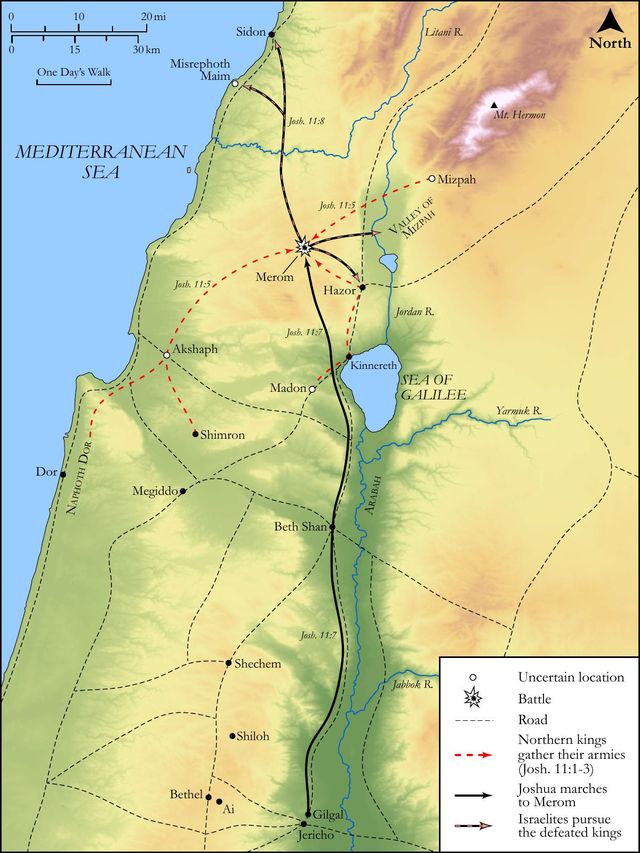
He obtained the honour and advantage of a complete victory; he smote them and chased them, in the several ways they took in their flight; some fled towards Zidon, which lay to the northwest, others towards Mizpeh, eastward, but the parties Joshua sent out pursued them each way. So the Lord delivered them into the hand of Israel; they would not deliver themselves into the hands of Israel to be made proselytes and tributaries, and so offered up to God's grace (Rom 15:16), and therefore God delivered them into their hands to be made sacrifices to his justice; for God will be honoured by us or upon us.
V.His obedience to the orders given him, in destroying the horses and chariots (Jos 11:9), which was an instance,
1.Of his subjection to the divine will, as one under authority, that must do as he is bidden.
2.Of his self-denial, and crossing his own genius and inclination in compliance with God's command.
3.Of his confidence in the power of God engaged for Israel, which enabled them to despise the chariots and horses which others trusted in, Psa 20:7; Psa 33:17.
4.Of his care to keep up in the people the like confidence in God, by taking that from them which they would be tempted to trust too much to. This was cutting of a right hand.
Continue studying Joshua 11:3 across the web’s major study libraries — every link below opens this exact verse, chapter, or book on the destination site.
Read & Compare
 BibleGatewayThis verse in more than 200 translations and 70 languages.
 Bible.comThe YouVersion reader — hundreds of translations, reading plans, and highlights.
 ESV.orgCrossway's official English Standard Version reader.
 NET BibleThe NET translation with 60,000+ translators' notes on every rendering decision.
 STEP BibleTyndale House's free study tool — original text, vocabulary, and scholarly resources.
 BibliaLogos Bible Software's free web reader.
 USCCBThe New American Bible (Revised Edition) with the U.S. bishops' study notes.
Commentaries
 BibleHub CommentariesDozens of classic commentaries on this verse, gathered on one page.
 StudyLightMore than 100 commentary sets — the largest collection on the web.
 BibleRefPlain-English commentary on what this verse means, verse by verse.
 Enduring WordDavid Guzik's free commentary on this chapter, widely used by Bible teachers.
 Bible Study ToolsVerse commentary alongside Greek and Hebrew study aids.
Original Language & Research
- BibleHub InterlinearThe verse word by word — original language, transliteration, and English.
- BibleHub LexiconEvery word's original-language definition and Strong's entry.
 Blue Letter BibleDeep-study tools — Strong's numbers, concordance, and word studies.
 SefariaThe Hebrew text with Rashi and centuries of Jewish commentary.
Sermons, Hymns & Audio


TrulyRandomVerse is not affiliated with these sites and doesn’t control their content. They’re linked because they’re genuinely useful.
Summary
Joshua 11:3 meticulously details the diverse ethnic groups inhabiting the northern regions of Canaan, specifying their geographical locations, as they prepared to confederate against Israel under the leadership of Jabin, king of Hazor. This verse serves as a critical exposition of the formidable opposition Israel faced in fulfilling God's mandate to dispossess the land, highlighting the extensive reach of the northern campaign and the varied nature of the indigenous peoples.
Context
ShowHideLiterary Context
This verse is embedded within the narrative of Joshua's northern campaign, immediately following the successful southern and central conquests (Joshua 10). Having heard of Israel's decisive victories, Jabin, the powerful king of Hazor, takes the initiative to form a vast coalition of northern kings and their armies, described as "a very great host, even as the sand which is upon the sea shore in multitude" in Joshua 11:4. Joshua 11:3 functions as a detailed roster and geographical map of the specific ethnic groups and their territories that comprised this formidable opposition, setting the stage for the climactic battle at the waters of Merom. It underscores the comprehensive nature of the challenge Israel faced in securing the promised land, moving from general accounts of conquest to specific enumerations of the remaining resistance.
Historical & Cultural Context
The Canaanite land in the days of Joshua was not a unified kingdom but a patchwork of city-states and tribal territories, often vying for dominance or forming temporary alliances. The peoples listed in Joshua 11:3—Canaanites, Amorites, Hittites, Perizzites, Jebusites, and Hivites—were well-established inhabitants with distinct cultural practices, religious beliefs (often involving Baal and Asherah worship), and territorial claims. Their presence across various terrains, from the coastal plains to the mountainous highlands and the northern reaches near Mount Hermon, reflects the diverse geography of Canaan. The act of forming a grand coalition, as seen here, was a common strategy among the nations of Canaan when facing a common threat, demonstrating the perceived strength and unity of the Israelites. God's command to dispossess these nations was not arbitrary but rooted in their idolatrous practices and moral corruption, which posed a significant spiritual threat to the nascent nation of Israel, as emphasized in passages like Deuteronomy 7:1-5.
Key Themes
ShowHideJoshua 11:3 contributes significantly to several overarching themes within the book of Joshua and the broader Pentateuch. Firstly, it highlights The Scope and Scale of the Conquest, emphasizing that the task was not merely to defeat a few isolated pockets of resistance but to confront a vast, diverse, and geographically entrenched array of peoples. This enumeration underscores the monumental nature of God's promise and the human challenge of its fulfillment. Secondly, the verse implicitly reinforces God's Faithfulness to His Covenant Promises. By listing these specific inhabitants, the text reminds the reader of God's long-standing promise to Abraham to give his descendants this land, which was already occupied by these very nations, as detailed in the Abrahamic Covenant (e.g., Genesis 15:18-21). The ongoing conquest, despite formidable opposition, is a testament to God's unwavering commitment. Thirdly, it underscores the theme of Divine Mandate and Obedience, as Joshua's campaign against these specific groups is a direct fulfillment of God's repeated command to drive out the inhabitants of the land to prevent their idolatrous practices from corrupting Israel (e.g., Exodus 23:23-24). The detailed listing here reinforces the thoroughness of the divine command and the subsequent obedience required from Israel.
Exposition and Analysis
ShowHideKey Word Analysis
ShowHideThis term refers to an inhabitant of Canaan. In the context of Joshua 11:3, it broadly denotes those dwelling in the lowlands, plains, and coastal regions "on the east and on the west" within the northern territories. They represent a significant portion of the indigenous population, frequently mentioned in the Pentateuch as a people to be dispossessed due to their idolatry and wickedness.
Likely derived from a root suggesting prominence, this term implies a "mountaineer." By the time of the conquest, the Amorites were well-established in the highlands of Canaan. Their inclusion "in the mountains" here indicates their presence in the elevated regions of northern Canaan, suggesting a strong, entrenched presence in strategic high ground, consistent with their designation as mountaineers.
This term, perhaps meaning "villager," refers to one of the aboriginal tribes of Palestine. This group is consistently associated with the northernmost regions of Canaan. Their specific mention "under Hermon in the land of Mizpeh" precisely locates them near Mount Hermon, a prominent peak marking the northern boundary of the promised land, further solidifying the geographical precision of the verse and the extensive reach of the northern coalition.
Verse Breakdown
ShowHide"And to the Canaanite on the east and on the west"
This phrase identifies the general inhabitants of the plains and valleys, specifying their presence across the breadth of the northern lowlands. This indicates that the opposition was not confined to a single geographical area but was spread widely, encompassing both the Jordan Valley to the east and potentially the coastal plains or valleys leading to them in the west. It underscores the extensive nature of the territory to be conquered.
"and to the Amorite, and the Hittite, and the Perizzite, and the Jebusite in the mountains"
This clause groups four distinct ethnic entities, explicitly locating them "in the mountains." This refers to the central and northern highlands of Canaan, a challenging terrain for military operations. The Hittites mentioned here are likely a local Canaanite group rather than the powerful Hittite empire of Anatolia, while the Jebusites are famously associated with Jerusalem (ancient Jebus). Their presence in the mountains signifies entrenched strongholds and a formidable defensive posture in the elevated regions.
"and to the Hivite under Hermon in the land of Mizpeh"
This final clause pinpoints the Hivites to the far northern reaches of Canaan. Mount Hermon is a significant geographical landmark, marking the northernmost extent of the land promised to Israel. "Mizpeh" in this context likely refers to a specific region or town in the vicinity of Hermon, further emphasizing the specific and far-reaching nature of the northern coalition. This detail highlights the comprehensive nature of the opposition and the vastness of the territory involved in the conquest.
Literary Devices
ShowHideJoshua 11:3 primarily employs Enumeration and Geographical Specification. The detailed listing of six distinct ethnic groups (Canaanite, Amorite, Hittite, Perizzite, Jebusite, Hivite) serves to emphasize the vast and diverse nature of the opposition Israel faced. This enumeration is not merely a dry list but a rhetorical device that conveys the formidable challenge of the conquest, highlighting the multitude of enemies. Coupled with this is precise Geographical Specification, which anchors each group to a particular terrain ("on the east and on the west," "in the mountains," "under Hermon in the land of Mizpeh"). This specificity not only provides a vivid mental map of the battlefield but also underscores the strategic depth and widespread nature of the resistance. The combination of these devices effectively communicates the comprehensive scope of the northern campaign and the entrenched nature of the peoples inhabiting the promised land.
Theological and Thematic Connections
ShowHideJoshua 11:3 serves as a powerful reminder of God's faithfulness in fulfilling His covenant promises, even in the face of seemingly insurmountable obstacles. The detailed listing of these diverse and geographically entrenched peoples underscores the magnitude of the task given to Israel, yet it simultaneously magnifies the power of God who enables His people to dispossess such formidable opposition. This divine mandate was not merely for territorial acquisition but for the establishment of a holy nation, free from the corrupting influence of idolatry and wickedness prevalent among these Canaanite groups. The verse thus highlights the divine imperative for Israel to be distinct and consecrated, fulfilling their role as God's chosen people in the land He had prepared for them.
Reflection and Application
ShowHideFor believers today, Joshua 11:3 offers profound insights into the nature of spiritual warfare and God's call to holiness. Just as Israel faced a diverse and geographically entrenched array of enemies, we too confront multifaceted spiritual opposition in our lives and communities. These "Canaanites" of our modern experience might manifest as deeply ingrained sinful patterns, pervasive worldly ideologies, cultural pressures that contradict biblical truth, or spiritual apathy. The detailed enumeration of the peoples in Joshua 11:3 encourages us to be discerning, to identify the specific spiritual strongholds that seek to hinder our walk with God, rather than facing a generic, undefined enemy. God's command to Israel to utterly dispossess these nations serves as a powerful metaphor for our call to thoroughly cleanse our lives of anything that stands in opposition to God's will, to "put off the old self" and "put on the new self" (Ephesians 4:22-24). Ultimately, this verse underscores God's unwavering sovereignty and His faithfulness to empower His people to overcome seemingly insurmountable obstacles when they act in obedience to His commands, reminding us that victory in spiritual battles is found in Christ, not in our own strength.
Questions for Reflection
ShowHideFAQ
ShowHideWhy does Joshua 11:3 list so many different peoples?
ShowHideJoshua 11:3 lists multiple distinct peoples—Canaanites, Amorites, Hittites, Perizzites, Jebusites, and Hivites—to emphasize the comprehensive and diverse nature of the opposition Israel faced in the northern campaign. This detailed enumeration serves several purposes: it highlights the vastness of the territory to be conquered, from the plains to the mountains and the far north; it underscores the formidable challenge of dispossessing such a varied and geographically entrenched population; and it demonstrates the fulfillment of God's earlier commands to drive out these specific nations from the land, as seen in passages like Deuteronomy 7:1. The listing also reinforces the idea that Israel's conquest was not against a single unified kingdom but against a mosaic of independent city-states and tribal groups.
What is the significance of the geographical locations mentioned in this verse?
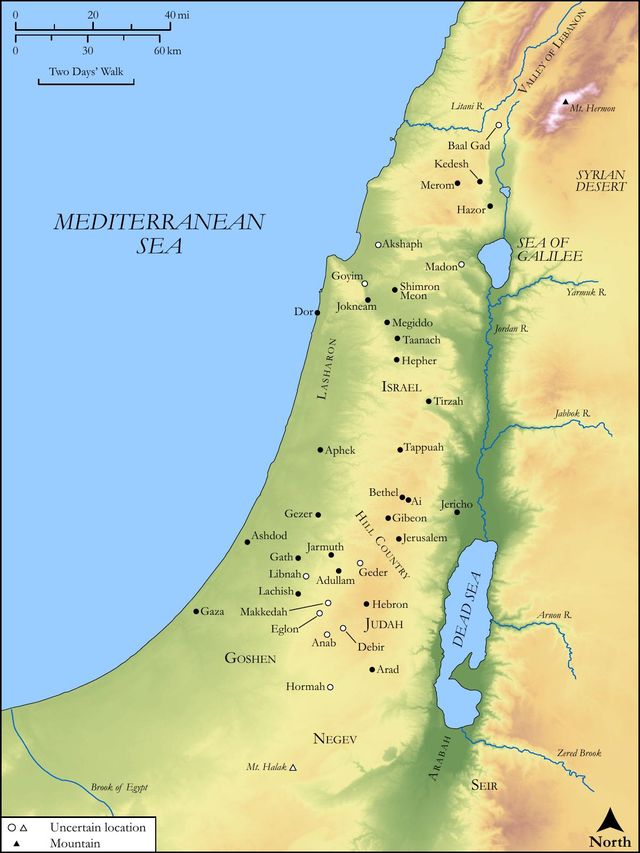
ShowHideThe geographical locations—"on the east and on the west," "in the mountains," and "under Hermon in the land of Mizpeh"—are highly significant because they provide a precise map of the northern Canaanite territories and the extent of the coalition's reach. "On the east and on the west" likely refers to the plains and valleys, indicating widespread presence. "In the mountains" points to the central highlands, a strategic and defensible region where groups like the Jebusites (associated with Jerusalem) were strong. "Under Hermon in the land of Mizpeh" clearly identifies the northernmost boundary of the promised land, showing that the opposition extended to the very limits of Israel's inheritance. This geographical specificity underscores the thoroughness of the conquest described in the book of Joshua and the comprehensive nature of God's promise to give Israel the entire land, from its southern to its northern borders, as outlined in Joshua 1:4.
Are the "Hittites" in this verse the same as the great Hittite Empire?
ShowHideWhile the Hittite Empire was a major power in Anatolia (modern-day Turkey) in those days, the "Hittites" mentioned in Joshua 11:3 and other biblical lists of Canaanite peoples are generally understood to be a smaller, localized group of people of Hittite origin who had settled in Canaan. They were likely remnants or offshoots of the broader Hittite population, or perhaps simply a group known by that name in the region. Their presence "in the mountains" of Canaan suggests they were one of the many ethnic groups inhabiting the highlands, distinct from the vast imperial power centered far to the north. This distinction is important for understanding the scope of Israel's conquest, which was primarily focused on the inhabitants of the land of Canaan itself, rather than engaging with major world empires of the time, as also suggested by the limited geographical scope described in Numbers 34:1-12.
Christ-Centered Fulfillment
ShowHideJoshua 11:3, with its detailed enumeration of the formidable and entrenched enemies of Israel, foreshadows the ultimate spiritual battle and the comprehensive victory achieved through Jesus Christ. Just as Israel was called to dispossess diverse nations from a promised land, believers are called to overcome the powers of darkness and the entrenched strongholds of sin in the spiritual realm. These "Canaanites" of the soul—idolatry, pride, lust, and rebellion—are ultimately conquered not by human might or military strategy, but by the decisive victory of Christ on the cross. He is the true Joshua, leading His people into a greater promised land, the Kingdom of God, by disarming the principalities and powers (Colossians 2:15). The detailed list of enemies in Joshua 11:3 emphasizes the totality of the opposition, mirroring the comprehensive nature of sin's dominion over humanity. Yet, Christ's sacrifice on Calvary offers a complete and final triumph over every spiritual foe, enabling His followers to live in freedom and holiness. Through His resurrection, He provides the power for believers to "put on the full armor of God" and stand firm against the schemes of the devil (Ephesians 6:11-12), ultimately inheriting an eternal kingdom where every enemy has been subdued under His feet (1 Corinthians 15:25). Thus, the physical conquest in Joshua points to the spiritual liberation and ultimate reign of Christ, who truly takes away the sin of the world and establishes His eternal dominion.