


Joshua 18:26
Bible text: King James Version (1769 Blayney text) · Public domain
Bible text: Berean Standard Bible · Public domain
Bible text: American Standard Version (1901) · Public domain
Bible text: World English Bible, Messianic edition · Public domain
Bible text: Geneva Bible (1599) · Public domain
Bible text: Young's Literal Translation · Public domain
- וְהַמִּצְפֶּהve·ha·mitz·Pehand <the> MizpahH4708Conj-w ¦ Art ¦ N-properNoun Proper Locationוְandהַ<the>מִּצְפֶּהMizpah
- וְהַכְּפִירָהve·ha·ke·fi·Rahand <the> KephirahH3716Conj-w ¦ Art ¦ N-properNoun Proper Locationוְandהַ<the>כְּפִירָהKephirah
- וְהַמֹּצָהve·ha·mo·Tzahand <the> MozahH4681Conj-w ¦ Art ¦ N-properNoun Proper Locationוְandהַ<the>מֹּצָהMozah
English is a literal word-by-word gloss of the Hebrew, not the KJV's wording. Why?
This is the original text the KJV's translators worked from — each Hebrew word with its own literal English meaning in this verse, prepared by scholars at Tyndale House, Cambridge. The KJV translates whole sentences, not word by word, so its wording differs: one Hebrew word can become several English words, and the KJV may choose “the LORD” where the gloss reads “Yahweh”. Both are faithful — they answer different questions. For the KJV's own rendering, switch to the KJV text.
Details
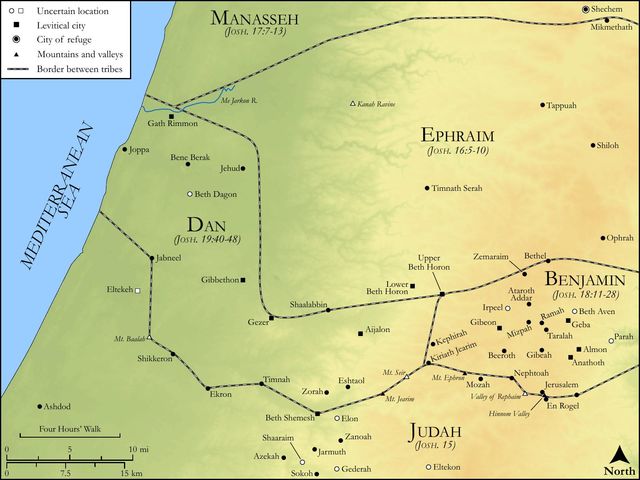
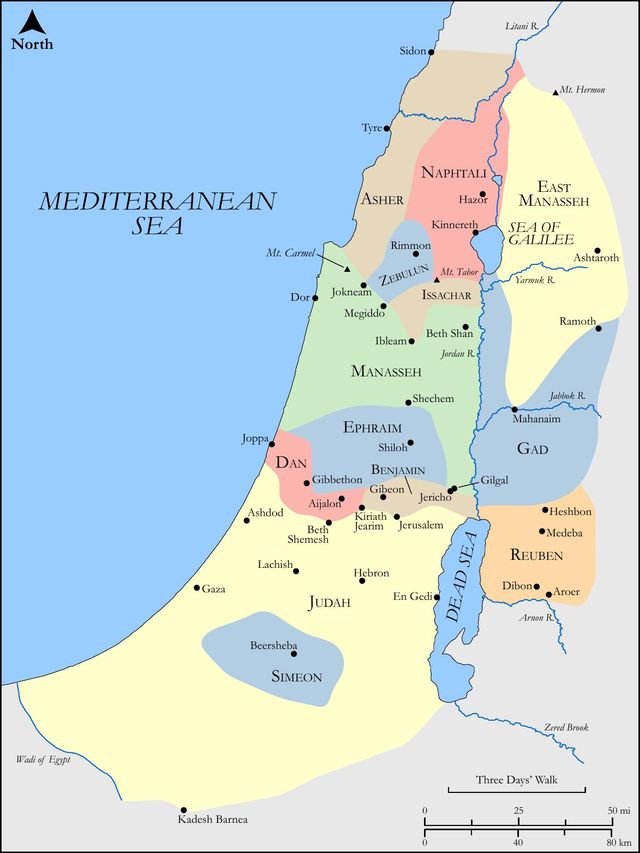
See on the biblical-era maps
Study this verse
Public-domain commentary
Matthew Henry
From his Commentary on the Whole Bible. Henry comments on passages, not single verses — this entry covers Joshua 18:11–28.
We have here the lot of the tribe of Benjamin, which Providence cast next to Joseph on the one hand, because Benjamin was own and only brother to Joseph, and was little Benjamin (Psa 68:27), that needed the protection of great Joseph, and yet had a better protector, for the Lord shall cover him all the day long, Deu 33:12. And it was next to Judah on the other hand, that this tribe might hereafter unite with Judah in an adherence to the throne of David and the temple at Jerusalem. Here we have, 1. The exact borders and limits of this tribe, which we need not be exact in the explication of. As it had Judah on the south and Joseph on the north, so it had Jordan on the east and Dan on the west. The western border is said to compass the corner of the sea southward (Jos 18:14), whereas no part of the lot of this tribe came near to the great sea. Bishop Patrick thinks the meaning is that it ran along in a parallel line to the great sea, though at a distance. Dr. Fuller suggests that since it is not called the great sea, but only the sea, which often signifies any lake or mere, it may be meant of the pool of Gibeon, which may be called a corner or canton of the sea; it is called the great waters of Gibeon (Jer 41:12), and it is compassed by the western border of this tribe. 2. The particular cities in this tribe, not all, but the most considerable. Twenty-six are here named. Jericho is put first, though dismantled, and forbidden to be rebuilt as a city with gates and walls, because it might be built and inhabited as a country village, and so was not useless to this tribe. Gilgal, where Israel first encamped when Saul was made king (Sa1 11:15), was in this tribe. It was afterwards a very profane place. Hos 9:15, All their wickedness is in Gilgal. Beth-el was in this tribe, a famous place. Though Benjamin adhered to the house of David, yet Beth-el, it seems, was in the possession of the house of Joseph (Jdg 1:23-25), and there Jeroboam set up one of his calves. In this tribe was Gibeon, where the altar was in the beginning of Solomon's time, Ch2 1:3. Gibeah likewise, that infamous place where the Levite's concubine was abused. Mizpeh, and near it Samuel's Ebenezer, and also Anathoth, Jeremiah's city, were in this tribe, as was the northern part of Jerusalem. Paul was the honour of this tribe (Rom 11:1; Phi 3:5); but where his land lay we know not: he sought the better country.
Continue studying Joshua 18:26 across the web’s major study libraries — every link below opens this exact verse, chapter, or book on the destination site.
Read & Compare
 BibleGatewayThis verse in more than 200 translations and 70 languages.
 Bible.comThe YouVersion reader — hundreds of translations, reading plans, and highlights.
 ESV.orgCrossway's official English Standard Version reader.
 NET BibleThe NET translation with 60,000+ translators' notes on every rendering decision.
 STEP BibleTyndale House's free study tool — original text, vocabulary, and scholarly resources.
 BibliaLogos Bible Software's free web reader.
 USCCBThe New American Bible (Revised Edition) with the U.S. bishops' study notes.
Commentaries
 BibleHub CommentariesDozens of classic commentaries on this verse, gathered on one page.
 StudyLightMore than 100 commentary sets — the largest collection on the web.
 BibleRefPlain-English commentary on what this verse means, verse by verse.
 Enduring WordDavid Guzik's free commentary on this chapter, widely used by Bible teachers.
 Bible Study ToolsVerse commentary alongside Greek and Hebrew study aids.
Original Language & Research
- BibleHub InterlinearThe verse word by word — original language, transliteration, and English.
- BibleHub LexiconEvery word's original-language definition and Strong's entry.
 Blue Letter BibleDeep-study tools — Strong's numbers, concordance, and word studies.
 SefariaThe Hebrew text with Rashi and centuries of Jewish commentary.
Sermons, Hymns & Audio


TrulyRandomVerse is not affiliated with these sites and doesn’t control their content. They’re linked because they’re genuinely useful.
Summary
Joshua 18:26, a seemingly simple enumeration of three cities—Mizpeh, Chephirah, and Mozah—serves as a vital detail within the meticulous account of the land distribution to the tribe of Benjamin. This verse underscores God's unwavering faithfulness in fulfilling His covenant promises to Israel, demonstrating His precise and orderly provision of the Promised Land, down to every specific town and boundary, ensuring each tribe received its divinely appointed inheritance.
Context
ShowHideLiterary Context
Joshua 18 marks a pivotal moment in the book of Joshua, detailing the allocation of land to the remaining seven tribes of Israel after Judah and the House of Joseph (Ephraim and Manasseh) had received their portions. The chapter opens with the significant act of setting up the tabernacle at Shiloh, signifying a more settled presence in the Promised Land and a central place of worship. Following this, Joshua commissions three men from each of the seven tribes to survey the remaining land and divide it into seven parts. The land was then distributed by lot at Shiloh before the Lord, ensuring a fair and divinely guided process. Verse 26, specifically, is part of the extensive list of cities and their associated villages that comprised the inheritance of the tribe of Benjamin, meticulously recorded from Joshua 18:21-28.
Historical & Cultural Context
The period described in Joshua is one of transition for the Israelites, moving from a nomadic, conquering force to a settled agricultural society. Land ownership was paramount, serving as the foundation of tribal identity, economic stability, and social structure. The concept of "inheritance" (Hebrew: nachalah) was deeply significant, representing not merely property but a permanent, divinely sanctioned possession passed down through generations. The division by lot was a practice known among the nations, but for Israel, it carried the theological weight of divine guidance and approval, ensuring that God's will was enacted in the distribution. Benjamin's territory was strategically located between the powerful tribes of Judah to the south and Ephraim to the north, encompassing important cities like Jerusalem (though it remained largely Jebusite at this time) and Jericho. The mention of Chephirah in this list is particularly noteworthy, as it was one of the four Gibeonite cities that made a deceptive treaty with Joshua, leading to their integration into Israelite society as "hewers of wood and drawers of water" (Joshua 9:17).
Key Themes
ShowHideThe meticulous listing of towns, including seemingly minor ones like Mizpeh, Chephirah, and Mozah, powerfully underscores several key themes woven throughout the book of Joshua and the broader Pentateuch. Primarily, it highlights the fulfillment of God's promises to Abraham (Genesis 12:7) and his descendants to inherit the land of Canaan. Every detail, down to each village, contributes to the narrative of divine promise meticulously realized. Secondly, the precise division of the land by lot and careful surveying reflects God's divine order and sovereignty. It established clear boundaries and responsibilities for each tribe, preventing future disputes and demonstrating God's orderly nature in His provision for His people. Finally, the concept of inheritance and identity is central; for the Israelites, their assigned territory was integral to their tribal identity and their future, serving as their permanent "heritage" or "inheritance" within the Promised Land, a concept echoed in Psalm 16:6.
Exposition and Analysis
ShowHideKey Word Analysis
ShowHideDerived from the root meaning "to watch," this name means "watchtower" or "lookout." It appears multiple times in the Old Testament for different locations. The Mizpeh mentioned here is likely the one in Benjamin's territory, which later played a significant role in Israelite history as a gathering place for the tribes, particularly in times of national crisis or assembly (e.g., Judges 20:1). Its inclusion signifies a place of strategic importance, likely offering a vantage point over the surrounding terrain.
This feminine noun means "the village." This town is notable for its historical connection as one of the four cities of the Gibeonites mentioned in the cunning treaty they made with Joshua (Joshua 9:17). Its inclusion within Benjamin's allocated territory confirms the Gibeonites' settlement within the tribal boundaries, highlighting the complex socio-political realities of the conquest era and the integration of these non-Israelite peoples.
This name is an active participle feminine, meaning "drained." While less prominent in biblical narrative compared to Mizpeh or Chephirah, its name suggests a geographical feature related to water drainage or a low-lying area. Its primary significance lies in its contribution to the exhaustive and precise geographical record of Benjamin's inheritance, reinforcing the meticulous nature of the land division and God's detailed provision.
Verse Breakdown
ShowHide"And Mizpeh"
This phrase introduces the first of three cities listed in this verse as part of the inheritance for the tribe of Benjamin. Mizpeh, a name meaning "watchtower," was a strategic location within Benjamin's territory, known for its elevated position and later historical significance as a gathering point for Israel. Its inclusion here emphasizes the detailed nature of the land allocation.
"and Chephirah"
Following Mizpeh, Chephirah is listed as another city belonging to Benjamin. This city is historically significant as one of the four Gibeonite cities that entered into a deceptive covenant with Joshua, resulting in their preservation and integration into Israelite society. Its specific mention indicates the inclusion of existing settlements, even those with a unique status, within the tribal boundaries.
"and Mozah"
The final city enumerated in this verse, Mozah, completes the trio of towns. While less prominent in the broader biblical narrative, its inclusion further underscores the exhaustive and precise nature of the land distribution. The listing of these three cities, along with others in the surrounding verses, serves to define the exact geographical boundaries and possessions of the tribe of Benjamin.
Literary Devices
ShowHideThe primary literary device employed in Joshua 18:26, and indeed throughout the lists of cities in Joshua 13-19, is Catalog or List. This technique involves the systematic enumeration of items, in this case, specific towns. Its use here serves to emphasize the completeness, precision, and divine order of the land distribution. The meticulous detail of these lists is not merely geographical record-keeping but a theological statement, demonstrating God's faithfulness in fulfilling His promises to Israel down to the very last detail. The repeated use of the conjunction "and" (a form of polysyndeton) before each city name ("And Mizpeh, and Chephirah, and Mozah") further emphasizes the distinct inclusion of each entity, giving weight and significance to every single place named, underscoring the thoroughness of the divine provision and the established boundaries. This precise Geographical Precision is a characteristic feature of the book of Joshua, grounding the theological narrative in tangible, verifiable locations.
Theological and Thematic Connections
ShowHideJoshua 18:26, though a mere fragment of a lengthy list, is profoundly significant in its theological implications. It speaks volumes about the character of God – His faithfulness, His meticulousness, and His commitment to fulfilling His covenant promises. The precise allocation of land, down to individual cities, demonstrates that God's promises are not vague generalities but specific, tangible realities. This detailed provision for Benjamin, a relatively small tribe, illustrates God's care for every part of His people, ensuring that each received its rightful inheritance. It also highlights the concept of divine order and the importance of boundaries, both physical and spiritual, for the flourishing of God's people. Just as Israel was given a defined inheritance, believers today are called to understand and inhabit the spiritual inheritance they have in Christ.
Reflection and Application
ShowHideThe seemingly mundane listing of cities in Joshua 18:26 offers profound insights for contemporary believers. It serves as a powerful reminder that God is faithful not only in grand, sweeping acts but also in the intricate, often unseen, details of our lives. Just as He meticulously surveyed and distributed the land to each tribe, ensuring every family had a place, He orchestrates the specific circumstances, provisions, and relationships that shape our existence. This verse encourages us to trust in God's sovereign care, knowing that He is attentive to our needs and committed to fulfilling His promises to us, even in what might appear to be insignificant details. Furthermore, it prompts us to reflect on our own "inheritance"—not merely material possessions, but the spiritual blessings and gifts we have received in Christ. We are called to recognize, appreciate, and steward these gifts, living fully within the boundaries and provisions God has established for us, understanding that our true identity is found in our relationship with Him and our place within His kingdom.
Questions for Reflection
ShowHideFAQ
ShowHideWhy are these specific cities listed, and what is their significance?
ShowHideThese cities—Mizpeh, Chephirah, and Mozah—are listed as part of the detailed record of the land inheritance given to the tribe of Benjamin. Their inclusion serves several purposes:
What is the broader message of these detailed lists of cities in Joshua?
ShowHideWhile seemingly mundane, the detailed lists of cities throughout Joshua (including Joshua 18) convey profound theological messages. They emphasize God's absolute sovereignty and meticulous care in fulfilling His promises. The land was not acquired by chance or human might alone, but by divine decree and precise allocation. These lists validate the historical reality of the conquest and settlement, grounding the spiritual narrative in tangible geography. They also highlight the importance of inheritance and belonging for the Israelite identity, demonstrating that God provides a secure and defined place for His people.
Christ-Centered Fulfillment
ShowHideThe physical inheritance of land in Joshua 18:26, meticulously detailed for the tribe of Benjamin, points forward to the greater, spiritual inheritance found in Jesus Christ. The Promised Land, with its specific boundaries and provisions, was a type and shadow of the ultimate "rest" and dwelling place that God provides for His people. Just as the Israelites entered into a physical inheritance after a period of wandering and conquest, believers in Christ enter into a spiritual inheritance of salvation, peace, and eternal life, not through their own striving but through the finished work of Jesus. He is the true "place" where we find our security, identity, and belonging. The land of Canaan, though a blessing, was temporary and imperfect; it was a foretaste of the eternal kingdom and the new heavens and new earth where righteousness dwells (2 Peter 3:13). Jesus, as the ultimate fulfillment of God's covenant promises, is the one who secures for us an "inheritance that is imperishable, undefiled, and unfading, kept in heaven for you" (1 Peter 1:4). Through Him, we are not merely given a plot of land, but adopted as co-heirs with Christ (Romans 8:17), inheriting all the spiritual blessings in the heavenly places (Ephesians 1:3) and the promise of dwelling eternally in the presence of God, the ultimate "rest" that the land of Canaan could only foreshadow (Hebrews 4:9-11).