


Jeremiah 41:14
Bible text: King James Version (1769 Blayney text) · Public domain
Bible text: Berean Standard Bible · Public domain
Bible text: American Standard Version (1901) · Public domain
Bible text: World English Bible, Messianic edition · Public domain
Bible text: Geneva Bible (1599) · Public domain
Bible text: Young's Literal Translation · Public domain
- וַיָּסֹבּוּvai·ya·So·buand they turned roundH5437Conj-w ¦ V-Qal-ConsecImperf-3mpVerb Qal Consecutive Imperfect 3rd Plural Masculineוַandיָּסֹבּוּthey turned round
- כָּלkolallH3605N-mscNoun Singular Masculine Construct
- הָעָםha·'Amthe peopleH5971Art ¦ N-msNoun Singular Masculine Absoluteהָtheעָםpeople
- אֲשֶׁר'a·SherwhichH834RelParticle Relative
- שָׁבָהsha·Vahhe had taken captiveH7617V-Qal-Perf-3msVerb Qal Perfect 3rd Singular Masculine
- יִשְׁמָעֵאלyish·ma·'ElIshmaelH3458N-proper-mNoun Proper Masculine
- מִןminfromH4480PrepPreposition
- הַמִּצְפָּהha·mitz·Pah<the> MizpahH4709Art ¦ N-properNoun Proper Locationהַ<the>מִּצְפָּהMizpah
- וַיָּשֻׁבוּvai·ya·Shu·vuand they turned backH7725Conj-w ¦ V-Qal-ConsecImperf-3mpVerb Qal Consecutive Imperfect 3rd Plural Masculineוַandיָּשֻׁבוּthey turned back
- וַיֵּלְכוּvai·Ye·le·Khuand they wentH1980Conj-w ¦ V-Qal-ConsecImperf-3mpVerb Qal Consecutive Imperfect 3rd Plural Masculineוַandיֵּלְכוּthey went
- אֶל'eltoH413PrepPreposition
- יוֹחָנָןyo·cha·NanJohananH3110N-proper-mNoun Proper Masculine
- בֶּןben[the] son ofH1121N-mscNoun Singular Masculine Construct
- קָרֵחַka·Re·achKareahH7143N-proper-mNoun Proper Masculine
English is a literal word-by-word gloss of the Hebrew, not the KJV's wording. Why?
This is the original text the KJV's translators worked from — each Hebrew word with its own literal English meaning in this verse, prepared by scholars at Tyndale House, Cambridge. The KJV translates whole sentences, not word by word, so its wording differs: one Hebrew word can become several English words, and the KJV may choose “the LORD” where the gloss reads “Yahweh”. Both are faithful — they answer different questions. For the KJV's own rendering, switch to the KJV text.
Details
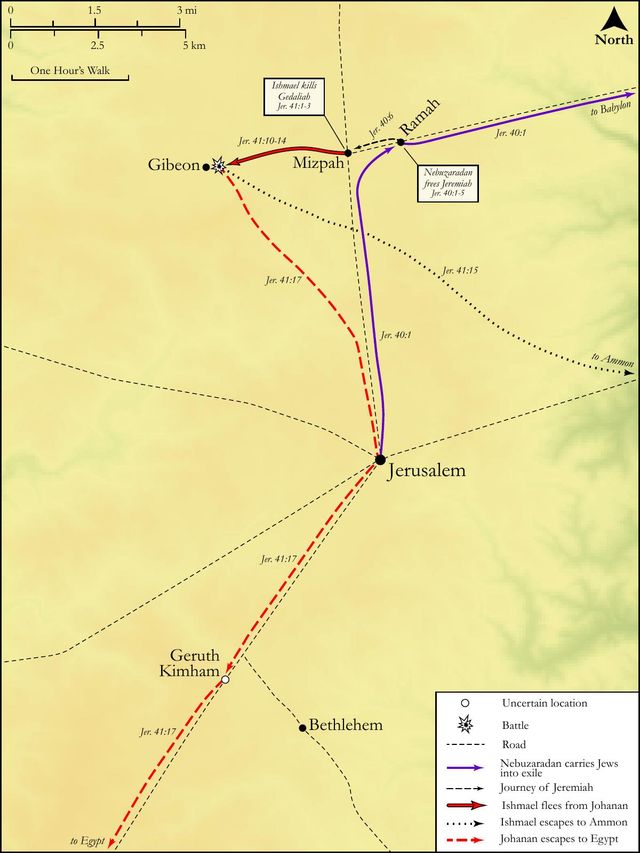
See on the biblical-era map
Study this verse
Public-domain commentary
Matthew Henry
From his Commentary on the Whole Bible. Henry comments on passages, not single verses — this entry covers Jeremiah 41:11–18.
It would have been well if Johanan, when he gave information to Gedaliah of Ishmael's treasonable design, though he could not obtain leave to kill Ishmael and to prevent it that way, yet had staid with Gedaliah; for he, and his captains, and their forces, might have been a life-guard to Gedaliah and a terror to Ishmael, and so have prevented the mischief without the effusion of blood: but, it seems they were out upon some expedition, perhaps no good one, and so were out of the way when they should have been upon the best service. Those that affect to ramble are many times out of their place when they are most needed. However, at length they hear of all the evil that Ishmael had done (Jer 41:11), and are resolved to try an after-game, which we have an account of in these verses. 1. We heartily wish Johanan could have taken revenge upon the murderers, but he prevailed only to rescue the captives. Those that had shed so much blood, it was a pity but their blood should have been shed; and it is strange that vengeance suffered them to live; yet it did. Johanan gathered what forces he could and went to fight with Ishmael (Jer 41:12), upon notice of the murders he had committed (for though he concealed it for a time, Jer 41:4, yet murder will out) and which way he was gone; he pursued him, and overtook him by the great pool of Gibeon, which we read of, Sa2 2:13. And, upon his appearing with such a force, Ishmael's heart failed him, his guilty conscience flew in his face, and he durst not stand his ground against an enemy that was something like a match for him. The most cruel are often the most cowardly. The poor captives were glad when they saw Johanan and the captains that were with him, looking upon them as their deliverers (Jer 41:13), and they immediately found a way to wheel about and come over to them (Jer 41:14), Ishmael not offering to detain them when he saw Johanan. Note, Those that would be helped must help themselves. These captives staid not till their conquerors were beaten, but took the first opportunity to make their escape, as soon as they saw their friends appear and their enemies thereby disheartened. Ishmael quitted his pray to save his life, and escaped with eight men, Jer 41:15. it seems, two of his ten men, that were his banditti or assassins (spoken of Jer 41:1), either deserted him or were killed in the engagement; but he made the best of his way to the Ammonites, as a perfect renegado, that had quite abandoned all relation to the commonwealth of Israel, though he was of the seed royal, and we hear no more of him. 2. We heartily wish that Johanan, when he had rescued the captives, would have sat down quietly with them, and governed them peaceably, as Gedaliah did; but, instead of that, he is for leading them into the land of Egypt, as Ishmael would have led them into the land of the Ammonites; so that though he got the command over them in a better way than Ishmael did, and honestly enough, yet he did not use it much better. Gedaliah, who was of a meek and quiet spirit, was a great blessing to them; but Johanan, who was of a fierce and restless spirit, was set over them for their hurt, and to complete their ruin, even after they were, as they thought, redeemed. Thus did God still walk contrary to them. (1.) The resolution of Johanan and the captains was very rash; nothing would serve them but they would go to enter into Egypt (Jer 41:17), and, in order to that, they encamped for a time in the habitation of Chimham, by Bethlehem, David's city. Probably it was some land which David gave to Chimham, the son of Barzillai, which, though it returned to David's family at the year of the Jubilee, yet still bore the name of Chimham. Here Johanan made his headquarters, steering his course towards Egypt, either from a personal affection to that country or an ancient national confidence in the Egyptians for help in distress. Some of the mighty men of war, it seems had escaped; those he took with him, and the women and children, whom he had recovered from Ishmael, who were thus emptied from vessel to vessel, because they were yet unchanged. (2.) The reason for this resolution was very frivolous. They pretended that they were afraid of the Chaldeans, that they would come and do I know not what with them, because Ishmael had killed Gedaliah, Jer 41:18. I cannot think they really had any apprehensions of danger upon this account; for, though it is true that the Chaldeans had cause enough to resent the murder of their viceroy, yet they were not so unreasonable, or unjust, as to revenge it upon those who appeared so vigorously against the murderers. But they only make use of this as a sham to cover that corrupt inclination of their unbelieving ancestors, which was so strong in them, to return into Egypt. Those will justly lose their comfort in real fears that excuse themselves in sin with pretended fears.
Continue studying Jeremiah 41:14 across the web’s major study libraries — every link below opens this exact verse, chapter, or book on the destination site.
Read & Compare
 BibleGatewayThis verse in more than 200 translations and 70 languages.
 Bible.comThe YouVersion reader — hundreds of translations, reading plans, and highlights.
 ESV.orgCrossway's official English Standard Version reader.
 NET BibleThe NET translation with 60,000+ translators' notes on every rendering decision.
 STEP BibleTyndale House's free study tool — original text, vocabulary, and scholarly resources.
 BibliaLogos Bible Software's free web reader.
 USCCBThe New American Bible (Revised Edition) with the U.S. bishops' study notes.
Commentaries
 BibleHub CommentariesDozens of classic commentaries on this verse, gathered on one page.
 StudyLightMore than 100 commentary sets — the largest collection on the web.
 BibleRefPlain-English commentary on what this verse means, verse by verse.
 Enduring WordDavid Guzik's free commentary on this chapter, widely used by Bible teachers.
 Bible Study ToolsVerse commentary alongside Greek and Hebrew study aids.
Original Language & Research
- BibleHub InterlinearThe verse word by word — original language, transliteration, and English.
- BibleHub LexiconEvery word's original-language definition and Strong's entry.
 Blue Letter BibleDeep-study tools — Strong's numbers, concordance, and word studies.
 SefariaThe Hebrew text with Rashi and centuries of Jewish commentary.
Sermons, Hymns & Audio


TrulyRandomVerse is not affiliated with these sites and doesn’t control their content. They’re linked because they’re genuinely useful.
Summary
Jeremiah 41:14 vividly describes a pivotal moment in the aftermath of Gedaliah's assassination, where the people whom Ishmael had violently taken captive from Mizpah made a decisive choice. Recognizing the opportunity amidst their perilous journey, they actively turned away from their treacherous captor, Ishmael, and returned to align themselves with Johanan the son of Kareah, who represented a beacon of stability and legitimate leadership in a time of profound chaos and national distress. This verse marks a significant shift, demonstrating the agency of the captives and the rejection of Ishmael's illegitimate authority.
Context
ShowHideLiterary Context
Jeremiah 41:14 is situated within a harrowing narrative of betrayal and survival following the Babylonian destruction of Jerusalem in 586 BC. Chapters 40-44 detail the plight of the Jewish remnant left in Judah under the governorship of Gedaliah, appointed by Babylon. Ishmael, a man of royal descent, treacherously assassinated Gedaliah and his associates at Mizpah, then took the remaining inhabitants captive, intending to flee to the Ammonites, as detailed in Jeremiah 41:2-3. Johanan the son of Kareah, who had previously warned Gedaliah of Ishmael's plot in Jeremiah 40:13-16, pursued Ishmael to rescue the captives. This verse marks the successful turning point in Johanan's pursuit, where the captives themselves, seeing their opportunity, abandon Ishmael and return to Johanan, setting the stage for the subsequent decision-making process regarding their future, as detailed in Jeremiah 42.
Historical & Cultural Context
The period immediately following the fall of Jerusalem was one of immense upheaval and instability. The Babylonian empire had devastated Judah, removing its monarchy and much of its population to exile. The appointment of Gedaliah as governor was an attempt to establish some semblance of order among the remnant. Mizpah, a significant ancient site, became the administrative center for this remnant, highlighting its strategic importance. Ishmael's actions were not merely criminal but politically destabilizing, threatening to undo any fragile peace and potentially provoke further Babylonian retribution. His intent to flee to Ammon, a long-standing enemy of Israel, underscores the desperate and dangerous nature of the situation. The people's decision to return to Johanan reflects a cultural understanding of seeking refuge and legitimate authority, particularly in a time when the traditional structures of leadership had collapsed.
Key Themes
ShowHideThis verse contributes to several overarching themes within Jeremiah and the broader biblical narrative. It powerfully illustrates the theme of leadership, contrasting the illegitimate, treacherous rule of Ishmael with the more righteous and protective leadership offered by Johanan. It highlights divine providence and deliverance, even amidst human depravity and national catastrophe, as God's hand is seen in the opportunity for the captives to escape their oppressor. The verse also speaks to the theme of human agency and choice, as the captives actively "cast about and returned," demonstrating their will to reject tyranny and seek safety. Furthermore, it subtly touches upon the remnant theology, focusing on the small group of survivors in Judah and their ongoing struggles for survival and faithfulness, a theme prevalent throughout prophetic literature, as seen in passages like Isaiah 10:20-22.
Exposition and Analysis
ShowHideKey Word Analysis
ShowHideFrom עָמַם; a people (as a congregated unit); specifically, a tribe (as those of Israel); hence (collectively) troops or attendants; figuratively, a flock. In this context, ʻam refers to the collective body of Jewish survivors who had been taken captive by Ishmael. It emphasizes their identity as a distinct group, a remnant of God's chosen people, whose fate is central to the ongoing narrative of Judah.
A primitive root; to revolve, surround, or border; used in various applications, literally and figuratively; bring, cast, fetch, lead, make, walk, [idiom] whirl, [idiom] round about, be about on every side, apply, avoid, beset (about), besiege, bring again, carry (about), change, cause to come about, [idiom] circuit, (fetch a) compass (about, round), drive, environ, [idiom] on every side, beset (close, come, compass, go, stand) round about, inclose, remove, return, set, sit down, turn (self) (about, aside, away, back). This verb signifies a deliberate turning or revolving, indicating a conscious and active decision by the captives to change their direction and allegiance, rather than being passively rescued.
A primitive root; to turn back (hence, away) transitively or intransitively, literally or figuratively (not necessarily with the idea of return to the starting point); generally to retreat; often adverbial, again; ((break, build, circumcise, dig, do anything, do evil, feed, lay down, lie down, lodge, make, rejoice, send, take, weep)) [idiom] again, (cause to) answer ([phrase] again), [idiom] in any case (wise), [idiom] at all, averse, bring (again, back, home again), call (to mind), carry again (back), cease, [idiom] certainly, come again (back), [idiom] consider, [phrase] continually, convert, deliver (again), [phrase] deny, draw back, fetch home again, [idiom] fro, get (oneself) (back) again, [idiom] give (again), go again (back, home), (go) out, hinder, let, (see) more, [idiom] needs, be past, [idiom] pay, pervert, pull in again, put (again, up again), recall, recompense, recover, refresh, relieve, render (again), requite, rescue, restore, retrieve, (cause to, make to) turn (again, self again, away, back, back again, backward, from, off), withdraw. This word reinforces the active nature of their decision. Coupled with "cast about," it paints a picture of a decisive reversal of course, signifying not just a physical turning but a rejection of Ishmael's path and a re-orientation towards safety and legitimate authority.
Verse Breakdown
ShowHide"So all the people that Ishmael had carried away captive from Mizpah"
This clause identifies the subjects of the action: the entire group of Jewish survivors whom Ishmael had forcibly abducted from Mizpah. They were a vulnerable remnant, dispossessed and now enslaved, facing an uncertain and dangerous future at the hands of a ruthless betrayer.
"cast about and returned"
This is the pivotal action of the verse. The double verb emphasizes the active and deliberate nature of their decision. "Cast about" (or "turned around") indicates a change of direction, while "returned" signifies their movement back towards a place of safety and away from their captor. This was an act of courage and self-preservation, seizing an opportune moment to escape tyranny.
"and went unto Johanan the son of Kareah"
This clause specifies the destination and new allegiance of the liberated captives. By turning to Johanan, they sought refuge and placed themselves under the protection of a leader who had demonstrated integrity and concern for their welfare, contrasting sharply with Ishmael's murderous intent. This choice was a vote of confidence in Johanan's leadership.
Literary Devices
ShowHideThe verse employs several literary devices to convey its powerful message. Contrast is evident in the stark opposition between Ishmael, the treacherous and violent captor, and Johanan, the pursuing rescuer and legitimate leader. This highlights the choice the people faced between continued oppression and a path toward potential safety. The phrase "cast about and returned" utilizes active verbs that emphasize the agency of the captives, transforming them from passive victims into active participants in their own deliverance. This active turning can also be seen as Symbolism, representing a broader theological theme of turning away from evil and turning towards righteousness or a divinely appointed deliverer. The rapid shift in allegiance and direction also creates a sense of dramatic tension and relief, marking a significant turning point in the narrative of the remnant.
Theological and Thematic Connections
ShowHideJeremiah 41:14 offers profound theological and thematic connections, illustrating God's providential care even in the darkest hours of human depravity and national collapse. The people's decisive "turning" from Ishmael to Johanan mirrors a spiritual principle: the necessity of turning away from destructive paths and aligning with righteous leadership. This act of choosing safety and integrity over continued peril reflects a deeper biblical call to repentance and reorientation towards God's will. Even when human leaders fail or betray, God often raises up others or orchestrates circumstances to provide deliverance for His people, demonstrating His faithfulness to preserve a remnant. The verse underscores that true security is found not in human strength or political maneuvering, but in discerning and following those who embody integrity and seek the welfare of others, ultimately pointing to the divine Shepherd who truly cares for His flock.
Reflection and Application
ShowHideJeremiah 41:14 serves as a powerful reminder that even in the most chaotic and dangerous circumstances, there can be opportunities for deliverance and the exercise of personal agency. The captives, facing imminent peril, made a courageous and decisive choice to turn away from their oppressor and embrace a path toward safety and legitimate leadership. For us today, this narrative encourages discernment in identifying and choosing leaders who embody integrity, compassion, and a genuine concern for the well-being of others, rather than those driven by selfish ambition or malice. It also offers a message of hope: even when we feel trapped or victimized by circumstances or individuals, there can be a moment, a turning point, where we can choose to reorient our lives, seek true refuge, and align ourselves with what is good and right. This might involve turning away from harmful relationships, destructive habits, or misleading ideologies, and instead moving towards sources of spiritual and emotional health.
Questions for Reflection
ShowHideFAQ
ShowHideWho was Ishmael and why was he a threat?
ShowHideIshmael, described as being of royal descent, was a treacherous figure who emerged after the Babylonian destruction of Jerusalem. He was a threat because he assassinated Gedaliah, the Babylonian-appointed governor over the Jewish remnant, along with many others, including both Jews and Babylonians, at Mizpah (Jeremiah 41:2-3). His actions plunged the already fragile remnant into further chaos and fear, jeopardizing their very existence and risking severe Babylonian reprisal. He then took the remaining inhabitants captive, intending to flee with them to the Ammonites, a hostile nation, effectively enslaving them and removing them from their homeland.
Why did the captives return to Johanan?
ShowHideThe captives returned to Johanan because he represented a legitimate and protective alternative to Ishmael's tyranny. Johanan had previously attempted to warn Gedaliah about Ishmael's plot (Jeremiah 40:13-16) and was actively pursuing Ishmael to rescue them. The captives, likely realizing Ishmael's malicious intent and seeing Johanan's forces approaching, seized the opportunity to escape their perilous situation. Their act of "casting about and returning" was a deliberate choice to align themselves with a leader who offered safety and stability, demonstrating their rejection of Ishmael's cruel and illegitimate authority.
What is the significance of Mizpah in this context?
ShowHideMizpah was a historically significant site in Israel, often associated with gatherings, covenants, and acts of judgment. In this context, after the fall of Jerusalem, Mizpah became the administrative center for the Jewish remnant left in Judah under Gedaliah's governorship. It represented the last vestige of organized Jewish life in the land before the final dispersion. Ishmael's massacre at Mizpah and the subsequent captivity of its inhabitants were therefore not just isolated acts of violence but symbolic attacks on the very heart of the surviving Jewish community in Judah, further deepening the national trauma and despair. The people's return from Mizpah, though under duress, signified a desperate attempt to reclaim some semblance of order and safety from the chaos unleashed there.
Christ-Centered Fulfillment
ShowHideJeremiah 41:14, though set in a specific historical moment of ancient Israel's brokenness, finds profound Christ-centered fulfillment in its themes of deliverance, righteous leadership, and the decisive turning of a people. Just as the captives turned from the treacherous Ishmael to the protective Johanan, humanity, held captive by sin and death, is called to turn to Jesus Christ, the ultimate Deliverer. Christ is the true Shepherd who lays down His life for His sheep (John 10:11), unlike the false shepherds who lead to destruction. He is the Lamb of God who takes away the sin of the world (John 1:29), offering freedom from the tyranny of spiritual bondage. Our salvation is not passive; it involves a decisive "casting about and returning"—a repentance that turns us away from the path of sin and self-destruction and toward the life-giving embrace of Christ. He is the only name under heaven given among mortals by which we must be saved (Acts 4:12), inviting all who are weary and burdened to come to Him for rest (Matthew 11:28). Thus, the physical turning of the captives in Jeremiah foreshadows the spiritual turning of all believers to their true and faithful Lord.