


Jeremiah 41:13
Bible text: King James Version (1769 Blayney text) · Public domain
Bible text: King James Version with Strong's numbers · Public domain
Bible text: Berean Standard Bible · Public domain
Bible text: American Standard Version (1901) · Public domain
Bible text: World English Bible, Messianic edition · Public domain
Bible text: Geneva Bible (1599) · Public domain
Bible text: Young's Literal Translation · Public domain
- וַיְהִיvay·Hiand it wasH1961Conj-w ¦ V-Qal-ConsecImperf-3msVerb Qal Consecutive Imperfect 3rd Singular Masculineוַandיְהִיit was
- כִּרְאוֹתkir·'otwhen sawH7200Prep-k ¦ V-Qal-InfVerb Qal Infinitive Constructכִּwhenרְאוֹתsaw
- כָּלkolallH3605N-mscNoun Singular Masculine Construct
- הָעָםha·'Amthe peopleH5971Art ¦ N-msNoun Singular Masculine Absoluteהָtheעָםpeople
- אֲשֶׁר'a·SherwhichH834RelParticle Relative
- אֶת'et[was] withH854PrepPreposition
- יִשְׁמָעֵאלyish·ma·'ElIshmaelH3458N-proper-mNoun Proper Masculine
- אֶת'et<obj.>H853DirObjMParticle Object Indicator
- יוֹחָנָןyo·cha·NanJohananH3110N-proper-mNoun Proper Masculine
- בֶּןben[the] son ofH1121N-mscNoun Singular Masculine Construct
- קָרֵחַka·Re·achKareahH7143N-proper-mNoun Proper Masculine
- וְאֵתve·'Etand <obj.>H853Conj-w ¦ DirObjMParticle Object Indicatorוְandאֵת<obj.>
- כָּלkolallH3605N-mscNoun Singular Masculine Construct
- שָׂרֵיsa·Rei[the] commanders ofH8269N-mpcNoun Plural Masculine Construct
- הַחֲיָלִיםha·cha·ya·Limthe armiesH2428Art ¦ N-mpNoun Plural Masculine Absoluteהַtheחֲיָלִיםarmies
- אֲשֶׁר'a·SherwhoH834RelParticle Relative
- אִתּוֹ'i·To[were] with himH854Prep ¦ 3msPreposition Definiteאִתּ[were] withוֹhim
- וַיִּשְׂמָחוּvai·yis·Ma·chuand they were gladH8055Conj-w ¦ V-Qal-ConsecImperf-3mpVerb Qal Consecutive Imperfect 3rd Plural Masculineוַandיִּשְׂמָחוּthey were glad
English is a literal word-by-word gloss of the Hebrew, not the KJV's wording. Why?
This is the original text the KJV's translators worked from — each Hebrew word with its own literal English meaning in this verse, prepared by scholars at Tyndale House, Cambridge. The KJV translates whole sentences, not word by word, so its wording differs: one Hebrew word can become several English words, and the KJV may choose “the LORD” where the gloss reads “Yahweh”. Both are faithful — they answer different questions. For the KJV's own rendering, switch to the KJV text.
Details
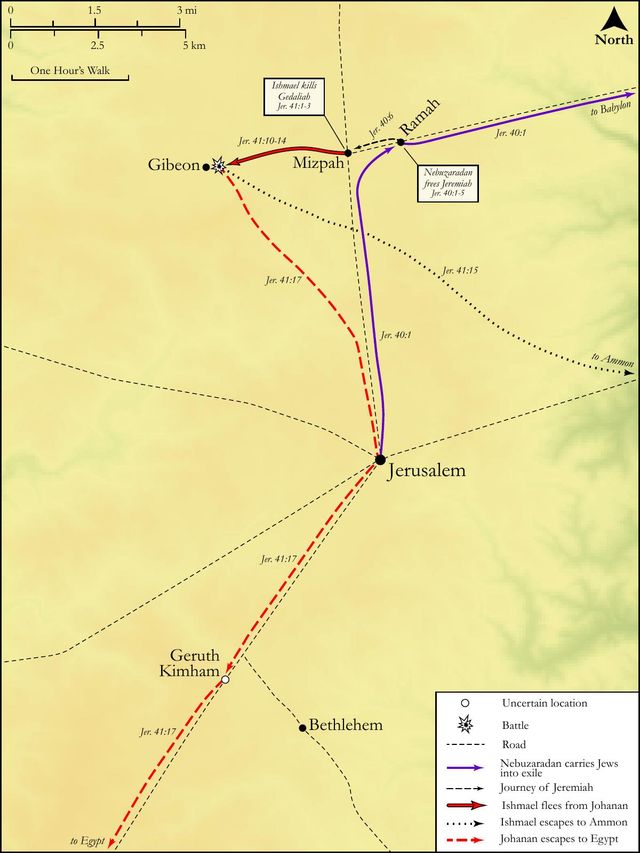
See on the biblical-era map
Study this verse
Public-domain commentary
Matthew Henry
From his Commentary on the Whole Bible. Henry comments on passages, not single verses — this entry covers Jeremiah 41:11–18.
It would have been well if Johanan, when he gave information to Gedaliah of Ishmael's treasonable design, though he could not obtain leave to kill Ishmael and to prevent it that way, yet had staid with Gedaliah; for he, and his captains, and their forces, might have been a life-guard to Gedaliah and a terror to Ishmael, and so have prevented the mischief without the effusion of blood: but, it seems they were out upon some expedition, perhaps no good one, and so were out of the way when they should have been upon the best service. Those that affect to ramble are many times out of their place when they are most needed. However, at length they hear of all the evil that Ishmael had done (Jer 41:11), and are resolved to try an after-game, which we have an account of in these verses. 1. We heartily wish Johanan could have taken revenge upon the murderers, but he prevailed only to rescue the captives. Those that had shed so much blood, it was a pity but their blood should have been shed; and it is strange that vengeance suffered them to live; yet it did. Johanan gathered what forces he could and went to fight with Ishmael (Jer 41:12), upon notice of the murders he had committed (for though he concealed it for a time, Jer 41:4, yet murder will out) and which way he was gone; he pursued him, and overtook him by the great pool of Gibeon, which we read of, Sa2 2:13. And, upon his appearing with such a force, Ishmael's heart failed him, his guilty conscience flew in his face, and he durst not stand his ground against an enemy that was something like a match for him. The most cruel are often the most cowardly. The poor captives were glad when they saw Johanan and the captains that were with him, looking upon them as their deliverers (Jer 41:13), and they immediately found a way to wheel about and come over to them (Jer 41:14), Ishmael not offering to detain them when he saw Johanan. Note, Those that would be helped must help themselves. These captives staid not till their conquerors were beaten, but took the first opportunity to make their escape, as soon as they saw their friends appear and their enemies thereby disheartened. Ishmael quitted his pray to save his life, and escaped with eight men, Jer 41:15. it seems, two of his ten men, that were his banditti or assassins (spoken of Jer 41:1), either deserted him or were killed in the engagement; but he made the best of his way to the Ammonites, as a perfect renegado, that had quite abandoned all relation to the commonwealth of Israel, though he was of the seed royal, and we hear no more of him. 2. We heartily wish that Johanan, when he had rescued the captives, would have sat down quietly with them, and governed them peaceably, as Gedaliah did; but, instead of that, he is for leading them into the land of Egypt, as Ishmael would have led them into the land of the Ammonites; so that though he got the command over them in a better way than Ishmael did, and honestly enough, yet he did not use it much better. Gedaliah, who was of a meek and quiet spirit, was a great blessing to them; but Johanan, who was of a fierce and restless spirit, was set over them for their hurt, and to complete their ruin, even after they were, as they thought, redeemed. Thus did God still walk contrary to them. (1.) The resolution of Johanan and the captains was very rash; nothing would serve them but they would go to enter into Egypt (Jer 41:17), and, in order to that, they encamped for a time in the habitation of Chimham, by Bethlehem, David's city. Probably it was some land which David gave to Chimham, the son of Barzillai, which, though it returned to David's family at the year of the Jubilee, yet still bore the name of Chimham. Here Johanan made his headquarters, steering his course towards Egypt, either from a personal affection to that country or an ancient national confidence in the Egyptians for help in distress. Some of the mighty men of war, it seems had escaped; those he took with him, and the women and children, whom he had recovered from Ishmael, who were thus emptied from vessel to vessel, because they were yet unchanged. (2.) The reason for this resolution was very frivolous. They pretended that they were afraid of the Chaldeans, that they would come and do I know not what with them, because Ishmael had killed Gedaliah, Jer 41:18. I cannot think they really had any apprehensions of danger upon this account; for, though it is true that the Chaldeans had cause enough to resent the murder of their viceroy, yet they were not so unreasonable, or unjust, as to revenge it upon those who appeared so vigorously against the murderers. But they only make use of this as a sham to cover that corrupt inclination of their unbelieving ancestors, which was so strong in them, to return into Egypt. Those will justly lose their comfort in real fears that excuse themselves in sin with pretended fears.
Continue studying Jeremiah 41:13 across the web’s major study libraries — every link below opens this exact verse, chapter, or book on the destination site.
Read & Compare
 BibleGatewayThis verse in more than 200 translations and 70 languages.
 Bible.comThe YouVersion reader — hundreds of translations, reading plans, and highlights.
 ESV.orgCrossway's official English Standard Version reader.
 NET BibleThe NET translation with 60,000+ translators' notes on every rendering decision.
 STEP BibleTyndale House's free study tool — original text, vocabulary, and scholarly resources.
 BibliaLogos Bible Software's free web reader.
 USCCBThe New American Bible (Revised Edition) with the U.S. bishops' study notes.
Commentaries
 BibleHub CommentariesDozens of classic commentaries on this verse, gathered on one page.
 StudyLightMore than 100 commentary sets — the largest collection on the web.
 BibleRefPlain-English commentary on what this verse means, verse by verse.
 Enduring WordDavid Guzik's free commentary on this chapter, widely used by Bible teachers.
 Bible Study ToolsVerse commentary alongside Greek and Hebrew study aids.
Original Language & Research
- BibleHub InterlinearThe verse word by word — original language, transliteration, and English.
- BibleHub LexiconEvery word's original-language definition and Strong's entry.
 Blue Letter BibleDeep-study tools — Strong's numbers, concordance, and word studies.
 SefariaThe Hebrew text with Rashi and centuries of Jewish commentary.
Sermons, Hymns & Audio


TrulyRandomVerse is not affiliated with these sites and doesn’t control their content. They’re linked because they’re genuinely useful.
Summary
Jeremiah 41:13 vividly captures a pivotal moment of profound relief and unexpected deliverance for a captive remnant of Judah. Following the devastating fall of Jerusalem and the subsequent assassination of the Babylonian-appointed governor Gedaliah by the treacherous Ishmael, a group of survivors, including the king's daughters, found themselves abducted and led towards Ammonite territory. This verse describes the immediate and overwhelming joy experienced by these captives when they sighted Johanan son of Kareah and his forces approaching, signaling their potential rescue from Ishmael's cruel grasp and a desperate situation.
Context
ShowHideLiterary Context
This verse is situated within the highly volatile and tragic period immediately following the destruction of Jerusalem and the temple by Babylon in 586 BCE. The preceding chapters detail the siege, fall, and subsequent exile of the majority of the Jewish population. Jeremiah 40 describes Nebuchadnezzar's appointment of Gedaliah as governor over the remaining poor in Judah, and Jeremiah's own release and decision to stay with Gedaliah. However, the narrative in Jeremiah 41 abruptly pivots to a new tragedy: Ishmael, a member of the royal family, driven by jealousy and perhaps Ammonite influence, treacherously murders Gedaliah and many others, then takes a large group of people captive, intending to flee to the Ammonites. Jeremiah 41:13 marks the climax of Johanan son of Kareah's pursuit of Ishmael, capturing the emotional turning point for the captives as they realize rescue is at hand. The immediate verses, such as Jeremiah 41:2 and Jeremiah 41:10, detail Ishmael's horrific actions that set the stage for this moment of deliverance.
Historical & Cultural Context
The historical backdrop is the immediate aftermath of the Babylonian exile, a time of immense national trauma and political instability for Judah. The Babylonians had left a small, impoverished remnant in the land, hoping to establish a puppet government under Gedaliah. This period was characterized by a desperate struggle for survival, with internal power struggles and external pressures from surrounding nations like Ammon. Ishmael's actions were not merely criminal but deeply destabilizing, threatening to undo any semblance of order or hope for the Jewish remnant. The cultural context reveals the deep-seated fear of forced migration and the desperation of those left behind, clinging to any hope of stability. The sight of Johanan and his forces would have represented not just personal safety but a glimmer of hope for the future of the fragile Jewish community in the land. The people's "gladness" reflects the profound relief of escaping a fate worse than death, likely involving further violence or permanent exile under a ruthless killer.
Key Themes
ShowHideThe primary theme in Jeremiah 41:13 is Deliverance and Relief, highlighting the profound emotional release of the captives upon seeing their rescuers. Their situation under Ishmael was one of imminent danger and despair, making the arrival of Johanan a sudden, unexpected beacon of Hope Amidst Despair. This moment powerfully underscores the human yearning for safety and freedom from oppression, even in the most dire circumstances. Furthermore, the narrative implicitly addresses the Consequences of Treachery, as Ishmael's murderous and deceitful actions plunged the already fragile remnant of Judah into further chaos, emphasizing the immediate repercussions faced by those who perpetrate such evil. Johanan's pursuit and the subsequent rescue attempt also introduce the theme of Righteous Intervention, where courageous individuals step forward to protect the vulnerable and confront injustice, reflecting a glimmer of divine providence working through human agents amidst the national tragedy. This entire section of Jeremiah speaks to God's enduring covenant faithfulness even in judgment.
Exposition and Analysis
ShowHideKey Word Analysis
ShowHideThis term (H5971) refers to a "congregated unit," specifically a tribe or nation, but also collectively troops or attendants. In this context, it emphasizes the collective identity of the captives—a vulnerable "flock" or remnant of Judah, now under Ishmael's oppressive control. Their shared experience of captivity and the collective surge of gladness underscore their unity in suffering and hope.
The verb (H7200) denotes not merely a physical act of seeing but also perceiving, discerning, or experiencing. The captives didn't just visually register Johanan's presence; they perceived the profound significance of his arrival—it was a sight that promised rescue, turning their despair into immediate, overwhelming relief and joy. It implies a recognition of impending salvation.
This word (H8055) signifies a deep sense of joy, rejoicing, or blitheness, often associated with a brightening or cheering up. In this context, it's far more than mere happiness; it's an intense, visceral reaction of liberation from a terrifying ordeal. It highlights the profound emotional impact of the rescue, emphasizing their immediate and heartfelt response to seeing their deliverers after facing the threat of death or further enslavement.
Verse Breakdown
ShowHide"Now it came to pass, that when all the people which were with Ishmael"
This opening clause sets the scene, identifying the subjects of the verse as "all the people" who were under the oppressive control of Ishmael. This group included not only the king's daughters but also others whom Nebuzaradan had left with Gedaliah, now captives being forcibly led away towards Ammon. The phrase "it came to pass" signals a significant, divinely orchestrated event unfolding in the narrative.
"saw Johanan the son of Kareah, and all the captains of the forces that were with him"
This is the pivotal moment of recognition and the turning point of the narrative. The captives, previously without hope and facing a grim future, suddenly behold their potential rescuers. Johanan, identified by his lineage, and his military "captains of the forces" (Hebrew, chayil, H2428, signifying strength or valor) represent a formidable and organized opposition to Ishmael's chaos, embodying the possibility of freedom and safety. The sight of these armed, purposeful men approaching would have instantly conveyed their intent to intervene.
"then they were glad"
This concluding clause encapsulates the emotional climax of the verse. The "gladness" is an immediate, overwhelming, and collective response to the sight of their deliverers. It signifies profound relief, joy, and the sudden restoration of hope after a period of terror and despair. It's the visceral emotional release of those who have been rescued from the brink of disaster, a testament to the power of unexpected deliverance.
Literary Devices
ShowHideThe verse employs several literary devices to convey its powerful message. Pathos is central, as the narrative evokes deep sympathy for the captives and their immediate, overwhelming emotional response of "gladness" upon seeing their rescuers. This highlights the universal human experience of relief from terror. There is also a strong element of Contrast and Irony. Ishmael, a descendant of the royal line, ironically acts as a destructive force, bringing death and captivity, while Johanan, a military leader, becomes the unexpected agent of salvation. This creates a stark contrast between the forces of chaos and those of order and deliverance. The arrival of Johanan and his forces serves as a powerful Symbolism of hope breaking through despair, representing the potential for rescue and the restoration of order in a land ravaged by violence and treachery.
Theological and Thematic Connections
ShowHideJeremiah 41:13, while describing a human act of rescue, resonates with deeper theological truths about divine care and intervention. Even in times of profound national collapse and human depravity, God's providence can work through faithful individuals to bring about deliverance. The sudden "gladness" of the captives reflects the universal human experience of finding freedom from oppression, a theme that echoes throughout scripture as God consistently acts to rescue His people from various forms of bondage—whether from physical enemies, spiritual darkness, or the consequences of sin. This verse serves as a powerful reminder that even in the darkest valleys of despair, hope can emerge, often through unexpected means, bringing profound joy and relief.
Reflection and Application
ShowHideThe profound gladness of the captives in Jeremiah 41:13 offers a timeless reflection on the human experience of deliverance and the enduring power of hope. In a world often marked by suffering, injustice, and despair, this verse reminds us that moments of unexpected rescue and relief are possible. It challenges us to consider where we might be held captive—by fear, anxiety, sin, or oppressive circumstances—and to recognize the profound joy that accompanies liberation. Furthermore, it highlights the vital role of those who, like Johanan, bravely step forward to intervene on behalf of the vulnerable, embodying compassion and justice in a fallen world. This narrative encourages us to be watchful for signs of hope, to be agents of deliverance for others, and to cherish the freedom we experience, recognizing it as a precious gift from God.
Questions for Reflection
ShowHideFAQ
ShowHideWho was Ishmael and why was he a threat?
ShowHideIshmael was a member of the royal family of Judah, specifically "of the royal seed" (Jeremiah 41:1). He was a treacherous and ruthless individual who, likely motivated by jealousy, power, or possibly incited by the Ammonite king Baalis, assassinated Gedaliah, the Babylonian-appointed governor over the remnant of Judah. He also murdered many Jewish and Chaldean soldiers, and then took a significant group of people, including the king's daughters, captive. His actions plunged the already fragile Jewish remnant into further chaos and despair, as he intended to take his captives to the Ammonites, effectively removing them from the land and further destabilizing the region. He was a direct threat to the lives and freedom of the remaining Jewish people.
Who was Johanan and what was his role?
ShowHideJohanan son of Kareah was a military captain and a leader among the remnant of Judah who had not gone into exile. He had previously warned Gedaliah about Ishmael's plot (Jeremiah 40:13-16), though his warning was tragically unheeded. Upon learning of Ishmael's atrocities—the assassination of Gedaliah and the abduction of the people—Johanan, along with other captains, quickly organized a pursuit. His role was that of a righteous and courageous leader who intervened to confront Ishmael's evil and rescue the innocent captives, bringing a moment of profound relief and hope to those who had fallen victim to Ishmael's violence.
What does the "gladness" of the people signify in this verse?
ShowHideThe "gladness" (Hebrew, sâmach') of the people signifies an overwhelming sense of relief, joy, and liberation. These captives had just witnessed horrific violence and were being forcibly led into an uncertain and likely perilous future under a ruthless killer. The sight of Johanan and his forces meant an immediate end to their terror, the promise of freedom, and a return to safety. It was the profound emotional release of those who had been on the brink of despair and now saw an unexpected, miraculous intervention. This gladness represents the universal human desire for freedom and the profound joy that comes with deliverance from oppression and danger.
Christ-Centered Fulfillment
ShowHideThe profound gladness experienced by the captives in Jeremiah 41:13 upon seeing their deliverer, Johanan, serves as a powerful foreshadowing of the ultimate joy and liberation found in Jesus Christ. Just as Johanan appeared as an unexpected rescuer in a moment of utter despair, so too does Christ enter a world held captive by sin and death, offering true freedom. The people's relief at escaping Ishmael's tyranny mirrors the spiritual emancipation that comes through faith in Jesus, who declares, "If the Son therefore shall make you free, ye shall be free indeed" (John 8:36). He is the ultimate deliverer, proclaiming liberty to the captives and opening the prison to those who are bound (Isaiah 61:1, a prophecy fulfilled by Jesus in Luke 4:18-19). The "gladness" of the captives in Jeremiah is but a glimpse of the "fullness of joy" (Psalm 16:11) that believers experience when they are set free from the law of sin and death by the Spirit of life in Christ Jesus (Romans 8:2). He is the true Shepherd who lays down His life for the sheep, rescuing them from the hand of the destroyer and leading them to abundant life (John 10:10).